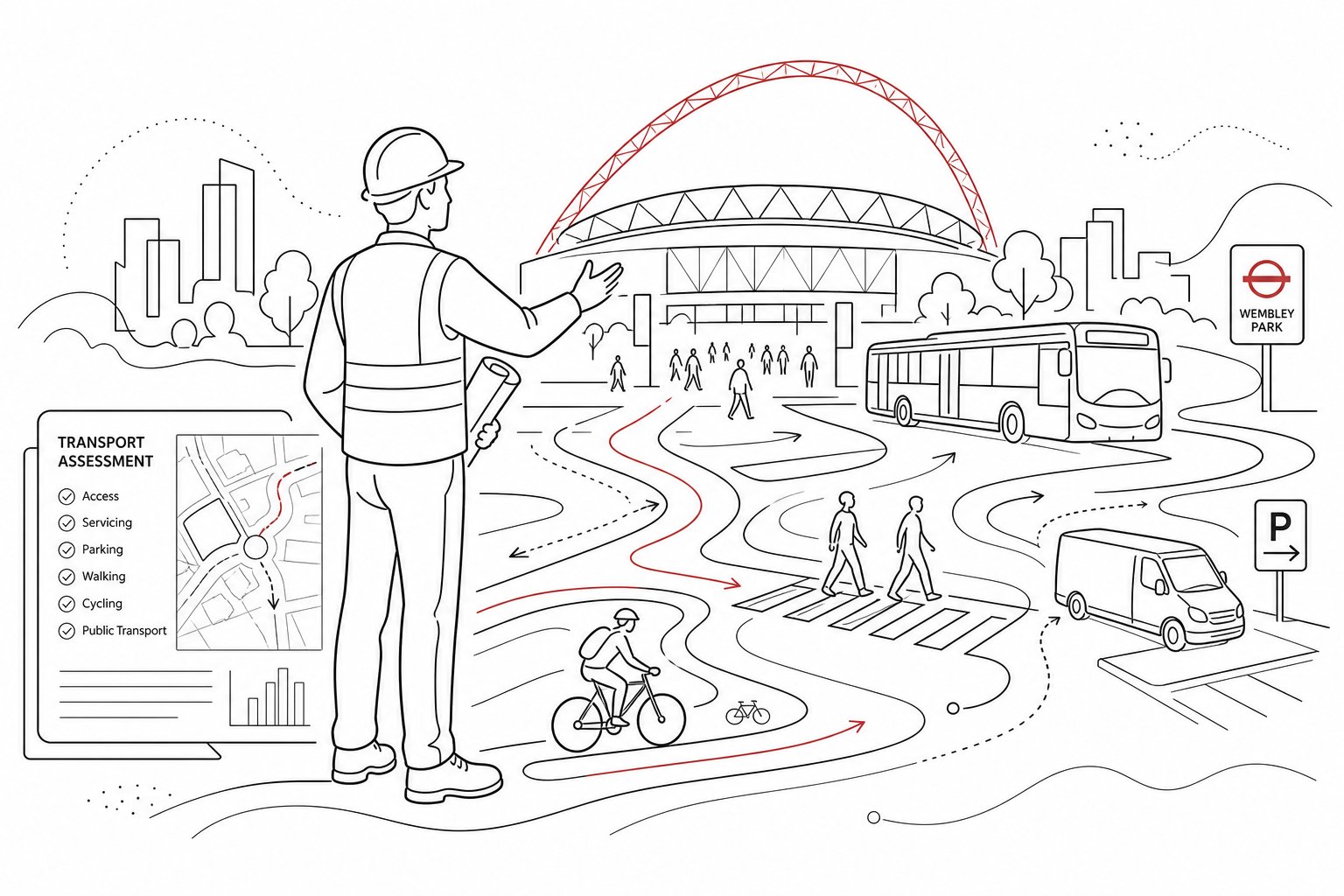
Wembley is rarely a straightforward planning location. It combines strategic roads, dense urban growth, major public transport interchanges, event-day crowd pressures and the kind of scrutiny that can turn a minor transport point into a planning delay. For architects, planners, developers and legal teams, that means transport work can’t be treated as a box-ticking exercise.
A traffic engineer in Wembley helps turn a proposal into something that can stand up to technical review. We assess how a scheme will affect traffic, access, servicing, parking, walking, cycling and public transport, then present that case in a proportionate way for the planning process. Sometimes that means a full Transport Assessment. Sometimes it means a short technical note that answers one awkward issue before it becomes an objection.
The real value is not just in producing a report. It’s in understanding what Brent, TfL and wider stakeholders are likely to focus on in this part of London: event impacts, overspill parking, constrained access points, delivery activity, bus reliability, pedestrian safety and cumulative growth. When those matters are anticipated early, applications tend to move more smoothly. When they’re left until late, even a good scheme can lose momentum.
In this text, we set out what planning-led transport support in Wembley actually involves, what common issues arise, and how the right technical approach can help secure faster, stronger applications in 2026.
Key Takeaways
- A traffic engineer in Wembley ensures development proposals align with complex local transport realities, including event-day surges and urban intensity.
- Early identification and mitigation of transport risks like parking overspill, junction congestion, and pedestrian safety improve planning application outcomes.
- Wembley-specific transport assessments must account for event impacts, local policies, and cumulative development effects for credibility.
- Proportionate transport reports—ranging from full Transport Assessments to focused technical notes—are chosen based on project scale and sensitivity.
- Effective parking, servicing strategies, and detailed vehicle tracking are crucial in Wembley’s constrained and busy street environments.
- Integrating sustainable travel plans, public transport links, and construction logistics ensures developments support long-term usability and planning approval.
What A Traffic Engineer In Wembley Does For Planning And Development
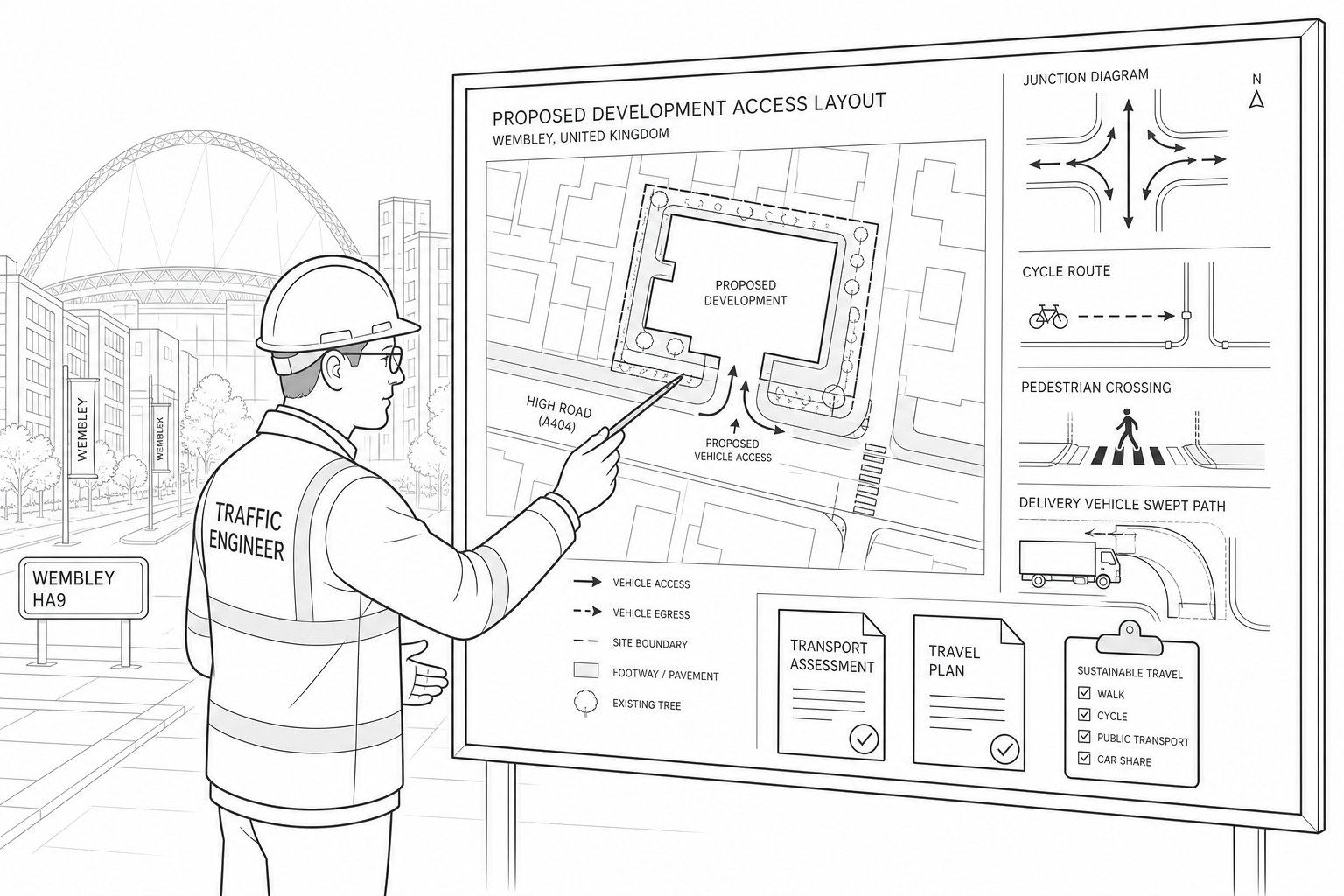
A traffic engineer in Wembley sits at the point where design ambition meets transport reality. Our role is to test whether a proposal works on the ground, on the road network and in planning terms.
For development projects, that usually starts with trip generation, mode share and network effects. We review how many movements a scheme is likely to create, where those trips will come from, how they’ll travel and whether nearby junctions or access points can accommodate them safely. In a Wembley context, that review often needs to account for unusual peaks, sensitive streets and the cumulative effect of nearby schemes.
But the job goes further than traffic numbers. We advise on access layout, vehicle manoeuvring, servicing strategy, refuse collection, cycle parking, visibility splays and pedestrian connections. If a design has transport weaknesses, we identify them early enough to fix them. That can save a planning team from expensive redesign later.
We also prepare the documents that planning officers, highway officers and consultants actually assess: Transport Assessments, Transport Statements, Travel Plans, swept-path drawings, technical notes and construction logistics material. In practice, that means translating complex transport evidence into a concise planning case.
For teams working across the capital, broader context matters too. Our work in Traffic Engineer In London: settings often helps benchmark what is likely to be considered proportionate, while support from experienced Traffic Engineering Consultants: keeps the advice aligned with planning rather than abstract highway theory.
Why Wembley Developments Need A Local Transport Strategy
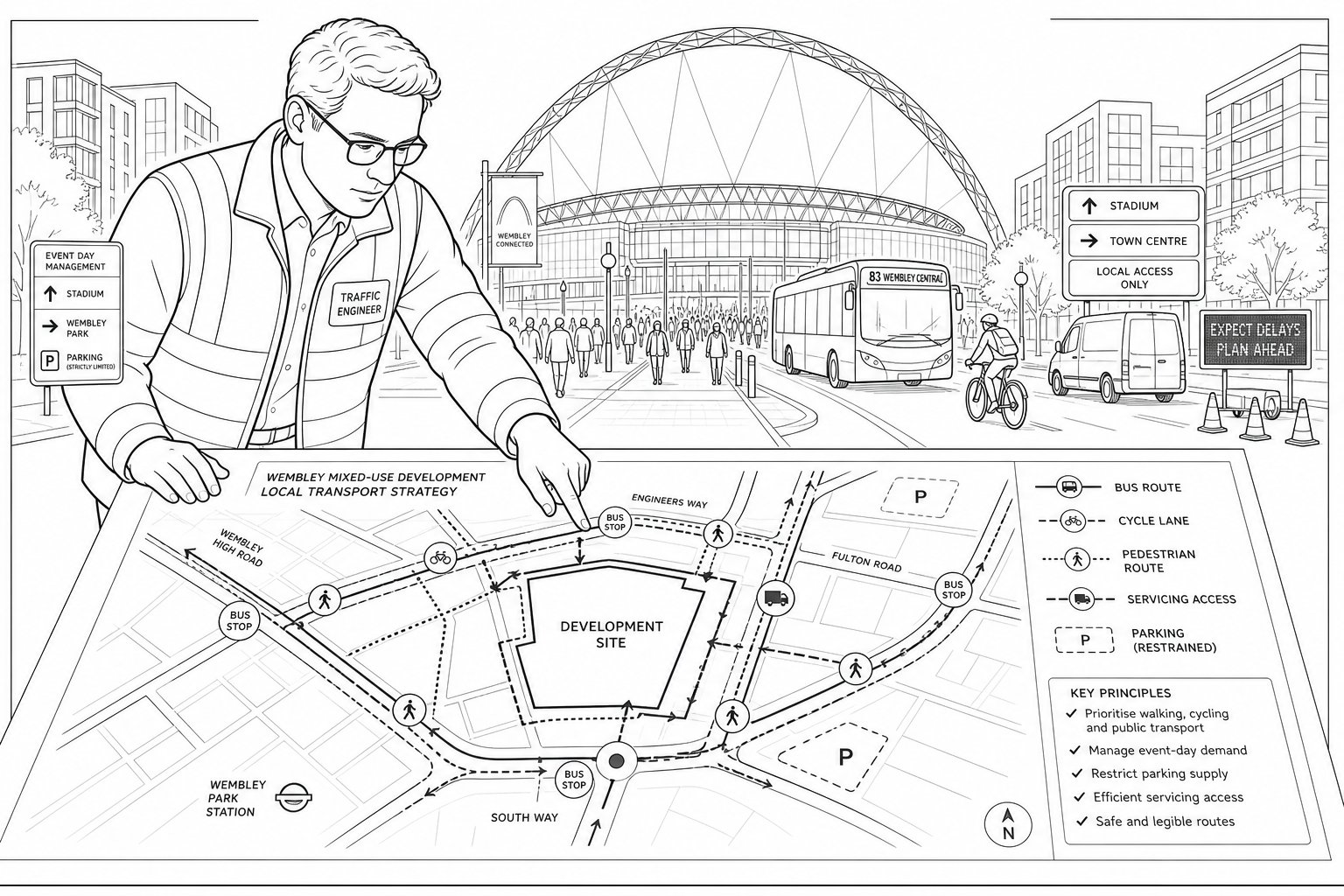
Wembley is not just another London growth area. It has a transport character of its own, and planning submissions need to reflect that. A local transport strategy is what connects a development proposal to the realities of the surrounding network.
The first reason is event activity. Wembley Stadium and the arena create highly variable conditions, with major surges in pedestrian movement, traffic management controls, parking demand and public transport loading. Even where a development is not directly tied to event uses, its access and operation may still be judged against match-day or event-day conditions.
The second reason is urban intensity. Many Wembley sites sit within mixed-use corridors where residential, commercial and visitor movements overlap. Streets can carry buses, cyclists, delivery vehicles, blue badge users and heavy pedestrian flows at the same time. A generic transport response rarely survives detailed review in that environment.
A local strategy helps establish practical answers early: how residents and staff will travel, where servicing happens, whether parking restraint is realistic, how active travel routes connect, and what happens on constrained streets when the surrounding area is already under pressure. That strategy can also explain why a proportionate level of assessment is justified.
For schemes with employment or mixed-use elements, the logic overlaps with wider Commercial Traffic Engineering practice: understand actual operating patterns, not assumed ones. And where the application demands integrated highway and planning thinking, lessons from Highway And Traffic Engineering work become especially relevant.
Key Planning And Transport Issues Commonly Raised In Wembley
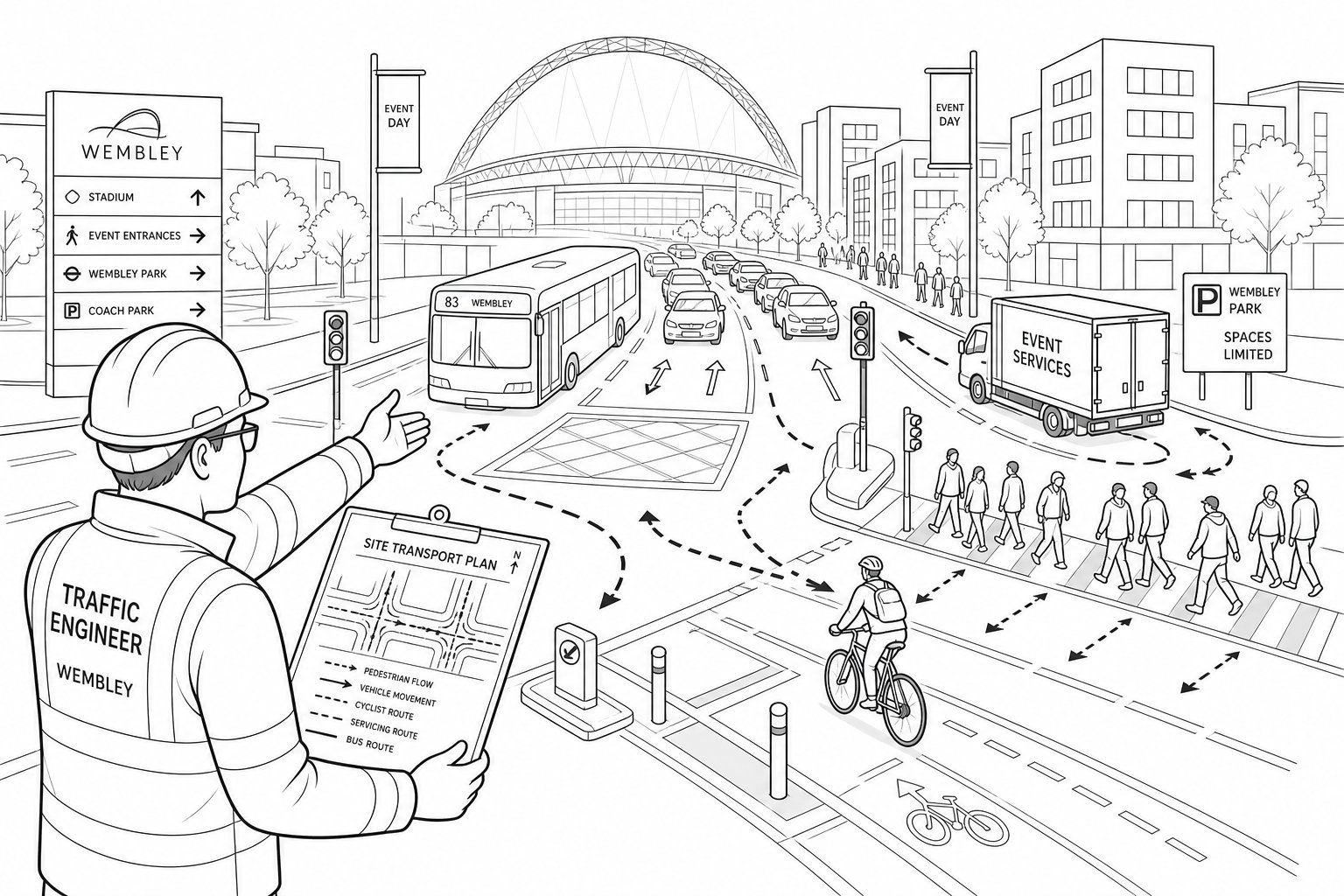
Certain transport issues appear again and again in Wembley planning reviews. Knowing them in advance makes a big difference.
Event-day traffic and parking overspill are near the top of the list. Even relatively modest schemes may be asked how they will operate during stadium or arena events, whether on-site controls are needed and how residents, staff or visitors will be prevented from adding to local parking pressure.
Junction capacity and congestion are another recurring concern. Wembley sits within a busy transport area influenced by strategic and local routes, so officers often want reassurance that additional trips will not materially worsen already stressed junctions or compromise bus movement.
Pedestrian safety and crowd movement matter more here than in many suburban locations. A site may have acceptable traffic generation on paper but still raise concern if access points conflict with heavy pedestrian desire lines, station routes, crossings or queueing patterns.
Cycling and micromobility interaction also comes up more often now. Secure cycle parking, access gradients, crossing design and conflict points with servicing areas all shape whether a proposal supports active travel in a convincing way.
Then there’s servicing. On constrained streets, delivery and refuse movements can become the issue that tips a review from manageable to contentious. If a vehicle blocks a lane, reverses excessively or conflicts with pedestrian flows, objections follow quickly.
In our experience, the strongest submissions do not wait for these points to be raised. They address them directly, using site evidence and practical mitigation rather than vague assurances. That’s often the difference between a transport response that merely exists and one that actually helps the planning case.
Transport Assessments, Statements And Technical Notes Explained
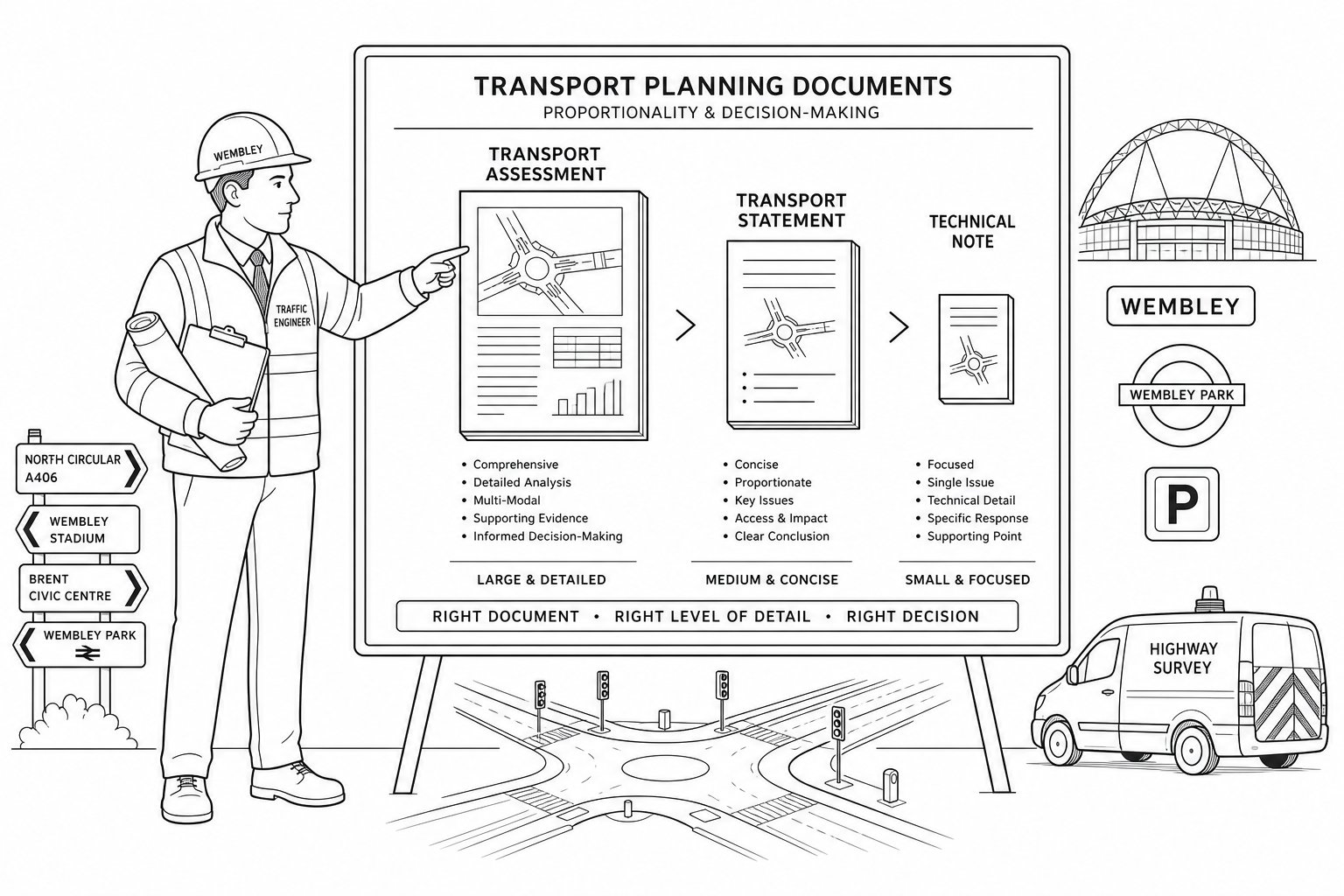
These documents sound similar, but they serve different planning purposes. Choosing the right one matters because an overblown report can slow a project, while an underpowered one can trigger requests for more information.
A Transport Assessment (TA) is the most detailed option. It usually covers baseline conditions, policy context, trip generation, distribution, junction impact, parking, servicing, public transport, walking, cycling and mitigation. It is designed for schemes where transport effects may be material to the planning decision.
A Transport Statement (TS) is lighter and more proportionate. It still explains the transport characteristics of a development, but usually without the same depth of modelling or strategic analysis. It is often suitable where impacts are expected to be limited and readily understood.
A technical note is more focused again. It may deal with one issue only: perhaps a parking review, a trip comparison, an updated survey, a visibility check or a response to consultee comments.
The best choice depends on scale, context and sensitivity. Wembley often pushes projects toward more evidence rather than less, simply because local conditions are complex. That said, proportionate submissions still win when the reasoning is clear.
If a planning team needs a broader grounding in methodology, our piece on Traffic Engineering: Your outlines the discipline behind these reports.
When A Full Transport Assessment Is Needed
A full TA is usually needed where a scheme generates significant trips, sits near constrained or sensitive junctions, introduces substantial servicing activity, or occupies a location where transport effects are likely to be debated.
In Wembley, that threshold can be reached faster than developers expect. A site near a station, event route, busy junction or heavily managed parking area may justify detailed analysis even if the floorspace is not enormous. The same applies where cumulative impact from nearby development is a live issue.
A proper TA allows us to test scenarios rather than rely on assertion. We can compare existing and proposed conditions, model junction performance where needed, review parking demand, assess servicing practicality and set out mitigation in a structured way. That tends to give planning officers more confidence because the report shows its workings.
When A Transport Statement Or Short Technical Note May Be Enough
A TS or short technical note may be enough where the proposal is modest, trip generation is low, access arrangements are unchanged or the transport question is narrow and clearly answerable.
Typical examples include small infill schemes, low-intensity changes of use, modest extensions, or revisions to a live application where only one transport point remains in dispute. In those cases, a concise report can be more effective than a large document that adds no real value.
The key is evidence. A short note still needs to be credible, site-specific and policy-aware. If it can show limited traffic impact, acceptable parking and servicing, and no meaningful safety issue, it may be all the planning authority needs. But if the site sits in a more sensitive Wembley location, we would usually advise erring on the side of stronger technical support.
Parking, Servicing And Vehicle Tracking Requirements
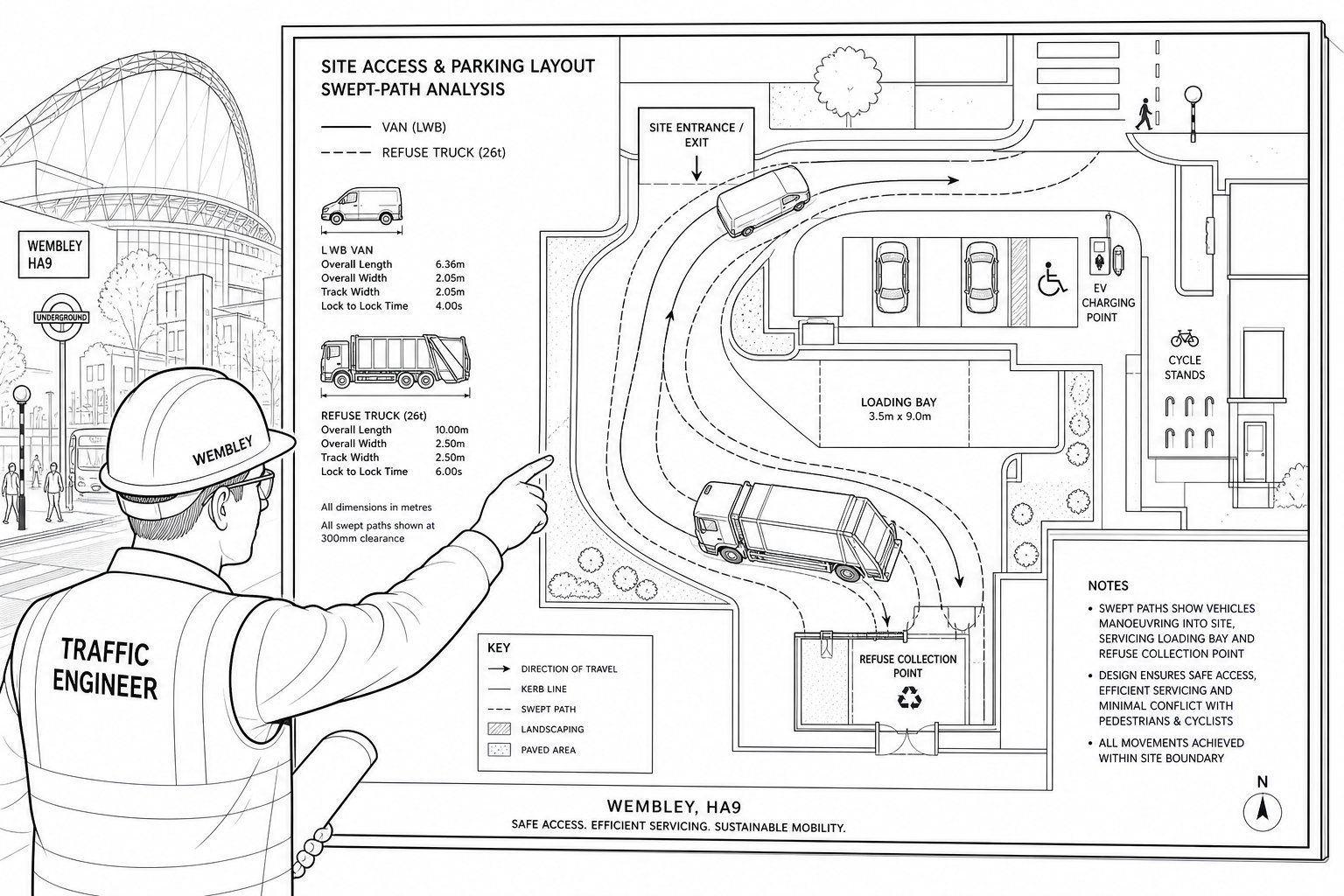
Parking and servicing are often where a planning application becomes genuinely practical, or visibly flawed. In Wembley, that practical test is strict because land is constrained, streets are busy and policy expectations around mode shift are high.
Parking provision needs to align with the London Plan, local standards and the accessibility profile of the site. That means we do not simply count spaces. We assess likely car ownership, disabled parking needs, visitor demand, electric vehicle provision, cycle parking, and whether restraint is justified by public transport access. Too much parking can be as problematic as too little if it undermines sustainability policy.
Servicing is even more sensitive on many sites. Officers typically want to know who delivers, when they deliver, what vehicle size is expected, where loading takes place and whether refuse collection is workable without unsafe reversing or on-street disruption. A vague note saying deliveries will be “managed” rarely carries much weight.
Vehicle swept-path analysis is the technical proof behind these points. Using tracking software, we demonstrate whether cars, vans, refuse vehicles and other design vehicles can enter, turn, load and exit safely. That includes checking overhang, kerb strikes, pedestrian conflict and whether manoeuvres remain practical in real conditions, not just on a tidy drawing.
Done well, this part of the package reassures decision-makers that the scheme will function every day, not only in concept. Done badly, it invites immediate questions from highway officers, waste teams and design reviewers.
Access Design, Highway Safety And Visibility Considerations
An access point can look minor on a layout plan, but from a transport perspective it often carries the whole scheme. If entry and exit arrangements are awkward, unsafe or poorly aligned with street conditions, everything built behind them becomes harder to defend.
In Wembley, access design usually needs close review of geometry, width, radii, gradient, pedestrian crossing points, nearby bus stops, cycle routes and existing street furniture. Even a few metres can change whether a layout works.
Visibility is a central issue. We assess whether drivers can see and be seen with enough distance to react safely, taking account of the road environment, vehicle speed and likely conflict points. On tighter urban streets, this is not just about textbook splays: it is about actual movement patterns, parked vehicles, footway activity and turning behaviour.
Highway safety review also extends beyond collisions. We consider whether an access encourages awkward manoeuvres, whether vehicles wait in the carriageway, whether pedestrians are exposed to turning traffic, and whether servicing activity undermines the safety case. Those are exactly the details officers pick up during review.
For schemes needing a wider technical framework, work informed by Highway And Traffic principles helps tie together design standards, user behaviour and planning risk. And when a project team wants a broader regional comparison, experience from a Traffic Engineer In Manchester: context shows how urban access issues are increasingly judged on safety and place as much as capacity.
Sustainable Travel, Active Travel And Public Transport Integration
In 2026, a credible planning submission in Wembley cannot focus only on vehicle access. It needs to explain how the development supports walking, cycling and public transport in a practical, measurable way.
That starts with location. Wembley benefits from strong rail, Underground and bus connections in many areas, but accessibility is not uniform. We assess what is actually available from the site: walking distances to stops and stations, service frequency, route quality, crossing opportunities, cycle connections and any barriers that reduce real-world usability.
Then we translate that into design and management. Good active travel planning might include direct pedestrian routes, secure and convenient cycle storage, changing facilities for staff uses, wayfinding, public realm improvements or a Travel Plan with realistic measures rather than generic promises. The aim is not to add policy language. It is to show why lower car dependence is believable.
Public transport integration matters especially for higher-density residential, mixed-use and commercial proposals. Trip timing, event-day conditions and station crowding may all affect how a scheme is viewed. A development can be close to a station and still need careful explanation if local access routes are heavily loaded.
This is where planning-led transport advice adds value. We connect sustainability policy with physical layout and likely behaviour, so the submission reads as one coherent strategy instead of a series of disconnected claims.
Construction Logistics And Operational Movement Planning
Many Wembley schemes are acceptable in operation but difficult during construction. Planning authorities know that, which is why construction logistics is often scrutinised more closely than applicants expect.
A Construction Logistics Plan sets out how vehicles will reach the site, when they will travel, where they will wait, how deliveries will be booked, how vulnerable road users will be protected and what controls apply during peak periods or event days. In Wembley, routing strategy can be critical because the wrong approach can push HGVs onto unsuitable streets or into conflict with crowd management arrangements.
Operational movement planning picks up once the building is complete. It considers routine deliveries, servicing windows, refuse collection, staff arrivals, visitor drop-off, courier activity and any restrictions needed on event days. For hotels, mixed-use schemes, student accommodation and commercial sites, these patterns can differ sharply from standard assumptions.
The point is simple: the authority wants to know not just whether a vehicle can access the site, but whether the movement pattern is manageable over time. If the answer depends on unrealistic driver behaviour or unworkable booking systems, the weakness will be exposed.
On more complex urban projects, methods used by a Traffic Engineer In Leeds: or other city-centre teams often translate well: clear routing, timed controls, off-site coordination and design that reduces conflict rather than merely describing it.
How Traffic Surveys And Local Data Support A Planning Submission
Transport reports are only as persuasive as the evidence behind them. In Wembley, local data matters because conditions vary sharply by street, time of day and event calendar.
We often begin with surveys: classified turning counts, automatic traffic counts, queue observations, pedestrian counts, parking beat surveys, speed data and delivery activity reviews. The right mix depends on the question being asked. If parking stress is the concern, parking survey quality becomes decisive. If access safety is in dispute, speed and visibility evidence may carry more weight. If junction impact is the issue, turning counts and modelling inputs are fundamental.
The timing of data collection also matters. In Wembley, survey dates may need to avoid abnormal periods, or deliberately test challenging conditions if that is the planning concern. A technically correct survey taken on an unrepresentative day can still produce the wrong planning conclusion.
Once collected, the data feeds the analysis. It informs trip comparisons, mode share assumptions, junction modelling, parking accumulation, servicing reviews and baseline narrative. More importantly, it gives the application a factual anchor. Officers may debate interpretation, but robust local evidence usually narrows the scope of that debate.
That’s why fast reporting alone is never enough. The submission has to be concise, yes, but also grounded in data that reflects how Wembley actually works on the street.
Choosing The Right Traffic Engineer In Wembley For Your Project
Not every transport consultant is the right fit for a Wembley planning application. The technical basics matter, of course, but local planning judgement matters just as much.
We would usually look for four things. First, genuine development-planning experience in the UK, not just highway design or general transport strategy. A report needs to answer planning questions in a planning format. Second, familiarity with London policy, borough expectations and TfL thinking. Third, confidence working in complex urban locations where pedestrian activity, servicing pressure and parking restraint all interact. And fourth, the ability to be proportionate, producing exactly the evidence needed, no less and no more.
Experience counts here. With more than 30 years in transport engineering, we know that the strongest submissions are rarely the longest ones. They are the ones that identify the real transport risks early, gather the right evidence and present a coherent mitigation strategy without padding.
It also helps to work with a team that can move quickly when planning timetables tighten. At ML Traffic, our focus is concise, accurate reporting tailored to local authority thresholds and real planning contexts. That can be the difference between a submission that keeps momentum and one that stalls while technical points are rewritten.
For clients comparing broader specialist support, our work across cities, including a Traffic Engineer In Liverpool: setting, shows the same principle: local understanding plus clear technical judgement tends to produce the best planning outcomes.
Conclusion
Wembley demands more from transport input than many locations. The mix of growth, event pressures, constrained streets and intense multi-modal movement means planning applications need transport support that is local, proportionate and technically solid.
A good traffic engineer in Wembley does not just prepare a report at the end of the design process. We help shape the scheme, identify risks early, gather the right evidence and answer the concerns that planning officers and highway consultees are most likely to raise. That may involve a full Transport Assessment, a focused technical note, refined access design, servicing strategy, survey work or construction logistics planning, but the objective is the same: make the proposal easier to approve because it is easier to trust.
For architects, planners, lawyers, surveyors, developers and councils, that planning-led approach is what turns transport from a possible delay into a practical advantage.
Frequently Asked Questions about Traffic Engineering in Wembley
What role does a traffic engineer in Wembley play in the planning process?
A traffic engineer in Wembley assesses how developments impact traffic, access, parking, pedestrian safety and public transport. They provide evidence-based reports like Transport Assessments or technical notes to help planning authorities understand and approve schemes while managing local transport pressures.
Why is a local transport strategy important for developments in Wembley?
Wembley has unique transport challenges such as event-day surges, congested junctions and mixed-use streets. A local transport strategy helps manage these by addressing trip patterns, parking restraint, servicing logistics and active travel integration, ensuring developments are acceptable and support sustainable growth.
When is a full Transport Assessment required for a Wembley development?
A full Transport Assessment is needed when a scheme generates significant trips, affects sensitive junctions, or sits near event routes. It provides detailed analysis of trip generation, junction modelling, parking and mitigation, which is crucial in Wembley’s complex transport environment.
How do traffic engineers in Wembley address parking and servicing challenges?
They align parking provision with London Plan standards and local policies, considering car ownership, disabled spaces and electric vehicles. For servicing, engineers use vehicle-swept-path analysis to ensure delivery and refuse vehicles can operate safely without disrupting traffic or pedestrians on constrained streets.
What measures support sustainable and active travel in Wembley developments?
Traffic engineers assess accessibility to public transport, design secure cycle parking, ensure convenient pedestrian routes, and prepare Travel Plans promoting walking, cycling and use of public transport. These measures reduce car dependence and fit Wembley’s push for sustainable travel solutions.
How can construction logistics be managed effectively for projects in Wembley?
Construction Logistics Plans are prepared to coordinate vehicle routing, timing, and delivery booking, avoiding conflicts with event traffic and pedestrian flows. Proper planning ensures HGVs use suitable routes, protecting sensitive streets and keeping construction operations safe and efficient.