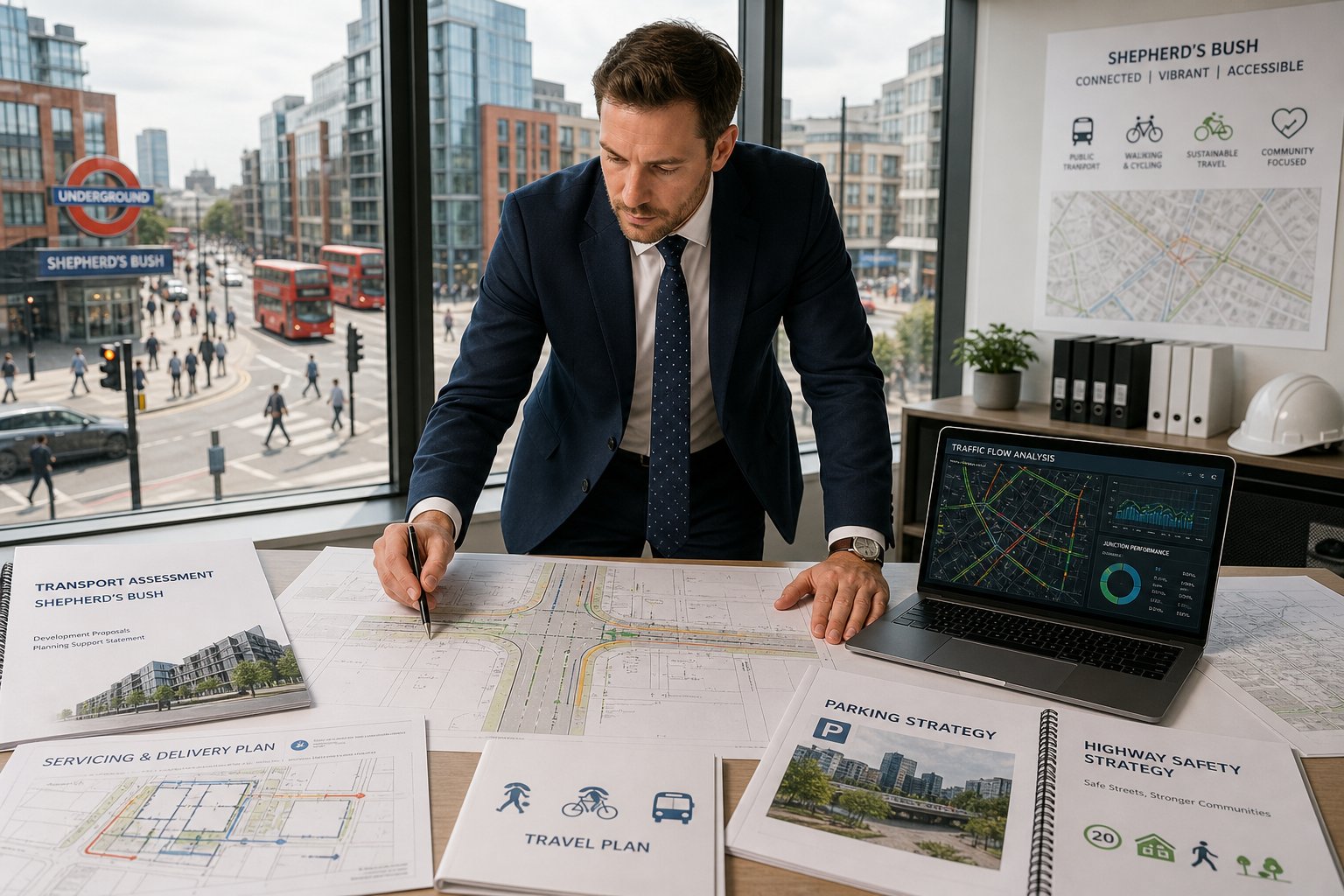
In Shepherd’s Bush, transport planning rarely sits in the background. It shapes whether a scheme feels workable from day one, whether a planning officer is reassured by the evidence, and whether a highway authority sees a proposal as manageable rather than problematic. In a part of west London defined by busy junctions, rail and Underground access, bus activity, constrained kerbsides and constant pedestrian movement, even relatively modest development can raise transport questions quickly.
That is where a traffic engineer in Shepherd’s Bush becomes central to the planning process. We help development teams understand how a proposal interacts with the street network, public transport, servicing patterns, parking pressure and safety requirements before those issues become objections. For architects, planners, lawyers, surveyors, developers and councils, the value is not just technical analysis. It is clear planning support, proportionate reporting and local judgement that aligns with what decision-makers actually need.
Our work typically involves preparing Transport Statements, Transport Assessments, Travel Plans and supporting notes on servicing, access or construction effects. But the best outcomes usually come from something simpler: spotting the likely transport concerns early, framing them properly, and resolving them with evidence that is concise, policy-aware and credible. In 2026, with planning timescales still tight and scrutiny still high, that practical approach matters more than ever.
Key Takeaways
- A traffic engineer in Shepherd’s Bush plays a vital role in supporting planning applications by analysing vehicle movement, pedestrian flow, servicing, parking, and safety within the area’s busy transport context.
- Transport Statements, Assessments, and Travel Plans are essential documents that must be tailored to Shepherd’s Bush’s unique transport pressures, ensuring evidence-based, proportionate analysis and practical mitigation measures.
- Developments of varying types—residential, mixed-use, commercial, educational, and healthcare—require customised traffic engineering input to address specific operational challenges and local network constraints.
- Delivery and Servicing Plans, along with Construction Logistics Support, are crucial in managing kerbside pressures and minimising construction-related disruptions in the densely connected Shepherd’s Bush area.
- Selecting a qualified traffic engineer who combines technical expertise with local knowledge and clear communication significantly increases the likelihood of smoother planning approvals and effective project delivery.
What A Traffic Engineer Does For Development Projects In Shepherd’s Bush
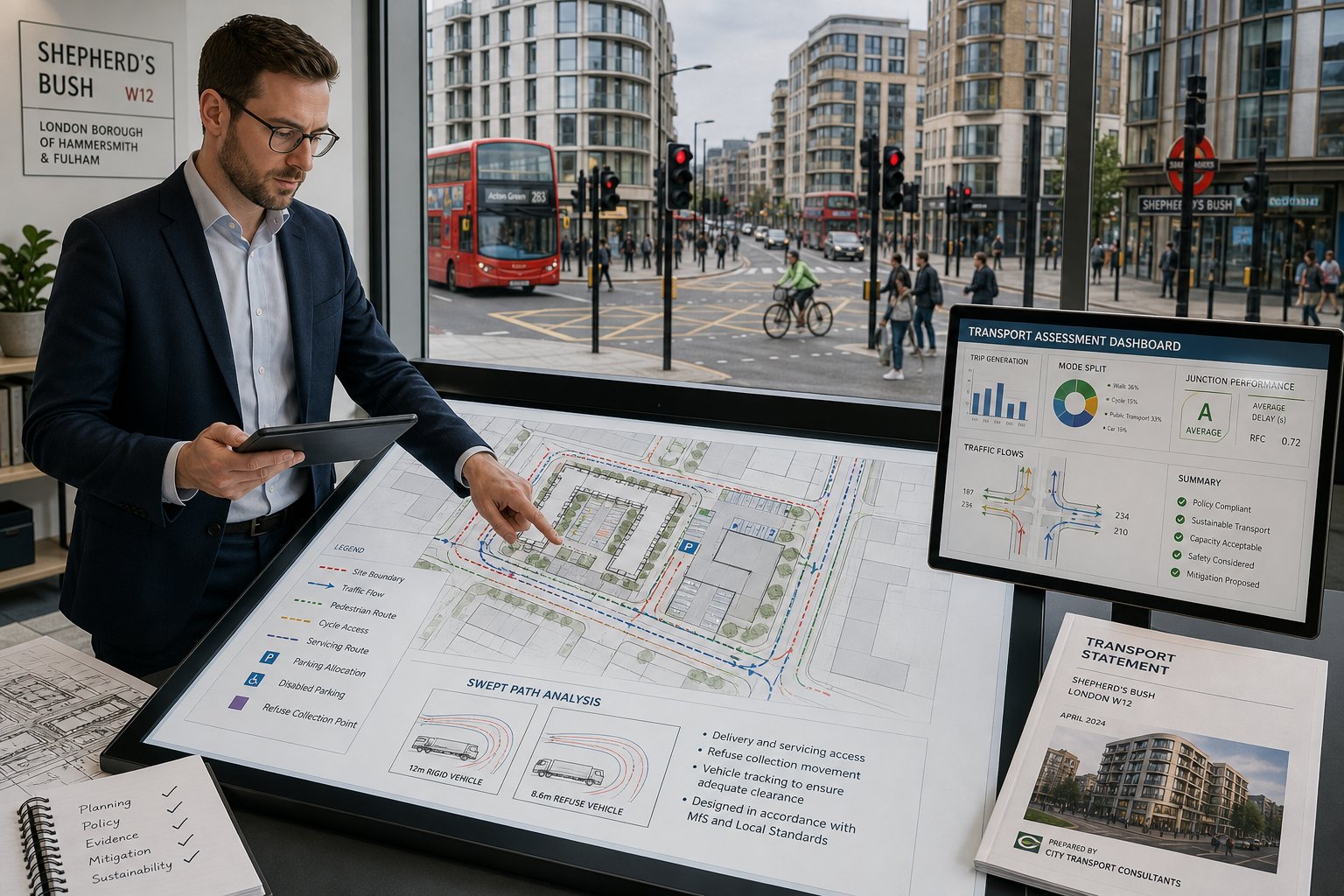
A traffic engineer supports a planning application by testing how a development will function in the real world. That means looking beyond drawings and gross floor area to understand vehicle movements, pedestrian activity, cycle access, servicing, parking demand, road safety and the effect on nearby junctions. In Shepherd’s Bush, where network pressure is already high, that analysis needs to be both technically sound and proportionate.
For some schemes, we prepare trip generation forecasts, assess junction capacity and review whether additional demand is likely to create material delay. For others, the main issue is access design: can vehicles enter and leave safely, can refuse and delivery vehicles turn on site, and does the arrangement conflict with pedestrians or cyclists? We also review internal circulation, loading areas, disabled parking, cycle parking and any highway changes needed to make the layout acceptable.
In practice, our role often includes translating planning and transport policy into a report that officers can use. A concise evidence base tends to carry more weight than a document padded with unnecessary modelling. That is one reason many teams work with experienced Traffic Engineering Consultants: who understand development control, technical standards and the pace of planning submissions.
Where appropriate, we also advise on signs, markings, swept path analysis, highway safety implications and mitigation measures so the proposal is easier to approve, and easier to build.
Why Shepherd’s Bush Requires A Strong Local Transport Strategy
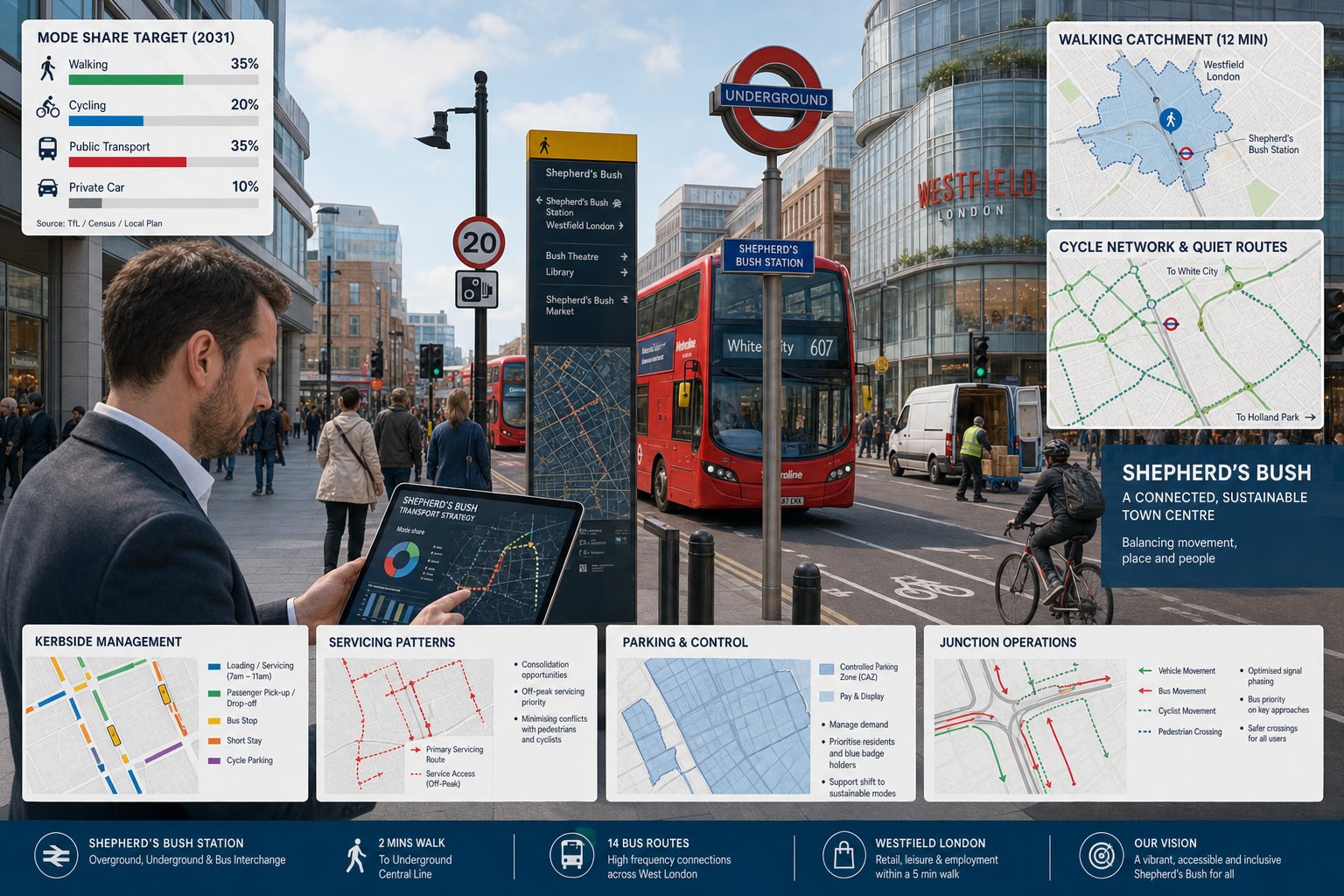
Shepherd’s Bush is not a location where generic transport wording will do the job. It is dense, mixed-use and highly connected, with Underground and rail links, major bus routes, strategic roads nearby, heavy footfall, retail activity and streets that can feel very different at 8am, lunchtime and late evening. A credible strategy has to reflect those local conditions rather than treating the site as if it were a suburban plot with spare road capacity.
The area’s strengths create its planning challenges. Excellent public transport supports lower car dependency, but it also means more demand at stations, bus stops and crossings. Active frontages and town centre uses generate frequent servicing needs. Kerbside space is limited, and competition between loading, drop-off activity, resident parking, blue-badge access, buses and cycle movement can become intense.
That is why we build a site-specific transport narrative around actual context: likely mode share, walk catchments, cycle routes, servicing patterns, parking controls and the operational characteristics of nearby junctions. A well-structured strategy shows not only that a development can be served safely, but that it fits the wider movement function of the area.
For projects crossing borough expectations or wider London planning themes, broader urban experience helps too. Work informed by Traffic Engineer In London: often proves useful because the policy logic is similar even when local detail changes. In Shepherd’s Bush, local detail is the whole game.
Common Planning Applications That Need Traffic Engineering Input
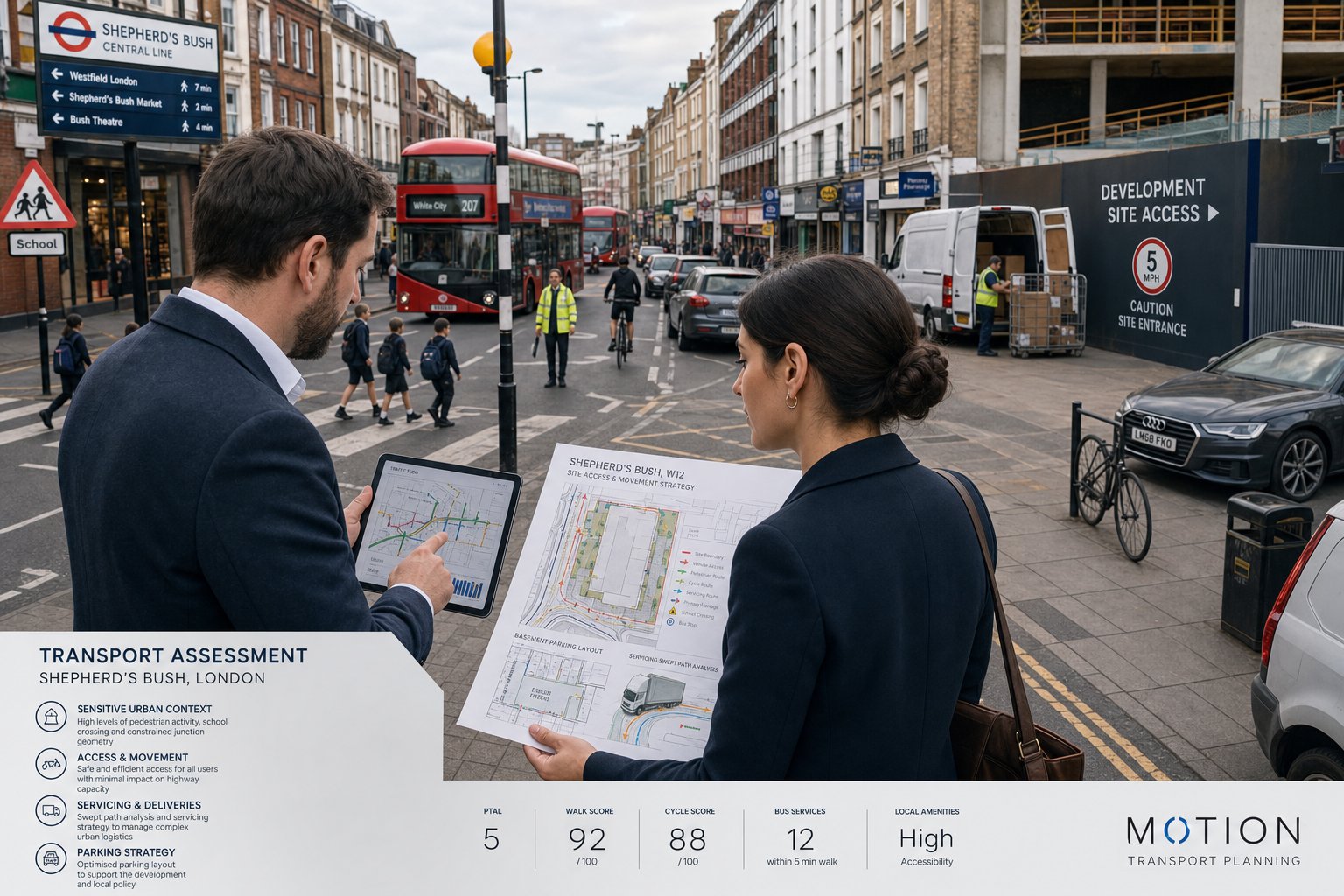
Not every planning application needs a full Transport Assessment, but many more schemes benefit from traffic engineering input than applicants first assume. In Shepherd’s Bush, the trigger is often not just development size. It is sensitivity of location, servicing complexity, constrained access, nearby schools, collision history, parking stress or concern from officers about cumulative impact.
New residential development is a common example. Even relatively modest schemes may need evidence on trip generation, car and cycle parking, refuse collection, delivery activity and visibility at the access point. Mixed-use proposals typically go further, because retail, workspace, leisure or community floorspace can create different peak periods and competing servicing demands.
Commercial development also frequently requires transport input, especially where loading, staff travel, visitor arrivals or basement access arrangements are involved. On that side of the market, practical guidance from Commercial Traffic Engineering is often relevant because the planning questions are operational as much as technical.
Schools, healthcare facilities and community buildings are another regular trigger. Their impacts can be short, sharp and highly visible: drop-off congestion, pavement crowding, patient access needs, or conflict between deliveries and vulnerable users. Change-of-use schemes can also require support where an apparently small planning shift leads to a meaningful change in traffic or servicing profile.
In short, if a proposal alters how people, vehicles or goods move to and from a site, traffic engineering input is usually worth considering early.
Transport Statements, Transport Assessments, And Travel Plans Explained
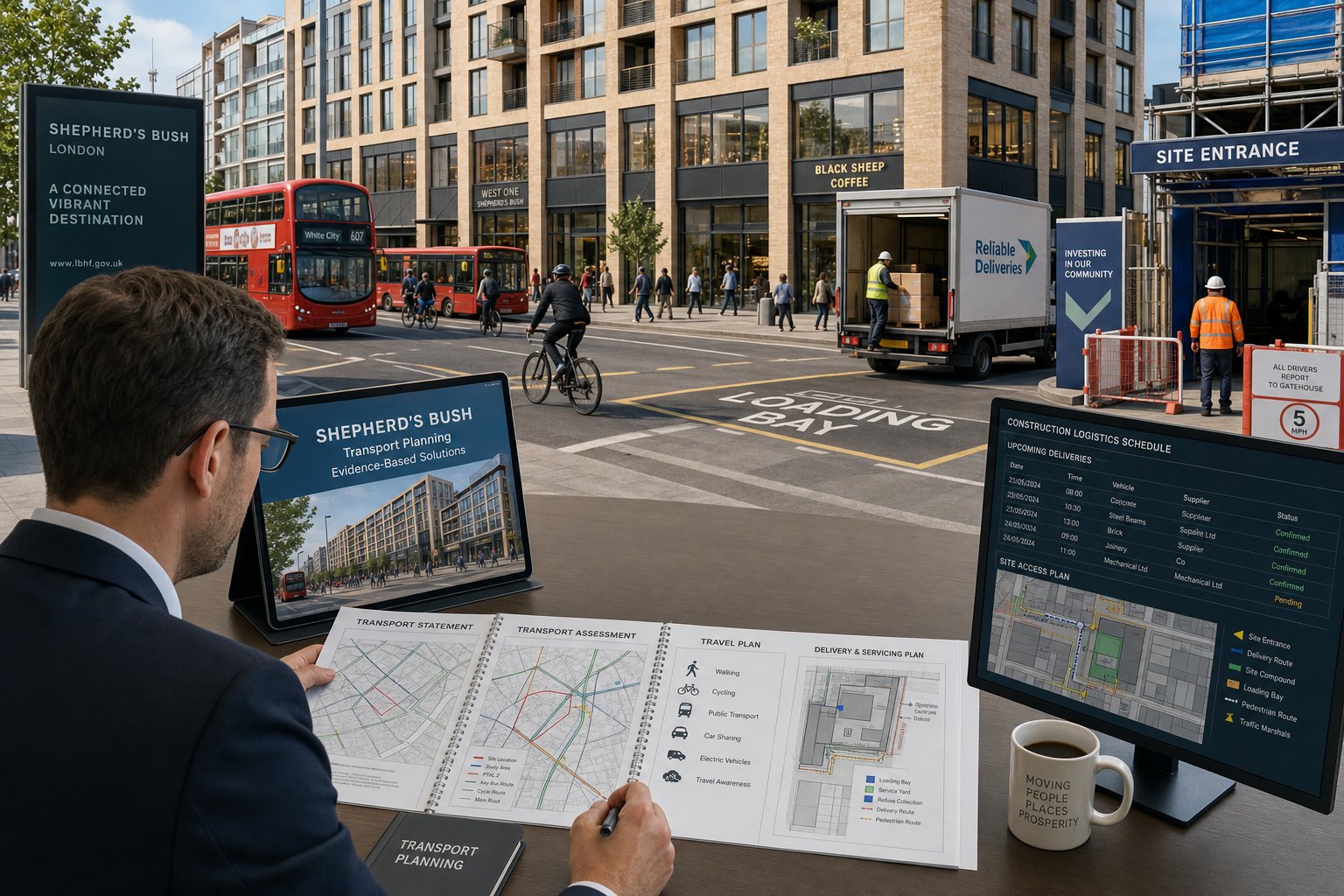
These documents are often mentioned together, but they serve different purposes.
A Transport Statement is usually the lighter-touch option. It explains existing conditions, site access, local transport connections and the likely movement effects of a smaller or less intensive proposal. A good TS is brief but not vague. It should show why the transport effects are limited, demonstrate that the site is accessible by sustainable modes, and deal with practical matters such as parking, servicing and highway safety.
A Transport Assessment goes further. It is used for larger, more complex or more sensitive schemes where the likely impacts need detailed testing. That can include trip generation, distribution and assignment, junction assessments, walking and cycling review, collision analysis, servicing strategy and mitigation proposals. In Shepherd’s Bush, where objections can turn on operational detail, a TA often succeeds or fails on whether it answers the right local questions.
A Travel Plan focuses on behaviour. It sets out measures to encourage sustainable travel by residents, staff or visitors, supported by targets, monitoring and management arrangements. For urban schemes in public-transport-rich locations, this can be a key part of showing policy compliance and limiting car reliance.
At a wider level, the principles behind Traffic Engineering: Your support all three documents: evidence first, proportionate analysis, then practical mitigation.
When A Delivery And Servicing Plan Is Needed
A Delivery and Servicing Plan is usually needed where the success of the development depends on regular goods movement or where poorly managed servicing could create street-level problems. Retail, offices, hotels, student accommodation, large residential blocks and mixed-use schemes commonly fall into this category.
The purpose is simple: to show who delivers, how often, in what vehicle type, where vehicles stop, how long they stay, and how conflicts with pedestrians, buses, cyclists or neighbouring occupiers will be managed. In Shepherd’s Bush, DSPs matter because kerbside pressure is real. If servicing spills onto the wrong frontage at the wrong time, it can create congestion and amenity issues very quickly.
A useful DSP covers delivery scheduling, waste collection, loading bay management, consolidation opportunities where relevant, and controls for occupiers or site managers. Done properly, it reassures officers that servicing has been designed into the scheme rather than left to chance.
When Construction Logistics Support Is Required
Construction logistics support becomes necessary when the build phase itself is likely to affect traffic flow, road safety, neighbours or access to nearby uses. In compact urban locations, that threshold is often lower than applicants expect.
We typically advise on routing, vehicle sizes, booking systems, worker travel, temporary traffic management, hoarding effects, site access control and arrangements for deliveries, cranes or lane occupation if relevant. The aim is to reduce disruption while keeping the site buildable.
This kind of support is especially important for constrained plots, basement works, phased development and sites on bus routes or busy pedestrian streets. A robust construction logistics approach can prevent planning conditions from becoming a late-stage headache. It also gives the project team a realistic operational framework instead of a generic promise to “manage construction responsibly”, which, frankly, convinces nobody.
Key Traffic And Transport Issues Considered By Local Planning Authorities
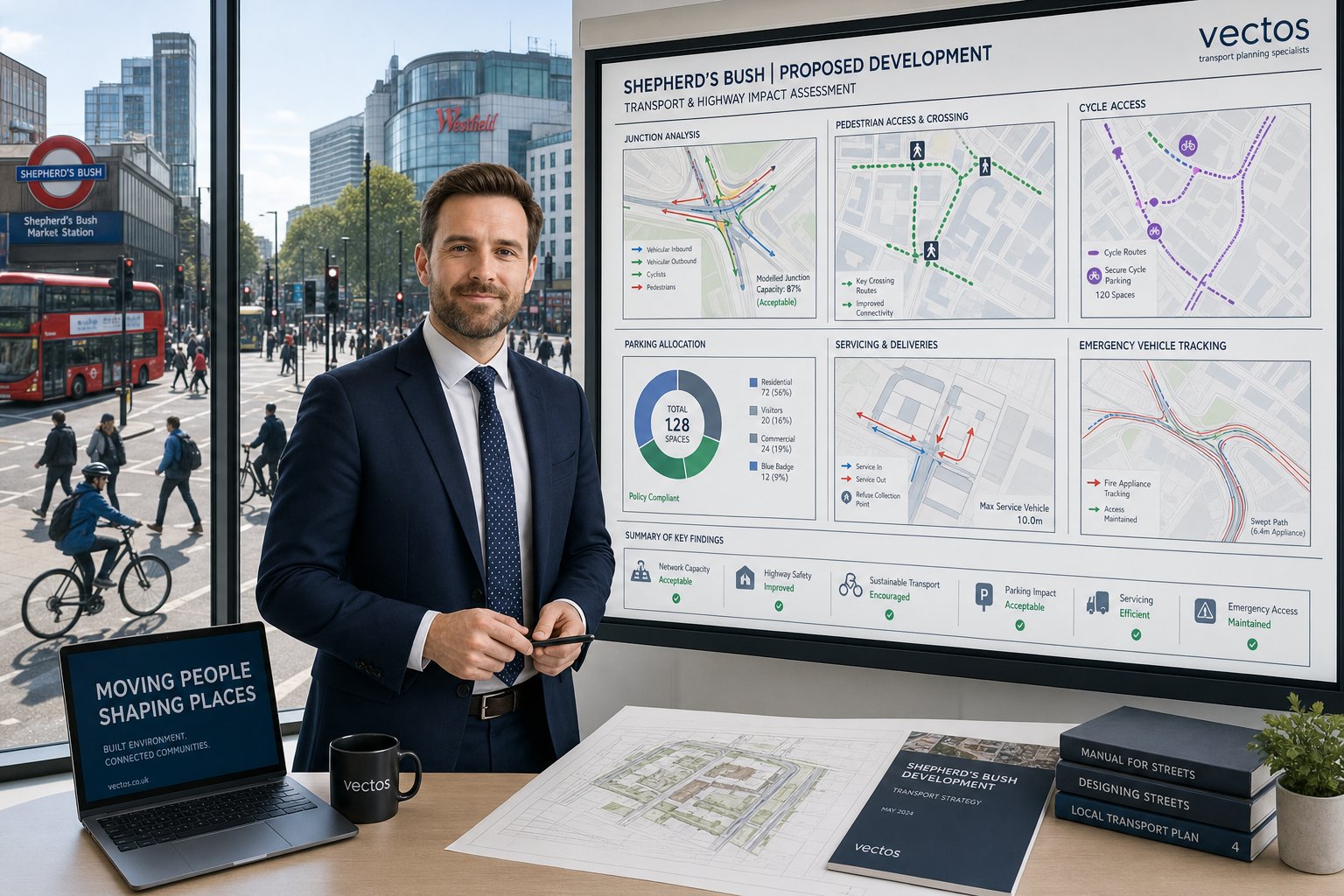
Local planning authorities and highway officers usually focus on a fairly consistent set of transport questions, though the emphasis varies by site.
First is network capacity and delay. Will the development materially increase traffic on already stressed links or junctions? The answer is not always about headline trip numbers. Sometimes the concern is peak-hour turning pressure, blocked servicing activity or interaction with buses.
Second is highway safety. Officers will want to know whether the access arrangement, visibility, vehicle tracking and pedestrian routes are safe, and whether local collision patterns indicate an existing problem that development could worsen. Safety concerns carry obvious weight and need careful, evidence-led treatment.
Third is sustainable transport access. In Shepherd’s Bush, proximity to stations and bus routes is helpful, but planners still expect clear analysis of walking routes, crossings, cycle parking, accessibility and the practicality of non-car travel for the likely user group.
Fourth is parking impact and overspill. Even in lower-car environments, authorities remain alert to stress on local streets, disabled parking needs, visitor demand and servicing overlap. Poorly justified parking strategy can undermine an otherwise sound scheme.
Finally, they consider servicing and emergency access, because a development that cannot function operationally tends to generate complaints later. Experience from Traffic Engineer In Manchester: and other major urban areas shows the same pattern: officers respond best when the report anticipates operational concerns before they are raised.
Access, Servicing, Parking, And Highway Safety Considerations
This is often the section of a planning submission that gets tested hardest because it moves from policy language to physical reality.
Access has to work for everyone using the site. That means suitable geometry, visibility, pedestrian priority where appropriate, cycle compatibility and an arrangement that matches the street context. A tight urban access that technically works on paper but feels unsafe or awkward in operation can still attract challenge.
Servicing needs equal attention. We assess expected vehicle types, frequency, loading duration, turning requirements and whether activity can happen on site without reversing onto the highway or obstructing movement. Swept path analysis is useful here, but it is only one part of the story. The practical question is whether the servicing strategy will still work on a wet Tuesday with bins out, a courier arriving early and pedestrians moving across the frontage.
Parking strategy also needs to be balanced. That includes general parking numbers, disabled provision, electric vehicle charging, cycle parking quality and likely visitor demand. In Shepherd’s Bush, a low-parking or car-free approach may be appropriate, but it still has to be credible and supported by local context, controls and travel planning measures.
Highway safety runs through all of it: signing, lining, crossing points, visibility, conflict reduction and emergency access. Many of the same design disciplines discussed in Traffic Engineer In Birmingham: apply here, though Shepherd’s Bush usually demands even tighter attention to street-level interaction.
How Traffic Surveys And Local Data Inform A Planning Submission
A strong planning submission is rarely built on assumption alone. It is built on evidence, and in transport work that usually means surveys plus local context.
Depending on the scheme, we may use automatic traffic counts, manual classified turning counts, queue length surveys, parking beat surveys, pedestrian and cycle counts, or servicing observations. The point is not to collect data for the sake of it. The point is to answer the planning question with enough confidence that officers and consultees can rely on the result.
Traffic survey data underpins trip impact analysis and junction modelling. Parking surveys help determine whether on-street demand is already tight and whether a development could reasonably be absorbed. Pedestrian and cycle observations can reveal something drawings miss entirely, such as desire lines, pinch points or school-related crowding at specific times.
Collision data is equally important. A site may sit on a corridor that appears ordinary until the personal injury record is reviewed and patterns emerge around turning movements, speed environment or vulnerable road users. That can shape both the design response and the wording of the planning submission.
We also review PTAL, public transport availability, walk distances and route quality because sustainable access claims need evidence. Comparative urban insights, including those reflected in Traffic Engineer In Liverpool:, are helpful, but local survey work remains the foundation. Good data does not guarantee consent: it does make the discussion far more grounded.
Supporting Different Project Types Across Shepherd’s Bush
Different land uses create different transport problems, so the reporting approach should change with them. One of the most common mistakes in planning support is applying a standard template to very different schemes. It saves time initially, then costs time later when consultees ask the obvious follow-up questions.
In Shepherd’s Bush, that tailoring matters because project types often sit close together: housing near retail, schools near main roads, healthcare near constrained side streets, and mixed-use blocks with active ground floors. The transport evidence has to reflect actual operation, not simply land-use labels.
Residential, Mixed-Use, And Commercial Schemes
For residential schemes, we usually focus on trip generation, mode share, car and cycle parking, refuse collection, delivery activity, access safety and whether the proposal supports a realistic lower-car lifestyle. In a well-connected area, officers often expect a clear explanation of why parking provision is appropriate and how residents will rely on walking, cycling and public transport.
Mixed-use and commercial projects add another layer. Peak periods can differ between occupiers, servicing can intensify, and frontage management becomes more sensitive. A café under flats is not just a land-use mix: it is a morning delivery pattern, visitor turnover, waste storage issue and possible kerbside management problem.
That is why we prepare transport strategies that link trip forecasts, parking restraint, loading arrangements and travel planning into one operational picture. Broader city-centre experience, including lessons seen in Traffic Engineer In Leeds:, can be valuable, but the assumptions still need to be tested against Shepherd’s Bush conditions.
Education, Healthcare, And Community Uses
Education, healthcare and community uses are often more sensitive than their scale suggests. A school may generate relatively little traffic over a full day but still create acute start-and-finish peaks, heavy crossing demand and serious pressure around drop-off behaviour. Those short peak windows are exactly what neighbours and officers notice most.
Healthcare uses can involve staff shifts, patient arrivals, taxi activity, blue-badge demand and servicing tied to clinical operations. Community uses vary widely, from places of worship to leisure or support services, but many involve irregular peaks that standard databases do not capture particularly well.
For these schemes, we pay close attention to safeguarding, accessibility and street management. That may include drop-off design, waiting restrictions, marshal arrangements, blue-badge provision, pedestrian comfort, cycle parking, and realistic advice on how users will arrive. Sometimes the right answer is not adding infrastructure at all: it is managing timing, access rules and occupier behaviour more carefully.
Choosing A Traffic Engineer For A Shepherd’s Bush Planning Application
Choosing the right consultant is partly about qualifications and partly about judgement. You will usually want a chartered or appropriately experienced traffic or transport engineer who understands UK planning, development control and the technical standards behind access, safety and impact assessment. But credentials alone are not enough.
The better test is whether they can scope work proportionately, explain risk early and produce reports that planning officers can actually use. In Shepherd’s Bush, that means being comfortable with Transport Statements, Transport Assessments, Travel Plans, Delivery and Servicing Plans, construction logistics support, swept path analysis, parking strategy and local authority negotiation. It also means understanding when not to overcomplicate the evidence.
We think speed matters too, but not the sort of speed that produces generic reports. Good planning support is concise, accurate and locally aware. With more than 30 years of experience, our approach is to identify the likely transport issues at the start, align the scope with local authority expectations, and deliver reporting that is robust without becoming bloated.
If a team can combine technical depth with practical planning sense, applications tend to move more smoothly. And that, really, is the point. A traffic engineer in Shepherd’s Bush should not just write a report: we should help make the development easier to justify, easier to condition and easier to deliver.
The strongest appointments usually come from that blend of local insight, clear communication and evidence-led problem solving rather than from sheer report volume or jargon.
Common Questions About Traffic Engineering in Shepherd’s Bush
What role does a traffic engineer play in Shepherd’s Bush development projects?
A traffic engineer in Shepherd’s Bush analyses vehicle movements, pedestrian activity, junction capacity, parking demand, and safety for planning applications to ensure schemes work practically and comply with local transport policies.
Why is a strong local transport strategy essential in Shepherd’s Bush?
Shepherd’s Bush is a dense, mixed-use area with high pedestrian flows and limited kerbside space. A tailored transport strategy balances road space, parking, public transport, cycling, and walking to support development while maintaining safety and amenity.
When is a Transport Assessment needed instead of a Transport Statement in Shepherd’s Bush?
A Transport Assessment is required for larger or more sensitive schemes needing detailed analysis of traffic impacts, junction performance, safety, and mitigation, whereas a Transport Statement suits smaller developments with limited transport effects.
How do Delivery and Servicing Plans benefit developments in Shepherd’s Bush?
Delivery and Servicing Plans manage regular goods, waste, and parcel movements to prevent congestion and safety issues on busy streets, ensuring that servicing activities are coordinated to fit the area’s kerbside constraints.
What factors do local planning authorities focus on regarding traffic issues in Shepherd’s Bush?
Authorities assess network capacity and delays, highway safety including collision history, sustainable transport access, parking impacts, and effective servicing and emergency access when considering development proposals.
How can I choose the right traffic engineer for my Shepherd’s Bush planning application?
Select a chartered engineer experienced in UK urban planning, familiar with local authority processes, capable of preparing TS, TA, DSPs, travel plans, and construction logistics support, and able to deliver clear, concise, locally aware reports.