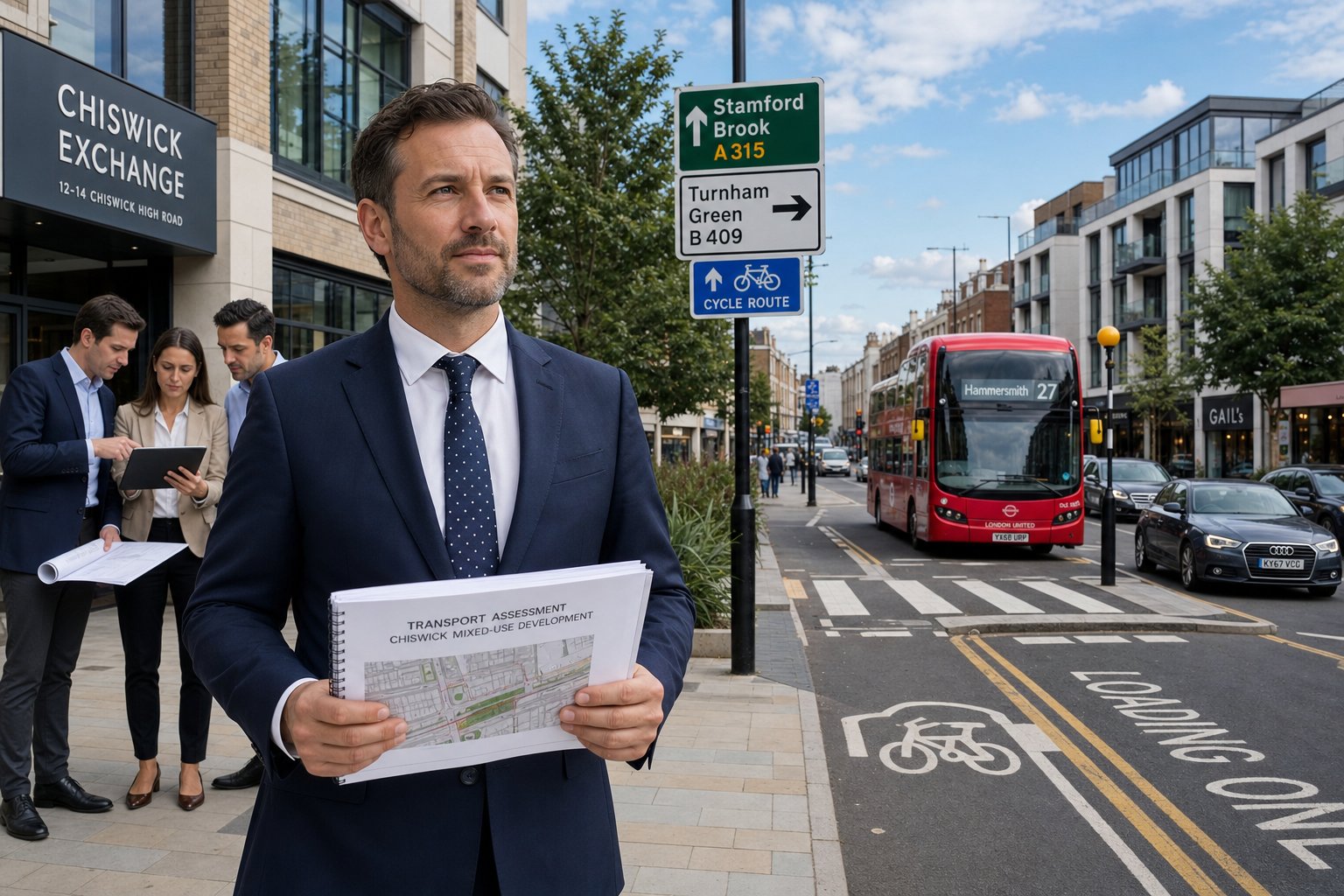
In Chiswick, transport planning is rarely a box-ticking exercise. It sits right in the middle of whether a scheme feels workable to officers, neighbours, highway authorities, and, eventually, the planning committee. Between the A4 corridor, the A315, busy local centres, constrained side streets, Controlled Parking Zones, bus routes, schools, and conservation sensitivities, even a modest development can raise familiar but important questions: Where will vehicles turn? Will deliveries block the road? Is parking demand realistic? Can the site support better walking and cycling access without creating safety problems elsewhere?
That is where a Traffic Engineer in Chiswick becomes valuable. We help project teams turn transport risk into a clear technical strategy, whether the scheme is a small residential conversion, a mixed-use infill site, a healthcare use, or a larger redevelopment needing detailed assessment. For architects, planners, surveyors, developers, lawyers, and local authorities, the goal is usually the same: produce proportionate evidence, align with London and local policy, and avoid avoidable objections from the London Borough of Hounslow (LBH) or Transport for London (TfL).
In this guide, we set out what traffic engineers actually do on Chiswick projects, which reports are commonly needed, what local issues tend to matter most, and how to choose the right support early enough to make a difference.
Key Takeaways
- A Traffic Engineer in Chiswick plays a crucial role in producing proportionate, locally informed transport evidence to support planning applications amidst complex urban and policy constraints.
- Early involvement of a traffic engineer helps address access, parking, servicing, and sustainable travel issues before they become objections, improving the chances of planning consent.
- Transport reports in Chiswick should be tailored to the scheme’s scale and sensitivity, ranging from concise Transport Statements to detailed Transport Assessments and Travel Plans when necessary.
- Effective traffic engineering balances technical accuracy with operational realism, ensuring developments align with London and local policies on mode shift, safety, and Healthy Streets.
- Understanding local factors like Controlled Parking Zones, kerbside competition, and peak traffic patterns is essential for managing transport impacts on Chiswick projects.
- Selecting a qualified traffic engineer familiar with Chiswick and TfL expectations ensures clear, concise reports that advance planning proposals without unnecessary delays or over-reporting.
Why Traffic Engineering Matters For Development In Chiswick
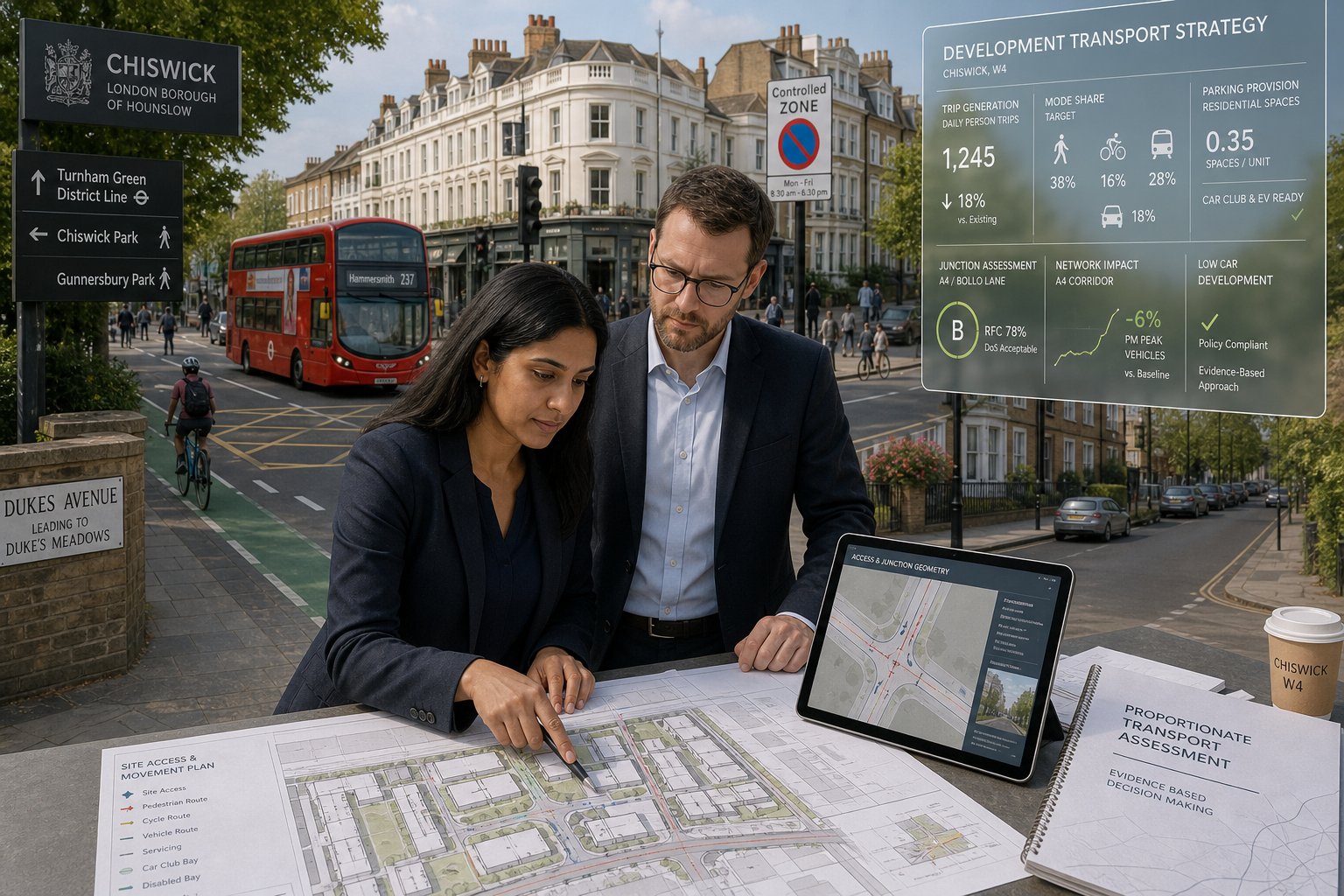
Chiswick is not a location where transport impacts can be treated casually. The area combines strategic movement corridors with highly localised constraints: the A4 and A315 carry significant traffic, town centre streets serve buses, servicing and short-stay activity, and nearby residential roads are often sensitive to overspill parking and rat-running. Add schools, cycling routes, conservation areas, and pressure on kerbside space, and the margin for planning error gets pretty thin.
A good traffic engineering input is about more than proving that a development creates “acceptable” traffic. We use evidence to understand how a proposal fits into the existing network and how it can be adjusted before transport becomes a planning problem. That may involve testing trip generation, assessing parking demand, reviewing visibility and access geometry, or showing that a low-car strategy is credible in policy and practical terms.
For many schemes, the real value lies in proportion. Over-scoping can waste time and budget: under-scoping can trigger delays, extra consultee questions, or refusal risk. Our role is to identify what LBH and, where relevant, TfL are likely to require, then produce concise reports that match the scale and sensitivity of the proposal. Broader context also matters, particularly where a scheme sits within wider London planning expectations around mode shift, safety, and public realm. That is why early coordination with a wider Traffic Engineer In London: perspective can help frame local Chiswick issues properly.
Common Projects That Require A Traffic Engineer
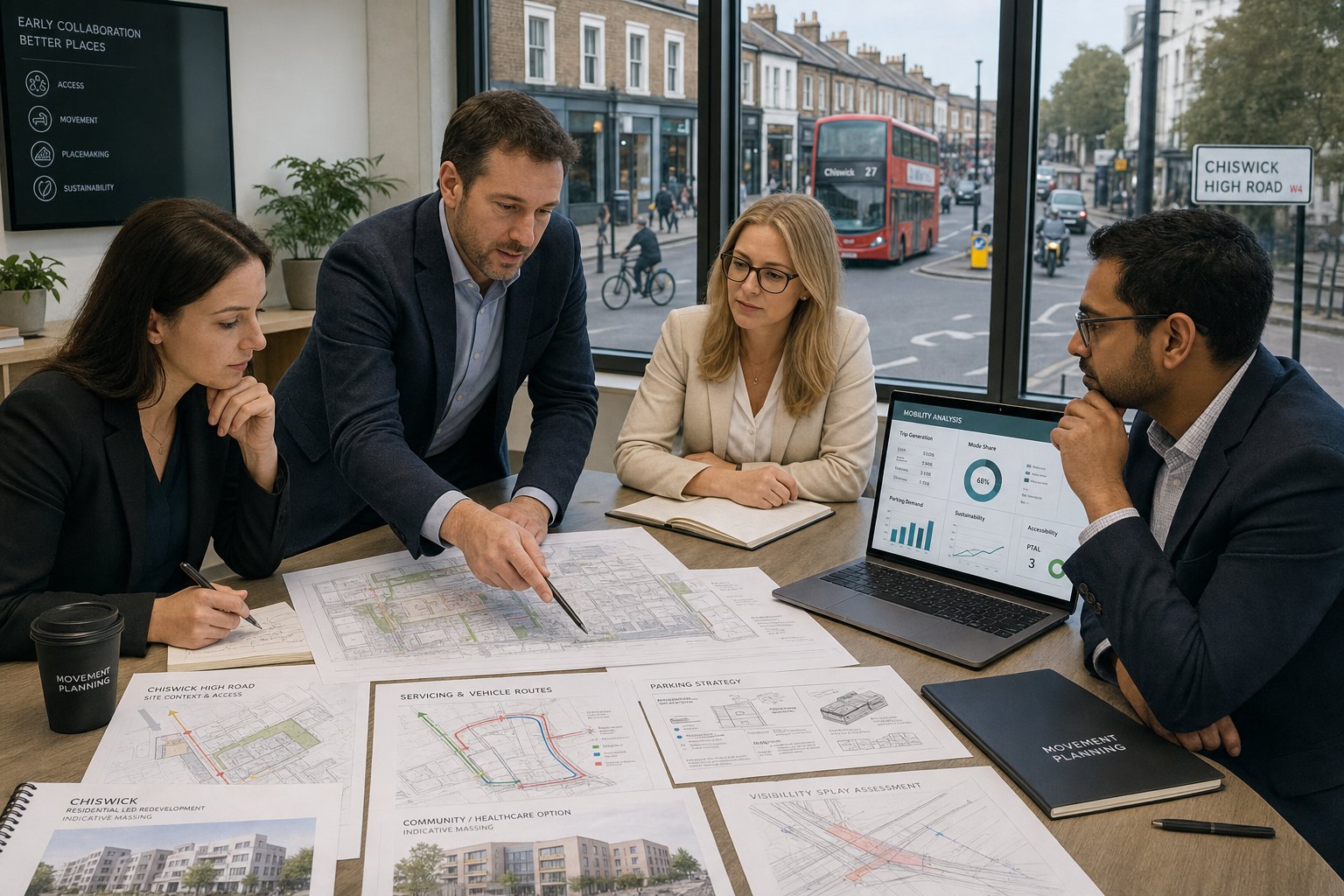
Not every planning application needs a full Transport Assessment, but a surprisingly wide range of projects benefit from transport input before submission. In Chiswick, schemes often sit on constrained plots, reuse existing buildings, or intensify land use in ways that create transport questions even when the physical works look modest on paper.
We are usually brought in where there is likely to be a change in trip-making, servicing, parking demand, access arrangements, or policy scrutiny. That includes residential redevelopment, commercial refits, education uses, healthcare facilities, and community projects. It also includes proposals where the planning risk is less about volume and more about site conditions, such as poor visibility, difficult servicing, or a tight urban frontage.
The practical point is simple: if transport is likely to be discussed in pre-apps, neighbour objections, or consultee comments, involving an engineer early is rarely wasted effort. It allows the design team to fix issues while layouts are still flexible.
Residential Schemes, Conversions, And Mixed-Use Developments
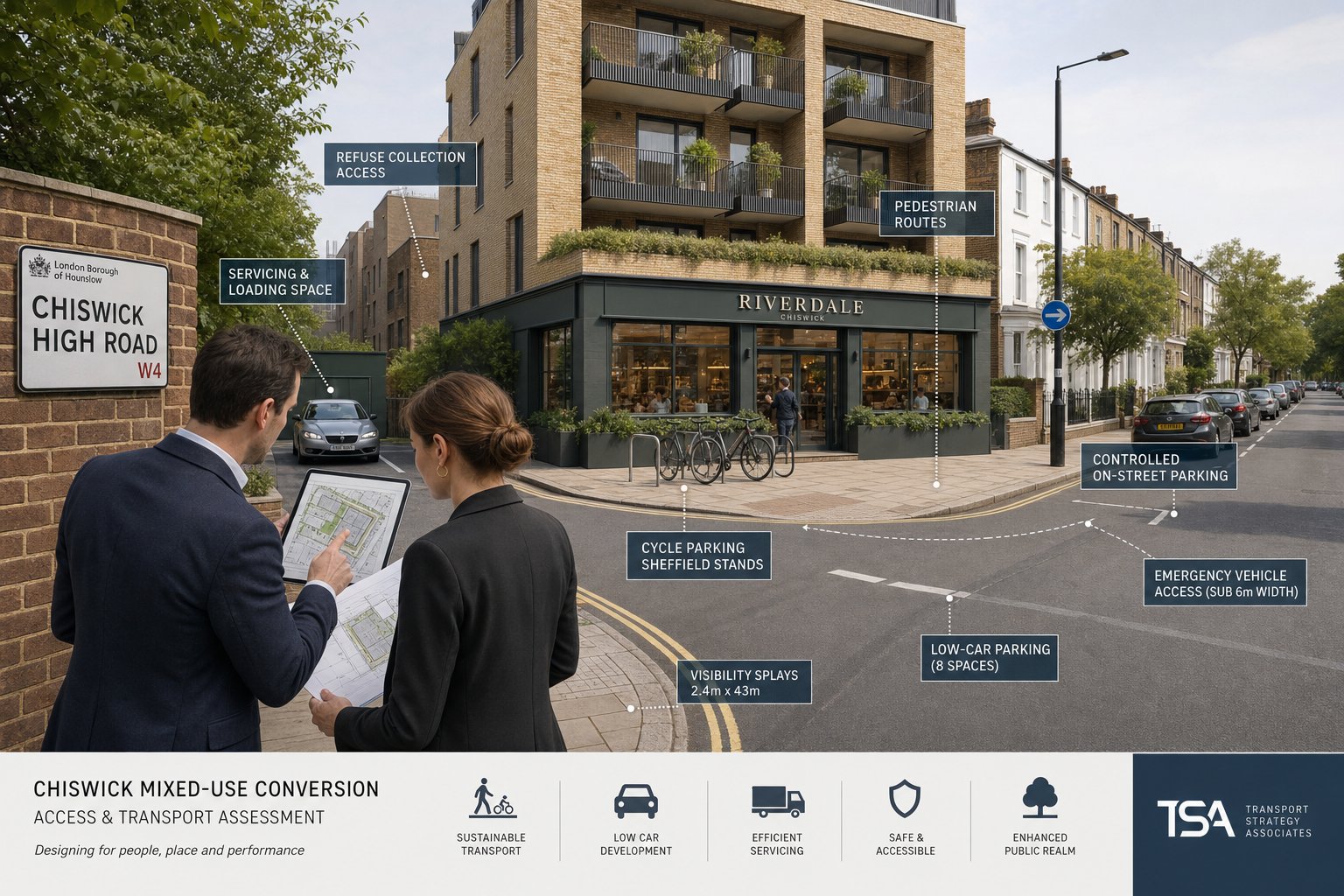
Residential schemes in Chiswick often look straightforward until the transport detail is tested. A new-build apartment block, a house-to-flats conversion, or a mixed-use scheme with ground-floor commercial space can all trigger questions on trip generation, cycle parking, refuse collection, servicing frequency, and whether emergency access works in practice rather than only on a drawing.
For these projects, we typically review the proposed unit mix, likely travel characteristics, local public transport accessibility, nearby parking controls, and the quality of walking and cycling links. We also assess whether a car-free or low-car approach is realistic, particularly where the planning strategy relies on reduced parking provision. In many cases, the debate is not only about the number of spaces, but about how confidently the proposal can justify them.
Conversions deserve special care because existing access points and internal geometry may be awkward. Tight forecourts, retained walls, and constrained visibility splays can create avoidable concerns if left unresolved. This is where detailed access design highway work becomes central. On mixed-use schemes, we also test whether residential amenity and commercial servicing can coexist without conflict at the kerbside or within the site.
Schools, Commercial Sites, Healthcare, And Community Uses
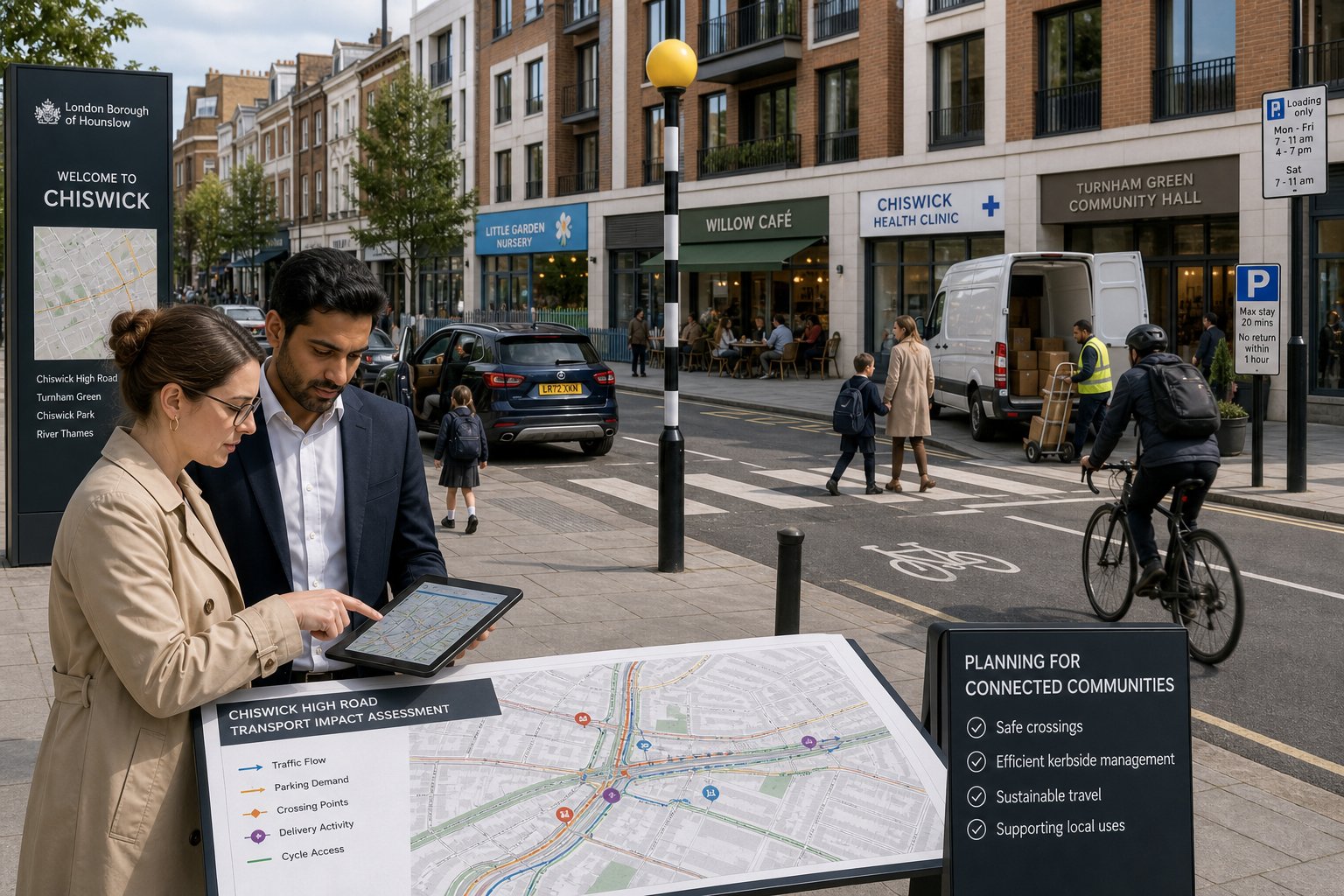
Higher-intensity uses can generate sharper peaks and more complex travel patterns. A nursery may create concentrated morning drop-off pressure. A café or retail unit can affect short-stay parking and deliveries. A healthcare use may produce a different spread of arrivals throughout the day, while a faith or community facility can create periodic surges tied to events rather than a standard weekday profile.
In Chiswick, these uses often sit close to homes and busy local roads, so operational realism matters. We assess likely staff and visitor travel choices, parking stress, servicing profiles, and the interaction between loading activity and the public highway. For schools and nurseries, the key issue is frequently not total trip generation but concentrated arrival behaviour, informal stopping, and road safety around crossing points.
Commercial sites also need transport evidence that reflects how the use will actually operate. That might include delivery windows, turnover, staff shifts, disabled parking, and cycle facilities. For developers and planning teams handling business-led schemes, wider best practice in Commercial Traffic Engineering is often useful because town centre logistics, kerbside pressure, and sustainable access expectations have all become more closely scrutinised in 2026.
Transport Reports Often Needed For Planning Applications

The type of report needed in Chiswick depends on the scale of the proposal, the sensitivity of the location, and whether LBH or TfL are likely to view the site as strategically important. Not every project needs a large evidence pack. But most transport-related planning submissions do need a clear, proportionate narrative backed by data.
At the lighter end, this may be a short note confirming expected trip levels, parking arrangements, cycle provision, servicing and access. At the more detailed end, it may include formal modelling, survey analysis, road safety review, delivery management proposals, and a Travel Plan with monitoring commitments.
The key is that each report should answer the right planning question. Officers and consultees generally want to know whether the development can operate safely, whether its impacts are acceptable, and whether it supports broader transport policy. A report that is technically dense but poorly focused does not help much. A concise document aligned to local thresholds and concerns usually does.
Transport Statements, Transport Assessments, And Travel Plans
A Transport Statement is typically used for small to medium schemes where impacts are expected to be limited but still need to be evidenced. It usually covers site accessibility, existing conditions, trip generation, parking, servicing, and a reasoned conclusion on highway and network effects. In Chiswick, that can be enough for many smaller residential, community, and change-of-use proposals.
A Transport Assessment goes further. It is generally needed where a development is larger, more sensitive, or potentially contentious in transport terms. That may mean more detailed survey work, junction impact testing, mode share analysis, collision review, or mitigation proposals. Sites on or near strategic roads, busy junctions, or heavily regulated kerbside environments are more likely to need this level of work.
Travel Plans sit alongside either document where ongoing travel behaviour management matters. They are especially common for schools, workplaces, healthcare, and larger residential schemes. A good Travel Plan is specific, monitorable, and realistic: not a generic list of aspirations. Our approach follows the practical principles set out in wider Traffic Engineering: Your Complete guidance, but always tailored to the local planning context and how people actually move around Chiswick.
Delivery, Servicing, Parking, And Highway Access Appraisals
This is often where planning applications become won or lost. Many Chiswick schemes are not refused because of headline traffic growth: they run into trouble because day-to-day operation has not been thought through. Can a refuse vehicle enter and leave in forward gear? Is there legal and safe loading space? Will delivery vans stop in the carriageway? Does the proposed crossover work with pedestrian movement, cycle activity, and visibility requirements?
We prepare delivery and servicing appraisals to show how vehicles will access, manoeuvre, load and depart. Swept-path analysis is a big part of that, but it is only part. We also consider timing, frequency, management arrangements, and kerbside constraints. Parking assessments examine not just how many spaces are proposed, but whether the provision aligns with policy, local stress conditions, blue badge needs, and the quality of alternative travel options.
Highway access appraisals usually combine geometry, visibility, pedestrian desire lines, and safety judgement. In dense urban settings, ideal standards may be constrained, so the report must explain risk and mitigation clearly. For project teams comparing different consultant approaches, the broader role of Traffic Engineering Consultants: is often less about producing drawings and more about making the access strategy defensible in planning terms.
Key Chiswick Transport And Planning Considerations
Chiswick has a transport profile that makes local knowledge genuinely useful. Sites may fall within the orbit of the A4, A316 or A315, near signal-controlled junctions, bus corridors, town centre frontages, or tightly parked residential streets. Each context brings different concerns, and the same development type can attract very different transport requirements depending on its exact location.
Controlled Parking Zones are a recurring issue. A low-parking proposal may appear acceptable on policy grounds, but officers will still want confidence that overspill effects are limited and that the site has credible access to public transport, walking routes, and cycle facilities. Kerbside competition also matters more than many applicants expect. Loading bays, bus stops, crossings, waiting restrictions, and resident parking can leave very little room for informal servicing.
Policy alignment is another major factor. London Plan principles on mode shift, active travel, Healthy Streets and reduced car dependency do not remove the need for operational realism: they raise the standard for how schemes must demonstrate it. In Chiswick, road safety history, bus reliability, air quality concerns, and the practical function of junctions can all shape the response from LBH and TfL. That is why local transport evidence needs to be both policy-aware and street-specific.
Junction Capacity, Road Safety, And Sustainable Travel
Junction capacity is often the most obvious technical issue, but it should not dominate to the exclusion of everything else. In Chiswick, a modest increase in turning traffic at the wrong location can matter more than a larger increase somewhere better distributed. We hence look at where trips are likely to route, which junctions are already sensitive, and whether a proposal changes traffic behaviour during established peak periods.
When required, we use industry-standard modelling and survey evidence to test impacts. But numbers on their own are not enough. We interpret them in context: signal staging, nearby bus operation, pedestrian crossings, queue interaction, and the practical tolerance of an urban network already operating under pressure.
Road safety is equally important. Collision analysis, site observations, visibility review, and layout testing help identify whether a scheme introduces new conflict points or worsens existing ones. Mitigation may be physical, operational, or both.
And then there is sustainable travel, which should be designed in, not bolted on at the end. Cycle parking, legible pedestrian access, wayfinding, car club measures, public transport connectivity, and targeted Travel Plan actions all strengthen an application. For teams working across multiple cities, comparisons with approaches used by a Traffic Engineer In Manchester: or other urban authorities can be useful, but Chiswick still demands a distinctly local reading of network pressure and policy expectations.
How A Traffic Engineer Supports The Planning Process
Our involvement usually starts before the formal report. We review the scheme, identify likely transport triggers, and help the wider consultant team decide what needs to be fixed early. That can include whether the site access should move, whether parking should be reduced or reconfigured, whether servicing needs a management plan, or whether a full TA is likely to be requested.
From there, we can help scope work with LBH and TfL, commission or interpret surveys, prepare transport documents, coordinate with architects on drawings, and respond to consultee comments after submission. In some cases, our job is to reduce the amount of reporting required by showing, persuasively and with evidence, that impacts are limited. In others, it is to build a full technical case for a more complex or sensitive scheme.
The planning process rarely moves in a straight line. Layouts change. Use classes shift. New comments emerge from officers, neighbours, or highway authorities. A useful traffic engineer stays engaged through that evolution and keeps the transport strategy aligned with the scheme rather than treating the report as a standalone deliverable. That practical, planning-led approach is the reason many teams look for concise support grounded in experience rather than generic templates.
What To Prepare Before Commissioning A Transport Assessment
A Transport Assessment is easier, faster, and usually better when the project team provides a clear starting brief. The most useful item is a current red-line plan with any access constraints identified. Draft site layouts are also valuable, even if they are still moving, because transport advice often turns on geometry and operational assumptions rather than abstract floorspace totals.
We also recommend preparing a land-use schedule, unit mix, parking proposals, cycle provision, servicing assumptions, and any phasing information. If surveys, pre-application notes, delivery data, or previous appeal material already exist, sharing them early avoids duplicated work and helps define whether the assessment can build on existing evidence.
Just as important is clarity on the planning strategy. Is the scheme intended to be car-free? Is a Section 106 Travel Plan likely? Has LBH raised concerns about junctions, parking stress, bus stops, or access safety? Those points shape the scope from day one.
For clients operating across several authorities, benchmarking can help sharpen expectations. Lessons from a Traffic Engineer In Leeds: or even a Traffic Engineer In Liverpool: commission may offer useful process comparisons, but the final scope still has to reflect Chiswick’s local highway and planning context.
Choosing A Traffic Engineer In Chiswick
Not all transport consultants are equally suited to planning work in a place like Chiswick. Technical competence matters, of course, but so does judgement. The right engineer will know when a short Transport Statement is enough, when a fuller TA is unavoidable, and how to explain constrained urban design choices without sounding evasive.
We would look first for relevant UK qualifications and experience, ideally with chartered civil or transport engineering credentials and a track record on London borough applications. Familiarity with TfL expectations is particularly useful for schemes near strategic roads or where bus, cycle or network performance issues may arise. Capability in modelling, road safety, active travel planning, parking analysis and servicing strategy should also be tested, because these issues often overlap.
Speed matters too, but not at the expense of quality. A concise report delivered quickly is only helpful if it answers the actual planning questions. That is one reason our own approach at ML Traffic focuses on tailored, authority-aware reporting built on more than 30 years of experience. The best appointment is usually the consultant who can speak clearly to planners, architects, lawyers and highway officers alike, and who understands that good transport advice is there to move the application forward, not simply add another document to the stack.
Conclusion
For most schemes in Chiswick, transport is not a side issue. It influences layout, servicing, parking, policy compliance, and the overall credibility of the planning case. On a constrained urban network, small details can carry a lot of weight.
That is why early, proportionate traffic engineering input tends to pay for itself. When the right scope is agreed at the right time, project teams can address access, operational and sustainable travel issues before they harden into objections. The result is usually a clearer submission, fewer avoidable questions, and a stronger route to consent.
Whether the project is a residential conversion, a mixed-use redevelopment, a school, a healthcare use or a commercial site, the best outcomes usually come from combining local awareness with concise technical evidence. In Chiswick, that mix is often what turns a transport report from a planning requirement into a planning advantage.
Frequently Asked Questions About Traffic Engineering in Chiswick
What role does a traffic engineer play in development projects in Chiswick?
A traffic engineer in Chiswick assesses transport impacts on busy roads and local streets, ensuring developments fit existing conditions, meet policy standards, and avoid congestion or safety issues, particularly for borough and TfL planning approvals.
Which types of projects typically require a traffic engineer in Chiswick?
Common projects include new housing, residential conversions, mixed-use developments, schools, healthcare, commercial sites, and community uses where transport impacts such as parking, servicing, and access need technical evaluation.
What transport reports are usually needed for planning applications in Chiswick?
Depending on size and impact, small to medium schemes require Transport Statements, larger or sensitive sites need detailed Transport Assessments, and projects generating sustained travel impact often require Travel Plans to manage ongoing behaviours.
How important is early involvement of a traffic engineer in Chiswick planning processes?
Early engagement helps identify and solve transport issues during design, reducing objections by LBH or TfL, improving layout, parking, and servicing plans, and streamlining planning approval.
What local challenges affect traffic engineering strategies in Chiswick?
Chiswick’s constrained urban network, busy junctions on the A4 and A315, Controlled Parking Zones, conservation areas, and pressure on kerbside space necessitate tailored transport solutions sensitive to road safety and sustainable travel policies.
How do traffic engineers address delivery, servicing, and parking concerns in Chiswick developments?
They conduct swept-path analyses, design safe highway access, evaluate loading zones and parking provisions aligned with policy, and propose management strategies to ensure operational realism without impacting public highway safety.