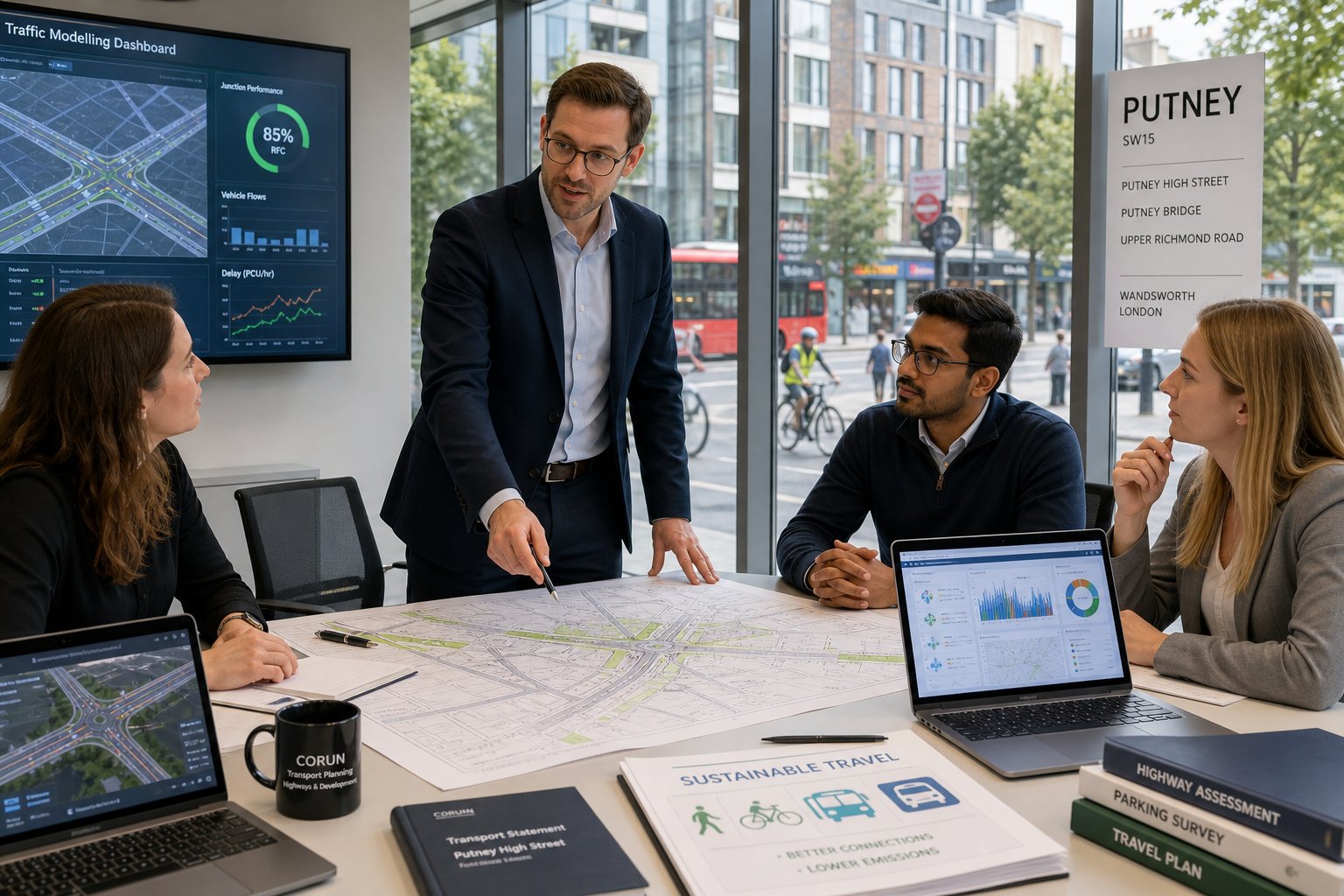
Putney is one of those places where transport issues look simple on a location plan and become much more complicated the moment a scheme reaches planning. A modest residential intensification can raise questions about parking stress. A commercial fit-out near a busy corridor can trigger scrutiny on servicing, cycle access, and peak-hour movements. And because Putney sits within a sensitive part of southwest London’s network, local context matters a lot more than generic transport commentary.
That is exactly where a Traffic Engineer in Putney adds value. We assess how a proposal interacts with the road network, public transport, walking and cycling routes, parking controls, and wider planning policy. For architects, planners, lawyers, surveyors, developers, and local authorities, that usually means turning transport risk into clear evidence: what the impact is, whether it is acceptable, and what mitigation is needed.
In 2026, that evidence has to do more than describe traffic. It needs to align with Wandsworth policy, London Plan expectations, and the practical realities of streets such as Putney High Street, Upper Richmond Road, and the approaches to Putney Bridge. Done well, transport input can strengthen an application early, reduce avoidable objections, and give decision-makers confidence that access, safety, capacity, and sustainability have all been dealt with properly.
Key Takeaways
- A Traffic Engineer in Putney provides vital, locally tailored transport assessments that address the specific challenges of Putney’s sensitive road network and comply with Wandsworth and London Plan policies.
- Early engagement with a traffic engineer helps identify transport risks, allowing scheme adjustments that prevent objections and streamline the planning approval process.
- Transport reports for Putney developments focus on realistic and proportionate evidence, covering site safety, trip generation, parking stress, servicing arrangements, and sustainable travel support.
- Putney’s constrained streets, heavy kerbside competition, and multimodal expectations require traffic engineers to deliver practical, concise, and context-specific transport solutions.
- Comprehensive parking surveys, trip generation analysis, and junction capacity assessments are crucial for demonstrating that developments will not exacerbate local traffic or parking stresses.
- Choosing a traffic engineer with proven Putney and London experience, strong communication skills, and the ability to produce clear, planning-relevant evidence significantly enhances the chances of gaining permission.
What A Traffic Engineer In Putney Does For Planning And Development
A traffic engineer supporting development in Putney is not just producing numbers for a planning file. We are usually helping a project team answer a set of planning-critical questions: will the site operate safely, how many trips will it generate, can nearby junctions accommodate them, is parking provision appropriate, and does the scheme support sustainable travel rather than undermine it?
That work starts with baseline analysis. We review the surrounding highway network, traffic conditions, pedestrian and cycle connectivity, public transport accessibility, local accident records where relevant, and parking controls. We then compare existing conditions with the likely operational effects of the proposed development. On a small scheme, that may mean a concise technical note or Transport Statement. On larger projects, it can involve a fuller assessment with surveys, trip generation, distribution assumptions, and capacity modelling.
In practice, we also advise on design. Access geometry, visibility, refuse tracking, servicing arrangements, cycle parking, drop-off strategy, and internal layout all have transport implications. A good report is only part of the job: the scheme itself often needs adjustment. That is why early coordination matters. Our role often overlaps with the wider discipline explained in Traffic Engineering: Your Complete, but local planning success depends on applying those principles to real Putney constraints, not abstract guidance.
For applicants, the benefit is straightforward: transport issues are addressed before they become formal objections from the highway authority or TfL.
Why Putney Requires A Local Transport And Highways Perspective
Putney is not a place where a generic, copied-and-pasted transport report tends to survive scrutiny. The area sits close to strategic movements associated with the A3 and A205, with pressure points around Putney Bridge, Putney High Street, Upper Richmond Road, and links toward Wandsworth, Roehampton, and Hammersmith & Fulham. Even when a site itself is modest, the surrounding network can already be operating under stress at key times of day.
That matters because planning transport work is rarely judged in isolation. Officers want to know how a scheme interacts with local junctions, bus corridors, cycling routes, school travel patterns, controlled parking zones, and the borough’s wider shift toward active and sustainable travel. Car-dominant assumptions are tested hard. So are unsupported claims that impacts will be “negligible”.
A local perspective also means understanding administrative boundaries. Some sites involve roads under borough control: others can raise issues on TfL-managed corridors or create cumulative effects with neighbouring boroughs. We hence frame reports in a way that speaks to the actual decision-makers and consultees involved. That local authority awareness is part of the broader planning support approach discussed in Traffic Engineer In London:, but Putney has its own transport personality: constrained streets, strong public transport expectations, and very little tolerance for weak parking evidence.
In short, local knowledge is not a nice extra here. It is often the difference between a report that reads adequately and one that genuinely helps secure permission.
Common Projects That Need Traffic Engineering Input In Putney
Many teams still assume traffic input is only needed on large development sites. In Putney, that is rarely the full story. We are often instructed on projects that appear moderate in scale but create planning sensitivity because they alter trip patterns, parking demand, servicing needs, or access arrangements.
The common thread is this: if transport effects could influence acceptability, a proportionate technical response is usually worthwhile. Sometimes it is mandatory because the local authority asks for it. Sometimes it is strategic because a concise, evidence-led report prevents avoidable delay.
Residential Developments And Change Of Use Schemes
Residential schemes are a frequent trigger for traffic engineering input in Putney, especially where density increases, layouts change, or a former commercial building becomes flats. On paper, these projects can seem low impact. In reality, they often prompt detailed questions about parking stress, delivery activity, refuse collection, visibility, and whether the site genuinely supports low-car or car-free living.
Change of use schemes are particularly interesting because the trip profile can shift in ways that are not obvious to non-transport specialists. An office may have concentrated commuter peaks and limited overnight parking demand. Flats may generate different peak spreading, visitor activity, deliveries, and stronger evening parking pressure. If a site sits within or close to a controlled parking zone, overspill concerns become central very quickly.
We typically test those issues through parking beat surveys, trip rate analysis, access review, and policy-based justification. For development teams that work across regions, the methodology may feel familiar, but the local thresholds and policy framing are not always the same. That is why comparison with work undertaken by a Traffic Engineer In Birmingham: or elsewhere is useful only up to a point: Putney demands London-specific evidence and stronger sustainable transport positioning.
Commercial, Education, And Mixed-Use Proposals
Commercial, education, and mixed-use schemes bring a broader set of transport questions. Offices, medical uses, retail units, schools, student accommodation, and blended developments can all create concentrated peaks, servicing demands, and more complex person-trip patterns than a straightforward residential proposal.
In Putney, these schemes are often tested against the practical operation of nearby streets rather than headline floor area alone. A school-related proposal may be acceptable in pure capacity terms but problematic because of drop-off behaviour and school-street restrictions. A café or retail fit-out may appear small yet create frequent deliveries and short-stay parking churn. Mixed-use schemes can be the trickiest of all, because each land use brings a different mode split, timing profile, and kerbside demand.
Our role is to convert that complexity into clear planning evidence. We estimate trip generation, identify likely distribution, test junction effects where necessary, and assess servicing and parking strategy in the context of local policy. On commercial-led sites, the issues often overlap with the themes set out in Commercial Traffic Engineering, but Putney projects usually need a tighter local narrative around buses, cycling access, and constrained frontage conditions.
Core Traffic Engineering Reports For Putney Planning Applications
Not every planning application needs the same level of transport documentation. The correct package depends on scale, use class, access changes, policy context, and likely highway concerns. But in Putney, the most common reports tend to fall into a fairly recognisable set.
The aim is not to produce paperwork for its own sake. It is to provide the minimum robust evidence needed to show that the scheme is safe, policy-compliant, and acceptable in operational terms.
Transport Statements, Transport Assessments, And Travel Plans
A Transport Statement (TS) is usually suitable for smaller or less impactful proposals. It explains baseline conditions, site accessibility, expected trips, parking arrangements, servicing, and why the proposal should not create severe transport effects. It still needs real substance. A weak TS that simply states impacts are limited, without evidence, tends to invite queries rather than resolve them.
A Transport Assessment (TA) goes further. It is used for larger or more sensitive schemes and typically includes survey data, trip generation analysis, modal assumptions, assignment to the road network, and assessment of effects on key junctions or links. In Putney, that may involve testing interactions with already busy corridors and demonstrating that any added demand remains acceptable or can be mitigated.
A Travel Plan supports both TS and TA work by showing how the development will reduce reliance on private car use. Measures may include cycle parking, shower facilities, car club provision, travel information packs, permit restrictions, deliveries management, and monitoring commitments. London boroughs expect this to be practical, not decorative.
Across our work, speed matters as much as accuracy. Teams looking at the wider role of specialist support often start with Traffic Engineering Consultants:, but for a Putney application the key test is whether the report directly addresses Wandsworth and TfL concerns.
Parking Surveys, Trip Generation, And Junction Capacity Assessments
Parking is often where relatively small Putney schemes become contentious. Existing stress can already be high, and nearby residents are quick to challenge unsupported claims that additional demand will be negligible. That is why parking surveys need to be undertaken properly, with suitable beat times, clear zone coverage, and interpretation that reflects local controls, not just raw occupancy percentages.
Trip generation analysis is another cornerstone. We estimate how many person trips and vehicle trips a scheme is likely to produce, usually by reference to recognised databases and local adjustment where needed. But numbers alone are not enough. We also need to explain mode split in a credible London context, including bus access, rail connections, walking catchments, cycle infrastructure, and any car-free or permit-managed strategy.
Where the highway authority raises operational concerns, we may carry out junction capacity assessments using recognised tools such as HCS, Synchro, SIDRA or VISSIM, depending on the site and issue. The purpose is not to over-model every small scheme. It is to test the points that actually matter: queueing, reserve capacity, delay, turning movements, or interaction with nearby signals and crossings.
A strong evidence chain here can save weeks of back-and-forth. It is also one reason project teams often benefit from transport support that is concise and planning-focused rather than overly academic.
How Traffic Engineers Support The Planning Application Process
The most effective transport input usually begins before an application is submitted. We often review a concept layout, identify likely transport risks, and advise whether a TS, TA, Travel Plan, parking survey, delivery strategy, or swept path analysis is likely to be needed. That early step can prevent a surprising amount of redesign later.
During pre-application work, we help shape the proposal itself. If a crossover is poorly positioned, if servicing cannot occur safely, or if cycle parking is underprovided, those issues are better fixed before the planning drawings settle. We also advise on likely authority concerns based on local thresholds and recent decisions. For teams operating across multiple cities, this kind of targeted support complements broader work such as a Traffic Engineer In Manchester: or other regional scheme, but the detail in Putney is always place-specific.
Once the application is live, our role becomes partly technical and partly strategic. We prepare reports, respond to officer comments, revise assessments if the scheme evolves, and answer questions from highways officers or TfL consultees. Occasionally that includes rebutting overstated third-party objections with calm, evidence-led explanations.
And if a project proceeds to committee, appeal, or inquiry, we can act as expert support. That means presenting transport evidence clearly enough for planners, members, legal teams, and non-specialists to follow. Good traffic engineering is not just about analysis. It is about making analysis useful within the planning process.
Key Local Considerations In Putney, Wandsworth, And Surrounding Roads
Putney’s transport context has a few recurring pressure points that regularly shape planning discussions. The first is network sensitivity. Corridors such as Putney High Street and Upper Richmond Road already carry significant movement, while Putney Bridge and the surrounding junctions can be vulnerable to delay, rerouting, and cumulative demand. A proposal does not need to be enormous to attract questions if it adds movements at the wrong location or time.
The second is multimodal expectation. Wandsworth, like other London boroughs, places strong emphasis on walking, cycling, and public transport. That changes how schemes should be framed. A parking-heavy approach that might pass with limited comment elsewhere can feel out of step in Putney unless there is a compelling operational case. Developments near stations, bus corridors, or established town-centre services are expected to reflect that accessibility in their mode share assumptions and design response.
The third is kerbside competition. Loading, drop-off, bus stop clearways, school access, cycle lanes, and resident parking all compete for limited street space. In practical terms, many objections arise not from strategic capacity but from simple operational friction at the frontage. We address that through realistic servicing plans, parking evidence, and where necessary swept path or access review.
Cumulative impact also matters. Nearby schemes in Wandsworth or across adjoining borough boundaries can change the baseline against which a new application is judged. This is one reason transport planning in London cannot be approached too narrowly, as highlighted by the cross-city perspective in Traffic Engineer In Leeds: and other regional examples, even though the local policy lens in Putney remains distinct.
Choosing The Right Traffic Engineer For A Putney Project
Choosing a traffic engineer for a Putney scheme is partly about qualifications and partly about judgement. Technical competence matters, of course. We would normally expect a suitable consultant to have strong planning experience, familiarity with London policy, confidence in transport statements and assessments, and the ability to undertake or interpret parking, trip generation, and capacity work properly. Experience with recognised software is important where modelling is likely to be needed.
But credentials alone are not enough. The better question is whether the consultant understands how to produce proportionate evidence that planning officers can actually use. Some reports are technically elaborate and still fail because they miss the real concern. Others are concise, local, and persuasive because they answer the right questions directly.
For Putney, we would look for proven Wandsworth or wider London case experience, an ability to deal with TfL issues when relevant, and a practical grasp of constrained urban streets. Communication matters too. Transport objections often need to be handled through meetings, written responses, and occasional public-facing discussion. A consultant who can explain parking stress, trip rates, or junction results in plain English is usually more valuable than one who hides behind jargon.
At ML Traffic, our focus is exactly that: concise, accurate reporting delivered quickly, grounded in more than 30 years of transport engineering experience and tailored to local planning thresholds. That combination tends to matter when deadlines tighten and applications need transport work that is both technically sound and decision-ready.
Conclusion
For developments in Putney, transport is rarely a box-ticking exercise. It can shape whether a scheme is considered safe, workable, policy-aligned, and eventually grantable. A well-prepared assessment does more than quantify trips or parking demand: it gives planning officers and consultees confidence that the proposal has been tested against real local conditions.
That is why early, locally informed input from a Traffic Engineer in Putney can be so valuable. We help project teams identify risks early, match the evidence to the scale of the application, and respond clearly to concerns around access, parking, servicing, junction impact, and sustainable travel. In a location as sensitive and scrutinised as Putney, that kind of focused transport support can make the difference between a delayed application and a stronger, faster route to permission.
What A Traffic Engineer In Putney Does For Planning And Development
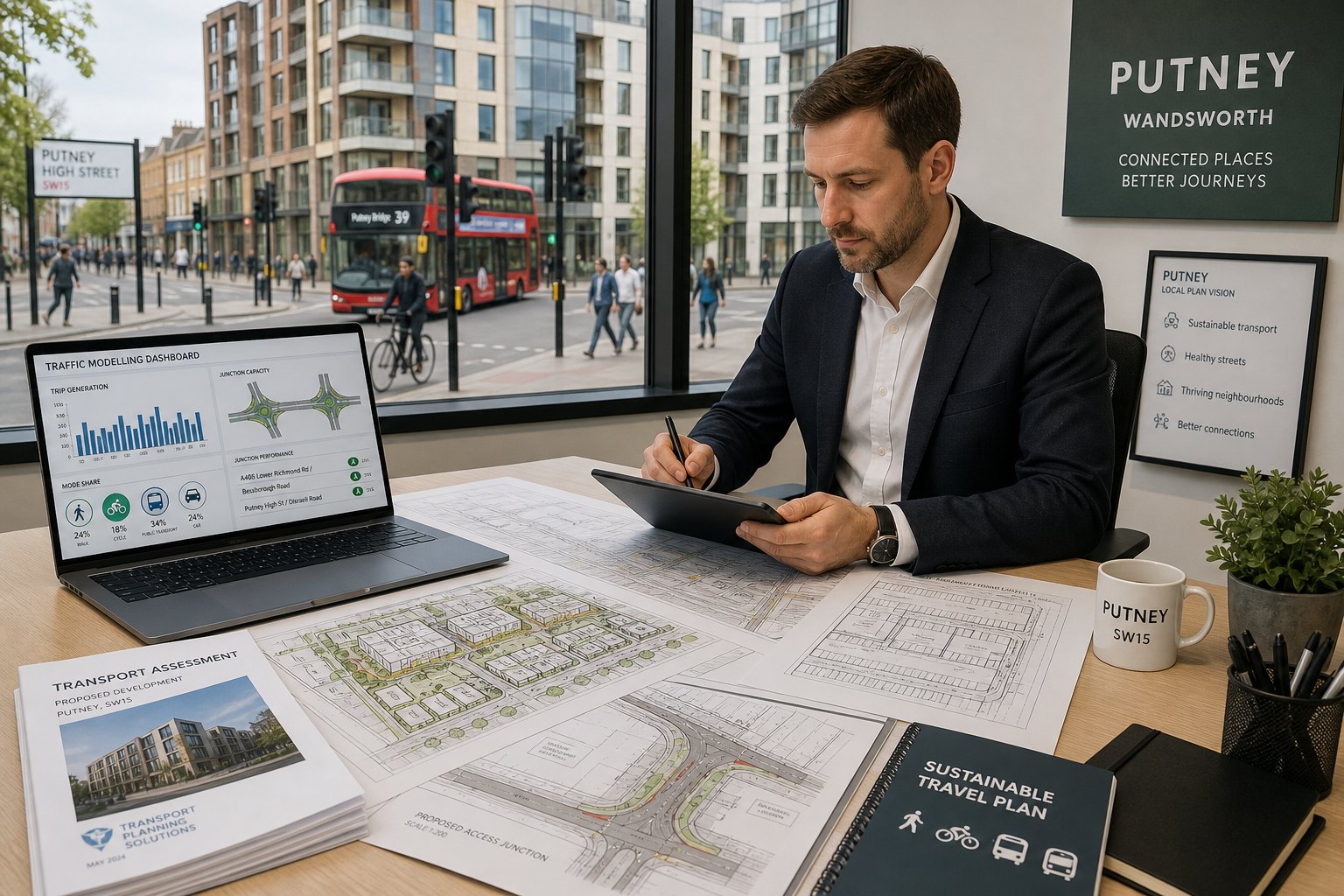
A traffic engineer supporting development in Putney is not just producing numbers for a planning file. We are usually helping a project team answer a set of planning-critical questions: will the site operate safely, how many trips will it generate, can nearby junctions accommodate them, is parking provision appropriate, and does the scheme support sustainable travel rather than undermine it?
That work starts with baseline analysis. We review the surrounding highway network, traffic conditions, pedestrian and cycle connectivity, public transport accessibility, local accident records where relevant, and parking controls. We then compare existing conditions with the likely operational effects of the proposed development. On a small scheme, that may mean a concise technical note or Transport Statement. On larger projects, it can involve a fuller assessment with surveys, trip generation, distribution assumptions, and capacity modelling.
In practice, we also advise on design. Access geometry, visibility, refuse tracking, servicing arrangements, cycle parking, drop-off strategy, and internal layout all have transport implications. A good report is only part of the job: the scheme itself often needs adjustment. That is why early coordination matters. Our role often overlaps with the wider discipline explained in Traffic Engineering: Your Complete, but local planning success depends on applying those principles to real Putney constraints, not abstract guidance.
For applicants, the benefit is straightforward: transport issues are addressed before they become formal objections from the highway authority or TfL.
Why Putney Requires A Local Transport And Highways Perspective
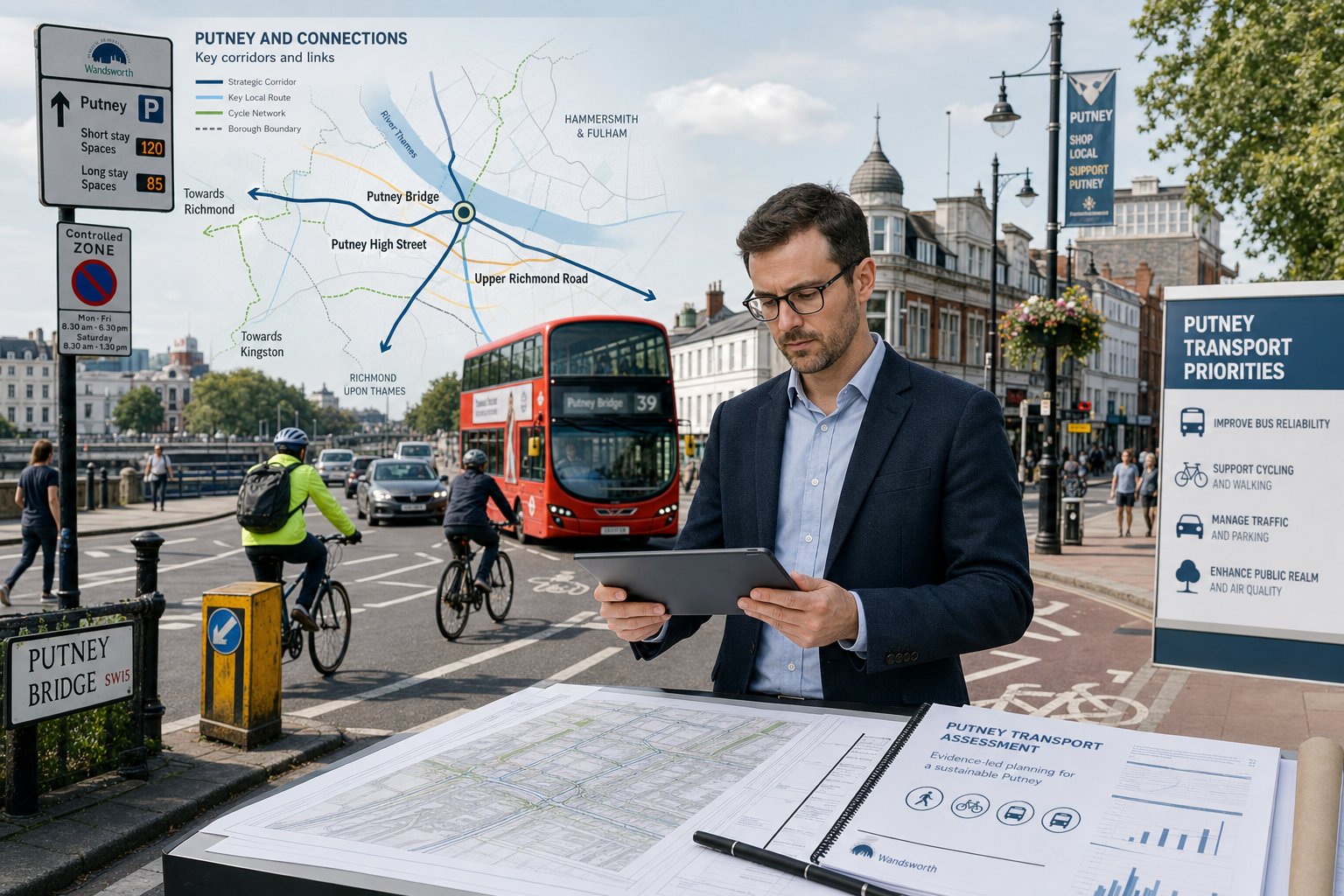
Putney is not a place where a generic, copied-and-pasted transport report tends to survive scrutiny. The area sits close to strategic movements associated with the A3 and A205, with pressure points around Putney Bridge, Putney High Street, Upper Richmond Road, and links toward Wandsworth, Roehampton, and Hammersmith & Fulham. Even when a site itself is modest, the surrounding network can already be operating under stress at key times of day.
That matters because planning transport work is rarely judged in isolation. Officers want to know how a scheme interacts with local junctions, bus corridors, cycling routes, school travel patterns, controlled parking zones, and the borough’s wider shift toward active and sustainable travel. Car-dominant assumptions are tested hard. So are unsupported claims that impacts will be “negligible”.
A local perspective also means understanding administrative boundaries. Some sites involve roads under borough control: others can raise issues on TfL-managed corridors or create cumulative effects with neighbouring boroughs. We hence frame reports in a way that speaks to the actual decision-makers and consultees involved. That local authority awareness is part of the broader planning support approach discussed in Traffic Engineer In London:, but Putney has its own transport personality: constrained streets, strong public transport expectations, and very little tolerance for weak parking evidence.
In short, local knowledge is not a nice extra here. It is often the difference between a report that reads adequately and one that genuinely helps secure permission.
Common Projects That Need Traffic Engineering Input In Putney

Many teams still assume traffic input is only needed on large development sites. In Putney, that is rarely the full story. We are often instructed on projects that appear moderate in scale but create planning sensitivity because they alter trip patterns, parking demand, servicing needs, or access arrangements.
The common thread is this: if transport effects could influence acceptability, a proportionate technical response is usually worthwhile. Sometimes it is mandatory because the local authority asks for it. Sometimes it is strategic because a concise, evidence-led report prevents avoidable delay.
Residential Developments And Change Of Use Schemes
Residential schemes are a frequent trigger for traffic engineering input in Putney, especially where density increases, layouts change, or a former commercial building becomes flats. On paper, these projects can seem low impact. In reality, they often prompt detailed questions about parking stress, delivery activity, refuse collection, visibility, and whether the site genuinely supports low-car or car-free living.
Change of use schemes are particularly interesting because the trip profile can shift in ways that are not obvious to non-transport specialists. An office may have concentrated commuter peaks and limited overnight parking demand. Flats may generate different peak spreading, visitor activity, deliveries, and stronger evening parking pressure. If a site sits within or close to a controlled parking zone, overspill concerns become central very quickly.
We typically test those issues through parking beat surveys, trip rate analysis, access review, and policy-based justification. For development teams that work across regions, the methodology may feel familiar, but the local thresholds and policy framing are not always the same. That is why comparison with work undertaken by a Traffic Engineer In Birmingham: or elsewhere is useful only up to a point: Putney demands London-specific evidence and stronger sustainable transport positioning.
Commercial, Education, And Mixed-Use Proposals
Commercial, education, and mixed-use schemes bring a broader set of transport questions. Offices, medical uses, retail units, schools, student accommodation, and blended developments can all create concentrated peaks, servicing demands, and more complex person-trip patterns than a straightforward residential proposal.
In Putney, these schemes are often tested against the practical operation of nearby streets rather than headline floor area alone. A school-related proposal may be acceptable in pure capacity terms but problematic because of drop-off behaviour and school-street restrictions. A café or retail fit-out may appear small yet create frequent deliveries and short-stay parking churn. Mixed-use schemes can be the trickiest of all, because each land use brings a different mode split, timing profile, and kerbside demand.
Our role is to convert that complexity into clear planning evidence. We estimate trip generation, identify likely distribution, test junction effects where necessary, and assess servicing and parking strategy in the context of local policy. On commercial-led sites, the issues often overlap with the themes set out in Commercial Traffic Engineering, but Putney projects usually need a tighter local narrative around buses, cycling access, and constrained frontage conditions.
Core Traffic Engineering Reports For Putney Planning Applications
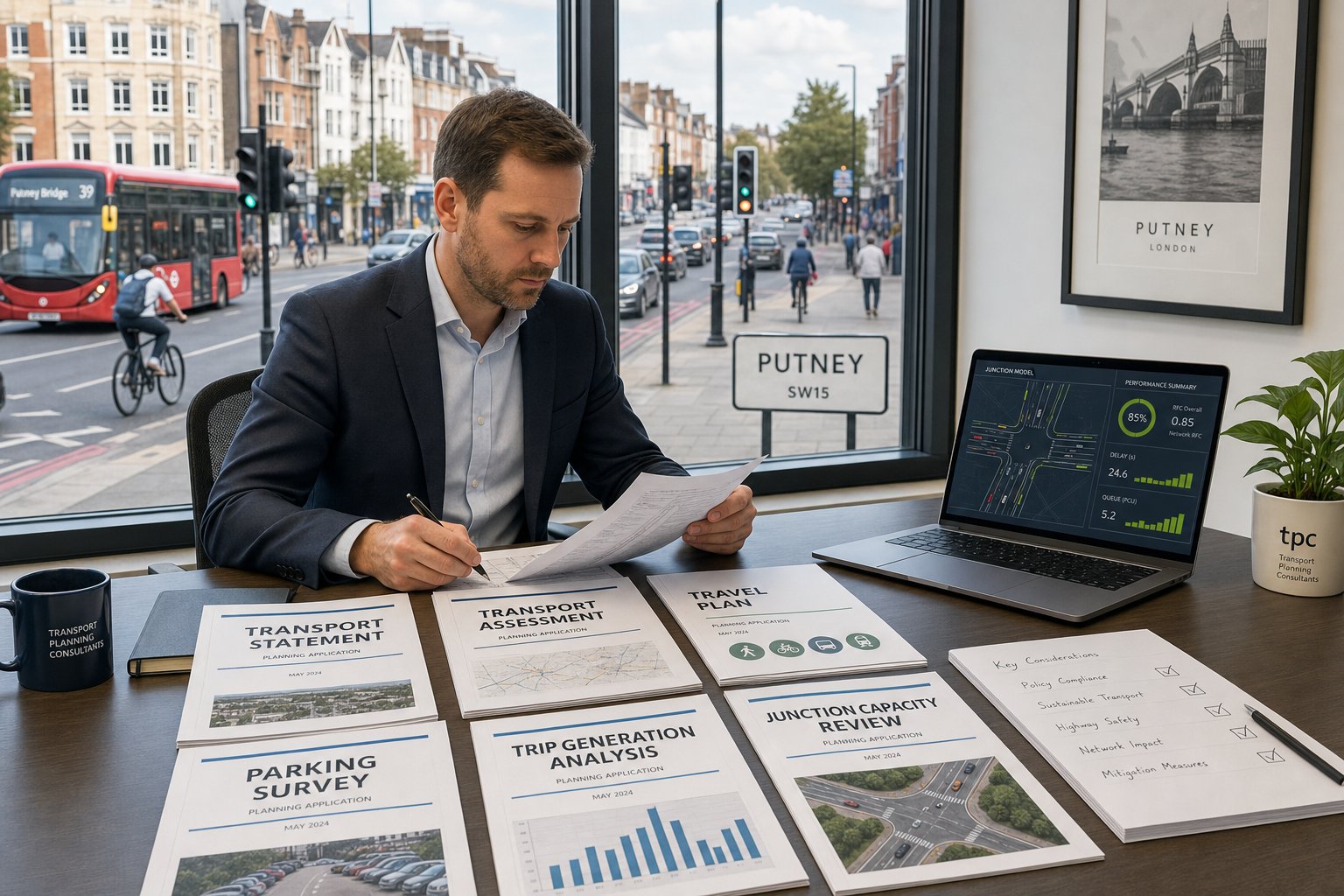
Not every planning application needs the same level of transport documentation. The correct package depends on scale, use class, access changes, policy context, and likely highway concerns. But in Putney, the most common reports tend to fall into a fairly recognisable set.
The aim is not to produce paperwork for its own sake. It is to provide the minimum robust evidence needed to show that the scheme is safe, policy-compliant, and acceptable in operational terms.
Transport Statements, Transport Assessments, And Travel Plans
A Transport Statement (TS) is usually suitable for smaller or less impactful proposals. It explains baseline conditions, site accessibility, expected trips, parking arrangements, servicing, and why the proposal should not create severe transport effects. It still needs real substance. A weak TS that simply states impacts are limited, without evidence, tends to invite queries rather than resolve them.
A Transport Assessment (TA) goes further. It is used for larger or more sensitive schemes and typically includes survey data, trip generation analysis, modal assumptions, assignment to the road network, and assessment of effects on key junctions or links. In Putney, that may involve testing interactions with already busy corridors and demonstrating that any added demand remains acceptable or can be mitigated.
A Travel Plan supports both TS and TA work by showing how the development will reduce reliance on private car use. Measures may include cycle parking, shower facilities, car club provision, travel information packs, permit restrictions, deliveries management, and monitoring commitments. London boroughs expect this to be practical, not decorative.
Across our work, speed matters as much as accuracy. Teams looking at the wider role of specialist support often start with Traffic Engineering Consultants:, but for a Putney application the key test is whether the report directly addresses Wandsworth and TfL concerns.
Parking Surveys, Trip Generation, And Junction Capacity Assessments
Parking is often where relatively small Putney schemes become contentious. Existing stress can already be high, and nearby residents are quick to challenge unsupported claims that additional demand will be negligible. That is why parking surveys need to be undertaken properly, with suitable beat times, clear zone coverage, and interpretation that reflects local controls, not just raw occupancy percentages.
Trip generation analysis is another cornerstone. We estimate how many person trips and vehicle trips a scheme is likely to produce, usually by reference to recognised databases and local adjustment where needed. But numbers alone are not enough. We also need to explain mode split in a credible London context, including bus access, rail connections, walking catchments, cycle infrastructure, and any car-free or permit-managed strategy.
Where the highway authority raises operational concerns, we may carry out junction capacity assessments using recognised tools such as HCS, Synchro, SIDRA or VISSIM, depending on the site and issue. The purpose is not to over-model every small scheme. It is to test the points that actually matter: queueing, reserve capacity, delay, turning movements, or interaction with nearby signals and crossings.
A strong evidence chain here can save weeks of back-and-forth. It is also one reason project teams often benefit from transport support that is concise and planning-focused rather than overly academic.
How Traffic Engineers Support The Planning Application Process
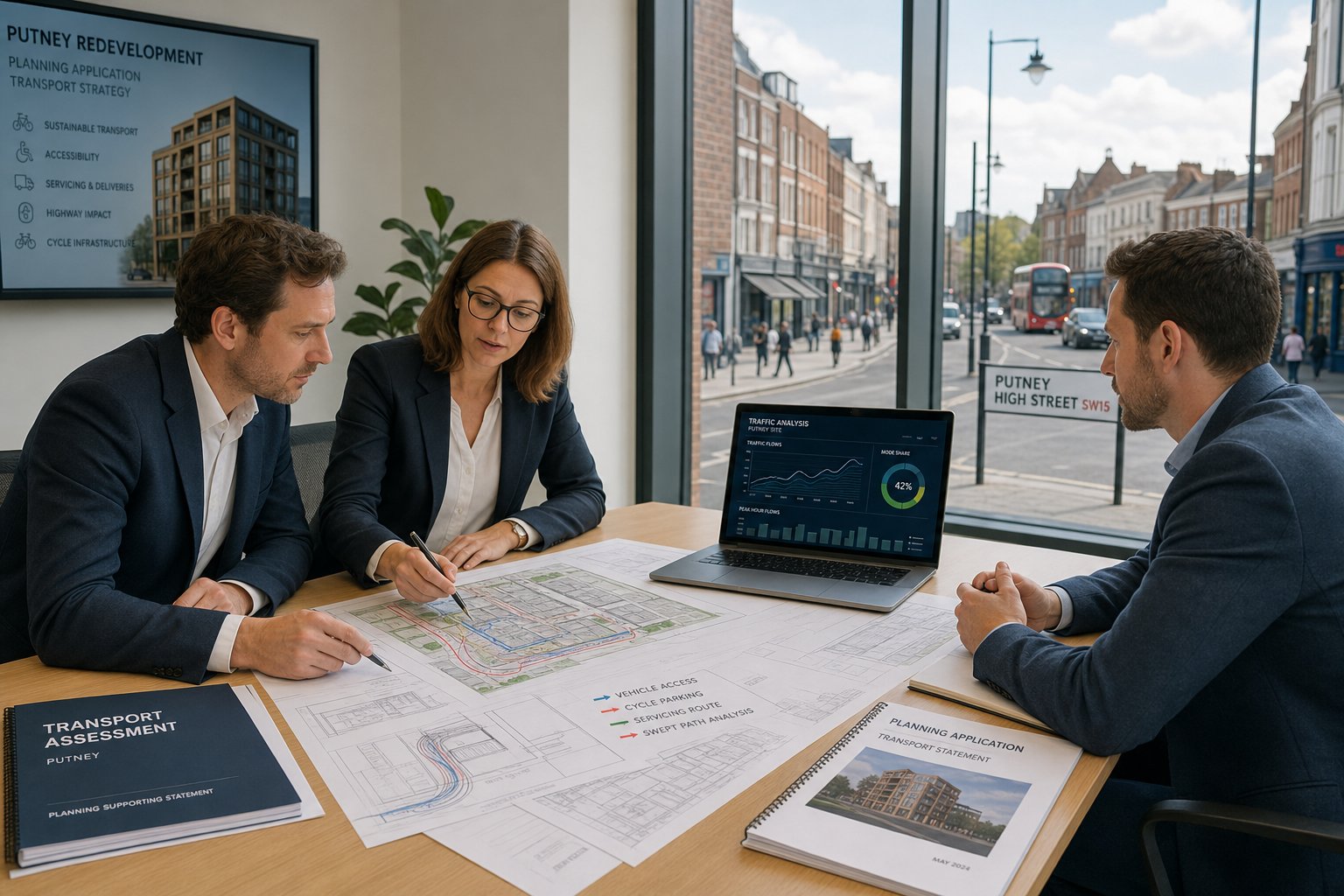
The most effective transport input usually begins before an application is submitted. We often review a concept layout, identify likely transport risks, and advise whether a TS, TA, Travel Plan, parking survey, delivery strategy, or swept path analysis is likely to be needed. That early step can prevent a surprising amount of redesign later.
During pre-application work, we help shape the proposal itself. If a crossover is poorly positioned, if servicing cannot occur safely, or if cycle parking is underprovided, those issues are better fixed before the planning drawings settle. We also advise on likely authority concerns based on local thresholds and recent decisions. For teams operating across multiple cities, this kind of targeted support complements broader work such as a Traffic Engineer In Manchester: or other regional scheme, but the detail in Putney is always place-specific.
Once the application is live, our role becomes partly technical and partly strategic. We prepare reports, respond to officer comments, revise assessments if the scheme evolves, and answer questions from highways officers or TfL consultees. Occasionally that includes rebutting overstated third-party objections with calm, evidence-led explanations.
And if a project proceeds to committee, appeal, or inquiry, we can act as expert support. That means presenting transport evidence clearly enough for planners, members, legal teams, and non-specialists to follow. Good traffic engineering is not just about analysis. It is about making analysis useful within the planning process.
Key Local Considerations In Putney, Wandsworth, And Surrounding Roads
Putney’s transport context has a few recurring pressure points that regularly shape planning discussions. The first is network sensitivity. Corridors such as Putney High Street and Upper Richmond Road already carry significant movement, while Putney Bridge and the surrounding junctions can be vulnerable to delay, rerouting, and cumulative demand. A proposal does not need to be enormous to attract questions if it adds movements at the wrong location or time.
The second is multimodal expectation. Wandsworth, like other London boroughs, places strong emphasis on walking, cycling, and public transport. That changes how schemes should be framed. A parking-heavy approach that might pass with limited comment elsewhere can feel out of step in Putney unless there is a compelling operational case. Developments near stations, bus corridors, or established town-centre services are expected to reflect that accessibility in their mode share assumptions and design response.
The third is kerbside competition. Loading, drop-off, bus stop clearways, school access, cycle lanes, and resident parking all compete for limited street space. In practical terms, many objections arise not from strategic capacity but from simple operational friction at the frontage. We address that through realistic servicing plans, parking evidence, and where necessary swept path or access review.
Cumulative impact also matters. Nearby schemes in Wandsworth or across adjoining borough boundaries can change the baseline against which a new application is judged. This is one reason transport planning in London cannot be approached too narrowly, as highlighted by the cross-city perspective in Traffic Engineer In Leeds: and other regional examples, even though the local policy lens in Putney remains distinct.
Choosing The Right Traffic Engineer For A Putney Project
Choosing a traffic engineer for a Putney scheme is partly about qualifications and partly about judgement. Technical competence matters, of course. We would normally expect a suitable consultant to have strong planning experience, familiarity with London policy, confidence in transport statements and assessments, and the ability to undertake or interpret parking, trip generation, and capacity work properly. Experience with recognised software is important where modelling is likely to be needed.
But credentials alone are not enough. The better question is whether the consultant understands how to produce proportionate evidence that planning officers can actually use. Some reports are technically elaborate and still fail because they miss the real concern. Others are concise, local, and persuasive because they answer the right questions directly.
For Putney, we would look for proven Wandsworth or wider London case experience, an ability to deal with TfL issues when relevant, and a practical grasp of constrained urban streets. Communication matters too. Transport objections often need to be handled through meetings, written responses, and occasional public-facing discussion. A consultant who can explain parking stress, trip rates, or junction results in plain English is usually more valuable than one who hides behind jargon.
At ML Traffic, our focus is exactly that: concise, accurate reporting delivered quickly, grounded in more than 30 years of transport engineering experience and tailored to local planning thresholds. That combination tends to matter when deadlines tighten and applications need transport work that is both technically sound and decision-ready.
Conclusion
For developments in Putney, transport is rarely a box-ticking exercise. It can shape whether a scheme is considered safe, workable, policy-aligned, and eventually grantable. A well-prepared assessment does more than quantify trips or parking demand: it gives planning officers and consultees confidence that the proposal has been tested against real local conditions.
That is why early, locally informed input from a Traffic Engineer in Putney can be so valuable. We help project teams identify risks early, match the evidence to the scale of the application, and respond clearly to concerns around access, parking, servicing, junction impact, and sustainable travel. In a location as sensitive and scrutinised as Putney, that kind of focused transport support can make the difference between a delayed application and a stronger, faster route to permission.
Frequently Asked Questions About Traffic Engineering in Putney
What role does a traffic engineer in Putney play in the planning process?
A traffic engineer in Putney analyses how developments affect traffic, safety, parking, and public transport. They advise on access design and mitigation measures, helping ensure schemes comply with local policies and reduce planning objections.
Why is local knowledge important for traffic engineering in Putney?
Putney’s transport network is sensitive due to busy corridors and junctions like Putney High Street and Putney Bridge. Local knowledge ensures reports address borough-specific policies, controlled parking zones, and TfL concerns accurately to support planning approval.
Which types of projects in Putney typically require traffic engineering input?
Residential intensifications, change of use schemes, commercial developments, education facilities, and mixed-use proposals often need traffic engineering to assess trip patterns, parking demand, servicing, and sustainable travel compliance.
What are the common traffic engineering reports needed for Putney planning applications?
Typical reports include Transport Statements for smaller sites, Transport Assessments for larger developments, Travel Plans to reduce car use, parking surveys, trip generation analysis, and junction capacity assessments using recognised modelling software.
How does a traffic engineer support sustainable travel in Putney developments?
They evaluate and promote walking, cycling, and public transport access, advising on cycle parking, travel plans with car-free strategies, and operational designs that align with Wandsworth and London transport policies to minimise car dependency.
What qualifications should I look for when choosing a traffic engineer in Putney?
Look for chartered civil or transport engineers with proven experience in Wandsworth and London policies, proficiency in capacity modelling tools, and strong communication skills to engage with local authorities, TfL officers, and community stakeholders.