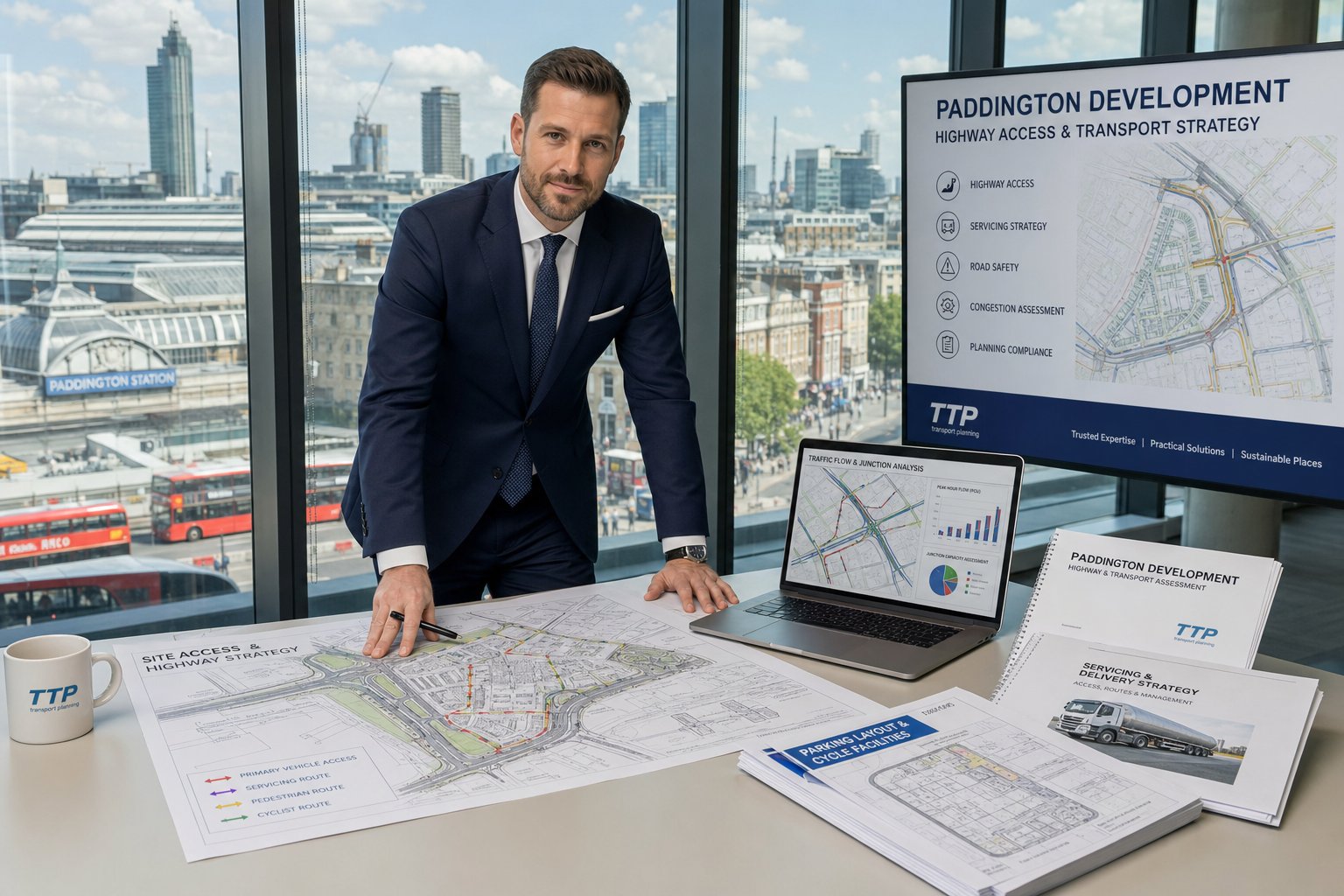
Paddington is one of those places where a seemingly modest planning change can have outsized transport consequences. A new servicing arrangement, a reworked basement car park, an amended access point or a higher-density scheme can quickly raise questions about congestion, safety, deliveries, pedestrian movement and highway capacity. In a dense inner-London setting, that is not a side issue: it is often central to whether an application moves smoothly through review or gets pulled into rounds of objections and revisions.
That is exactly where a traffic engineer in Paddington adds value. We help planning teams, architects, developers, surveyors, legal advisers and local authorities show that a proposal has been tested properly and can operate safely on the surrounding network. That means more than producing a report for the file. It means understanding local thresholds, reading the street context accurately, and presenting transport evidence in a way that aligns with decision-making.
In our experience, the strongest applications are usually the ones that deal with transport early, not after a concern is raised. When access, servicing, trip generation, parking demand and junction effects are addressed at the right stage, design teams have room to solve problems before they become planning risks. In this guide, we set out why traffic engineering matters in Paddington, when transport input is needed, what is typically assessed, and how the process works from first brief to submission.
Key Takeaways
- Hiring a traffic engineer in Paddington early ensures transport issues like access, servicing, and parking are addressed before becoming planning obstacles.
- Traffic engineering in Paddington requires tailored, site-specific analysis due to its dense urban context and complex transport demands.
- Effective traffic engineering reports focus on practical solutions for safe vehicle movement, realistic parking demand, and minimal impact on congested local streets.
- Transport assessments and statements must align with local authority expectations, balancing detailed analysis with proportionality to avoid delays.
- A skilled traffic engineer brings urban judgement, clear communication, and local planning awareness to streamline the planning approval process in Paddington.
- Robust transport input supports sustainable movement while managing intense servicing, delivery, and pedestrian activity unique to Paddington’s location.
Why Traffic Engineering Matters In Paddington
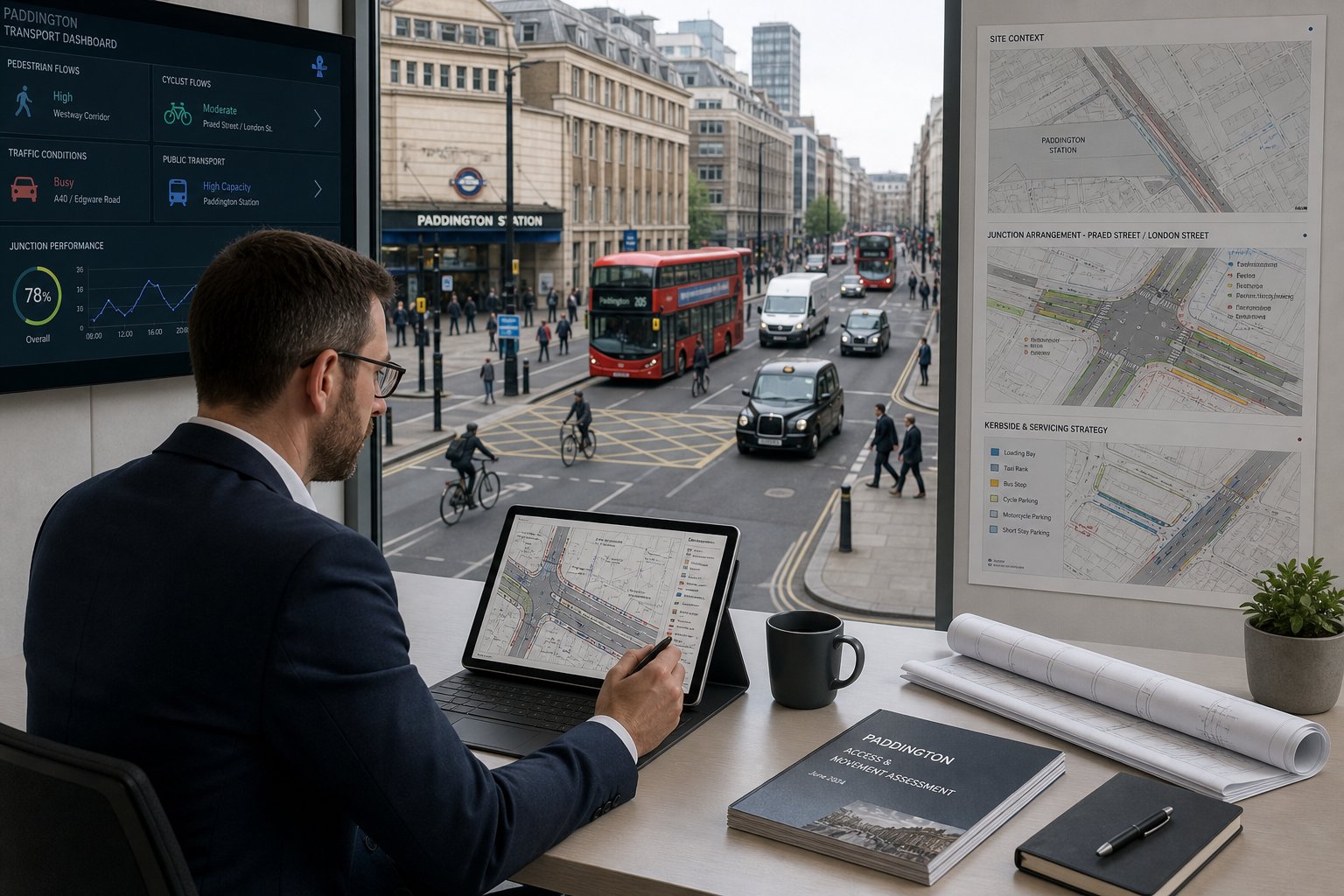
Paddington is not a location where generic transport advice tends to hold up for long. The area combines major rail infrastructure, busy strategic corridors, constrained side streets, high pedestrian activity, taxis, buses, servicing demand, cycle movement and continuous redevelopment pressure. That mix creates a planning environment in which transport evidence needs to be specific, proportionate and locally aware.
For applicants, the practical issue is straightforward: decision-makers want confidence that a development will function acceptably. They want to know whether vehicles can enter and leave safely, whether deliveries can be accommodated without causing conflict, whether parking demand has been handled realistically, and whether the proposal adds material pressure to already stressed streets and junctions. Those questions sit at the heart of traffic engineering.
We often find that good transport input does two things at once. First, it identifies genuine risks early. Second, it gives the wider project team workable options. That may involve adjusting an access geometry, reducing reliance on on-street activity, refining servicing hours, or evidencing why a transport statement is sufficient rather than a more extensive assessment. Broader Traffic Engineering: Your principles still apply, but in Paddington the margin for error is usually smaller.
How Paddington’s Urban Context Shapes Transport Planning
Paddington’s urban form drives the scope of transport work. Streets are often constrained by frontage activity, narrow kerbside space, existing loading demand and competing road-user needs. Even where a site looks straightforward on plan, the real-world operation can be more complicated once refuse collection, courier activity, hotel servicing, taxis, blue badge access and cycle routes are taken into account.
That is why transport planning here rarely focuses on private cars alone. We assess how people and vehicles actually use the street. A site near a major station, for example, may generate relatively low car ownership but intense pick-up, drop-off and delivery patterns. A commercial scheme might rely more on timed servicing than employee parking. Residential redevelopment may trigger detailed questions around disabled parking, cycle storage interface, and short-stay stopping behaviour.
Local review in Paddington also tends to be highly sensitive to cumulative impact. A development does not sit in isolation: it joins an already busy urban system. So we look carefully at nearby junctions, frontage activity, existing restrictions, pedestrian crossing desire lines and the likely interaction between proposed uses and the surrounding highway network. In dense locations, small operational changes can matter quite a lot.
When You Need A Traffic Engineer For A Planning Application
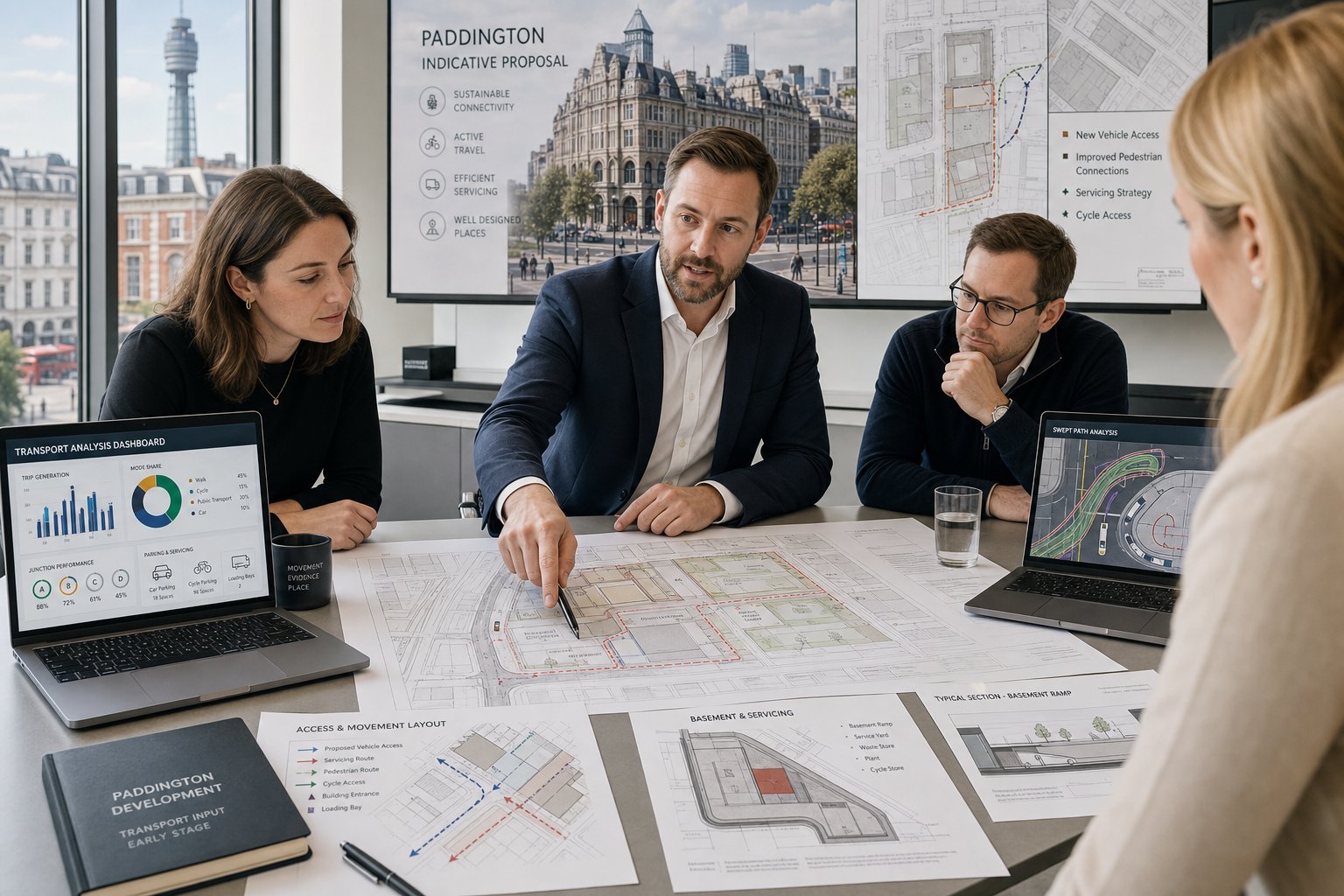
Not every planning application in Paddington requires a long transport report, but many schemes need some level of traffic engineering input far earlier than clients initially expect. If a proposal changes access, affects parking, alters servicing arrangements, increases trip activity or has any plausible road safety implication, transport evidence is usually sensible and often necessary.
In practice, we are commonly appointed when a local authority is likely to ask how the development will operate on the highway. That can apply to relatively large schemes, of course, but also to smaller urban projects where the site context is tight. A basement access ramp, a relocated crossover, new commercial floorspace, subdivision of units, or changes to loading arrangements can all trigger transport questions.
The timing matters. Bringing in a traffic engineer after drawings are fixed often limits the options. Bringing us in while layouts are still movable usually leads to better outcomes because access design, swept path requirements, servicing strategy and parking provision can be tested before they are embedded. For planning teams wanting wider context on appointment timing, Traffic Engineering Consultants: What a consultant contributes is often clearest at pre-application and design-development stage.
Typical Development Types That Require Transport Input
In Paddington, transport input is regularly needed for:
- residential new-build and redevelopment schemes
- mixed-use and commercial projects
- hotels and serviced accommodation
- healthcare, education and community uses
- parking layout changes and basement car parks
- proposals involving new or altered vehicle access
- schemes that change servicing, deliveries or refuse collection
- developments that may affect nearby junctions or road safety conditions
Commercial and mixed-use projects deserve a special mention because operational patterns can be harder to predict than headline floor area suggests. A modest ground-floor use may create frequent courier visits: an office scheme may rely heavily on cycle access and passenger pick-up activity: a hotel can generate round-the-clock servicing pressures. That is where a careful, evidence-led approach is essential. For teams dealing with business-led schemes, Commercial Traffic Engineering issues often overlap directly with planning strategy, access design and occupier requirements.
Core Traffic Engineering Services For Paddington Projects

Traffic engineering support in Paddington is rarely just one report. More often, it is a package of analysis and advice shaped around the scheme, the planning route and the local highway context. The exact scope varies, but common services include traffic impact analysis, parking demand review, access and servicing design input, junction appraisal, road safety review, swept path analysis and support during planning queries.
We also help teams judge proportionality. Some schemes need a concise transport statement: others require a full transport assessment with detailed trip generation and operational analysis. In between those two sits a lot of professional judgement. The objective is not to over-produce technical material for the sake of it. It is to provide the level of evidence that matches the proposal and answers foreseeable concerns.
For applicants working across multiple boroughs or comparing urban authority expectations, a broader Traffic Engineer In London: planning context can be helpful, but Paddington still needs site-by-site reading. A single street can have very different operational issues from the next one over.
Transport Statements, Transport Assessments, And Travel Plans
These are the core planning documents most teams will encounter.
A Transport Statement is typically used where the transport impact is expected to be limited but still needs explanation. It usually covers the site context, access arrangements, existing transport conditions, parking and servicing, and a reasoned view of likely effects.
A Transport Assessment goes further. It is used when a proposal may generate more significant movement or where the highway and transport implications require detailed analysis. That can include trip generation, distribution, junction review, collision data, parking demand, servicing strategy and mitigation.
A Travel Plan sets out measures to encourage sustainable travel. In Paddington, this may include public transport information, cycling facilities, delivery management measures, car club provision, welcome packs, monitoring commitments and sometimes staff or occupier targets.
The right document depends on local thresholds, scale, use class and context. We tailor reports to avoid the two classic mistakes: under-scoping the work so objections arise later, or over-scoping it so the planning process becomes slower and more expensive than necessary.
Highway Access, Servicing, And Road Safety Reviews
Access is often where transport issues become most tangible. A drawing may show a neat vehicle entrance, but the key question is whether it actually works with street geometry, visibility, pedestrian movement, kerbside controls and expected vehicle types. In Paddington, even a viable access point can become problematic if it conflicts with loading activity, buses, cycling flows or narrow footway conditions.
Servicing is equally important. Many planning delays happen because deliveries and refuse collection were treated as an afterthought. We assess what vehicles will come to the site, how often, where they will stop, whether turning is possible, whether on-site servicing is achievable, and what restrictions or management measures may be needed.
Road safety review then ties the picture together. We consider user conflict points, visibility, manoeuvring risk, pedestrian exposure, cycle interaction and any available collision context. Parking-related evidence can also be crucial in dense areas, especially where overspill or operational misuse is a concern, and a robust parking strategy traffic approach often strengthens the overall planning case.
Local Planning And Highway Considerations In Paddington
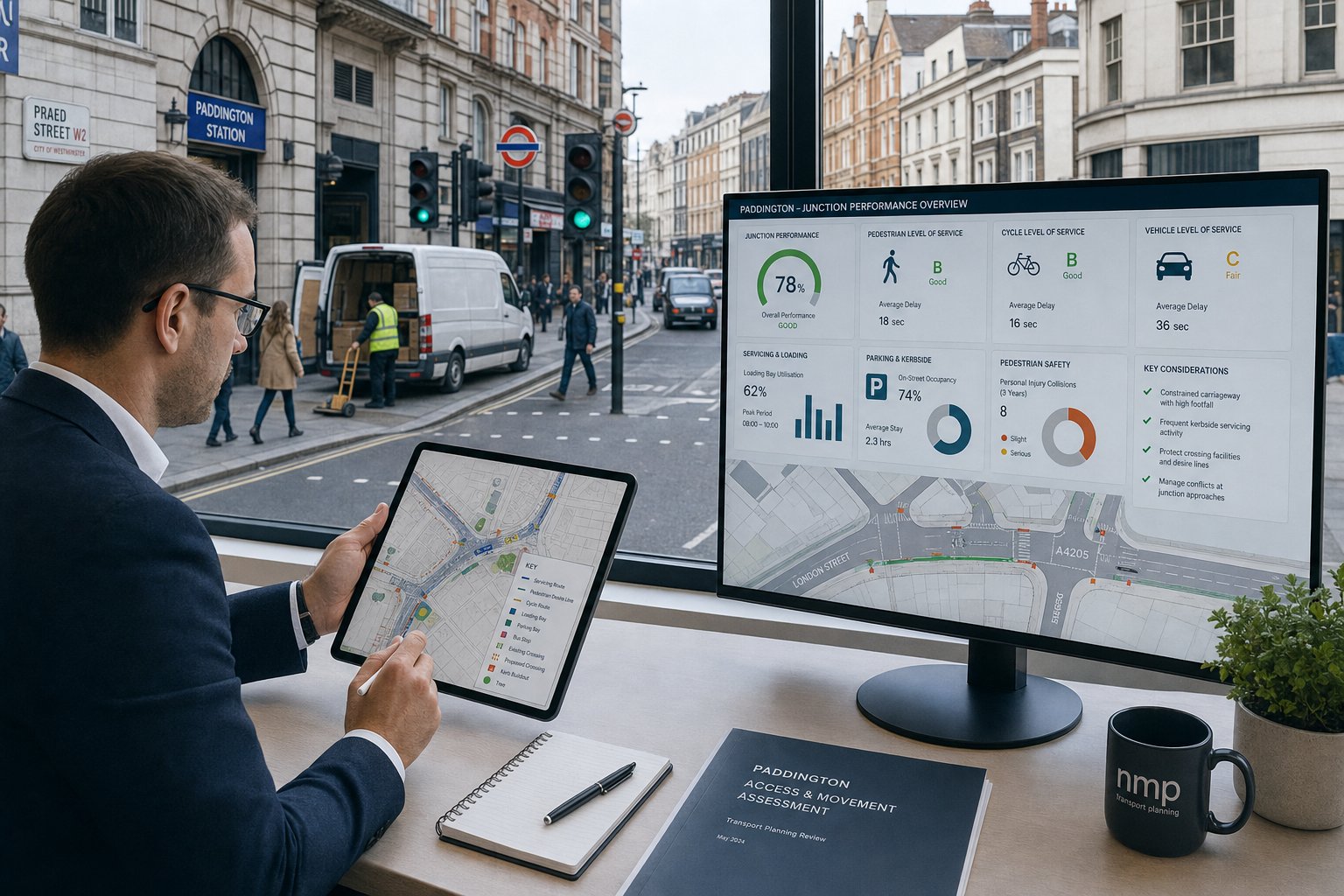
Paddington applications sit within a local review environment that is typically focused on whether development can be accommodated without unacceptable effects on safety, operation and amenity. In practical terms, that means transport evidence needs to engage with congestion, constrained road space, servicing feasibility, parking pressure, pedestrian conditions and junction performance in a realistic way.
One of the recurring issues in Paddington is that highway acceptability is rarely just about capacity in the narrow modelling sense. A junction may perform within an acceptable range and still attract concern if the proposal creates awkward delivery behaviour, footway obstruction, reversing risk or repeated kerbside conflict. That is why we do not treat transport planning as a box-ticking exercise. The planning answer has to reflect how the site will actually run day to day.
Another local consideration is policy alignment. Decision-makers will expect transport documents to support sustainable movement and minimise unnecessary vehicle impact, especially in a well-connected urban area. But “well-connected” does not automatically mean “problem-free”. Station proximity can reduce car dependency while increasing pick-up, drop-off and servicing intensity. Dense streets can absorb some activity and fail on a very specific pinch point.
We hence frame our reports around what the authority is likely to test: Is access feasible? Is servicing credible? Is parking provision justified? Are vulnerable road users protected? Is there a realistic understanding of local street conditions? Good local transport work answers those questions before they become objections.
What A Traffic Engineer Will Assess On Your Site
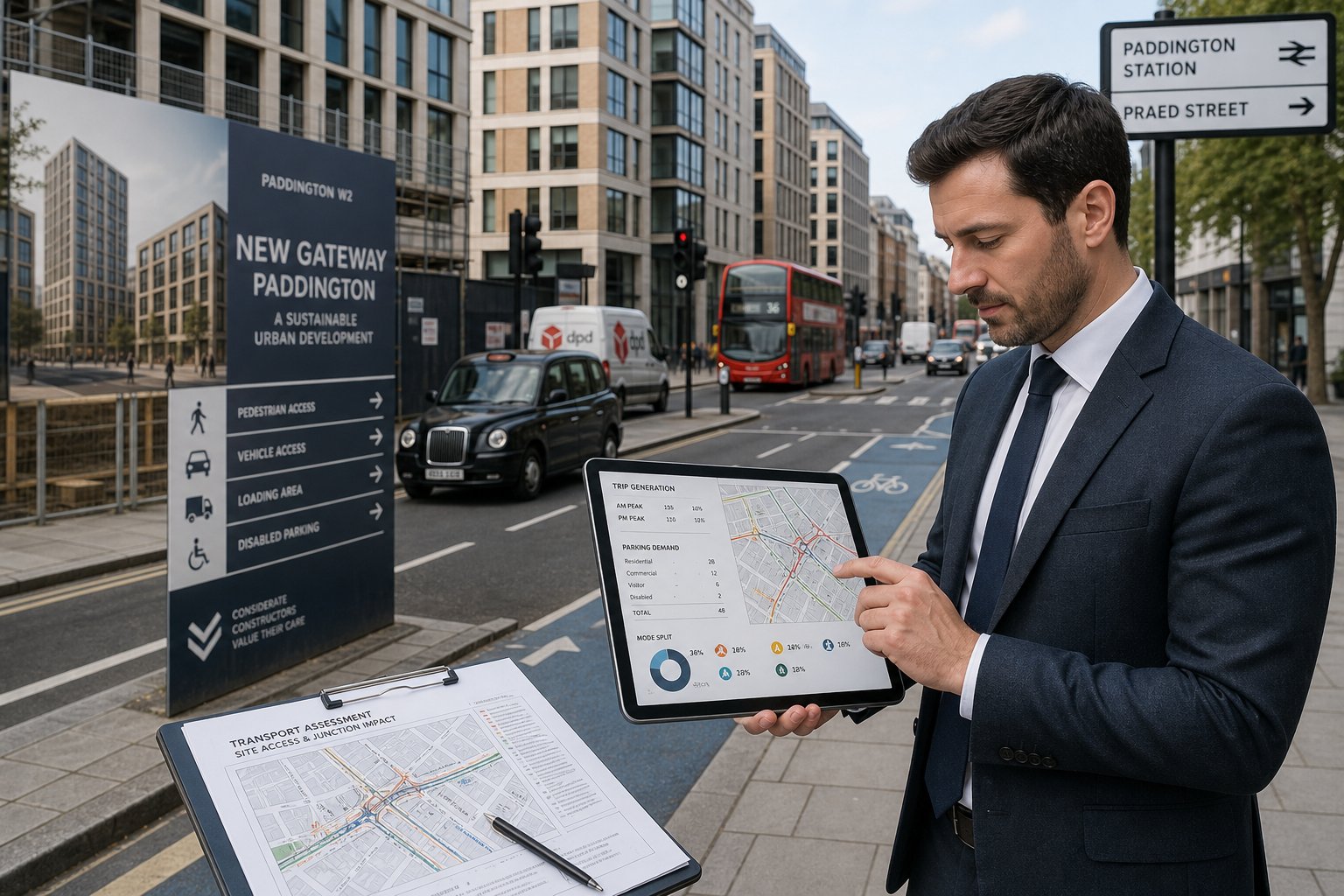
A traffic engineer’s site assessment is part technical analysis, part practical reality check. The aim is to understand not just how many trips a development may generate, but how those trips translate into movement, stopping, access and interaction on the surrounding network. In Paddington, that broader operational view is essential.
We usually start with the basics: site location, surrounding road hierarchy, existing access points, nearby junctions, parking controls, servicing conditions, pedestrian environment, cycle movement and public transport accessibility. Then we examine the proposal itself. What uses are proposed? What activity patterns are likely across the day? Which vehicles need access? What cannot happen on-street without creating problems?
The answer often sits in the detail. A scheme may be acceptable in transport terms overall but need one layout amendment to avoid delivery conflict. A low-car proposal may still require a strong plan for drop-offs, taxis or disabled access. A compact site might work well only if servicing is timed, managed and restricted to certain vehicle types.
For multidisciplinary teams, this stage is where transport evidence becomes most useful. It helps architects refine layouts, planners anticipate authority questions, and legal or development teams understand where operational obligations may later appear in conditions or agreements.
Trip Generation, Parking, Delivery Activity, And Junction Impact
These are four of the most common assessment areas.
Trip generation considers how many movements a proposal is likely to create and when. We use recognised data sources, local context and professional judgement to estimate vehicle, cycle, pedestrian and sometimes servicing trips. In Paddington, the emphasis is often on realistic mode share and urban behaviour rather than suburban assumptions.
Parking is not just about counting spaces. We assess likely demand, user type, disabled provision, cycle parking interface, short-stay activity and the potential for overspill or misuse. Where relevant, comparisons with urban casework in places such as Traffic Engineer In Manchester: or Traffic Engineer In Leeds: show how local thresholds differ, but Paddington remains highly context-specific.
Delivery activity often decides whether a scheme feels operationally credible. We review vehicle sizes, frequency, dwell times, loading locations, refuse collection and courier behaviour.
Junction impact addresses whether added trips materially affect surrounding nodes or access points. Sometimes that requires detailed analysis: sometimes a clear, evidence-led proportionality case is enough. The right level depends on the proposal, not just the template.
How The Traffic Engineering Process Works From Brief To Submission
A well-run traffic engineering process is structured, but it should not feel cumbersome. The typical workflow begins with a brief covering the proposed development, planning stage, likely submission route, key dates and any known authority concerns. At that point, we usually identify the probable scope of work: whether the scheme needs a short note, a transport statement, a transport assessment, access review, servicing strategy, travel plan, or a combination.
Next comes data gathering. That may include site visits, review of drawings, local street observations, parking and servicing conditions, collision data, policy review and any available traffic counts or transport accessibility information. For urban projects, the site visit matters more than many people assume. Kerbside behaviour, frontage activity and pedestrian patterns often tell us as much as a drawing set.
Analysis follows. We assess access, likely trip generation, parking demand, delivery requirements, road safety considerations and, where relevant, junction effects. If the evidence indicates a design issue, we feed that back early so the project team can amend the scheme before the report is finalised.
Report preparation then turns the analysis into a planning-ready document. The best reports are concise, clear and directly tied to the application. We aim to explain the transport effects in plain, defensible terms rather than burying the point under unnecessary technical wording.
Finally, the transport material is submitted as part of the application and may be followed by clarification notes, responses to comments or minor revisions. With more than 30 years of experience behind our work, we know that speed matters, but accuracy matters more. Quick turnaround only helps if the authority can rely on the evidence.
Choosing The Right Traffic Engineer In Paddington
Choosing the right consultant is not just about whether they can produce a report. It is about whether they understand the planning function of that report and the local street reality behind it. In Paddington, you want a traffic engineer who can work comfortably with dense urban constraints, explain proportionality clearly, and spot the issue that might derail an otherwise strong application.
We would usually suggest looking for five things.
First, relevant planning experience. The consultant should routinely prepare transport statements, assessments, travel plans and access reviews for live applications, not just highway design work in isolation.
Second, urban judgement. Paddington sites often involve kerbside pressure, servicing sensitivity and limited room for design error. Experience in inner-city contexts makes a real difference.
Third, clear reporting. A technically sound report still needs to be readable by planners, clients and sometimes legal teams. Dense jargon rarely helps.
Fourth, practical responsiveness. Planning programmes move quickly. You need advice early enough to influence the design, and you need comments turned around when new authority questions land.
Fifth, local-authority awareness. Every authority has its own thresholds, expectations and recurring concerns. A consultant who understands that landscape can often scope work more efficiently from the start.
That is the approach we bring to projects at ML Traffic: concise, accurate transport evidence delivered quickly and tailored to the planning context rather than recycled from a standard template. In a place like Paddington, that tailored approach is usually what separates a useful report from a merely completed one.
Conclusion
Paddington is a demanding place to secure planning permission if transport issues are left vague. Access, deliveries, parking, trip generation and safety all need to be addressed in a way that reflects the real street environment, not just the red line boundary. That is why the role of a traffic engineer in Paddington is so often central to a robust application.
When transport input is brought in early, project teams have more room to solve problems intelligently, present evidence clearly and reduce avoidable planning friction. For architects, planners, developers, surveyors, lawyers and councils, the value is not simply the report itself. It is the confidence that the proposal has been tested properly and can operate credibly within a dense urban network.
In 2026, with development pressure still high and highway scrutiny unlikely to ease, well-judged transport support remains one of the most practical ways to strengthen an application before it reaches decision stage.
Frequently Asked Questions About Traffic Engineering in Paddington
Why is traffic engineering important for developments in Paddington?
Traffic engineering is vital in Paddington due to its dense urban setting and complex transport demands. It ensures that developments manage access, parking, servicing, and safety effectively, helping applications navigate planning reviews smoothly within the busy local network.
When should I involve a traffic engineer in my Paddington planning application?
A traffic engineer should be involved early, especially if the proposal affects access points, parking, servicing, trip generation, or road safety. Early input allows for effective problem-solving and alignment with local authorities’ requirements, often improving planning outcomes.
What types of developments in Paddington require traffic engineering input?
Typical schemes needing traffic engineering support include residential builds, commercial and mixed-use projects, hotels, healthcare and community facilities, parking changes, new or altered vehicle access, and proposals impacting servicing or nearby junctions.
How do traffic engineers assess the impact of a development on Paddington’s streets?
They analyse trip generation, parking demand, delivery activity, junction performance, and road safety. This includes site visits and detailed evaluations of vehicle movement, pedestrian interaction, curbside activity, and compliance with local transport policies.
What planning documents do traffic engineers prepare for Paddington projects?
Traffic engineers produce Transport Statements for limited impact projects, Transport Assessments for significant transport effects, and Travel Plans promoting sustainable travel. These documents address site access, parking, servicing, and mitigate transport-related concerns in applications.
How does Paddington’s urban context influence traffic engineering solutions?
Paddington’s constrained streets, high pedestrian traffic, and mixed transport modes demand tailored solutions. Traffic engineers must address kerbside pressures, servicing conflicts, cycle routes, and safety to develop practical, proportionate evidence reflecting local conditions.