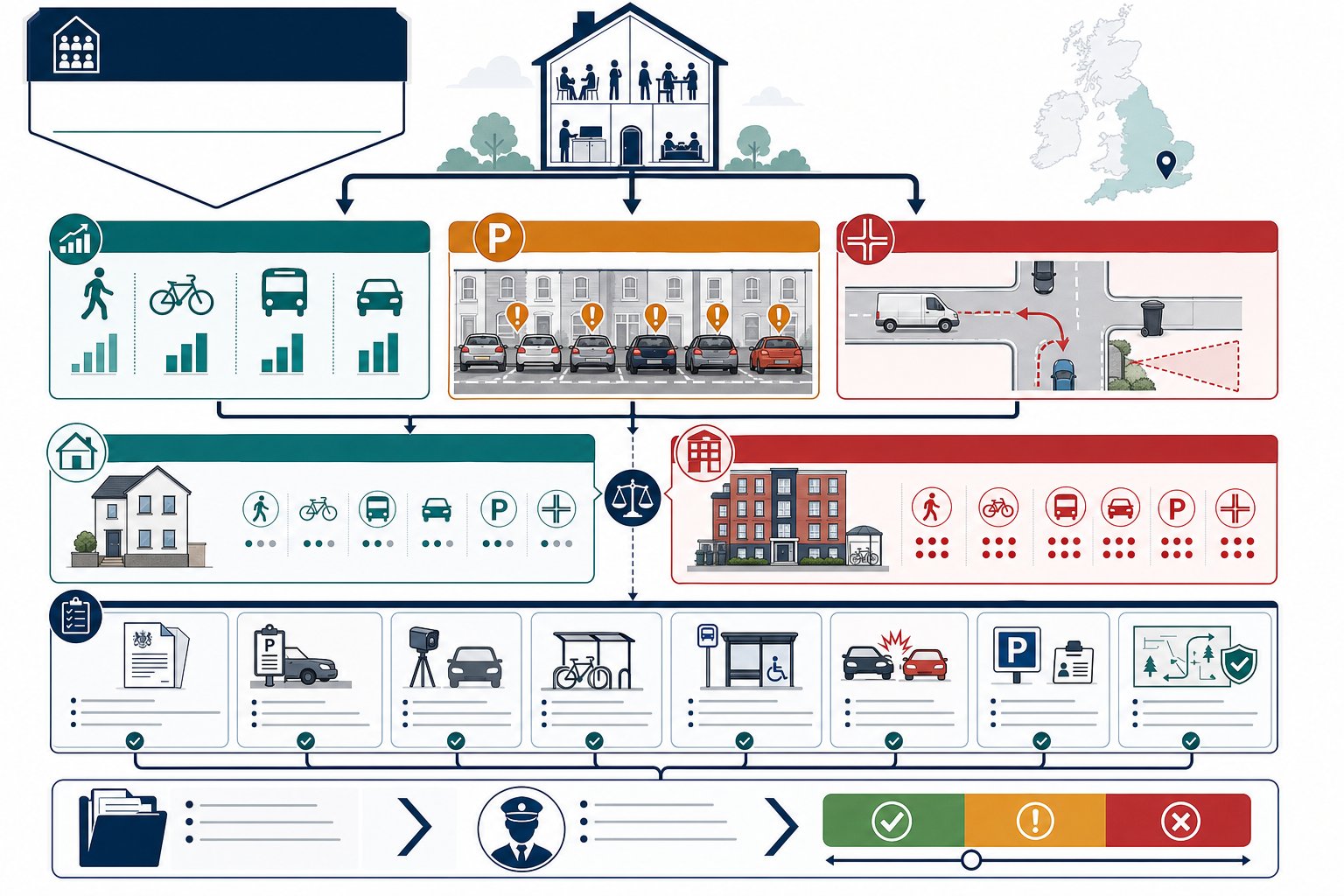
A House in Multiple Occupation Transport Assessment sounds niche until a planning application stalls on parking stress, neighbour objections, or a terse highways response. Then it becomes central very quickly.
In 2026, HMOs sit right at the overlap between housing need, local amenity, and transport evidence. That overlap matters because many HMO schemes look modest on paper, a change of use, a loft conversion, a few additional bedrooms, yet can alter how people travel, where cars are parked, how deliveries happen, and whether a street or junction can cope. For planning teams, the risk is rarely the headline principle of HMO use alone. It’s the credibility of the supporting evidence.
We see this regularly across urban and suburban schemes: an applicant assumes a former family house will generate fewer car trips than expected, or that a sustainable location automatically neutralises parking concerns. Local planning authorities and highway officers often take a more forensic view. They want local data, policy alignment, realistic assumptions, and a clear explanation of impact.
This article sets out what planning, design and development teams need to know about preparing a robust House in Multiple Occupation Transport Assessment in the UK. We cover when it is likely to be required, how small and large HMOs differ in transport terms, what evidence should sit behind the report, and the mistakes that most often weaken an otherwise sound application.
Key Takeaways
- A House in Multiple Occupation Transport Assessment is crucial for planning applications to demonstrate how the proposal impacts movement, parking, and highway safety.
- Transport evidence requirements vary by local context, with larger HMOs and complex sites often needing detailed parking surveys and transport statements.
- Accurate trip generation and parking demand assessments must reflect local conditions, resident profiles, and not rely solely on generic urban assumptions.
- Common challenges include parking displacement, highway safety concerns, and cumulative impacts from multiple HMOs in the area.
- Early engagement with local authorities and alignment with local policies and standards improve the credibility and acceptance of the transport assessment.
- A clear, data-backed transport strategy including realistic mitigation measures strengthens HMO planning applications and reduces objections.
What A House In Multiple Occupation Transport Assessment Is
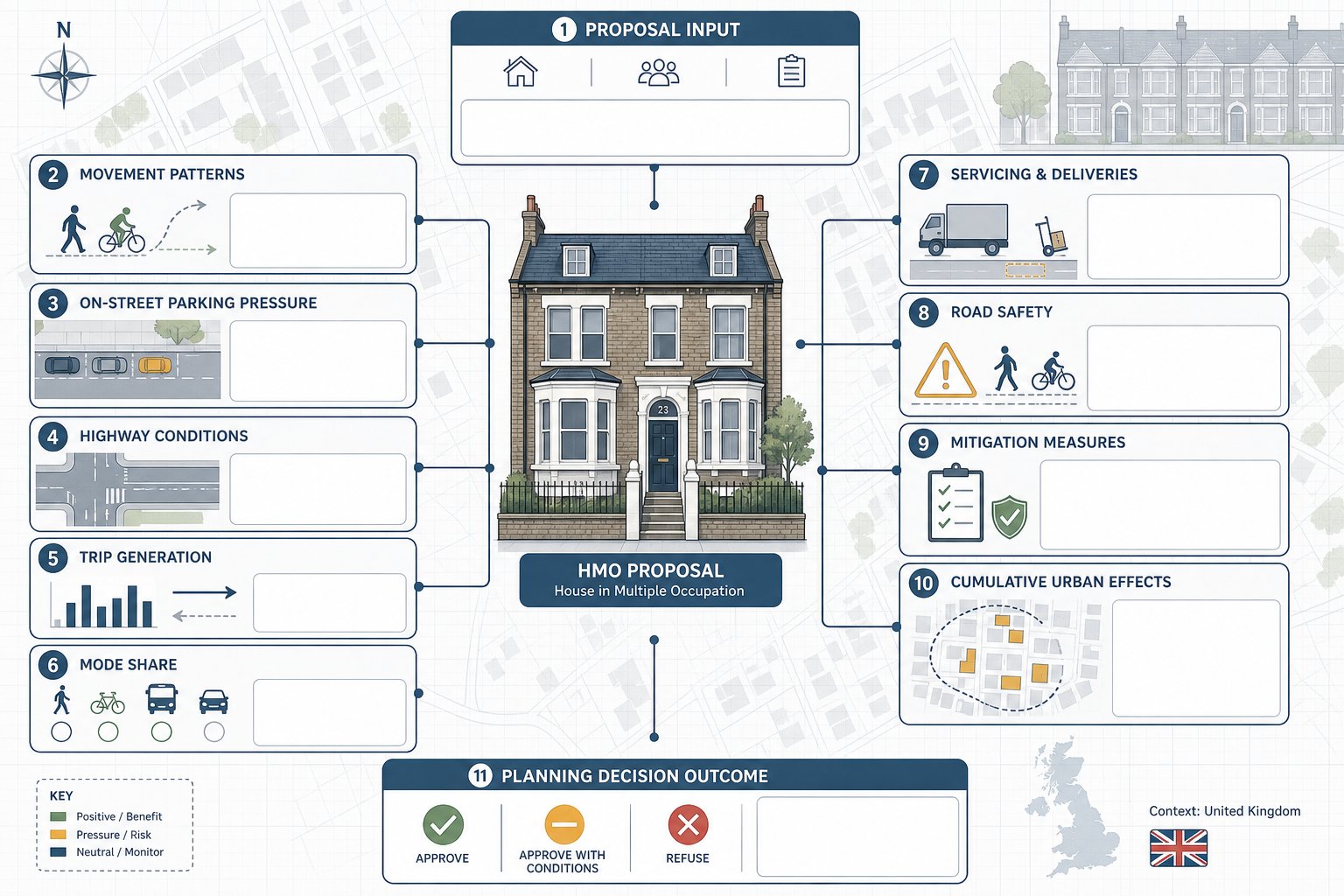
A House in Multiple Occupation Transport Assessment is a transport evidence document prepared to support an HMO planning application. Depending on scale and local sensitivity, it may take the form of a concise Transport Statement or a fuller Transport Assessment. Either way, its job is the same: to test whether the proposal creates acceptable movement, parking and highway effects, and to show that any impacts have been understood properly.
For HMOs, this usually means going beyond generic residential assumptions. Occupancy patterns can differ from a standard family dwelling. Residents may have different work schedules, more independent travel habits, a wider spread of destinations, and varying levels of car ownership. In some places that reduces peak-hour pressure. In others, especially where on-street parking is already tight, it can do the opposite.
A good HMO transport assessment hence covers the proposal, local policy context, baseline highway and transport conditions, likely trip generation, mode share, parking demand, servicing, road safety, and any mitigation needed. If the site sits in a constrained urban area, the assessment may also need to look at cumulative effects from nearby HMOs or broader land-use changes.
In practice, we treat it as a decision-making document, not a box-ticking exercise. Planning officers and highway officers use it to judge whether the scheme is acceptable, what conditions may be required, and whether the applicant’s assumptions can be trusted.
When An HMO Transport Assessment Is Required For Planning
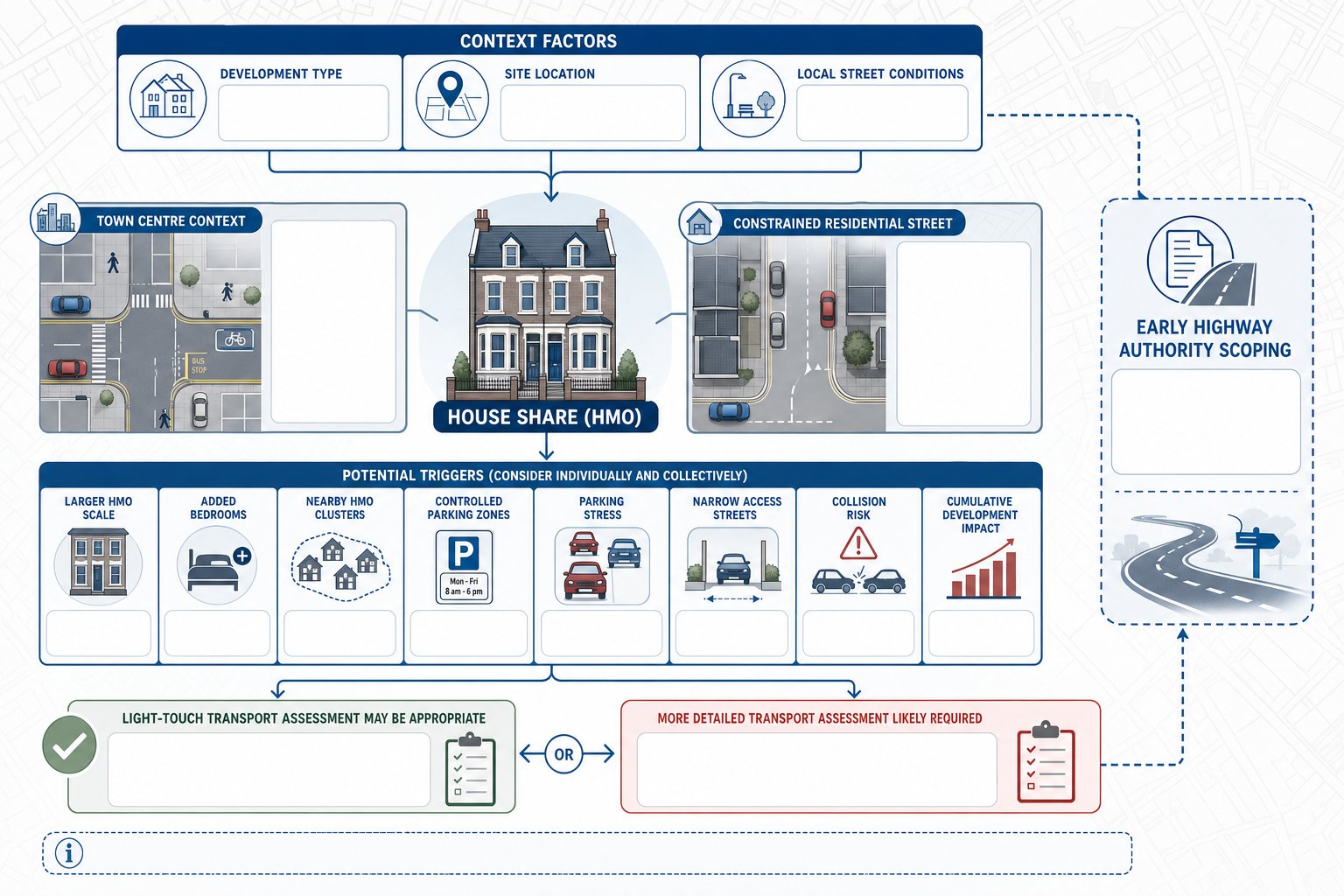
There is no universal national threshold that says every HMO must submit a transport assessment. The starting point remains the National Planning Policy Framework and Planning Practice Guidance: transport evidence is needed where a development is likely to generate significant amounts of movement, taking account of the type of development, its location and local context.
That means requirement is often driven by circumstance rather than labels. A small C4 HMO in a highly accessible town-centre location may only need a short note, particularly where parking controls are effective and local policy is supportive. But a similar proposal on a heavily parked residential street, close to a sensitive junction, may need detailed parking surveys and a more formal statement.
The likelihood increases where proposals involve:
- larger sui generis HMOs:
- intensification through extra bedrooms:
- clusters of HMOs within the surrounding area:
- locations inside or adjacent to controlled parking zones:
- known local parking stress:
- constrained access arrangements or narrow streets:
- roads with recorded personal injury collisions: or
- cumulative development impacts.
Where a scheme is more complex, early scoping with the highway authority is worth doing. That avoids the familiar planning problem: a submission that is technically complete but evidentially thin. For wider context, the same principle appears across transport assessment for other development types too, local circumstances shape the level of analysis required more than a single national rule.
How HMO Proposals Affect Trip Generation, Parking, And Highway Impact
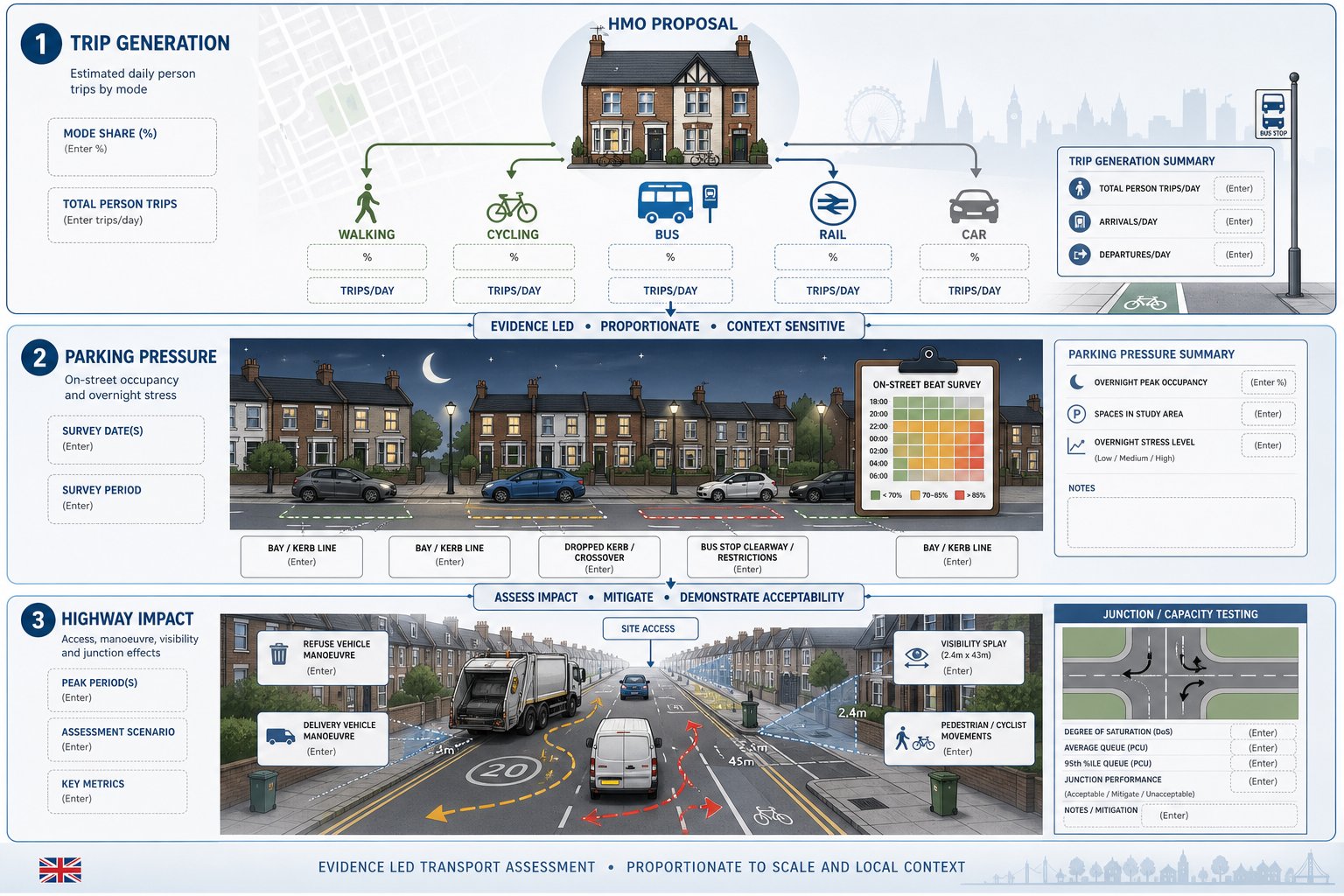
The transport effects of an HMO proposal normally fall into three linked questions: how many trips it generates, where vehicles are parked, and whether the surrounding highway network can accommodate the change safely.
Trip generation should be assessed across modes, not just by counting cars. Residents may walk to local services, cycle, use buses or rail, and travel at different times of day. That said, planning teams should be careful not to assume low car use simply because the site is in an urban area. Occupier profile, rent levels, availability of permits, and local employment geography can all influence car ownership materially.
Parking is often the flashpoint. Even where net traffic increase is modest, displaced overnight parking can drive objections and refusal risk. That is why on-street parking beat surveys are so important in HMO cases. They reveal whether spare capacity actually exists when residents return home, which is often the point of greatest stress.
Highway impact is not always dramatic, but it still needs to be examined. Access manoeuvres, refuse collection, delivery activity, visibility, and turning movements on narrow roads can all become relevant. If the proposal sits near a constrained junction, queueing or capacity testing may be necessary. In some cases, software-based junction review using tools such as Junctions 11 Software helps demonstrate whether localised impact is negligible or needs mitigation.
The key is proportionality backed by evidence, not guesswork.
Key Differences Between Small HMOs And Large HMOs In Transport Terms
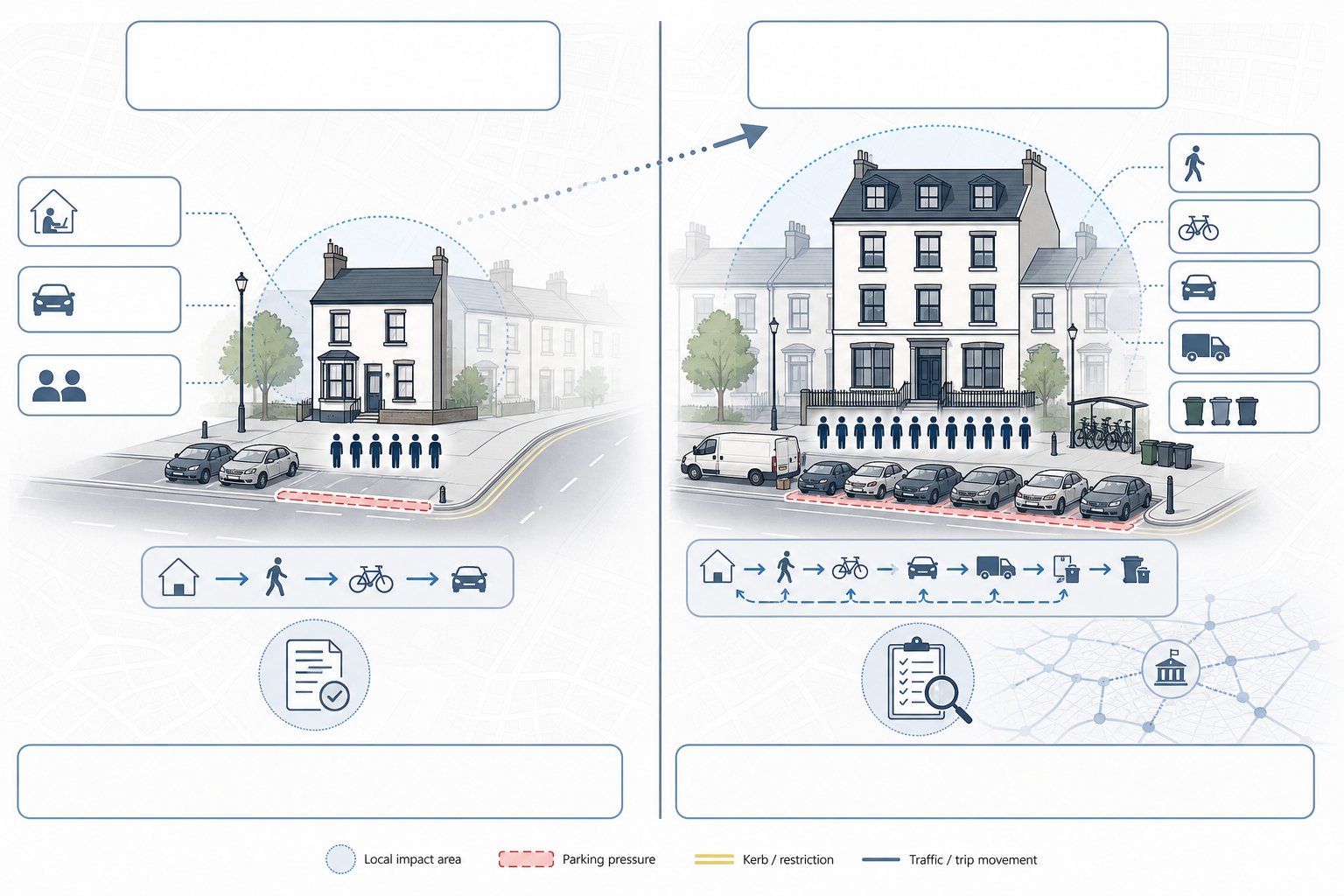
In planning terms, the transport distinction between a small HMO and a large HMO is more than administrative. It affects likely occupancy, travel patterns, report scope, and the level of scrutiny from councils and highway officers.
A small HMO, typically within Use Class C4, may house up to six unrelated residents. In many authorities, these schemes are assessed broadly as residential changes of use unless local parking stress, an Article 4 Direction, or cumulative HMO concentration pushes transport issues higher up the agenda. Often, a concise Transport Statement or technical note is enough if assumptions are well evidenced.
A large HMO, generally sui generis, usually attracts closer attention because occupancy is higher and operational characteristics are less like a standard dwelling. More residents can mean more person trips, more deliveries, more servicing demand, and greater pressure on cycle storage, bin presentation and on-street parking. The scheme may also begin to interact with network capacity and local character in a more noticeable way.
We often explain the distinction to clients like this: with a small HMO, the main battle is usually local parking and neighbour concern: with a large HMO, the authority may test the wider transport consequences as well. On bigger schemes, the evidential approach often starts to resemble that used in a Residential Development Transport submission, albeit tailored to HMO occupancy and management patterns rather than general market housing.
Typical Planning Scenarios That Trigger Transport Evidence
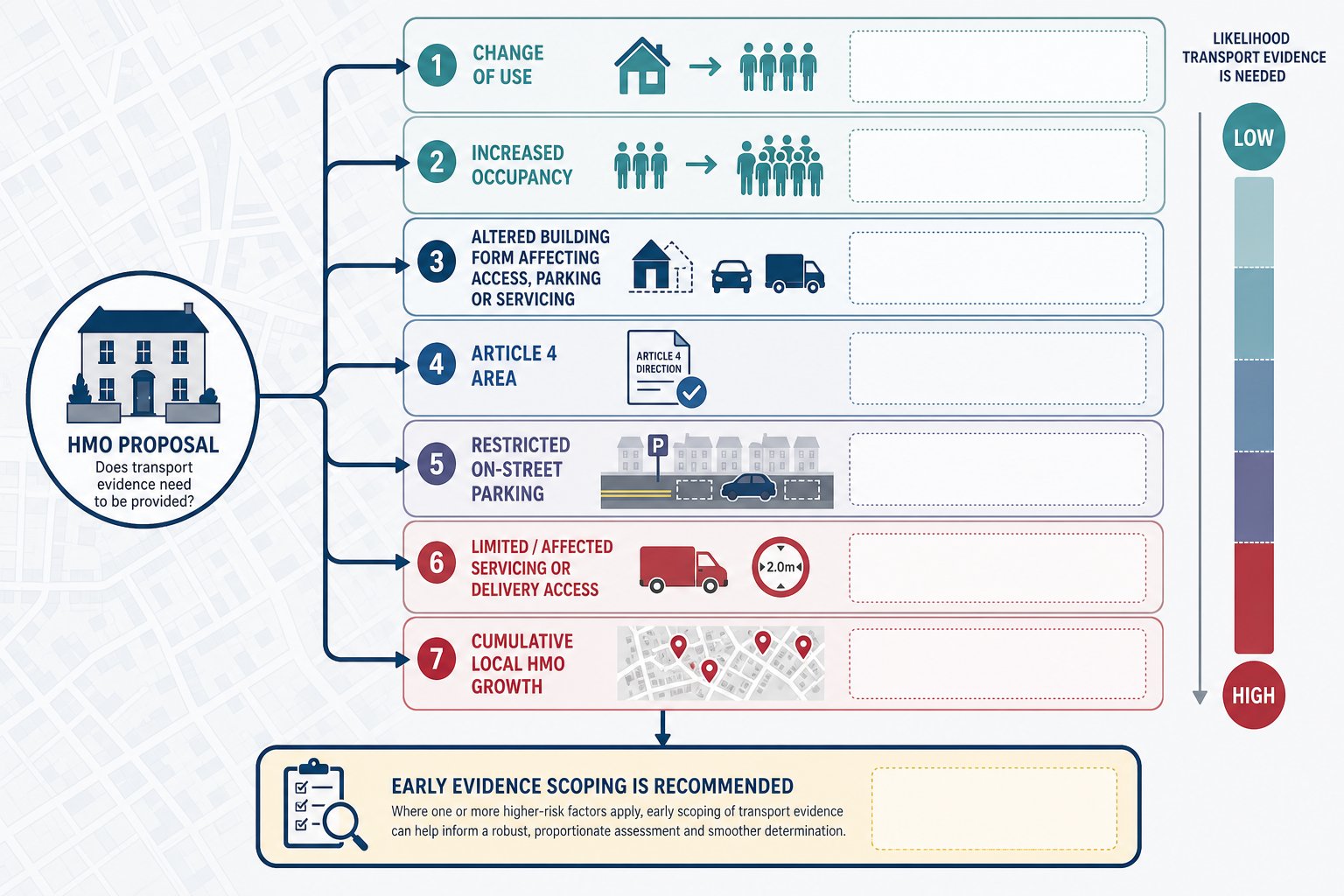
Some HMO applications attract little transport debate. Others almost invite it. The difference usually lies in the planning scenario, the existing street conditions, and whether the proposal changes intensity in a meaningful way.
In practice, transport evidence is most commonly triggered where use changes, occupancy rises, or the physical form of development alters how access, parking and servicing work. Councils also look harder at proposals in areas with Article 4 controls, restricted parking supply, or a known pattern of cumulative HMO growth.
That does not mean every scheme needs a lengthy report. But it does mean applicants should judge the planning risk early and scope the evidence accordingly. If a proposal could plausibly alter trip-making or parking demand, a written explanation backed by local data is usually worth having from the outset.
Change Of Use From Family Home To HMO
This is the classic trigger. A change from a C3 family dwelling to a C4 or sui generis HMO may appear straightforward, but transport effects can shift in ways that matter locally.
A family house often has a relatively predictable travel pattern. An HMO can produce more individual journeys, a different peak profile, and a less consistent relationship between occupancy and car ownership. In some university or city-centre markets, car ownership may be low. In commuter suburbs or lower-density edge locations, it may not be low at all. That is why generic assumptions are risky.
For change-of-use cases, councils commonly focus on whether parking demand will exceed available capacity and spill onto surrounding roads. If the street already experiences overnight stress, the application may need robust beat surveys, permit eligibility analysis, and a realistic account of resident car ownership. Access and servicing also matter where the property sits on a narrow street, near a bend, or close to a school entrance or busy junction.
Where HMOs are already concentrated nearby, cumulative impact should not be ignored. Individually modest changes can become collectively material, and officers know it.
New-Build, Intensification, And Extensions
New-build HMOs, upward extensions, rear additions and bedroom intensification proposals often generate more transport scrutiny than simple changes of use because they make the uplift in occupancy more explicit.
If additional floorspace creates extra bedrooms, the planning team should test not only trip generation but also whether the site layout still works. Can cycles be stored securely and conveniently? Is refuse collection practical? Can delivery drivers stop safely? Does any off-street parking arrangement operate without awkward reversing or blocked footways?
For larger schemes, the transport work may overlap with broader site-planning issues such as internal circulation, servicing, frontage treatment and pedestrian access. On mixed or denser urban sites, HMO proposals can start to raise the same questions seen in mixed use masterplan work: how movement, access and parking fit together rather than being considered in isolation.
Extensions can be deceptively sensitive. Adding two bedrooms to a constrained terraced property may have a bigger practical parking effect than building a larger HMO next to a controlled parking zone with strong public transport. Context decides everything.
What A Robust HMO Transport Assessment Should Include
A robust HMO transport assessment should read like a clear chain of evidence. It needs to show what is proposed, what the surrounding conditions are, what change is likely to occur, and why that change is acceptable, or how it will be mitigated.
At a minimum, we would expect the report to include:
- a description of the proposal, site and surrounding transport context:
- review of national policy, local plan policy, parking standards and any supplementary guidance:
- baseline conditions for walking, cycling, public transport, highway access and local parking:
- surveys appropriate to the site, often including parking beat surveys and traffic counts where relevant:
- trip generation and mode split assessment, with justification for data selection and any TRICS filtering:
- parking supply and demand analysis, including permit controls where relevant:
- servicing, refuse collection and delivery arrangements:
- road safety review, including personal injury collision data where appropriate:
- junction or network assessment if local capacity concerns exist:
- mitigation and travel plan measures: and
- construction traffic considerations if building works are material.
What matters most is not volume but fit. A short report with well-chosen local evidence will often perform better than a long generic document. Where proposals sit within more sensitive planning environments, transport evidence may also need to align with wider environmental material, particularly where cumulative effects overlap with environmental impact assessment themes such as noise, air quality or townscape pressure.
Surveys, Data Sources, And Local Policy Benchmarks
Good HMO transport reports are usually won or lost on data quality. If the survey work is weak, every later conclusion looks shaky.
Parking beat surveys are often the most valuable evidence source because they test actual overnight and early morning kerbside stress. One survey at the wrong time is rarely enough. Depending on local conditions, it may be sensible to capture weekday and weekend patterns, controlled parking hours, and nearby streets likely to absorb displacement.
Trip generation should typically use TRICS or comparable evidence, but selection matters. Filtering should reflect urban form, accessibility, occupancy characteristics and housing type as closely as possible. A broad residential comparator set may be convenient, but it can mislead. Census journey-to-work data, NTEM and local trip-end information can help sense-check assumptions, particularly around mode share.
Other useful evidence includes traffic counts, speed surveys, queue observations, cycle parking audits, bus frequency data, and collision records. For some sites, permit parking eligibility and local restrictions are just as important as raw parking capacity.
And then there is policy. Local parking standards, design guides, HMO supplementary planning documents, Article 4 evidence and highway authority notes can all be decisive. The report must align with them directly rather than treating them as footnotes. Too many submissions fail not because the transport effect is severe, but because the evidence ignores the authority’s own benchmark framework.
Common Issues Raised By Local Planning Authorities And Highway Officers
Highway and planning officers tend to raise the same cluster of concerns on HMO schemes, especially where neighbourhood sensitivity is high.
The first is displacement parking. Officers want to know whether residents, visitors and short-stay service vehicles will occupy already scarce kerbside space. If the report relies on a blanket claim of low car ownership without local proof, that usually gets challenged.
The second is highway safety. Narrow carriageways, substandard visibility, refuse collection conflicts, and awkward manoeuvring can all trigger objections. Even low trip growth will not rescue a proposal if access arrangements feel unsafe in daily operation.
Third comes cumulative impact. A single HMO may be acceptable, but councils increasingly ask whether another one adds pressure to an area already saturated with similar uses. This is particularly common where Article 4 Directions exist or where communities have raised repeat complaints about parking and turnover.
Officers also look for realism. They notice when TRICS sites are poorly matched, when walking distances to bus stops are presented too optimistically, or when cycle storage is shown on a drawing but not actually practical to use. On larger or more contentious schemes, they may also ask whether the methodology mirrors the standards expected in a broader House in Multiple Occupation Transport Assessment approach across comparable residential submissions.
In short: if something looks convenient rather than evidenced, expect a question on it.
How To Strengthen An HMO Application With A Clear Transport Strategy
The strongest HMO applications do not treat transport as a defensive appendix. They use it to explain clearly why the scheme works in its location.
The first step is early scoping. Agree, as far as possible, whether the authority expects a Transport Statement, a fuller assessment, parking surveys, or junction work. That simple conversation can save weeks later.
Next, build the evidence around local reality. If car ownership is likely to be low, prove it with area data, permit controls, accessibility metrics and comparable occupation patterns. If parking stress exists, address it honestly rather than minimising it. Authorities are more receptive to a balanced report than to one that overclaims.
Mitigation should also feel practical. Depending on the site, that may include:
- secure, covered and genuinely accessible cycle parking:
- resident travel information packs:
- car-club membership or sustainable travel incentives:
- restrictions on parking permits where legally and operationally possible:
- waiting restrictions or management measures, if justified:
- clear refuse and delivery arrangements: and
- a proportionate travel plan.
Presentation matters too. Plans should match text, assumptions should be transparent, and the report should explain not just what the numbers are but why they are credible. At ML Traffic, that emphasis on concise, authority-specific reporting is often what helps avoid unnecessary back-and-forth during validation and consultation.
Frequent Mistakes In HMO Transport Reports And Planning Submissions
Most weak HMO transport submissions do not fail because the site is impossible. They fail because the evidence is too thin, too generic, or too obviously assembled late in the process.
One common mistake is skipping parking surveys in streets where stress is already visible. Another is relying on generic residential trip rates without filtering for comparable HMO characteristics or accessibility. That may save time initially, but it rarely survives scrutiny.
We also see reports that ignore servicing. Waste collection, parcel deliveries and short-stay drop-off activity are easy to underestimate, yet they can be exactly what neighbours and highway officers notice first. Construction impacts are another regular omission, particularly on tight urban plots where contractors have little room to operate.
Policy misalignment is just as damaging. If local parking standards, HMO guidance or CPZ rules are relevant, the report needs to engage with them directly. Pretending they are secondary seldom works. Nor does assuming sustainable location arguments automatically outweigh local parking harm.
Finally, some submissions bury the critical point. A good report states plainly whether the proposal will create material transport harm, where pressure points sit, and what mitigation is offered. If the reader has to hunt for the answer, confidence drops, and once confidence drops, objections tend to follow.
Conclusion
A House in Multiple Occupation Transport Assessment is rarely about producing the longest report in the planning file. It is about producing the right report for the scheme, the street and the authority.
In 2026, that means being realistic about occupancy, car ownership, parking stress and local highway conditions. Small HMOs and large HMOs should not be treated as transport equivalents. Change-of-use schemes, extensions and new-build proposals each bring their own evidence needs. And local policy alignment matters just as much as technical methodology.
For planners, architects, developers, lawyers and councils, the practical lesson is simple: scope early, survey properly, test assumptions locally, and present a transport strategy that feels credible from first reading. When that happens, HMO applications are far easier to defend, review and determine, which is, after all, the point.
House in Multiple Occupation Transport Assessment FAQs
What is a House in Multiple Occupation Transport Assessment and why is it important?
A House in Multiple Occupation Transport Assessment is a report that evaluates the trip generation, parking demand, and highway impacts of an HMO proposal. It ensures planning authorities can assess whether the scheme is acceptable regarding local transport, parking stress, and safety.
When is an HMO Transport Assessment typically required for planning applications?
An HMO Transport Assessment is generally needed when the proposal could cause significant movement changes, such as large HMOs, clusters of HMOs, locations in controlled parking zones, or areas with known parking stress or constrained streets.
How do small HMOs and large HMOs differ in transport assessment requirements?
Small HMOs (C4) usually house fewer residents and often only require a concise Transport Statement. Large HMOs (sui generis) have higher occupancy, more trips, and typically need a full Transport Assessment, especially in areas with parking or highway constraints.
What key evidence should a robust HMO Transport Assessment include?
A strong HMO assessment includes description of the proposal, local transport context, baseline parking surveys, trip generation analysis using TRICS or similar data, parking demand evaluation, servicing and refuse arrangements, safety reviews, and appropriate mitigation or travel planning measures.
How can applicants strengthen their HMO planning applications with transport strategies?
Applicants should engage early with highway authorities to scope requirements, provide locally relevant car ownership and parking data, and propose practical mitigation like secure cycle parking, travel plans, car-club memberships, or parking restrictions where justified.
Why is parking often a critical concern in HMO transport assessments?
Parking is sensitive because even modest traffic changes can displace overnight parking to nearby streets, raising neighbour objections. Beat surveys are crucial to assess actual parking capacity and stress, helping authorities evaluate impact realistically.