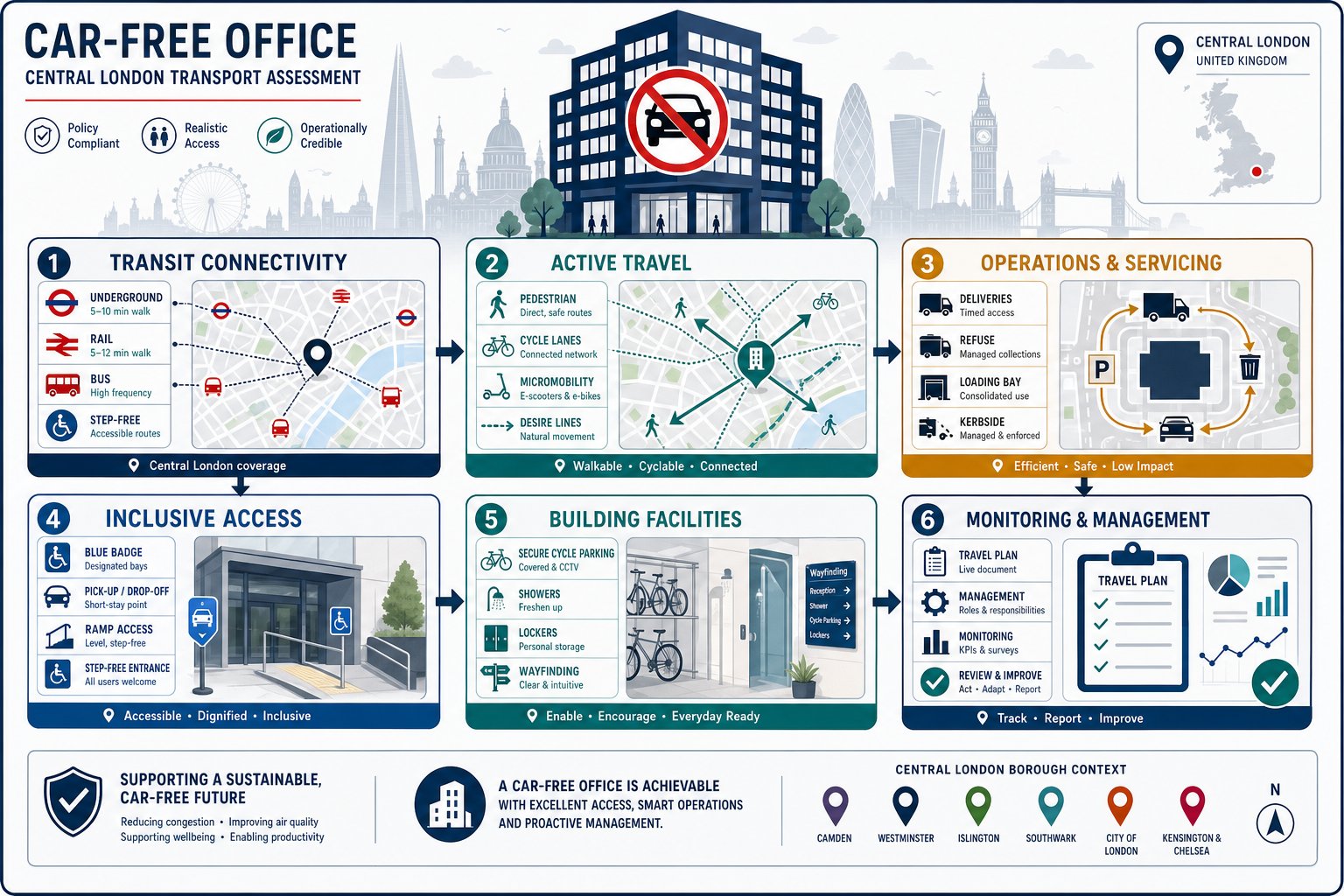
Central London office schemes are now being judged against a fairly blunt reality: if the site sits in an area with strong public transport, planners will usually expect it to be car-free. That sounds simple on paper. In practice, a car-free office transport assessment has to do much more than state there’s no general parking.
It needs to prove that the building will function day to day without hidden transport problems emerging later, no unsafe loading on the street, no muddled pick-up arrangements, no inaccessible approach for disabled users, no overspill parking on nearby roads, and no optimistic cycling assumptions unsupported by actual facilities. For architects, planners, developers, and local authority teams, that means the assessment has to be precise, policy-aware, and operationally credible.
In our experience, the strongest submissions are the ones that treat transport as an operating system, not a checkbox. They explain how staff arrive, how visitors find the site, how refuse is collected, how couriers turn around, how move-in works, and what happens when real travel behaviour doesn’t match the original forecast.
This article sets out what a Car-Free Office in Central London Transport Assessment needs to cover in 2026, how London Plan and borough policy shape expectations, and where planning submissions most often come unstuck. The aim is practical: to help project teams prepare evidence that reads like it has been designed for committee questions, not just uploaded for validation.
Key Takeaways
- A Car-Free Office Transport Assessment must demonstrate practical, safe, and inclusive operation without general car parking, addressing real daily use challenges rather than just policy compliance.
- In Central London, strong public transport accessibility (high PTAL) is essential but must be supported by detailed analysis of walking, cycling, micromobility links, and inclusive Blue Badge access.
- Effective servicing, deliveries, refuse operations, and disabled access arrangements are critical to avoid common planning issues and ensure the building functions smoothly without parking.
- Cycle parking and end-of-trip facilities should be high-quality and usability-focused, with clear management plans to encourage mode shift from private cars.
- A robust Travel Plan with monitoring, governance, and clear management responsibilities is vital to turn car-free intentions into operational reality and satisfy planning conditions.
- Weak submissions often fail due to generic evidence, vague servicing strategies, overlooked accessibility details, or untested assumptions; specificity and operational credibility are key for success.
What A Car-Free Office Transport Assessment Needs To Demonstrate
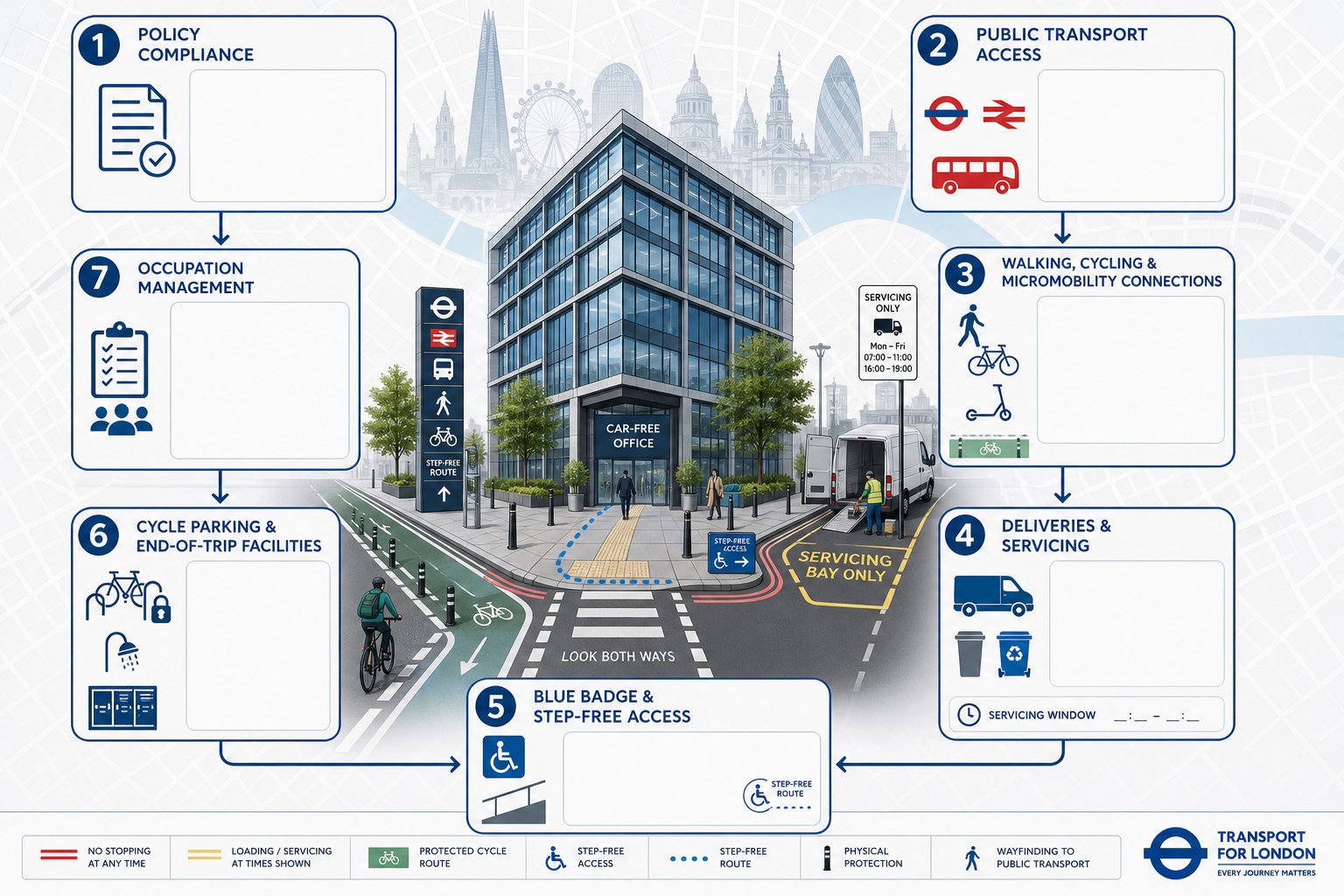
A robust assessment has one central job: show that the office can operate effectively without general car parking while maintaining safe, inclusive, and efficient access for everyone who needs to use it.
That means we need to demonstrate more than low private car mode share. Planners will expect a joined-up narrative covering:
- why a car-free approach is policy compliant in this location:
- how the public transport offer supports staff and visitor access:
- whether walking, cycling, and micromobility connections are realistic rather than theoretical:
- how deliveries, servicing, and refuse are managed:
- how Blue Badge access and step-free arrival are handled:
- what cycle parking and end-of-trip facilities are provided: and
- how the building will be managed during occupation.
The best transport assessments read almost like operational manuals. They test the awkward bits, not just the easy ones. If the scheme relies on timed servicing windows, that needs explaining. If a nearby bay is proposed for occasional pick-up and drop-off, the walking route and kerb conditions matter. If staff are expected to cycle in large numbers, showers, lockers, and secure cycle access can’t be an afterthought.
For many schemes, we also align the document with wider transport assessment for principles so the office-specific case sits within accepted planning practice. In Central London, a car-free statement on its own rarely carries much weight: demonstrable functionality does.
How Central London Planning Policy Shapes Car-Free Office Proposals
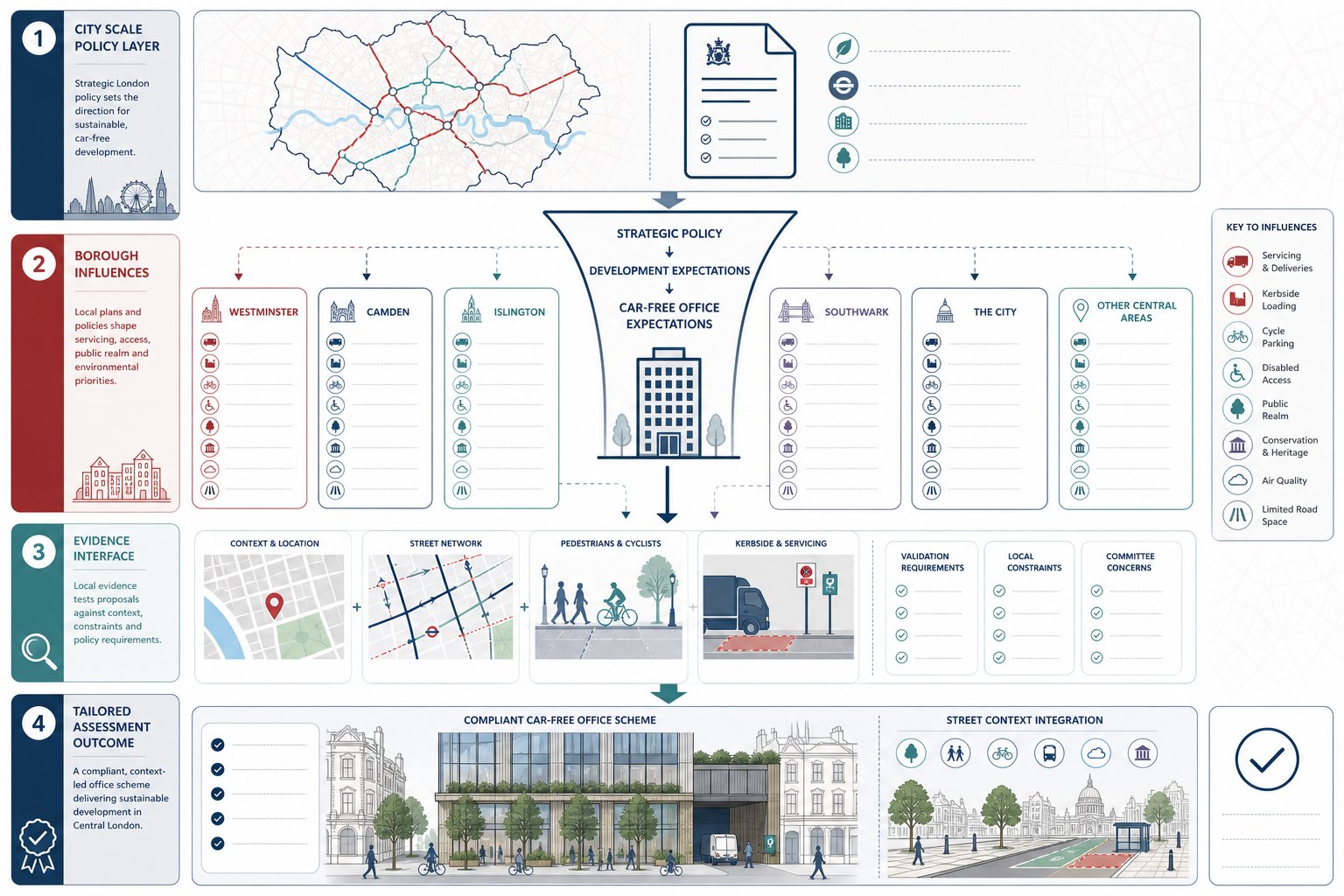
Policy is doing a lot of the heavy lifting here. The London Plan strongly supports reducing private car dependency, and in Central London that position is reinforced by borough-level policy, controlled parking pressures, public realm objectives, air quality priorities, and the basic scarcity of road space.
For office development, the default expectation is often that general parking should not be provided unless there is an exceptional and clearly justified reason. That doesn’t remove the need for transport evidence: it raises the standard of it. We have to show that the proposal does not simply comply with policy wording but actually works in the context of the street network and surrounding uses.
This is where local nuance matters. Westminster, Camden, Islington, Southwark, the City, and other central boroughs can all approach servicing, kerbside management, cycle standards, and disabled access with slightly different emphasis. A sound assessment should reflect the borough’s validation requirements, any relevant area action plans, conservation or public realm constraints, and known committee concerns.
A practical policy response usually combines London-wide strategic framing with location-specific evidence. That is exactly where tailored London Development Transport Advice: becomes valuable: the scheme needs to speak the language of both the London Plan and the local case officer. In 2026, generic wording is easier than ever to spot, and easier than ever to challenge.
Defining The Site Context, Catchment, And Accessibility Baseline
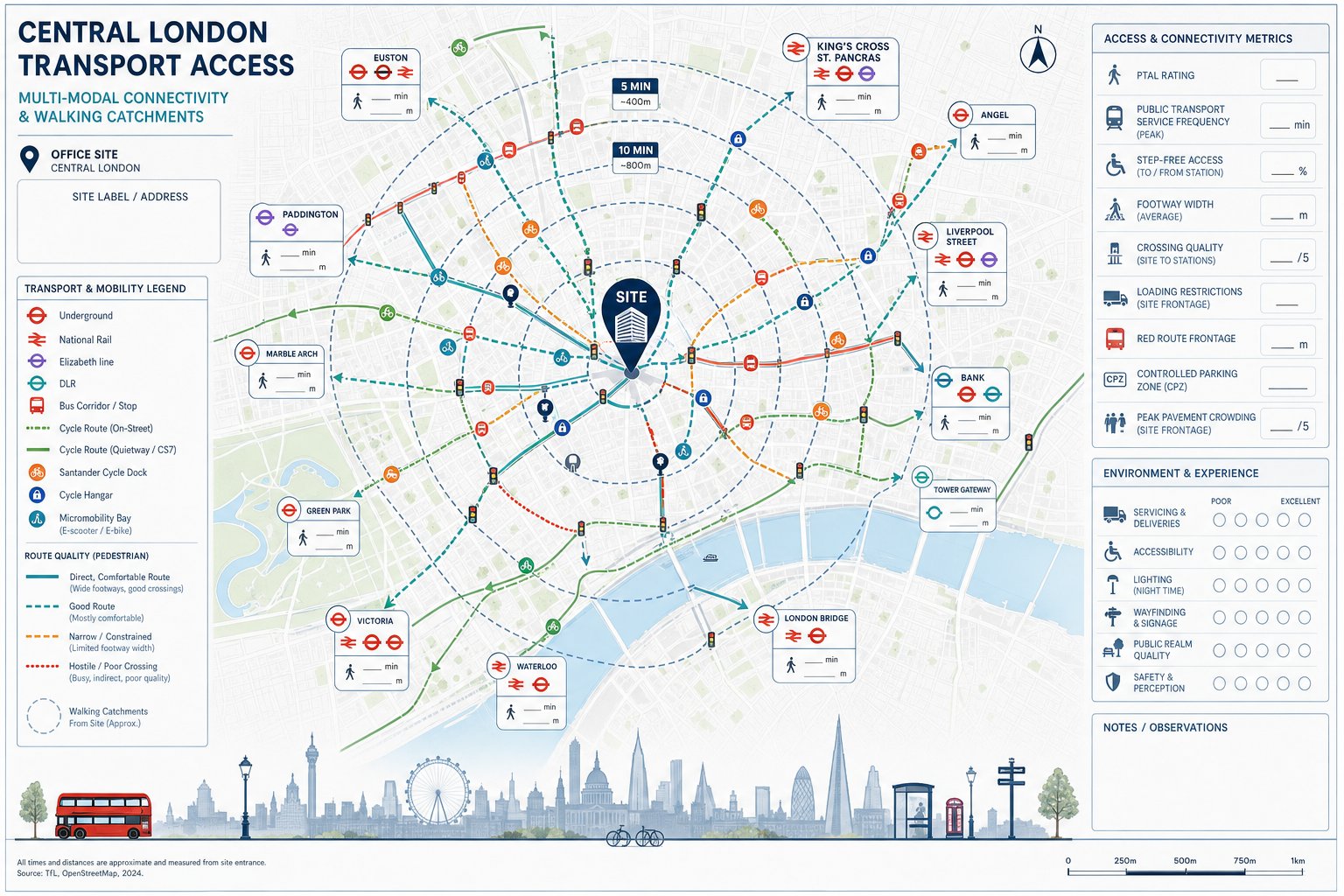
A car-free office proposal only makes sense if the surrounding context supports it. So this section of the assessment should establish the site’s transport geography clearly and early.
We normally define the land use context, nearby stations and bus corridors, pedestrian environment, cycle routes, servicing constraints, controlled parking conditions, and relevant trip attractors. The catchment should be realistic. Five hundred metres to a station may be comfortable on a direct, level route: it feels very different if the route is narrow, cluttered, and crosses several hostile junctions.
The baseline should also explain current travel conditions and constraints. Are there existing loading restrictions? Is the site on a red route frontage? Are footways heavily trafficked at peak times? Are there nearby Santander docking points or cycle hangars? Is the building in a cluster where demand patterns are spread across multiple Underground lines and national rail nodes?
Good evidence here underpins everything that follows. It justifies low car reliance, supports trip distribution assumptions, and tells the planning authority that we understand how the building will plug into the city around it.
For larger or more sensitive schemes, site context can overlap with wider environmental impact assessment considerations, especially where traffic, public realm, air quality, or cumulative impacts are being scrutinised in parallel.
Public Transport Accessibility And PTAL Evidence
PTAL is not the whole story, but in Central London it remains one of the clearest shorthand indicators of whether a car-free office proposal is plausible. A high PTAL score helps demonstrate that staff and visitors have strong access to rail, Underground, DLR, Elizabeth line, Overground, and bus services within reasonable walking distance.
The assessment should present PTAL evidence accurately and explain what it means in practical terms. We should identify the relevant stations and routes, service frequencies, first and last train context where relevant, and any step-free access considerations. If the site benefits from multiple stations serving different destinations, that dispersal effect can strengthen the case by reducing pressure on any single access route.
But PTAL should never be used lazily. A high score does not excuse poor analysis of walking routes, crowded pavements, or accessibility barriers. Nor does it automatically answer concerns around servicing or disabled access.
Where the scheme sits in a particularly well-connected location, input from Public Transport Strategy work can help translate network accessibility into planning-ready evidence rather than just dropping a map into an appendix.
Walking, Cycling, And Micromobility Connections
If a scheme is car-free, active travel can’t be treated as a soft benefit. It is core infrastructure.
The assessment should map pedestrian desire lines to stations, bus stops, nearby amenities, and adjacent employment areas. We need to comment on crossings, footway widths, lighting, wayfinding, gradients, and the quality of the public realm. For cycling, the analysis should identify local cycle routes, protected lanes where available, quieter backstreet links, and how riders actually enter the site.
Micromobility also deserves a more mature treatment in 2026 than it often got a few years ago. Even where private e-scooter use remains constrained by regulation, folding bikes, docked hire cycles, and other first/last-mile options shape how office workers travel. If the building is relying on non-car access, these links matter.
The key test is realism. Are people genuinely likely to choose these modes in workwear, in the dark, in winter, and during a rushed commute? If the answer is yes, the document should show why.
Trip Generation For A Car-Free Office Development
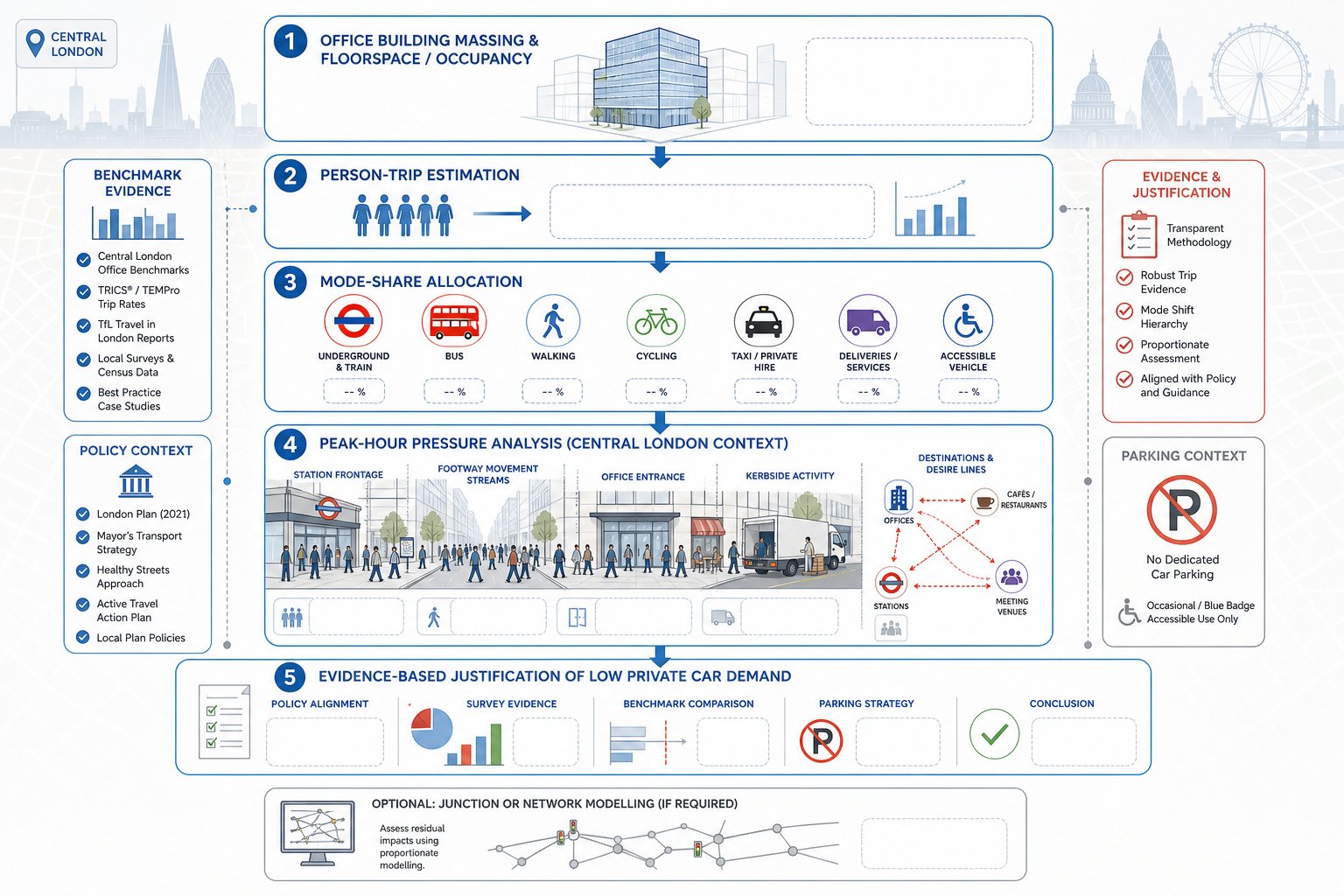
Trip generation for a car-free office is not the same as pretending there are no car trips. It is about estimating total person trips, assigning likely mode shares, and then evidencing why private car demand will be very low.
Most assessments start with office floorspace, likely occupancy, and established database or survey evidence, then refine that with local context. In Central London, we usually expect high public transport mode share, meaningful walking and cycling demand, some taxi and private hire activity, delivery traffic, and a limited but important category of disabled or exceptional vehicle trips.
Peak-hour analysis should be proportionate. The main issue is often not highway capacity in the traditional suburban sense, but kerbside pressure, station access, and footway movement at the busiest arrival and departure times. Where linked trips are expected between nearby offices, stations, cafés, and meeting venues, those patterns should be acknowledged.
It helps to explain assumptions openly. If parking restraint is expected to suppress private car trips, say so and support it with policy, accessibility, and operational management. If there are benchmark surveys from similar car-free commercial sites, use them carefully.
And if the proposal includes junction works or relies on local network changes, modelling tools such as Junctions 11 Software In may be relevant, but only where the transport questions genuinely require that level of analysis.
Assessing Delivery, Servicing, And Refuse Operations Without General Parking
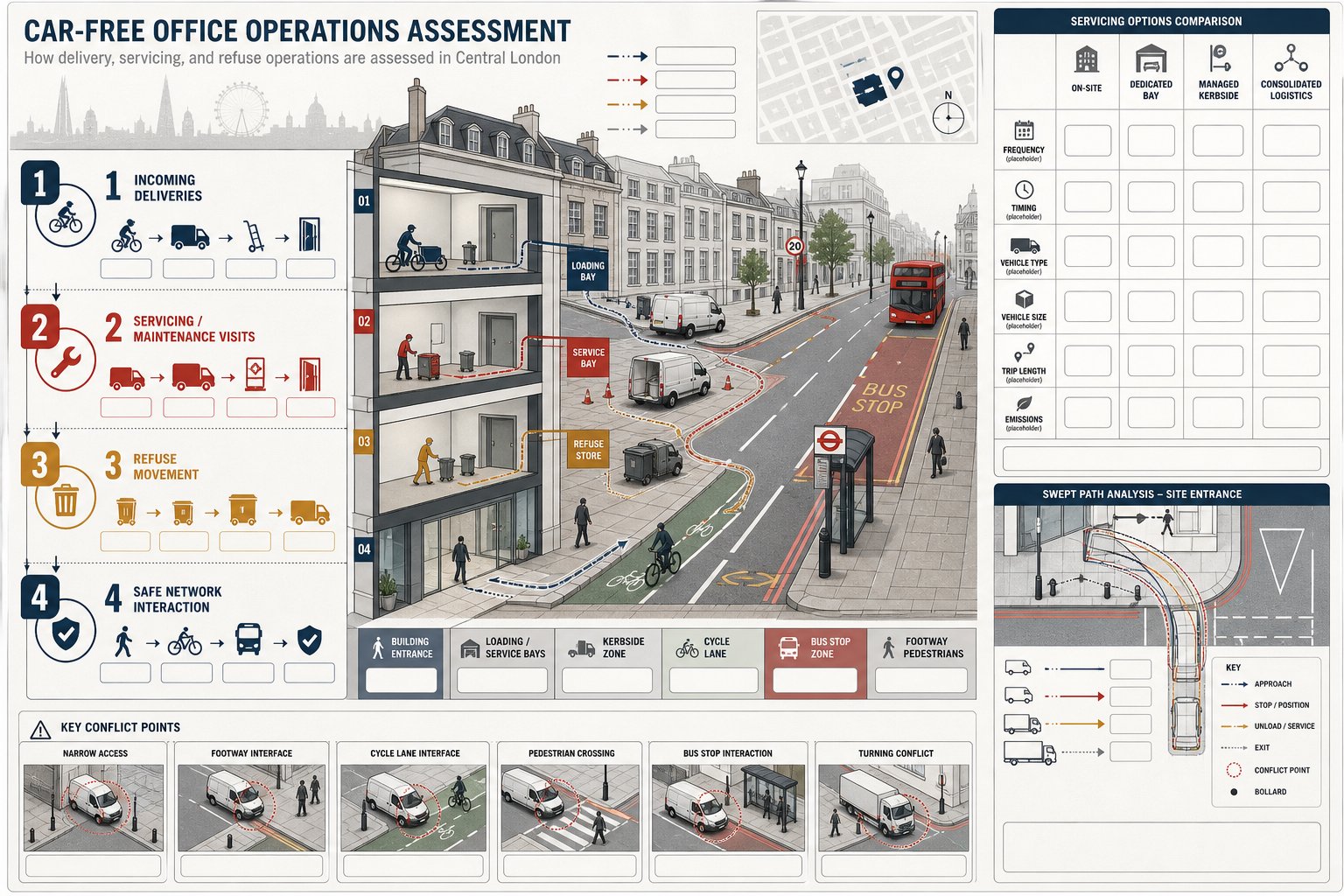
This is one of the fastest ways for an otherwise strong application to unravel. A car-free office may have no staff parking, but it still needs to function as a workplace. Parcels arrive. Catering comes in. Waste goes out. Maintenance contractors appear at inconvenient times. If the transport assessment ducks those realities, planners will notice.
We should set out the likely servicing profile by vehicle type, frequency, timing, and location. That includes courier arrivals, small vans, occasional larger vehicles, and refuse collection arrangements. The document should explain whether servicing takes place on-site, from a dedicated bay, from a managed kerbside location, or through a consolidated logistics approach.
Swept path analysis may be needed where access is tight. So may observations of existing street conditions, loading restrictions, peak pedestrian flows, and interaction with cycle lanes or bus stops. The operational question is simple: can these movements happen safely and without blocking the network?
For complex urban sites, support from a Traffic Engineer In London often makes the evidence more credible because it connects geometry, kerbside behaviour, and authority expectations. Refuse strategy should also align with the building management plan. If bins are dragged across a busy footway at peak time, that is not a detail, it is a planning issue.
Blue Badge Parking, Pick-Up, Drop-Off, And Inclusive Access
Car-free does not mean inaccessible. In fact, one of the main tests of a credible Central London office proposal is whether inclusive access has been thought through in detail rather than patched in later.
The assessment should explain how disabled staff and visitors reach the building, whether Blue Badge parking is provided on-site or nearby, and how pick-up and drop-off can occur safely. Step-free routes from the vehicle stopping point to the entrance matter. So do kerb heights, crossing points, door thresholds, gradients, weather protection, and waiting space.
Where no on-site disabled bay is proposed, the justification has to be robust. We need to show what alternative arrangement exists, whether it is reliable, whether it is lawful to use, and whether the route is genuinely accessible. Vague references to nearby public parking are rarely enough.
This section also benefits from coordination with the architect and access consultant. A transport assessment should not make promises the building layout cannot keep. If the entrance sequence is awkward, if servicing conflicts with drop-off, or if security measures impede access, those issues need resolving before submission.
Done well, inclusive access strengthens the whole car-free case. Done badly, it can sink it.
Cycle Parking, Showers, And End-Of-Trip Facilities
Cycle provision is often presented as a numbers exercise. In reality, planners increasingly look at quality, usability, and management. A compliant headline figure will not rescue a poor basement layout or a convoluted access route.
The assessment should specify long-stay and short-stay cycle parking, parking type, security, accessibility, and relationship to the entrance. It should also cover showers, lockers, drying space where relevant, maintenance provision, and arrangements for adapted cycles if required.
For office schemes in Central London, this is more than policy compliance. It is part of the behavioural logic of the proposal. If staff are expected to shift away from private car use, the building has to make cycling practical for ordinary working days, not just for the ultra-keen employee who arrives in Lycra before sunrise.
We also need to think about management. How will spaces be allocated if demand exceeds supply at launch? Is there passive provision for expansion? How are abandoned cycles handled? Can visitors park close enough to feel welcome but not create clutter?
There is useful crossover here with evidence used on other schemes, including Residential Development Transport work, because many of the same lessons apply: convenience drives actual uptake, not just standards tables.
Construction, Move-In, And Operational Management Considerations
Planning teams sometimes focus heavily on the completed building and forget the messy phases in between. Yet in dense Central London streets, construction activity and first occupation can create some of the sharpest transport impacts.
A sound assessment should explain how the scheme links to construction logistics planning, including routing, booking systems, vehicle sizes, loading locations, workforce travel expectations, and protection of pedestrians and cyclists. Even if the detail sits in a separate document, the transport assessment should show that the strategy is feasible.
Move-in day deserves more attention than it usually gets. Office occupation can generate concentrated courier activity, contractor vans, furniture deliveries, IT installation trips, and staff arrival patterns that do not reflect normal operations. If the building is marketed as car-free, the management team should already have a plan for those first weeks.
Operational management is the long tail of the same issue. We should explain tenancy fit-out rules, delivery booking procedures, waste collection timing, and how unauthorised parking or waiting will be discouraged. On some schemes, early engagement and public consultation transport work can also reduce friction with neighbours who are often most concerned about the servicing reality, not the planning slogan.
Travel Planning, Monitoring, And Planning Condition Readiness
A car-free office should not rely on hope. It needs a Travel Plan that turns policy intent into day-to-day management.
That means setting out measures to support sustainable travel from first occupation: staff travel information, cycle incentives, visitor communications, delivery management, induction material, and coordination with occupiers. The strongest Travel Plans also identify a named coordinator, monitoring periods, survey methods, reporting arrangements, and realistic remedial triggers if travel patterns drift away from expectations.
Planning authorities increasingly want condition-ready material. In other words, not a generic promise that a Travel Plan will appear later, but a draft that already covers targets, governance, and implementation. This is especially important where there is concern about overspill parking, disabled access arrangements, or servicing pressures.
We often advise treating this section as the bridge between design and occupation. If the transport assessment explains what the building will do, the Travel Plan explains who will make sure it actually happens. For applicants working across multiple London boroughs, that level of readiness often shortens post-permission negotiation and reduces the risk of awkward condition wording.
Common Reasons Car-Free Office Transport Assessments Fall Short
Most weak submissions do not fail because the idea of a car-free office is controversial. They fail because the evidence feels incomplete, generic, or too optimistic.
The most common problems include:
- Overreliance on policy wording. Saying Central London is a car-free location is not enough: the site-specific operation still has to be demonstrated.
- Thin PTAL analysis. A map with a high score does not explain route quality, step-free access, or station choice.
- Vague servicing strategy. If deliveries are hand-waved away, officers tend to assume the worst.
- Poor inclusive access detail. Unclear Blue Badge or drop-off arrangements raise immediate red flags.
- Cycle provision that works on paper only. Tight corners, stairs, poor security, or inadequate showers undermine mode shift claims.
- No credible management framework. Without monitoring, controls, and named responsibilities, the scheme can look fragile.
- Copied text from unrelated schemes. This is surprisingly common, and usually obvious.
The cure is specificity. We need to show the assessor has actually stood on the street, traced the routes, watched the kerbside, and coordinated with the design team. That is also why concise, authority-aware reporting matters so much on commercial applications. A good document anticipates objections before they harden into reasons for delay.
Conclusion
In 2026, a successful Car-Free Office in Central London Transport Assessment is less about making a philosophical case against cars and more about proving that the building will run smoothly without general parking. Policy support is already there in most central locations. What determines the planning outcome is the quality of the operational evidence.
For project teams, that means being disciplined about the basics: define the accessibility baseline properly, present PTAL and active travel evidence honestly, test servicing and refuse in the real street environment, resolve inclusive access early, and arrive with a Travel Plan that is ready for conditions rather than vaguely promised.
When those pieces line up, car-free office proposals tend to look logical, policy-compliant, and manageable. When they do not, even well-designed schemes can stall. The transport assessment is where that difference usually shows.
Car-Free Office in Central London Transport Assessment: Frequently Asked Questions
What key elements must a car-free office transport assessment in Central London demonstrate?
It must prove the office operates effectively without general car parking, ensuring safe, inclusive, and efficient access for staff, visitors, deliveries, servicing, and disabled users, complying with London Plan and local policies.
How does the London Plan influence car-free office proposals in Central London?
The London Plan strongly supports reducing private car dependency, expecting central office developments to be car-free unless exceptional justification is provided, raising the standard for transport assessments in line with borough policies.
Why is PTAL evidence important in a car-free office transport assessment?
PTAL shows the strength of public transport accessibility nearby, supporting low car dependency claims, but must be accompanied by detailed analysis of walking routes, accessibility, and station connections.
How should deliveries and servicing be managed without general parking in Central London offices?
The assessment must detail vehicle types, frequencies, loading locations, and times, ensuring safe, unobstructed operation on the street or dedicated bays, supported by swept path analysis or traffic engineering guidance.
What facilities are essential to support cycling in a car-free office?
Secure and accessible long- and short-stay cycle parking, showers, lockers, drying spaces, and maintenance provisions are vital to encourage cycling as a practical commuting option for staff.
How can a car-free office ensure inclusive access for disabled users?
By providing clear Blue Badge parking or suitable alternatives with step-free routes, kerb height considerations, safe pick-up/drop-off arrangements, and integrating access planning with the building design to comply with accessibility requirements.