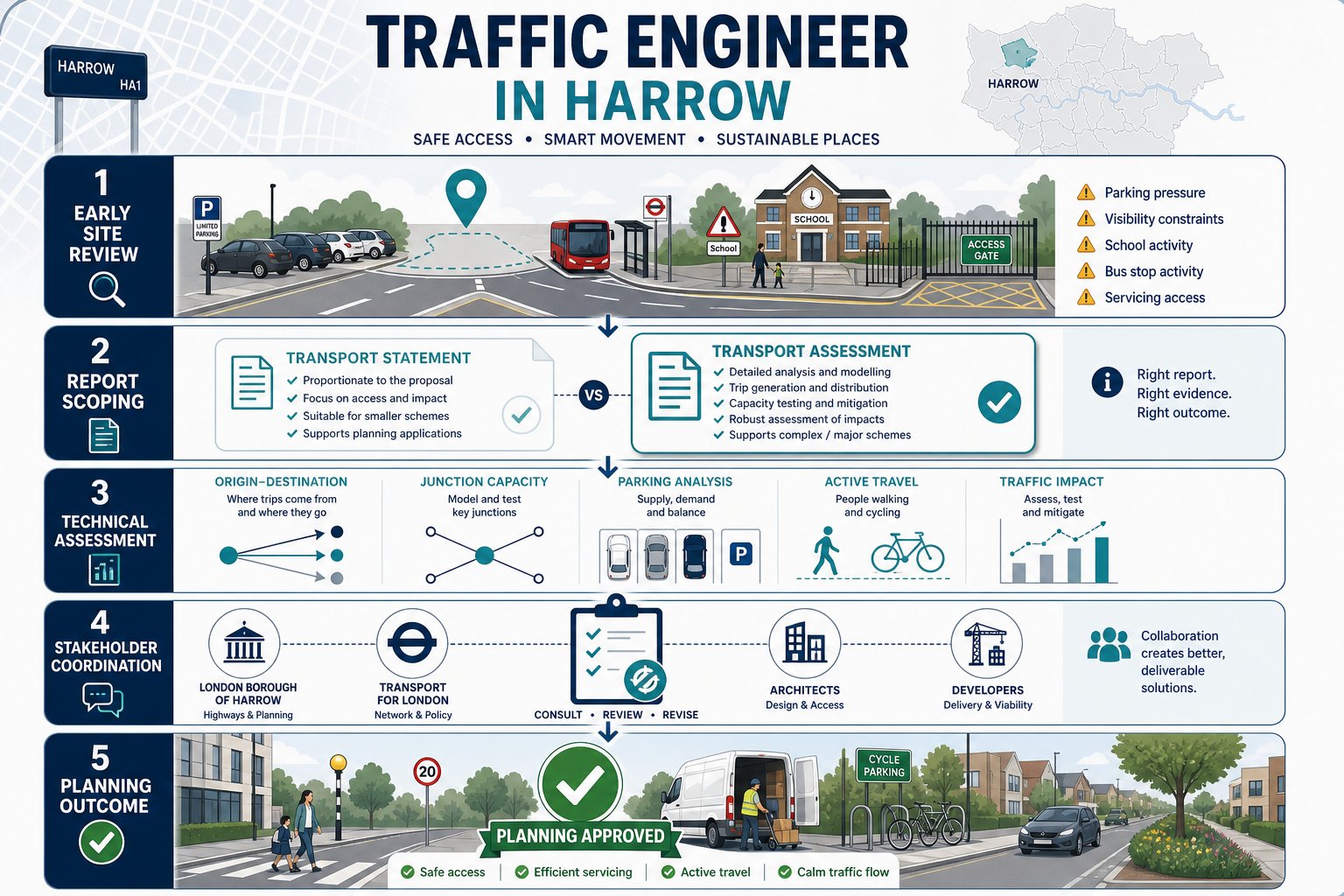
Planning in Harrow rarely fails because of one dramatic traffic issue. More often, it stalls on smaller questions that weren’t answered clearly enough: Will the junction cope? Is parking stress already high? Can servicing happen without blocking the road? Is a Transport Statement enough, or will the council expect a fuller assessment?
That’s where a traffic engineer in Harrow becomes central to the planning process. For architects, planning consultants, developers, surveyors and legal teams, transport evidence is often the bridge between a well-designed scheme and a delayed application. Done properly, it gives local officers and highway stakeholders confidence that access, highway safety, parking, walking, cycling and servicing have all been considered in a proportionate, policy-led way.
In our work, we see the same pattern again and again: the earlier transport input is brought in, the easier it is to shape a proposal around real site constraints instead of trying to defend weak assumptions later. In Harrow, that usually means understanding local streets, residential parking pressures, public transport accessibility, school-run peaks, nearby junction performance and, where relevant, Transport for London expectations.
This guide explains what a traffic engineer in Harrow actually does for planning applications, when key reports are needed, how impacts are assessed, and what project teams should look for when appointing the right consultant in 2026.
Key Takeaways
- A traffic engineer in Harrow plays a crucial role in shaping planning applications by providing clear, proportionate transport evidence that addresses local constraints and planning policies.
- Early involvement of a traffic engineer ensures practical, site-specific solutions for access, parking, and servicing, reducing delays and objections in the planning process.
- Transport Statements are suited for smaller developments with limited impact, while Transport Assessments are needed for larger or more complex projects requiring detailed traffic and junction analysis.
- Accurate trip generation, junction capacity, and traffic impact assessments are essential to determine whether developments can be supported without causing severe transport issues.
- Effective transport reports in Harrow must align with local conditions, including parking surveys, access appraisals, and engagement with council and TfL stakeholders to preempt objections.
- Choosing the right traffic engineer involves ensuring local planning knowledge, proportional reporting, strong technical ability, clear communication, and relevant project experience.
What A Traffic Engineer In Harrow Does For Planning Applications
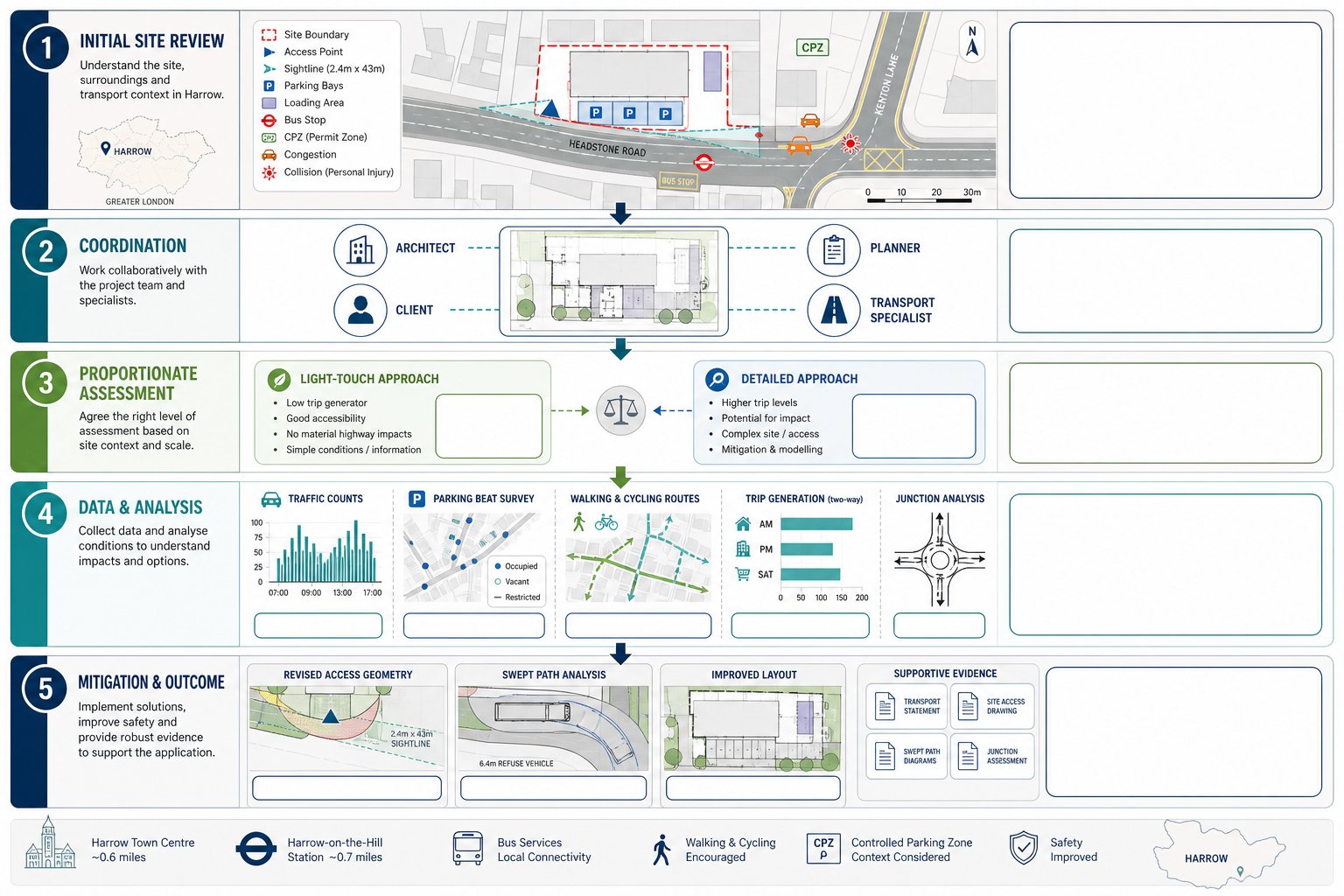
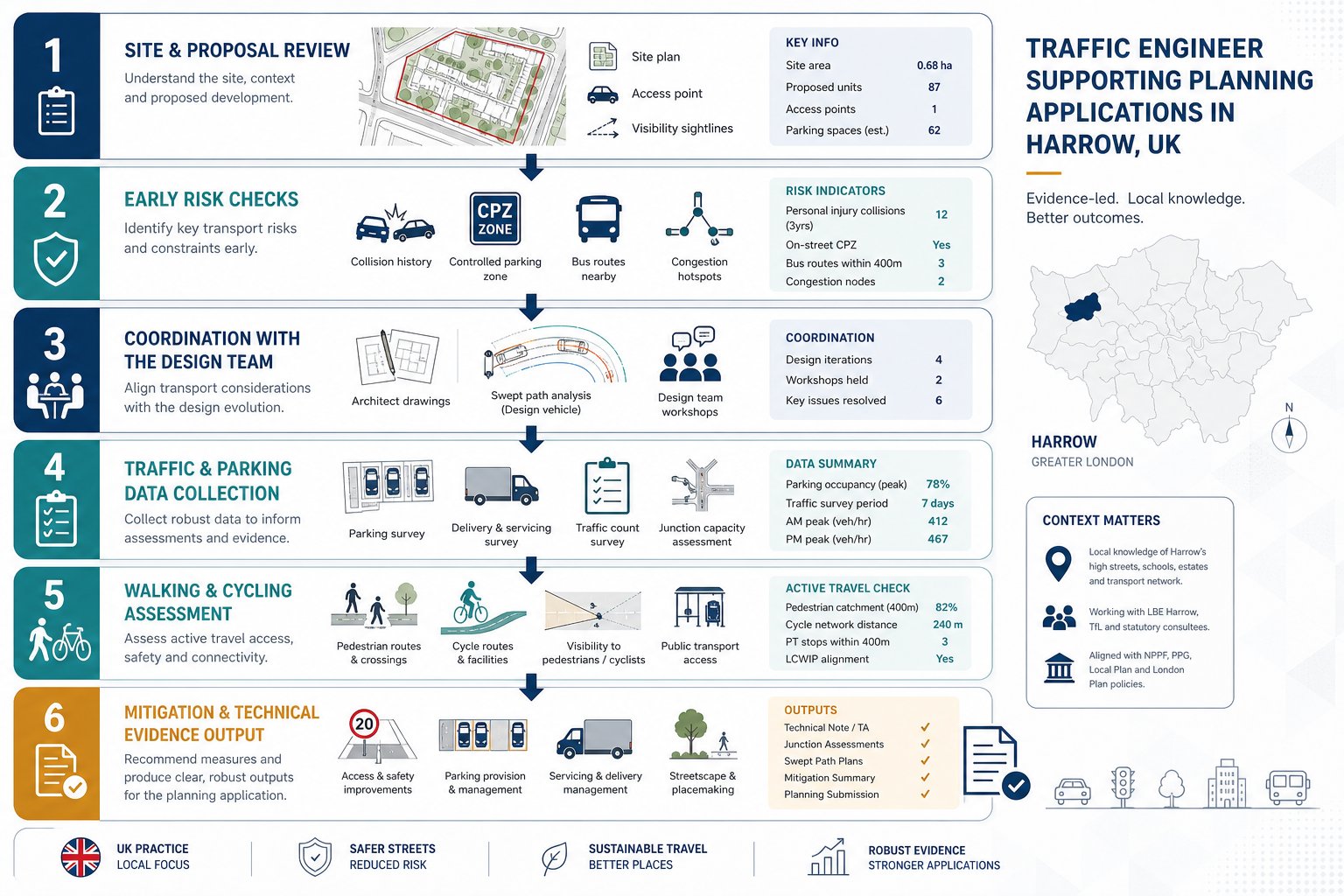
A traffic engineer in Harrow supports the planning case by turning transport risk into structured evidence. That sounds tidy on paper: in practice, it means reviewing the proposed land use, access strategy, parking provision, servicing arrangements, likely trip demand and the effect on surrounding streets.
At the start of a project, we usually test the basics first. Is the site access workable? Does visibility look acceptable? Is the level of parking likely to be challenged? Are there collision records, loading constraints, controlled parking zones, bus route sensitivities or local congestion issues that could become planning objections? Those early checks often save weeks.
For many schemes, the role goes well beyond writing a report. We coordinate with architects on swept paths, with planning consultants on application strategy, and with clients on whether the evidence should be light-touch or more detailed. A proportionate approach matters. A modest infill scheme should not carry the same technical burden as a major mixed-use redevelopment.
We also collect and interpret traffic data, commission parking beat surveys where needed, review pedestrian and cycle connectivity, and assess whether mitigation is required. Sometimes the answer is design-led: a revised access width, better bin collection arrangements, or altered parking layout. Sometimes it is analytical, supported by trip generation and junction modelling.
Broader Traffic Engineering and Transportation principles still apply, but local context always shapes the advice. And when teams need wider strategic support, experienced Traffic Engineering Consultants: can align technical evidence with planning strategy rather than treating transport as a last-minute add-on.
When A Transport Assessment Or Transport Statement Is Needed In Harrow
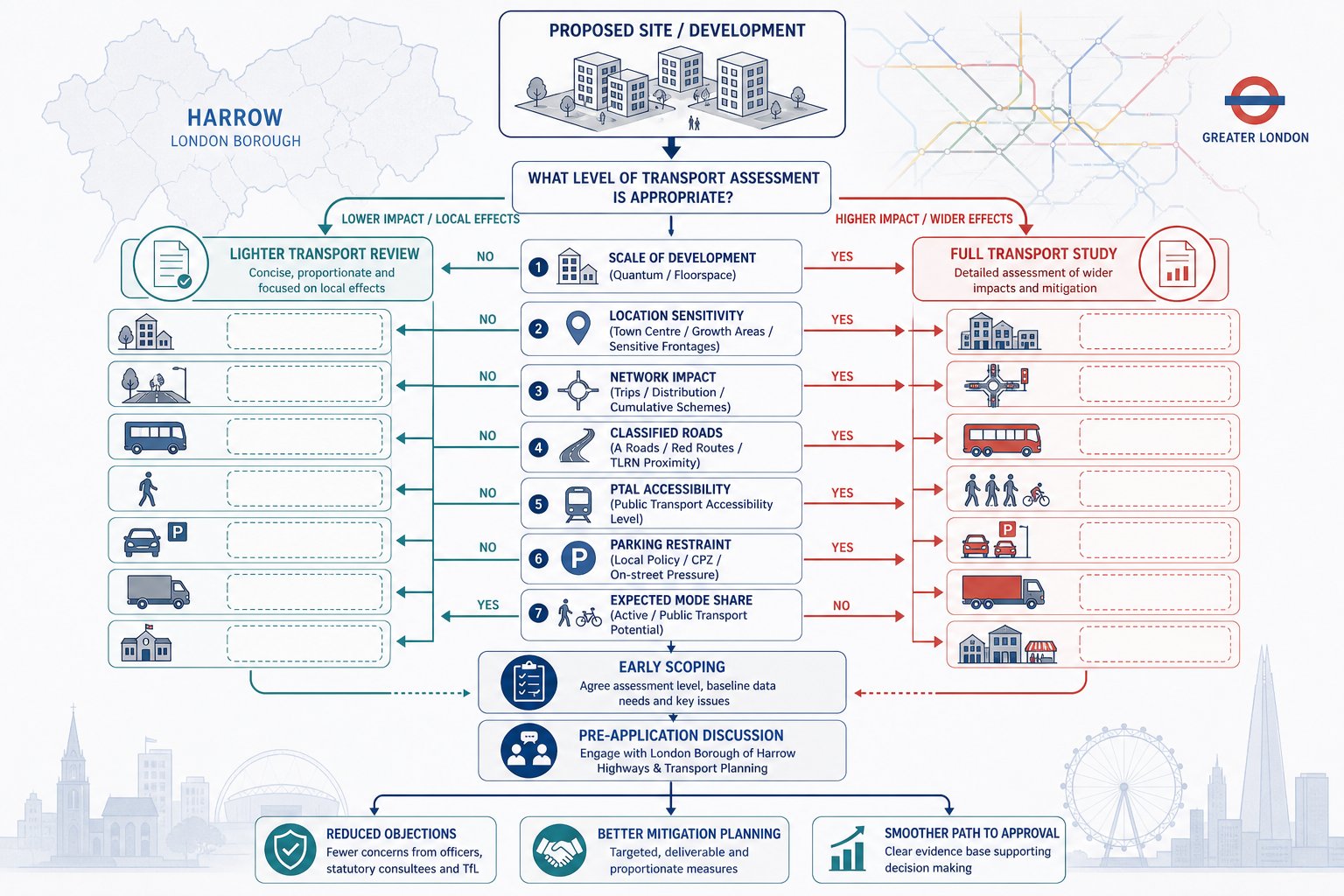
The question clients ask most is simple: do we need a Transport Statement or a Transport Assessment? The answer depends less on labels and more on scale, location and likely impact.
In Harrow, a Transport Statement is usually appropriate for smaller developments where transport effects are expected to be limited and can be addressed through a concise, evidence-based review. A Transport Assessment is typically required for larger or more complex schemes, or where the site sits on a sensitive part of the network and officers need a fuller understanding of traffic, access, mode share and mitigation.
There is no one-size-fits-all trigger that covers every site neatly. The same number of units can generate very different expectations depending on parking restraint, PTAL, nearby schools, town centre conditions, servicing demand or whether the proposal affects a classified road. That is why early scoping is so important.
We generally advise project teams to think in terms of proportionality. If a proposal may materially alter vehicle trips, pedestrian activity, servicing patterns or junction operation, a fuller assessment is often sensible even before the council formally asks. That can make pre-application discussion more productive and reduce the chance of transport objections later.
For London-wide context, a Traffic Engineer In setting will often need to balance borough expectations with wider strategic policy. Equally, sound Highway And Traffic Engineering advice helps teams decide whether a short statement is genuinely enough or merely optimistic.
How Trip Generation, Junction Capacity, And Traffic Impact Are Assessed
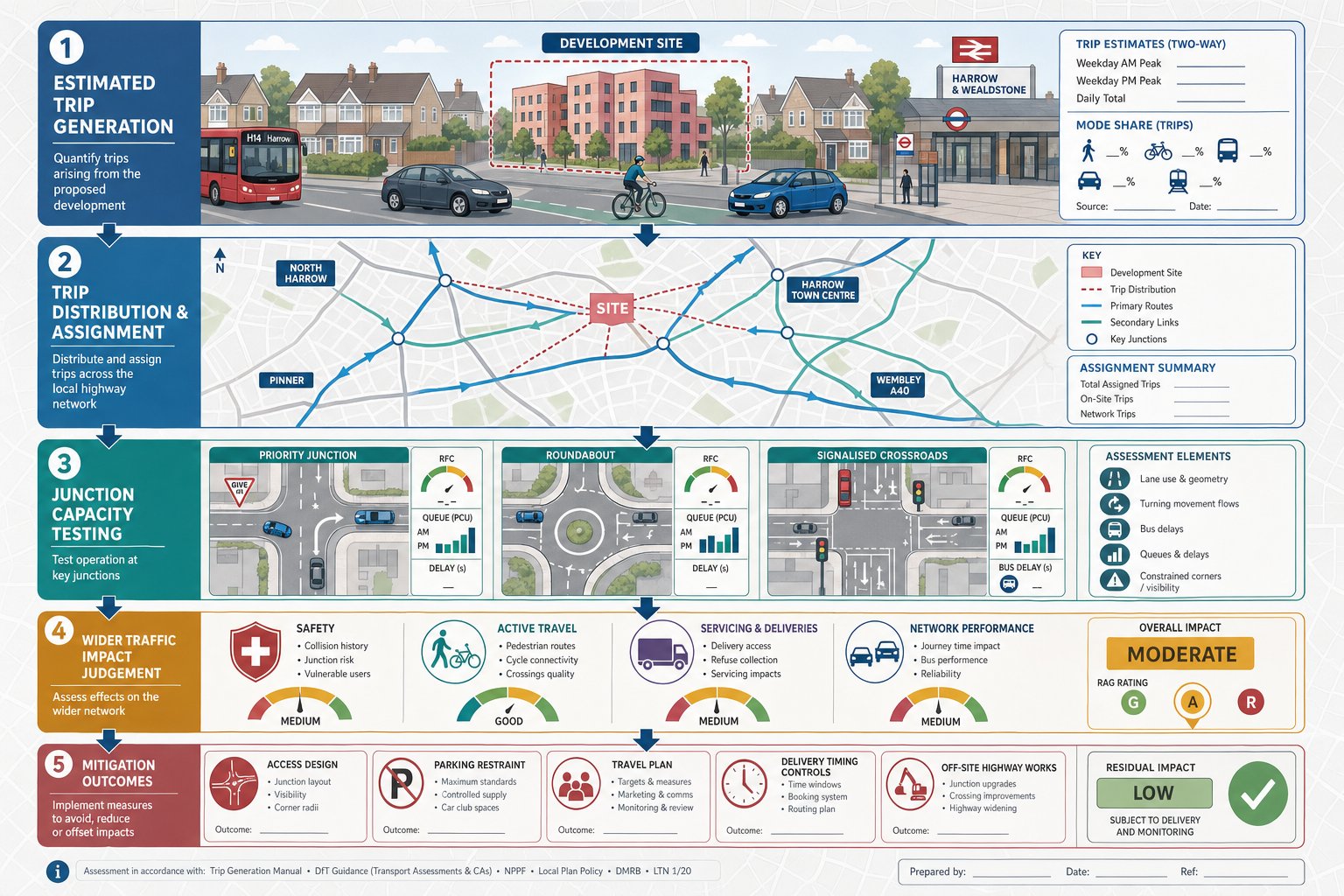
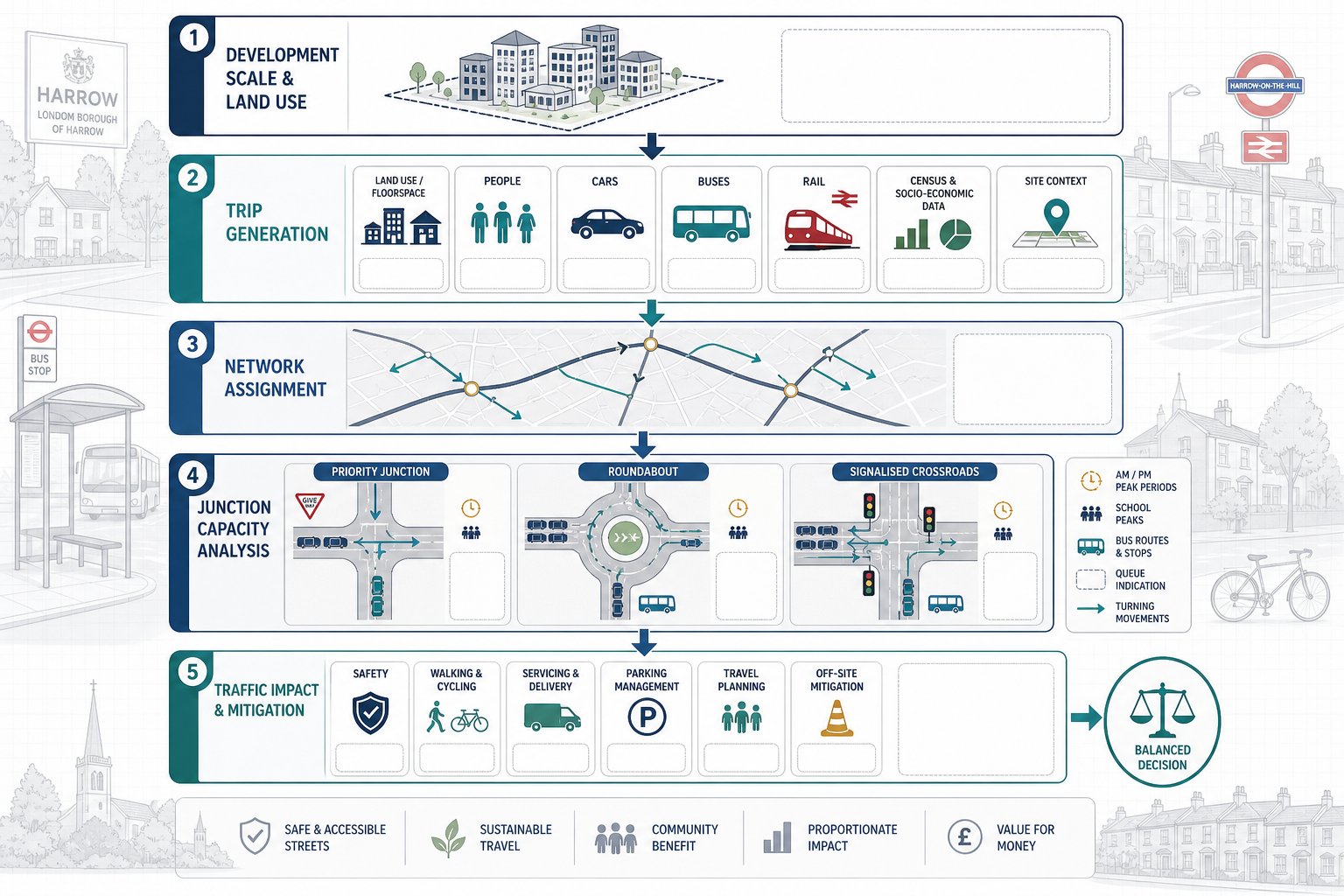
This is the technical core of many planning submissions. Once the development quantum and land use are known, we estimate how many person trips and vehicle trips the scheme is likely to generate. That is trip generation.
Usually, we draw on comparable survey databases, census-style travel characteristics, local public transport accessibility, existing site use and scheme-specific factors. A car-free apartment block near strong bus and rail links should not be assessed in the same way as a low-density edge location with poor alternatives to driving.
From there, we distribute and assign trips across the network. In plain English: where are people likely to come from, and which junctions will feel the effect? That lets us identify the links and nodes worth testing rather than modelling every road in the borough.
Junction capacity analysis then checks whether nearby priority junctions, roundabouts or signalised layouts are likely to operate within acceptable limits with development traffic included. The output is not just a spreadsheet exercise. We consider practical operation too: queue interaction, blocked turning movements, school-run peaking, bus delay and whether constrained geometry already causes driver frustration.
Traffic impact is the bigger planning judgement. We combine forecast trips, network performance, access safety, active travel conditions and servicing effects to decide whether the proposal would create severe residual impacts or whether mitigation can address concerns. Sometimes the answer is a simple access amendment: sometimes it requires parking restraint, a Travel Plan, delivery controls or off-site works.
Good analysis is detailed, yes, but it should still be readable. Decision-makers need clear reasoning, not pages of unexplained modelling outputs.
Key Transport Reports Commonly Required For Harrow Developments
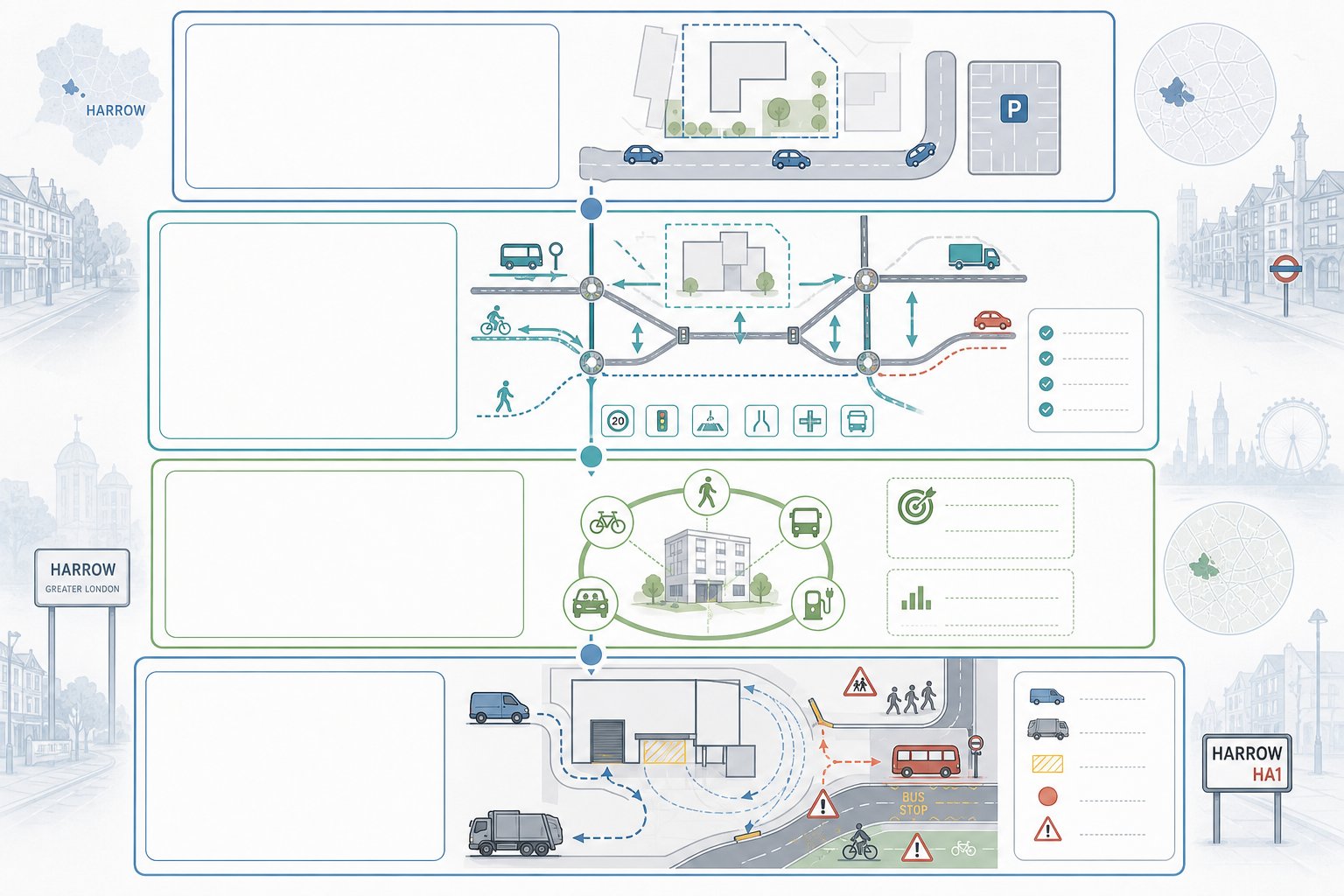
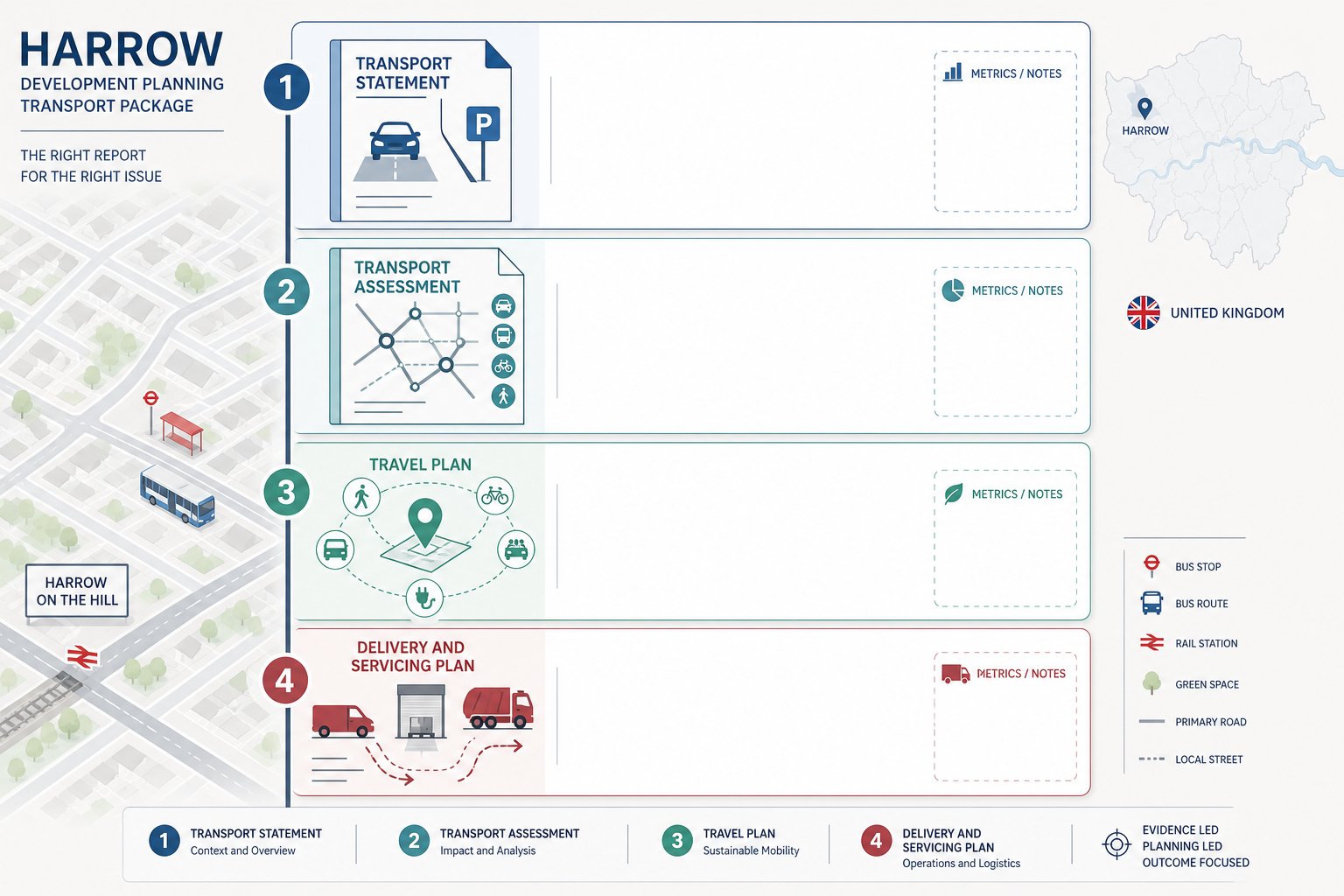
Most Harrow planning applications do not need every transport document available. They need the right ones, prepared at the right depth, for the right planning questions. The reports below are the ones we most commonly see requested or relied upon.
Transport Statement
A Transport Statement is generally a concise appraisal for smaller developments with limited transport effects. It explains the site context, reviews access and parking, summarises sustainable travel opportunities, and gives a proportionate view on traffic impact.
In Harrow, a good statement usually covers existing highway conditions, local policy context, likely trip demand, parking provision, servicing arrangements and any design measures needed to make the scheme acceptable. It should be short enough to stay proportionate but not so thin that officers are left filling the gaps themselves.
Transport Assessment
A Transport Assessment is more detailed and is usually expected for larger, busier or more sensitive proposals. It expands on baseline conditions, multi-modal accessibility, trip generation, trip distribution, junction capacity, highway safety, servicing, and mitigation.
The difference is not merely length. A proper assessment tests whether the surrounding network can accommodate the proposal and whether any residual impacts remain acceptable in planning terms. For commercial or employment-led sites, Commercial Traffic Engineering considerations often become central because delivery activity, staff travel and peak spreading can matter as much as headline traffic volumes.
Travel Plan
A Travel Plan supports more sustainable travel outcomes. It sets out measures to encourage walking, cycling, public transport use, car sharing, electric vehicle uptake where relevant, and practical occupier information.
But it should not read like a generic wish list. In Harrow, an effective Travel Plan needs site-specific actions, realistic targets, monitoring arrangements and named responsibilities. For schools, healthcare, offices and larger residential schemes, this can be an important part of the planning package.
Delivery And Servicing Plan
A Delivery and Servicing Plan focuses on how goods, waste collection, courier activity and operational vehicle movements will be managed. This becomes especially important for mixed-use developments, food uses, constrained urban sites and schemes on roads where kerbside activity is already under pressure.
We normally use it to show when servicing occurs, how vehicles enter and exit, whether they can manoeuvre safely on site, and what management controls are needed to avoid conflict with residents, buses, cyclists or school traffic. Sometimes this document quietly resolves the objection everyone was worried about.
Parking Surveys, Access Appraisals, And Highway Design Considerations
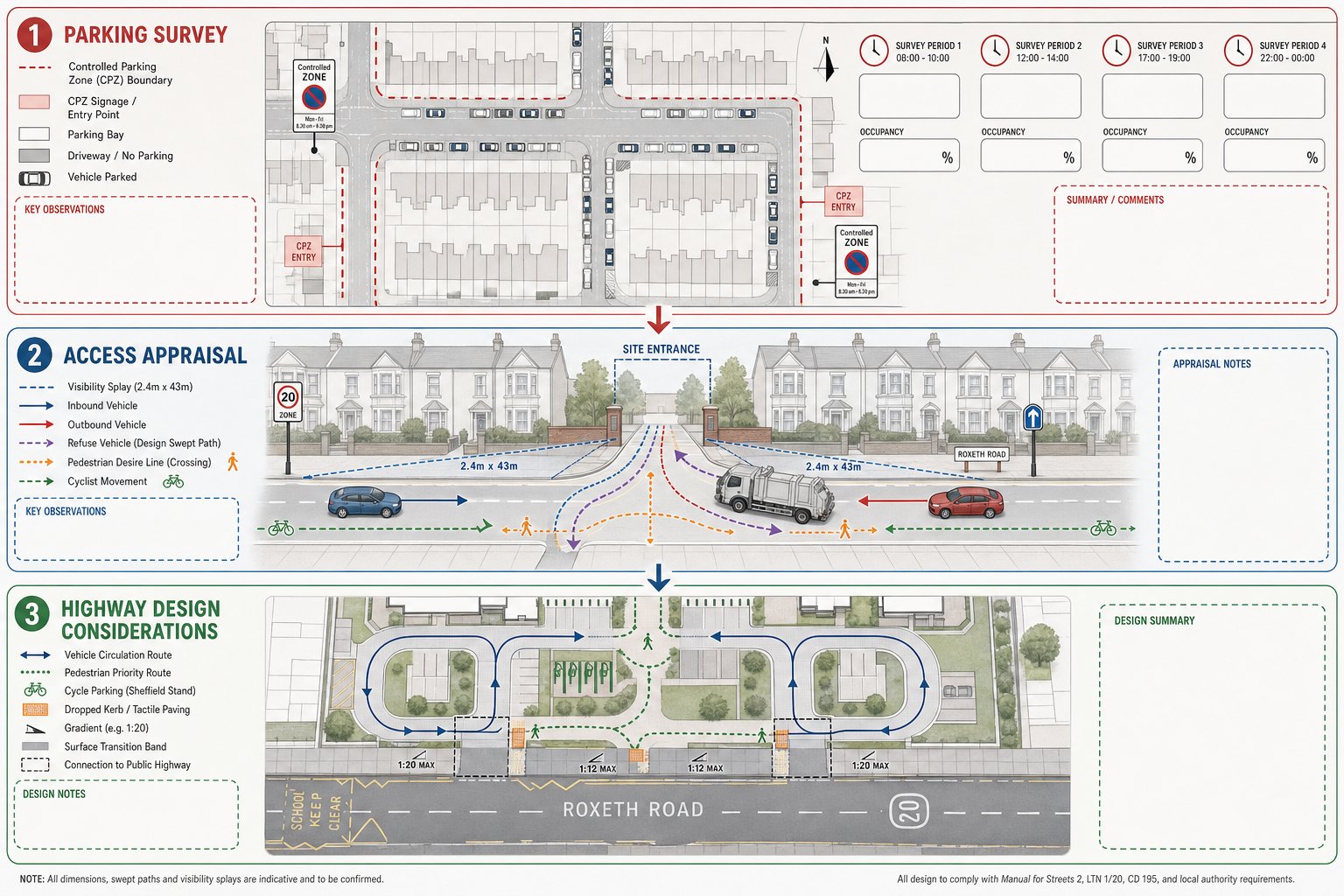
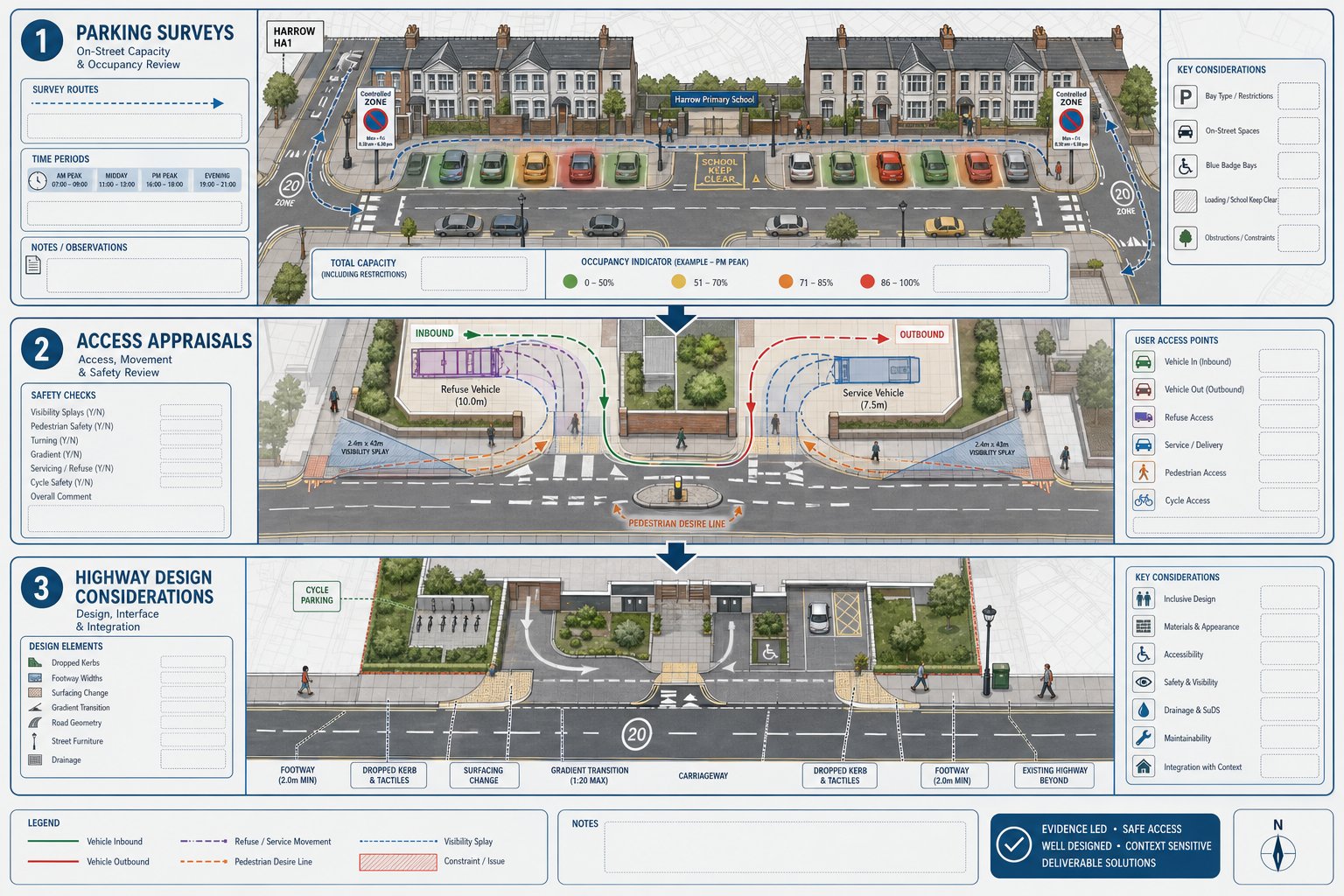
Parking and access issues can look secondary at concept stage. In planning, they often become decisive.
Parking surveys are commonly needed where a scheme proposes reduced parking, relies on existing on-street capacity, or sits in an area where officers and neighbours are likely to raise parking stress concerns. The survey work itself has to be robust: right days, right time periods, sensible beat coverage and a clear explanation of local controls such as CPZ restrictions. Weak parking evidence tends to unravel quickly under scrutiny.
We use these surveys to answer practical questions. Is there genuine spare capacity nearby? Is it only available late at night? Are school pick-up periods skewing the picture? Does overspill parking already affect junction visibility or informal pedestrian crossing behaviour? Numbers matter, but so does interpretation.
Access appraisals are equally important. They review whether vehicles can enter and leave safely, whether visibility splays are achievable, whether refuse and service vehicles can turn, and whether the access arrangement works for all users, not just confident drivers in ideal conditions. Detailed access design highway thinking is often the difference between a layout that survives highway review and one that comes back marked up in red.
Highway design considerations may also include internal circulation, tracking, pedestrian priority, cycle parking access, dropped kerbs, gradient and surfacing transitions, and interface with the public highway. On parking-heavy schemes, a realistic parking strategy traffic approach can strengthen the planning case by showing the provision is not just compliant on paper, but workable in day-to-day use.
Working With Harrow Council, TfL, And Other Planning Stakeholders
Transport reports do not sit in a vacuum. They are part of a live planning conversation between applicants, consultants, local officers and, in some cases, Transport for London.
In Harrow, we typically deal with the local planning authority and highway officers first, but the stakeholder map can widen quickly depending on the site. If a proposal affects the Transport for London Road Network, bus operations, strategic cycling routes or wider corridor performance, TfL may become a key consultee. On some projects, neighbouring borough concerns, land ownership issues or delivery operator requirements also come into play.
The skill is not only technical accuracy. It is knowing how to frame evidence in a way that answers stakeholder concerns before they harden into objections. A council officer may want reassurance on residential parking stress. TfL may focus more on network resilience, servicing discipline or active travel quality. An architect may need quick feedback on whether a revised ramp or refuse strategy will trigger more work.
That coordination role is why transport input should arrive early, not after the planning statement is nearly finalised. We often find that a short pre-application note, a scoped methodology or a targeted technical response can resolve issues more efficiently than a long report produced too late.
And yes, revisions are normal. Schemes change. Tracking changes, unit mixes change, basements disappear, servicing gets moved. The right consultant helps teams adapt without losing the thread of the planning argument.
Common Development Types That Need Traffic Engineering Input In Harrow
Not every proposal in Harrow needs the same level of transport input, but several development types regularly do.
Residential schemes are the most common. Even relatively small apartment or infill projects can raise questions on parking demand, cycle provision, refuse collection, access width, visibility and local junction impact. Larger residential-led schemes add Travel Plans, delivery management, trip forecasting and sometimes capacity testing.
Mixed-use developments are more complex because they combine travel patterns. A scheme with homes above retail or workspace can spread demand across the day, but it can also create servicing conflicts, short-stay parking issues and more intensive kerbside pressure. These are rarely solved by a generic report.
Office and employment uses often require close attention to staff travel patterns, peak hour generation, servicing demand and the realism of sustainable travel assumptions. Retail, food and drink proposals can generate stronger weekend and evening patterns, plus short dwell-time parking and frequent delivery activity.
Health, education and community uses bring their own quirks. School-run conditions, patient drop-off, accessibility requirements and volunteer or staff travel all need careful thought. Redevelopment and intensification schemes can be particularly sensitive because they may replace a low-trip existing use with a much busier one, even where the site footprint barely changes.
Across all of these, the point is the same: the transport evidence should reflect how the use will actually operate, not just what the floor area table says.
How To Choose The Right Traffic Engineer For A Harrow Project
Choosing the right consultant is partly about credentials and partly about judgement. You need someone who understands transport analysis, but also someone who knows how planning decisions are really made.
First, look for local and policy awareness. A traffic engineer in Harrow should understand London planning context, borough-level expectations, parking restraint principles, active travel policy, and the practical realities of suburban and town-centre sites in northwest London. Generic national advice is not enough.
Second, check whether the consultant writes proportionate reports. Overblown documents can waste time and cost: underpowered ones invite objections. The best teams know when a concise statement will do and when a fuller assessment, survey package or modelling exercise is needed.
Third, ask about relevant technical capability. Can they handle trip generation, junction capacity analysis, swept-path work, access appraisals and parking surveys in-house or through trusted delivery? Can they respond quickly if officers request clarifications? Strong Traffic Engineering: Your fundamentals matter, but so does responsiveness under planning deadlines.
Fourth, pay attention to communication. A good consultant should be able to explain risk clearly to architects, lawyers, planning consultants and clients without drowning the project team in jargon. That is one reason firms with long experience, like the team behind ML Traffic, often add value: concise reporting and realistic advice tend to move projects forward faster than technical theatre.
Finally, ask for examples of similar schemes. Past work on residential, commercial, mixed-use or constrained urban sites tells you far more than a polished capabilities page ever will.
Conclusion
A strong planning submission does not treat transport as a box-ticking exercise. In Harrow, it is often one of the key disciplines shaping whether a scheme feels credible, policy-compliant and deliverable.
The right traffic engineer in Harrow helps teams answer the questions that matter early: what evidence is proportionate, what risks are likely to be raised, how access and parking should be designed, and whether mitigation is needed before an application is submitted. That can mean the difference between a smooth determination and months of avoidable back-and-forth.
For architects, planners, developers, surveyors and legal teams, the practical takeaway is simple: bring transport input in early, scope it properly, and make sure the consultant understands both the technical work and the local planning context. Good transport advice does not just defend a proposal. It improves it.
Frequently Asked Questions about Traffic Engineering in Harrow
What does a traffic engineer in Harrow do for planning applications?
A traffic engineer in Harrow reviews proposed land use, access, parking, servicing, and highway safety. They collect traffic data, assess trip demand and impacts, recommend design changes or mitigation, and help turn transport risk into clear evidence for planning decisions. This ensures proposals are credible and policy-compliant.
When is a Transport Assessment required instead of a Transport Statement in Harrow?
In Harrow, a Transport Statement suits smaller developments with limited transport effects. Larger or more complex schemes that could significantly impact traffic or sensitive network areas typically need a fuller Transport Assessment. The exact requirement depends on development scale, location, and likely impact, assessed in consultation with local officers.
How are trip generation and junction capacity assessed for developments in Harrow?
Trip generation estimates the number of vehicle and pedestrian movements a development may produce using local data and travel patterns. Junction capacity analysis checks if nearby junctions can handle additional development traffic without delays or safety issues. Together, these assessments inform whether mitigation is needed to avoid harmful impacts.
What key transport reports are commonly needed for Harrow planning applications?
Common reports include a Transport Statement for smaller projects, a detailed Transport Assessment for larger schemes, a Travel Plan to encourage sustainable travel, a Delivery and Servicing Plan for managing operational vehicle movements, parking surveys to assess local parking capacity, and access appraisals to verify safe site entry and exit.
How does a traffic engineer in Harrow work with local authorities like Harrow Council and TfL?
Traffic engineers coordinate closely with Harrow Council’s planning and highway teams and, where relevant, Transport for London. They address local policy, road safety, servicing, and mitigation concerns to align technical evidence with planning strategy, ensuring smoother application processes and fewer objections from stakeholders.
What should I look for when choosing a traffic engineer for a Harrow project?
Choose a consultant with strong local knowledge of Harrow and London transport policy, experience in planning applications and highway negotiations, ability to produce proportionate reports, technical skills in junction analysis and access design, and clear communication skills to work effectively with councils and project teams.