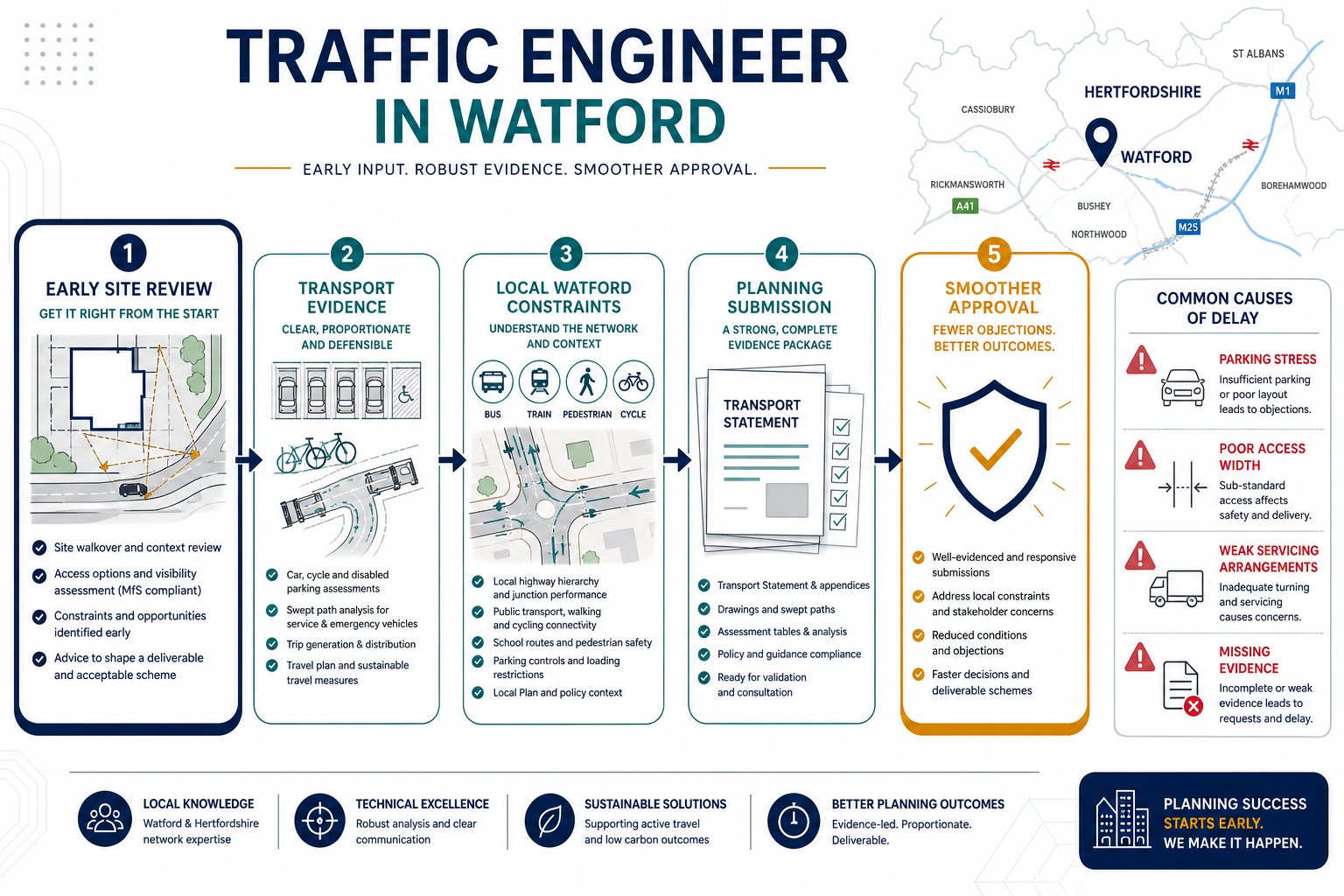
Planning in Watford rarely falls over because of architecture alone. More often, schemes run into trouble when access doesn’t quite work, parking assumptions look optimistic, servicing is squeezed in as an afterthought, or the highway authority asks questions the design team can’t answer quickly. That’s where a traffic engineer in Watford becomes central rather than optional.
We work with architects, planners, developers, surveyors and legal teams who need transport input that is practical, proportionate and tuned to local decision-making. In simple terms, our role is to show that a development can be accessed safely, function properly, and sit within the surrounding network without creating unacceptable impacts. But in practice, that means much more: advising on site layout before it hardens, identifying planning risks early, preparing transport reports that stand up to scrutiny, and helping teams respond fast when comments come back from consultees.
Watford has its own pressures. It combines dense urban streets, strategic movement corridors, bus activity, rail influence, constrained sites and understandable sensitivity around parking, road safety and active travel. That mix means transport evidence has to be locally aware, not copied from a template.
In this guide, we set out what a traffic engineer in Watford actually does, which reports are commonly needed, where applications tend to get delayed, and how to choose support that helps move a scheme forward rather than simply adding another document to the pile.
Key Takeaways
- A traffic engineer in Watford is essential early in the planning process to ensure safe access, realistic parking, and effective servicing that align with local conditions.
- Transport reports in Watford must be tailored and proportionate, ranging from concise Transport Statements to detailed Transport Assessments based on scheme size and local sensitivities.
- Close coordination with Hertfordshire County Council and Watford Borough Council is vital to address planning and highway authority concerns effectively.
- Common planning delays arise from underestimating trip generation, poor access design, and insufficient supporting evidence, all avoidable with early and robust transport input.
- Choosing a traffic engineer with local expertise, clear communication skills, and a proven track record in Watford can significantly streamline planning approval and reduce costly redesigns.
- A strong transport submission in Watford integrates trip evidence, practical access design, and sustainable travel measures, demonstrating the development’s viability and safety to decision-makers.
What A Traffic Engineer In Watford Does For Planning Applications
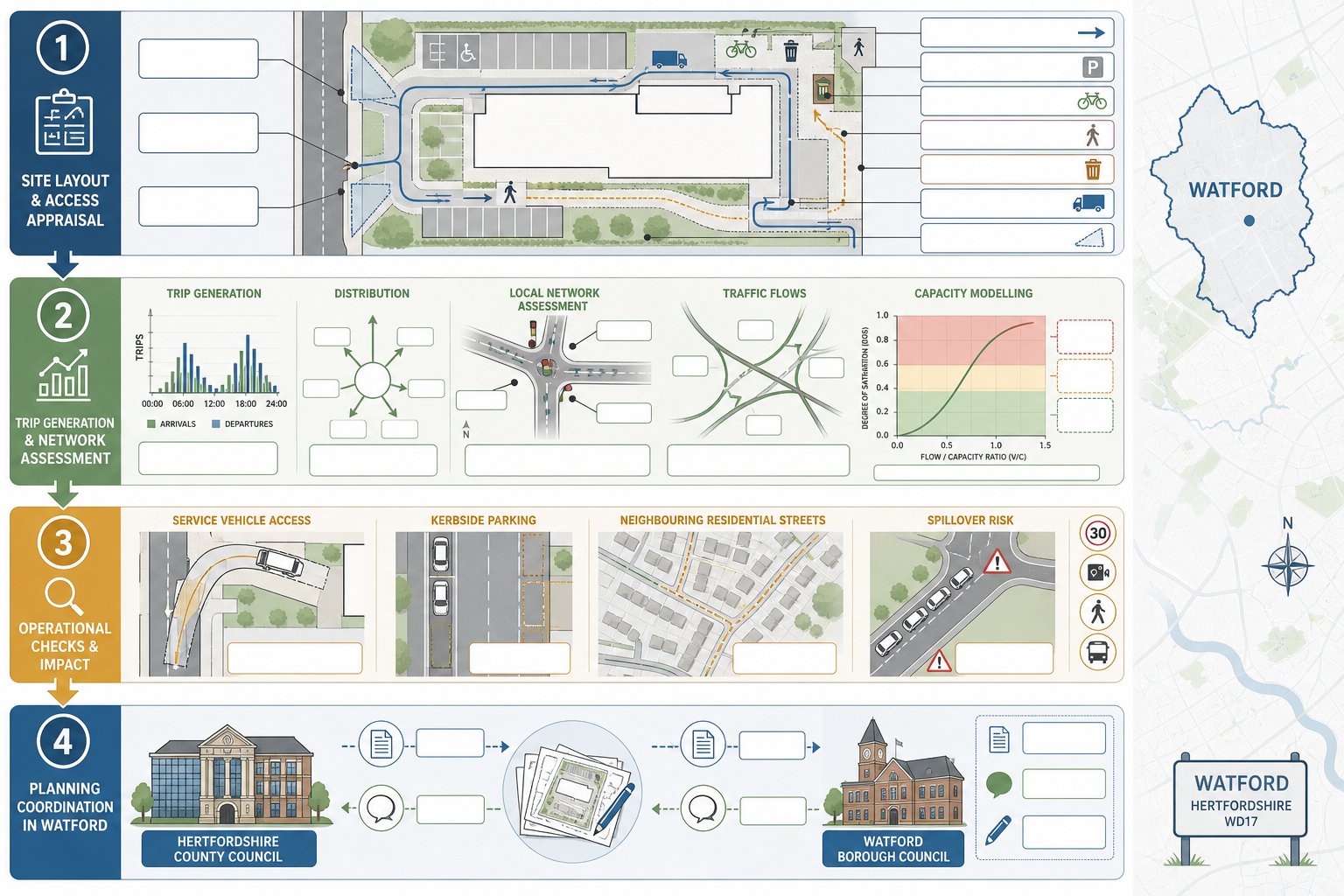
A traffic engineer in Watford supports the planning process by testing whether a development works in transport terms before the application is submitted, and by defending that position once the file is live. That usually starts with the basics: access arrangements, parking provision, cycle parking, refuse collection, delivery movements, pedestrian routes and visibility splays. If one of those elements is weak, it can trigger a highway objection surprisingly quickly.
We also assess how many trips a site is likely to generate, where those trips may go, and whether nearby junctions can accommodate them. Depending on the scale of the proposal, that can involve database review, survey interpretation, junction capacity modelling and reasoned professional judgement. For some schemes, the issue is not headline congestion but something more specific, like whether a service vehicle can turn safely or whether informal parking pressure will spill into neighbouring streets.
Just as important is coordination. In Watford, transport planning often sits between Hertfordshire County Council as highway authority and Watford Borough Council as local planning authority, so advice needs to be clear enough for both audiences. Our work often includes direct liaison, technical responses to consultee comments, and revised drawings that align the transport case with the design team’s wider planning strategy. Broader context from Traffic Engineering Consultants: is useful here, because planning success usually depends on integrated transport thinking rather than a standalone report.
Why Watford Developments Need Transport Input Early In The Design Process
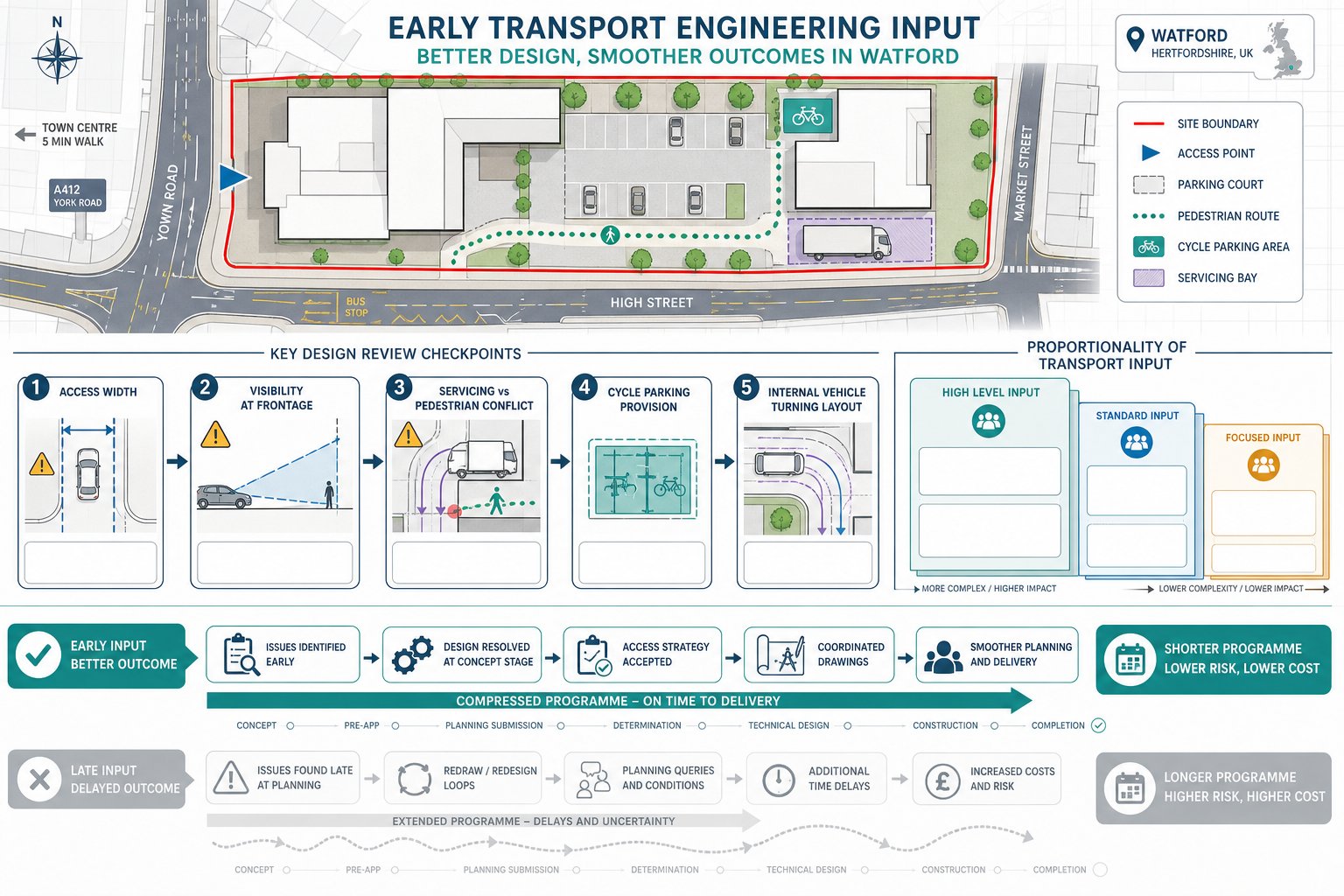
The biggest value we add is often before a formal report is written. Early transport input helps shape the scheme while options are still flexible. Once the red line boundary is fixed, the building massing is agreed and the parking court is drawn, changing access geometry or servicing strategy becomes slower, more expensive and politically awkward.
In Watford, early review can flag classic show-stoppers: a substandard access width, poor visibility at the site frontage, conflict between servicing and pedestrian movement, insufficient cycle parking, or an internal layout that simply won’t accommodate expected vehicle movements. Those issues are much easier to resolve at concept stage than after a planning officer or highway consultee has raised them formally.
Early advice also improves proportionality. Not every site needs a full Transport Assessment with detailed modelling: some need a concise Transport Statement, a focused highways note or a parking technical review. Scoping that correctly avoids overproducing paperwork in one case and under-supporting the application in another. The principles set out in Traffic Engineering and Transportation are especially relevant on constrained urban sites, where land use, movement and access all compete for the same space.
There’s another practical benefit: programme certainty. When transport work is left late, applications can drift because surveys are missing, drawings need redrafting, or the design team discovers that the preferred access strategy is not likely to be accepted. A few hours of informed review at the front end can save weeks later.
Key Transport Reports Commonly Required In Watford
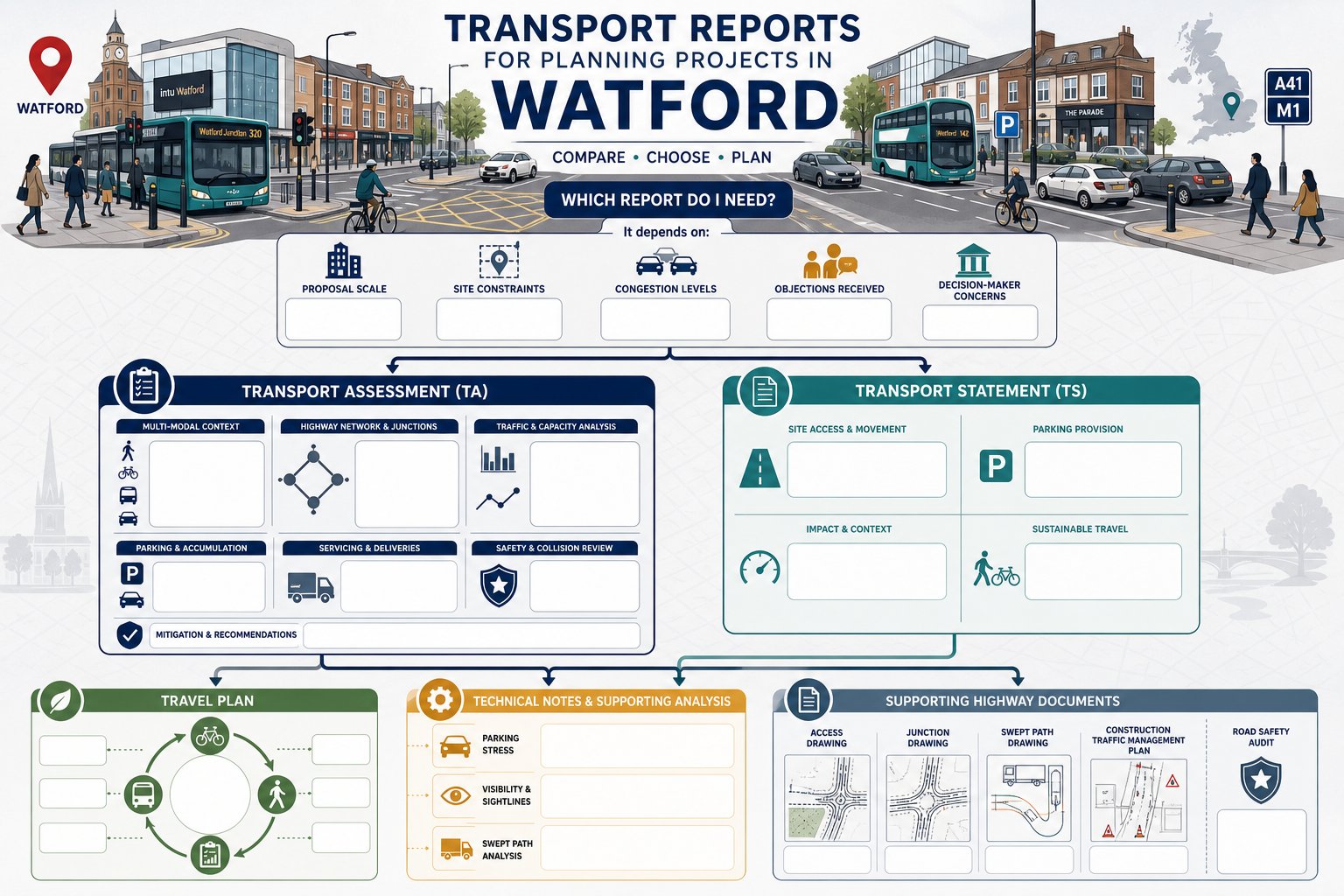
The right report depends on the nature, scale and likely impact of the proposal. In Watford, local context matters just as much as scheme size. A modest development on a constrained town-centre street can attract more scrutiny than a larger site in a less sensitive location, particularly where parking stress, servicing or pedestrian safety are already live issues.
At application stage, transport documents need to do two things well. First, they must answer the authority’s technical questions with evidence. Second, they must do so in a proportionate way that fits the proposal. A submission that is too thin invites objections: one that is bloated but unfocused can be nearly as unhelpful.
Most projects we advise on fall into a familiar set of report types: Transport Assessments or Transport Statements, Travel Plans, technical notes and supporting highway documents such as access drawings, swept path plans, construction traffic information or Road Safety Audit material. On some schemes, one concise note is enough. On others, the package needs to be layered and carefully sequenced.
For teams comparing report types across sectors and authorities, Highway And Traffic provides a useful wider frame. In Watford specifically, the key is not just knowing what each report is called, but understanding why it is needed and what decision-maker concern it is meant to resolve.
Transport Assessments And Transport Statements
A Transport Assessment (TA) is typically required for larger or more impactful proposals, or for sites where local sensitivity means the authority needs a fuller picture of transport effects. A well-prepared TA usually covers baseline conditions, trip generation, trip distribution, assignment assumptions, junction impact, access arrangements, parking, servicing, sustainable travel opportunities, collision review and mitigation. It should explain not only the outputs, but the logic behind them.
A Transport Statement (TS) is usually more proportionate for smaller schemes. It is shorter and less modelling-heavy, but it still needs to be robust. The mistake we sometimes see is treating a TS as a light-touch narrative document. In practice, it still has to address the same core planning questions: can the site be accessed safely, is the parking strategy credible, are likely impacts acceptable, and does the proposal support sustainable travel in context?
In Watford, the line between a TA and TS is not purely numerical. Existing congestion, site constraints, land use intensity and local objections can all influence what level of work is sensible. The strongest documents are tailored, not templated.
Travel Plans, Technical Notes, And Supporting Highway Documents
A Travel Plan sets out how a development will encourage sustainable travel choices over time. For residential schemes, that may focus on welcome packs, cycle facilities, public transport information and monitoring. For offices, education or healthcare uses, it can extend to staff travel surveys, targets, coordinator responsibilities and parking management measures. If written properly, a Travel Plan is not just a policy appendix: it helps show that the transport strategy is active rather than passive.
Technical notes are often decisive in Watford because many applications hinge on one or two specific questions. A parking stress note, a visibility review, a swept path exercise or a short response on servicing can resolve a concern without requiring an entirely new core report. That’s particularly helpful where comments arrive late in the process and the team needs a clear, focused answer.
Supporting highway documents may include access drawings, lining and signing concepts, construction traffic management information, tracking plans, or audit material. The detail matters. A good report can still stall if the drawing package does not show how the strategy works on the ground. For access-led schemes, access design highway guidance is often directly relevant, especially where frontage constraints, vehicle tracking and visibility need to line up precisely.
How Local Highway And Planning Considerations Shape Development In Watford
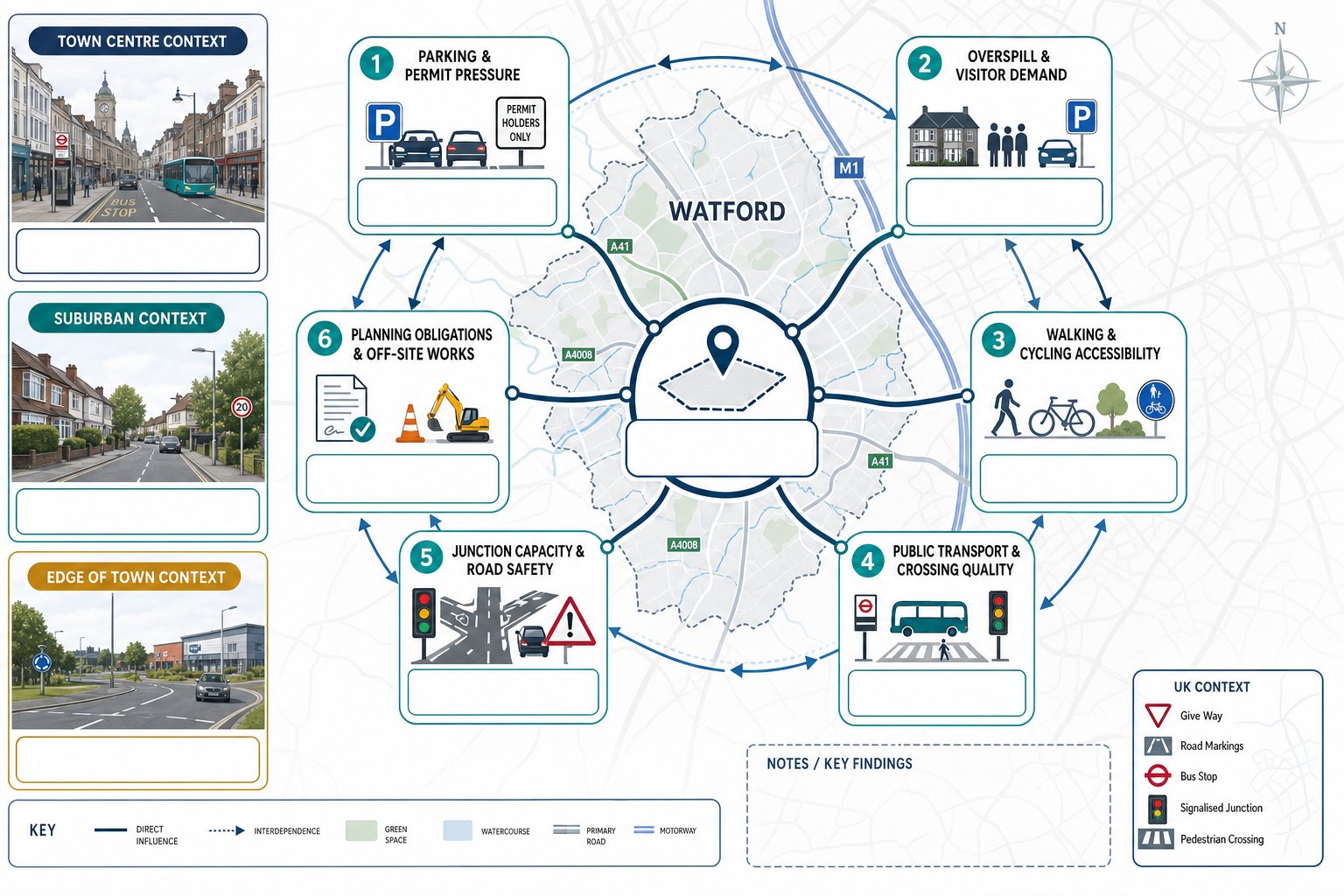
Watford is not assessed in a vacuum. Planning decisions sit within local policy, existing network conditions and the expectations of consultees who know the area well. That means transport strategy has to respond to more than generic national guidance.
Parking is a good example. On many Watford schemes, the debate is not simply about whether parking numbers meet a standard on paper. It is also about local street conditions, permit arrangements, likely overspill, visitor demand, cycle provision and whether the proposal’s location genuinely supports lower car dependency. The same goes for active travel. A statement that a site is “accessible” is rarely enough unless it is backed by realistic walking distances, route quality, crossing opportunities and public transport availability.
Then there is road safety and network performance. Some sites sit near junctions with known pressure points, bus movement constraints or a collision history that makes highway officers understandably cautious. Others involve potential off-site works under section 278, or obligations through section 106 tied to travel planning, monitoring or local improvements. Those requirements can materially affect viability and programme, so they need to be anticipated early.
We also find that urban character matters. Watford includes town-centre, suburban and edge conditions that behave very differently. Assumptions suitable in one part of Hertfordshire may not persuade decision-makers here. Practical grounding in Commercial Traffic Engineering can be especially useful for schemes where delivery activity, customer turnover or shared frontages create operational complexity beyond standard residential metrics.
Typical Schemes That Benefit From Traffic Engineering Advice
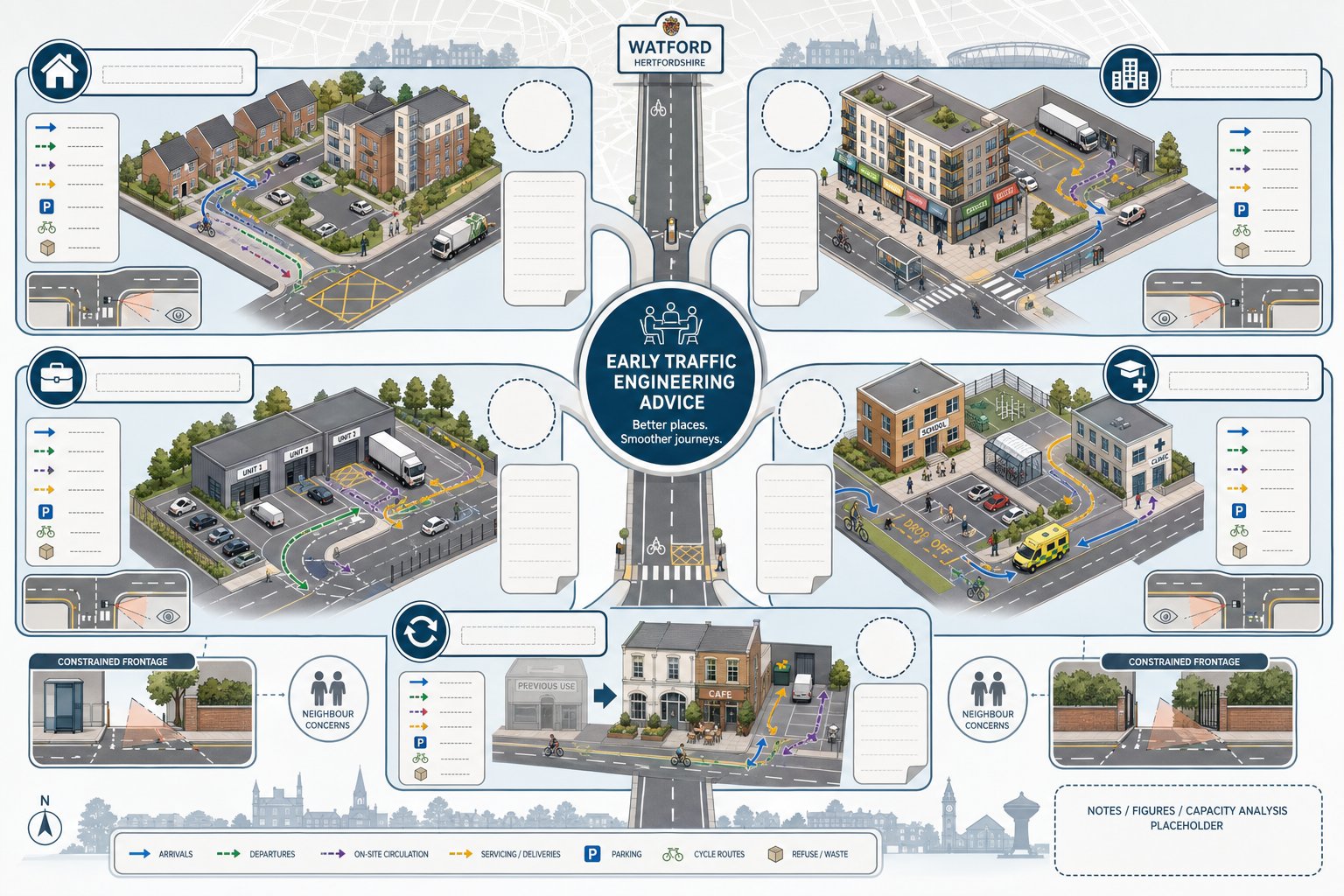
A surprisingly wide range of projects benefit from traffic engineering advice in Watford. Some are obvious, larger housing developments, retail parks, mixed-use regeneration sites. Others look modest on the face of it but raise transport issues that become central once the application is reviewed.
In our experience, the need for advice is driven less by planning label and more by transport consequence. If a scheme changes how people arrive, leave, park, receive deliveries or move around a site, transport input is worth having. And if the site frontage is constrained, near a sensitive junction, or likely to draw neighbour concern, that advice should come early.
Residential, Mixed-Use, And Commercial Developments
Residential schemes often hinge on parking provision, access geometry, refuse collection, emergency access, cycle storage and whether the local road network can absorb the additional movements. Even relatively small developments can become contentious if the parking ratio looks optimistic compared with surrounding street conditions.
Mixed-use schemes are more demanding because they combine movement patterns. Residential arrivals may overlap with retail servicing, office peak trips, evening leisure demand or shared parking assumptions. That requires a transport strategy that is genuinely integrated rather than split into isolated land-use chapters.
Commercial development adds another layer: servicing. Delivery frequency, loading bay design, turning space, staff parking and customer dwell times all need proper testing. For teams working across multiple urban locations, comparisons with a Traffic Engineer In London: context can be informative, but Watford usually demands its own response because site constraints and local expectations differ.
Schools, Healthcare Sites, And Change-Of-Use Proposals
Schools and healthcare sites are often among the most sensitive transport projects because peak movements are concentrated and operationally specific. A school may be acceptable in land-use terms yet still trigger severe concern over drop-off behaviour, walking routes, crossing points and staff parking. Healthcare uses can raise questions about ambulance access, patient turnover, blue badge provision and pharmacy or servicing activity.
Change-of-use proposals are another area where applicants underestimate transport risk. An office-to-residential conversion might appear straightforward until parking demand, cycle storage, refuse collection and altered trip patterns are examined. Likewise, a retail-to-restaurant proposal can transform evening vehicle activity, delivery timing and short-stay parking demand.
In these cases, the transport task is often less about major modelling and more about careful evidence. A clear note, credible survey information and an operationally realistic management plan can make the difference between a smooth determination and months of avoidable back-and-forth.
What A Strong Watford Transport Submission Should Cover
A strong submission is not the longest one. It is the one that gives planners and highway officers confidence that the proposal has been properly tested. In Watford, that usually means starting with a reliable baseline: existing traffic conditions, parking stress where relevant, collision data, site constraints, nearby public transport, and the practical quality of walking and cycling connections.
From there, the core analytical pieces need to be joined up. Trip generation should be evidenced and sensible. Distribution and assignment assumptions should reflect local reality. Any junction assessment should be transparent about methodology and limitations. Access design must tie directly to the submitted drawings, not sit in a report as an abstract concept. Servicing and refuse collection should work in operational terms, with tracking where required.
A good submission also addresses sustainable movement credibly. That includes pedestrian routes, cycle facilities, bus and rail accessibility, and any Travel Plan measures that support mode shift. But credibility is the key word. Authorities are less persuaded by generic sustainability claims than by practical measures suited to the site.
Clarity matters too. We’ve found that concise, structured reporting often performs better than inflated documents full of copied guidance. The wider principles in Traffic Engineering: Your Complete align with this: explain the issue, show the evidence, and demonstrate how the design responds. If mitigation is proposed, it should be specific, deliverable and proportionate, not just a vague promise to fix details later.
Common Issues That Delay Approval And How To Avoid Them
Most transport-related planning delays are predictable. They usually stem from under-scoped work, weak evidence, or a mismatch between what the drawings show and what the report claims. The frustrating part is that many of these problems are avoidable with early coordination.
One common issue is underestimating trips. If generation assumptions feel artificially low, officers will question the entire submission. The same applies to parking. A layout may technically provide the required number of spaces but still fail if bays are impractical, disabled provision is weak, cycle parking is poor, or likely overspill has not been addressed.
Another frequent problem is access design. We regularly see schemes delayed because visibility splays are unclear, tracking has not been provided, kerb radii are wrong for the expected vehicle type, or pedestrian priority across access points has not been thought through. Those are not cosmetic details: they go to the heart of highway safety and operability.
Then there is missing evidence. An application may mention servicing, construction traffic, or sustainable travel, but without the drawing, note or management detail needed to support the statement. Once consultees ask for that information, determination can slow sharply.
The practical fix is straightforward: scope early, gather robust local data, coordinate closely with the architect, and respond to consultee comments directly rather than defensively. Experience from a Traffic Engineer In Manchester: setting shows the same pattern, but in Watford the compressed urban form often makes these details even less forgiving.
How To Choose The Right Traffic Engineer In Watford
Choosing the right consultant is partly about qualifications, but not only that. Yes, you want a suitably experienced transport or highways professional with UK development-planning expertise, sound knowledge of recognised guidance, and the technical ability to prepare or review modelling, access design and supporting reports. But competence on paper is only the starting point.
For Watford work, local judgement matters. We would look for someone who understands how Hertfordshire highway considerations interact with borough planning concerns, knows when a concise note is enough and when a fuller assessment is wiser, and can speak plainly to architects, planners, solicitors and decision-makers without hiding behind jargon.
Track record is important too. Has the consultant supported applications in Hertfordshire or similar urban authorities? Can they show examples across residential, commercial, education or change-of-use schemes? Are their reports readable and proportionate, or dense and defensive? Fast turnaround helps, but speed is only valuable if the advice is accurate.
We’d also weigh responsiveness. Planning applications move in bursts: pre-app comments land unexpectedly, drawings change late, committee deadlines tighten. A good traffic engineer in Watford should be able to adapt quickly, coordinate with the wider team and, where needed, liaise directly with council officers to resolve technical points before they harden into formal objections.
That blend of technical depth, local awareness and practical communication is what turns transport work from a compliance exercise into real planning support.
Conclusion
In Watford, transport input is rarely a box-ticking extra. It shapes whether a scheme can be accessed safely, whether parking and servicing work in practice, and whether the planning case feels credible to officers, consultees and neighbours. The earlier that work starts, the more useful it becomes.
For architects, planners, developers and legal teams, the goal is not simply to produce a Transport Assessment or Statement because a list says one may be needed. It is to submit a transport case that is proportionate, evidence-based and clearly tied to the design. Done properly, that reduces redesign, shortens technical debates and improves the chances of a smoother determination.
A capable traffic engineer in Watford brings more than modelling or drawings. We bring local judgement, realistic risk identification and the ability to turn transport concerns into workable solutions. And in a planning environment where delays are expensive, that can make a very real difference.
FAQs About Traffic Engineers in Watford
What does a traffic engineer in Watford do for planning applications?
A traffic engineer in Watford assesses access, parking, servicing, and visibility splays to ensure safe and functional development. They analyse traffic generation, junction capacity, and work closely with Hertfordshire County Council and Watford Borough Council to support planning approvals.
Why is early transport input important in Watford developments?
Early transport input identifies potential issues like substandard access or parking shortfalls before plans are fixed. This proactive advice reduces redesign costs, avoids late objections, and ensures the transport strategy fits local policy and site constraints.
What types of transport reports are commonly required in Watford?
Common reports include Transport Assessments for larger schemes, Transport Statements for smaller proposals, Travel Plans to promote sustainable travel, technical notes addressing specific issues, and supporting documents like access drawings and Road Safety Audits.
How do local highway and planning considerations affect developments in Watford?
Developments must align with local parking standards, active travel priorities, and road safety policies. Considerations include existing congestion, collision history, and obligations under section 278 or 106 works, which influence viability and design requirements.
Which developments in Watford typically need traffic engineering advice?
Residential, mixed-use, and commercial projects often require input, as do schools, healthcare sites, and change-of-use proposals. Any scheme affecting access, parking, servicing, or local junctions benefits from expert transport assessment.
How should I choose the right traffic engineer in Watford?
Select a chartered transport or highways professional with UK planning experience and a track record in Hertfordshire. They should provide clear, proportionate reports, understand local policies, and communicate effectively with planning authorities and design teams.