
With planning fees in England having increased by 3.8% in April 2026, can your project afford a transport objection that forces a costly and time-consuming resubmission? It’s a common frustration for developers when transport planning becomes a barrier rather than a facilitator. The technical complexity of TRICS data and Swept Path Analysis often leads to regulatory delays, while unexpected highway authority requirements can quickly erode your project’s contingency budget. You need a strategy that prioritizes precision and compliance from the very first assessment.
We recognize that navigating these logistical and regulatory pressures is a high-stakes task. This guide provides the technical authority you need to master the complexities of the planning system and secure your permission. We’ll deliver a clear roadmap of the required documentation, from Transport Statements to Travel Plans, ensuring your site layout is fully optimized for vehicle access. By the end of this article, you’ll understand how to align your submission with the Summer 2026 NPPF updates and eliminate the risk of transport-related objections.
Key Takeaways
- Understand how the National Planning Policy Framework influences local requirements to ensure your project aligns with national standards from the outset.
- Learn the scale-based thresholds used to determine if you’ll require a Transport Statement or a full Transport Assessment.
- Integrate technical tools like Swept Path Analysis during design. This creates robust applications that are difficult for authorities to challenge.
- Identify the differences between Section 278 and Section 38 agreements to manage highway works and mandatory sustainability requirements effectively.
- Choose a transport planning partner with local expertise to secure planning permission and avoid regulatory delays.
What is Transport Planning in the Context of UK Development?
Transport planning isn’t just about drawing lines on a map; it’s the critical technical integration of land use and physical infrastructure. In the UK, it serves as the functional blueprint for how people move between homes, workplaces, and essential services. A successful strategy ensures that a new development doesn’t exist in isolation. Instead, it must integrate seamlessly into the existing highway network while maintaining safety and efficiency for all users.
National policy, specifically the National Planning Policy Framework (NPPF), sets the standard for these requirements. With a significant update to the NPPF expected in Summer 2026, the emphasis on connectivity-led planning is sharper than ever. Local authorities use these national guidelines to judge whether a project is sustainable. If your transport planning strategy fails to demonstrate safety or capacity, the application will likely face a refusal before other design elements are even considered. It’s your first line of defence against costly planning objections.
To better understand the core principles of this process, watch this helpful overview:
It’s vital to distinguish between strategic and development-led planning. Strategic planning is typically managed by government bodies to oversee regional infrastructure and long-term network growth. In contrast, development planning is a specialized consultancy service focused on securing permissions for specific sites. This is where precision becomes a functional necessity. We bridge the gap between your commercial goals and the strict regulatory requirements of the Local Highway Authority, ensuring every technical detail is addressed.
The Core Objectives of a Transport Planning Consultant
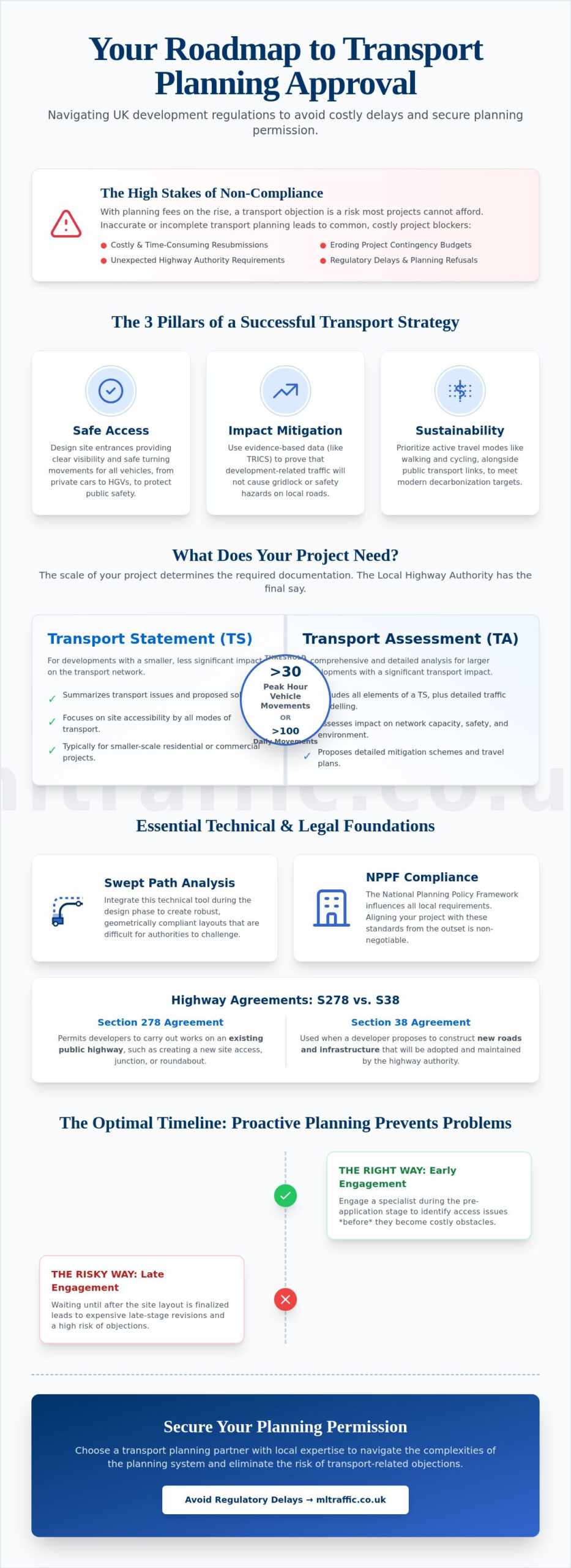
A consultant’s primary role is to protect the safety of the public and the viability of the project. We focus on three non-negotiable pillars to ensure a site is fit for purpose:
- Safe Access: We design site entrances that provide clear visibility and safe turning movements for all vehicles, from cars to heavy goods vehicles.
- Impact Mitigation: We use evidence-based data to prove that development-related traffic won’t cause gridlock or safety hazards on local roads.
- Sustainability: We prioritize active travel modes like walking and cycling, alongside public transport links, to meet modern decarbonization targets.
When Should You Engage a Transport Planner?
Don’t wait until you’ve finalized your site layout to seek expert advice. Engaging a specialist during the pre-application stage allows us to identify “red flag” access issues before they become permanent obstacles. This proactive input informs the initial car park design and site access points. By resolving these technical challenges early, you avoid expensive late-stage design revisions and significantly reduce the risk of a highway authority objection. Early involvement is the most efficient way to manage your project’s long-term costs and timelines.
Transport Statements vs. Transport Assessments: Which Do You Need?
Determining whether your development requires a Transport Statement or a full Transport Assessment is a critical first step in the planning process. The decision is primarily based on the scale of the project and the volume of vehicular traffic it’s expected to generate. While national guidelines provide a framework, the Local Highway Authority (LHA) holds the final say on which report is necessary for your specific site. These documents provide the technical evidence base that planning officers use to recommend approval. Producing an accurate, data-driven report is essential for securing Transport for planning permission without facing costly delays or technical objections.
The thresholds for these reports are often determined by the potential impact on the local road network. A common industry benchmark used by many LHAs suggests that a full assessment is required if a development generates more than 30 vehicle movements in the peak hour or 100 in a single day. However, these figures aren’t fixed. A small development in a sensitive or congested urban area might still trigger the need for a more detailed analysis. This technical nuance is why professional transport planning is a functional necessity for modern developers who want to avoid regulatory friction.
Transport Statements: For Smaller Scale Developments
Transport Statements are designed for projects with limited highway impact. Typical examples include small residential schemes, minor retail changes, or office refurbishments. These reports focus on three core areas: the existing site conditions, the safety of the proposed access, and a simplified prediction of trip generation. Even for smaller projects, the requirements can vary significantly by geography. For instance, a Transport Statement London must often adhere to stricter “Healthy Streets” principles compared to regional requirements. We ensure your report meets these specific local standards to streamline the approval process.
Transport Assessments: For Major Development Projects
Major developments require a comprehensive Transport Assessment. This is a deep technical analysis of significant traffic impacts and junction capacity across a wider area. We utilize the TRICS database to predict multi-modal trip generation, ensuring the data is robust enough to withstand scrutiny from highway officers. These assessments also address the cumulative impact of your project alongside other developments in the vicinity. Adhering to the professional standards set by the Chartered Institution of Highways and Transportation is essential to ensure your submission is respected by statutory consultees. If you’re unsure which report your project needs, we can help you identify the correct documentation during a pre-application review.
Technical Analysis: The Foundation of Sound Transport Planning
Data-driven evidence is the most effective way to overcome subjective objections from local authorities. When a submission relies on rigorous technical analysis, it shifts the conversation from opinion to objective fact. This level of precision is essential in modern transport planning, where every square metre of site layout must be technically justified. By providing quantifiable proof of safety and capacity, you create a robust application that’s far more resilient during the consultation phase. Local authorities are far less likely to challenge a proposal when it’s supported by verified data and industry-standard simulations.
Our technical approach ensures that your site layout is optimized for both safety and commercial viability. We use evidence to prove the feasibility of essential services, such as fire tender and refuse vehicle access, which are often the first points of scrutiny for highway officers. By addressing these operational requirements through data, we reduce the risk of late-stage design changes that can compromise your project’s timeline or budget.
Swept Path Analysis (SPA) and Vehicle Manoeuvrability
We integrate Swept Path Analysis Services directly into the design phase to prevent costly design errors. Using specialized CAD software, we simulate the movement of specific vehicles to ensure they can navigate the proposed layout without incident. This is particularly vital for proving fire tender access and refuse vehicle manoeuvrability. Demonstrating that the largest expected vehicles can turn safely protects pedestrian zones and prevents structural damage to the built environment. It provides the highway authority with the absolute certainty they require regarding site safety and operational efficiency.
Traffic and Parking Surveys: The Lambeth Methodology
In high-density urban environments, parking stress is a frequent point of contention for residents and planners alike. We conduct detailed Parking Surveys to establish an accurate baseline of current demand within a 200m radius of your site. Our team utilizes the Lambeth Methodology, which remains the recognized gold standard for London-based surveys. This involves conducting “beat” surveys during peak stress times to measure exactly how much on-street space is available. This data is crucial for justifying parking-light or car-free developments, especially in areas with high Public Transport Accessibility Levels (PTAL). By proving that a development won’t overstrain local street capacity, we remove a major hurdle to your planning approval.
Technical analysis isn’t just a box-ticking exercise; it’s a strategic tool that optimizes your site’s footprint while ensuring full compliance with safety standards. Whether you’re designing a complex urban infill or a large commercial hub, data-backed transport planning ensures your project is both viable and safe from day one.
Navigating Statutory Requirements: S278, S38, and Travel Plans
Statutory requirements are the legal framework that turns technical designs into physical infrastructure. This phase of transport planning is often where developers encounter the most significant financial and regulatory pressure. Highway officers may request extensive modifications or substantial financial contributions through Section 106 agreements. We help you manage these demands to ensure they remain proportionate to your development’s actual impact. Precision is a functional necessity here. Without a clear understanding of the legal landscape, you risk agreeing to highway works that can compromise your project’s bottom line.
The most common developer objection we hear is that highway requirements are making a site unviable. This usually happens when authorities demand over-engineered road designs or excessive junction improvements. We counter this by using the precise data from your Transport Assessment to negotiate more cost-effective solutions. By applying the latest standards from the Manual for Streets or the Design Manual for Roads and Bridges, we ensure that every requested modification is technically justified and commercially realistic. If you are facing excessive highway demands, consult our team to review your statutory requirements and protect your site’s viability.
Section 278 (S278) and Section 38 (S38) Agreements
Section 278 and Section 38 agreements, governed by the Highways Act 1980, are the standard legal instruments for highway works. A Section 278 agreement is mandatory when you need to modify the existing public highway, such as creating a new site access or improving a nearby junction. Conversely, a Section 38 agreement allows the local highway authority to adopt new roads built within your development. This process ensures the roads are constructed to a specific standard before they become public property. For a comprehensive breakdown of these processes, see our guide on Highway Design S278 & S38.
Travel Plans: Beyond the Planning Permission
Travel Plans are critical for reducing the long-term carbon footprint of a development. They move beyond the initial planning submission to influence how residents and staff move daily. Depending on the scale and nature of your project, you may require a Framework, Full, or Workplace Travel Plans. These are living documents that include actionable strategies to promote walking, cycling, and public transport use. Monitoring and management are essential post-occupation. We ensure your plan remains effective and compliant with local targets, preventing future regulatory friction. Our approach focuses on creating realistic targets that genuinely promote sustainability without placing an undue burden on the developer.
Choosing the Right Transport Planning Partner for Your Project
Selecting a consultancy isn’t just about technical capability; it’s about finding a partner that understands the nuances of local government. Every Borough or Council has specific highway requirements that aren’t always found in national manuals. Local knowledge allows a consultant to anticipate these preferences, reducing the risk of a “back-to-the-drawing-board” scenario. A combined approach that integrates traffic engineering with transport planning is far more efficient than hiring separate specialists. It ensures that the technical data from your Swept Path Analysis informs the final Transport Statement without any loss of detail or delay.
Precision is a functional necessity when your project’s timeline is at stake. A “right-first-time” technical report is the most effective way to avoid planning delays and keep your development on track. When local authorities receive a report that is professionally formatted and technically sound, it builds immediate trust. ML Traffic Engineers UK focuses on delivering high-quality documentation that streamlines the what we do process, allowing you to focus on the broader aspects of your development.
What to Look for in a Transport Consultancy
- Relevant Experience: Ensure the team has a proven track record with similar project types and scales. This experience is vital for navigating complex urban sites.
- Responsiveness: You need a partner that can handle urgent pre-application queries and adapt to rapid design changes as they occur.
- Accreditation: Professional membership in bodies like the Chartered Institution of Highways and Transportation (CIHT) or the Transport Planning Society (TPS) is a non-negotiable sign of quality and adherence to standards.
How ML Traffic Engineers UK Delivers Planning Success
We provide expert preparation of Transport Statements and Assessments for projects across England. Our in-house technical capabilities for Swept Path Analysis and Traffic Surveys mean we control the quality and speed of the data collection process. This integrated model allows us to produce safety-conscious reports that Local Authorities trust. We understand the high-stakes nature of infrastructure development and provide the unwavering reliability you need to secure your planning permission. By managing the full project lifecycle from inception to completion, we reduce the logistical and regulatory pressures on your team.
If you’re ready to secure your site’s access and optimize your layout, contact ML Traffic Engineers UK for a project-specific quote today. Our team is ready to provide the technical authority your project requires.
Secure Your Planning Approval with Technical Precision
Effective transport planning transforms regulatory hurdles into strategic design advantages. By integrating data-driven technical analysis and navigating statutory requirements with precision, you eliminate the risk of costly objections. Whether your project requires a detailed Transport Statement or a comprehensive Swept Path Analysis, our team ensures every technical detail aligns with current UK and London-specific regulations. Mastery of these complexities is what separates a stalled application from a successful development.
Founded in 2014, ML Traffic Engineers UK brings over a decade of planning success to your project. We’re specialists in Transport Statements and Swept Path Analysis, providing the technical authority needed to protect your site’s viability and safety. Our experts understand the intricacies of both UK-wide and London-specific highway regulations, ensuring your submission is robust and reliable from the start. Don’t let highway objections stall your progress when expert support is available.
Request a Transport Planning Quote for Your Project
We’re ready to help you secure your planning permission and optimize your site’s accessibility with confidence.
Frequently Asked Questions
Is a transport statement the same as a transport assessment?
No. A Transport Statement is a simplified report for smaller developments with limited highway impact, while a Transport Assessment is a comprehensive technical study for major projects. Local authorities typically require the more detailed assessment if a site generates significant traffic, often over 30 two-way movements in peak hours. We help you identify which document is necessary based on your specific development scale and location.
When is a swept path analysis required for a planning application?
A swept path analysis is necessary when you must demonstrate that a specific vehicle can safely manoeuvre through your site or access point. It’s a functional requirement for proving fire tender access, refuse vehicle routing, and delivery bay viability. Planning officers use these simulations to ensure your layout doesn’t create safety hazards or structural damage risks. This analysis is especially critical for tight urban infill projects.
How much does a transport planning consultant cost in 2026?
Costs for these services vary based on the project’s technical complexity and the specific documentation required by the local authority. Factors that influence the total fee include the development’s scale, the need for specialized traffic surveys, and the depth of the required transport planning report. Because every site has unique highway constraints, we recommend requesting a project-specific quote to ensure all regulatory requirements are covered accurately.
Do I need a travel plan for a small residential development?
Requirements for a travel plan depend on the thresholds set by your Local Planning Authority. While very small schemes often avoid this requirement, many councils now request a “Travel Plan Statement” for minor developments to promote sustainable travel. These documents outline how residents will be encouraged to use cycling, walking, or public transport. We check your local policy during the pre-application stage to prevent unexpected delays.
What is the TRICS database and how is it used in transport planning?
TRICS is the industry-standard national system used to predict the number of trips a new development will generate. It contains thousands of survey records from existing sites across the UK. In transport planning, we use this data to provide an evidence-based forecast of how your project will affect the local road network. This objective data is harder for authorities to challenge than subjective estimates, making it vital for successful applications.
Can a transport planner help with parking survey requirements in London?
Yes, we specialize in conducting parking surveys using the Lambeth Methodology, which is the recognized standard for most London Boroughs. These surveys measure overnight parking stress within a 200m radius of your site. The results provide the technical evidence needed to justify parking-light or car-free developments. This is particularly important in high PTAL areas where local residents may have concerns about overspill parking on public streets.
What happens if the Highway Authority objects to my planning application?
An objection from the Highway Authority often leads to a refusal unless the technical concerns are resolved immediately. We act as your advocate, negotiating with highway officers to address their specific objections through design revisions or additional data. This process might involve providing a more detailed swept path analysis or a revised site access plan. Quick, evidence-based responses are essential to keep your application moving toward a positive recommendation.
How long does it take to prepare a full Transport Assessment?
Preparation usually takes between two and four weeks, though this depends on the availability of current traffic and parking data. If your project requires new on-site surveys, the timeline must account for the data collection period. We prioritize efficiency to meet your submission deadlines while ensuring every technical report meets the strict standards of the local authority. Early engagement allows us to identify and resolve potential issues before they impact your schedule.

Disclaimer
The content on mltraffic.co.uk, including all technical articles, guides, and resources, is provided for general informational and educational purposes only. It is not intended to constitute professional advice in traffic engineering, transportation planning, development approvals, or any other technical or legal field.
While ML Traffic Engineers makes every reasonable effort to ensure the accuracy, completeness, and timeliness of the information published, we do not provide any warranties or representations (express or implied) regarding its reliability, suitability, or availability for any particular purpose. Any reliance you place on the content is strictly at your own risk.
In no event shall ML Traffic Engineers, its directors, employees, authors, or affiliates be liable for any direct, indirect, incidental, special, consequential, or punitive damages (including, without limitation, loss of profits, data, or business opportunities) arising out of or in connection with the use of, or inability to use, any information provided on this website.
The articles and guides on this site are not a substitute for engaging a qualified, professional traffic engineer to assess your specific project requirements. For tailored advice, compliance assessments, or traffic engineering services, please contact a competent professional.
This disclaimer may be updated from time to time without notice. By accessing or using this website, you agree to be bound by the most current version of this disclaimer.