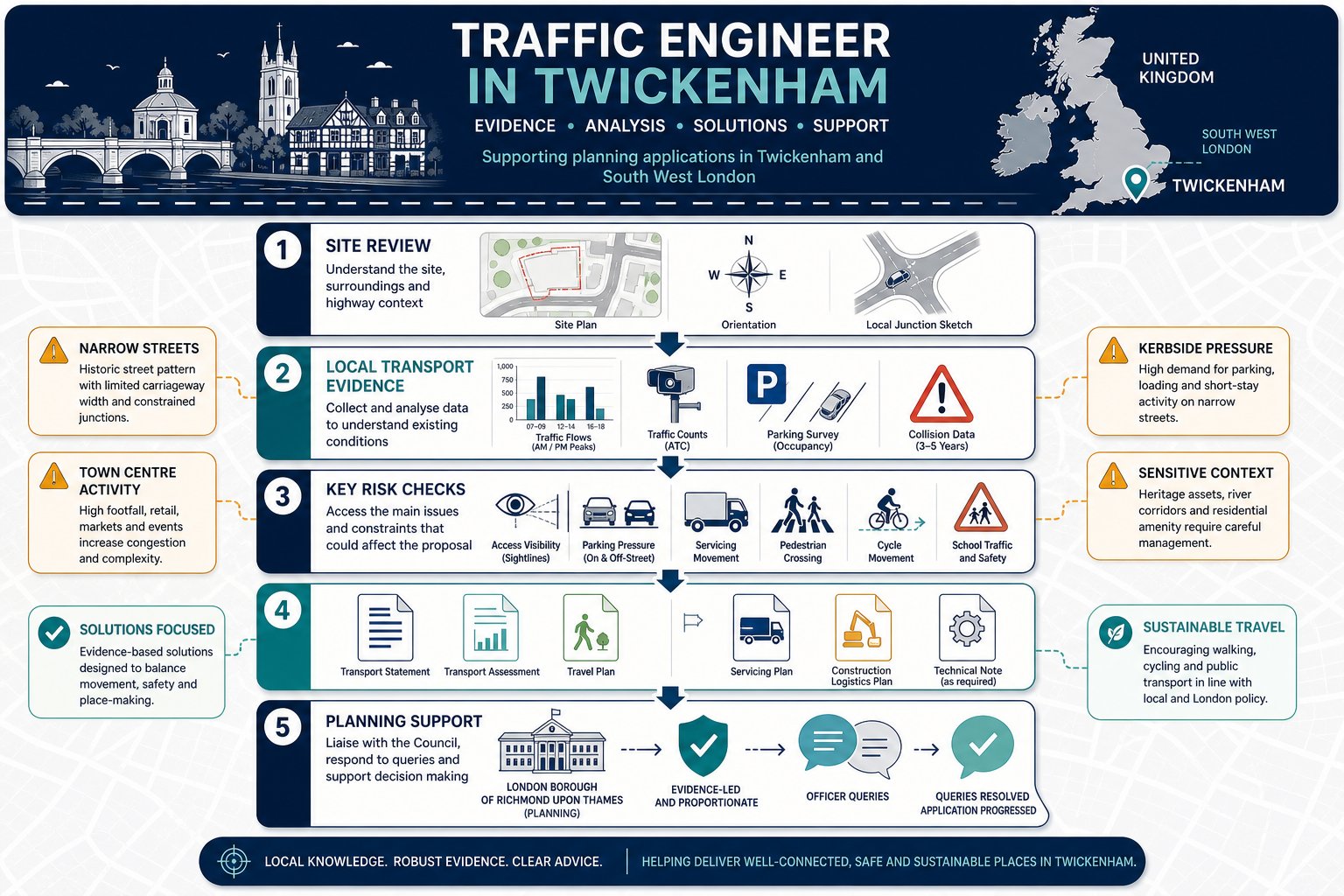
Planning in Twickenham rarely fails because a scheme looked fine on paper. More often, it stalls because the transport case wasn’t strong enough, wasn’t local enough, or arrived too late. That matters in a part of London where constrained streets, town centre activity, school traffic, parking pressure and sensitive highway conditions can turn a modest proposal into a detailed transport discussion very quickly.
That’s where a Traffic Engineer in Twickenham becomes central to the planning team. We help architects, planners, surveyors, lawyers, developers and councils translate a development proposal into robust transport evidence that local highway officers can assess with confidence. In practice, that means testing assumptions, identifying risks early, shaping access and servicing strategies, and producing the right reports in the right level of detail.
Twickenham schemes often sit at the intersection of borough policy, London-wide guidance, local movement patterns and practical design constraints. A blanket approach doesn’t work. What usually does work is proportionate analysis, clear reporting, and recommendations grounded in the realities of the site and surrounding network.
In this guide, we set out what a traffic engineer does for planning applications in Twickenham, the issues most likely to draw scrutiny, the reports commonly required, and how local experience can help keep submissions moving. If you need planning support in 2026, the transport piece is rarely an add-on: it’s often one of the parts that decides the pace of the whole application.
Key Takeaways
- Engaging a Traffic Engineer in Twickenham early ensures transport issues are identified and addressed before planning submissions, preventing costly delays.
- A strong transport evidence base, tailored to local Twickenham conditions, is essential for convincing highway officers and supporting planning applications effectively.
- Transport reports such as Transport Statements, Assessments, Travel Plans, and Delivery and Servicing Plans should be proportionate to the development scale and aligned with local expectations.
- Addressing local transport challenges—including access safety, parking demand, servicing logistics, and active travel integration—is crucial for smooth planning approval in Twickenham.
- Local experience and knowledge of Twickenham’s specific transport patterns help create credible, concise submissions that reduce objections and expedite approvals.
- Transport planning in Twickenham must balance vehicle impact with support for sustainable movement modes to meet borough and London-wide policies.
What A Traffic Engineer In Twickenham Does For Planning Applications
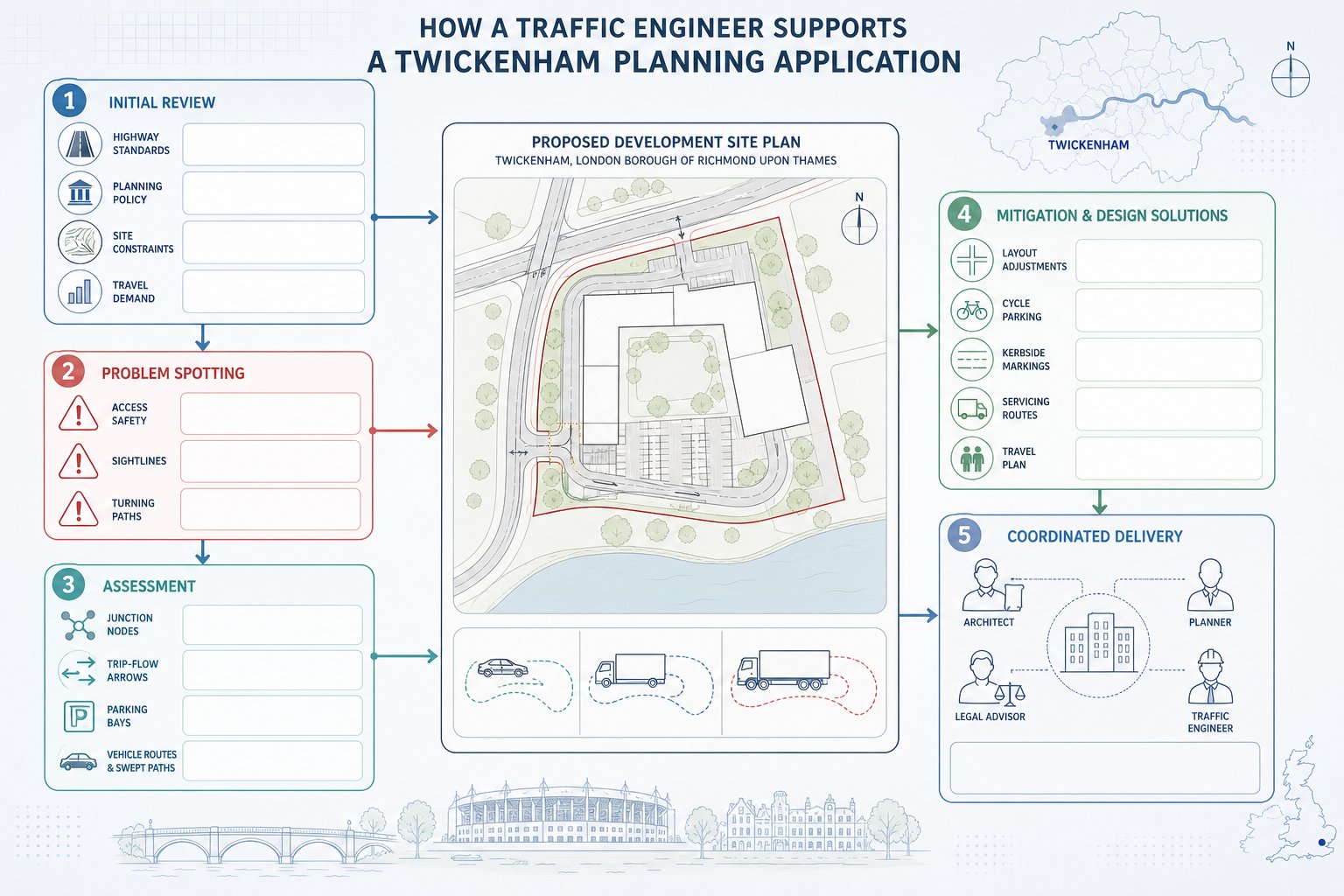
A Traffic Engineer in Twickenham provides the technical transport input that turns a planning proposal into an evidence-backed submission. At the most basic level, we review the development against highway standards, planning policy, site constraints and expected travel demand. But the real value is earlier than that: spotting the transport problems that might trigger objections before the application is fixed.
For some sites, that means checking whether the proposed access works safely, whether visibility is achievable, and whether refuse or delivery vehicles can turn within the site. For others, it means forecasting trips, assessing junction effects, reviewing parking demand, or explaining why the impact is low enough for a concise statement rather than a full assessment.
We also advise on mitigation. That might include amendments to site layout, changes to servicing arrangements, cycle parking improvements, travel plan measures, kerbside management, or a more realistic parking strategy. On tighter schemes, small technical adjustments can make the difference between a highways objection and a manageable condition.
The role is part engineering, part planning support. Our work often sits alongside architects, planning consultants and legal teams, and it needs to be coordinated. Broader Traffic Engineering and Transportation input is useful here because transport issues rarely exist in isolation from layout, frontage design, or operational use. And when the project needs a wider view of how specialist advisers fit into the process, experienced Traffic Engineering Consultants: can help frame the right scope from the outset.
Why Twickenham Developments Need A Strong Transport Evidence Base
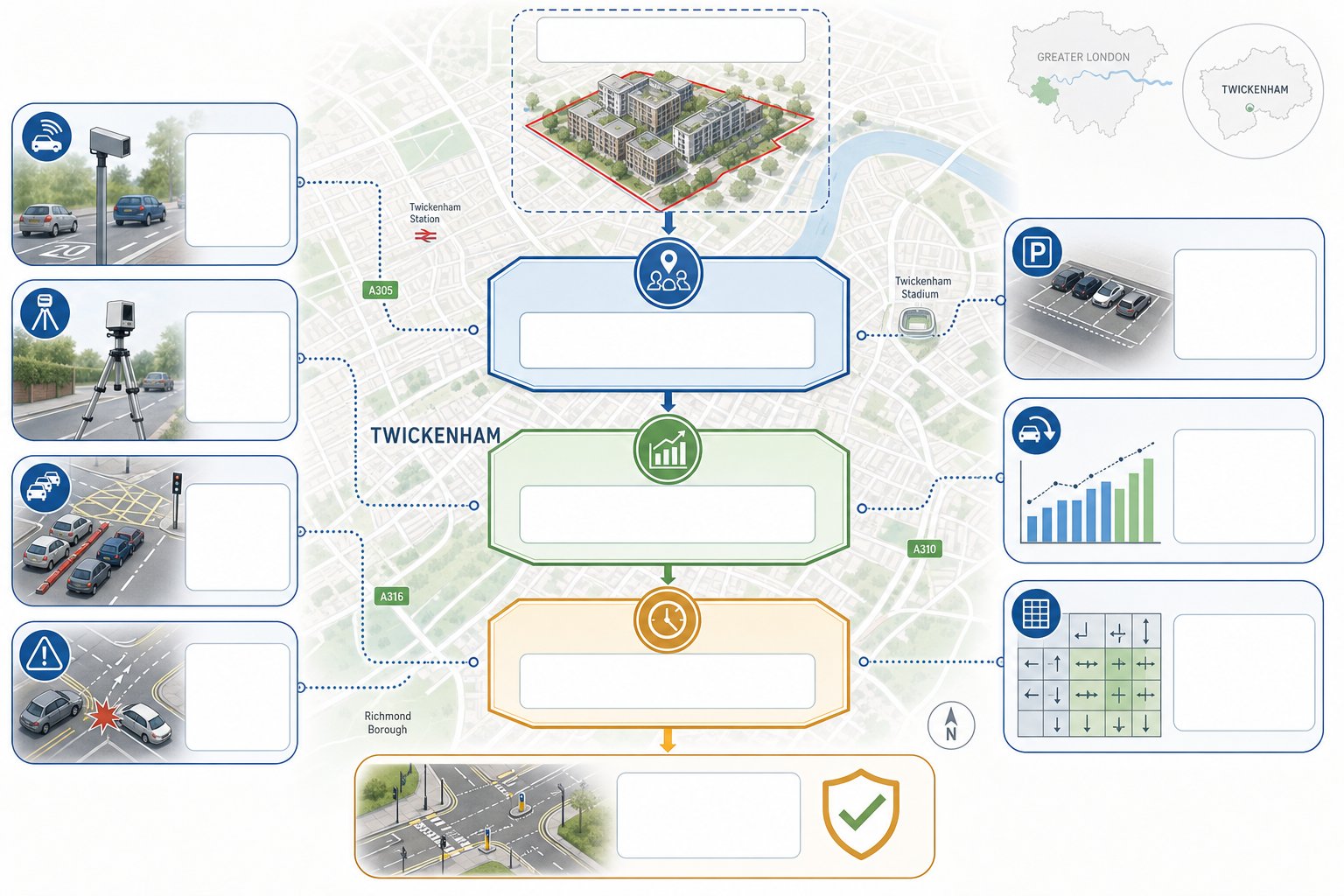
Twickenham is not a location where vague transport assumptions survive for long. Planning officers and highway authorities typically want quantified, site-specific evidence: how many trips the development is likely to generate, where they will come from, what times matter, whether nearby junctions can cope, and whether the proposal creates or worsens safety issues.
A strong transport evidence base does three things. First, it demonstrates that the development has been understood in context rather than treated as a generic site. Second, it gives decision-makers something measurable to rely on when balancing benefits and impacts. Third, it protects applicants from avoidable delays caused by requests for further surveys, technical clarifications or revised mitigation.
That evidence can include traffic counts, automatic traffic surveys, queue observations, collision data, parking beat surveys, trip generation analysis, and junction modelling where material effects are likely. The level of work should be proportionate. Over-reporting can be as unhelpful as under-reporting if it clouds the key points. But underpowered evidence is usually what causes trouble.
In practice, a robust evidence base is also strategic. It allows us to justify why a scheme should be considered acceptable, why certain impacts are negligible, or why targeted mitigation is enough. For larger or more sensitive proposals, a focused traffic impact assessment often becomes the document that anchors the wider planning case.
Key Planning And Transport Issues Commonly Raised In Twickenham
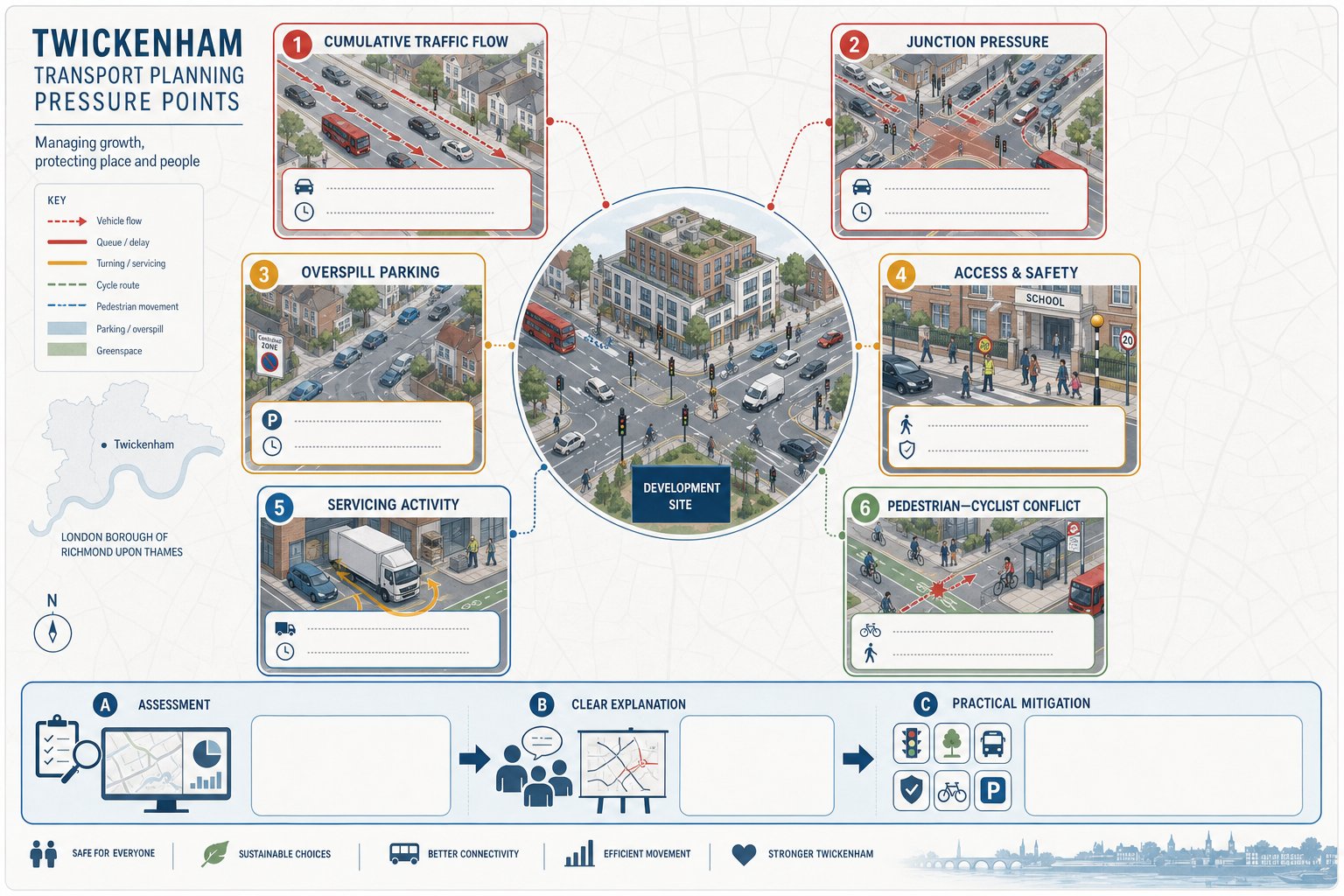
Twickenham brings together many of the transport concerns that appear across outer London, but in a locally concentrated way. Corridors can be busy without being obviously strategic. Residential streets can look calm off-peak and still experience severe parking stress or school-run conflict at the exact times a proposal matters most. Town centre locations may benefit from public transport accessibility while still facing scrutiny over servicing, kerbside demand and pedestrian safety.
The issues we see most often include cumulative traffic effect, pressure on nearby junctions, overspill parking into controlled or lightly managed streets, access safety, and conflicts between vehicles and vulnerable road users. Councils will also look closely at whether a proposal supports mode shift rather than quietly defaulting to car-based assumptions.
A recurring mistake is treating transport as one question. It is usually several: can people arrive safely, can vehicles operate safely, can servicing happen without disruption, and does the proposal align with local movement priorities? Those questions may overlap, but they are not identical.
For planning teams, the key is to address likely concerns directly and in plain terms. A technically correct report that ducks the obvious local issue tends to invite follow-up queries. A concise report that identifies the pressure points, explains them properly and proposes workable responses usually performs better.
Access, Parking, Servicing, And Highway Safety Constraints
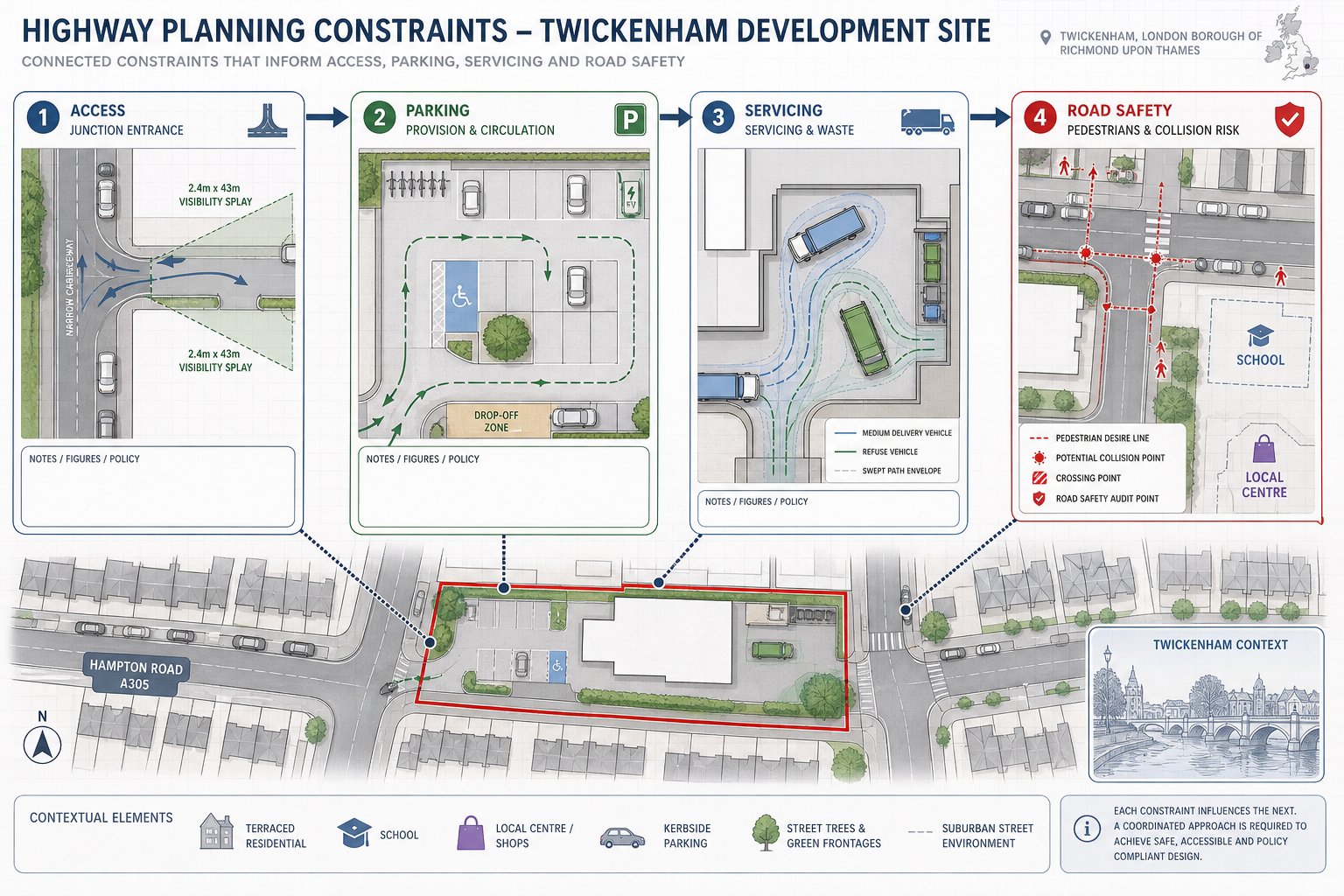
Access is often the first technical test. If a proposed entrance is awkward, visibility is restricted, or turning movements are unrealistic, everything downstream becomes harder to defend. In Twickenham, that can be especially relevant on narrower roads, corner plots, streets with existing parking, and sites near schools or local centres.
Parking raises a different set of tensions. The question is not only how many spaces are proposed, but whether the number is policy-led, operationally realistic and unlikely to create overspill. Disabled bays, electric vehicle charging, cycle storage, drop-off areas and internal manoeuvring all matter. We often find that the strongest approach is not simply maximising spaces, but demonstrating a balanced provision supported by local accessibility and demand evidence.
Servicing is another point where otherwise good schemes come unstuck. Delivery vehicles, refuse trucks and maintenance access need to be accommodated without forcing unsafe reversing onto the highway or causing regular obstruction. Swept-path analysis can be essential, particularly where site geometry is tight.
Road safety sits across all of this. Collision records, desire lines, crossing movements and likely user behaviour all inform whether a layout is acceptable. Careful access design highway work, supported where needed by a Stage 1 Road Safety Audit or technical note, can resolve objections before they harden into a formal refusal reason.
Active Travel, Public Transport, And Town Centre Movement
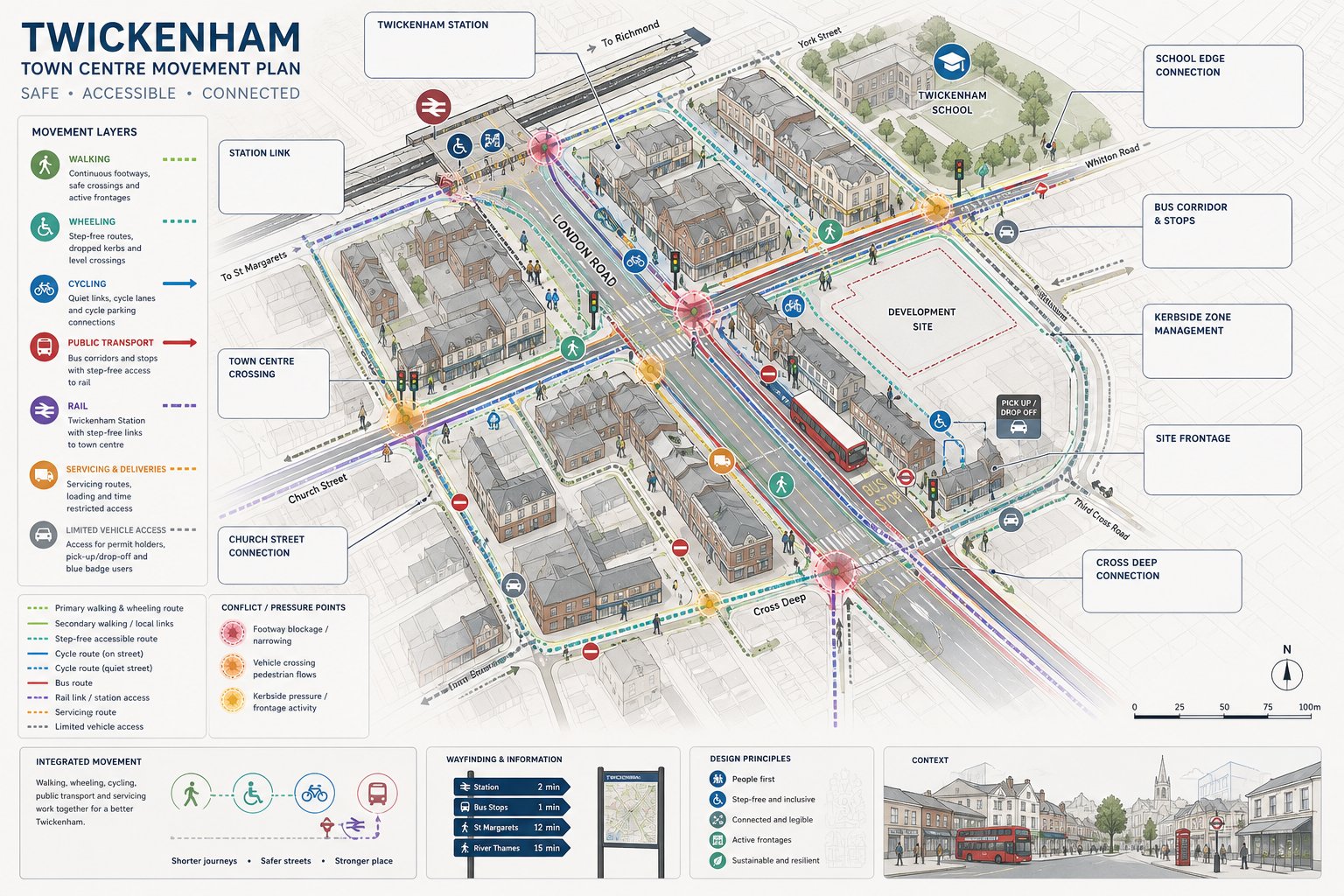
Transport scrutiny in Twickenham is not limited to vehicle impact. Increasingly, schemes are judged on whether they support safe, convenient movement by walking, wheeling, cycling and public transport. That is especially true near stations, bus corridors, schools and busy local centres where pedestrian activity is high and kerbside space is contested.
For applicants, this means active travel cannot be an afterthought tacked on near the end of a report. Secure and convenient cycle parking, legible pedestrian routes, step-free considerations, crossing opportunities, and links to nearby bus or rail services all strengthen the planning case when they are genuinely integrated into the design.
Town centre movement needs particular care. A site may have excellent accessibility in strategic terms but still create local friction if deliveries block footways, vehicles cross heavy pedestrian flows, or pick-up and drop-off activity spills into already pressured frontage space. We hence look not just at route availability, but at how a site will operate minute by minute.
This broader perspective reflects current Highway And Traffic Engineering practice: moving beyond car counts alone and addressing how all users experience the street. For many Twickenham schemes, that wider movement story is exactly what makes the transport case feel credible.
Transport Reports Commonly Required For Twickenham Schemes
The right report depends on scale, use, location and likely impact. In Twickenham, the most common planning submissions include a Transport Statement, a fuller Transport Assessment, a Travel Plan, and supplementary documents dealing with servicing, construction or specific technical issues.
The important point is that these documents are not interchangeable labels. A weak Transport Statement cannot simply be renamed as an Assessment because concerns have been raised, and an oversized Assessment can muddy a straightforward case by burying simple points in unnecessary modelling. Matching scope to the development is a technical judgement.
We typically advise clients on what is likely to be proportionate before surveys begin. That avoids wasted cost and, just as importantly, helps ensure the application package aligns with what officers expect to validate and review. It also reduces the risk of receiving a request for additional transport information late in the process.
Where schemes involve multiple operational components, the reports may need to work together: a Transport Statement dealing with person trips, a Delivery and Servicing Plan covering goods movements, and a Construction Logistics Plan managing temporary effects during build-out. The coordination matters as much as the individual documents.
Transport Statements, Transport Assessments, And Travel Plans
A Transport Statement is usually suited to smaller or lower-impact developments where the central task is to show that transport effects are limited and manageable. It may cover site context, accessibility, parking, servicing, accident history, trip generation and a concise impact review. The best ones are focused: they answer the likely highways questions without pretending the scheme is larger than it is.
A Transport Assessment goes further. It is generally required where a development could have a material effect on traffic conditions, junction performance, safety or wider network operation. That often involves more detailed baseline surveys, distribution and assignment assumptions, capacity modelling and clearer mitigation testing.
Travel Plans sit alongside both. Their purpose is not to decorate the submission with sustainability language: it is to show how travel behaviour will be managed over time. Measures might include cycle facilities, car club provision, public transport information, staff travel incentives, welcome packs, monitoring arrangements or mode-share targets.
A capable Traffic Engineer In London: approach is helpful here because Twickenham applications are shaped by both borough-level expectations and wider London transport policy. And where the proposal is commercial in character, the operational emphasis found in Commercial Traffic Engineering work becomes especially relevant.
Delivery And Servicing Plans, Construction Logistics, And Technical Notes
Delivery and Servicing Plans are often underestimated until a consultee asks the obvious question: how will the site actually function day to day? A DSP sets out the expected vehicle types, routing, timing, loading arrangements, management controls and any measures to reduce conflict with residents, pedestrians or peak traffic periods. In constrained parts of Twickenham, that level of operational clarity can be decisive.
Construction Logistics Plans deal with the temporary but highly sensitive build phase. Even where the completed scheme has modest impact, construction traffic can generate strong concern if HGV routes, contractor parking, access arrangements, delivery timing and safety management are not addressed properly. For urban sites, CLPs are often where neighbour anxiety and highways scrutiny overlap.
Technical Notes serve a different purpose. They are targeted responses to specific issues: a parking objection, a visibility question, a query about trip rates, or a request to explain why extra modelling is unnecessary. Good technical notes are brief, precise and evidence-led. They can keep an application moving without reopening the entire transport package.
These documents are often most effective when prepared as part of a wider Traffic Engineering: Your strategy rather than as reactive add-ons once concerns have escalated.
How Traffic Engineering Supports Different Development Types
Different uses generate different transport risks, and that is exactly why a generic report rarely convinces anyone. Residential schemes in Twickenham tend to focus on access quality, parking stress, cycle provision, refuse collection, and peak interactions with school travel or commuter parking. Family housing and flatted schemes can produce very different patterns, even on nearby sites.
Commercial and retail proposals usually bring greater attention to servicing, loading frequency, staff travel patterns, customer turnover and peak-hour network interaction. A small town centre unit may create little traffic but significant kerbside pressure if delivery management is poor. Office schemes, meanwhile, often turn on mode share assumptions and how credible the Travel Plan really is.
Education, healthcare and leisure uses introduce another layer. Their peaks can be intense, concentrated and operationally unusual. Parent drop-off behaviour, coach access, ambulance priority, event dispersal or weekend activity can all reshape the assessment.
This is where project-specific judgement matters. We tailor the transport scope to the use, not just the floor area. For mixed-use proposals, that often means separating user groups and analysing operations by component. In short, the right transport strategy for a residential infill scheme is not the right strategy for a clinic, gym, foodstore or school extension, and trying to force one template across all of them usually shows.
The Process From Initial Review To Planning Submission
The process usually starts with a high-level review. We look at the proposed use, site layout, surrounding highway network, planning history and likely policy triggers. That first pass helps determine whether the scheme needs a Transport Statement, a full Assessment, a Travel Plan, servicing work, a CLP, or a lighter-touch technical response.
Next comes baseline data. Depending on the site, that may include traffic counts, turning counts, queue observations, collision analysis, parking surveys, accessibility review and site observations at the times that actually matter. We then assess likely trip generation and, where necessary, distribute those trips across the network for capacity testing.
Once the effects are understood, we refine mitigation. Sometimes the answer is geometric: adjust the access, alter internal turning, relocate cycle parking, or revise the servicing bay. Sometimes it is operational: delivery restrictions, management measures, travel planning, or construction controls. Then the formal reports are prepared and coordinated with the wider planning submission.
The final stage is support through validation and consultation. Queries from officers or highways teams often require quick, clear responses. That is one reason clients often engage us for both report preparation and follow-up. Efficient planning support depends not just on writing the report, but on defending it coherently when comments come back.
What To Prepare Before Instructing A Traffic Engineer
Good instructions save time. Before appointing a transport consultant, it helps to assemble the core material that lets us scope work properly from day one. The essentials are the redline boundary, the latest site layout drawings, floor areas or unit schedules, land-use description, and any known design parameters affecting access, parking or servicing.
We also need to understand how the development is expected to operate. That includes proposed servicing arrangements, refuse strategy, anticipated vehicle types, opening hours, likely staffing levels, phasing if relevant, and any assumptions already being used by the planning or design team. If there is pre-application feedback, prior highways correspondence or a planning history with transport comments, that should come over early rather than halfway through drafting.
Photographs, topographical information and neighbouring land-use context are often useful too. On constrained sites, even a quick note on known local concerns, school peaks, event-day pressures, parking sensitivity, difficult corners, can sharpen the scope.
When the brief is clear, we can usually advise faster on whether surveys are needed, which reports are proportionate, and where the likely planning risks sit. That upfront clarity is often what keeps a transport package concise instead of sprawling.
How Local Experience Can Help Reduce Delays And Objections
Local experience matters because transport planning is never done in a vacuum. Two sites of similar size can receive very different scrutiny depending on nearby junction behaviour, parking conditions, pedestrian demand, local committee sensitivities or the way previous schemes were assessed in the area. Knowing those patterns helps us frame reports in a way that answers real concerns, not theoretical ones.
In Twickenham, that can mean anticipating questions around overspill parking, school-time conflict, servicing on constrained streets, or whether a proposal genuinely supports sustainable travel. It can also mean understanding when detailed modelling is warranted and when a proportionate qualitative case is more persuasive.
Familiarity with authority expectations helps reduce delays in another way: it allows likely validation and consultation issues to be identified before submission. That is often more valuable than any single piece of modelling. A transport package that is technically strong but poorly aligned with local review practice can still lose weeks.
Our experience across London planning contexts helps, but local judgement is what turns that experience into practical value. We know that faster approvals usually do not come from flashy analysis. They come from relevant evidence, clear recommendations and fewer surprises for the case officer and highways reviewer.
Conclusion
For many schemes, transport is the part of the planning application that quietly determines whether the rest of the submission feels credible. In Twickenham, that is especially true. A proposal needs more than broad assurances: it needs evidence on access, traffic, parking, servicing, safety and sustainable movement that reflects the site as it really operates.
A well-prepared Traffic Engineer in Twickenham role is hence not just about writing reports. It is about shaping the proposal early, selecting the right level of assessment, resolving constraints before submission and helping the planning team respond confidently when questions arise.
If the transport case is proportionate, locally informed and technically clear, applications tend to move with fewer surprises. And in a planning environment where delays are expensive, that is often the difference between a scheme that progresses and one that spends months circling the same highways concerns.
Frequently Asked Questions About Traffic Engineering in Twickenham
What role does a traffic engineer play in Twickenham planning applications?
A traffic engineer in Twickenham provides specialist input by reviewing transport impacts, assessing access and parking, forecasting trip generation, and advising on mitigation measures to ensure planning proposals meet local highway standards and reduce objections.
Why is a strong transport evidence base essential for Twickenham developments?
Twickenham planning decisions require quantified, site-specific evidence such as trip generation and traffic impacts. This robust data, including surveys and modelling, helps justify proposals, avoid delays, and address safety concerns effectively.
What common transport issues arise with developments in Twickenham?
Key concerns include the impact on congested junctions, parking overspill, pedestrian and cyclist safety, especially near schools and town centres, as well as servicing and loading challenges on narrow streets.
How can a Transport Statement differ from a Transport Assessment in local planning?
A Transport Statement is suited for smaller, low-impact schemes showing limited effects, while a Transport Assessment involves detailed surveys, traffic modelling, and safety evaluations for developments likely to have a material traffic impact in Twickenham.
What documents are typically required to support planning applications regarding traffic in Twickenham?
Common documents include Transport Statements or Assessments, Travel Plans to promote sustainable travel, Delivery and Servicing Plans managing goods movements, Construction Logistics Plans for build phases, and targeted Technical Notes addressing specific queries.
How does local experience of Twickenham’s traffic environment help reduce planning delays?
Familiarity with local junctions, parking pressures, and prior planning decisions allows a traffic engineer to anticipate objections, recommend proportionate mitigation, and align reports with authority expectations, speeding up validation and approvals.