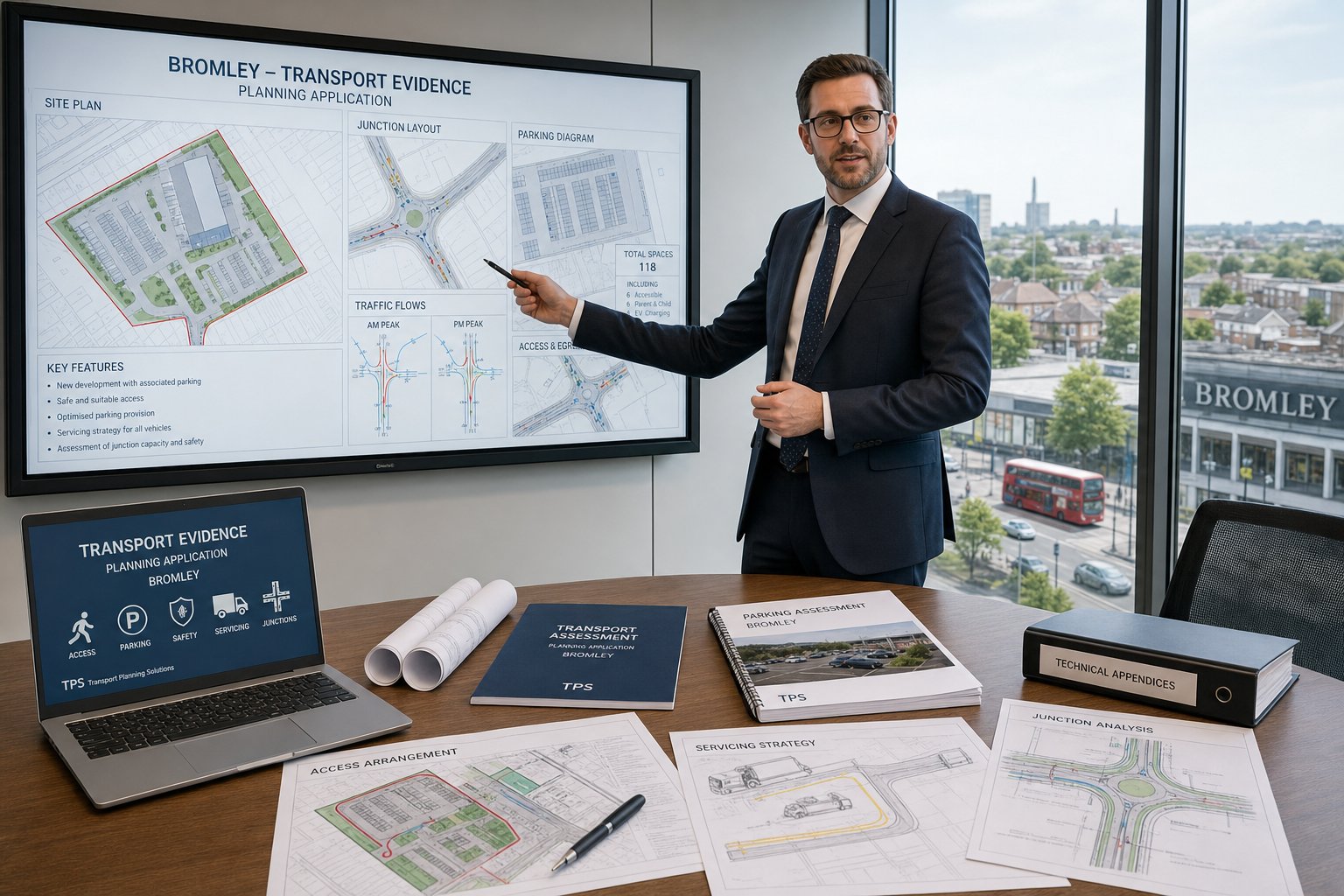
Getting a planning application over the line in Bromley rarely comes down to architecture alone. Access, parking, servicing, pedestrian safety, and the effect on nearby junctions can all become deciding factors surprisingly early in the process. And in a borough with everything from busy town centres and station approaches to narrow suburban roads and school-run pressure points, transport evidence needs to be both technically sound and locally realistic.
That is where a Traffic Engineer in Bromley becomes central to the planning team. We help translate a proposal into transport terms that planning officers, highway officers, consultants, and appellants can all test properly. In practice, that means advising on access geometry, checking visibility, reviewing parking demand, forecasting trips, and preparing reports that match the scale of the scheme rather than burying everyone in unnecessary paperwork.
For architects, planners, lawyers, surveyors, builders, developers, and local authorities, the real value is often speed as much as compliance. A well-scoped transport submission can reduce avoidable objections, cut down back-and-forth after validation, and give a project a more defensible planning position. In this guide, we set out what traffic engineering support in Bromley usually involves, which reports are commonly required, what local factors matter most, and how to prepare a stronger application in 2026.
Key Takeaways
- A Traffic Engineer in Bromley is essential to create technically sound and locally realistic transport evidence that supports successful planning applications.
- Early involvement of traffic engineers ensures access, parking, servicing, and pedestrian safety issues are identified and addressed before submission, reducing delays and objections.
- Transport reports in Bromley should be proportionate and tailored to local road conditions, with common documents including Transport Statements, Transport Assessments, and Travel Plans.
- Understanding Bromley’s varied local context—such as suburban road constraints, parking stress, and public transport accessibility—is critical to producing credible transport assessments.
- Choosing a traffic engineer with local expertise and development planning experience improves the quality and speed of planning submissions, helping projects navigate Bromley’s specific transport policies.
- Incorporating clear, concise, and consistent transport evidence that reflects Bromley’s actual street usage fosters better officer feedback and a smoother planning process.
What A Traffic Engineer In Bromley Does For Planning Applications
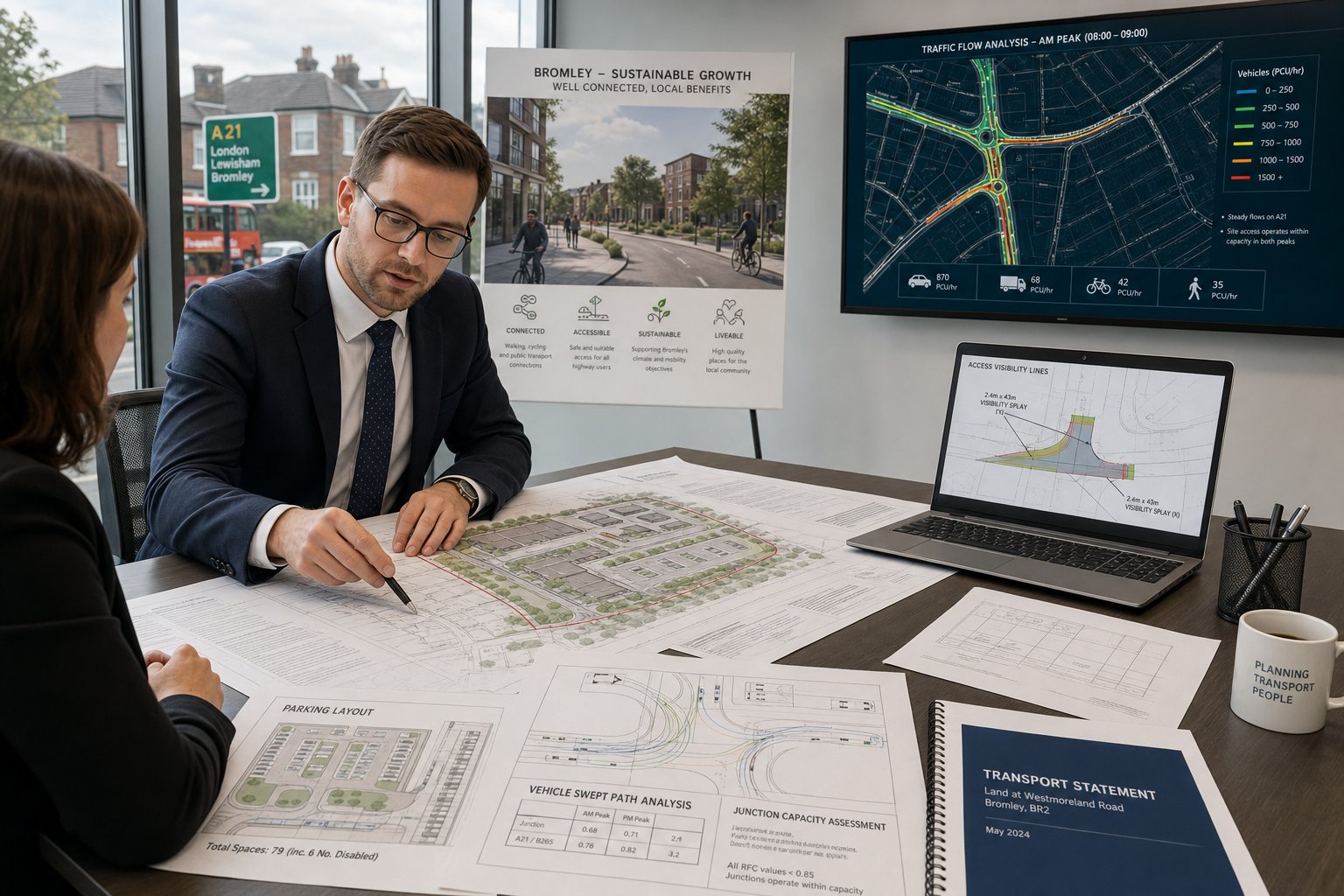
A traffic engineer supporting a Bromley planning application does far more than produce a report at the end of the design process. Our role usually starts with reviewing the proposal in context: how vehicles enter and leave, whether parking is realistic, how refuse and delivery activity will work, and whether pedestrians and cyclists are being asked to navigate an awkward or unsafe arrangement.
For smaller schemes, that may mean a concise review of access, parking accumulation, and likely trip generation. For larger or more sensitive developments, it often extends to traffic surveys, junction capacity modelling, swept-path analysis, and formal technical documents for submission. We also help identify risks early. A dropped kerb that looks acceptable on a plan can fail on visibility: a parking layout can work geometrically but still create operational conflict: a servicing arrangement can look tidy until a large vehicle has to reverse into a residential street.
In Bromley, this work needs to sit comfortably with local planning expectations and wider London guidance. That is why practical development-planning experience matters. Our work often overlaps with wider Traffic Engineering Consultants: support, especially where applications need transport evidence that is concise, policy-aware, and quick to review. Done properly, the traffic engineer is not just documenting a scheme: we are helping shape one that stands a better chance of approval.
Why Local Highway And Planning Context Matters In Bromley
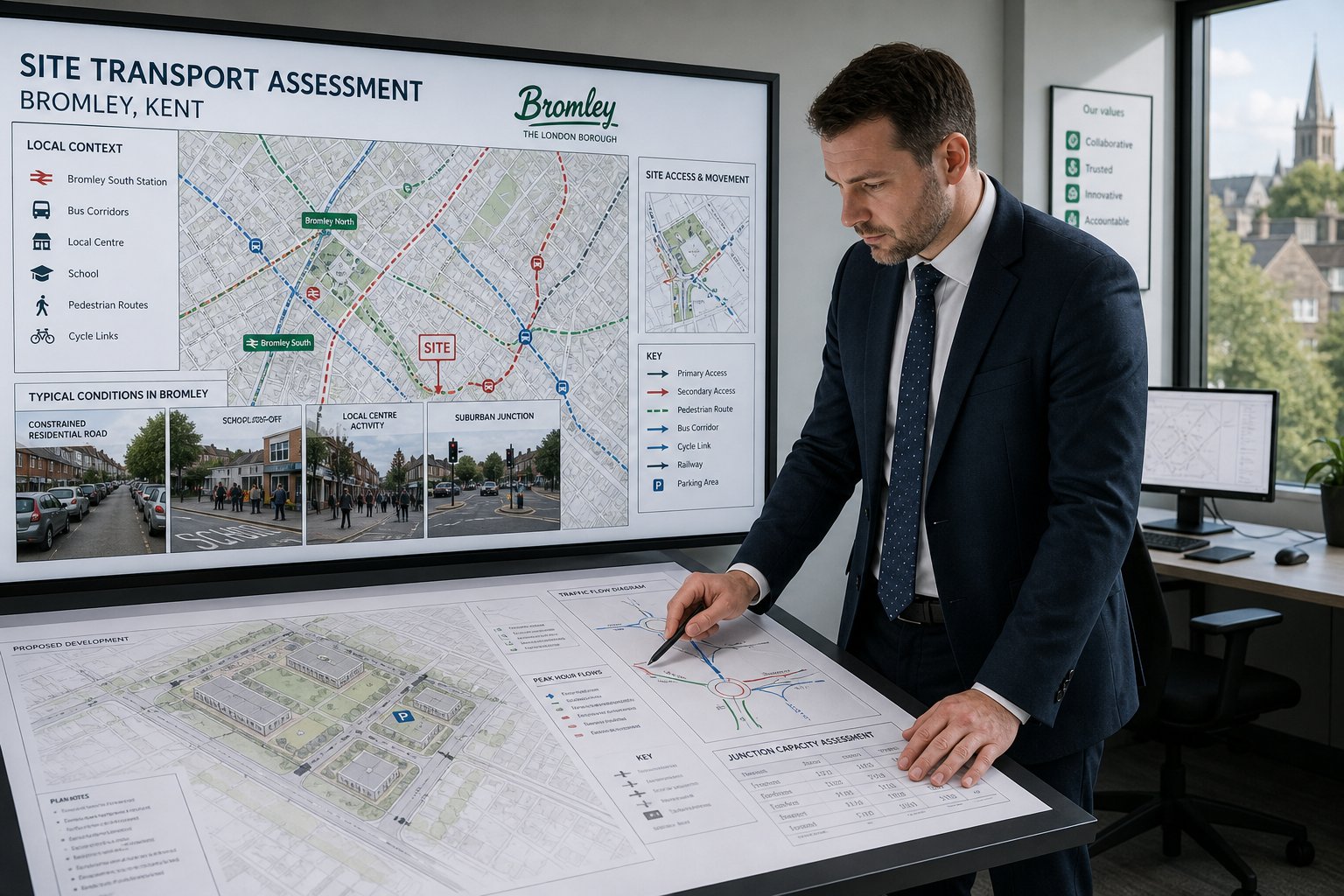
Bromley is not a one-condition borough. Some sites sit close to rail stations and stronger bus corridors: others are in suburban locations where car ownership and parking demand are plainly higher. Some roads have generous geometry and multiple access options: others are constrained by bends, frontage parking, schools, or narrow carriageways that make passing difficult at peak times. That variation is exactly why generic transport evidence often struggles.
A robust submission has to reflect the borough’s real operating conditions. Local highway officers will usually want to know whether the proposal fits actual street character, not just whether a standard drawing can be produced. Parking stress, turning behaviour, school drop-off patterns, and pedestrian movements around local centres can all influence what is considered acceptable. In outer London locations, assumptions copied from inner-London schemes can look optimistic very quickly.
We hence treat local context as part of the technical assessment, not a footnote. That includes borough policy, London Plan expectations, and the practical threshold at which officers are likely to request more detail. Broader Highway And Traffic Engineering principles still apply, but Bromley-specific judgement is what turns a compliant-looking report into one that feels credible when reviewed by planners, highways teams, or at appeal.
Key Transport Reports Often Needed For Bromley Developments
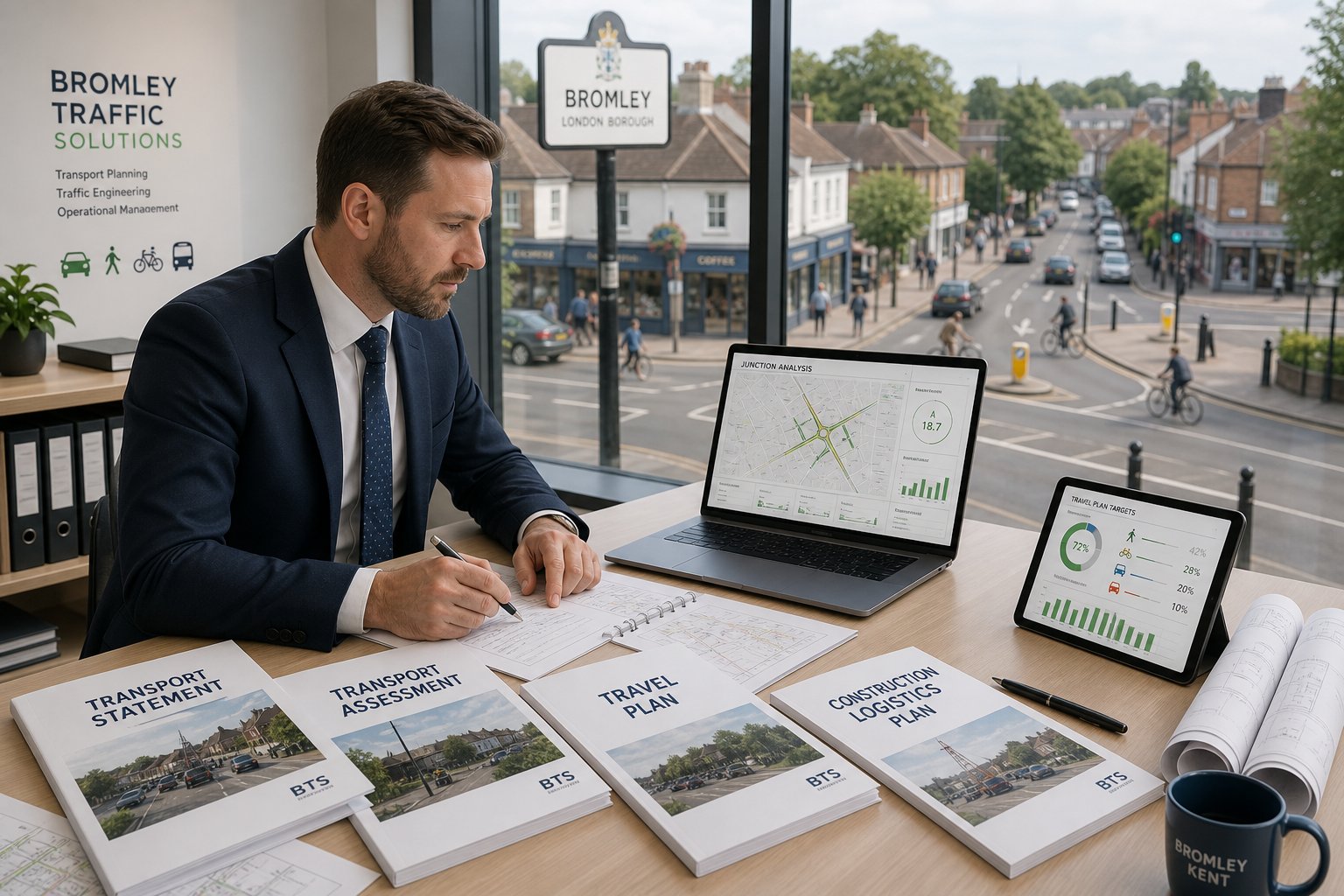
The right report depends on the scale, sensitivity, and transport effects of the proposal. One of the most common mistakes we see is either under-scoping the evidence or producing an overly elaborate package for a modest scheme. Both can slow an application down.
Transport Statements
A Transport Statement is usually prepared for smaller developments where impacts are expected to be limited but still need to be explained clearly. It typically covers existing site conditions, local accessibility, parking provision, access arrangements, servicing basics, and a proportionate review of trip generation.
In Bromley, a good Transport Statement should not read like a generic template. It should explain why the proposal is suitable for its exact location, whether nearby streets can accommodate the change, and whether any small design refinements would improve matters. We often use these reports for modest residential schemes, changes of use, infill projects, and lower-intensity commercial proposals where officers need reassurance rather than full strategic modelling.
Transport Assessments
A Transport Assessment is a more detailed piece of work, normally required where trip generation is greater, the site is more sensitive, or the highway network may experience a noticeable effect. This can include junction capacity testing, turning counts, queue analysis, mode share assumptions, servicing review, collision analysis, and a more developed mitigation strategy.
For larger proposals, the methodology matters just as much as the result. Trip rates should be derived from recognised data sources and then sense-checked against local conditions. Junction performance may need to be tested under future-year scenarios. Pedestrian and cycle movements can also become more important where town centre, station, or school routes are involved.
This is often where a wider understanding of Traffic Engineering and Transportation planning becomes useful, particularly if the development team is balancing transport evidence with viability, massing, and staged design changes.
Travel Plans, Delivery Plans, And Construction Transport Documents
Many Bromley applications also benefit from supporting management documents. A Travel Plan sets out measures to encourage sustainable travel by staff, residents, or visitors. A Delivery and Servicing Plan explains how operational traffic will be managed. Construction documents, often in the form of Construction Logistics Plans or Construction Management Plans with transport content, deal with routing, hours, contractor parking, site access, and vehicle management during the build phase.
These documents matter because not every transport issue is solved by geometry. Sometimes the key question is operational discipline: when vehicles arrive, where they wait, how servicing is booked, how staff travel information is provided, and how conflicts with school-run or commuter peaks are minimised. For Bromley schemes on tighter roads or near sensitive neighbours, those commitments can make a real difference to officer confidence.
When A Bromley Project Is Likely To Need Traffic Engineering Input
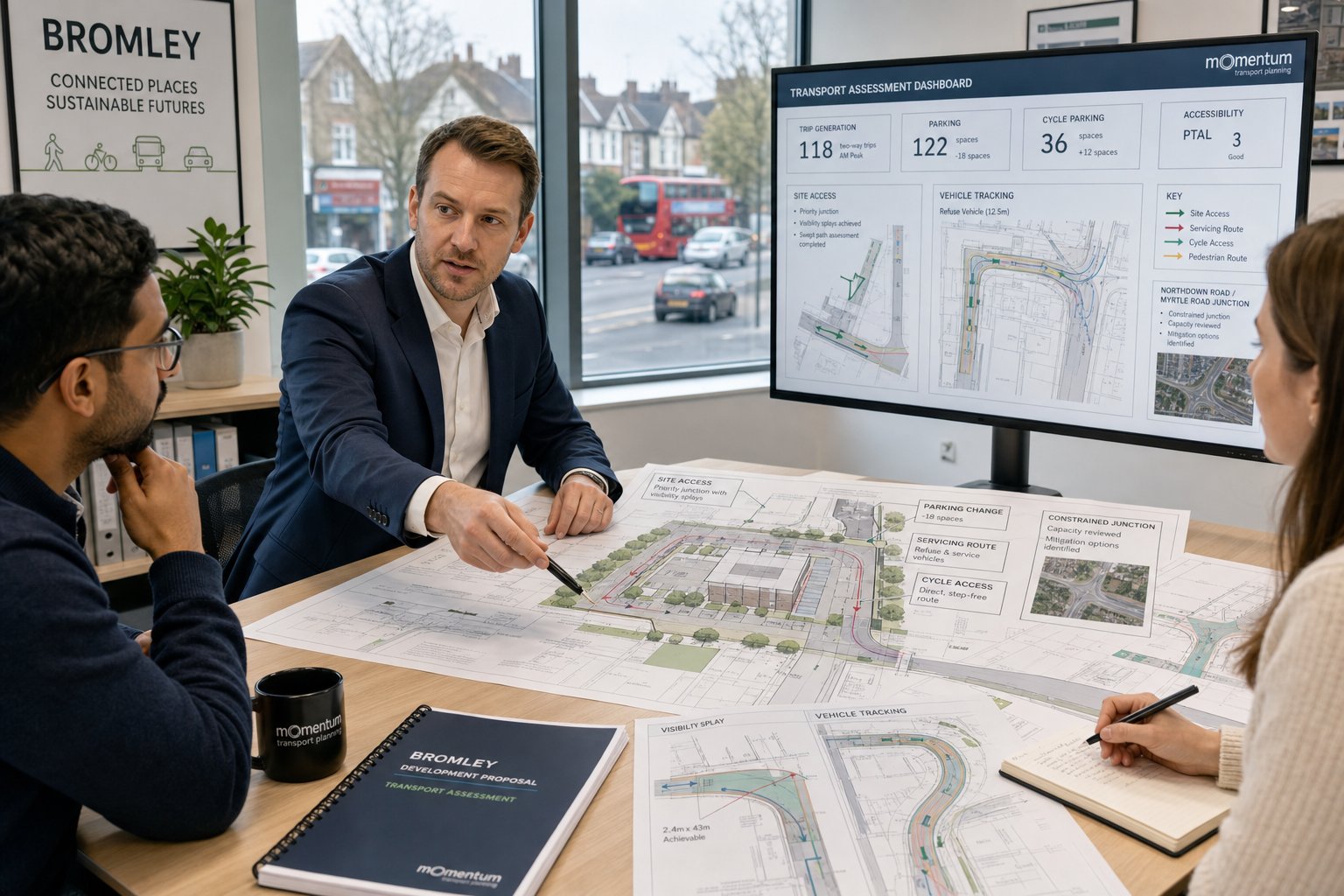
Not every planning application in Bromley needs a full transport package, but a surprising number need input earlier than the design team first expects. As a rule, once a proposal changes access, intensifies use, affects parking provision, introduces regular servicing, or sits close to a constrained junction, there is a strong case for bringing in a traffic engineer.
Residential schemes are a good example. A small block of flats may seem straightforward, yet questions quickly arise around vehicle tracking, bin collection, visitor parking, cycle access, and whether the local street can absorb added demand. The same applies to HMOs, healthcare uses, schools, food-led premises, and mixed-use infill sites. If the design reduces on-site parking or relies on surrounding streets, parking stress usually becomes a live issue.
We also advise early where the site has awkward visibility, a steep gradient, frontage activity, or neighbour sensitivity. In those cases, a short early review can save weeks later. That is often the difference between refining the layout before submission and defending a weak arrangement after objections arrive. For project teams comparing local and regional approaches, our wider Traffic Engineer In London: perspective is useful because Bromley sits within London policy, but it behaves very differently from more central boroughs in practical transport terms.
Typical Development Types That Benefit From Early Transport Advice
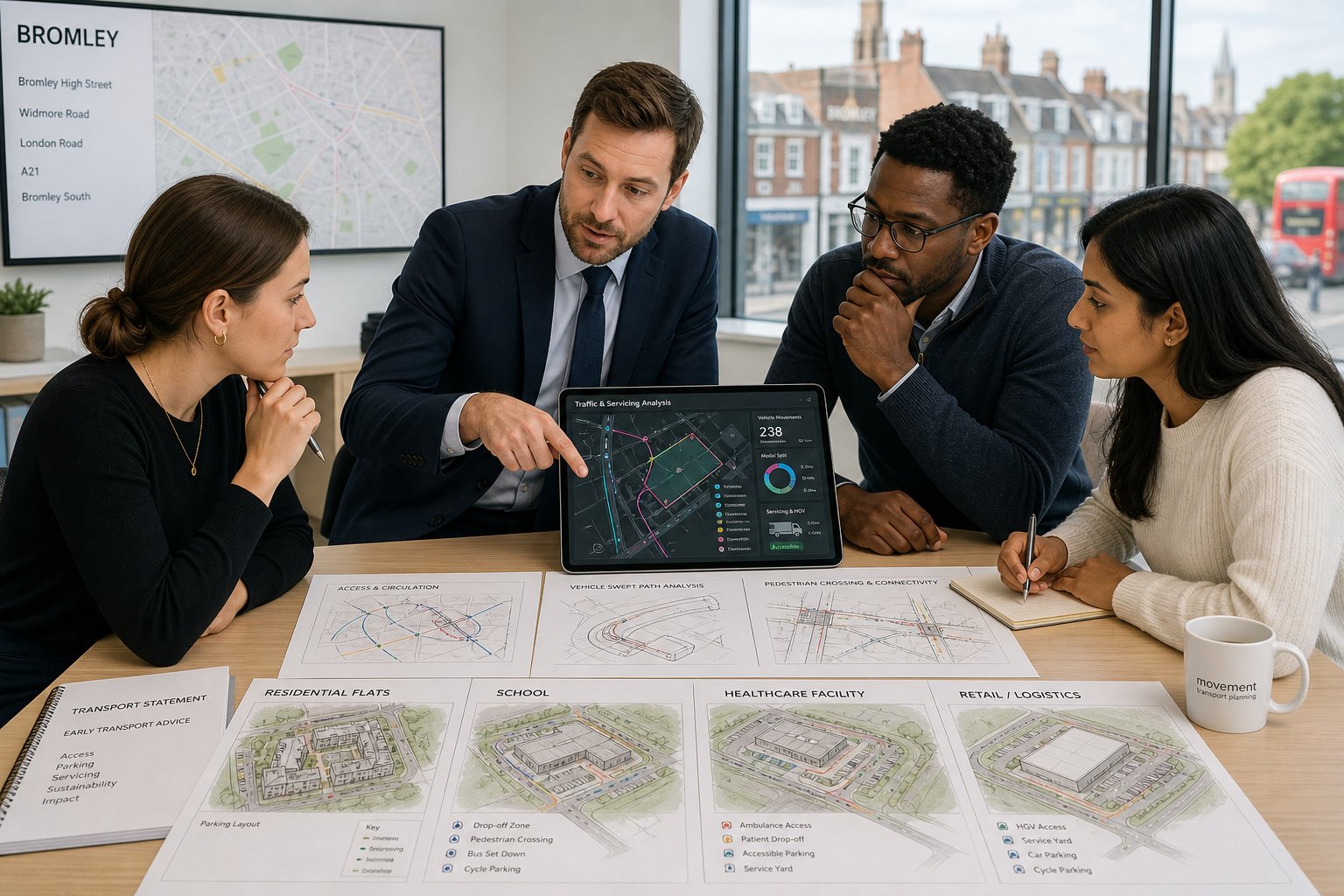
Some development categories almost always benefit from early transport input because access and movement are part of the planning debate from day one.
Residential development is high on that list, especially flats, backland schemes, estate infill, and conversions to higher-density occupation. These projects often trigger concerns about parking displacement, refuse access, delivery activity, and manoeuvring in constrained courtyards. Early review helps avoid layouts that work only on paper.
Schools, colleges, nurseries, and healthcare facilities also need careful thought. Their traffic patterns are peaky, sensitive, and highly visible to local residents. Drop-off behaviour, walking routes, crossing points, and coach or patient transport can all influence acceptability.
Retail, leisure, and drive-through proposals usually need transport advice before the architecture is fixed. Queueing, servicing, and interaction with existing highway flows can become the central planning issue very quickly. Industrial, logistics, and office schemes raise a different set of questions around employee mode split, HGV routing, yard circulation, and future flexibility.
Where the project is commercially focused, broader Commercial Traffic Engineering thinking often helps teams align operational needs with what officers are likely to support. The recurring lesson is simple: if vehicles, servicing, or street impact matter to the function of the site, transport advice should not be left until the end.
How Traffic Engineers Assess Access, Safety, And Network Impact
Our assessment process usually starts with a site visit, because plans rarely tell the whole story. We look at road width, forward visibility, crossing desire lines, frontage parking, existing access behaviour, bus stops, school gates, and whether larger vehicles can actually move through the area without creating conflict. We then combine that with traffic counts, speed data, parking surveys, and where relevant, collision records.
The next step is design review. We assess access geometry, visibility splays, internal circulation, refuse and servicing movements, emergency access, and the relationship between vehicles and vulnerable road users. If a vehicle can technically enter but must make an awkward reverse manoeuvre across a footway, that is not a detail to leave vague in a planning submission.
For schemes with greater impact, we test network performance using recognised modelling tools such as HCS, SIDRA, VISSIM, or Synchro, depending on the junction type and complexity. The aim is not to drown the application in software output: it is to answer practical questions. Will queues materially worsen? Will right-turning traffic block through movement? Is mitigation likely to work in the real world?
These methods sit within established Traffic Engineering: Your practice, but good judgement is still essential. Numbers matter. So does understanding how people actually drive, walk, cycle, and load vehicles on a suburban street at 8.30 in the morning.
Local Factors That Can Influence Transport Evidence In Bromley
Bromley’s local character can substantially change what evidence is needed and how it is interpreted. Public transport accessibility varies a lot across the borough, so assumptions on car ownership, staff mode split, and visitor travel need to be rooted in place. A site near a station or stronger bus corridor may justify lower parking provision more easily than one in a more car-dependent suburban pocket.
On-street parking stress is another recurring issue. Even where a development appears modest, existing kerbside demand can be high, especially on roads without generous off-street parking. Controlled Parking Zones, permit restrictions, and informal parking practices all shape the discussion. If overspill is likely, officers and neighbours will notice.
Nearby schools, local centres, and rail stations can also amplify transport effects. The same access that seems quiet at midday may be heavily constrained during school opening and closing periods. Narrow roads, bends, mature street trees, and sloping topography can make HGV or refuse access more difficult than desktop plans suggest.
And because Bromley often combines suburban layouts with London policy expectations, evidence needs to bridge both worlds. Comparative insight can help here: for instance, a Traffic Engineer In Birmingham: approach may involve different suburban assumptions, but the common lesson is that local network behaviour always matters more than generic averages.
How To Prepare A Strong Submission For A Bromley Planning Application
The strongest Bromley submissions usually begin before the application is drafted. We recommend bringing transport input into the design stage, while access points, parking numbers, servicing strategy, and internal circulation can still be changed without major cost. Waiting until the end often means the report becomes a defence of decisions already fixed, rather than a tool to improve them.
Evidence should be proportionate and well organised. That means using recognised trip-rate sources, validating assumptions against local context, presenting clear plans, and explaining conclusions in plain English. Highway officers should not have to hunt through appendices to understand how a refuse vehicle turns or why parking demand is expected to remain acceptable.
Swept-path analysis, visibility drawings, local accessibility mapping, and concise survey summaries all help. So does consistency across documents. A common weakness is mismatch: the planning statement says one thing, the site plan shows another, and the transport report quietly assumes a third version of the scheme.
From our experience, concise reports with strong drawings are reviewed more efficiently than long, repetitive submissions. That practical approach is a big part of how Traffic Engineer In place-specific planning support tends to work well: accurate scope, local realism, and no unnecessary noise. In Bromley, that combination often shortens consultation and improves the quality of officer feedback.
Choosing The Right Traffic Engineer For Bromley Work
Choosing the right consultant is not just about whether they can produce a Transport Statement. The better question is whether they understand development planning well enough to help shape a proposal, anticipate objections, and keep the evidence proportionate. In Bromley, that usually means experience with outer-London boroughs, familiarity with London-wide standards, and a practical grasp of suburban transport conditions.
We would usually suggest looking for a chartered civil or transport professional, or at minimum a team led by one, with a track record in development-led transport work. Ask whether they regularly produce Transport Statements, Transport Assessments, Travel Plans, servicing strategies, and swept-path analysis. Ask how they scope surveys, how they deal with parking stress concerns, and whether they are comfortable discussing issues directly with design teams and planning consultants.
Speed matters too, but only when paired with accuracy. A quick report that misses a visibility constraint or weakens the justification for reduced parking is not efficient in any meaningful sense. For many clients, the best support comes from teams that can produce concise planning evidence quickly while still tailoring it to authority thresholds and local review styles.
That is the standard we believe transport advice should meet: technically robust, commercially aware, and readable by decision-makers. In Bromley, that combination is often what separates a smooth application from a prolonged technical debate.
Conclusion
In Bromley, transport evidence is rarely just a supporting document. It is often the mechanism that shows whether a scheme can function safely, fit its surroundings, and operate without unacceptable pressure on the local network. That applies to modest residential proposals as much as larger commercial, education, or mixed-use projects.
A capable traffic engineer brings more than calculations. We bring local judgement, proportionate reporting, and the ability to spot transport risks while there is still time to solve them properly. When access, parking, servicing, or junction impact are addressed early and clearly, planning applications tend to move with less friction.
For architects, planners, developers, lawyers, surveyors, builders, and councils, the practical takeaway is straightforward: involve transport input early, keep the scope proportionate, and make sure the evidence reflects Bromley’s actual street conditions rather than a generic template. That is usually the fastest route to a stronger planning submission in 2026.
Frequently Asked Questions About Traffic Engineering in Bromley
What does a traffic engineer in Bromley do for planning applications?
A traffic engineer in Bromley assesses access layouts, parking, site circulation, and junction designs using civil engineering principles. They produce technical reports like Transport Statements and Assessments, carry out traffic counts and safety reviews, ensuring proposals comply with local standards and London-wide guidance.
When is traffic engineering support typically required for Bromley development projects?
Traffic engineering input is needed when a proposal changes access, increases vehicle trips, affects parking provision, or impacts constrained junctions or sensitive routes like school areas. Common developments include residential flats, schools, healthcare, retail, and commercial schemes where transport impact must be managed carefully.
What are the key transport reports often needed for Bromley planning submissions?
Smaller schemes generally require a Transport Statement outlining access and parking. Larger or sensitive sites need a detailed Transport Assessment, including junction modelling and trip analysis. Additionally, Travel Plans, Delivery and Servicing Plans, and Construction Logistics Plans help manage operational traffic effects responsibly.
How does local context in Bromley affect traffic engineering assessments?
Local factors like suburban road geometry, public transport availability, parking stress, nearby schools, and narrow streets significantly influence acceptable transport solutions. Traffic evidence must align with Bromley’s specific highway policies and reflect real operating conditions rather than generic templates.
How can developers prepare a strong transport submission for a Bromley planning application?
Engage a traffic engineer early to shape access, parking, and layout decisions. Use recognised trip rates with local validation, present clear plans and swept-path analyses, and ensure concise reports tailored to Bromley’s review standards to facilitate faster, more successful planning approvals.
What should I look for when choosing a traffic engineer in Bromley?
Choose a chartered civil or transport engineer with proven experience in development planning and traffic modelling within London and outer-London boroughs. They should produce varied reports like Transport Statements and Travel Plans and understand local standards to deliver technically robust and commercially aware advice.