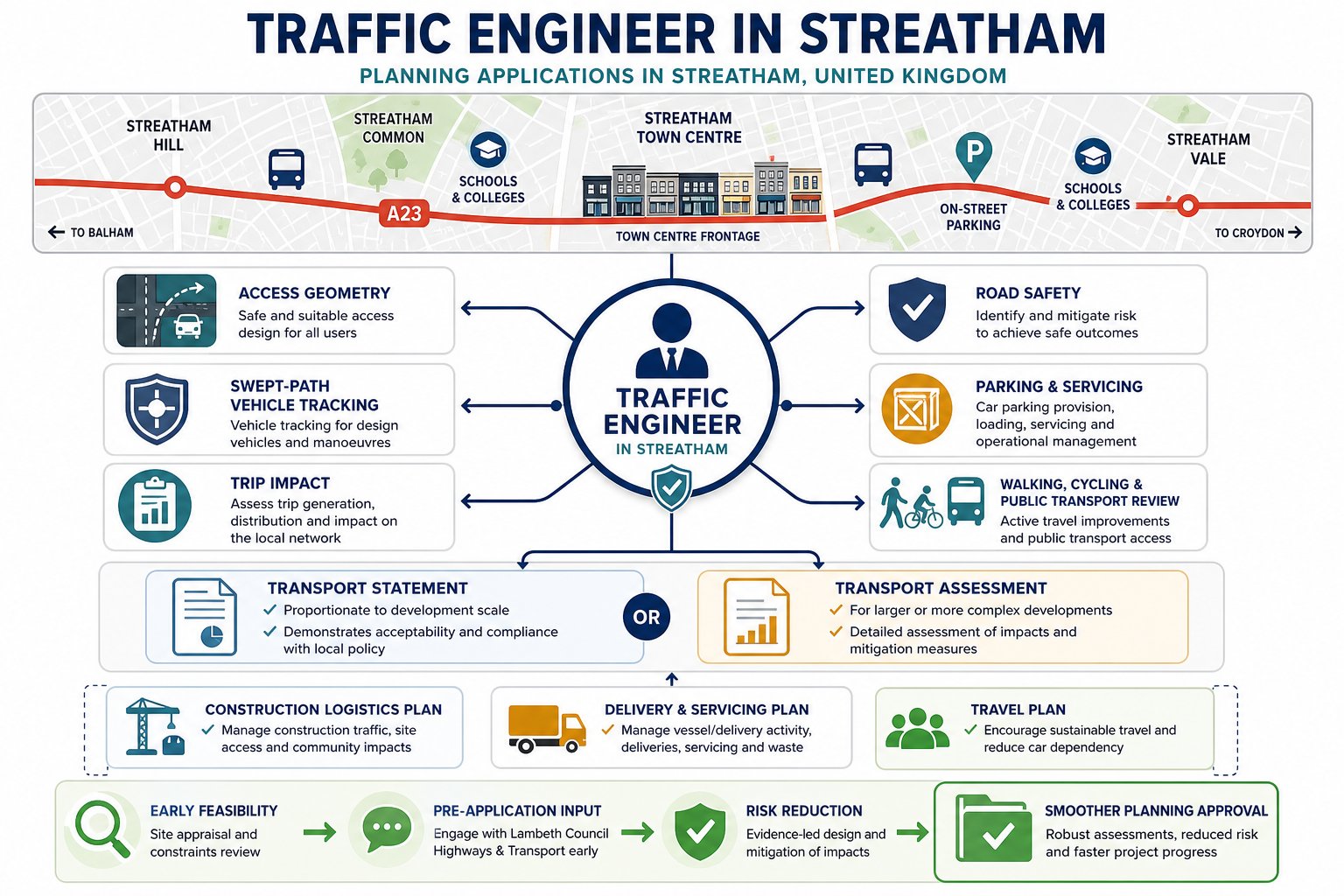
Streatham looks straightforward on a map until a scheme lands on a live planning desk. Then the real picture appears: the A23 carrying heavy movement through the area, busy bus corridors, side streets already under parking pressure, schools affecting peak patterns, and town-centre frontages where servicing can become the deciding issue. In that setting, transport input isn’t a box-ticking exercise. It often shapes whether an application moves smoothly or stalls in questions from highways officers.
That’s where a traffic engineer in Streatham becomes valuable. We assess how a proposal will work in practice, not just in principle. That means looking at access, vehicle tracking, trip generation, road safety, walking and cycling conditions, servicing, parking demand, and the policy framework that Lambeth and, in some cases, Transport for London will apply.
For architects, planners, lawyers, developers, surveyors, builders, and public-sector teams, the goal is usually the same: clear, proportionate, defensible transport evidence that supports the planning case without slowing the programme. In this guide, we set out what a traffic engineer in Streatham actually does, when input is needed, which reports are commonly required, and how a local, context-led approach can reduce risk and help projects progress faster in 2026.
Key Takeaways
- A traffic engineer in Streatham plays a crucial role by providing clear, context-specific transport evidence that influences planning application success.
- Early involvement of a traffic engineer during feasibility or pre-application stages can prevent costly redesigns and streamline development processes.
- Transport assessments in Streatham must address local conditions such as the busy A23 corridor, bus routes, parking pressures, and peak school traffic to be effective.
- Proportional and coordinated transport reports, including Transport Statements, Assessments, and Delivery and Servicing Plans, ensure compliance with Lambeth and TfL policies without overcomplicating planning cases.
- Collaboration among architects, planners, developers, and local authorities leads to better transport solutions and reduces the risk of delays in planning approvals.
- Choosing a traffic engineer with London-specific experience, clear reporting, and practical problem-solving skills is essential to navigate Streatham’s unique transport challenges efficiently.
What A Traffic Engineer In Streatham Does For Planning Applications
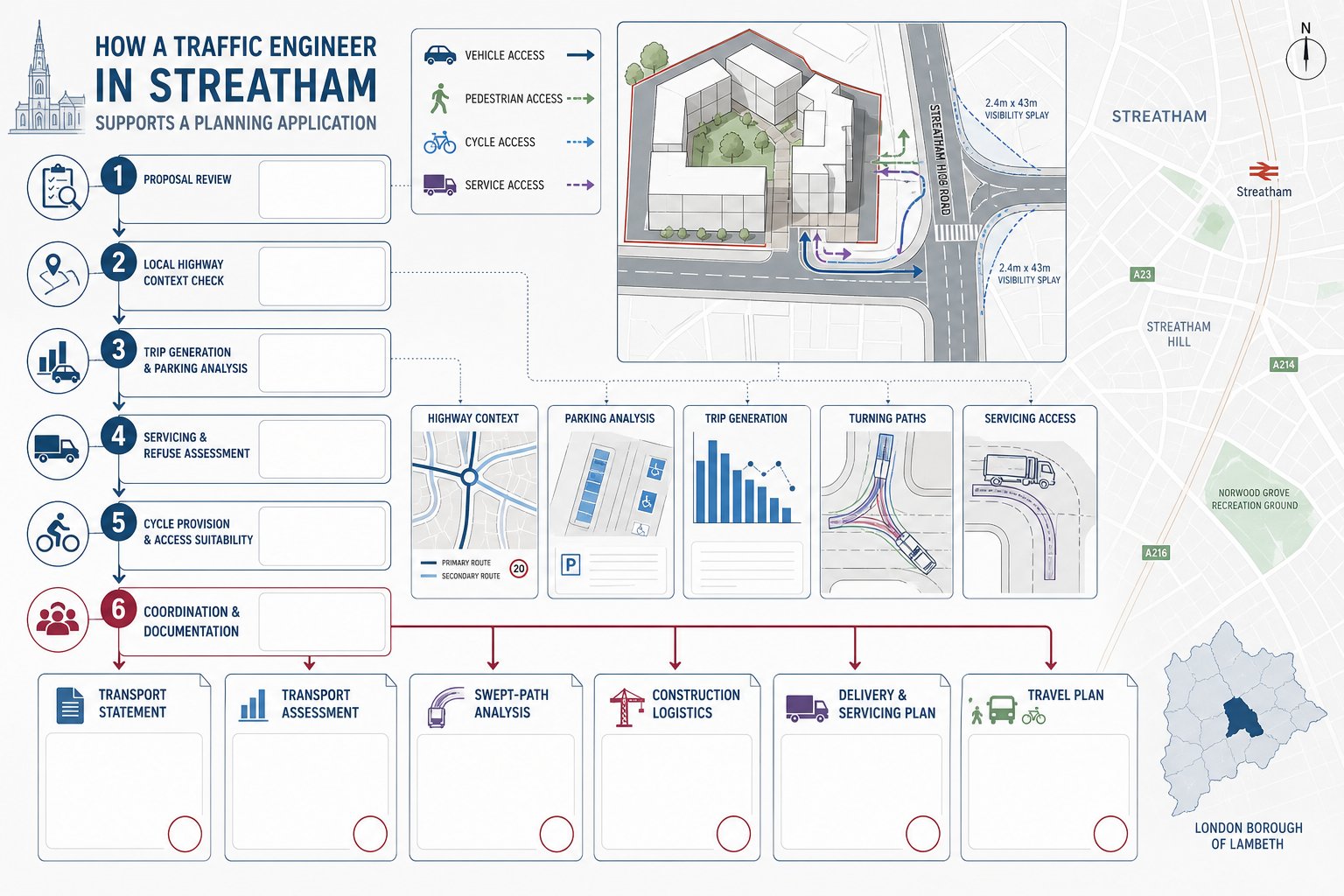
A traffic engineer in Streatham helps translate a development idea into transport evidence that planning officers and highway authorities can properly test. In practical terms, we review the proposal, identify likely transport concerns early, and prepare the technical material needed to show that the scheme can operate safely and in policy-compliant fashion.
That usually starts with the fundamentals: what kind of use is proposed, how many units or how much floorspace is involved, where vehicles and people will enter and leave, and what the surrounding highway network is already dealing with. From there, we assess likely trip generation, parking demand, servicing needs, refuse collection, cycle provision, and whether the access arrangement is suitable in visibility, geometry, and operational terms.
For planning applications, our role is rarely limited to one report. We often coordinate transport statements, transport assessments, swept-path analysis, construction logistics plans, delivery and servicing plans, and travel plans so they align with the wider planning narrative. That matters because a technically correct report can still create friction if it does not match the drawings, red line boundary, operational assumptions, or phasing strategy.
On London schemes, that joined-up approach is essential. Broader Traffic Engineering Consultants: support often overlaps with planning strategy, while strong Highway And Traffic Engineering input helps resolve the practical details that officers tend to focus on first.
When You Need Transport Input For A Streatham Development
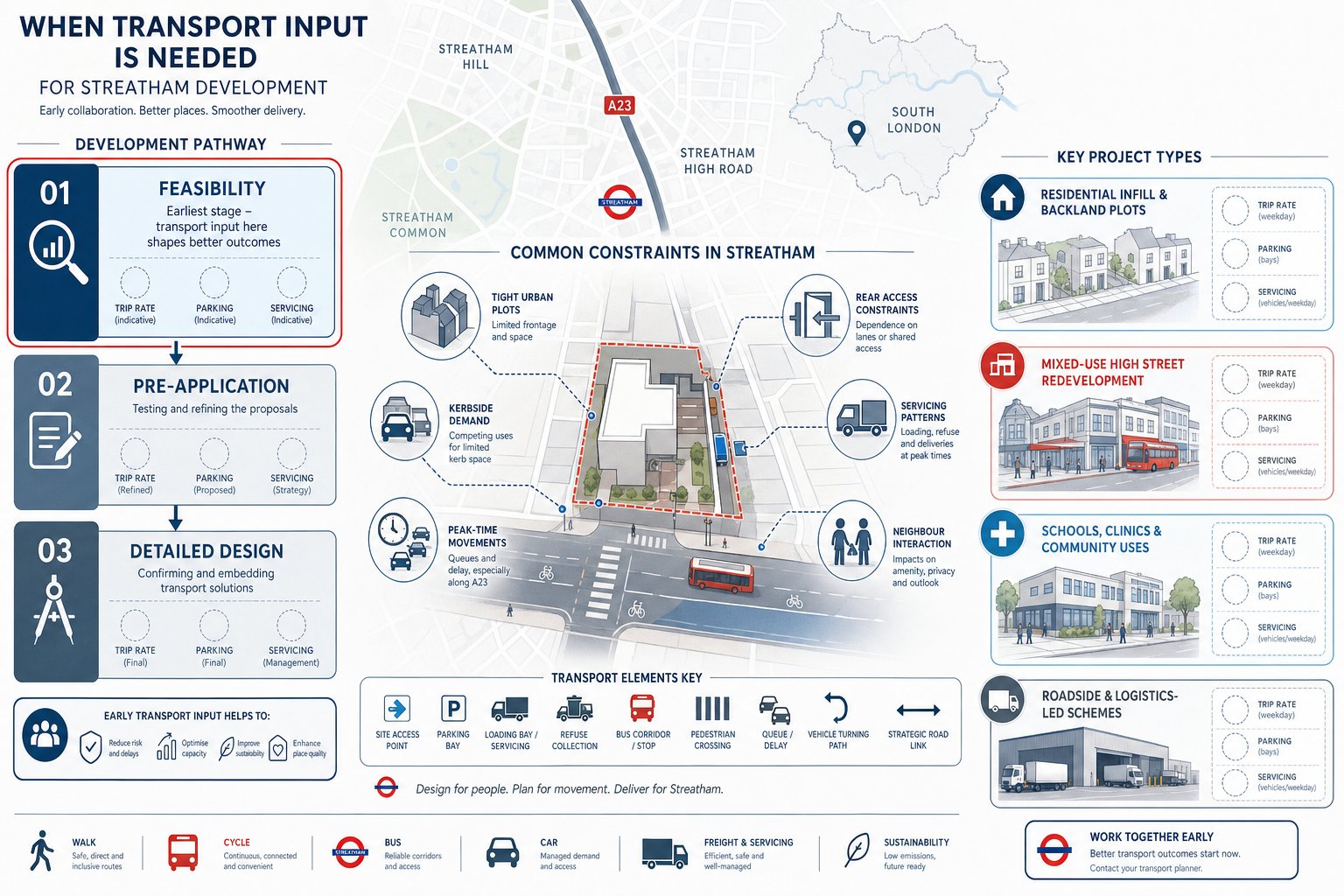
The short answer is earlier than many teams expect. We’re often brought in once an application is nearly ready, but the most useful point is normally at feasibility or pre-application stage, when access, parking, servicing, and highways constraints can still influence the design without expensive rework.
Transport input is typically needed for new-build residential schemes, flat conversions, HMOs, mixed-use redevelopment, and changes of use. It becomes particularly important where a site fronts a strategic route, sits close to bus priority corridors, relies on constrained rear access, or could affect on-street parking and servicing patterns. In Streatham, those issues come up a lot because sites are rarely isolated from neighbouring activity.
Even modest proposals may need technical justification. A small restaurant replacing a retail unit can alter delivery frequency and kerbside demand. A residential infill scheme might generate only limited vehicle trips but still fail if refuse vehicles cannot enter or exit safely. Likewise, a school, clinic, place of worship, or community use may trigger concentrated peak movement that concerns officers more than daily averages.
For teams looking at wider UK benchmarks, our experience on Traffic Engineer In London: projects is often the most relevant comparator, because borough expectations, TfL sensitivities, and urban street constraints differ sharply from lower-density locations.
Common Project Types That Require Traffic Engineering Support
The most frequent instructions in Streatham tend to fall into a few recognisable categories.
Residential infill and backland schemes often need detailed access testing, swept paths, parking review, and evidence on trip impact. The transport issue is not always volume: sometimes it’s whether the arrangement feels credible on a tight urban plot.
Mixed-use and town-centre redevelopment commonly raises servicing and loading questions. Ground-floor commercial uses with homes above can work well, but only if deliveries, refuse, and short-stay activity are managed without undermining pedestrian movement.
Education, healthcare, community, and religious uses usually require a closer look at peak concentration, pick-up and drop-off behaviour, coach or minibus activity, and pedestrian safety. One school entrance near a busy crossing can become the key planning issue.
Industrial, roadside, and logistics-led uses such as drive-thrus, fuel stations, trade counters, car washes, or last-mile operations generally need the most scrutiny. Those schemes can generate turning movements, queues, and servicing patterns that have to be carefully modelled and justified, particularly where they interact with the A23 or heavily trafficked side roads.
Local Planning And Highway Considerations In Streatham
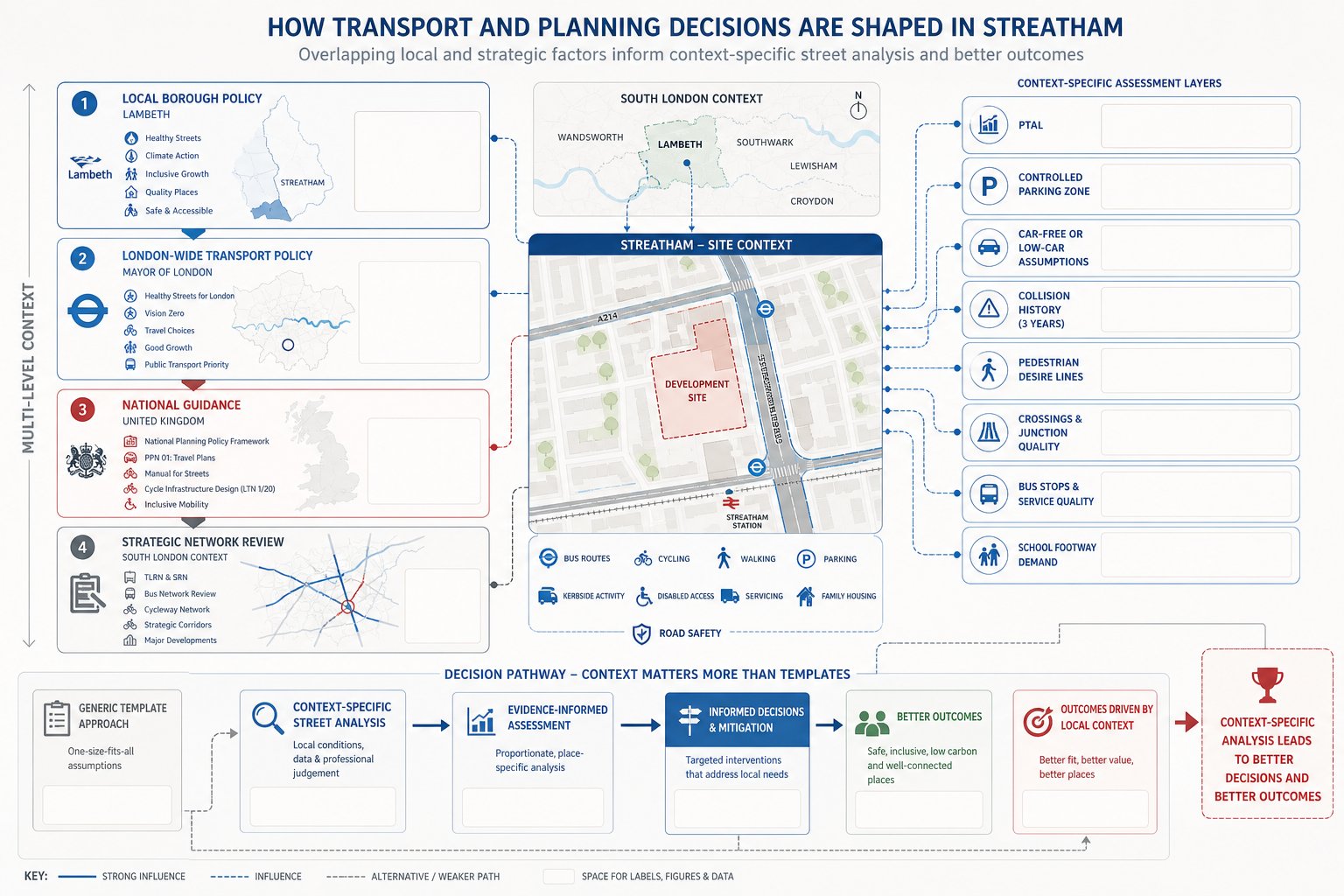
Streatham sits within a policy and transport context that rewards detail. Lambeth will consider the development plan, local transport impacts, street design, and safety, while TfL may become involved where strategic routes, bus operations, or wider network effects are relevant. National guidance, including the NPPF, still matters, but in practice decisions are usually shaped by how well a scheme responds to local conditions.
The London Plan is central, especially around sustainable travel, car parking restraint, cycle parking, Healthy Streets principles, and mode shift. Lambeth’s own policies add local nuance, and officers will often look closely at PTAL levels, controlled parking zones, site accessibility, and whether the proposal would intensify existing kerbside pressure. On a site with good public transport access, for example, low-car or car-free assumptions may be entirely reasonable. On another, those same assumptions may be challenged if disabled parking, servicing, or family housing needs are not properly addressed.
Road safety is another live issue. A review of collision history, pedestrian desire lines, crossing points, bus stops, and school-related footway demand can quickly reveal concerns that a generic report would miss. That is why a context-specific reading of the street matters more than lifting a template from another borough.
Where project teams need broader technical framing, principles from Traffic Engineering: Your and Traffic Engineering and are useful, but Streatham decisions still hinge on the local network, local policy interpretation, and local officer expectations.
Key Transport Reports Often Needed In Streatham
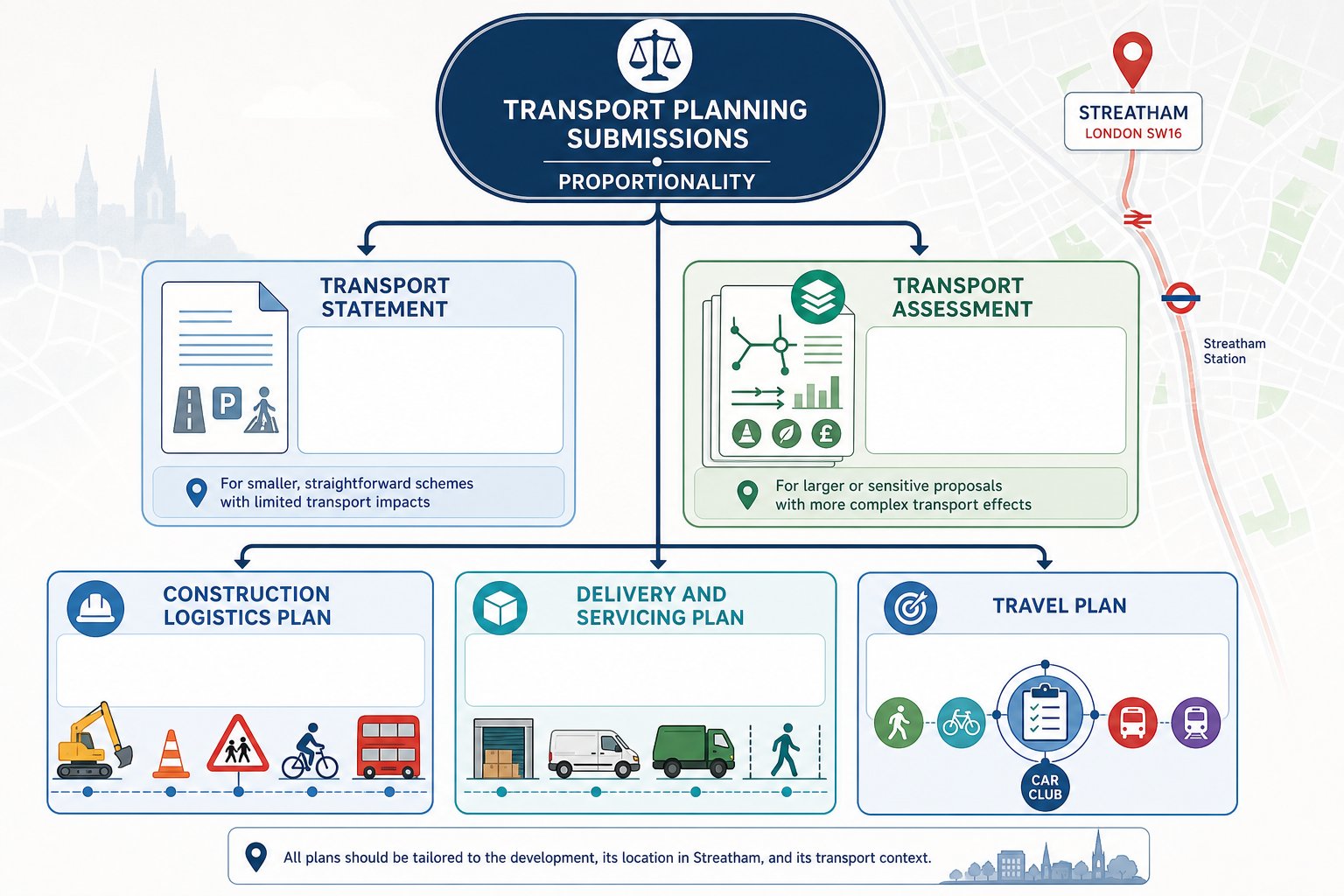
Most Streatham planning submissions do not need every possible transport document, but they do need the right ones. The key is proportionality. An overly thin submission invites objections: an overly bloated one wastes time and budget without improving the planning case.
For smaller and more straightforward schemes, a Transport Statement may be enough to explain baseline conditions, likely movement patterns, parking, servicing, and why impacts are not severe. Larger, more sensitive, or more intensely trafficked proposals usually require a fuller Transport Assessment with quantified analysis and, where necessary, junction modelling or mitigation proposals.
Beyond those core reports, supporting plans are often what unlock progress. Construction Logistics Plans matter where build activity could affect narrow streets, schools, cyclists, or bus corridors. Delivery and Servicing Plans are often essential for town-centre and mixed-use schemes. Travel Plans can also be expected for schools, workplaces, and larger residential developments where mode shift commitments need to be set out clearly.
The trick isn’t just producing these reports. It’s making sure each one tells the same operational story, uses the same assumptions, and speaks directly to the site’s planning risks.
Transport Statements And Transport Assessments
A Transport Statement (TS) is generally used for smaller or lower-impact developments. It explains the proposal, reviews the site and surrounding network, summarises relevant policy, and considers how the scheme will affect movement, access, parking, servicing, and sustainable travel. For many infill or change-of-use projects, that is the main planning transport document.
A Transport Assessment (TA) goes further. It is usually needed where the development is larger, more complex, or more likely to influence junction operation, queueing, or travel patterns. A TA will typically include forecast trip generation, trip distribution and assignment, junction impact analysis, parking review, and mitigation where required. It may also assess cumulative development effects.
The threshold between TS and TA is not fixed in a simple way. It depends on local sensitivity, the character of the street, and whether officers consider the impact likely to be material. A modest scheme on a constrained road can prompt more scrutiny than a larger one in a more forgiving location.
Construction Logistics Plans, Delivery And Servicing Plans, And Travel Plans
A Construction Logistics Plan (CLP) sets out how the build phase will be managed. In Streatham, that usually means defining construction routes, avoiding conflict with peak pedestrian periods, controlling vehicle sizes and timing, protecting cyclists, and reducing disruption on constrained residential streets or along bus corridors.
A Delivery and Servicing Plan (DSP) focuses on the completed development. It explains what deliveries are expected, what vehicles will be used, where loading will take place, how refuse collection works, and how conflict with pedestrians, residents, and through traffic will be minimised. For many commercial and mixed-use schemes, this document carries real weight.
A Travel Plan supports sustainable movement. It sets objectives, measures, and monitoring targets to encourage walking, cycling, public transport use, car clubs, and other lower-impact travel choices. On larger developments, schools, and employment-led schemes, it can be a practical commitment rather than a generic add-on.
That same discipline is common on Commercial Traffic Engineering In projects, where operational detail often decides whether a proposal feels workable to the planning authority.
How Traffic Engineers Assess Access, Safety, And Trip Impact
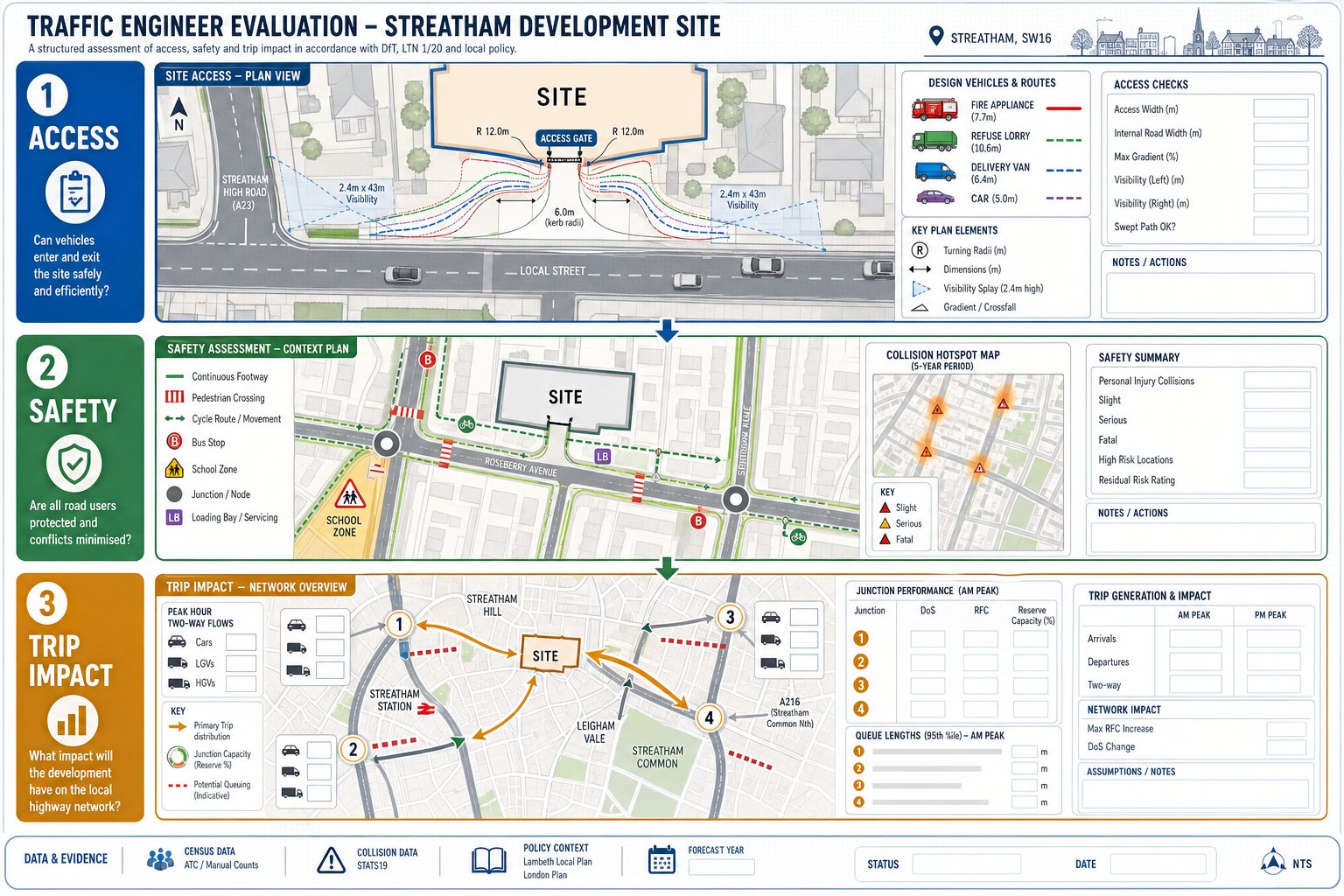
This is usually the section of work clients notice most, because it turns a concept into evidence. We assess whether vehicles can access and use the site safely, whether people walking and cycling are protected, and whether the development’s traffic effect is material in network terms.
Access assessment often begins with geometry: carriageway width, radii, gradients, intervisibility, and whether vehicles can enter and leave in forward gear where expected. Then comes swept-path analysis. Cars are only one part of the picture: in many schemes the critical vehicle is the refuse lorry, fire appliance, delivery van, or rigid servicing vehicle. If that movement does not work on plan, the application can unravel quickly.
Safety assessment typically covers visibility splays, crossing demand, footway continuity, cycle movement, collision history, and interaction with nearby junctions, schools, bus stops, or loading activity. A Personal Injury Collision review can be especially important where officers are already cautious about a corridor or junction.
Trip impact analysis then asks how many movements the proposal is likely to generate, when they occur, where they go, and whether nearby junctions or kerbside conditions can absorb them. Depending on scale, that may involve census data, TRICS-informed forecasting, distribution assumptions, and modelling of queueing or capacity.
The point is not to overdramatise impacts. It is to identify what is genuinely material, explain it clearly, and propose mitigation only where mitigation is truly needed.
Why Streatham Sites Need A Local, Context-Led Approach
Streatham is not a place where copy-and-paste transport reporting works well. The area combines a strategic north-south corridor with intensely local conditions: bus-heavy movement on the A23, active shopping frontages, side streets with limited spare parking, residential servicing constraints, school travel peaks, and a public realm where pedestrian demand can be high even outside the obvious town-centre core.
That means two sites only a short walk apart can face very different transport questions. One may be dominated by bus stop interaction and right-turn pressure. Another may hinge on whether a delivery van can stop legally without blocking movement. A residential plot may look low impact until the tracking shows that refuse collection depends on awkward reversing. This is why officers tend to respond better to reports that show actual local understanding rather than generic London wording.
A context-led approach also helps with proportionality. We do not need to model everything everywhere. We need to focus on the constraints that genuinely matter on that street, at that access, and for that mix of users. Sometimes the answer is a simple design amendment. Sometimes it is a stronger servicing strategy. Sometimes it is early engagement before assumptions become fixed.
That same local sensitivity is what distinguishes a borough-specific submission from a generic Traffic Engineer In comparison or a regional precedent lifted from elsewhere.
Working With Architects, Planners, Developers, And Councils
Good transport work is collaborative. It is rarely most effective when done in isolation after the drawings are finalised. We usually get the best outcomes when architects, planning consultants, developers, and highways specialists test the operational assumptions together from an early stage.
With architects, that often means iterating access width, bin collection points, cycle storage, vehicle tracking, and the practical relationship between building layout and servicing. Small layout decisions can remove large transport objections. With planners and planning lawyers, our input helps align technical evidence with policy arguments, pre-application strategy, and committee risk.
For developers and contractors, timing matters just as much as content. If a scheme is heading for a fixed submission date, transport surveys, baseline observations, and report scoping need to happen early enough to avoid rushed assumptions. That is particularly true where a junction assessment, parking stress review, or TfL discussion may be needed.
Engagement with councils can be equally valuable. Pre-application contact with Lambeth, and with TfL where relevant, often helps define whether a TS or TA is expected, whether a CLP or DSP will be conditioned, and what mitigation themes officers are likely to focus on. It does not guarantee agreement, of course. But it usually reduces avoidable surprises, which is half the battle on a live planning programme.
How To Prepare For A Smooth Transport Assessment Process
The easiest transport assessment is the one that starts before the design hardens. In practice, a smooth process depends on getting a few basics right early.
First, define the development quantum clearly. Unit mix, gross floorspace, land use class, parking provision, servicing assumptions, cycle parking, and phasing all feed directly into transport analysis. If those elements keep changing late in the programme, the reporting will have to keep changing with them.
Second, make sure the red-line boundary and the access strategy are stable enough to assess. We often see avoidable delay where the drawings imply one thing, the operating statement implies another, and the transport report is left trying to reconcile both.
Third, collect the right data. That may include site observations, parking beat surveys, classified turning counts, pedestrian flows, or delivery activity. In an urban location, using weak or outdated data is one of the fastest ways to invite challenge from officers.
Fourth, agree the scope where possible. A brief pre-application note or scoping discussion with Lambeth or TfL can clarify whether the authority expects a TS, TA, Travel Plan, CLP, junction modelling, or additional safety work. That can save weeks.
Finally, leave room for iteration. A good transport process is not just about writing reports: it is about allowing enough programme time to refine access, mitigation, and wording before submission. That is where experience really earns its keep.
Choosing The Right Traffic Engineer In Streatham
Not every consultant who can produce a transport report is the right fit for a Streatham planning application. The difference usually shows up in judgment: knowing what level of analysis is proportionate, which local issues will matter to officers, and how to present technical evidence in a way that supports the wider planning strategy rather than complicating it.
We would usually look for three things.
First, relevant UK and London experience. Chartered or highly experienced practitioners who understand borough decision-making, London Plan policy, TfL expectations, and urban site constraints tend to spot risk earlier and frame evidence more persuasively.
Second, clear and robust reporting. A good report is not just technically competent. It is readable, consistent with the drawings, and precise about assumptions. Officers should not have to guess how servicing works or whether trip forecasts reflect the actual scheme.
Third, practical problem-solving ability. The best traffic engineer in Streatham does more than identify issues. They help solve them, whether through layout amendments, operational controls, mitigation measures, or direct discussion with highway officers.
At ML Traffic, that is the value we aim to bring: concise, accurate reporting, tailored to authority thresholds, backed by more than 30 years of experience. And honestly, speed matters too. On planning programmes, a technically sound answer delivered late can still become a programme problem.
Conclusion
In Streatham, transport planning succeeds when it is specific to the site, the street, and the decision-makers reviewing the application. A local, context-led traffic engineer in Streatham can help teams evidence safe access, realistic servicing, proportionate parking, and policy-compliant movement strategy without drowning a project in unnecessary analysis.
For residential, mixed-use, commercial, education, and community schemes alike, the strongest submissions usually share the same qualities: early input, accurate data, joined-up reporting, and a practical understanding of how the A23 corridor and surrounding streets actually function day to day.
When that work is done well, transport reports stop being a late-stage hurdle and become part of moving the project forward, faster, with fewer surprises, and with a much better chance of planning progress in 2026.
Frequently Asked Questions about Traffic Engineering in Streatham
What does a traffic engineer in Streatham do for planning applications?
A traffic engineer in Streatham assesses development proposals to ensure safe and policy-compliant access, trip generation, parking, and servicing. They prepare key transport reports like Transport Statements or Assessments to support planning applications within local and national guidelines.
When should I involve a traffic engineer for a Streatham development?
Transport input is best sought early at feasibility or pre-application stage, especially for new residential builds, mixed-use projects, or sites affecting parking, bus corridors, or schools, to avoid design reworks and align with local highway policies.
What transport reports are typically required in Streatham?
Depending on project size, required documents include Transport Statements for smaller schemes, detailed Transport Assessments for larger developments, Construction Logistics Plans, Delivery and Servicing Plans, and Travel Plans for sustainable transport commitments.
How do traffic engineers assess safety and access for Streatham sites?
They analyse vehicle movements with swept-path studies for cars and larger vehicles, review visibility splays and pedestrian safety, check collision history, and model trip impacts to ensure proposals operate safely within the busy A23 corridor and local streets.
Why is a local, context-led traffic engineering approach important in Streatham?
Streatham’s unique conditions like heavy A23 traffic, bus routes, parking pressures, and peak school movements require tailored assessments focusing on site-specific constraints rather than generic reports to meet Lambeth and TfL expectations effectively.
How can I prepare for a smooth transport assessment process in Streatham?
Clearly define the development scale early, ensure stable site access and layout, collect accurate traffic and parking data, agree the report scope with authorities like Lambeth or TfL, and allow time for iterative revisions before submission for best results.