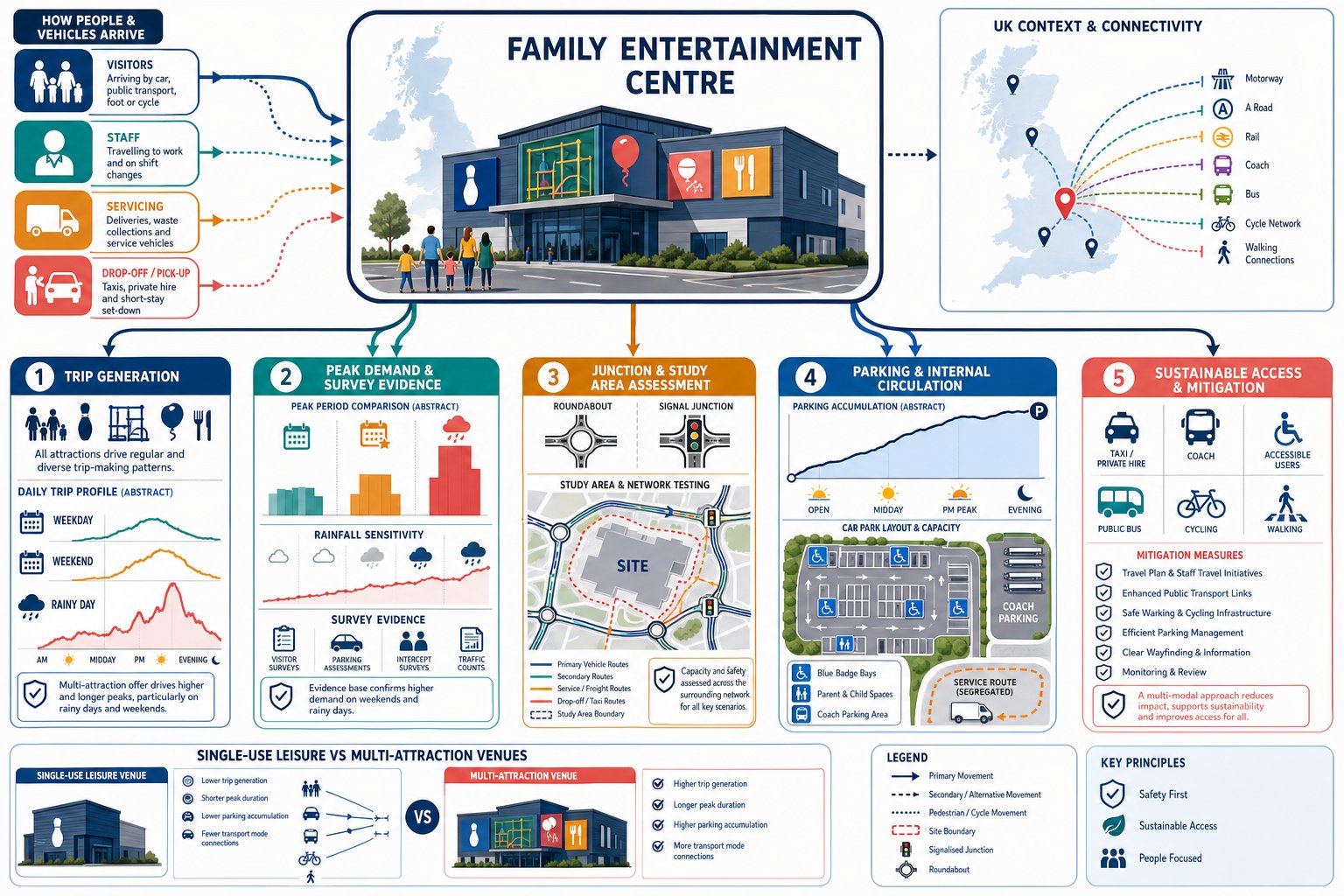
A multi-attraction family entertainment centre can look straightforward on a site plan: one building, one access, a parking layout, perhaps some landscaping around the edges. In practice, though, these schemes create some of the most layered leisure trip patterns we deal with. A bowling offer pulls one audience, soft play another, food and drink extends dwell time, birthday parties create sharp arrival waves, and wet-weather demand can suddenly push everything harder than a typical weekday forecast ever suggested.
That is exactly why a Multi-Attraction Family Entertainment Centres Transport Assessment has to do more than count cars and run a couple of junction models. It needs to show, clearly and credibly, that the development can function in the real world: during school holidays, on rainy Saturdays, at after-school peaks, when parents are collecting children, when coaches arrive, and when servicing overlaps with visitor activity.
For architects, planning consultants, lawyers, developers, surveyors and local authorities, the planning question is usually the same. Can the proposal be accommodated safely and efficiently, and are any impacts acceptable or properly mitigated? In 2026, the answer depends on robust evidence, realistic assumptions and a transport strategy that reflects how modern leisure destinations actually operate.
Below, we set out what planning teams need to cover, where applications often fall short, and how a well-structured assessment can materially strengthen the case for consent.
Key Takeaways
- A Multi-Attraction Family Entertainment Centres Transport Assessment must accurately reflect varied visitor behaviour, including different dwell times and peak demand influenced by weather and events.
- Effective transport assessments require robust comparator surveys from similar venues to forecast trip generation, mode split, and peak periods realistically.
- The assessment should address network performance, site access, on-site circulation, and parking, ensuring safety, efficiency, and mitigation of conflicts between visitors, staff, and service vehicles.
- Sustainable travel options must be seriously considered and integrated into the transport strategy, reflecting local context and realistic opportunities to reduce car dependence.
- Early agreement with highway authorities on scope, study area, and methods enhances the strength of the application and mitigates common planning risks.
- Clear presentation with visual plans and concise explanations improves understanding and support among decision-makers, making the transport assessment a practical planning tool.
What A Transport Assessment For A Multi-Attraction Family Entertainment Centre Needs To Prove
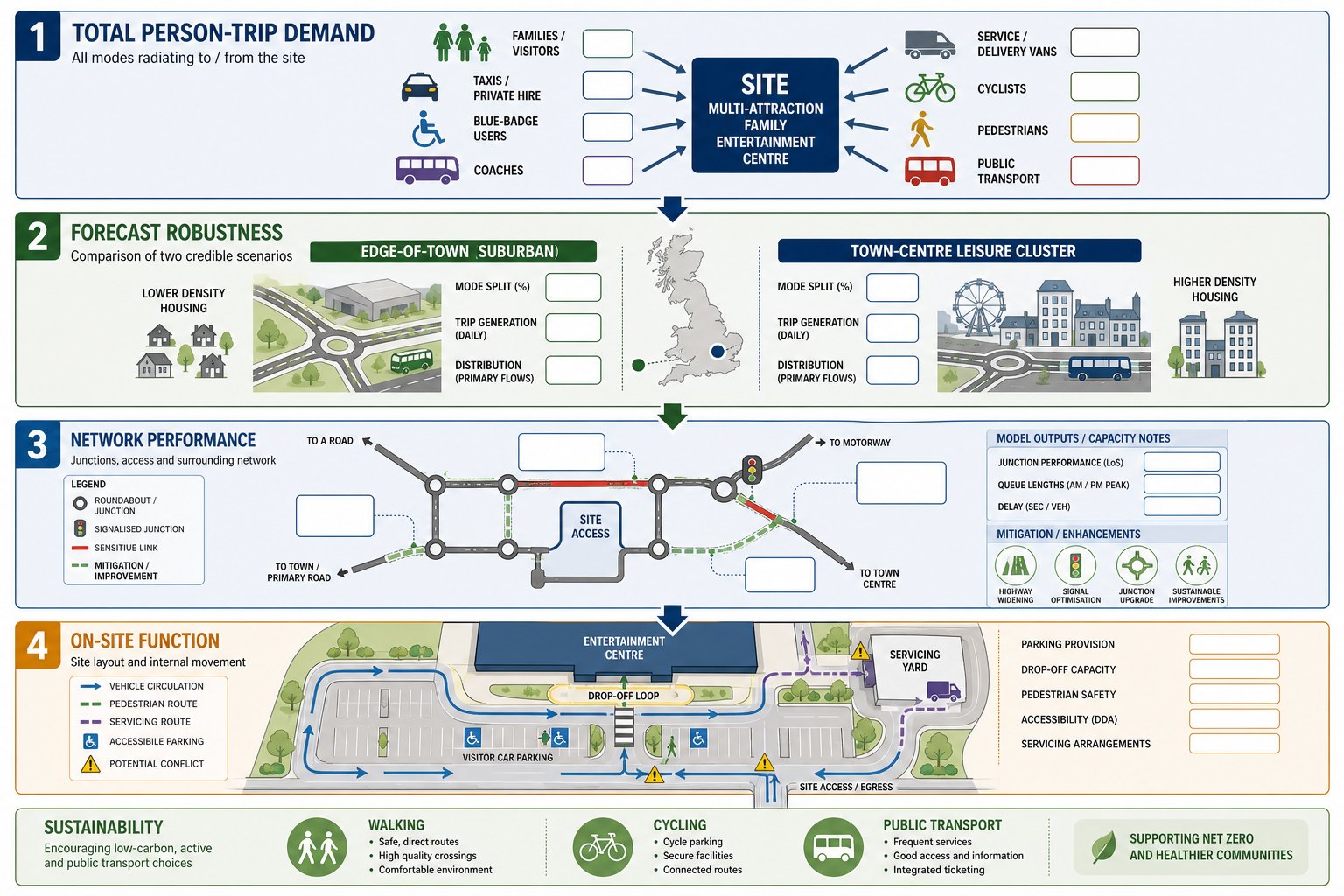
At its core, the transport assessment has to demonstrate that the development’s total movement demand can be accommodated safely and acceptably in planning terms. That means all person trips, not just private cars. We need to account for visitor arrivals, staff commuting, taxis and private hire vehicles, blue-badge users, coaches and minibuses where relevant, servicing, refuse collection, and realistic opportunities for walking, cycling and public transport.
For a multi-attraction family entertainment centre, the first test is whether trip generation, distribution and mode split have been forecast on a robust basis. Comparable sites matter. Local context matters just as much. A suburban edge-of-town location with high car ownership and patchy bus coverage will behave very differently from a town-centre leisure cluster.
The second test is network performance. The TA should show that the site access, nearby junctions and any sensitive links either operate within acceptable capacity or can be improved through mitigation. This is where a good transport assessment for developments follows the same discipline as any other planning-led highway review: define the problem properly, model it transparently, and explain the result in plain English.
The third test is on-site function. Parking, drop-off, internal circulation, pedestrian safety and disabled access all need to work together. If children are crossing live vehicle routes, if queues can back onto the public highway, or if service vehicles conflict with family arrivals, the application is vulnerable even before wider junction analysis begins.
And finally, the TA must show that sustainable travel has been considered seriously, not bolted on at the end.
How Multi-Attraction Venues Differ From Single-Use Leisure Developments
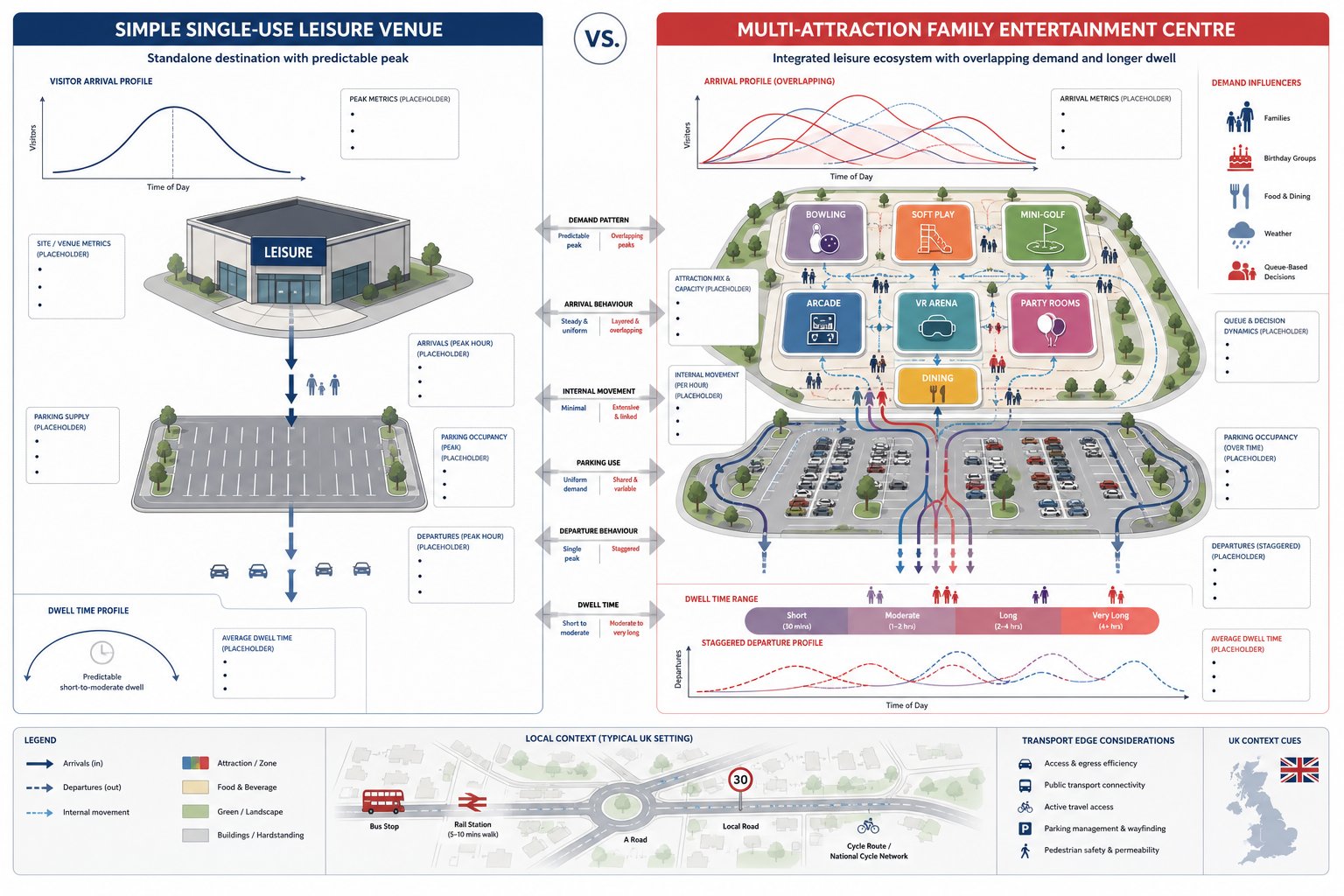
Planning teams sometimes start with benchmarks from cinemas, gyms or individual food-and-drink units because those datasets are easier to find. The problem is that a multi-attraction venue behaves differently.
A single-use leisure development often has a relatively consistent demand profile. A cinema, for instance, tends to peak around screening times. A bowling centre on its own may have more predictable evening and weekend demand. But when bowling, soft play, mini-golf, arcade space, VR experiences, party rooms and food offers are bundled together, the transport picture becomes more complex.
Dwell times lengthen and diversify. Some families stay 45 minutes in soft play: others remain for three hours because they combine activities and eat on site. Arrival patterns become less tidy. A birthday party may generate a concentrated check-in period followed by staggered departures. Corporate events can push demand into times that would otherwise be quiet.
There is also more internal trip interchange. People don’t simply arrive for one use and leave. They move between attractions, extend visits and make linked decisions based on queues, weather and children’s energy levels, which, frankly, is not something any standard parking ratio captures very well.
This is why we often frame these schemes more like leisure ecosystems than single uses. The same principles seen in mixed use masterplan transport work can apply here: overlapping demand, linked trips, shared parking behaviour and a need to understand the whole site as an operational system, not a collection of isolated land uses.
Key Trip Generation Factors Across Leisure, Food, And Ancillary Uses
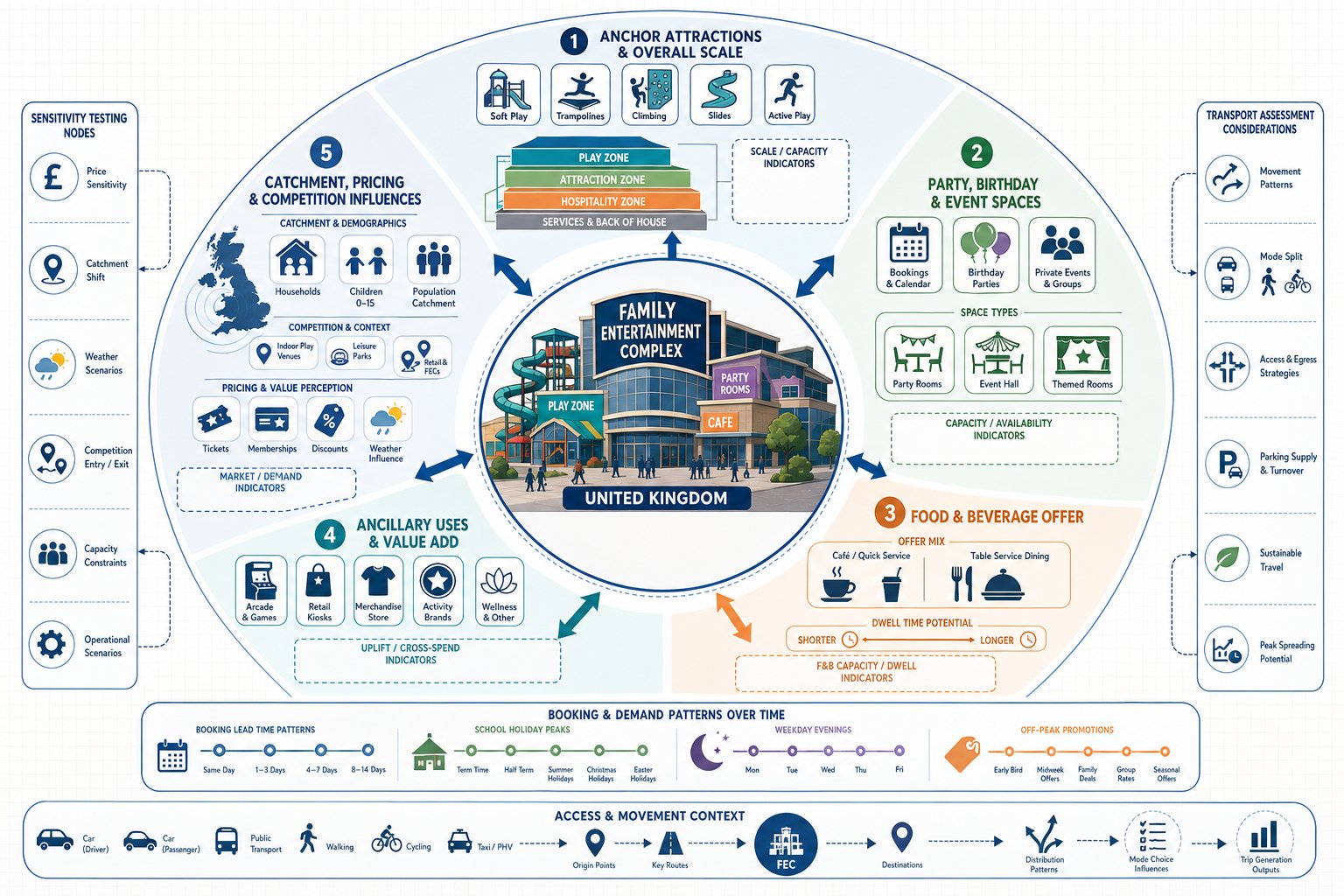
Trip generation for these schemes should never be reduced to gross floor area alone. Floor space matters, of course, but it is only one variable.
The strongest drivers usually include the type and scale of the anchor attractions, the amount of dedicated party or event space, the nature of the food offer, and the role of ancillary uses such as arcades, retail kiosks or branded activity zones. A restaurant-style offer with table service can significantly increase dwell time compared with a simple café. Dedicated birthday rooms can create very distinct peaks around booked slots. Corporate bookings may shift demand into weekday evenings or shoulder periods.
Catchment characteristics are equally important. Household composition, child population, local car ownership, deprivation profile and competition from nearby attractions all influence trip rates and mode split. Pre-booking can smooth some uncertainty, but it doesn’t remove it. Walk-ins, weather-driven decisions and promotional campaigns can still change actual demand substantially.
Pricing also plays a role. Discounted off-peak sessions, bundled family offers and meal-plus-activity packages can re-shape when people travel and how long they stay. So can school-holiday promotions.
Where the scale or nature of a proposal is unusual, broader planning work may overlap with an environmental impact assessment transport review, particularly if cumulative movement effects or wider mitigation obligations are in play. Even where a full EIA is not required, the same discipline applies: assumptions should be traceable, locally relevant and sensitivity-tested.
Peak Periods, Seasonal Demand, And The Importance Of Robust Survey Data
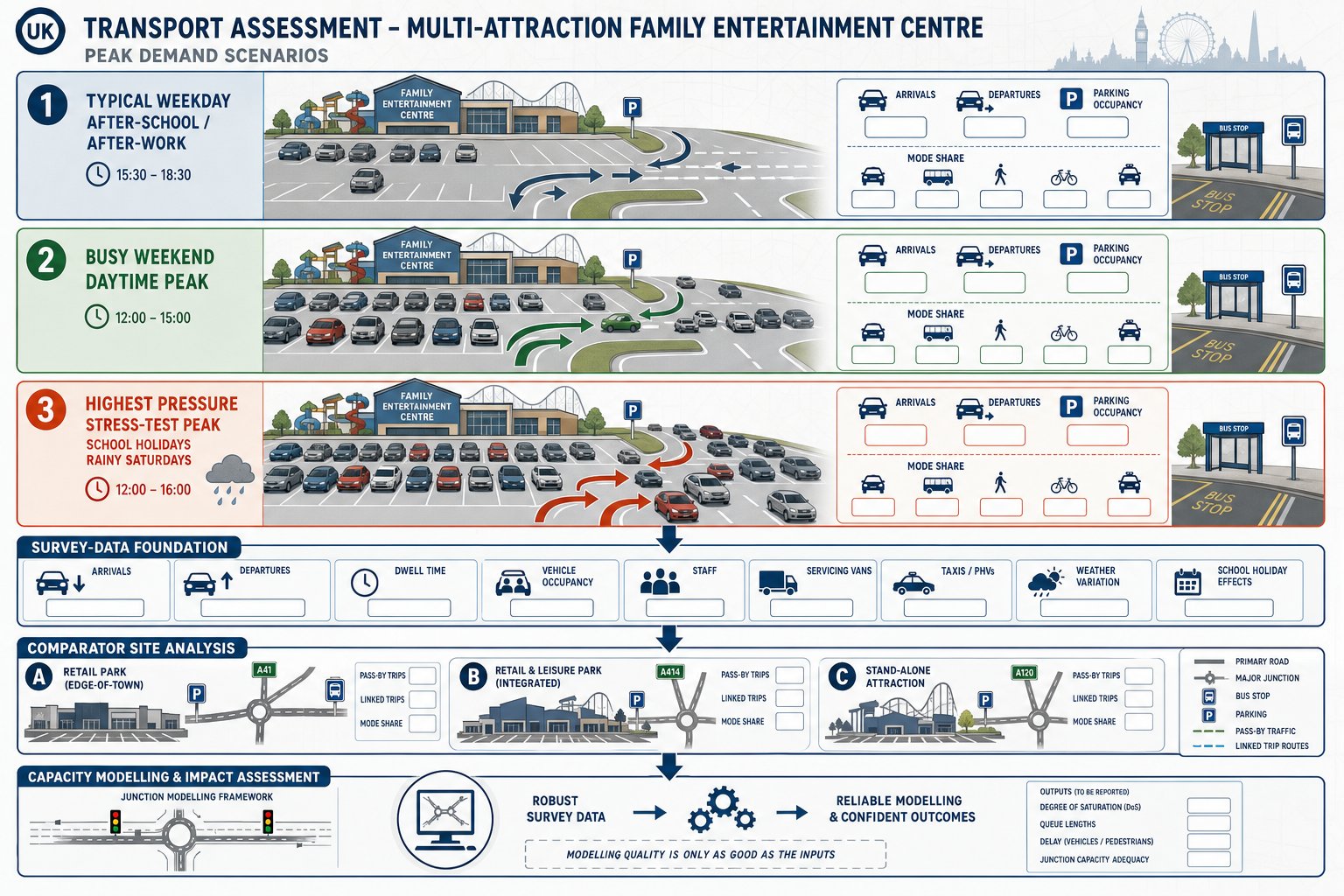
One of the most common weaknesses in leisure applications is treating the network peak and the development peak as if they are the same thing. For family entertainment centres, they often are not.
A proper assessment should normally consider at least three conditions:
- a typical weekday, especially after-school and after-work periods:
- a weekend daytime peak, often the most operationally intense period: and
- an absolute or stress-test peak, such as school holidays, wet-weather Saturdays or periods when outdoor leisure demand transfers indoors.
That final category matters more than many applicants expect. Family entertainment centres are classic “rainy day” destinations. If the TA only uses average conditions, it can understate both parking accumulation and access-junction pressure exactly when the site is busiest.
Comparable-site survey evidence is hence critical. We usually want multi-day, in-season surveys from genuinely similar venues, not one off counts from a loosely comparable unit in another region. The data should cover arrivals, departures, dwell times, vehicle occupancy, staff numbers, servicing, taxi activity and, where possible, variation by weather and school holiday status.
And the survey evidence needs interpretation, not just presentation. If one comparator sits beside a major retail park and another is effectively stand-alone, their pass-by and linked-trip patterns will differ. If bus accessibility varies sharply between sites, mode split will too.
Where junction modelling follows, tools such as Junctions 11 Software can support standard capacity testing, but the inputs are only as good as the survey foundations underneath them.
Choosing The Right Study Area And Assessing Junction Impacts
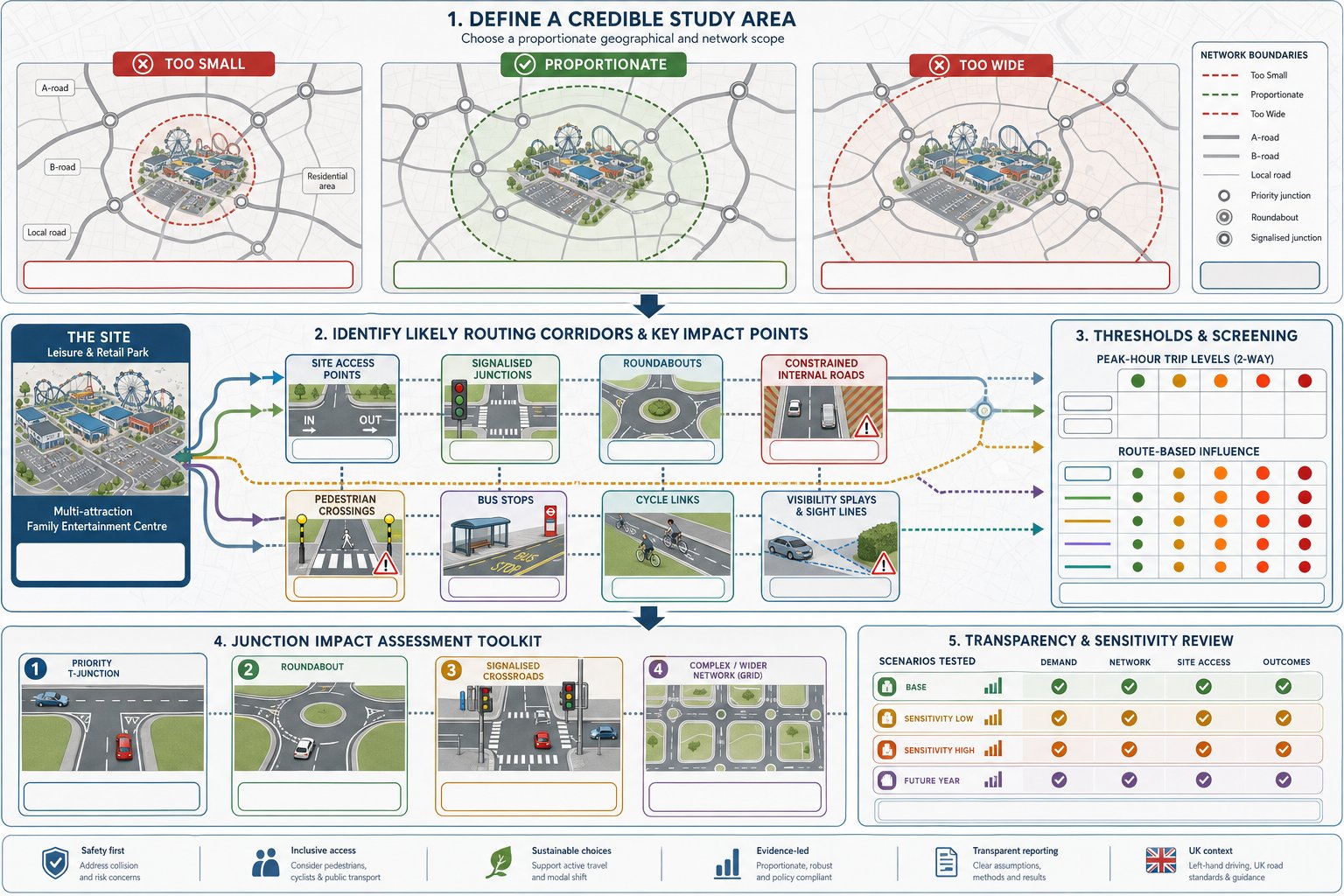
The study area should be proportionate, but it also needs to be credible. If it is too narrow, obvious effects get missed. If it is too wide, the assessment becomes noisy and less useful.
In practice, we define the study network around forecast development traffic, likely routeing, existing constraints and discussions with the local highway authority. A sensible starting point is often links or junctions expected to experience more than around 30 to 50 two-way peak-hour development trips, though local conditions can justify wider or tighter thresholds.
For multi-attraction leisure sites, we also pay close attention to access complexity. Multiple entrances to a retail or leisure park, nearby signalised nodes, roundabouts with weak reserve capacity, and constrained internal roads can all become material even when the headline trip numbers appear modest.
Assessment should cover the site access for all modes, not just the driver turning movement. Pedestrian crossings, bus stop connections, cycle routes and visibility arrangements are part of the transport case. If there are known safety issues, collision data and operational observations should be addressed directly rather than buried in an appendix.
The modelling approach should match the problem. Priority junctions may suit PICADY, roundabouts ARCADY, urban signal junctions LINSIG, and more complex networks sometimes justify microsimulation. The choice should be explained, with assumptions clearly stated. Highway officers are much more receptive when the method has been agreed early and the results are shown transparently, including sensitivity tests where baseline conditions are already stretched.
Car Parking Demand, Drop-Off Activity, And Internal Circulation
Parking is usually where concern becomes tangible. Members can debate modelled RFCs all evening: they immediately understand a car park that is likely to overflow on a wet Saturday.
For a family entertainment centre, standard parking ratios are rarely enough on their own. What we need is parking accumulation built from observed dwell times, turnover and arrival profiles. That allows us to estimate not just peak demand, but when spaces fill, how quickly they recycle, and whether separate event or party traffic creates secondary spikes.
Layout matters as much as quantity. General parking, blue-badge bays, parent-and-child provision, coach or minibus space where relevant, staff parking, servicing areas and short-stay drop-off all need coherent routing and signing. The internal road system should accommodate two-way flow, emergency access and queue storage without causing blockages back to the public highway.
In some cases, shared parking with neighbouring uses is workable, but only where the overlap in peaks has been tested properly. Leisure next to food, retail or cinemas can produce either helpful complementarity or complete operational pain. It depends on the timing.
This part of the TA also benefits from clear plans. AutoTRACK-style swept paths, pedestrian desire-line diagrams and queue storage illustrations often resolve concerns faster than pages of narrative.
Forecasting Staff, Visitor, And Servicing Movements
Staff, visitors and servicing should be forecast separately because they behave differently and affect the site in different ways.
Staff demand depends on shift patterns, opening hours, cleaning and management schedules, and whether food operations are integrated or independently staffed. A realistic TA should identify likely staff numbers by time period, then apply an evidence-based mode split. In urban locations, staff public transport use may be material: on out-of-centre sites, car use often remains dominant unless there is a strong bus offer.
Visitor forecasting should consider party size, vehicle occupancy, pre-booked sessions, walk-ins and the split between general leisure users and dedicated events such as birthday parties. This matters because a party booking may produce several short-stay drop-offs followed by a later pick-up pulse, whereas general family visits tend to generate longer parking accumulation.
Servicing is often underplayed. Food and drink uses, amusement equipment, consumables, cleaning contracts and refuse collections all have movement implications. If service vehicles need to reverse across pedestrian routes or occupy shared parking aisles, that should be designed out where possible. Swept-path testing is essential for critical manoeuvres, and timing restrictions can be a sensible mitigation where visitor periods are intense.
The discipline is similar in other sectors too, whether for leisure or a Residential Development Transport assessment: separate the movement components, then rebuild the operational picture honestly.
Managing Queuing, Pick-Up Points, And Conflict Between User Groups
If there is one issue that regularly creates avoidable objections, it is unmanaged interaction between cars, children, taxis, coaches and service vehicles.
Family venues generate a lot of short-duration stopping activity. Parents drop off older children, taxis collect groups, minibuses arrive for organised events, and blue-badge users need close, clear access. Without dedicated space, those movements spill into aisles, block turning heads or create informal stopping near the entrance.
The design response should be deliberate. On-site queue storage at the access needs to be sufficient to prevent tailback onto the public highway. Pick-up and drop-off areas should be signed, intuitive and, where possible, separated from the main pedestrian desire lines. Coaches and minibuses need enough room to manoeuvre without dominating the front door environment. Service access should either be segregated physically or controlled operationally.
Pedestrian safety deserves more than a standard note. Children do not always take the route the drawing intended. They cut across aisles, run ahead, and move unpredictably. That means low vehicle speeds, clear crossing points, strong visibility and a layout that feels self-explaining.
Where conflict cannot be designed out fully, management measures matter: time restrictions for servicing, stewards at peak periods, barrier systems, one-way circulation, or pre-booked collection windows for large events. These are practical details, but they often decide whether the site works calmly or becomes chaotic.
Sustainable Travel Expectations In The Planning Process
In 2026, a leisure-led scheme cannot rely on the old argument that “families will drive anyway”. Planning policy and local validation expectations are more demanding than that.
We need to show that reasonable opportunities for non-car access have been identified and, where practical, improved. That does not mean pretending every family entertainment centre will achieve a city-centre mode split. It means being honest about the site context while still reducing avoidable car dependence through design, connectivity and management.
For some authorities, sustainable transport is now a decisive part of the planning balance, especially where the site is edge-of-centre, close to existing bus corridors, or linked to wider regeneration. If the TA dismisses walking, cycling and public transport in a couple of paragraphs, it will usually invite challenge.
The better approach is proportionate but serious. Assess the surrounding network for active travel, identify barriers, measure actual walking distances to stops and stations, and set out what can realistically be improved. On larger schemes, the transport work may need to align with wider access and placemaking principles often found in mixed use masterplan transport: studies, even where the proposal itself is a single planning unit.
Highway and planning officers do not expect miracles. They do expect evidence, consistency and a Travel Plan that feels real.
Walking, Cycling, Public Transport, And Accessibility Considerations
The TA should describe, in practical terms, how people reach the site without a car and whether those routes are attractive enough to be used.
For walking, that means direct pedestrian links from surrounding streets, adjacent uses and bus stops, with safe crossing points, dropped kerbs, lighting and overlooked routes where possible. We should identify actual desire lines, not only formal footways. If the most obvious route from a bus stop is across a loosely marked car park aisle, that is the route the design needs to fix.
Cycling provision should be visible, secure and proportionate to demand, with stands located near the entrance rather than hidden behind service yards. For staff, showers and lockers can make a difference where the building layout allows. Public transport assessment should cover routes, frequency, service span, interchange quality and the quality of walking routes to stops or stations. On some sites, a contribution to improved stops, shelters or wayfinding may be justified.
Accessibility must run through the whole design. Gradients, surfaces, crossing widths, parking bay location, door arrangements and internal vertical circulation all matter. For a family-oriented venue, inclusive access is not a niche issue: it is central to how the destination functions.
The strongest submissions pull these points together visually with access plans and short, readable commentary rather than hiding them in technical appendices.
Travel Plans, Mitigation Measures, And Planning Conditions
A good Travel Plan for a family entertainment centre should be operational, monitored and tied to the actual user profile. Too many are still written as generic templates. Planning officers spot that immediately.
At minimum, we would expect clear objectives, baseline assumptions, mode share targets where measurable, named measures, monitoring arrangements and review triggers. For staff, that may include season-ticket loans, cycle support, car-share promotion, shift-aware travel information and induction material. For visitors, the focus is often on journey information, booking-stage messaging, event-specific advice, wayfinding and promotion of realistic non-car options.
Mitigation can be physical or operational. Physical measures might include junction upgrades, signal optimisation, revised access geometry, extra parking capacity, blue-badge bay reconfiguration, new pedestrian links, better crossings or bus stop improvements. Operational mitigation could include staggered party slots, servicing restrictions, stewards at peak times or controlled overflow parking arrangements.
Conditions and obligations usually secure implementation. That may mean no occupation until access works are complete, no use above a certain floorspace or visitor threshold without further review, or Travel Plan monitoring over a fixed period. The drafting matters. Conditions should be precise enough to be enforceable without becoming so rigid that normal site operation becomes difficult.
Done properly, these measures turn the TA from a defensive document into a practical delivery strategy.
Common Planning Risks, Evidence Gaps, And How To Strengthen An Application
Most weak applications fail in familiar ways. Peak demand is under-estimated. Comparator sites are too generic. Parking is justified with flat standards instead of accumulation analysis. Overlap with neighbouring uses is ignored. Sustainable travel is treated as an afterthought. And the whole case becomes harder to defend at committee because the technical evidence is not explained clearly enough.
The simplest way to strengthen an application is to agree scope early with the highway authority. Comparator sites, survey dates, assessment periods, study area and modelling tools should be discussed before the TA is finalised. That does not guarantee agreement, but it reduces surprise and narrows the room for procedural objection.
Survey evidence should be multi-site and, where possible, multi-season. Sensitivity testing is worth the effort. If a wet-weather uplift or holiday scenario still performs acceptably, the planning case becomes far more resilient. If it does not, the design team can address the issue before determination rather than under pressure afterwards.
Presentation matters too. Clear routing diagrams, parking accumulation charts, queue plans, swept paths and a concise non-technical summary make a real difference, especially for members and non-transport stakeholders.
From our perspective, the strongest applications are usually the ones that are honest about risk, precise about mitigation and realistic about how families actually use the site.
Conclusion
A Multi-Attraction Family Entertainment Centres Transport Assessment succeeds when it reflects operation, not just theory. These venues generate varied dwell times, weather-sensitive demand, layered pick-up activity and overlapping user groups, so the evidence has to be sharper than a simple leisure benchmark and a standard parking ratio.
For planning teams in 2026, the essentials are clear: robust comparator surveys, realistic peak testing, a properly defined study area, credible parking and circulation analysis, and a sustainable travel strategy that stands up to scrutiny. Just as importantly, the assessment needs to explain the scheme in a way decision-makers can follow.
When those pieces come together, the TA becomes more than a technical requirement. It becomes a planning tool that reduces risk, answers highway concerns early and gives the wider project team a much firmer platform for consent.
Multi-Attraction Family Entertainment Centres Transport Assessment FAQs
What must a transport assessment prove for a multi-attraction family entertainment centre?
It must demonstrate safe and efficient accommodation of all person trips, including private vehicles, coaches, taxis, staff, servicing, and sustainable travel, supported by robust trip forecasts, network capacity analysis, safe site layout, and a credible Travel Plan.
How do multi-attraction family entertainment centres differ from single-use leisure developments in transport demand?
They feature varied anchor activities like bowling and soft play with diverse dwell times and complex trip patterns, resulting in staggered arrivals, linked internal trips, and weather-sensitive peaks, unlike single-use venues which have more predictable demand profiles.
Why is using comparable site survey evidence critical in transport assessments for these centres?
Comparable, multi-day surveys provide reliable data on trip generation, mode split, dwell times, and peak-period traffic under varying conditions, allowing realistic forecasts and sensitivity testing of demand especially for peak and absolute peak scenarios.
What role does sustainable travel play in transport assessments for family entertainment centres?
Sustainable travel must be seriously considered through assessing local active travel routes and public transport quality, enhancing connections where feasible, and including management measures in the Travel Plan to reduce car dependence and meet planning policy.
How should parking and drop-off areas be designed in these centres?
Parking demand should be based on detailed accumulation analysis reflecting dwell times and turnover. Layout must include dedicated bays for blue-badge, coaches, taxis, with safe internal circulation and drop-off zones separated from pedestrian routes to avoid conflicts.
What are key mitigation measures to manage queuing and conflicts between different user groups on-site?
Designated, signed pick-up/drop-off points, sufficient queue storage to prevent highway tailbacks, physical or operational segregation of service vehicles, stewards during peak times, and low-speed zones improve safety and operational efficiency at busy periods.