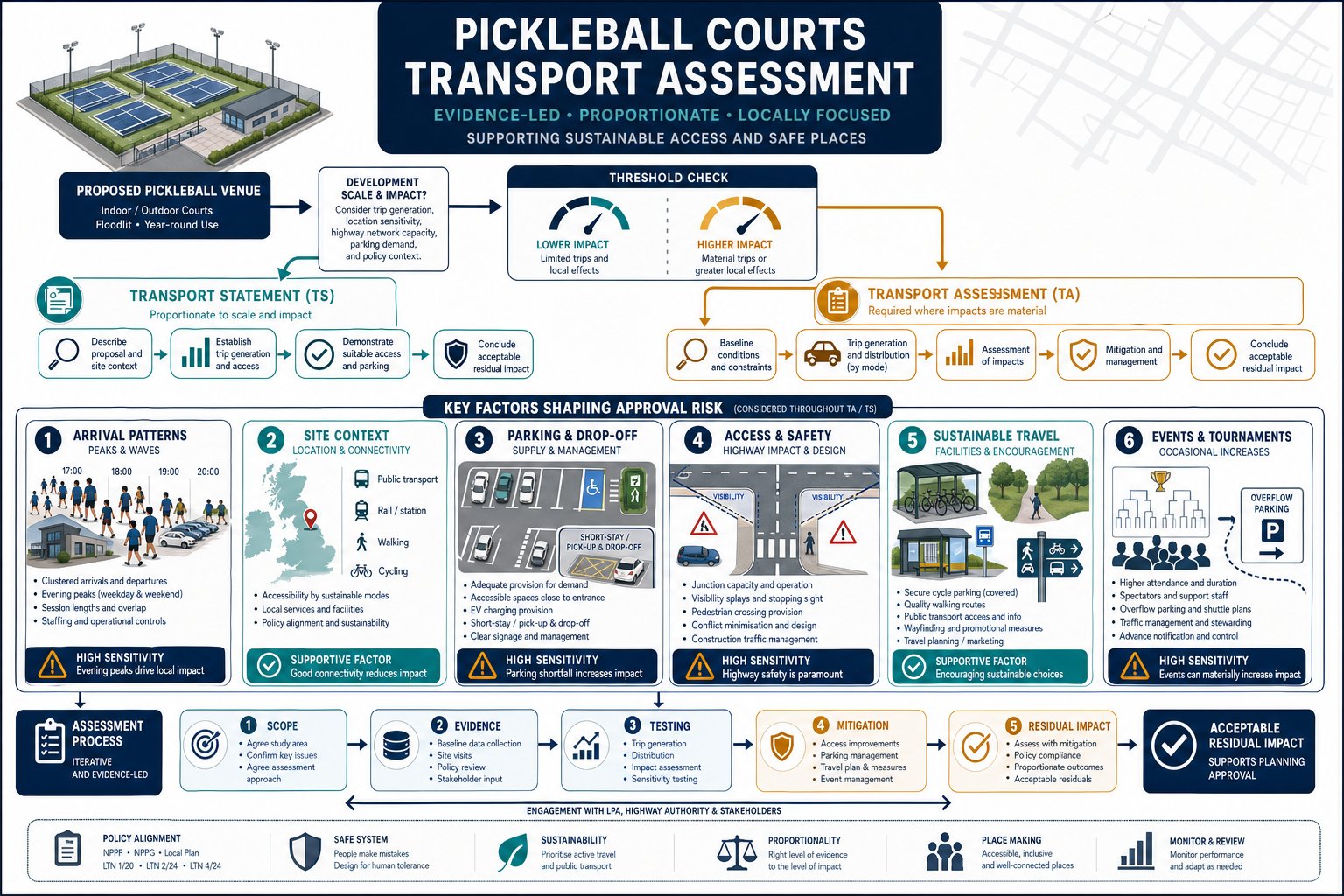
Pickleball has moved from a niche court booking request to a genuine planning issue. And not because the sport is especially traffic-heavy in every case. The problem is that its operating pattern can be deceptively intense: short games, clustered arrivals, evening play under lights, coaching blocks, social sessions, and occasional tournament days that behave nothing like a normal weekday booking profile.
That means a Pickeball Courts Transport Assessment can’t be treated as a generic leisure add-on. If the application is for a new multi-court venue, a conversion within an existing sports club, or an expansion of an established site, local authorities will want to know one thing above all else: will the transport impacts be acceptable, and if not, how will they be managed?
For architects, planning consultants, developers, solicitors, councils, and sports operators, the detail matters. A weak scope, unrealistic trip assumptions, or vague parking evidence can slow validation or trigger objections from the highway authority. A strong submission, by contrast, frames the scheme properly, uses proportionate evidence, and shows that access, safety, parking, and sustainable travel have been thought through from the start.
In this guide, we set out what planning teams need to get right in 2026, drawing on the way transport assessments are typically scoped, reviewed, and challenged in practice across UK planning applications.
Key Takeaways
- A Pickleball Courts Transport Assessment must address the sport’s unique operating patterns, including clustered arrivals and evening play under floodlights, to accurately forecast transport demand.
- Local planning policy and validation requirements critically shape the scope; aligning assessments with local parking, cycling standards, and access constraints ensures smoother approval processes.
- Trip generation should be based on realistic assumptions about court numbers, operating hours, player turnover, and shared leisure demand rather than generic sport multipliers.
- Parking demand and vehicle access require careful evidence-based analysis to manage potential overspill and ensure safe, efficient site circulation, especially during peak and event times.
- Sustainable travel measures must be practical and integrated from the start, facilitating walking, cycling, and public transport use tailored to the venue’s location and user profile.
- Explicitly assessing match days, coaching sessions, and tournaments with clear mitigation plans reduces objections and demonstrates that transport impacts are manageable and acceptable.
What A Pickleball Courts Transport Assessment Covers
A pickleball courts transport assessment is the document that explains how people will reach the site, what demand the development will create, and whether the surrounding network can accommodate that demand safely and efficiently.
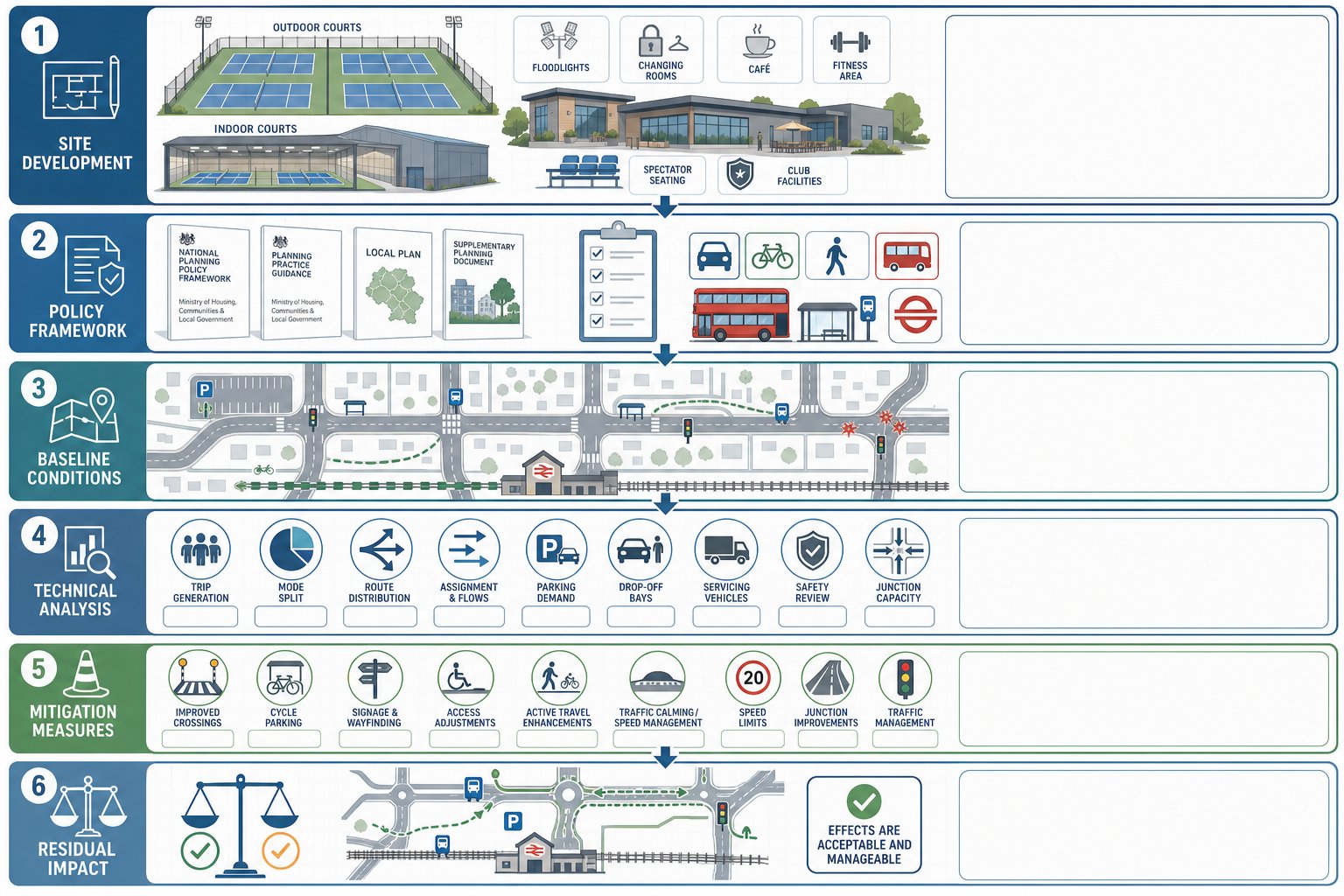
In practice, the scope usually starts with the development description. We need to define court numbers, whether the scheme is indoor or outdoor, the presence of floodlighting, changing areas, cafés, fitness rooms, spectator space, and any wider club facilities. Even modest differences in layout and operation can materially alter transport effects.
From there, the assessment reviews the planning and transport policy framework, including the National Planning Policy Framework, Local Plan transport policies, parking standards, cycling requirements, and any local walking or public transport strategies. For broader methodology, the principles used in a transport assessment for development apply here too, but pickleball needs sport-specific assumptions.
The baseline section then records existing conditions: traffic flows, parking demand, access arrangements, nearby junctions, collision history, bus stops, rail connections, footways, crossings, and cycle links.
After that come the technical core elements: trip generation, mode split, distribution and assignment, parking demand, drop-off, servicing, highway safety, and junction capacity if needed. Finally, the assessment should identify mitigation and any residual impacts. That last part matters. Planning officers rarely expect “no impact whatsoever”: they expect a clear explanation of whether the impact is acceptable and manageable.
When A Transport Assessment Or Transport Statement Is Likely To Be Required
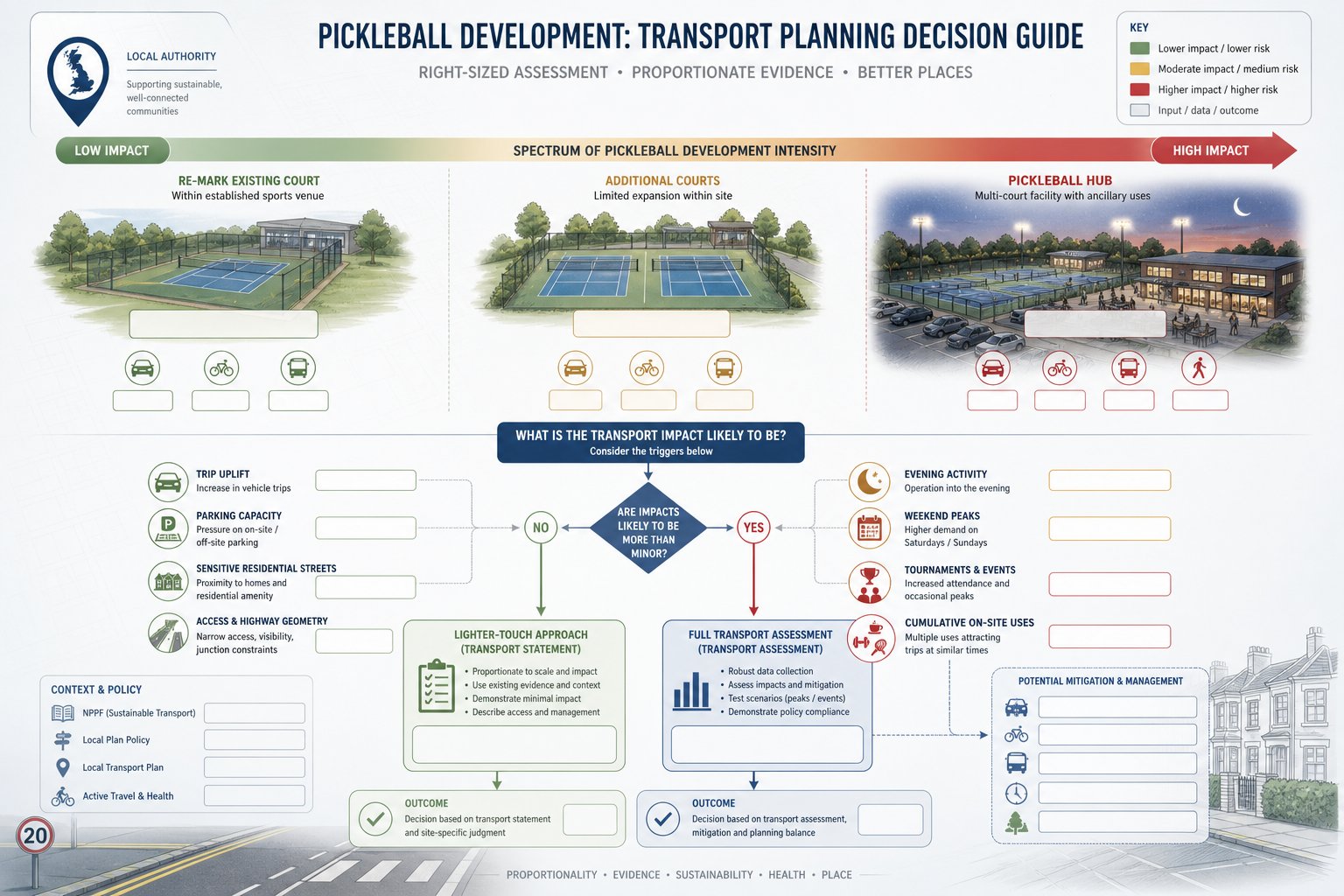
Not every pickleball proposal needs a full Transport Assessment. Some will justify a lighter-touch Transport Statement, particularly where changes are limited and the site already operates as a sports venue with established access and parking.
The distinction usually turns on whether the proposal is likely to create a material increase in travel demand or a meaningful change in how the site functions. Re-marking an existing tennis court for occasional pickleball sessions may sit at one end of the spectrum. A new multi-court hub with floodlights, evening programming, café use, and weekend competitions sits at the other.
In 2026, authorities are still taking a case-by-case approach rather than applying one universal national threshold. We normally look at several practical triggers:
- a noticeable uplift in vehicle trips
- parking demand that may exceed on-site supply
- sensitive residential streets nearby
- constrained access geometry
- regular evening or weekend peak activity
- tournament or spectator demand
- cumulative impact with other leisure uses on the site
A Transport Statement may be sufficient where impacts are demonstrably modest. But if there is any doubt, under-scoping can become a planning risk. We often advise teams to discuss scope early with the local highway authority because a proportionate full assessment is usually better than a thin statement that leaves obvious questions unanswered. That is especially true where objectors are likely to focus on overspill parking or traffic at school-run and evening peak times.
How Local Planning Policy And Validation Requirements Shape The Scope
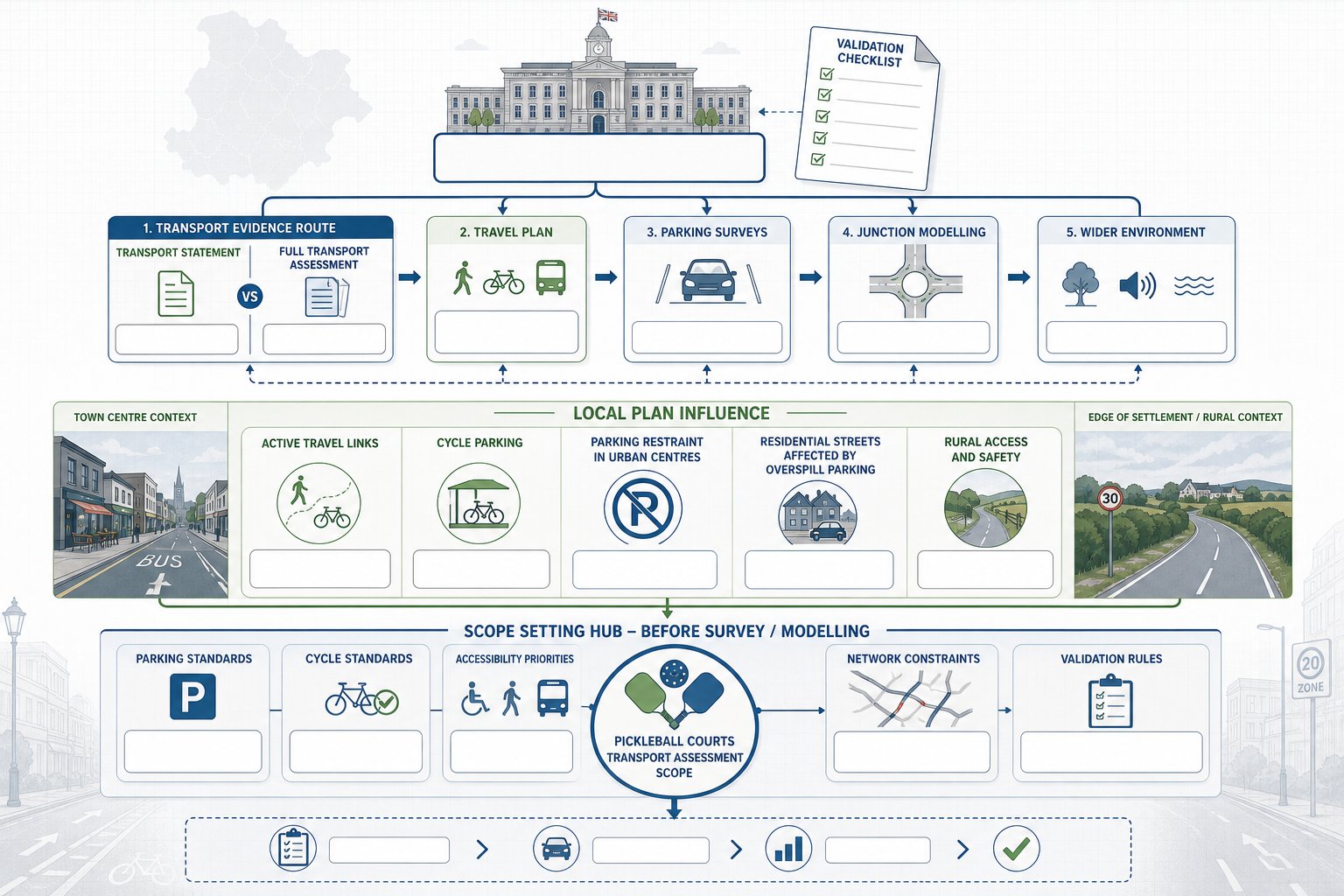
This is where many otherwise decent submissions become weaker than they should be. Planning teams sometimes start from generic leisure assumptions, when the real test is local policy and local validation.
Every authority has its own expectations on when a full TA, a Transport Statement, a Travel Plan, parking surveys, or junction modelling will be needed. The local validation checklist can be just as important as national guidance because it tells us what the application must contain before it is even considered complete.
Local Plan policies then shape the substance. Some councils place strong emphasis on active travel links and cycle parking. Others focus on parking restraint in urban centres or protection of residential amenity where overspill parking has been a known issue. In edge-of-settlement or rural areas, authorities may accept higher car mode share assumptions but still expect robust evidence on access safety and sustainable travel measures.
This is also where related planning documents can overlap. On larger leisure-led schemes, transport scope sometimes interacts with wider topics covered in an environmental impact assessment, particularly where traffic, noise, lighting, and cumulative effects are being considered together.
The practical lesson is simple: we should not write the scope in a vacuum. We need to align the assessment with local parking standards, cycle standards, accessibility priorities, known network constraints, and validation rules before the modelling or survey work even begins.
Core Site Factors That Influence Trip Generation
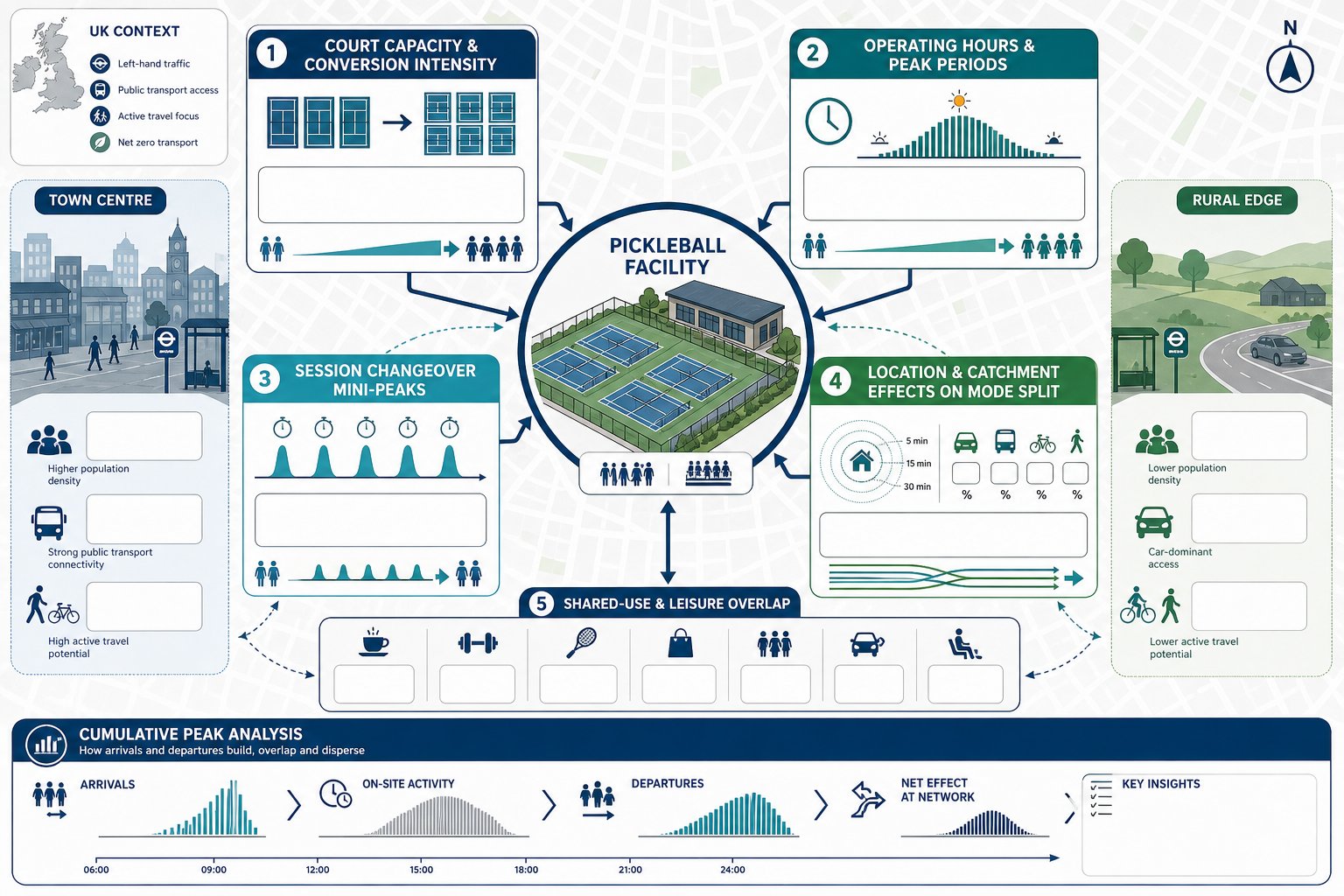
Trip generation for pickleball is rarely just a matter of counting courts and multiplying by players. The sport’s operational pattern can produce surprisingly uneven demand, and that is why site-specific judgement matters.
Court Numbers, Operating Hours, And Peak Demand Patterns
Court numbers obviously matter, but so does utilisation. Up to four pickleball courts can fit on one tennis court footprint, which means a seemingly modest conversion can increase playable capacity quite sharply. If bookings are structured in tight hourly blocks, arrivals and departures may cluster in a way that creates mini-peaks around every session changeover.
Operating hours are equally influential. Daytime recreational use may spread trips fairly gently. Evening floodlit sessions, leagues, coached blocks, and social ladders often compress demand into the late afternoon and evening, sometimes overlapping with commuter traffic or nearby school pick-up activity. Weekend mornings can also become dominant.
This is where we need realistic assumptions on dwell time, player turnover, spectator presence, and whether users arrive early for warm-up or stay afterwards for food, drinks, or club socialising.
Location, Catchment, And Shared-Use Leisure Demand
Location changes mode split more than many applicants assume. A town-centre club near bus routes and dense housing can attract a meaningful share of walking, cycling, and public transport trips. A peripheral or rural venue will usually be more car-oriented, even with a good-quality Travel Plan.
Catchment also matters. Dedicated pickleball facilities may draw from a wider area than general community tennis, particularly in places where supply is still limited. That wider catchment can increase average journey length and car dependence.
Shared-use demand complicates matters further. Where pickleball sits alongside tennis, padel, gym, bar, or café uses, total site demand may reflect overlapping leisure patterns rather than a simple stand-alone court model. In those cases, linked trips, double counting, and cumulative peaks all need careful handling.
Forecasting Vehicle, Walking, Cycling, And Public Transport Trips
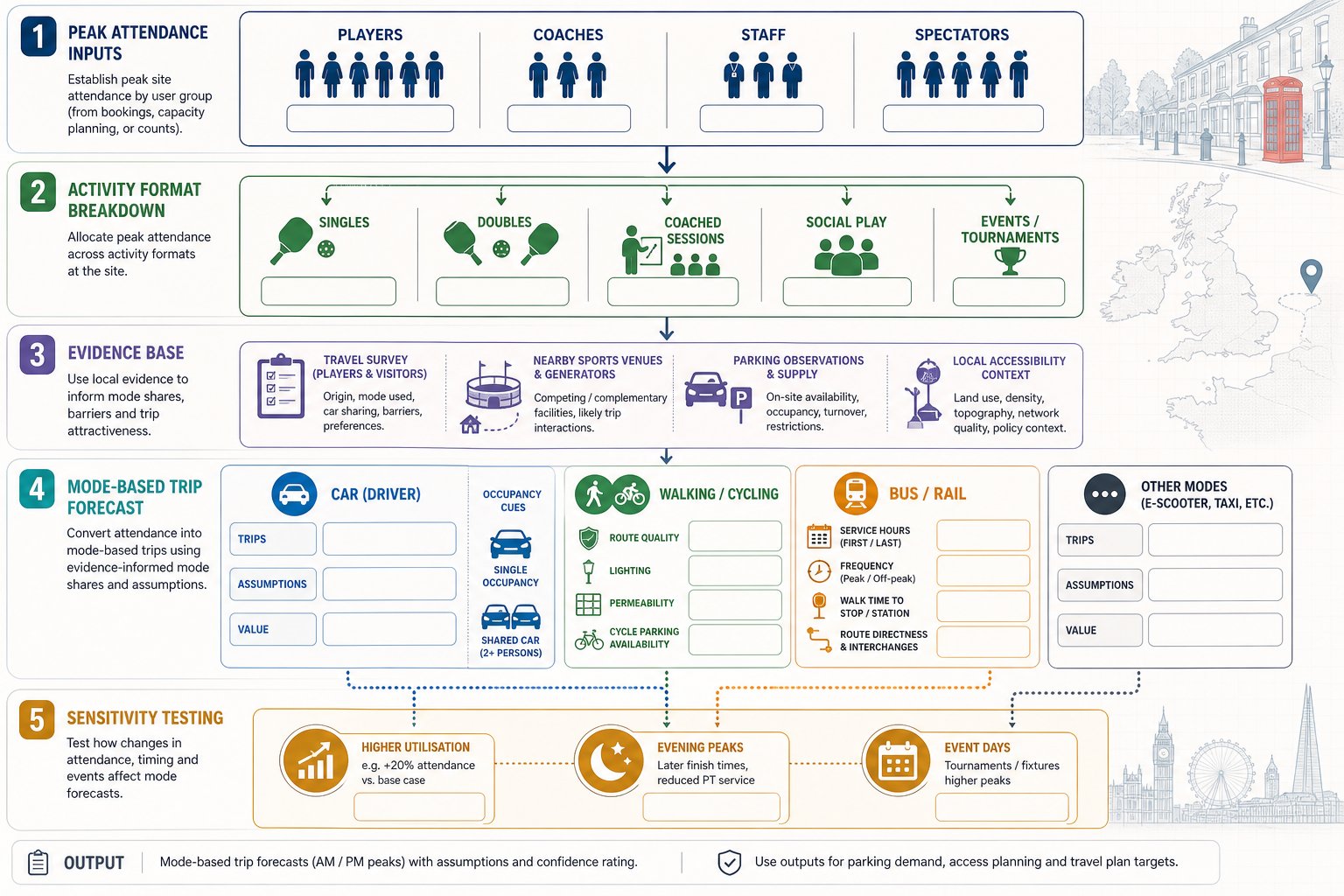
A sound forecast starts with person trips, not vehicle trips. We first estimate how many players, coaches, staff, and spectators are likely to be present during the busiest periods. Then we convert those movements into travel by mode.
For pickleball, player assumptions should reflect actual format: singles or doubles, casual sessions or coached groups, social play or tournament rotation. Staff can be modest on smaller sites, but larger venues with reception, café, maintenance, or event management functions need a fuller staffing profile. Spectators are often low in day-to-day operation but can become significant during leagues and events.
Mode split should be evidence-led. Census travel-to-work data are not a perfect fit for leisure demand, but they can inform local car ownership and accessibility context. Better still are local surveys of comparable sports clubs, existing tennis or padel activity on site, and observed parking accumulation. Comparable evidence from schemes such as Residential Development Transport work is methodologically useful on survey design, though the trip purpose is obviously different.
Vehicle trips then depend on occupancy. Doubles play can lower cars-per-player if people share lifts, but in practice many adult leisure trips still arrive in separate vehicles unless incentives or geography support car sharing. Walking and cycling forecasts should respond to actual route quality, lighting, permeability, and secure parking. Public transport assumptions need to consider service hours, not just stop locations. A bus route that ends before evening play finishes does not meaningfully support mode shift.
Sensitivity testing is often the difference between a credible forecast and an optimistic one. We should test higher utilisation, stronger evening demand, and event-day scenarios where relevant.
Access, Parking, Drop-Off, And Servicing Considerations
For many pickleball applications, this section attracts the closest scrutiny. Not because the scheme generates motorway-scale traffic, but because local concern usually centres on the everyday experience of arriving, parking, walking to the entrance, and leaving without conflict.
Vehicle access should be reviewed for width, geometry, turning provision, visibility splays, gate positions, and interaction with pedestrians and cyclists. If the site shares access with another sports or education use, we need to understand who arrives when and where conflict points sit.
Parking demand has to be based on more than a standard ratio. Local standards provide the policy framework, but survey evidence often decides the argument. We look at typical occupancy, seasonal variation, evening demand, disabled parking, EV charging requirements, and whether existing spaces are already heavily used by neighbouring activities. Overspill risk is a recurring issue, especially near residential streets with informal kerbside parking.
Drop-off is easy to underestimate. Junior coaching, accessible users, and ride-share arrivals all need a safe place to stop without blocking internal circulation. Even a small inset bay or managed short-stay area can make a disproportionate difference.
Servicing tends to be light, but it should still be covered properly: refuse, court maintenance, deliveries, emergency access, and any minibus or event support vehicles. Planning teams sometimes treat servicing as an afterthought: highway officers usually don’t.
Highway Safety And Junction Capacity Assessment
Highway safety and capacity are related, but they are not the same question. A site can have acceptable capacity effects and still raise safety concerns, particularly where visibility, crossing demand, or parking overspill are poorly handled.
The safety review should examine recent collision data, speed environment, frontage conditions, pedestrian desire lines, crossing points, lighting, and the quality of footways and cycle connections. We also need to think about behaviour, not just geometry. A technically adequate junction may still feel uncomfortable if players are crossing informal desire lines between overspill parking and the club entrance.
Capacity assessment should be proportionate. Some smaller schemes will not require formal modelling. Others, particularly where there is a new access or a known pressure point nearby, may justify junction modelling for weekday evening or weekend peak periods. The key is choosing the right peak. For pickleball, that may not be the traditional highway network peak if the operational intensity occurs later in the evening or on Saturday mornings.
We also need to consider redistribution effects. Sometimes the concern is not the site access itself but turning movements at a nearby mini-roundabout, priority junction, or constrained lane where a small increase in traffic causes noticeable delay or manoeuvring stress.
A robust conclusion here should explain residual effects plainly: safe or not safe, severe or not severe, and what mitigation closes the gap if there is one.
Sustainable Travel Measures For Pickleball Developments
Sustainable travel measures work best when they are practical rather than performative. There is little value in promising mode shift if the site layout, booking system, and local connections still nudge everybody towards the car.
The basics matter most: direct pedestrian routes from the site frontage, safe crossings, step-free access, secure covered cycle parking close to the entrance, and clear wayfinding from bus stops or station routes. If evening use is proposed, lighting and personal security are central, not optional extras.
Operational measures can help too. Booking confirmations can include travel information, walking and cycling routes, and realistic public transport options. Session timing can be coordinated with local bus or rail availability where services permit. Car-sharing can be encouraged for league nights and coaching groups, though it usually works better through club administration than generic posters on a noticeboard.
For larger schemes, a Travel Plan may be appropriate, with baseline surveys, targets, monitoring, and named management responsibility. EV charging spaces may also be policy-led depending on the authority.
The wider point is this: sustainable travel should not be bolted on at the end to make the report look complete. It should reflect the actual catchment, operating hours, and user profile of the venue. When that happens, the package feels credible to officers and more likely to work in practice.
How Match Days, Coaching Sessions, And Tournaments Affect Transport Impacts
This is the section that often separates a polished assessment from a merely adequate one. Normal weekday use and event-day use are rarely the same thing.
Coaching sessions can produce dense arrival waves, especially where juniors are dropped off in short windows. Club ladders and social nights may fill every court at once and create heavier parking demand than casual daytime play. Tournaments add another layer again: spectators, officials, staggered match rotation, longer dwell times, catering activity, and sometimes informal gathering before and after play.
Where event activity forms part of the application description, we should assess it explicitly rather than burying it in a footnote. That may involve separate trip generation assumptions, parking accumulation analysis, temporary stewarding arrangements, overflow parking strategy, and, for larger sites, a simple event management plan.
The key is realism. A planning authority will be far more comfortable with an applicant who says, in effect, “yes, tournament conditions are busier, here is how they are managed,” than with one who assumes every day looks like a quiet Tuesday afternoon.
Even where tournaments are infrequent, they can dominate neighbour perception. If residents experience only the busiest days, those days shape objections. So we need to address them head-on, with evidence and mitigation rather than optimistic wording.
Common Planning Risks And How To Strengthen The Submission
The most common weakness is underestimating demand. That usually shows up in one of three places: parking, peak-hour assumptions, or event activity. A report that feels too neat can invite challenge very quickly.
Another risk is failing to deal with cumulative effects. If the site already hosts tennis, padel, football, gym, or clubhouse functions, the transport story is about the whole venue, not just the new pickleball courts in isolation. Likewise, if nearby roads already experience parking stress, even a modest increase can become contentious.
We also see problems where the assessment does not line up with the planning description. If the application mentions coaching, leagues, floodlit evening use, or food and drink space, the transport evidence has to reflect that. Otherwise officers and objectors will notice the gap.
To strengthen the submission, we usually recommend:
- site-specific parking and traffic surveys where impacts could be disputed
- transparent assumptions on player numbers, occupancy, and turnover
- sensitivity tests for higher participation or overlapping activities
- early dialogue with the highway authority on scope and peak periods
- mitigation that is specific, deliverable, and proportionate
And speed matters. A concise, authority-aware report often performs better than a bloated document with generic text. That is why experienced transport consultants who understand local thresholds, such as the approach reflected across our Pickeball Courts Transport Assessment work, can often help planning teams avoid avoidable delays and rounds of clarification.
Conclusion
Pickleball schemes are not automatically high-impact developments, but they do have transport characteristics that can catch planning teams out: compressed session changes, evening activity, shared-site demand, and periodic event peaks. That is why a good assessment is less about volume and more about precision.
In 2026, the submissions that tend to progress most smoothly are the ones that match scope to local policy, use realistic operating assumptions, test the busiest conditions honestly, and address parking and safety in plain terms. If the likely impacts are modest, the evidence should show that confidently. If there are pinch points, the mitigation should be practical and specific.
For architects, planners, councils, and developers, the goal is straightforward: give the authority a transport case it can rely on. When that happens, transport becomes a managed planning issue rather than the reason a perfectly viable pickleball scheme stalls.
Frequently Asked Questions about Pickleball Courts Transport Assessment
What is a Pickleball Courts Transport Assessment and why is it important?
A Pickleball Courts Transport Assessment evaluates the transport impacts of new or expanded pickleball courts, ensuring local authorities can manage traffic, parking, and safety effectively. It’s crucial for demonstrating that access and sustainable travel have been properly considered.
When is a full Transport Assessment required for pickleball developments?
A full Transport Assessment is typically needed for multi-court venues, floodlit evening use, tournaments, or developments that significantly increase traffic or parking demand, especially near sensitive residential streets or constrained access points.
How do court numbers and operating hours influence trip generation in pickleball transport assessments?
More courts and structured session times, like coaching or evening leagues, create concentrated arrival and departure peaks. These operational details materially affect transport demand and need accurate assessment in the transport submission.
What sustainable travel measures are recommended for pickleball facilities?
Effective measures include direct, lit pedestrian routes, secure cycle parking, travel information with public transport options, scheduling aligned with transport services, and incentives for car-sharing or active travel, ensuring practical support for reduced car reliance.
How should event days and tournaments be handled in a Pickleball Courts Transport Assessment?
Event days require separate analysis of increased trip generation, parking, and temporary traffic management. Plans for stewarding, overflow parking, and realistic management strategies are essential to address concentrated demand and neighbour concerns.
Why is early engagement with highway authorities advised when preparing a transport assessment?
Early dialogue helps determine appropriate scope, local policy alignment, and peak period selection, reducing risks of under-scoping or delays. It ensures the assessment addresses specific local concerns about parking, safety, and cumulative impacts effectively.