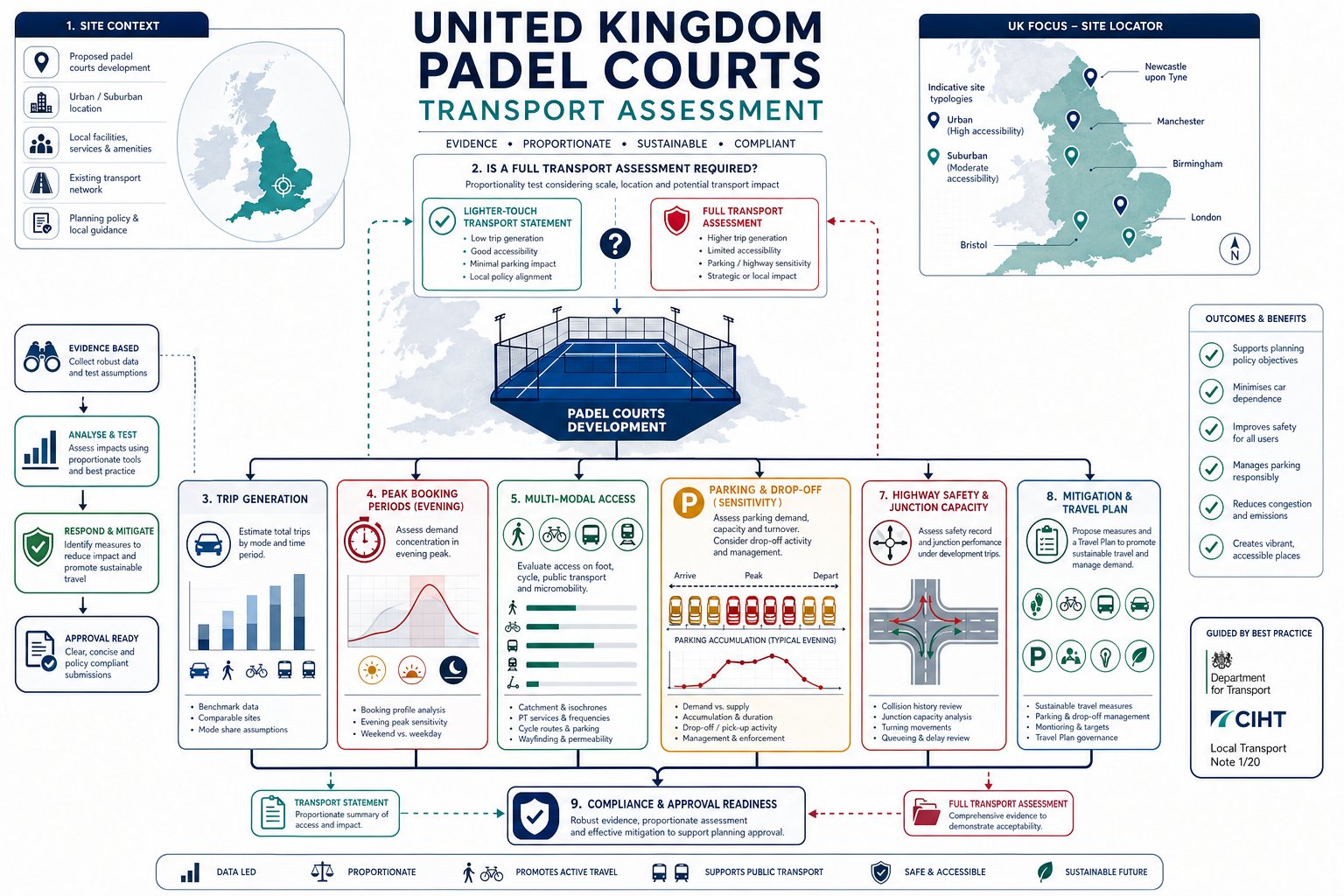
Padel is moving fast in the UK. What started as a niche racket sport has become a serious planning topic, with proposals appearing at tennis clubs, leisure parks, schools, standalone commercial sites and mixed-use schemes. That growth is creating a very familiar problem for planning teams: enthusiasm for the sport doesn’t remove the need to prove that people can get to and from a site safely, park without causing overspill, and use the local highway network without creating unacceptable impacts.
That is where a Padel Courts Transport Assessment becomes central. In practice, it is often one of the documents that helps move an application from “this could be contentious” to “this is manageable”. We use it to explain likely trip generation, identify realistic peak periods, test access and parking arrangements, and show the local planning authority and highway authority that the proposal has been thought through properly.
In 2026, the bar is fairly clear. Councils expect padel schemes to be assessed in line with the National Planning Policy Framework, local validation requirements and site-specific transport conditions. Small ancillary additions may justify a concise statement. Larger or more intensive proposals usually need a fuller evidence base. The key is not producing a long report for the sake of it. It is producing the right report, at the right scale, with assumptions that stand up to scrutiny.
Below, we set out what planning teams need to know when scoping, preparing and defending a transport submission for padel courts.
Key Takeaways
- A well-prepared Padel Courts Transport Assessment is crucial to demonstrate safe access, parking adequacy, and manageable impact on local highways, facilitating smoother planning consent.
- Transport assessment scope should be proportionate and considers factors like court number, hours, site context, and local policy to provide robust, site-specific evidence.
- Forecasting trip generation uses comparable leisure data and operator insights to produce realistic vehicle arrival estimates, focusing on peak periods like weekday evenings and weekends.
- Multi-modal access, including walking, cycling, and public transport, must be audited alongside car travel to meet growing local authority expectations for sustainable transport.
- Operational management measures such as pre-booking, capped occupancy, and controlled opening hours strengthen transport submissions by reducing congestion and parking overspill.
- Comprehensive submissions integrate parking analysis, safety reviews, and potential mitigations, with clear, concise reporting tailored to local authority requirements to address planning concerns effectively.
Why A Transport Assessment Matters For Padel Court Developments
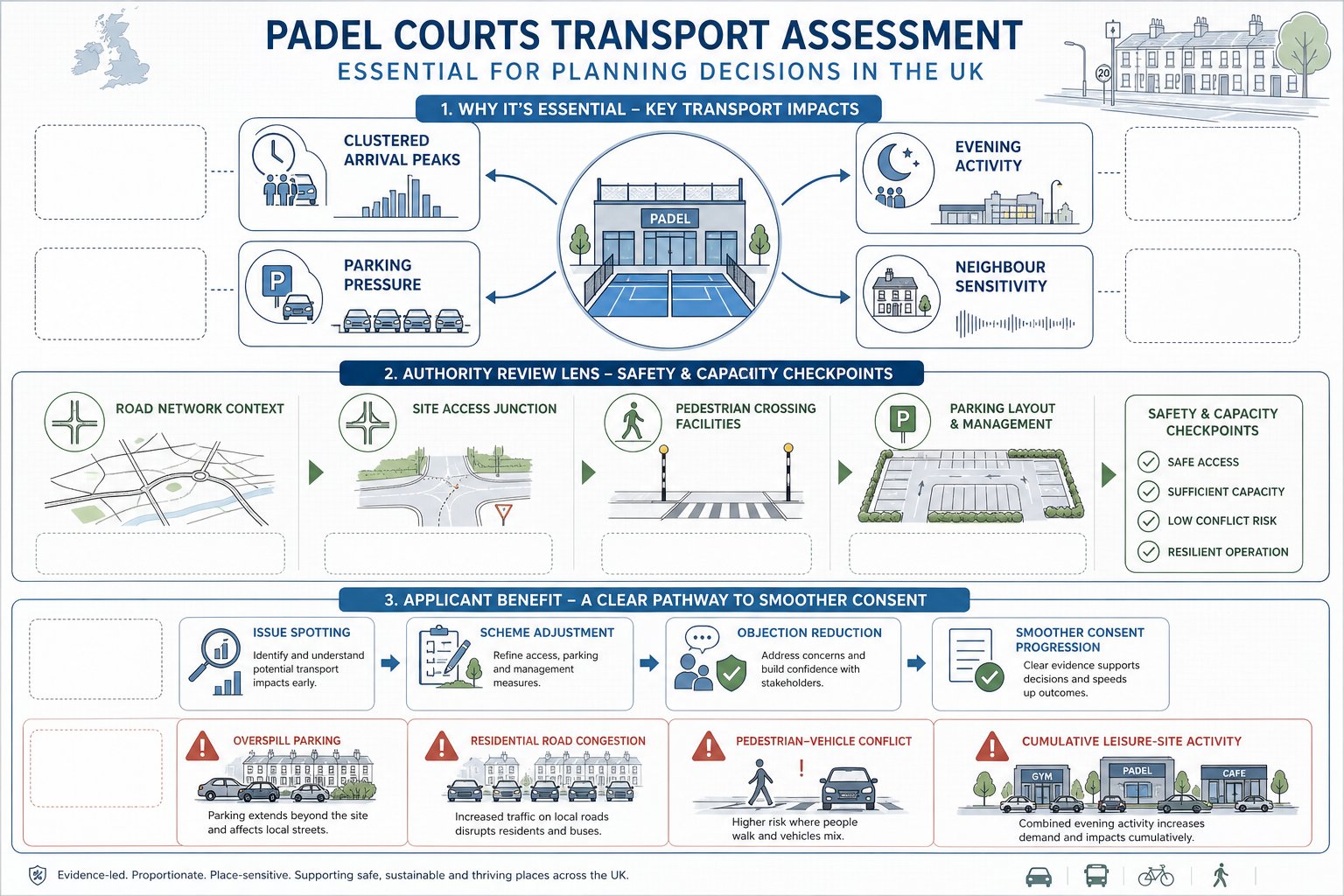
A transport assessment matters because padel courts often generate exactly the type of planning concern that can stall an application: concentrated arrivals, evening activity, parking pressure and neighbour sensitivity. Even where the development footprint is modest, the operational pattern can be intense.
For local authorities, the main question is straightforward. Can the surrounding network, site access and parking layout accommodate the proposal without creating unacceptable safety or capacity problems? A well-prepared assessment answers that with evidence rather than optimism.
For applicants, the benefit is equally practical. It allows us to identify issues early, adjust the scheme before submission, and address the objections that usually appear in consultation responses. Those objections tend to focus on overspill parking, congestion on nearby residential roads, conflicts between pedestrians and vehicles, and the cumulative effect of adding another active leisure use to an already busy site.
That is why a padel proposal should rarely be treated as “just a few courts”. Its planning impact depends on how the venue will operate, not simply on built area. A concise, authority-focused transport assessment for can often make the difference between a delayed determination and a smoother route to consent.
At mltraffic.co.uk, our approach is to keep the evidence proportionate but robust. Overcomplication is unhelpful. Under-evidencing is worse.
When A Padel Scheme May Require A Transport Statement Or Full Transport Assessment
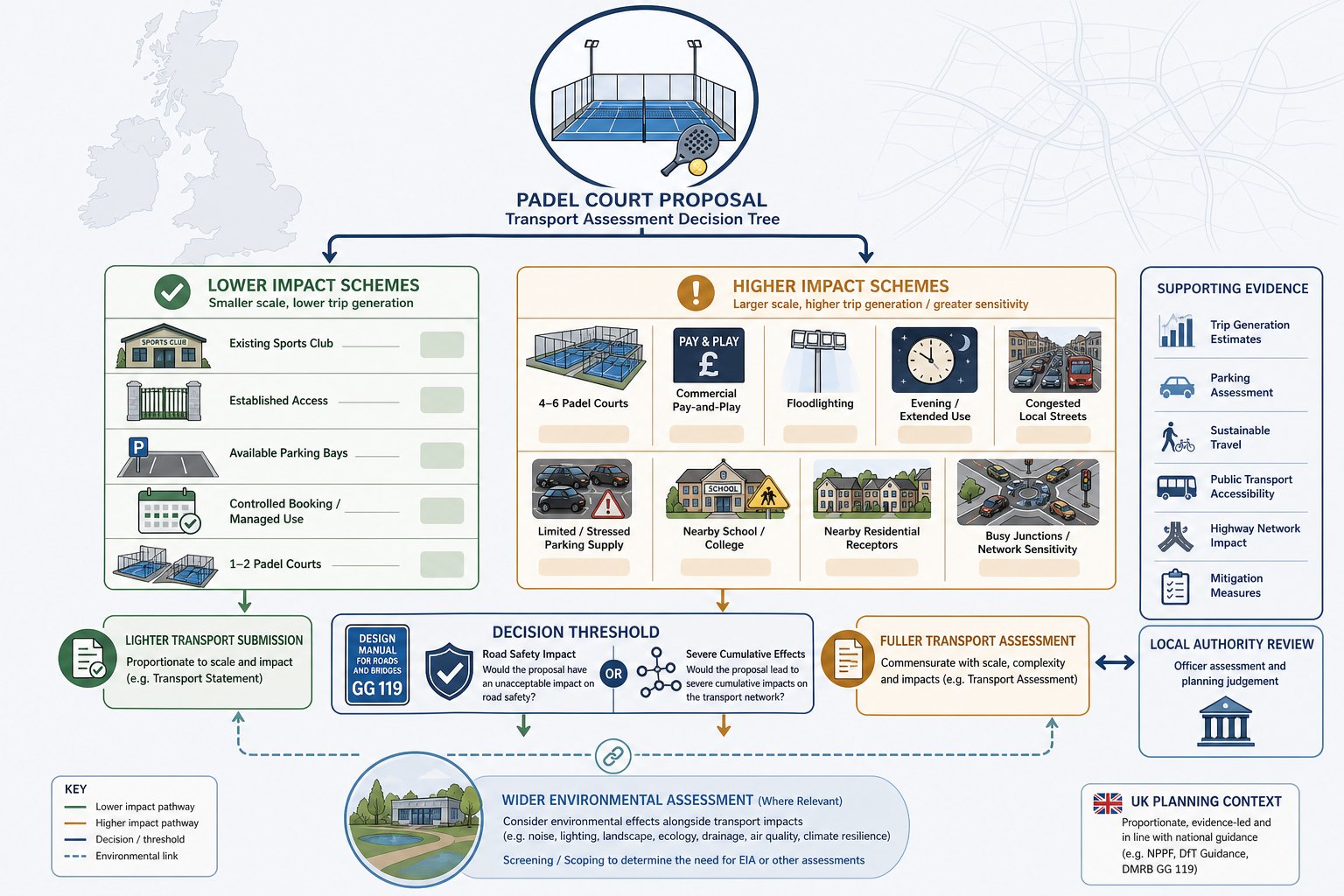
Not every padel development needs a full Transport Assessment. Some require a Transport Statement, and a few very small schemes may only need a short note if the local authority agrees. The issue is proportionality.
As a rule, a smaller proposal is more likely to sit within Transport Statement territory where it forms part of an existing sports club, uses established access arrangements, has spare parking capacity and does not materially intensify peak traffic. For example, adding one or two ancillary courts to a well-functioning site with controlled booking may justify a lighter-touch submission.
A fuller assessment becomes more likely where we are dealing with four to six or more courts, a commercial pay-and-play model, extended opening hours, floodlit evening use, constrained local streets or a site that already experiences parking stress. The same applies where the proposal sits close to schools, within sensitive residential areas, or on a network where junction performance is already a live issue.
The National Planning Policy Framework remains the touchstone: development should only be prevented on highways grounds where there would be an unacceptable impact on safety, or the residual cumulative impacts would be severe. But to show that threshold is not crossed, councils often expect supporting evidence through local validation lists and pre-application advice.
In some cases, transport scope also intersects with wider environmental work, especially if the proposal forms part of a larger leisure scheme requiring an environmental impact assessment.
Key Planning And Highway Factors That Influence Assessment Scope
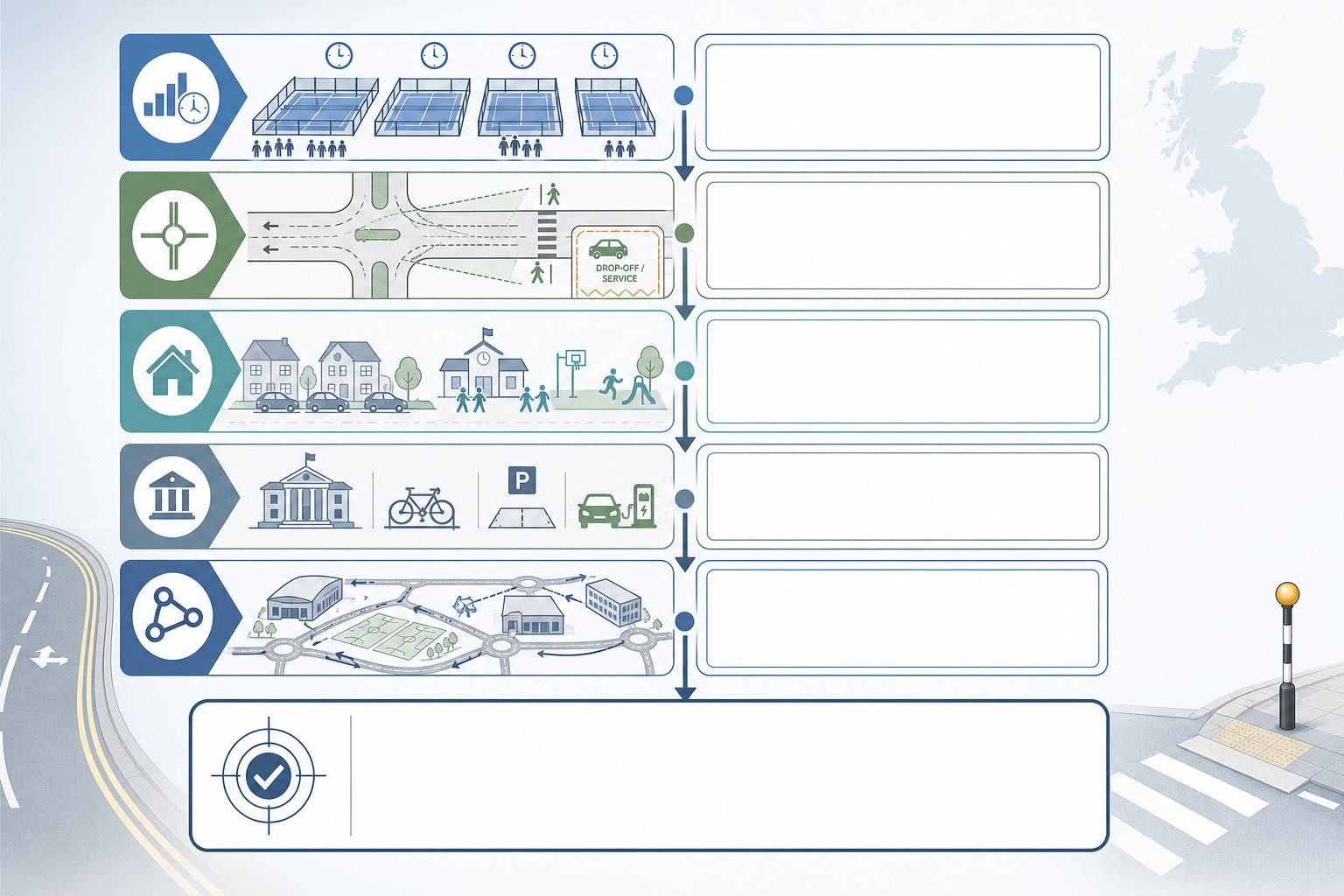
Assessment scope should be driven by real site conditions, not copied from another sports project. A padel venue on a strategic leisure site with signal-controlled access is a different planning proposition from courts tucked behind housing on a narrow local road.
The first factor is scale and intensity of use. Number of courts matters, but so do opening hours, lesson programmes, league play, spectator potential and any food, drink or clubhouse element. A four-court venue operating from early morning to late evening can create more transport sensitivity than a larger daytime-only facility.
Second, we need to understand access quality. Highway authorities will look closely at visibility splays, junction form, width, gradients, pedestrian crossing points and whether service vehicles or drop-off activity can be accommodated safely.
Third, context matters. Residential amenity concerns tend to rise quickly if on-street parking is already stressed or if evening arrivals overlap with school-run patterns, faith uses or adjacent leisure peaks. That often drives a broader assessment scope, including parking accumulation and multi-modal analysis.
Local policy is the fourth major factor. Parking standards, cycle parking expectations, sustainable travel requirements and net-zero policy language vary by authority. If the site sits in a town centre or accessible urban area, councils may expect stronger evidence on non-car mode share than they would for a more rural edge-of-town location.
And finally, cumulative context can’t be ignored. A proposal attached to a wider club or leisure campus may need a more joined-up approach, similar in principle to Residential Development Transport work where surrounding conditions often define what evidence is proportionate.
Trip Generation For Padel Courts: How Travel Demand Is Typically Forecast
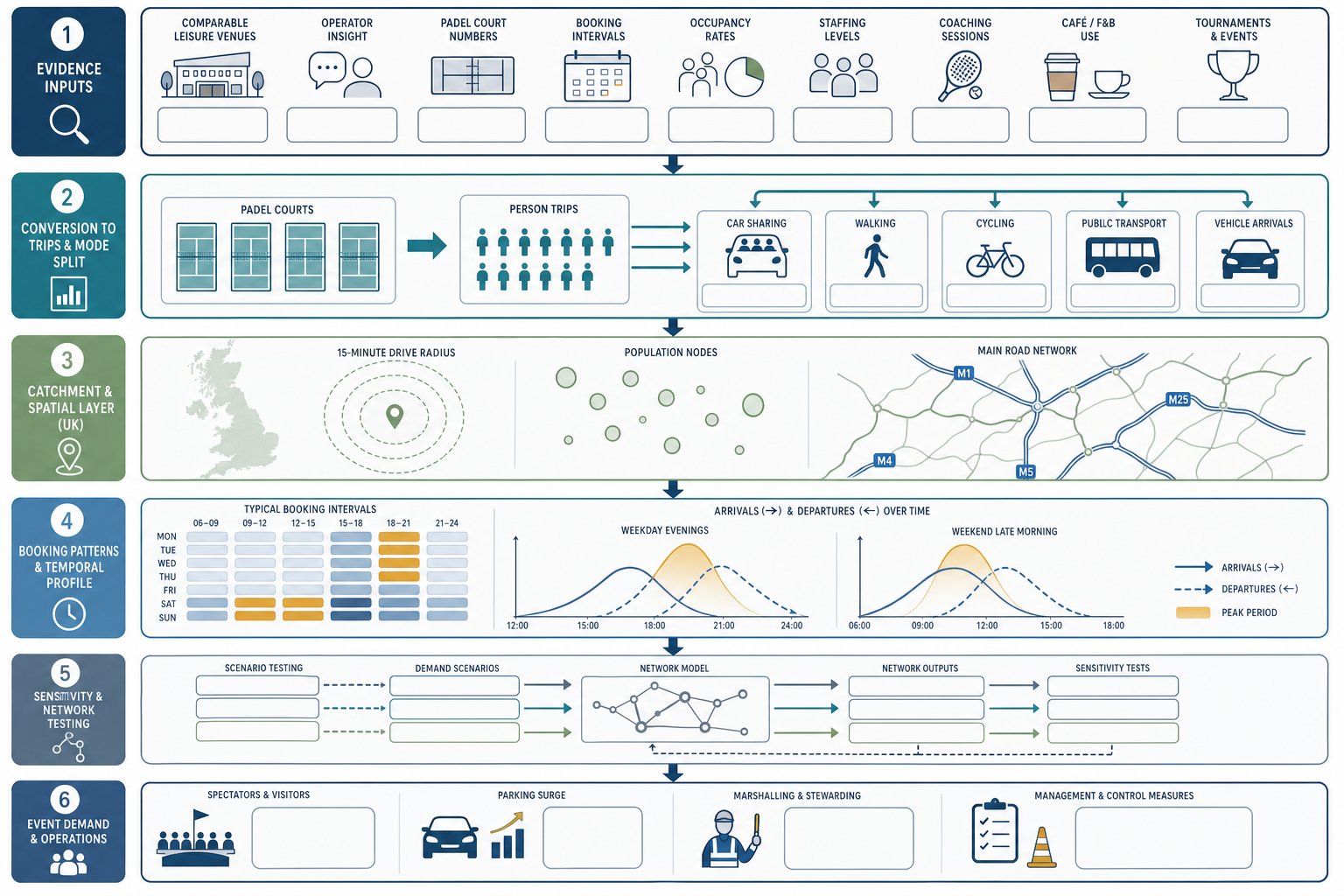
Trip generation for padel courts is usually forecast through a blend of comparable leisure uses, operator input and common-sense calibration. There is rarely a perfect database category that captures every venue type, so we normally build a reasoned forecast from several strands of evidence.
Comparable facilities often include tennis clubs, health and fitness venues, five-a-side football centres and other booked recreational uses with identifiable arrival profiles. We then refine that by looking at the number of courts, booking intervals, expected occupancy per court, doubles versus singles play, staffing and whether the venue includes coaching, café activity or tournaments.
One useful starting point is person trips rather than vehicle trips. A single court can produce four players per booking slot, but not every player arrives separately. Car sharing is common, especially among doubles groups. Urban sites may also achieve a meaningful walking, cycling or public transport share. So the key is converting player demand into realistic vehicle arrivals rather than assuming one car per person.
Catchment analysis also helps. Many commercially successful venues sit within around a 15-minute drive of a substantial population base and close to main roads. That tells us something about likely origins, route choice and peak dispersal.
Where larger or more contentious schemes are proposed, forecasting should be transparent enough to withstand challenge. It is often sensible to test sensitivity scenarios and, where needed, model junction effects using tools such as Junctions 11 Software.
Peak Periods, Booking Patterns, And Event-Led Demand
Padel demand is rarely flat through the day. Weekday evenings and weekends are usually the key assessment periods, particularly after-work slots from roughly 17:00 to 21:00 and Saturday late morning or early afternoon.
Online booking systems are helpful here because they let us forecast demand by 30- or 60-minute slot rather than using generic daily totals. That gives a more realistic picture of arrival and departure waves. In practice, players tend to arrive shortly before a session and leave fairly quickly after, creating short but noticeable peaks.
That pattern can work in an applicant’s favour if it shows turnover rather than long-stay occupation. But it can also expose pinch points, especially where back-to-back bookings overlap, coaching sessions run in parallel, or several courts start on the hour.
Events need separate thought. Tournaments, open days and corporate bookings may generate spectators, temporary marshalling requirements and a very different parking profile from normal club play. If event use is part of the business model, it is much better to acknowledge it and control it through management measures than pretend it will never happen.
Multi-Modal Access: Walking, Cycling, Public Transport, And Car Travel
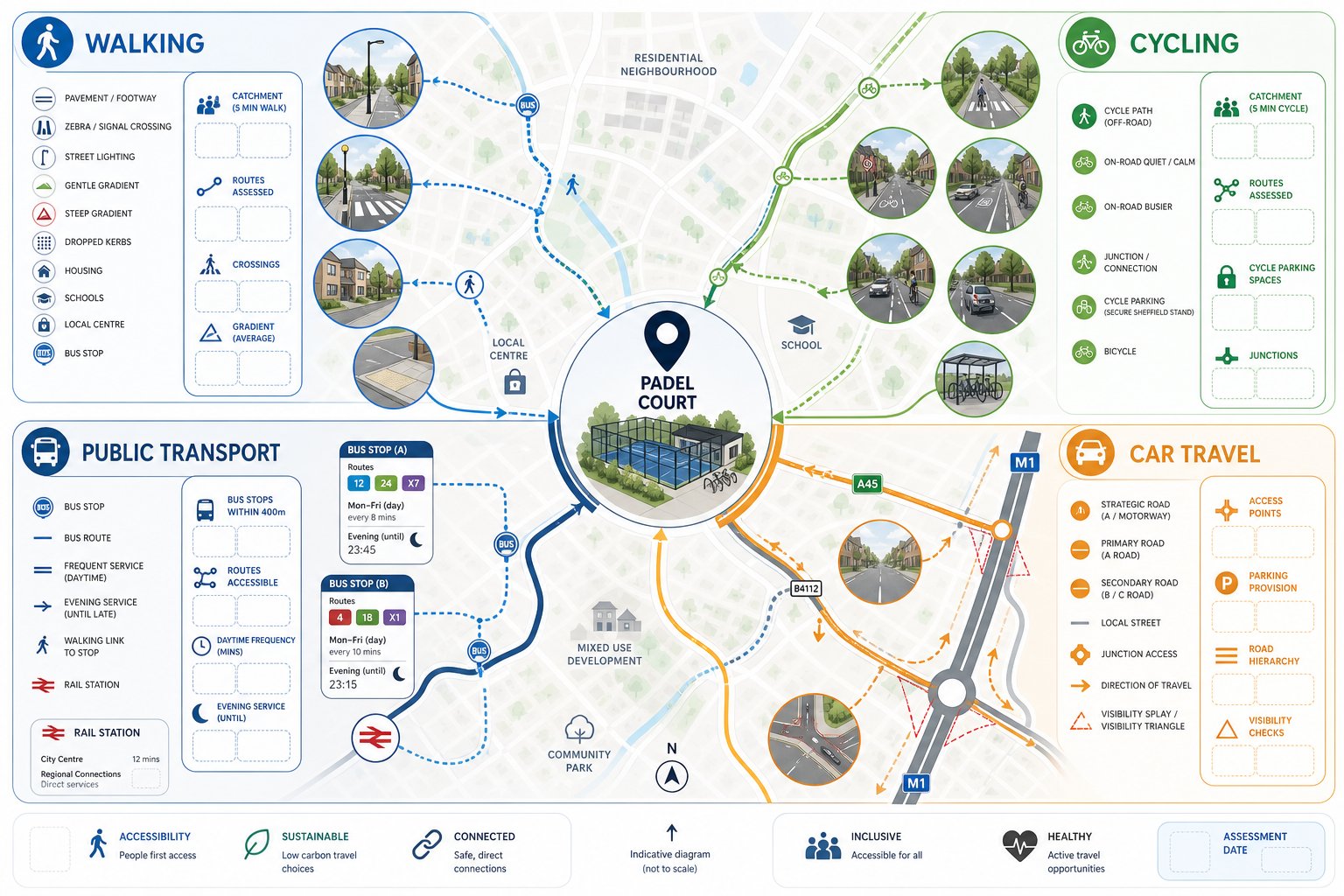
A credible padel transport submission should show how people can reach the site by more than car. Even where car travel will remain dominant, particularly in suburban or rural locations, authorities increasingly expect a proper multi-modal accessibility audit.
For walking, we assess footway provision, crossing opportunities, lighting, gradients, personal security and the relationship to nearby housing, schools, centres and bus stops. A route that looks acceptable on a plan can feel poor in reality if it includes narrow verges, missing dropped kerbs or awkward crossings.
For cycling, the basic questions are simple: are there connected routes, is the surrounding road environment tolerable for typical users, and does the site offer convenient, secure cycle parking? Leisure trips are often more cycleable than people assume, especially for local members.
Public transport matters most where the venue serves an urban catchment or younger users. We normally summarise bus frequencies, walking times to stops, evening service availability and rail access where relevant. A site with genuinely good non-car links should say so clearly.
Car travel still needs realistic treatment. We should explain likely access routes, strategic road visibility and whether nearby roads are suitable for the expected traffic profile.
For schemes on larger campuses or hybrid leisure destinations, this analysis often aligns with broader mixed use masterplan principles, where access by multiple modes is part of the planning logic rather than an afterthought.
Parking Demand, Drop-Off Activity, And On-Site Circulation
Parking can be the most contentious issue on a padel application, not because the absolute traffic increase is always large, but because local residents tend to notice parking overspill immediately. A sound assessment needs to deal with that head-on.
A common industry assumption is around four to six car spaces per court, but that is only a starting point. The right figure depends on mode share, doubles participation, shared parking opportunities, booking controls, local policy standards and whether the site already hosts other uses. Urban clubs with strong non-car access may justify less. Edge-of-town destinations may need more.
Parking accumulation is often more informative than a simple ratio. We can map arrivals and departures by booking slot, account for staff and coaches, and identify whether overlap between sessions pushes demand above supply at particular times.
Drop-off activity is easy to underestimate. Junior coaching, casual lifts, taxis and private hire vehicles can all generate short-stay movements that interfere with circulation if they have nowhere obvious to stop. The same goes for servicing, deliveries and occasional maintenance vehicles.
Internal layout matters too. We need to show that cars, pedestrians and cyclists can move around the site without unnecessary conflict, that turning areas work, and that disabled parking is convenient and policy-compliant. A good transport report does not stop at the site boundary: it explains how the site actually functions once users arrive.
Highway Safety, Junction Capacity, And Network Impact
Highway authorities will usually focus on three related questions: is the access safe, can the surrounding junctions cope, and does the overall impact cross the threshold of concern set by policy?
Safety review normally starts with geometry and visibility. We assess whether drivers can enter and leave safely, whether pedestrians have clear routes, and whether the junction form suits the likely traffic mix. On constrained sites, even a relatively modest increase in movements can become sensitive if visibility is poor or pedestrians are forced into vehicle paths.
Collision analysis is another important strand. Recent personal injury accident data can help identify existing patterns around the access or nearby junctions. That does not mean every historic collision is relevant to the proposal, but recurring issues with turning, speed or vulnerable road users should never be glossed over.
Capacity testing becomes more important as scale increases. For larger commercial venues, multi-court sites or proposals on already busy corridors, weekday PM and Saturday peak assessments are often expected. The aim is to show that residual impacts are not severe and that queues, delays and blocking-back risks remain acceptable.
The right level of modelling depends on the site. Sometimes a simple priority junction review is enough. Sometimes a more detailed exercise is warranted, particularly where neighbouring uses already load the network. The best submissions are honest about stress points and then explain why operational management or mitigation resolves them.
How Shared Sports, Leisure, Or Mixed-Use Sites Affect The Assessment
Many padel proposals are not standalone. They sit within tennis clubs, gyms, golf facilities, schools, hotels or wider leisure parks. That can help an application, but only if the transport case is handled properly.
The obvious advantage is shared infrastructure. Existing access points, parking areas, lighting, changing facilities and management arrangements can reduce the need for new built elements. But a shared site does not automatically mean impacts are negligible. We still need to understand cumulative demand.
The key question is whether peak periods complement each other or clash. A gym may peak before work and after work. Tennis may spread through the day. Padel may create intense evening bookings. A café or bar element may hold people on site longer than expected. If all those layers stack up on the same access and parking stock, a cumulative assessment is essential.
This is where real operational data becomes valuable. Existing occupancy surveys, membership data and booking patterns can show whether spare capacity truly exists. If the proposal displaces courts, reallocates parking or changes who uses the site, the baseline must reflect that.
On broader development parcels, padel may also sit within a more strategic movement plan. In those cases, the transport logic often mirrors wider leisure and commercial planning, with shared access, internal wayfinding and parking zones needing a joined-up narrative rather than isolated technical notes.
Operational Details That Strengthen A Padel Courts Submission
Some of the strongest transport submissions are strengthened not by extra modelling, but by credible operational detail. Authorities want to know how the venue will actually be run.
Pre-booking only is a good example. It helps predict arrivals, limits random peak surges and supports parking management. If sessions are allocated in fixed slots with capped occupancy, that gives us a far firmer basis for trip generation and accumulation analysis.
Managed opening hours can also make a big difference, especially near housing. If weekday morning demand is light but evening sensitivity is high, the applicant may choose to control late-night use. Similarly, limits on tournament frequency or spectator events can reduce the need for worst-case assumptions to dominate the whole assessment.
Membership caps, coaching schedules, staff presence and site supervision are all relevant. For larger events, temporary marshalling or stewarding may be appropriate. And if the operator can demonstrate active monitoring of parking and neighbour complaints, that often reassures decision-makers.
There is a wider point here: transport evidence is strongest when it reflects operations that can be conditioned and enforced. Vague statements about “encouraging sustainable travel” carry less weight than a clear, workable management plan tied to how the venue will trade.
Travel Plans, Sustainable Transport Measures, And Mitigation Options
A Travel Plan is often worthwhile for padel schemes, and on larger sites it may be expected. Done properly, it is not just a standard appendix. It shows that the operator has thought about reducing car dependence in a realistic way.
Typical measures include secure cycle parking, changing or locker provision for staff, public transport information, car-share promotion, discounted first sessions for users arriving by non-car modes, and staff travel management. At well-located sites, even small interventions can shift mode share at the margins.
Mitigation should match the problem identified. If parking pressure is the issue, options might include additional marked bays, overspill control, revised booking intervals or event caps. If pedestrian safety is the concern, crossing upgrades, footway links, dropped kerbs or internal route improvements may be more relevant. If access capacity is marginal, localised junction works or operational controls may solve the issue more proportionately than major infrastructure.
Where the transport effects form part of a broader planning balance, it can be useful to align mitigation with related environmental work. In larger applications, transport conclusions sometimes feed into a wider environmental impact assessment transport: approach.
The most persuasive package is usually the one that is simple, evidence-led and enforceable. Fancy mitigation with no delivery route rarely carries much weight.
Common Evidence, Surveys, And Supporting Documents For Planning Applications
A good padel transport submission is usually made up of several pieces of evidence rather than one report trying to do everything. Which documents are needed depends on scale, but the core components are fairly consistent.
We would typically expect site location and access drawings, visibility splay plans, parking layout information and a clear description of operations. For many schemes, parking accumulation calculations and a multi-modal accessibility audit are central. Public transport summaries, walking and cycling route reviews, and local policy references should be tailored to the authority rather than pasted in from another project.
Surveys may include existing parking beat surveys, access observations, turning counts or junction turning movements, depending on the level of sensitivity. On mixed or existing sports sites, occupancy surveys are often particularly useful because they show whether spare parking and access capacity really exist.
Larger schemes may need capacity modelling outputs, swept path analysis, a Framework or full Travel Plan, and event management information. If amenity is contentious, transport evidence should be coordinated with noise and lighting submissions so that operating assumptions are consistent across the planning pack.
Presentation matters too. A concise report with transparent assumptions, clean appendices and authority-relevant analysis usually performs better than a longer report that buries the key point. For planning teams, that clarity is part of risk management.
Conclusion
A Padel Courts Transport Assessment is rarely just a technical formality. In 2026, it is often the document that shows whether a promising leisure scheme can work in planning terms as well as commercial ones.
For us, the key is proportionate evidence. Small ancillary schemes may only need a focused statement. Larger or more sensitive proposals need fuller analysis on trip generation, parking, access, safety, peak demand and sustainable travel. Either way, the most successful submissions are rooted in how padel venues actually operate, not generic assumptions borrowed from unrelated developments.
If planning teams get the scope right early, gather the right surveys, and tie operational controls to the transport story, many common objections can be dealt with before they harden into refusal reasons. That is usually what moves an application forward: clear evidence, realistic forecasting and a submission that gives the local authority confidence the scheme will function well on day one.
Padel Courts Transport Assessment FAQs
What is the importance of a Transport Assessment for padel court developments?
A Transport Assessment demonstrates that traffic, parking, access, and safety impacts of a padel scheme are acceptable, addressing common objections like parking overspill and congestion, and is often crucial for securing planning permission in the UK.
When is a full Transport Assessment required instead of a Transport Statement for padel courts?
Smaller ancillary courts at an existing club may only need a Transport Statement, while larger commercial sites with four or more courts, extended opening hours, or locations on constrained networks typically require a full Transport Assessment to comply with the National Planning Policy Framework.
How is trip generation for padel courts typically forecasted?
Trip generation is estimated using data from comparable sports facilities like tennis clubs, booking patterns, court numbers, and occupancy, factoring in car sharing and local catchment areas, often within a 15-minute drive of major population centres and main roads.
What are the typical peak periods for padel court use affecting transport assessments?
Padel court demand usually peaks on weekday evenings, especially 17:00 to 21:00, and on weekend late mornings or early afternoons, with online booking systems enabling detailed assessment of arrival and departure patterns by short time slots.
How do multi-modal access and parking considerations influence a padel courts Transport Assessment?
A credible assessment examines walking, cycling, public transport links, and realistic car travel routes, alongside parking demand estimated around 4–6 spaces per court, plus drop-off activity and internal circulation to identify and mitigate conflicts or overspill.
What operational strategies can strengthen a padel courts Transport Assessment submission?
Operational details such as pre-booking only systems, membership caps, managed opening hours, limits on events, and on-site management enhance submissions by demonstrating enforceable controls linked to the transport impacts of the venue.