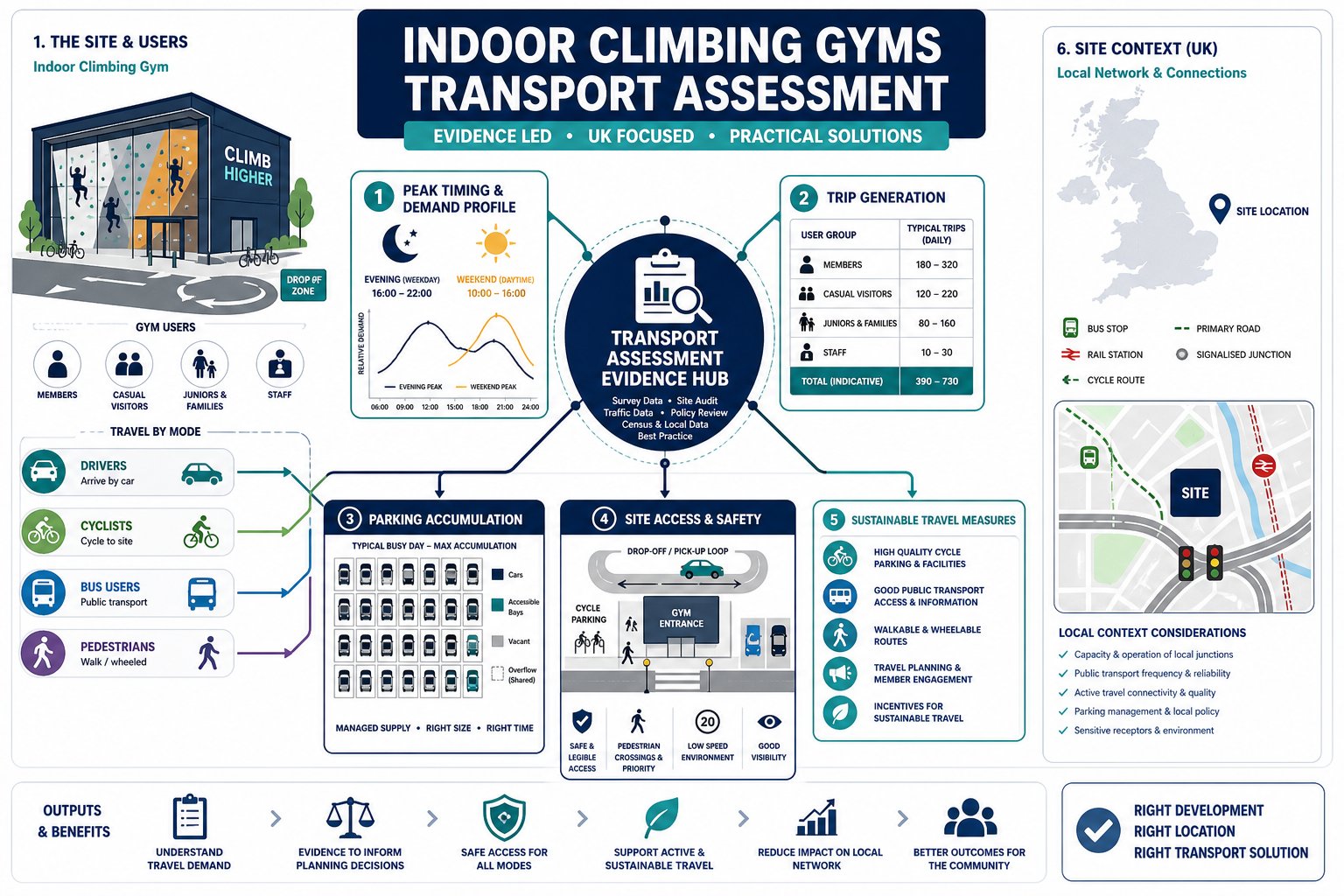
Indoor climbing gyms rarely behave like a standard leisure use on paper, and that is exactly why they can become awkward in planning if the transport case is thin. A scheme may sit in a former warehouse, a trade counter unit, or an edge-of-centre commercial block and still generate a very particular pattern of movement: strong weekday evening arrivals, busy weekend periods, clusters of pick-ups and drop-offs, and a user base that mixes drivers, cyclists, bus users and pedestrians in the same short windows.
For planning teams, that means a generic leisure assumption usually is not enough. We need to show how the site will actually work in operation: who arrives when, how long they stay, whether parking accumulates, whether the access is safe, and what realistic opportunities exist for sustainable travel. Local planning authorities and highway officers are not simply asking whether a climbing gym is popular. They are asking whether the transport effects are acceptable, evidence-based and policy compliant.
A robust Indoor Climbing Gyms Transport Assessment should hence be bespoke. In 2026, the strongest reports are the ones that combine comparable climbing-gym evidence, local network understanding and practical mitigation that fits the site rather than a template. Below, we set out what planning teams need to get right, from the choice of assessment type through to trip generation, parking, access design and sustainable travel measures.
Key Takeaways
- Indoor climbing gyms require bespoke transport assessments due to their unique demand patterns, including strong weekday evening peaks and mixed user modes.
- A full Transport Assessment is necessary for large or complex gyms, while smaller gyms may only need a Transport Statement or Technical Note depending on site sensitivity.
- Accurate trip generation and modal split analyses should use comparable climbing gym data combined with local context to reflect real travel behaviour.
- Parking assessments must focus on accumulation and turnover during peak times, with dedicated drop-off areas enhancing safety and operational flow.
- Site access should prioritise safety and convenience for all users, including pedestrians, cyclists, and disabled persons, with sustainable travel measures integrated into the gym’s operations.
- Aligning transport assessments with local planning policies and thresholds early in the process ensures compliance and builds confidence in the scheme’s safe and sustainable operation.
Why Indoor Climbing Gyms Need A Transport Assessment
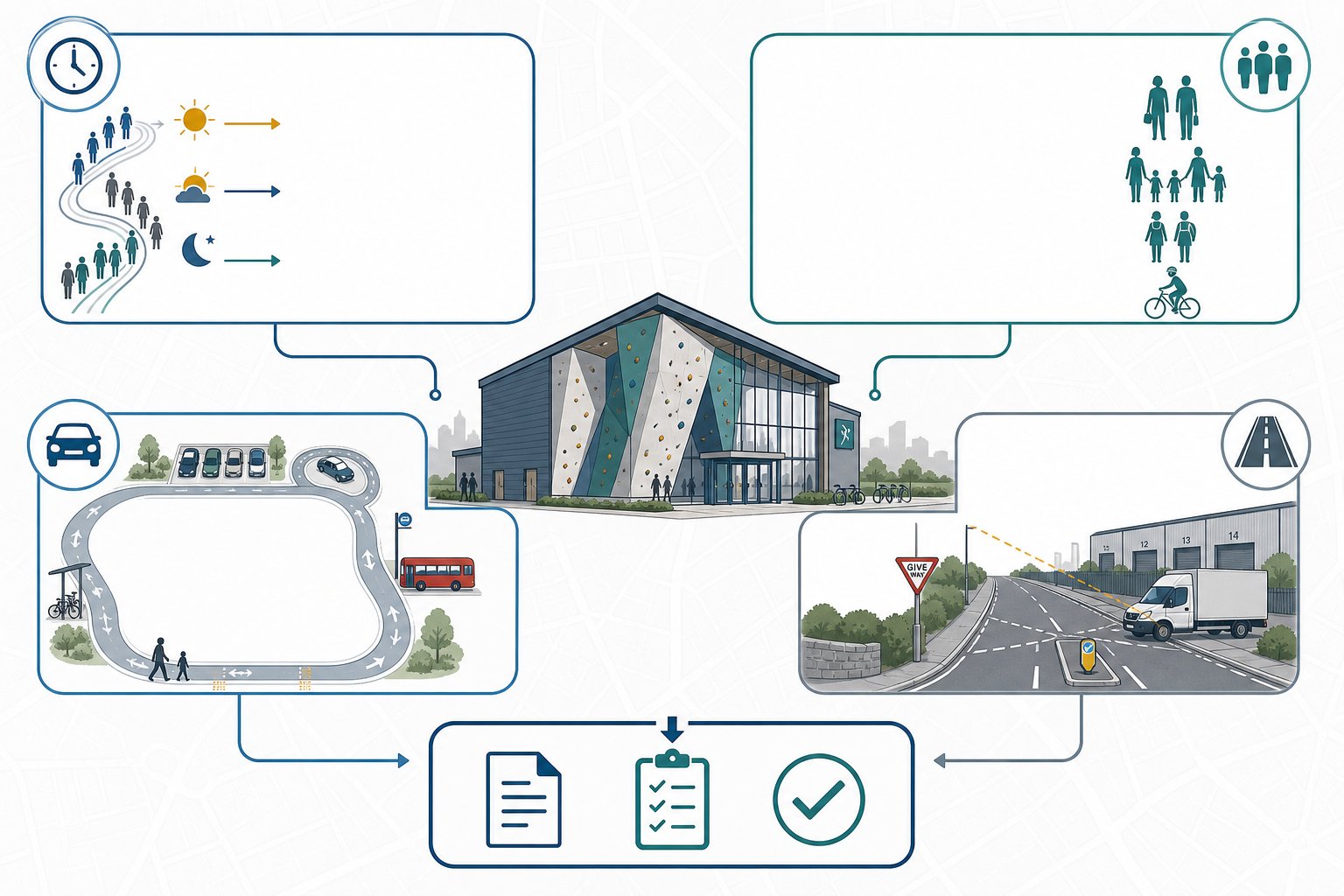
Indoor climbing gyms often land in categories that look straightforward at first glance: change of use, fit-out within an existing unit, or leisure reuse of industrial floorspace. But their transport profile is distinctive enough that many authorities will expect clear supporting evidence rather than broad assumptions.
The main reason is timing. Unlike some daytime leisure uses, climbing gyms tend to concentrate demand in the late afternoon and evening, often overlapping with the network’s busier periods. Weekend activity can also be intense, particularly from late morning into mid-afternoon. If the unit sits on an industrial estate, near a constrained junction, or on a corridor with mixed commercial traffic, even moderate additional flows can become material in planning terms.
There is also the question of user mix. These facilities attract adults visiting after work, families, children’s groups, school sessions, coached classes and occasional competition crowds. Some arrive by car, some share lifts, and many urban gyms attract a genuine cycle and public transport market. That combination affects parking demand, drop-off activity, footway use and cycle storage provision in ways that standard B2, E, or generic leisure benchmarks may miss.
And because many proposals involve a change from a lower-person-trip use, authorities usually want comfort that the scheme will not worsen highway safety or network operation. In practice, that means an evidence-led submission addressing access, parking accumulation, servicing and sustainable travel. On broader schemes, our approach to a transport assessment for developments follows the same principle: the report has to reflect the real transport behaviour of the land use, not just the label on the application form.
When A Full Transport Assessment, Transport Statement, Or Technical Note Is Appropriate
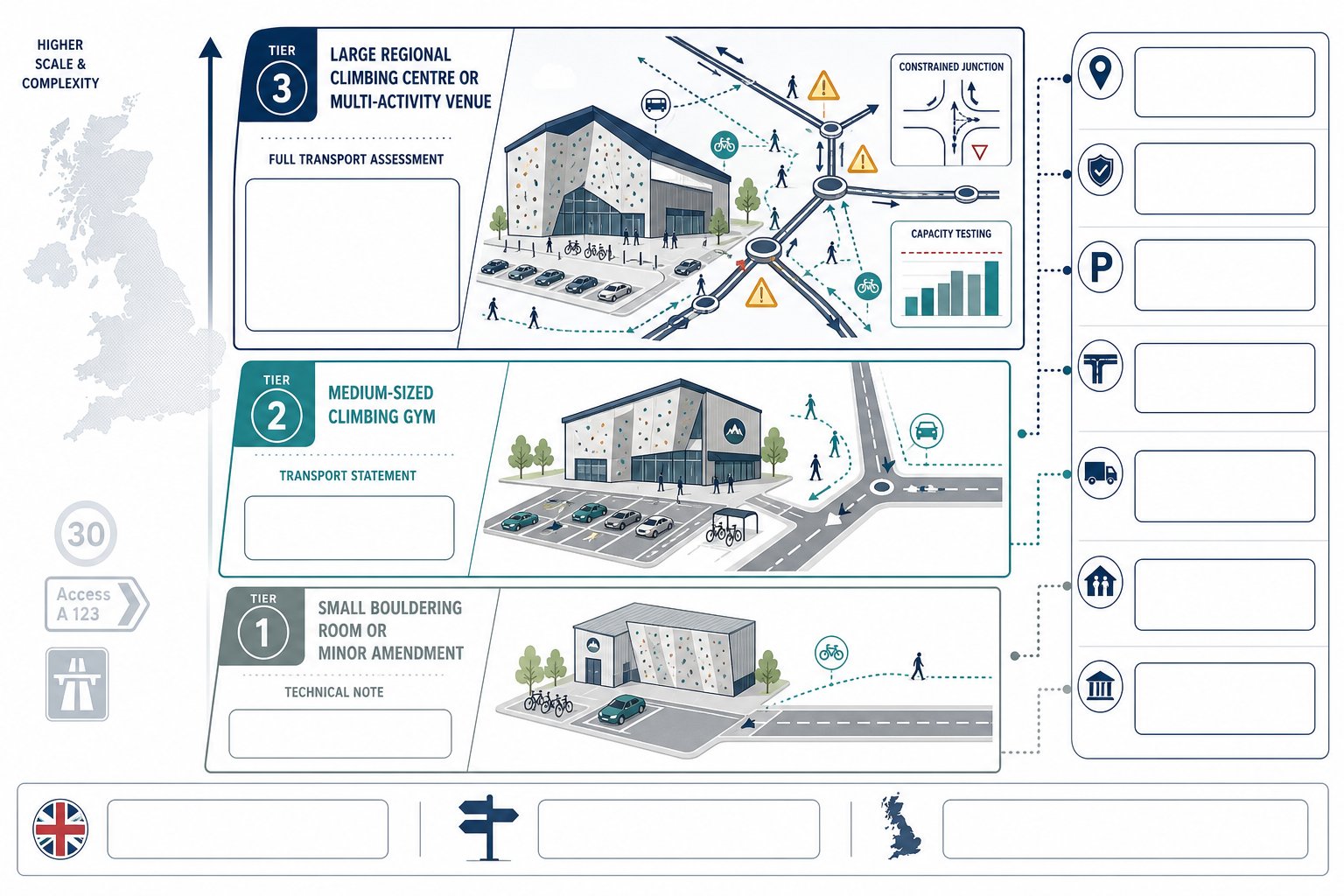
Not every climbing proposal needs the same level of reporting. The right document depends on the scale of the gym, the sensitivity of the site and the likely planning issues raised by the local authority.
A full Transport Assessment is usually appropriate for large regional climbing centres, multi-activity venues, proposals with substantial floorspace, or sites where the surrounding network is already constrained. The same applies where there are known road safety concerns, limited parking supply, awkward access geometry, or nearby junctions that may require capacity testing. In those situations, we would typically expect robust trip generation analysis, modal split evidence, parking accumulation, access appraisal and, where necessary, modelling.
A Transport Statement is often enough for medium-sized gyms where traffic effects are likely to be low to moderate and there is no obvious trigger for detailed capacity work. The key is still to be specific. A shorter document can be perfectly acceptable if it demonstrates likely demand, reviews site accessibility, considers parking and sets out proportionate mitigation.
A Technical Note may suit very small bouldering rooms, ancillary walls within a broader leisure offer, or minor amendments to an already assessed scheme. But “small” does not automatically mean “no issue”. If the site has poor visibility, constrained servicing, limited parking or sensitive neighbours, a more detailed submission may still be justified.
In practice, local validation lists and officer advice remain central. Thresholds vary. So do expectations on surveys, TRICS use and assessment years. For schemes tied to larger planning packages, questions can overlap with environmental impact assessment, town centre policy and travel plan obligations. The best route is to agree scope early rather than argue about document labels late in the process.
How Climbing Gym Travel Demand Differs From Standard Leisure Uses
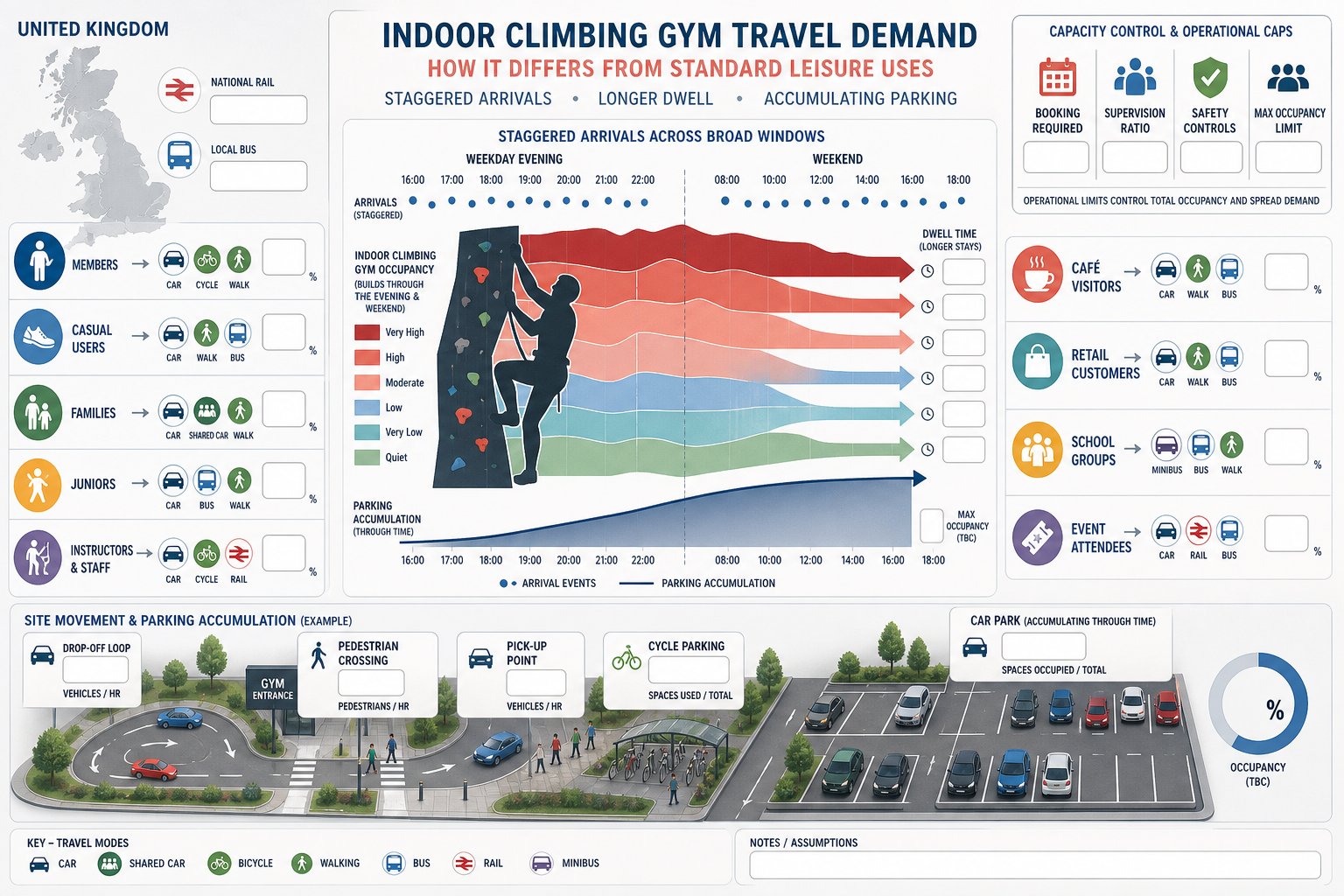
The mistake we still see is treating an indoor climbing gym as if it behaves like a generic indoor recreation unit. It does not, at least not without adjustment.
Climbing visits are usually longer than a quick retail stop and less rigid than cinema screenings or arena event arrivals. Users often come for one and a half to three hours, but they do not all arrive on the hour. They drift in across overlapping windows. That rolling demand pattern can soften pure peak arrival rates while increasing parking accumulation because vehicles stay for longer.
There is also a strong membership culture. Repeat users build habits. They know the quieter sessions, learn the best routes in, and often choose modes more consistently than one-off leisure visitors. In urban locations, that can mean higher rates of cycling, walking or public transport than generic leisure comparators suggest. In more suburban or edge-of-town settings, car use may still dominate, but even there car occupancy and car sharing can differ from standard assumptions.
Another important difference is the operational cap created by wall capacity, supervision and safety management. Climbing gyms are not infinite-throughput spaces. Busy periods may be managed through booking systems, coached sessions, junior clubs or occupancy controls. That matters because the transport analysis should reflect real operating practice, not theoretical maximums.
Peak Periods, Session Patterns, And Multi-User Occupancy
The most common peaks for climbing gyms are weekday evenings, roughly 17:00 to 21:00, and weekend late mornings into afternoons. Those windows do not perfectly mirror many standard leisure uses. A bowling centre, for instance, may have a different family split: a trampoline park may generate stronger child drop-off waves: a fitness gym may spread entries more evenly through the day.
Climbing also produces layered occupancy. One group may be finishing while another arrives. Parents may drop younger users and return later. Instructors, café users and retail customers add smaller supporting movements. Schools or organised groups can create short bursts of activity with minibuses or coaches, which matter even if they are occasional.
Because of that, we need to assess more than just inbound trips in a single peak hour. Parking accumulation, pick-up behaviour and pedestrian movement within the site can be just as important. A car park that appears acceptable on hourly trip totals can still fail operationally if long dwell times and overlapping sessions fill bays earlier than expected.
Membership Use, Casual Visits, And Event-Day Variations
Members are usually the backbone of the weekly profile. They travel repeatedly, often at familiar times, and their mode choice can be more sustainable where the location supports it. If a gym is near a rail station, on a good bus corridor or linked to safe cycle routes, members are often the first users to switch away from single-occupancy car travel.
Casual users behave differently. Taster sessions, birthday parties and first-time climbers are more likely to arrive by car, sometimes with multiple people per vehicle. That can reduce trip numbers but increase demand for short-stay waiting, pick-up activity and family-friendly circulation.
Then there are events. Competitions, social nights and corporate bookings may be infrequent, but they can sharply change travel patterns on specific days. A sensible assessment does not inflate everyday impacts by assuming constant event conditions. Equally, it should not ignore them. Where events are material, we normally recommend a separate management strategy covering timing, stewarding, overflow parking, travel information and neighbour protection. That distinction between normal operation and exceptional days is often what gives officers confidence in the submission.
Key Planning Policy And Local Authority Considerations
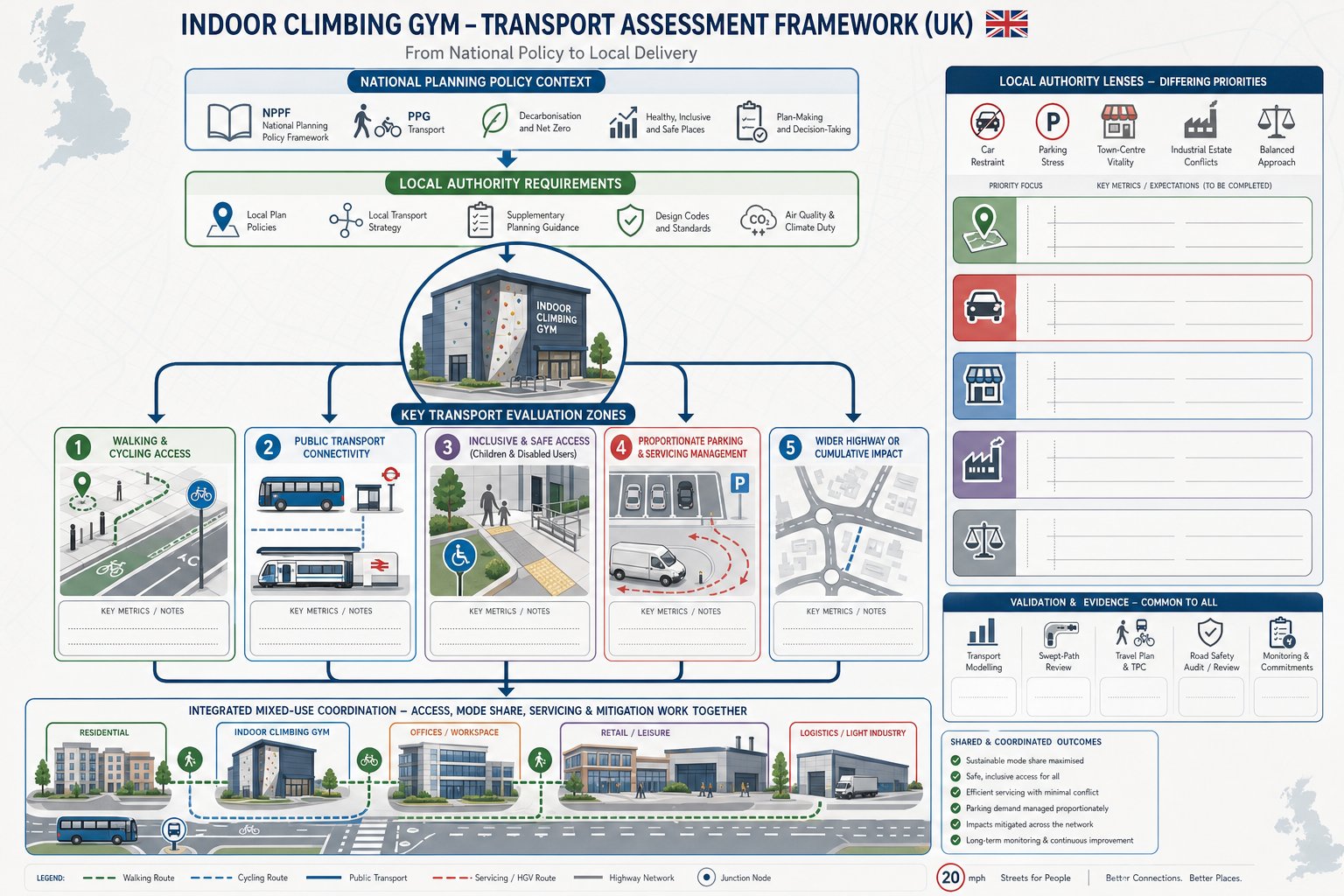
By 2026, the planning position is fairly clear: transport submissions for leisure uses must do more than count cars. They need to show that the development offers safe and suitable access for all users and that opportunities for sustainable transport have been properly taken.
At national level, that ties directly into the NPPF approach to sustainable transport, accessibility and highway impacts. For climbing gyms, the practical policy questions are usually these:
- Is the site accessible by walking, cycling and public transport?
- Can all users, including children and disabled users, reach the building safely?
- Is parking provision proportionate rather than excessive or deficient?
- Are servicing and operational movements controlled safely?
- Would the residual cumulative impacts on the network be severe?
Local plans then add their own detail. Some councils are highly focused on car restraint and active travel. Others place heavy emphasis on parking stress in industrial estates, town-centre vitality, or conflict between customer traffic and servicing yards. Validation requirements may also specify when junction modelling, swept path analysis, travel plans or road safety audits are expected.
This is where local knowledge really matters. Two authorities may look at the same unit size and reach very different views on scope because their policy frameworks, network constraints and parking standards differ. We hence advise aligning the report to local thresholds from the start, not after consultation comments arrive.
That is also true when the climbing gym forms part of a wider mixed-use proposal. Lessons from a Residential Development Transport assessment are useful here: policy compliance is strongest when access, mode share, servicing and mitigation are integrated across the whole site rather than presented as isolated topics.
Trip Generation And Modal Split For Indoor Climbing Facilities
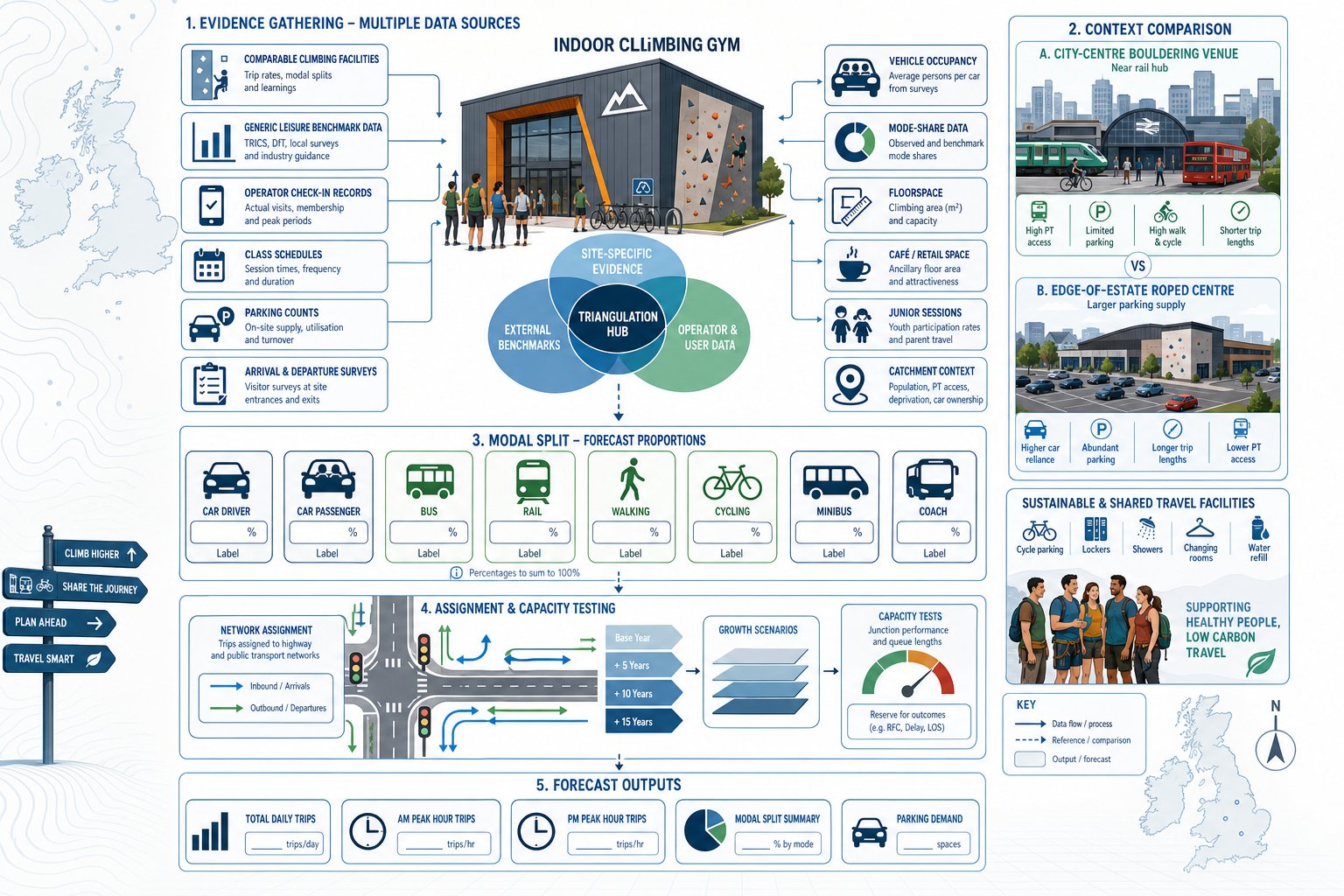
Trip generation is the point where many otherwise decent reports become too generic. For indoor climbing gyms, a defensible forecast usually needs a blend of evidence rather than reliance on one dataset.
TRICS can still help as a sense check, especially under indoor leisure or related categories, but unadjusted rates can be misleading. They may not capture climbing-specific dwell times, membership behaviour, event patterns or the tendency for evening-focused demand. The better approach is to start with comparable climbing facilities wherever possible, then test those findings against local context.
Useful inputs include entry or check-in data, class timetables, parking counts, arrival/departure surveys, vehicle occupancy and mode-share information. We also want to understand gross internal area, climbing offer, ancillary café or retail space, junior sessions, and catchment characteristics. A city-centre bouldering gym beside a rail hub should not be modelled like an edge-of-estate roped centre with abundant parking.
Modal split deserves the same care. We need realistic percentages for car driver, car passenger, public transport, walking and cycling, informed by site accessibility and likely user profile. For membership-led facilities, it is often sensible to distinguish between routine member travel and casual family-based trips rather than presenting one flat all-user average.
When highway officers ask for capacity testing, the forecast flows must then be translated into assignment assumptions that fit local routing, signal operation and background growth. If modelling is needed, tools such as Junctions 11 Software may be appropriate depending on junction type, scope and authority preference.
Using Comparable Leisure Sites And Local Survey Data
Comparable sites are usually the strongest foundation. The key word, though, is comparable. We look for gyms with similar floorspace, urban context, offer mix and catchment characteristics. A large destination centre with lead walls, training areas, café space and national competitions may be a poor comparator for a compact bouldering venue aimed mainly at after-work members.
Once comparable sites are chosen, local survey data adds the nuance. Parking beat surveys can show whether surrounding streets or shared estates already run hot. Pedestrian observations can identify desire lines from nearby bus stops or stations. Local census, accessibility and deprivation data can help explain likely mode choice. And operator data, where available, often reveals the most useful pattern of all: actual arrivals by time band and actual duration of stay.
We generally prefer a triangulated method. If comparable climbing data indicates one thing, generic leisure TRICS another, and local context a third, the answer is rarely to pick the most convenient number. It is to explain the differences and derive a reasoned forecast.
Accounting For Car Sharing, Public Transport, Walking, And Cycling
This is the section that often decides whether a report feels credible. Climbing gyms are exactly the sort of use where mode choice is mixed and dynamic. Friends travel together. Parents lift-share. Clubs arrive as groups. Members may cycle in summer and drive in winter. If the assessment ignores that complexity, it tends to look flat and unconvincing.
Car sharing should be modelled positively but carefully. We should not overstate it without evidence, yet many climbing trips genuinely involve more than one person per car. The same applies to schools and youth groups arriving by minibus or coach. Those movements can lower car trip totals but create specific kerbside and manoeuvring needs.
Public transport assessment should go beyond listing bus stops. We need walking times, service frequency, evening and weekend availability, rail access if relevant, and the quality of onward routes. Walking and cycling catchments also deserve proper treatment: directness, gradients, crossings, lighting, natural surveillance and secure bike parking all influence real take-up.
Where sustainable access is viable, the design should support it with covered cycle spaces, lockers, showers where appropriate, clear wayfinding and travel information integrated into memberships and bookings. That combination of infrastructure and management is often what turns a policy aspiration into a believable modal split.
Parking, Drop-Off, Servicing, And Highway Impact Assessment
Parking for a climbing gym should be sized around accumulation, not just raw trip generation. That sounds obvious, but it is where many poor assessments go wrong. Long stays and rolling arrivals mean a moderate flow of vehicles can still fill a car park quickly. So we need to test how occupancy builds through the busiest periods and how quickly spaces turn over.
For many sites, the critical issue is not only quantity but layout. Parents dropping children, club organisers, taxis, accessible users and cyclists can all converge near the entrance. If the design forces those movements through the main parking aisle or service yard, conflict risk rises. A dedicated drop-off area, even if modest, can make a disproportionate difference to safety and operation.
Servicing is another area that deserves more attention than it usually gets. Climbing gyms may receive retail stock, food and drink deliveries, cleaning supplies, maintenance equipment, wall panels and replacement holds. Some of that servicing is light: some is not. The report should confirm vehicle types, frequency, turning arrangements and whether deliveries can occur without blocking customer circulation.
Where forecast flows are material, highway impact assessment may extend to nearby junctions, priority accesses or internal estate roads. The scope should be proportionate. There is no value in over-modelling a low-impact site. But where thresholds are triggered, capacity work, queue review and routing assumptions need to be robust and transparent. And yes, officers increasingly expect the modelling evidence to be clean, reproducible and aligned with local growth assumptions rather than thrown in at the last minute.
Site Access, Safety, And Sustainable Travel Measures
A good climbing-gym scheme can be undermined by a poor final fifty metres. We have seen sites with acceptable strategic accessibility but awkward access roads, weak pedestrian priority, poor lighting or no safe crossing between the bus stop and the entrance. Those details matter because they shape both safety and mode choice.
Vehicular access should offer suitable visibility, intuitive circulation and enough space for two-way movement where flows require it. If the site sits within an industrial estate, attention should be paid to conflict with HGVs, reversing movements and peak servicing periods from neighbouring occupiers. Pedestrian routes should be step-free where possible, legible, overlooked and separated from vehicle manoeuvring areas. Cycle access should be direct, not an afterthought squeezed behind bins and plant.
Sustainable travel measures also need to be practical rather than decorative. A Travel Plan for an indoor climbing gym can work well if it reflects how climbers actually book and travel. Useful measures include:
- membership incentives linked to cycling or public transport:
- journey-planning information in joining packs and booking confirmations:
- car-share matching for clubs and coached sessions:
- secure, convenient cycle parking near the entrance:
- showers, lockers and drying space where the format of the gym supports them:
- monitoring of mode share and parking demand after opening.
These commitments help on policy, of course, but they also reduce operational risk. If sustainable modes work, pressure on parking and local streets falls. And if post-opening monitoring is promised, it should be realistic and enforceable. Authorities are far more receptive when the mitigation package feels like something the operator will actually run, not a hopeful appendix.
Conclusion
An Indoor Climbing Gyms Transport Assessment works best when it treats the use as its own transport category, not as a generic leisure placeholder. The strongest planning submissions are built around real operating patterns: evening-heavy demand, longer dwell times, mixed mode share, membership behaviour, family drop-offs and occasional event surges.
For planning teams, the task in 2026 is straightforward in principle, even if the detail takes care. We need to match the assessment type to the scheme, use credible comparable data, test parking accumulation rather than headline trips alone, and demonstrate safe access for drivers, pedestrians and cyclists alike. Then we need to tie that evidence back to national policy and the local authority’s own validation and transport expectations.
When those pieces are in place, the report does more than satisfy a checklist. It gives officers confidence that the climbing gym can operate safely, sustainably and without unacceptable network effects, which is, in the end, what gets schemes moving.
Indoor Climbing Gyms Transport Assessment FAQs
Why do indoor climbing gyms require a bespoke transport assessment?
Indoor climbing gyms generate distinct travel patterns with high evening and weekend peaks, longer dwell times, and a mix of transport modes. A bespoke transport assessment ensures safe access, appropriate parking, and sustainable travel, addressing local planning and highway policy requirements accurately.
When is a full Transport Assessment needed for an indoor climbing gym?
A full Transport Assessment is necessary for large regional gyms, multi-activity venues, or sites with constrained networks or sensitive junctions. It involves detailed trip generation, parking, access appraisal, and may include modelling using tools like Junctions 11 Software In 2026: A Practical Guide For Transport Assessments And Planning Applications.
How does travel demand at climbing gyms differ from typical leisure facilities?
Climbing gyms have longer user dwell times (1.5–3 hours) with rolling arrivals, strong evening peaks, and a high proportion of repeat members. This results in distinct parking accumulation patterns and a different modal split, often with more cycling, walking, and car sharing compared to generic leisure uses.
What sustainable travel measures support climbing gym transport assessments?
Effective measures include secure cycle parking, showers and lockers, member incentives for cycling and public transport, car-share matching schemes, and integrated journey planning information. These reduce car dependency and align with national sustainable transport policy objectives.
How should parking and drop-off areas be designed for climbing gyms?
Parking should be sized based on peak accumulation considering long stays and rolling sessions. Dedicated drop-off zones separate from main parking improve safety and operation. Servicing access must accommodate delivery vehicles without obstructing customer movement, as detailed in environmental impact assessment transport guidelines.
What local policy considerations are important in indoor climbing gym transport assessments?
Compliance with the NPPF on sustainable transport, safe access for all users including disabled and children, appropriate parking provision, and avoidance of severe residual impacts on the highway network are key. Local plans may also require travel plans and highway safety audits to support sustainable site operation.