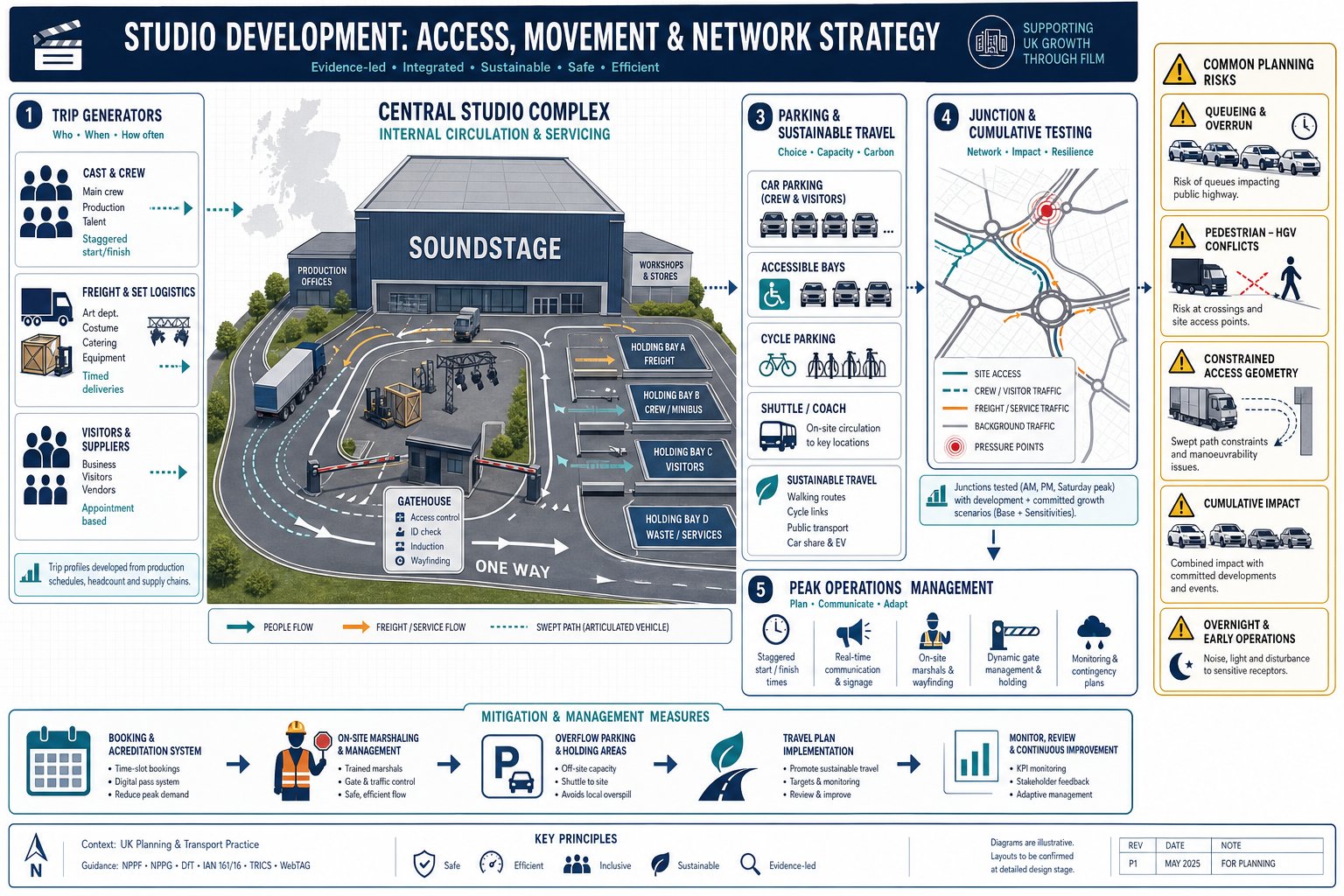
Studio development is having a big moment in the UK. New soundstages, expanded production campuses and hybrid creative employment sites are moving through planning in response to long-term demand from film, high-end TV, streaming and digital content. But these schemes bring a transport profile that rarely fits neatly into standard office, warehouse or business park assumptions.
That is where a Film, TV and Creative Production Studios and Soundstages Transport Assessment becomes critical. For planning teams, the challenge is not simply proving that a site can be reached. It is demonstrating how highly variable staff arrivals, technical deliveries, set logistics, unit moves, visitor activity and occasional peak filming conditions will work in practice without creating unacceptable effects on the surrounding highway network.
We regularly find that the strongest applications are the ones that treat transport as an operational design issue from the outset, not a reporting exercise left until the end. Access geometry, internal circulation, holding areas, parking strategy, shift patterns and cumulative traffic testing all need to reflect how studios actually function on live production days.
In this guide, we set out what architects, planners, solicitors, surveyors, developers and local authorities need to get right in 2026: when a Transport Assessment is likely to be required, which trip generators matter most, how studio impacts differ from more familiar land uses, and where planning applications most often come unstuck.
Key Takeaways
- A Film, TV and Creative Production Studios and Soundstages Transport Assessment must reflect the unique operational rhythms of production, including shift changes, variable peak times, and complex servicing demands.
- Early integration of transport assessment into studio design improves site access, internal circulation, and parking strategies, preventing application risks and ensuring smooth daily operations.
- Realistic trip generation modelling should separate staff movements from freight and technical deliveries to accurately assess transport impacts on local highway networks.
- Robust transport assessments acknowledge the episodic, peak-driven nature of studios, differing significantly from standard office or industrial land uses in traffic profiles.
- Effective transport management includes tailored mitigation measures like shuttle services, delivery booking systems, and on-site marshalling that handle both routine and peak filming activities.
- Early collaboration with local authorities and clear, concise reporting strengthen planning applications and build confidence in the studio’s transport feasibility.
Why Transport Assessments Matter For Studios, Soundstages And Production Campuses
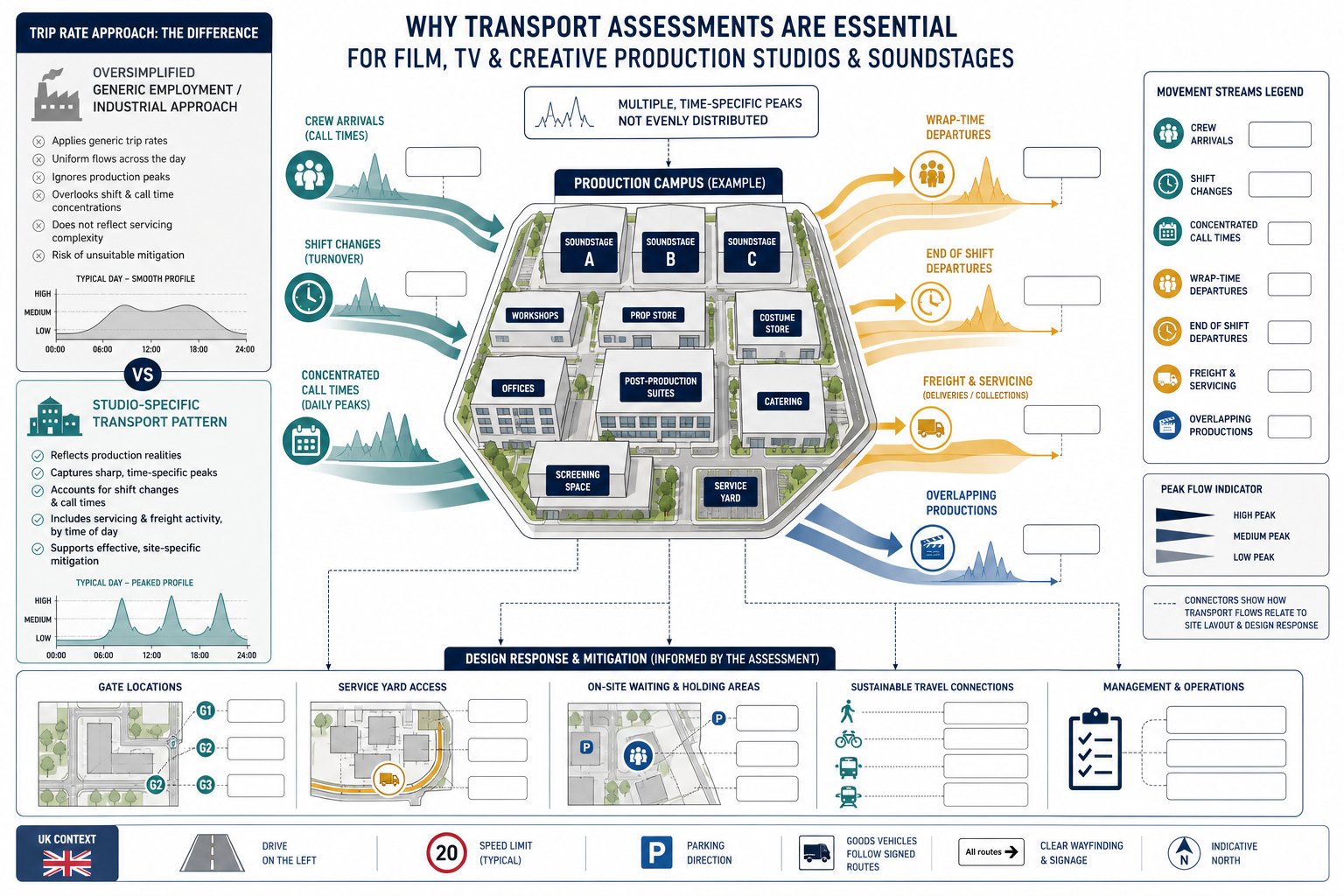
Studios are often described as employment-led development, and that is true in a broad sense. The problem is that transport effects are not driven by floorspace alone. A production campus can include soundstages, workshops, mill space, offices, costume and prop storage, post-production areas, catering, screening facilities and yard space. Each has its own movement pattern.
A Transport Assessment matters because local planning authorities need evidence on whether those combined movements can be accommodated safely and efficiently. For studio schemes, pressure typically comes from concentrated call times, wrap times, crew shift changes, overlapping productions and servicing demand that behaves more like freight than conventional commuter traffic.
This is why a generic B1, E(g) or industrial comparison usually falls short. Even where daily traffic is moderate on average, the peaks can be sharp and site-specific. A robust TA helps explain that operational reality in a way planning officers, highway authorities and committee members can interrogate.
It also supports better design. Done early enough, the assessment can shape gate locations, service yards, on-site waiting areas and travel planning measures before those issues become application risks. In our experience, concise and evidence-led reporting is far more persuasive than relying on broad employment trip rates that do not reflect how film and TV production actually works.
When A Film Or TV Development Is Likely To Need A Transport Assessment
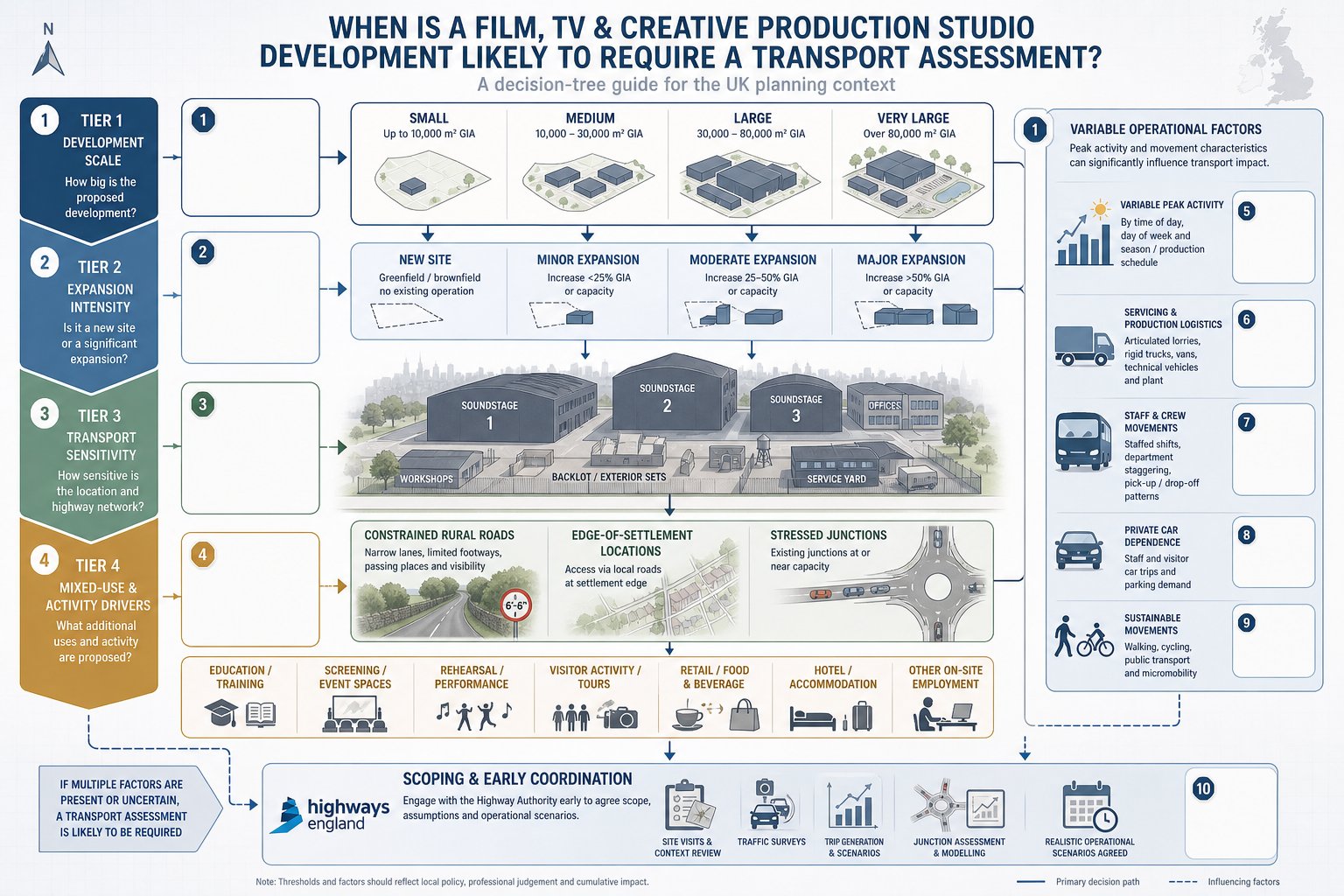
Not every creative workspace will need a full TA, but many studio-led proposals will. The likelihood rises quickly where a scheme includes multiple soundstages, substantial gross floorspace, backlot activity, ancillary production offices, workshops, yard operations or a material uplift in servicing and staff movements.
In practice, new studio campuses and major expansions are strong candidates because they introduce both daily operational trips and less predictable peak scenarios. Local authority thresholds vary, so the right starting point is always the scale of development, local validation requirements and the sensitivity of the surrounding network. On constrained rural roads, edge-of-settlement locations or sites near already stressed junctions, the transport evidence burden is usually higher.
Mixed-use creative schemes can also trigger a TA when the studio element combines with offices, rehearsal space, education uses, screening venues or visitor-facing functions. The cumulative transport picture matters more than the planning label.
Where screening is less clear, early scoping with the highway authority helps. We often advise teams to frame the proposal around realistic operational scenarios rather than headline floorspace alone. That approach tends to produce better agreement on scope, survey needs and modelling requirements, much like any wider transport assessment for significant planning applications require in 2026.
Key Trip Generators Across Production-Led Sites
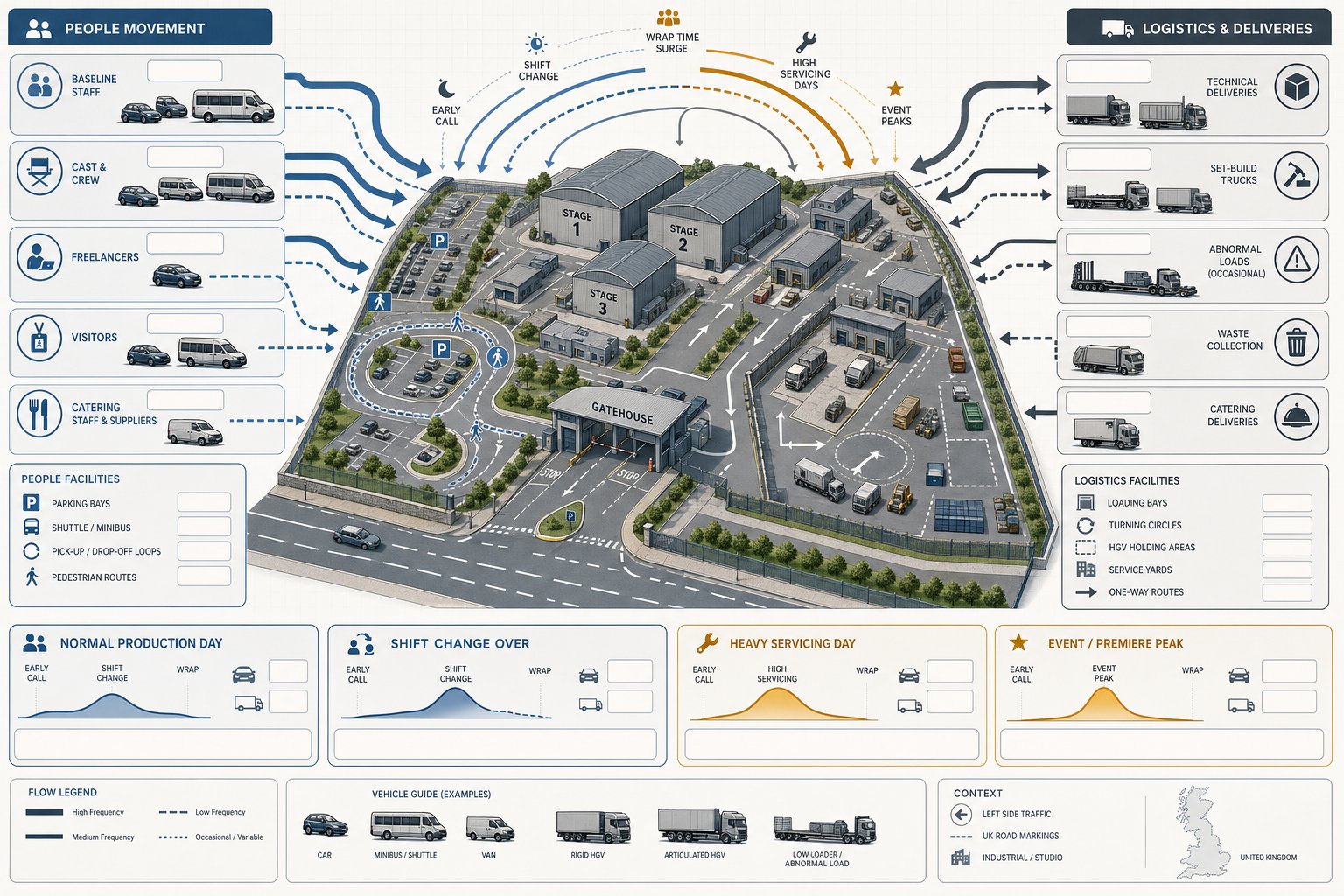
The central mistake in many studio applications is treating trip generation as if the site were a steady-state office campus. It rarely is. Production-led sites have multiple trip generators operating at different rhythms, and the assessment needs to identify them separately before drawing them back together into tested scenarios.
Baseline staff travel is only one part of the picture. Cast, crew, freelancers, clients, specialist contractors, visitors, catering suppliers, technical deliveries, waste collection, set construction vehicles and occasional abnormal loads can all affect network performance. On larger campuses, overlapping productions may produce very different traffic patterns from one week to the next.
The answer is not to invent precision where none exists. It is to set out transparent assumptions, define realistic operating cases and test the conditions most likely to concern the authority: normal production, shift crossover, high-servicing days and any event-led or screening-related peaks.
Cast, Crew And Shift Change Movements
Cast and crew trips are usually the dominant people-movement element. But they are not the same as a normal commuter peak. Call times may be staggered, very early, very late or compressed around production demands. Wrap times can produce concentrated outbound traffic, especially where several stages operate simultaneously.
Crew composition matters too. Some productions rely heavily on freelancers travelling long distances with equipment: others are more locally staffed. Unit bases, shuttle arrangements and car sharing can materially affect demand. If the TA assumes a simple 9-to-5 profile, it can miss the very peak that matters.
For that reason, we usually recommend a production-informed staffing profile with explicit shift assumptions, arrival curves and sensitivity testing. Parking demand, pick-up and drop-off activity and pedestrian movements between buildings should all align with that profile.
Heavy Goods Vehicles, Set Logistics And Technical Deliveries
Studios also generate a freight profile that is more complex than standard employment uses. Scenic materials, rigging equipment, lighting, generators, props, wardrobe deliveries, catering, refuse collection and workshop supplies all create servicing demand. During set build and strike periods, HGV activity can rise sharply.
Some sites will also need to accommodate longer vehicles, low loaders or infrequent abnormal loads. That has direct implications for access width, turning, gatehouse operations, holding areas and internal one-way systems. If vehicles queue on the public highway because the service yard is full, the planning issue stops being theoretical very quickly.
A robust TA should hence separate staff trips from servicing trips, identify expected vehicle types and test how loading activity interacts with general arrivals. It is often the interface between production logistics and ordinary daily access that determines whether a scheme feels workable to a highway authority.
How Studio Transport Impacts Differ From Standard Employment Or Industrial Uses
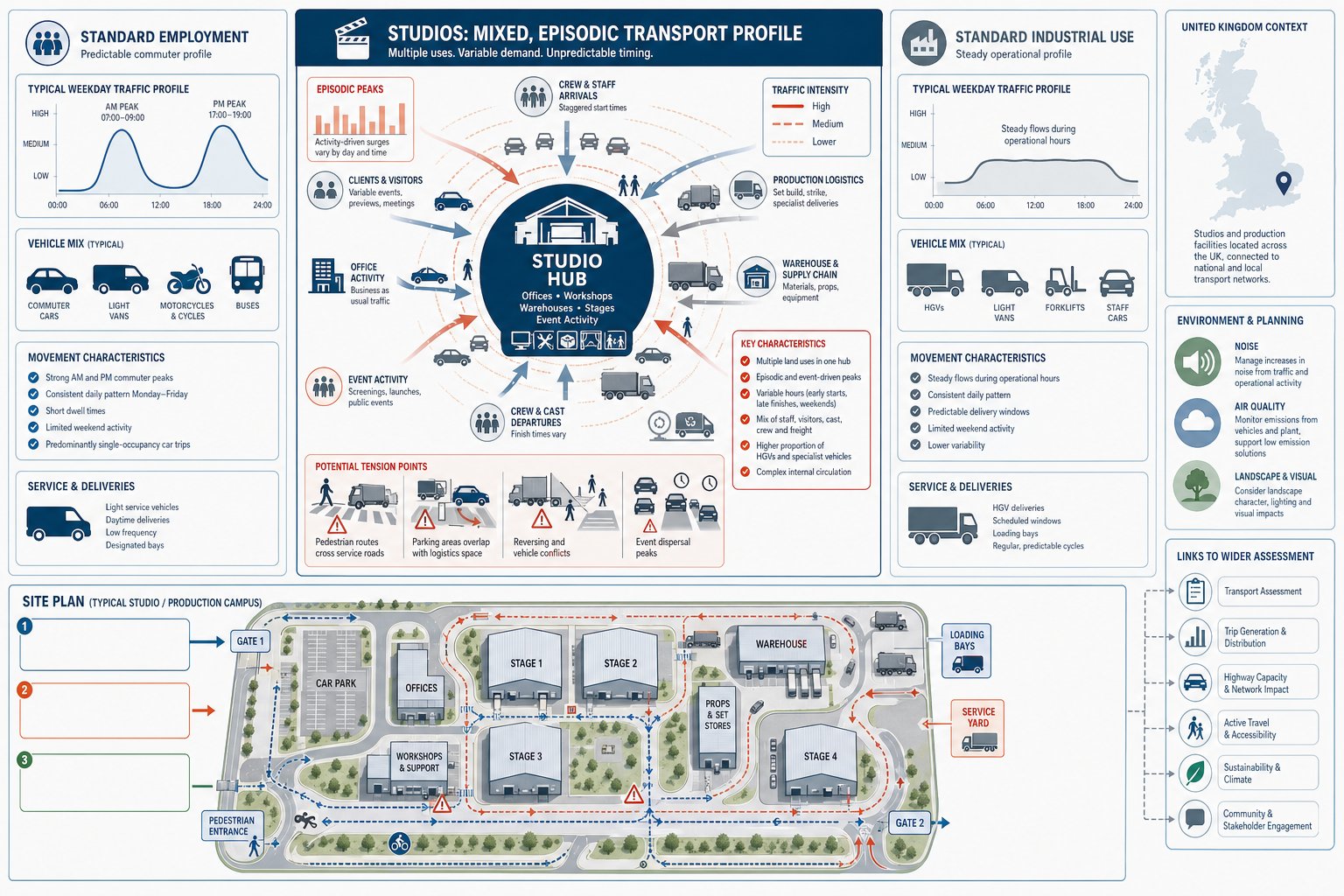
Studios sit awkwardly across conventional land-use categories, and that is exactly why transport evidence has to be handled carefully. They can behave like offices, workshops, warehouses and event venues, sometimes all within the same day.
A standard employment use often produces recognisable commuter peaks with relatively stable servicing patterns. A standard industrial use may generate heavier freight but more predictable operational cycles. Studios, by contrast, can be episodic. Demand may be moderate for weeks, then intensify during stage turnover, major set builds, location support activity or simultaneous productions.
That variability changes the assessment strategy. The key question is not just average weekday traffic. It is whether the network and the site layout can perform acceptably under realistic operational peaks. This is one reason benchmark data from unrelated uses should be treated cautiously.
Studios also create more interaction between people movement and logistics. Pedestrians crossing service routes, crew parking competing with production vehicles, or client arrivals overlapping with HGV deliveries are common operational tensions. The TA needs to reflect these mixed conditions.
Where a proposal also sits within a wider planning package, transport effects may intersect with landscape, noise, air quality and community impacts. On larger sites, that can overlap with the scope of an environmental impact assessment as part of the wider application strategy.
The Core Elements Of A Robust Transport Assessment
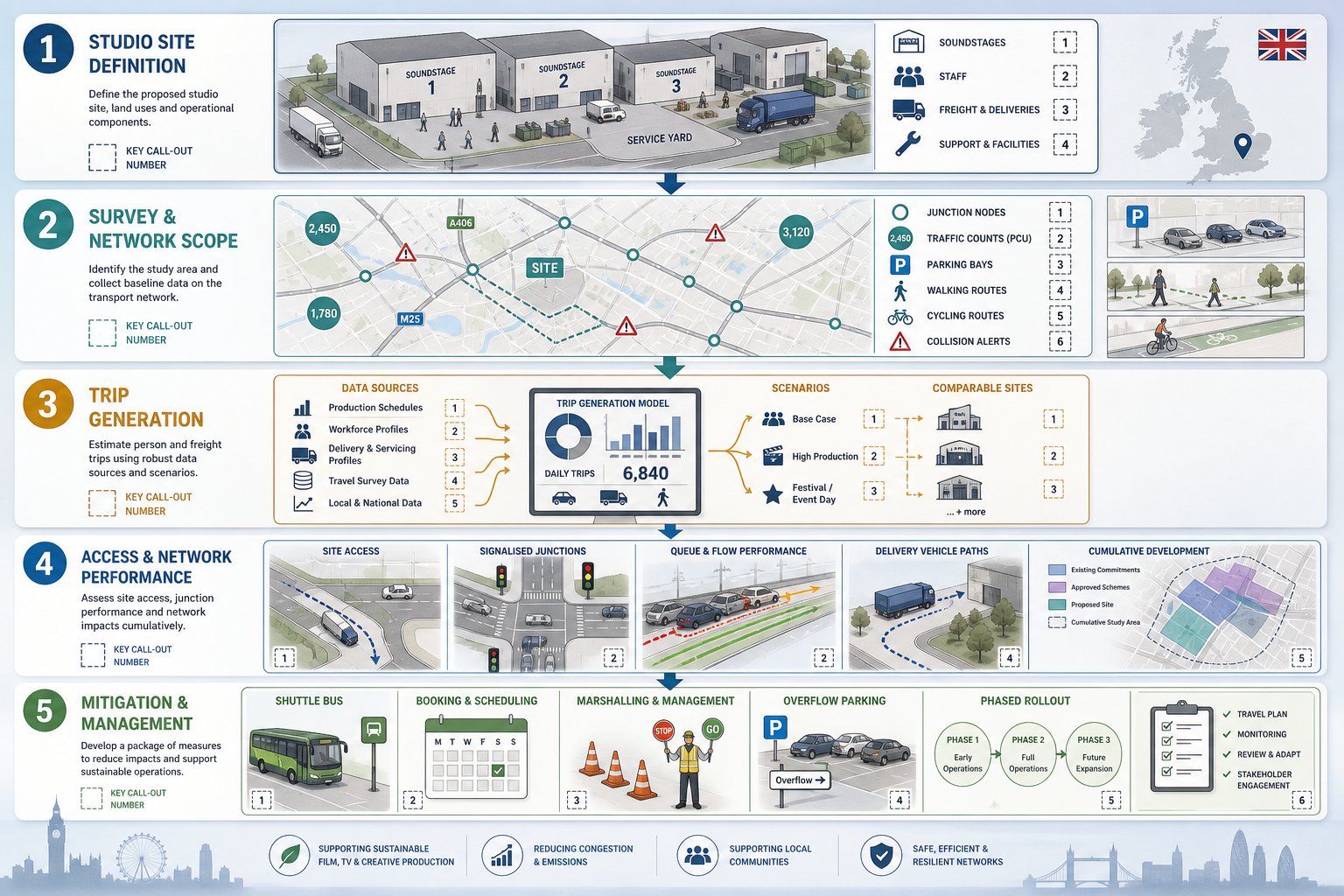
A sound TA for a studio scheme should be practical, evidence-led and tailored to how the site will actually operate. The fundamentals are familiar, but the application of them needs to be production-specific.
First, define the development clearly. That means soundstage numbers and sizes, ancillary uses, likely staffing ranges, service yard functions, operational hours and any unusual vehicle requirements. Without that baseline, the rest of the report becomes guesswork.
Second, establish the right surveys and network scope. That may include junction counts, queue observations, parking stress review, active travel context and collision data. For larger or more sensitive sites, agreed modelling scenarios are often needed.
Third, derive trip generation using a reasoned methodology. Comparable sites, operator input, TRICS where relevant, first-principles assumptions and scenario testing can all play a part. The important thing is transparency.
Fourth, test access and network performance. This should address priority junctions, signals, site access operation, delivery interactions and cumulative effects with committed development.
Finally, include mitigation and management. Travel planning, booking systems for deliveries, shuttle services, on-site marshalling, overflow parking controls and phased occupation triggers often carry real weight. The strongest reports explain not only what the impact is, but how the site will be run so that impact remains acceptable.
Access, Servicing, Swept Path And Internal Circulation Requirements
Access design is where many otherwise credible applications start to wobble. A studio may have enough overall highway capacity in strategic terms, yet still fail on day-to-day operation if the entrance, gatehouse or internal roads cannot handle the vehicles that actually need to use them.
The assessment should cover the full chain of movement: approach route suitability, visibility, gate control, stacking space, turning movements, pedestrian segregation, loading arrangements and safe exit. Swept path analysis is especially important where articulated vehicles, rigid HGVs, trailers or specialist production vehicles are expected.
Internal circulation deserves just as much attention as the main access. Can two large vehicles pass safely? Is there room for waiting without blocking staff parking or emergency routes? Are loading bays positioned so reversing is controlled and predictable? If a one-way system is proposed, does it work on busy changeover days rather than only on a quiet baseline plan?
Authorities tend to be sceptical when servicing is shown as a generic yard box with little operational explanation. It helps to define loading protocols, marshal roles and holding capacity. Where applications cover phased studio growth, we should also show that later phases will not compromise the access logic established by the first. In short, geometry and operations have to line up.
Parking, Blue Badge Provision, Cycle Facilities And Sustainable Travel Measures
Parking strategy for studios is more nuanced than simple ratio-based provision. Too little parking can push crew vehicles into nearby residential streets or rural verges. Too much can weaken the sustainability case and sterilise valuable site area. The right answer depends on staffing patterns, local accessibility, production type and whether shuttle or remote parking options are realistic.
Blue Badge provision needs to be convenient, compliant and genuinely usable during live production conditions, not just on a layout plan. That means thinking about route quality, gradients, kerb details and proximity to the buildings people actually need to reach.
Cycle parking and end-of-trip facilities should also be proportionate and well located. On urban or edge-of-centre creative sites, cycling may capture a meaningful share of commuter trips. On isolated studio campuses, secure cycle parking still matters, but it should be supported by realistic wider measures rather than tokenism.
Travel plans carry more weight when they are specific. Car sharing platforms, crew shuttle services from rail stations, staggered call times, delivery booking systems and clear parking management rules are often more effective than generic aspiration. Comparisons with broader sectors, including Residential Development Transport, can be useful methodologically, but studio travel planning always needs to reflect the distinct mix of freelancers, shift workers and servicing activity on site.
Junction Capacity, Network Performance And Cumulative Development Effects
Junction modelling is often the point at which a studio scheme becomes contentious. Highway authorities will want to know whether forecast traffic can be absorbed without severe queuing, delay or safety concerns, especially at nearby priority junctions, signals, roundabouts and motorway or trunk road interfaces.
The technical work should match the scale and sensitivity of the proposal. For some sites, ratio-to-flow analysis and observed queue review may be enough. For others, LINSIG, ARCADY, PICADY or microsimulation may be appropriate. What matters most is that the tested scenarios reflect studio operations rather than generic employment peaks.
Cumulative development effects are equally important. A junction that appears acceptable in isolation may become problematic once nearby housing, logistics, retail or other employment schemes are included. This is particularly relevant in growth corridors where several allocations come forward at once.
We usually advise testing at least three layers: baseline, development traffic and cumulative future year conditions. Sensitivity testing for peak filming or turnover periods can also be sensible where operational peaks differ materially from the average day. If mitigation is needed, it should be specific, proportionate and deliverable, with a clear explanation of trigger points, funding or phasing. Vague promises rarely survive detailed consultation.
Construction, Peak Filming Periods And Event-Led Traffic Management
Construction traffic can be substantial on studio schemes, particularly where enabling works, major earthworks, large-span buildings and extensive servicing yards are involved. Planning teams should not assume that operational assessment alone is enough. Authorities will often expect a Construction Traffic Management Plan or at least a clear framework for one.
That framework should address routeing, wheel washing, contractor parking, delivery hours, abnormal loads, temporary access arrangements and protection for walking and cycling routes. If nearby schools, constrained villages or sensitive junctions are affected, the level of scrutiny tends to increase.
Operationally, peak filming periods also need attention. These might include simultaneous productions, set strike and rebuild periods, high-profile talent movements or on-site events such as screenings, launches or audience activity. Not every studio hosts all of these, but where they are possible, the TA should explain how traffic will be managed.
Practical controls can include pre-booked delivery slots, on-site marshalling, overflow holding, remote crew parking, shuttle buses, temporary traffic management and communication protocols with local stakeholders. The key is credibility. If the proposed controls rely on perfect behaviour with no management resource behind them, they will not reassure decision-makers. A good application shows that both routine operation and exceptional days have been thought through properly.
Common Planning Risks And How To Strengthen An Application
The most common risk is underestimating how irregular studio traffic can be. Averages can look comfortable while actual busy-day conditions are not. If trip generation is optimistic, parking is light-touch and servicing is simplified, consultees will usually notice.
Another recurring problem is weak operational definition. Phrases such as “creative campus” or “production hub” sound attractive, but they are not transport evidence. Authorities need to understand what will happen on the ground: who arrives, when, in what numbers, by which mode and with what vehicle mix.
Internal layout is another pressure point. A poor yard arrangement, inadequate turning head, limited gate stacking or unresolved conflict between pedestrians and HGVs can undermine an application even where off-site junctions perform adequately.
To strengthen the submission, we should build the TA around realistic use cases, not generic land-use labels. Operator input, scenario testing, clear plans, swept path drawings and a credible travel plan all help. So does early engagement with the highway authority and a willingness to revise assumptions before positions harden.
From a programme perspective, concise reporting often wins. Planning teams do not need bloated documents: they need accurate evidence, local-threshold awareness and recommendations that fit the application strategy. That practical approach is exactly why specialist transport input tends to add most value on studio and soundstage proposals.
Conclusion
A Film, TV and Creative Production Studios and Soundstages Transport Assessment is strongest when it reflects the real operating rhythm of production, not a borrowed template from office or industrial development. That means understanding shift changes, set logistics, servicing peaks, parking behaviour, internal circulation and the cumulative stress placed on nearby junctions.
For planning teams in 2026, the priority is straightforward: define the use properly, test realistic scenarios and show how the site will function on both normal and busy days. If those fundamentals are covered early, the TA becomes more than a validation document. It becomes part of the design and consenting strategy.
And that is usually the difference between an application that invites avoidable objections and one that gives officers, consultees and committees confidence that the development will work in practice.
Film and TV Studio Transport Assessment FAQs
What is a Film, TV and Creative Production Studios and Soundstages Transport Assessment?
It is a detailed study analysing how transport movements such as staff arrivals, technical deliveries, and visitor activity impact local roads for studio developments, ensuring operational demands don’t cause unacceptable highway effects.
When is a Transport Assessment required for a studio development?
A TA is usually needed for new or expanded studio campuses with multiple soundstages, substantial floorspace, or increased servicing and staff movements, especially where local road capacity or junction sensitivity is a concern.
How do transport impacts of studios differ from standard office or industrial uses?
Studios experience highly variable and episodic transport demand driven by staggered call times, set logistics and event peaks, combining office, industrial and event-type traffic patterns that require bespoke assessment approaches.
What are the key trip generators to consider in a studio Transport Assessment?
Major trip sources include cast and crew movements with variable shift patterns, heavy goods vehicles for set logistics and technical deliveries, visitor and client travel, and occasional abnormal loads or event-related spikes.
How can a robust Transport Assessment improve studio planning applications?
By integrating realistic operational scenarios and production-specific trip assumptions early, the TA can guide access design, parking, servicing layouts and travel planning to demonstrate practical site function and mitigate highway impacts.
What practical measures help manage transport during peak filming and construction phases?
Effective strategies include pre-booked delivery slots, on-site marshalling, crew shuttles, overflow parking, traffic management plans, and clear communication with local stakeholders to control variable and abnormal traffic flows.