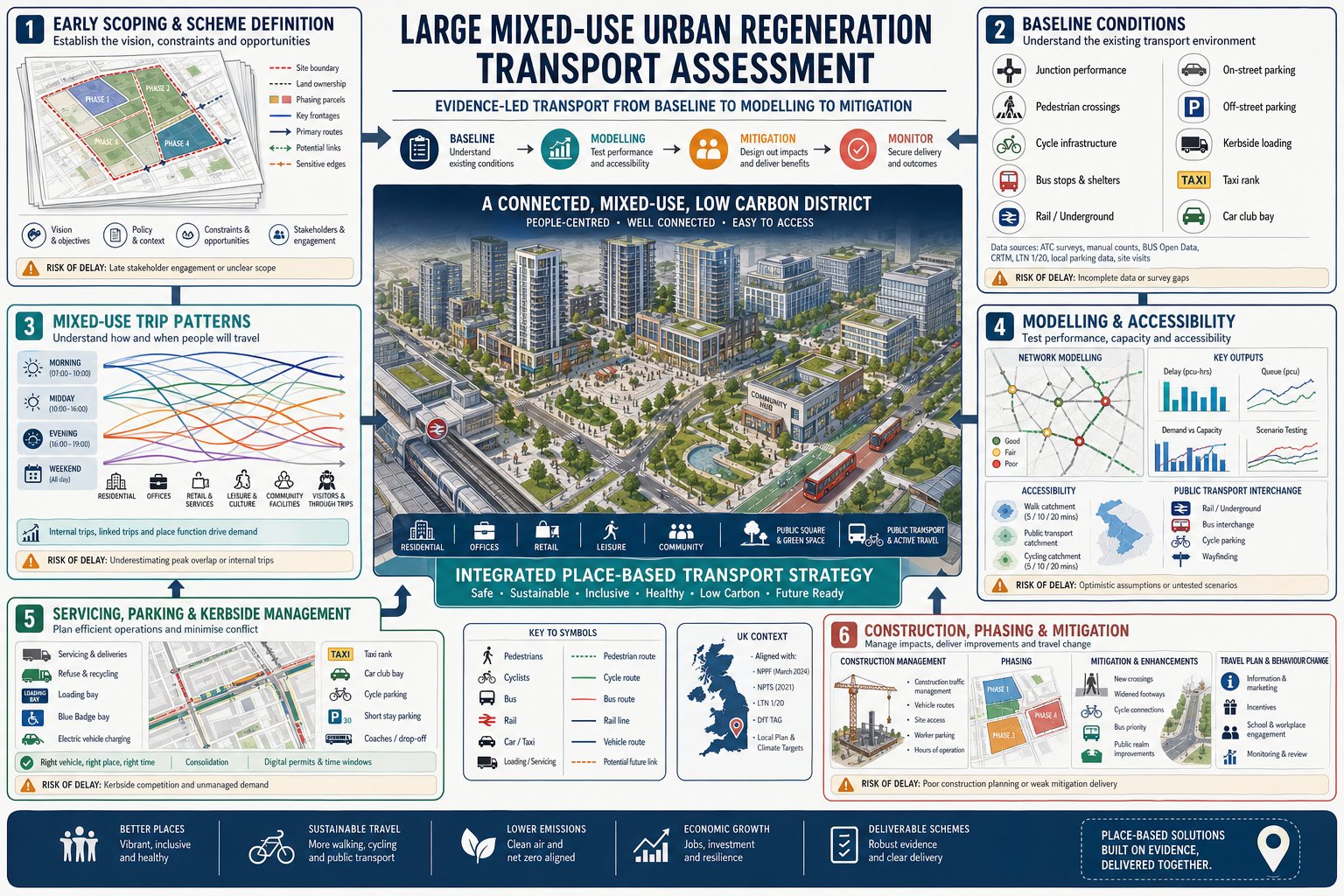
Urban regeneration projects rarely fail because of a single junction model or one awkward access point. More often, they stall because the transport story is incomplete. A large mixed-use regeneration scheme has to work as a place before it can work as a planning application: people need to arrive, move through it, service it, park within it, and live with it during construction and phasing.
That is why a Large Mixed-Use Urban Regeneration Schemes Transport Assessment needs a different level of care from a standard single-use development appraisal. Residential, office, retail, leisure and community uses do not behave in neat silos. Their trip patterns overlap, offset and shift across the day. Internal trips can reduce external demand. Good public transport and walkable street networks can materially change mode share. And temporary phases can create impacts that matter just as much as the completed scheme.
For architects, planners, lawyers, surveyors, developers, builders and local authorities, the practical challenge in 2026 is clear: present a transport assessment that reflects how the scheme will actually function, not just how a spreadsheet says it might. In this text, we set out what planning teams need to define early, test properly and resolve before determination, so that transport becomes a planning enabler rather than the reason a major regeneration proposal drifts into delay.
Key Takeaways
- A Large Mixed-Use Urban Regeneration Schemes Transport Assessment requires bespoke methodologies that reflect complex, overlapping trip patterns and phased site evolution.
- Accurate baseline transport conditions, including traffic, accessibility, and kerbside activity, are essential to build a credible assessment and avoid later challenges.
- The transport assessment must integrate walking, cycling, and public transport accessibility evidence to support mode shift and sustainable urban mobility.
- Servicing, deliveries, parking strategy, and kerbside management should be explicitly detailed and operationally feasible to prevent objections and operational conflicts.
- Construction and phased occupation impacts need thorough assessment and mitigation strategies to ensure smooth interim site functioning.
- Early engagement with planning authorities, clear development definitions, and integrated mitigation tied to the wider place vision expedite planning decisions and reduce delays.
What Makes Transport Assessment Different For Urban Regeneration Schemes
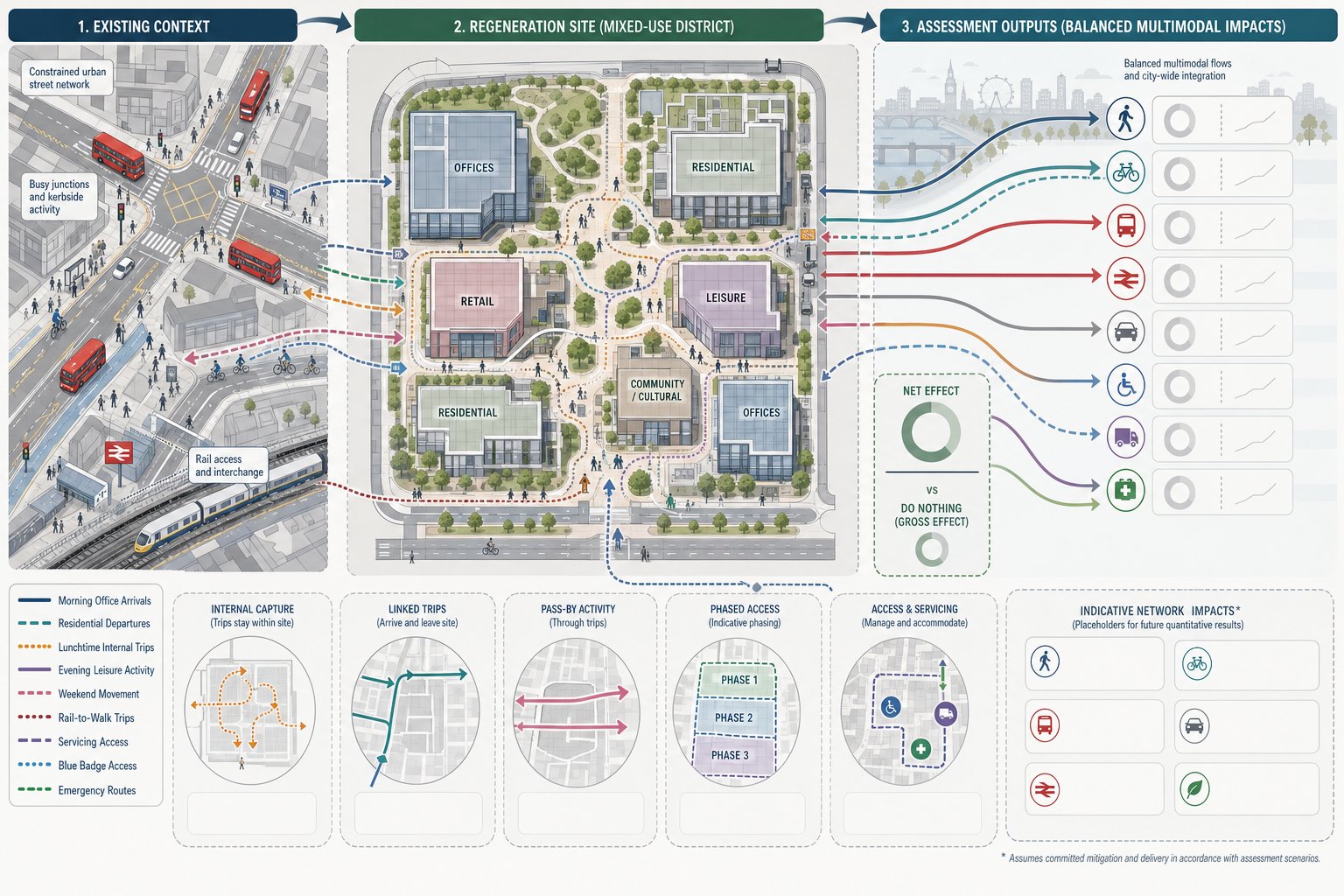
A regeneration-led transport assessment is not simply a larger version of a suburban housing TA. The core difference is complexity of movement. Mixed-use urban sites usually sit in constrained networks, rely on several modes, and evolve in phases over years rather than months. Existing streets may already be busy, kerbside activity may be intense, and there may be political pressure to reduce car dependence while still protecting access for servicing, blue badge users and emergency vehicles.
That means the assessment has to do more than count forecast trips. It has to explain how the site integrates with the surrounding town or city, how access will operate at different stages, and whether the transport strategy supports the planning vision. In practice, we often need a more bespoke methodology than a standard edge-of-town development would require. The principles behind a broader transport assessment for developments still apply, but regeneration schemes demand more detailed judgement around internalisation, accessibility and operational management.
How Mixed-Use Trip Patterns Change Assessment Assumptions
This is where many applications either become persuasive or start to wobble. Standard trip-rate databases are useful, but they can overstate impacts if applied crudely to a mixed-use scheme. Office arrivals may peak in the morning: residential departures may do the same: retail and leisure can strengthen lunchtime, evening and weekend activity. Some trips will stay on site. Others will transfer from existing nearby destinations.
So we should test net effects by time period and by mode, not just present gross vehicular generation. A resident walking to an on-site gym or café is movement, but not highway impact. A worker arriving by rail and walking through the scheme still matters for public realm and crossing design. The right approach is to identify linked trips, internal capture, pass-by activity where relevant, and realistic mode split assumptions based on actual urban context. Done well, that produces a truer picture of impact and a stronger planning case.
When A Full Transport Assessment Is Required
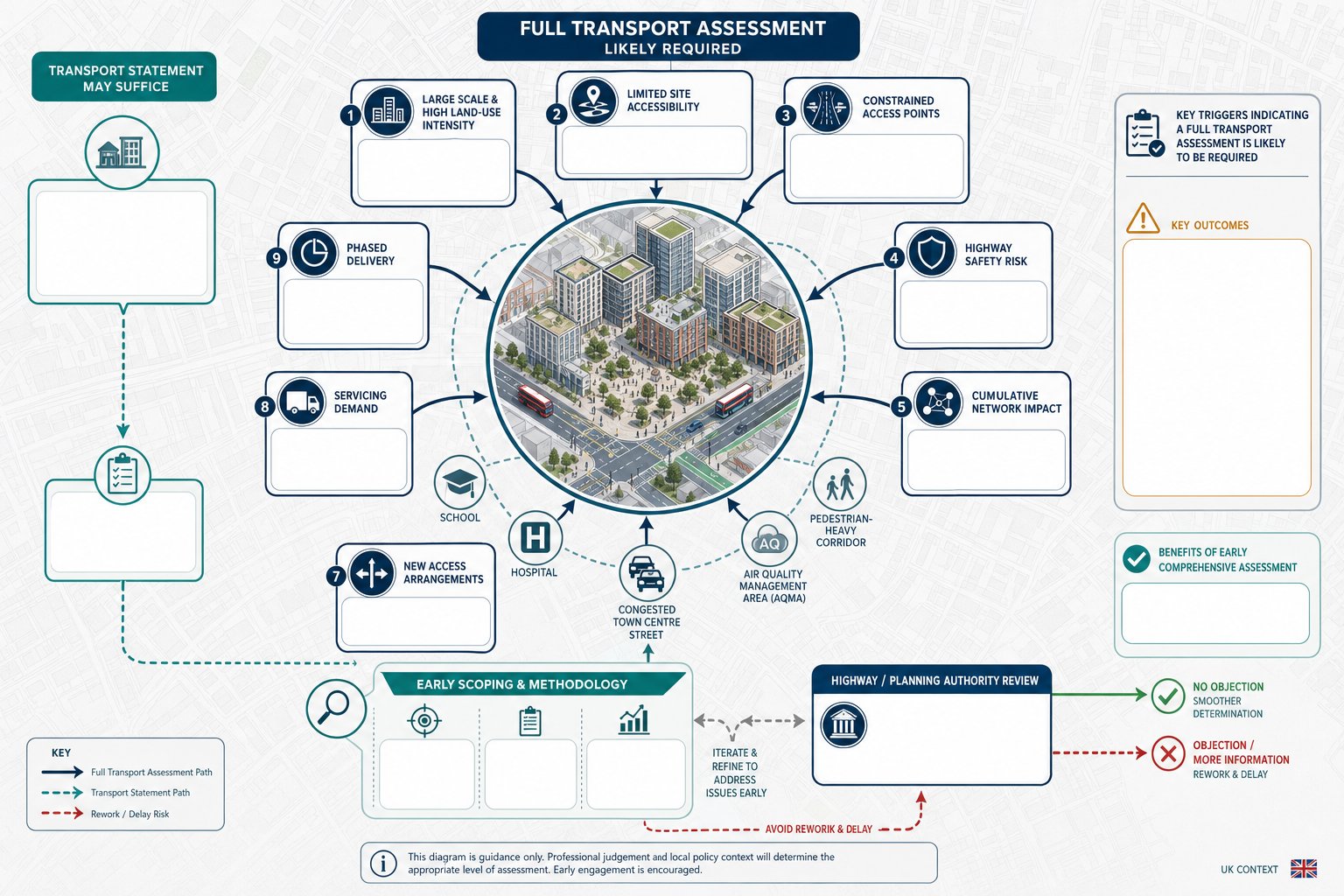
Not every application needs a full transport assessment, but large urban regeneration schemes very often do. In 2026, local planning authorities and highway authorities still focus on the same practical triggers: scale, land-use intensity, site accessibility, access constraints, highway safety concerns, cumulative impact and whether transport effects could influence the planning decision.
For major mixed-use proposals, a Transport Statement is rarely enough unless the development is modest in scale or reserved matters are tightly controlled by an already-tested outline consent. If the scheme introduces substantial floorspace, new access arrangements, network changes, significant servicing demand or multi-phase delivery, a full TA is typically the safer and more credible route. That is especially true where there are sensitive receptors nearby: schools, hospitals, congested town centre corridors, air quality management areas or heavily used pedestrian streets.
We also need to think beyond formal thresholds. Sometimes the site is technically accessible, but politically sensitive. Sometimes a local authority is pursuing modal shift targets, bus priority or town centre public realm changes, and the transport evidence has to demonstrate alignment. In those cases, robust scoping matters early. A clear methodology, agreed with officers where possible, can avoid the familiar cycle of under-submission, consultation objection and expensive rework.
Defining The Development, Site Context, And Planning Scope
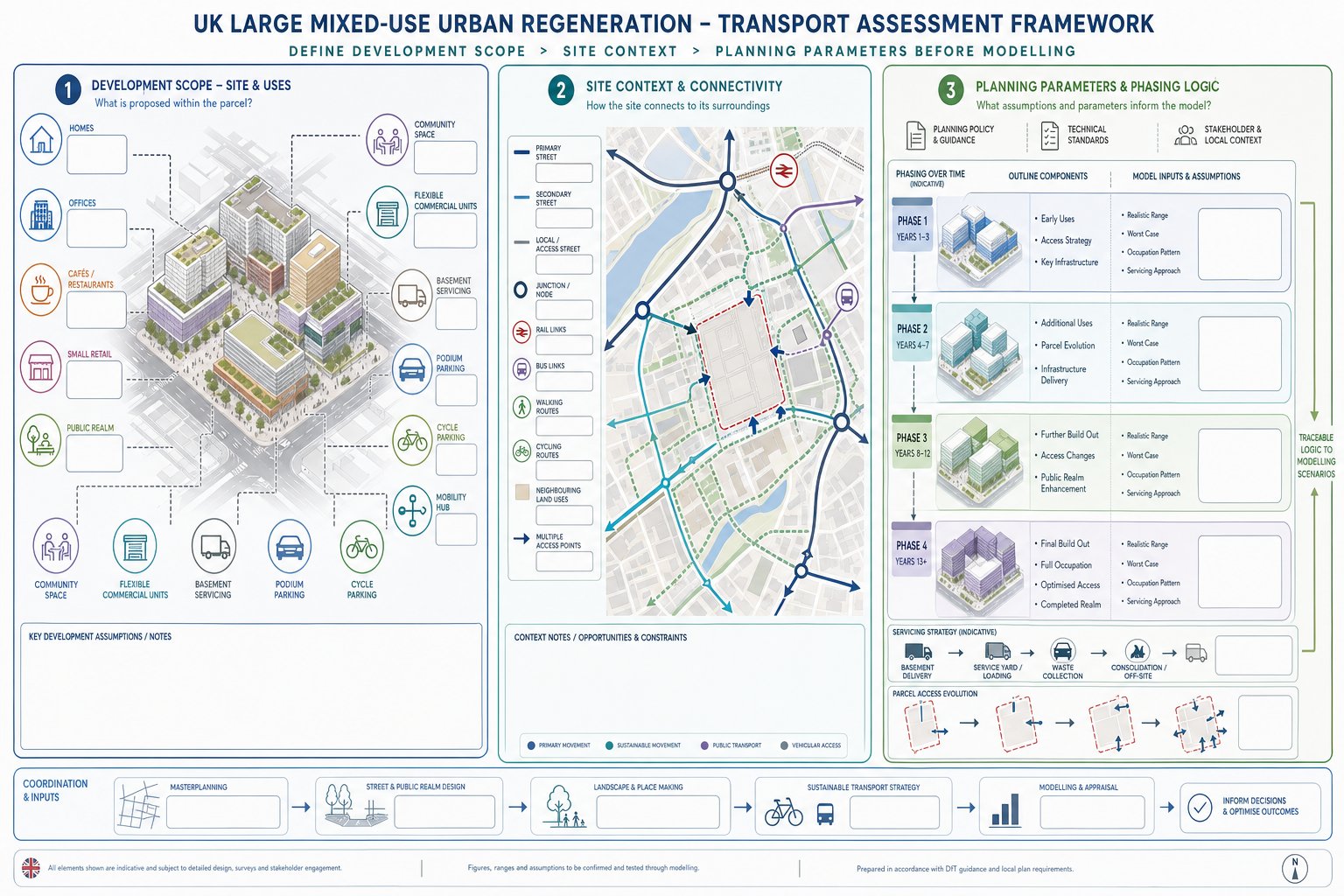
Before we model anything, we need to define what is actually being assessed. That sounds obvious, yet it is a common weak point in regeneration applications. A mixed-use scheme may include homes, workspace, food and drink, small-format retail, public realm, flexible commercial units, community uses, basement servicing, podium parking, mobility hubs and temporary phases. If those elements are vague, the transport assessment will be vague too.
The scheme description should set out land uses, quantum, dwelling mix where relevant, access points, servicing strategy, parking provision, cycle parking, anticipated occupation patterns and the phasing logic. For outline schemes, the assessment must still establish realistic parameter ranges and sensible worst cases. For hybrid applications, we need to separate detailed and outline components carefully so that modelling assumptions are traceable.
Urban regeneration also requires us to explain the planning context around the site: neighbouring uses, existing street hierarchy, public transport connections, proposed area changes and local policy ambitions. This is where early coordination with masterplanning teams pays off. A transport strategy is stronger when tied directly to street design, active frontages and public realm intent, rather than bolted on later. In that sense, the thinking behind Masterplan Transport Inputs: A practical planning process is particularly relevant to regeneration sites with multiple development parcels and evolving access arrangements.
Establishing The Baseline Transport Conditions
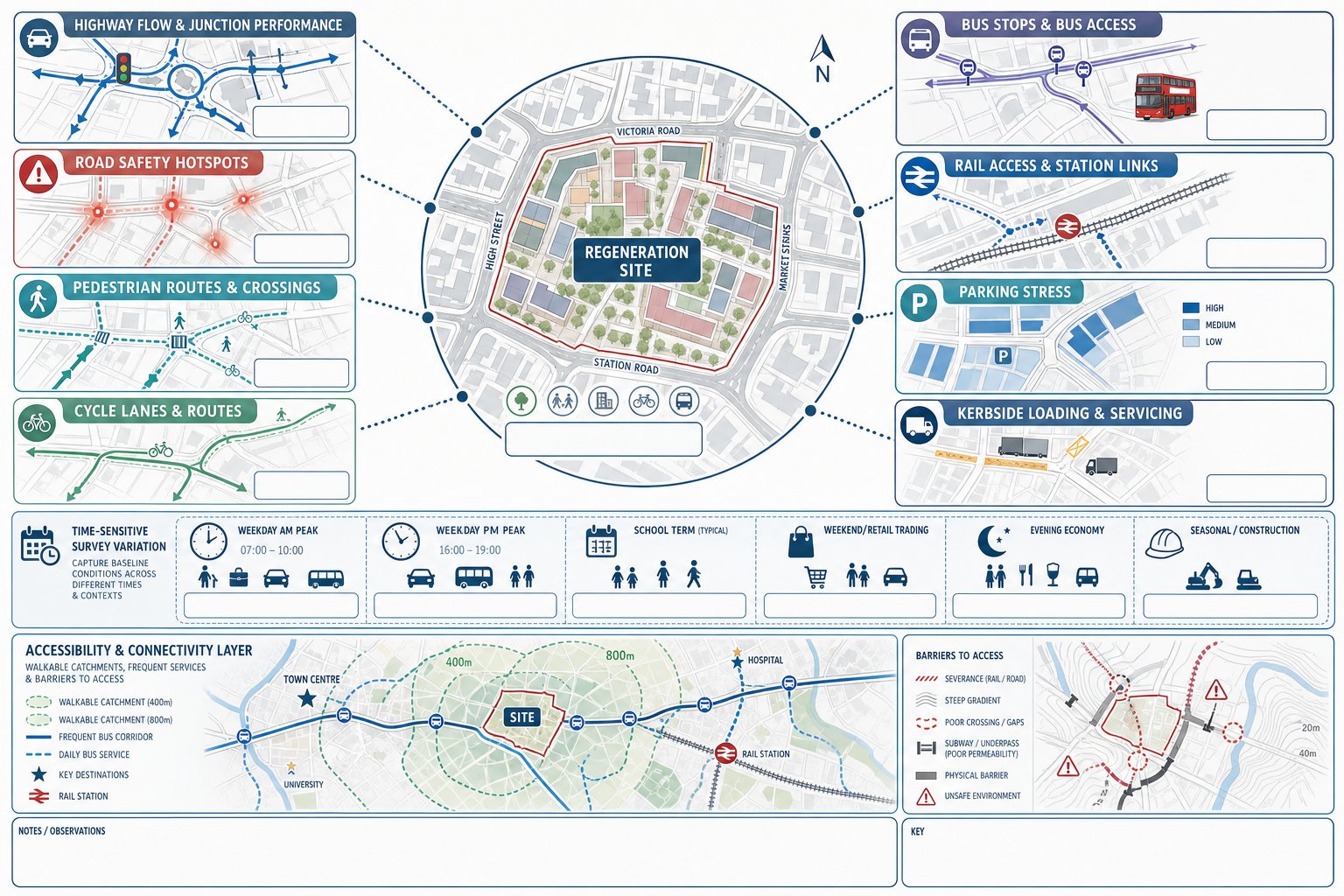
A credible baseline is the foundation of the entire assessment. If existing conditions are weakly described or based on stale surveys, every later conclusion becomes easier to challenge. For regeneration schemes, baseline work should cover highway operation, junction performance, road safety, pedestrian routes, cycle infrastructure, public transport services, parking stress, kerbside activity and accessibility to key destinations.
We should also be careful about timing. Urban sites can vary sharply by weekday peak, school term, weekend trading, evening economy activity and seasonal construction nearby. One set of counts may not tell the whole story. In some cases, supplementary surveys are worth the effort, especially where the authority is likely to scrutinise pedestrian crossings, bus stop capacity or kerbside loading pressure.
Accessibility review matters just as much as traffic counts. If the site sits within walking distance of rail, high-frequency bus routes and everyday services, that should shape mode split assumptions and mitigation priorities. Equally, if severance, steep gradients or poor crossing conditions suppress active travel, the baseline needs to show that honestly. Good baseline analysis is not about painting the site in the best possible light. It is about showing the real starting point, including constraints the design and mitigation strategy must resolve.
Highway Capacity, Junction Modelling, And Network Performance
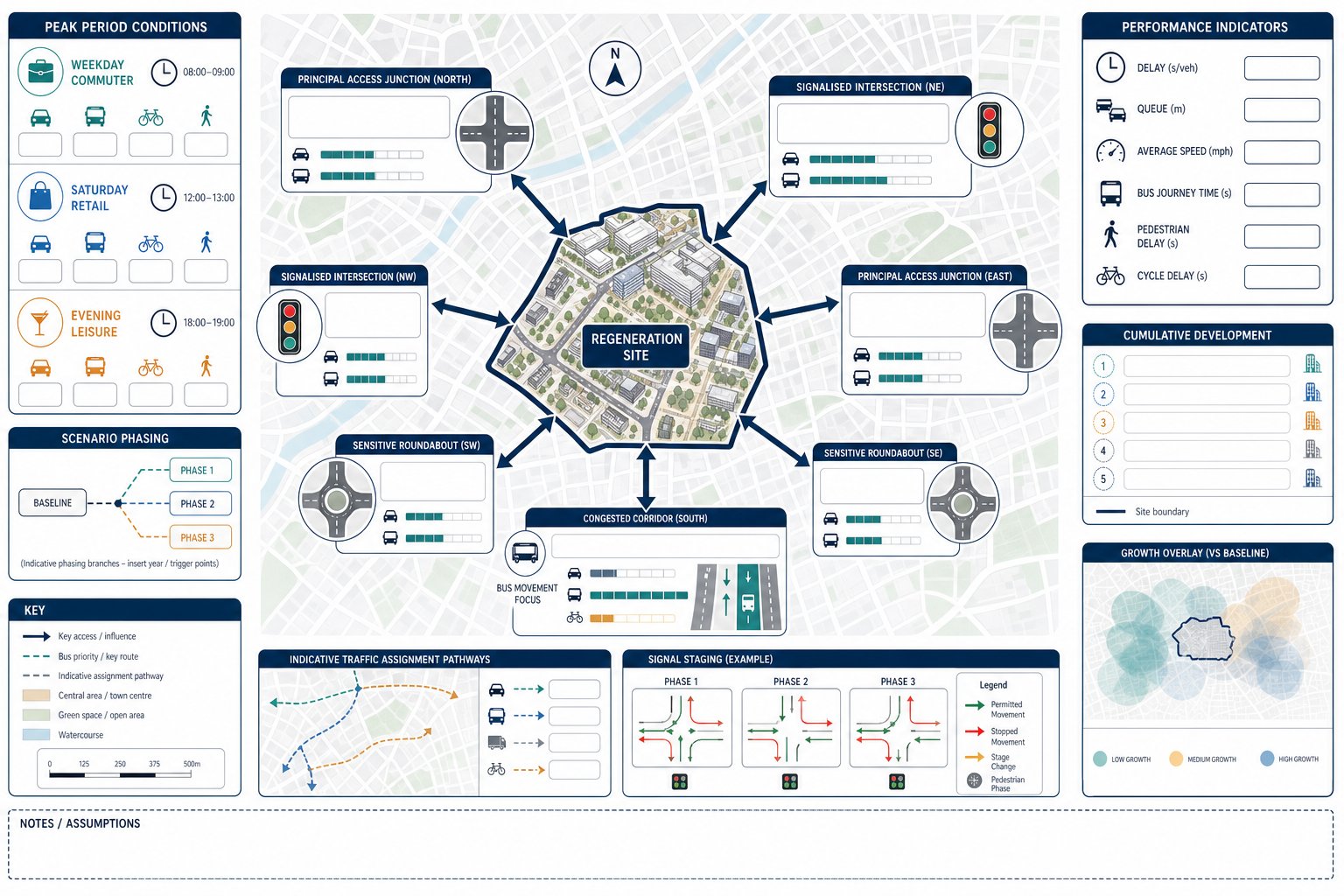
Even on highly sustainable urban sites, highway modelling remains important. Decision-makers still need to know whether access junctions will operate safely, whether queues will create blocking back, and whether cumulative growth plus development traffic could materially worsen network performance.
The key is proportionality and relevance. We do not need to model half a city because one regeneration block is proposed, but we do need to assess the junctions and corridors most likely to experience measurable impact. That usually includes principal access points, nearby signalised nodes, sensitive roundabouts and any corridor where bus reliability or queue interaction is already a concern. For larger schemes, it may also include phased testing and sensitivity scenarios.
Software outputs are only as good as the assumptions behind them. We should be transparent on trip assignment, growth factors, committed development, signal staging and queue interpretation. And where microsimulation or detailed priority modelling is needed, it should answer a planning question, not just generate impressive appendices. Tools discussed in Junctions 11 Software In current practice are useful, but they need to sit within a clear narrative about how the street network functions.
For mixed-use sites, net impact by period is especially important. A junction may perform acceptably in the traditional commuter peak yet face more pressure in a Saturday retail period or evening leisure window. Those patterns should be tested where relevant rather than assumed away.
Walking, Cycling, Public Transport, And Accessibility Review
This is the section too many transport assessments still underplay, even though it is often central to the planning case. A major urban regeneration scheme succeeds when it becomes easier to reach on foot, by cycle and by public transport than by private car for a meaningful share of trips. If that shift is only asserted and not evidenced, authorities will notice.
The accessibility review should assess pedestrian permeability, footway quality, crossing opportunities, desire lines, cycle links, cycle parking, public transport frequency, interchange quality and step-free access where relevant. It should also consider how the development itself supports sustainable movement: active ground-floor frontages, direct walking routes, secure cycle storage, end-of-trip facilities, mobility hubs and wayfinding.
For genuinely mixed-use places, this is more than a compliance exercise. The whole point is often to create a connected district where short internal trips replace some external car trips. That is why a mixed use masterplan transport strategy should be integrated with land-use distribution and public realm design from the outset. The strongest applications also reflect vision led transport principles, asking what kind of place the scheme is trying to become, then aligning movement accordingly.
And yes, hard numbers still matter: PTAL-style analysis where relevant, walk catchments, cycle isochrones, bus capacity and mode split evidence. But those numbers need to support a coherent place-based argument.
Servicing, Deliveries, Refuse, And Operational Vehicle Movements
One of the quickest ways for a regeneration application to attract late-stage objections is to undercook servicing. Mixed-use schemes generate a wide range of operational movements: parcel deliveries, food and beverage servicing, office supplies, retail stock, building maintenance, refuse collection, recycling, clinical or specialist deliveries in some cases, and emergency access requirements. These patterns do not behave like customer traffic and should never be buried inside generic trip-rate totals.
A robust transport assessment should identify vehicle types, likely frequency, routing, on-site manoeuvring, waiting space, refuse collection arrangements and conflict points with pedestrians, cyclists and general traffic. If servicing is time-restricted, that needs to be workable in practice, not just neat on a plan. If loading occurs from the kerb, the interaction with bus stops, cycle lanes and neighbouring frontage activity must be addressed.
In dense urban locations, a Delivery and Servicing Plan is often as important as the TA itself. The assessment should make clear whether vehicles can enter and leave in forward gear, whether basement ramps work for the intended fleet, and whether occupier management arrangements are realistic over time. This is one area where operational detail often carries more planning weight than headline trip generation, because poor servicing can undermine an otherwise sustainable scheme very quickly.
Parking Strategy, Drop-Off, And Kerbside Management
Parking strategy in regeneration projects is no longer just a numbers exercise. The harder question is how parking, pick-up, blue badge spaces, taxis, car clubs, short-stay loading and micro-mobility all fit within limited kerbside and basement space without creating conflict or overspill.
A sound assessment should explain total parking provision, allocation by use, disabled parking, electric vehicle charging, cycle parking, visitor arrangements, car club spaces and the demand management logic behind the strategy. But it should also go further and test overlap. Residential demand rises overnight: office parking peaks by day: leisure and food uses may peak in the evening. Drop-off demand can be short but intense, especially for hotels, student accommodation, healthcare or event-related uses.
Where parking is restrained, the evidence for that restraint has to be strong. That means demonstrating accessibility, realistic mode split, local parking controls and the likely effect on surrounding streets. In some applications, a linked parking stress survey is essential. In others, kerbside management plans matter more than off-street provision.
The strongest submissions treat kerbside as a scarce operational asset, not leftover space. Booking systems for servicing, managed drop-off windows, enforcement mechanisms and occupier rules can all help. If those controls are needed to make the strategy work, they should be stated clearly in the TA and, where necessary, secured through management plans or planning conditions.
Construction, Phasing, And Interim Transport Impacts
Construction and phased delivery are often where regeneration schemes become most vulnerable. A completed development may function well, but planning officers and local communities will still ask what happens in year one, year three and the awkward in-between period when roads are diverted, plots are partly occupied and public realm is unfinished.
A proper assessment should identify construction access routes, vehicle numbers, hours, temporary traffic management, workforce travel arrangements, abnormal loads where relevant and interface with existing neighbours. For long programmes, phasing analysis should also test interim site accesses, temporary parking arrangements, partial occupation scenarios and whether junction or crossing improvements need to arrive before, not after, certain phases open.
This is especially important where regeneration proposals sit beside active town centre streets or live residential areas. A weak Construction Management Plan can generate more objection than the permanent transport effects. If the wider planning package includes environmental statements, transport effects during construction may also need to align with broader environmental impact assessment work, particularly around traffic, noise and air quality.
Phasing should be presented as a transport question, not merely a programme note. If the site depends on later bridge links, bus re-routing, highway adoption or parcel-by-parcel access changes, that sequencing needs to be visible and tested.
Mitigation, Travel Planning, And Section 106 Or Section 278 Measures
Mitigation should not read like a shopping list attached at the end of the report. It should flow logically from the impacts identified and the place the scheme is trying to create. In regeneration projects, that often means combining physical works with operational controls and travel behaviour measures.
Typical highway and access mitigation can include junction alterations, signal optimisation, new crossings, footway widening, cycle connections, bus stop improvements, servicing controls, parking restrictions and wayfinding. Some works may fall under Section 278. Others may be secured through Section 106 contributions, monitoring commitments or phased triggers linked to occupation levels.
Travel planning also matters more than some teams assume. For a mixed-use scheme, there may be separate but coordinated travel plans for residents, employees, schools, leisure operators or managed workspace. Targets should be realistic, evidence-based and tied to measures people can actually use: cycle facilities, public transport incentives, car club membership, travel information, concierge-style mobility support or freight consolidation where suitable.
A well-structured traffic impact assessment can help distinguish between impacts that require engineering mitigation and those better addressed through management and travel planning. The best outcomes usually come when we resolve that distinction early, before obligations become a negotiation fought under determination pressure.
Common Risks That Delay Planning Decisions
Most delays are predictable. We see them repeatedly across large regeneration schemes, and they are rarely caused by one dramatic flaw. Instead, they arise from several smaller weaknesses that erode confidence in the submission.
The first is an unclear development description. If floorspace, access strategy, servicing or phasing are inconsistent across drawings, the TA becomes impossible to trust. The second is poor baseline evidence: out-of-date surveys, missing kerbside data, weak pedestrian analysis or no realistic account of nearby committed development. The third is unrealistic trip generation, especially where mixed-use internalisation is claimed but not evidenced, or where standard rates are applied without local adjustment.
Another regular issue is under-modelled servicing and operational activity. Authorities may tolerate some flexibility on occupier mix, but they rarely like uncertainty on where delivery vehicles wait, turn or load. Parking overspill risk, blue badge provision and drop-off behaviour can also trigger prolonged queries. And then there is phasing: many schemes describe the end state well but leave interim access and temporary impacts dangerously thin.
Finally, mitigation can hold up decisions when it is unresolved, unfunded or badly sequenced. A stronger Development Transport Assessment: approach usually comes from early scoping, honest baseline work, integrated design coordination and authority engagement before positions harden. In practice, speed often comes from clarity, not from submitting less.
Conclusion
For major regeneration proposals, transport assessment is no longer just about proving that extra vehicles can be squeezed through a nearby junction. The real test is whether the scheme functions as a connected urban place: one that supports walking, cycling and public transport, manages servicing properly, handles kerbside pressure, and remains workable through construction and phased occupation.
That is why a Large Mixed-Use Urban Regeneration Schemes Transport Assessment has to be bespoke. The right question is not simply how many trips the development generates, but when those trips occur, which modes they use, how many are internal, and what changes as the site evolves over time.
When planning teams define the scheme clearly, establish a robust baseline, test realistic mixed-use assumptions and tie mitigation to the broader place strategy, transport becomes much easier to defend. And in 2026, that can make the difference between a scheme that moves efficiently through planning and one that spends months stuck in avoidable transport queries.
Frequently Asked Questions about Large Mixed-Use Urban Regeneration Schemes Transport Assessment
What makes transport assessment for large mixed-use urban regeneration schemes different from standard developments?
Transport assessments for large mixed-use urban regeneration schemes are more complex due to overlapping trip patterns, phased delivery, multiple access modes, and internal trip capture, requiring bespoke methodology beyond standard single-use development appraisals.
When is a full transport assessment typically required for mixed-use urban regeneration projects?
A full transport assessment is generally needed for large-scale schemes involving substantial floorspace, new access arrangements, significant servicing demand, or potential impact on sensitive receptors like schools or busy corridors where transport effects influence planning.
How should trip generation be approached for mixed-use urban regeneration schemes?
Trip generation should account for internal trips, linked trips, mode shifts, and time of day variations, testing net impacts by period and mode rather than relying solely on gross vehicular trips or standard trip-rate databases.
Why is assessing walking, cycling, and public transport important in urban regeneration transport assessments?
Because mixed-use schemes can support reduced car dependence, assessing pedestrian permeability, cycle routes, public transport access, and facilities is central to demonstrating sustainable movement and aligning transport strategy with place-making goals.
How do construction and phasing impact transport assessment for large regeneration schemes?
Construction and phased delivery affect temporary traffic management, site access, and interim transport impacts, requiring careful assessment of construction vehicle movements and phased scenarios to avoid delays and community objections.
What are common risks that cause delays in planning decisions related to transport assessments?
Delays often result from unclear development descriptions, poor baseline evidence, unrealistic trip generation, under-modelled servicing operations, inadequate phasing plans, and unresolved mitigation or funding arrangements.