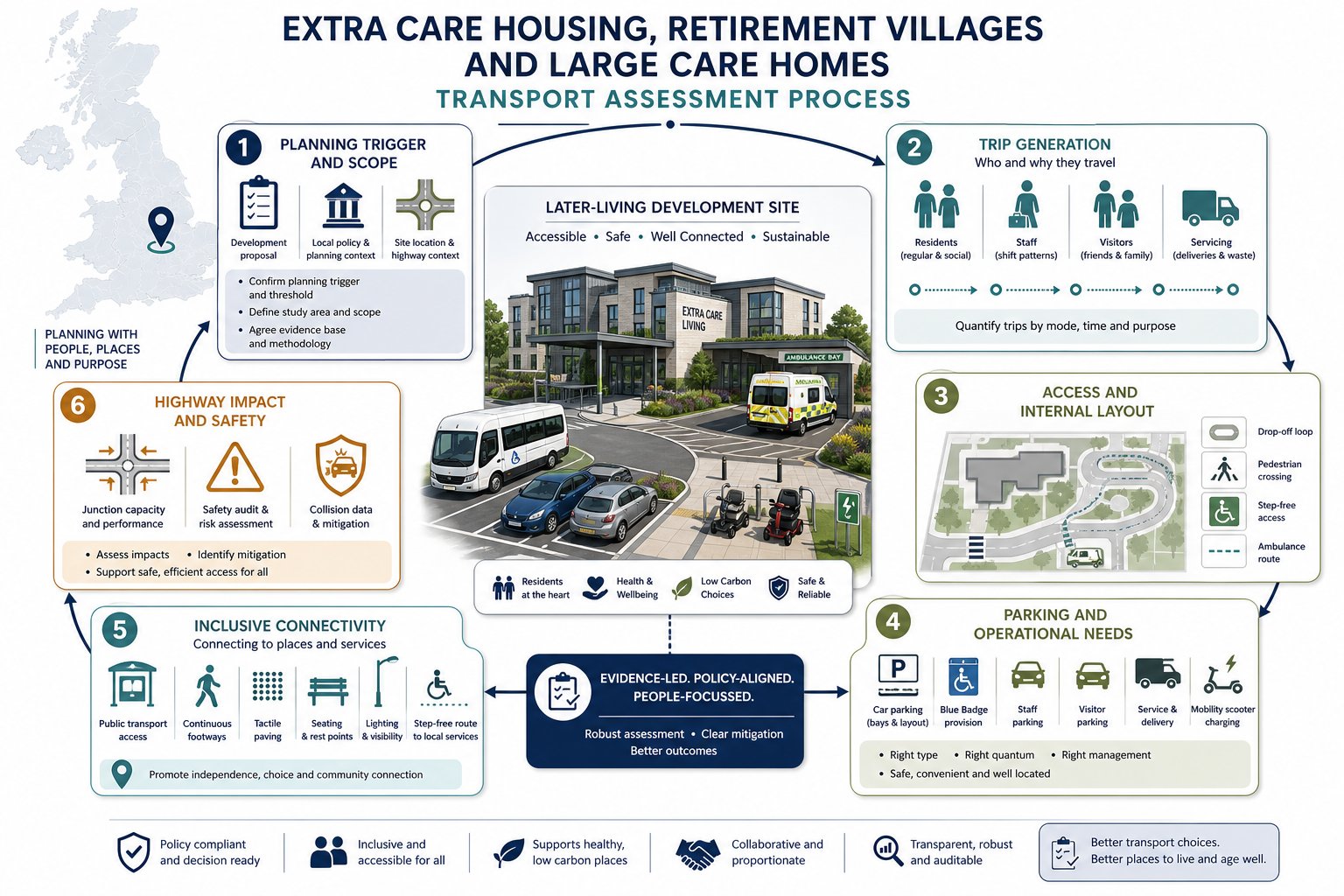
Planning for later living isn’t just about unit numbers, care models or architectural quality. On schemes such as extra care housing, retirement villages and large care homes, transport can become the quiet issue that either supports a smooth planning approval or triggers avoidable objections. Access for ambulances, staff shift arrivals, visitor parking, mobility scooter storage, step-free routes to nearby bus stops, these details carry real weight because they shape day-to-day life for residents who may be older, frailer, or less likely to drive regularly.
That’s why an Extra Care Housing, Retirement Villages and Large Care Homes Transport Assessment needs a different lens from a standard residential appraisal. We have to look beyond typical commuter assumptions and focus on how residents, staff, visitors, healthcare professionals and servicing activity actually use a site. Local planning authorities increasingly expect that level of realism, especially where developments include communal facilities, operate around the clock, or sit on constrained highway networks.
In this guide, we set out the practical issues that matter most in 2026: when a transport assessment is likely to be required, how trip generation differs from conventional housing, what highways officers usually examine, and what should go into a robust submission. For architects, planners, lawyers, surveyors, developers and councils, the aim is simple, to help shape transport evidence that is policy-aware, operationally credible and much easier to defend at application stage.
Key Takeaways
- An Extra Care Housing, Retirement Villages and Large Care Homes Transport Assessment must reflect the unique travel patterns of residents, staff, visitors and servicing activities, rather than relying on standard residential assumptions.
- Accessibility is crucial; developments should provide step-free, well-lit routes to local services and public transport to support residents with varied mobility needs.
- Parking strategies need to balance resident, staff, visitor and operational demands, including dedicated bays for mobility scooters, blue badge holders, and emergency vehicles.
- Early engagement with local highway authorities helps define the scope and ensures realistic trip generation and impact assessments tailored to site-specific conditions.
- Safe, clear internal layouts with direct pedestrian routes and suitable vehicle access are key to supporting the independence and wellbeing promises of later living schemes.
- Robust transport assessments strengthen planning applications by integrating operational realities, accessibility, and safety, creating more defensible and policy-compliant submissions.
Why Transport Assessments Matter For Later Living And Care Developments
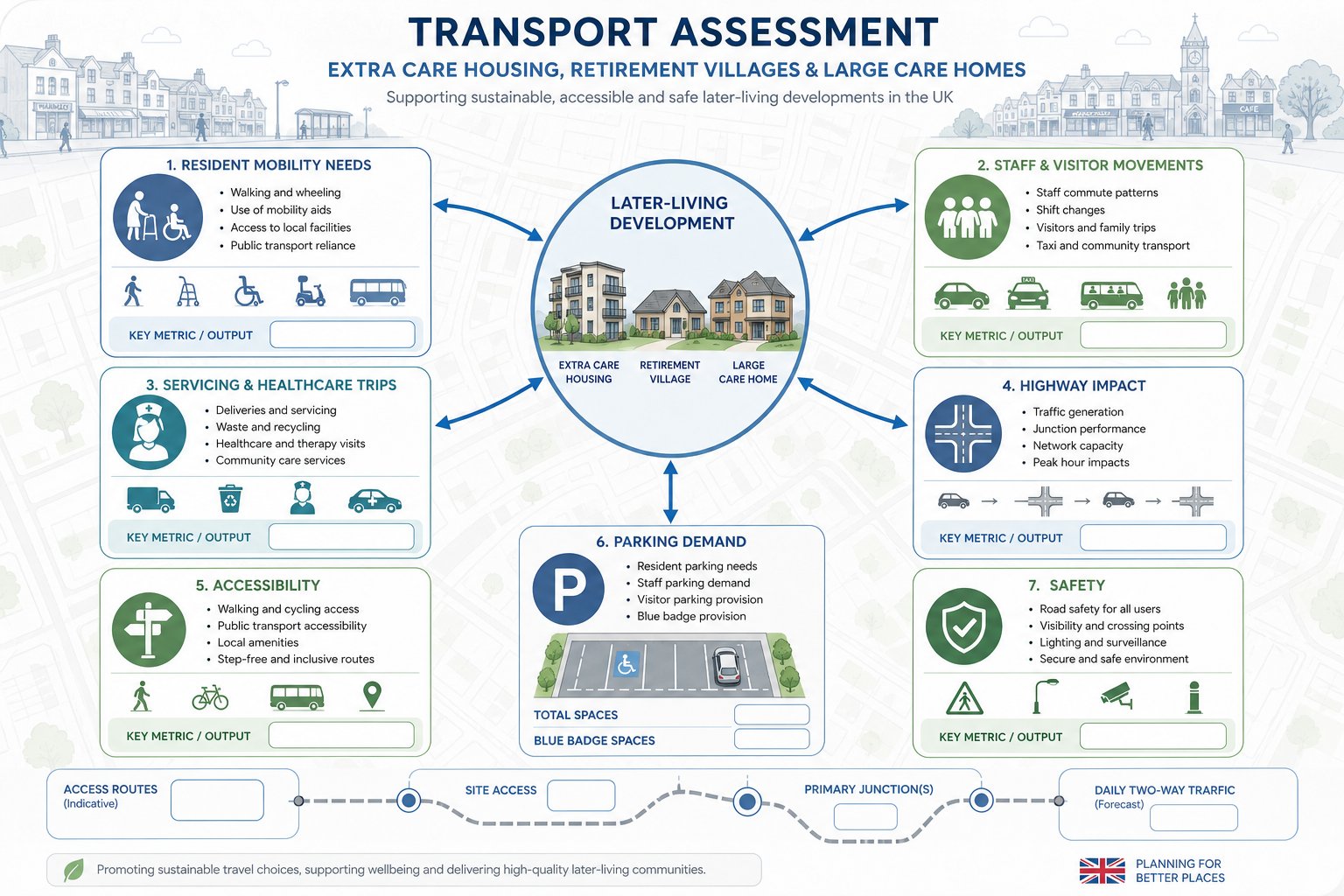
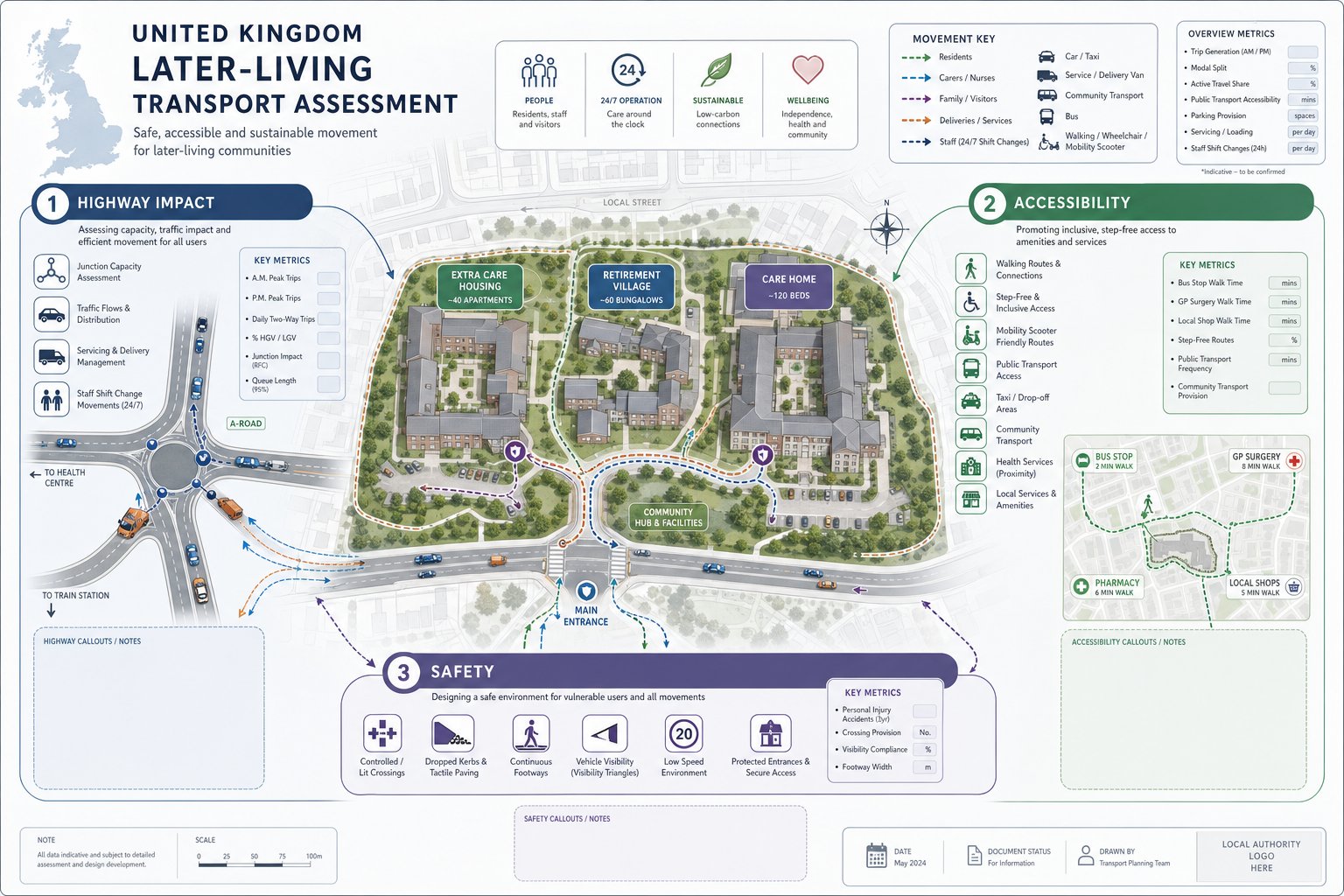
Later living and care developments place transport considerations at the centre of planning in a way that many ordinary housing schemes simply do not. The reason is straightforward: residents often have more varied mobility needs, lower car ownership, and a greater reliance on walking aids, wheelchairs, mobility scooters, community transport, taxis and healthcare-related journeys. If the site doesn’t work safely and conveniently for those users, the development’s core promise, independent or supported living in a suitable setting, starts to weaken.
Transport assessments matter because these schemes also generate movement patterns that are easy to underestimate. A retirement village may include communal dining, leisure space or wellness facilities. An extra care scheme may host carers, district nurses and frequent family visitors. A large care home may operate 24/7 with distinct staff shift changes and regular servicing. That means the transport case has to be grounded in how the development will actually function, not in generic residential assumptions.
From a planning perspective, local authorities want confidence on three fronts: highway impact, accessibility and safety. They need to know whether nearby junctions can absorb traffic, whether parking demand has been properly considered, and whether residents can reach local services in an inclusive way. In practice, the strongest reports connect the transport story to the wider planning case. That broader approach is central to any solid transport assessment for planning applications, and it is especially important for later living proposals where independence and care provision sit side by side.
When An Extra Care, Retirement Village Or Large Care Home Scheme Needs A Transport Assessment
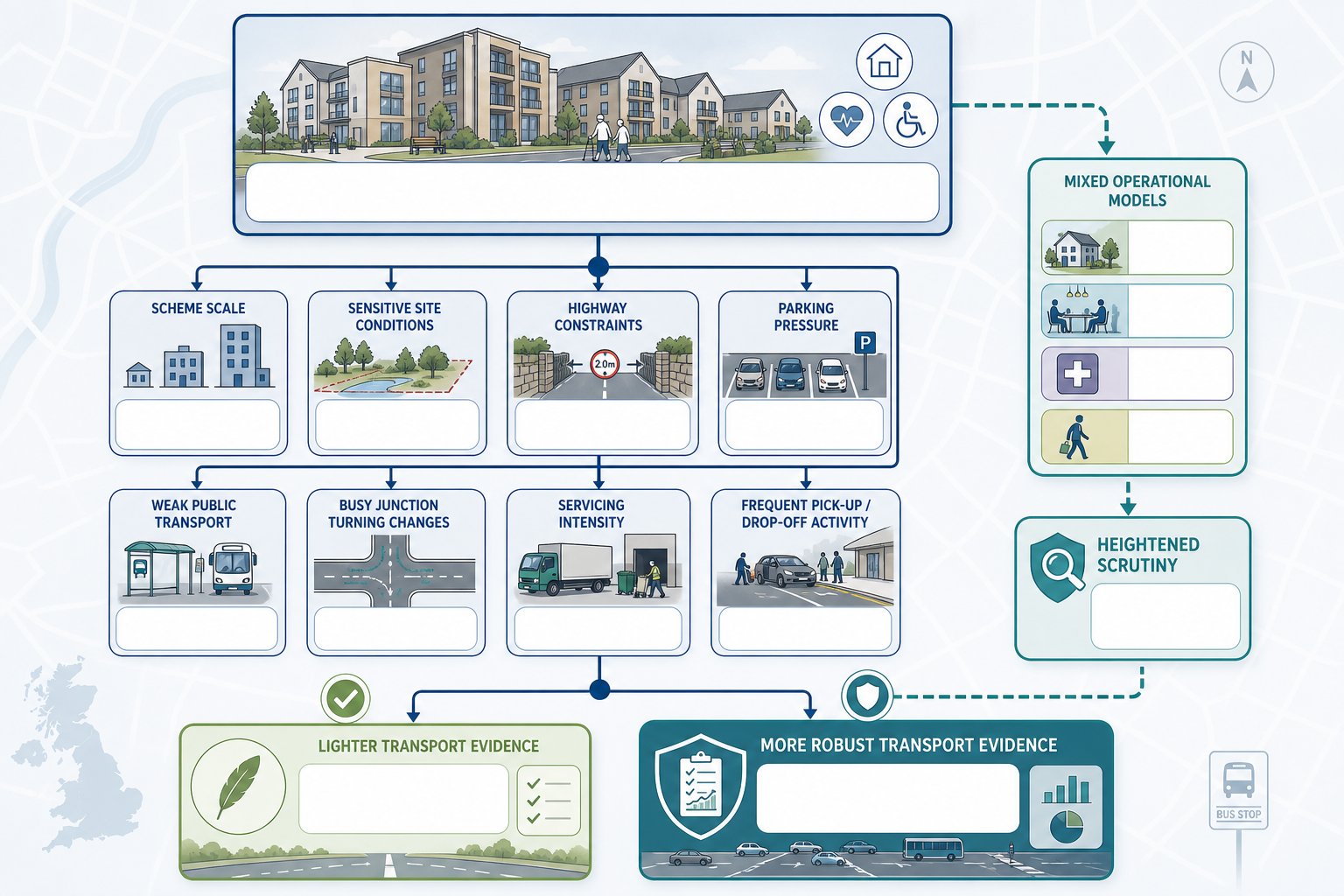
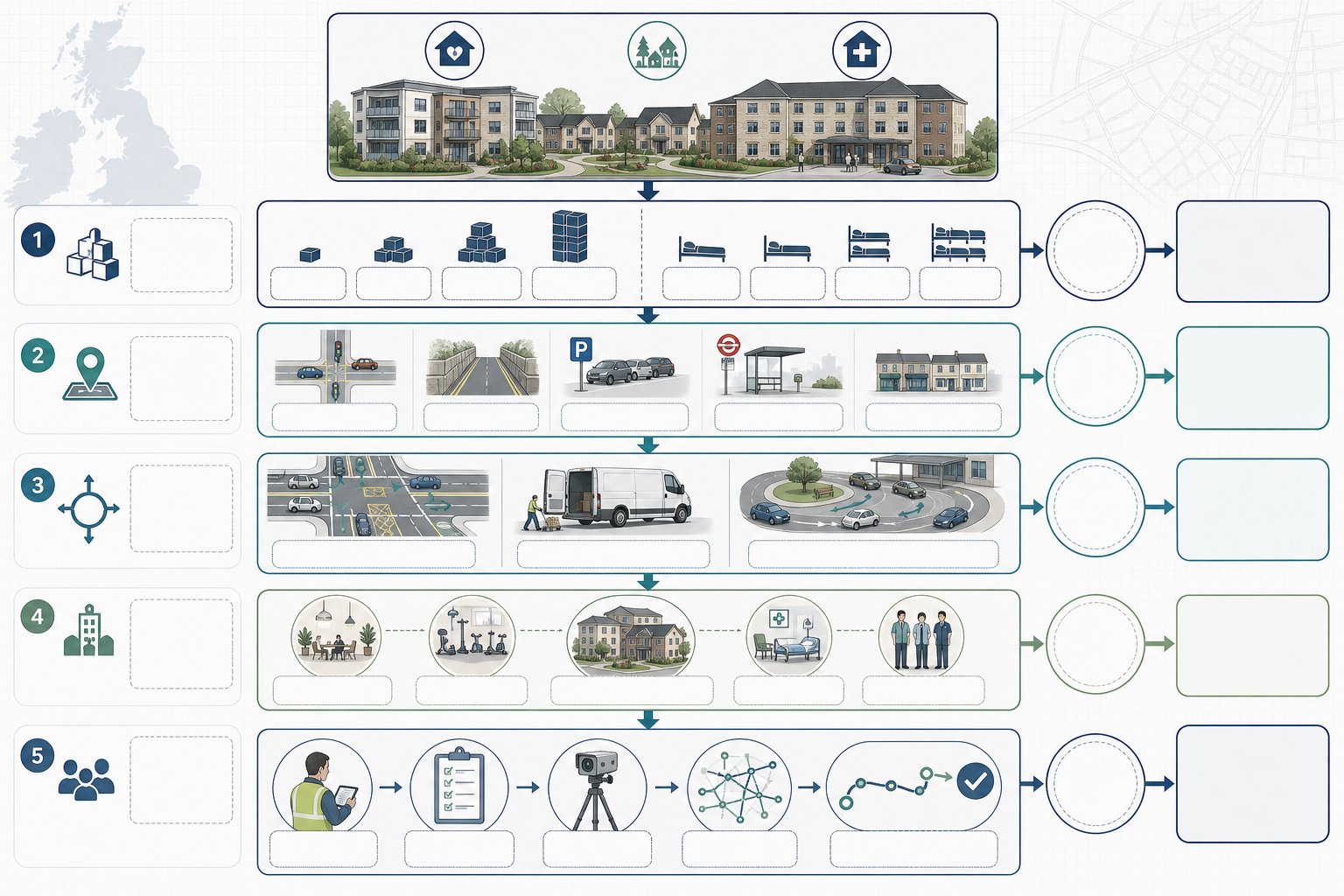
Not every later living development will require a full transport assessment, but many will need one, or at least a transport statement, once they reach a certain scale or sit in a sensitive location. In most cases, local thresholds set the starting point. Some highway authorities use broad triggers based on unit numbers or bedspaces, and larger extra care, retirement village or care home proposals often cross those thresholds quickly.
Size, though, is only part of the picture. A smaller scheme can still need detailed transport evidence if it is accessed from a constrained junction, lies on a narrow frontage road, sits in an area with existing parking stress, or depends heavily on car travel because public transport and local services are weak. Equally, if the proposal is likely to change turning movements at a busy junction, intensify servicing, or create regular pick-up and drop-off activity, the authority may ask for a more robust assessment regardless of raw scale.
We also find that mixed operational models tend to trigger more scrutiny. For example, a retirement village with communal facilities, healthcare space and staff presence can perform very differently from a typical apartment-led scheme. Where planning teams are unsure, early dialogue with the highway authority is worth the effort. It helps define scope, survey requirements and modelling expectations before positions harden. On wider projects, the same scoping discipline used in a Development Transport Assessment: practical planning exercise can prevent later disagreements about methodology, baseline conditions or what “material impact” really means.
How Trip Generation Differs From Standard Residential Development
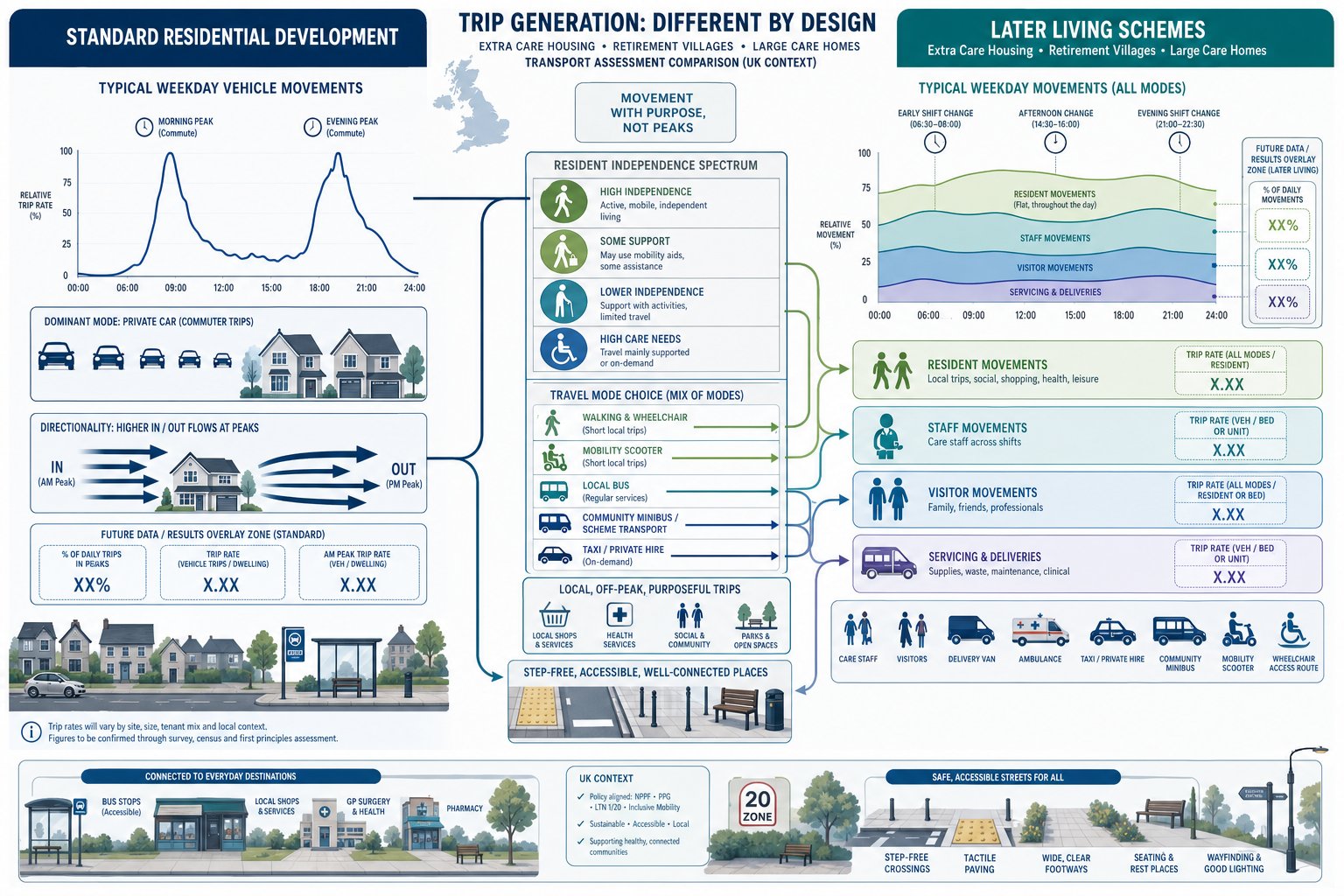
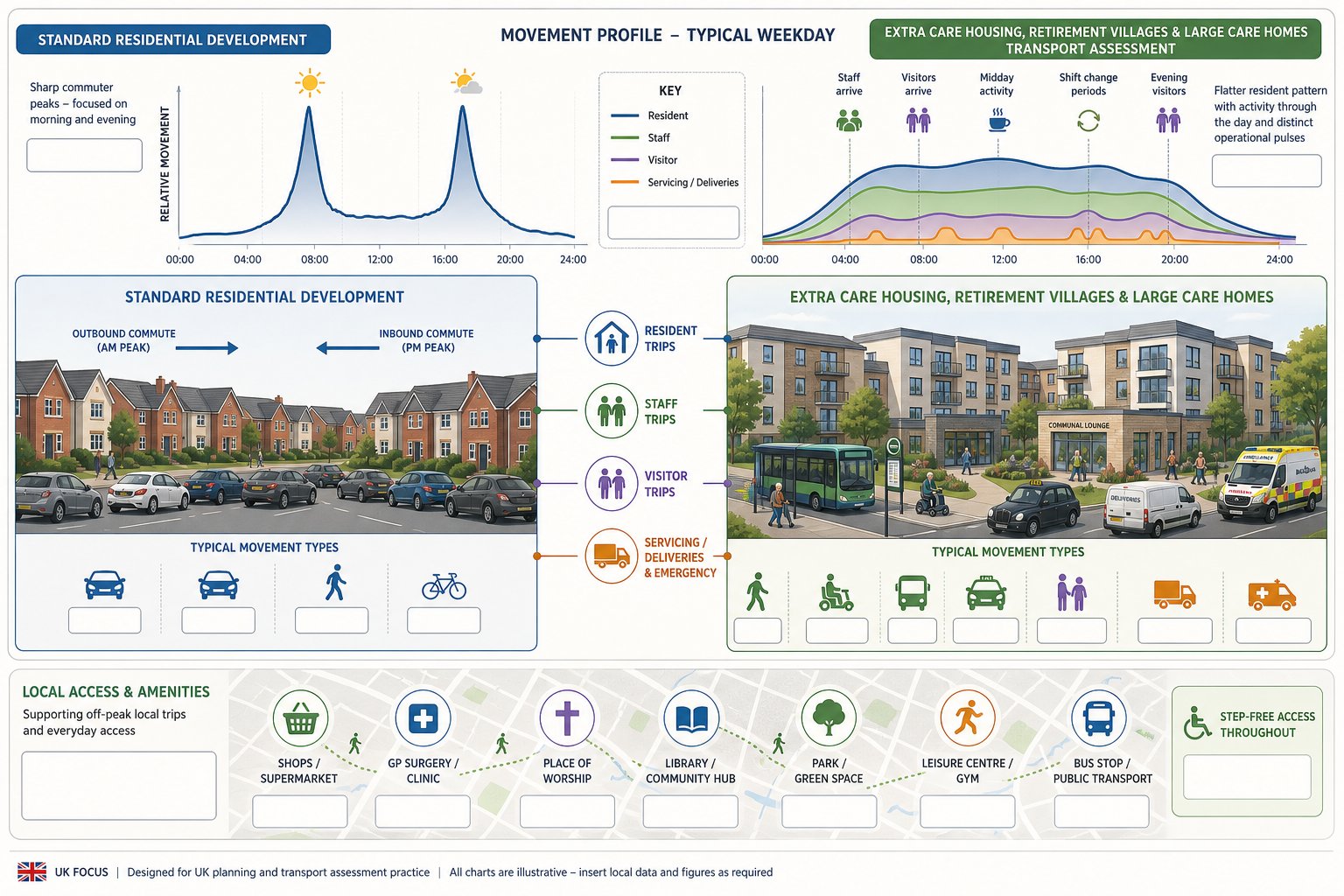
Using suburban housing trip rates for later living schemes is one of the most common mistakes in planning submissions. An extra care housing, retirement villages and large care homes transport assessment has to reflect the operational reality of the proposal. Resident travel demand is often lower in car terms, but that does not mean overall movement is negligible. It is simply made up differently.
In standard residential development, peak demand tends to be tied to commuter departures in the morning and returns in the evening. Later living schemes usually show a flatter resident profile, but more staff-related, visitor-related and servicing-related movements. That changes not just the number of trips, but their timing, mode split and operational impact.
Resident Travel Patterns And Levels Of Independence
Residents in extra care and retirement settings are not a uniform group. Some drive regularly and maintain active social lives: others travel with support or depend on lifts, community transport, taxis or mobility scooters. Many make short local trips during off-peak periods for shopping, appointments, worship, leisure or simply to stay connected with the surrounding neighbourhood.
That has two implications for assessment work. First, lower resident car trip rates do not remove the need for good accessibility. Quite the opposite: the less residents drive, the more important nearby shops, services, bus stops and step-free walking routes become. Second, trip generation should be informed by comparable later living sites where possible, rather than broad residential databases alone. On schemes with self-contained units, it can still be useful to sense-check assumptions against a Residential Development Transport evidence base, but only as a secondary reference, not the headline comparator.
Staff, Visitors, Servicing And Shift Change Movements
The bigger transport story often sits with non-resident demand. Staff travel can be substantial, especially where care is provided around the clock. Early morning, afternoon and evening shift changes create short bursts of arrivals and departures that do not mirror standard housing peaks. Visitor patterns can be broad too, often concentrated in daytime and early evening periods, with weekend intensity in some schemes.
Then there is servicing: food deliveries, laundry, medical supplies, waste collection, maintenance teams, patient transport and, at times, ambulance access. If communal facilities are open to non-residents, movement can increase again. A realistic assessment should separate these components rather than bundling them into a single “background operational traffic” figure. That level of granularity gives local planning authorities far more confidence that the proposed highway and parking strategy is built on how the site will actually run.
Key Transport Issues Local Planning Authorities Usually Examine
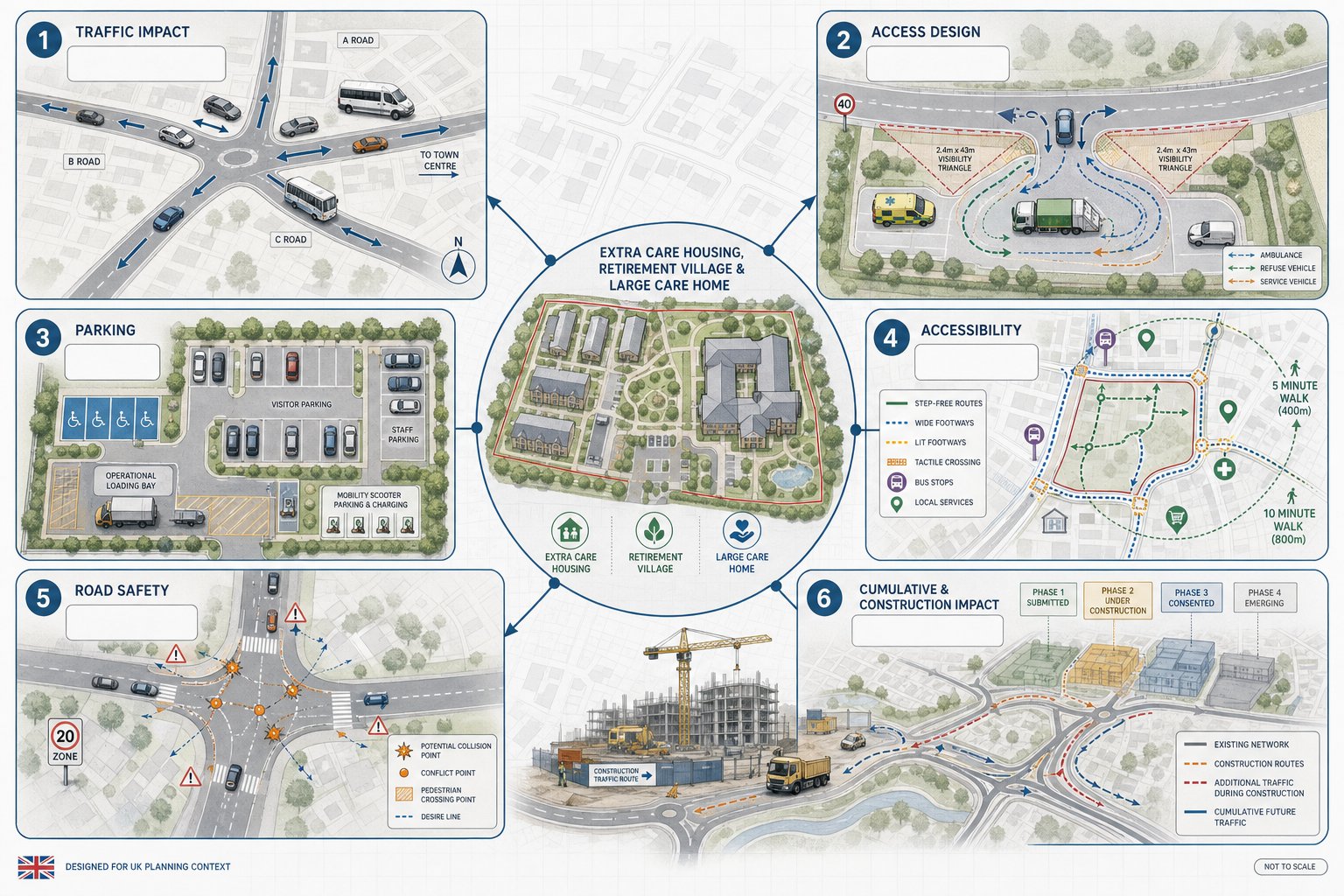
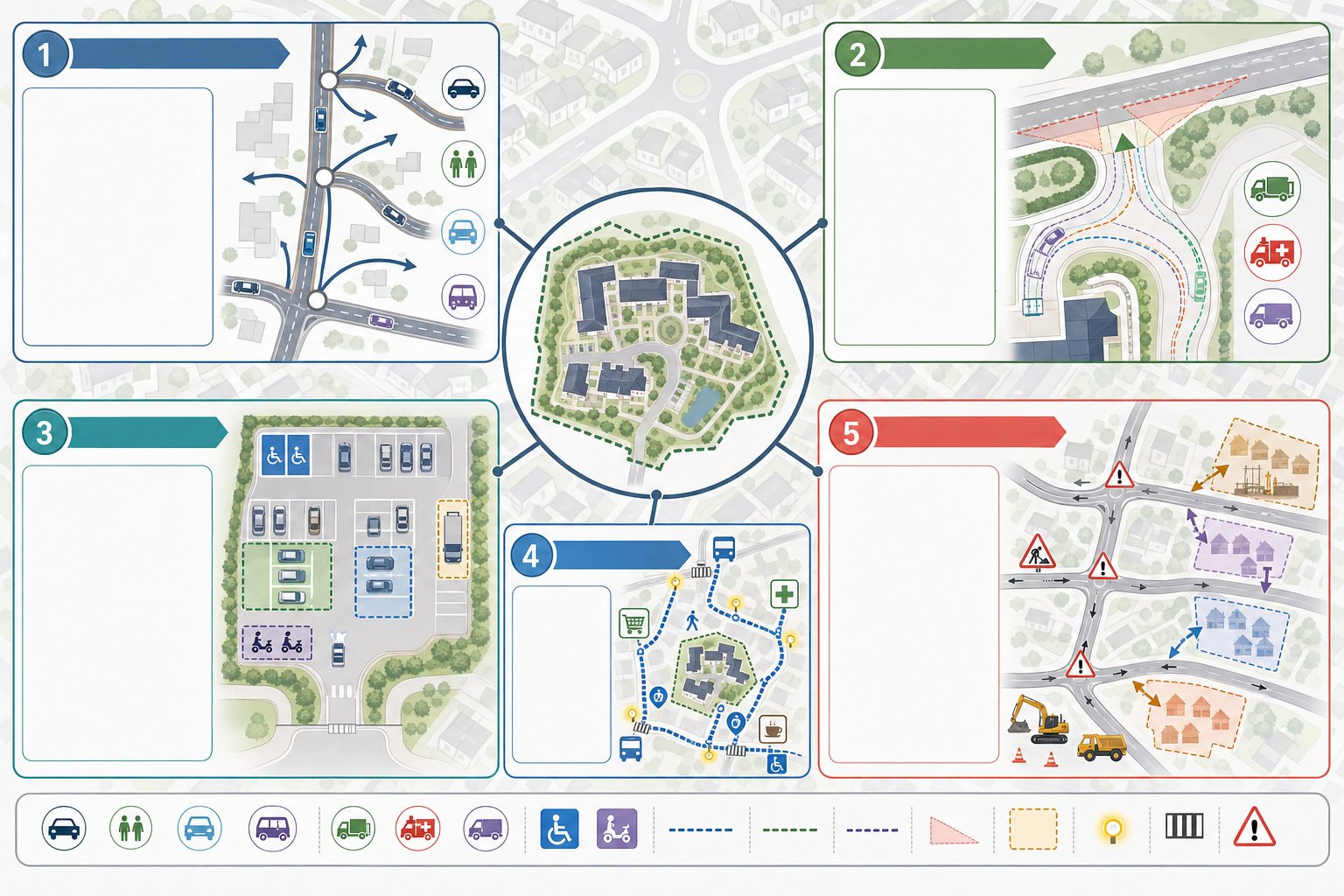
Highway officers and planning teams tend to focus on a familiar set of questions, but later living schemes add a sharper edge to each one. First is traffic impact: how many vehicle movements will the development generate, where will they route, and will nearby junctions continue to operate acceptably? Because these developments often have lower resident car use but stronger staff and visitor demand, the quality of the trip generation evidence matters as much as the totals.
Second is access design. Authorities will look closely at whether vehicles can enter and leave safely, whether visibility is appropriate, and whether the access arrangement works for refuse vehicles, minibuses, ambulances and occasional larger servicing vehicles. Third is parking: not just headline numbers, but the balance between staff, visitors, blue badge holders, operational bays and mobility scooter provision.
Accessibility is another major theme. Can residents reach local services on foot or by wheelchair? Are bus stops realistic to use for older people? Are routes well lit, step-free and easy to understand? For proposals with more complex land uses or extensive communal facilities, lessons from mixed use masterplan planning can be surprisingly relevant, because the authority is often reviewing a small operational ecosystem rather than a simple residential block.
Finally, local authorities will examine road safety, collision history, construction traffic and cumulative impact with nearby allocations. A scheme may look acceptable in isolation but become more sensitive when added to other consented development. Robust transport work anticipates those questions rather than waiting for them to appear in consultation responses.
Access, Internal Layout And Safe Movement Around The Site
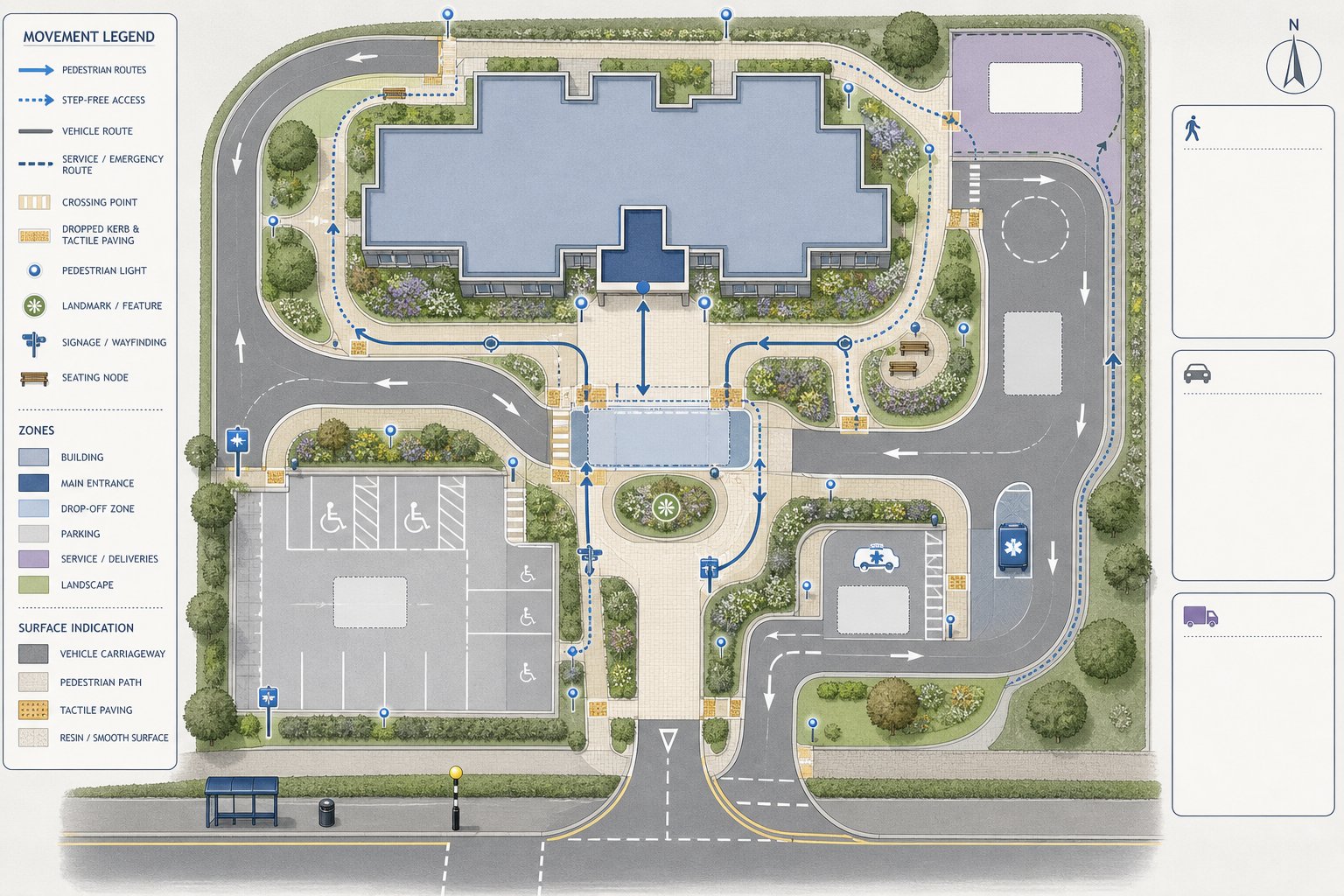
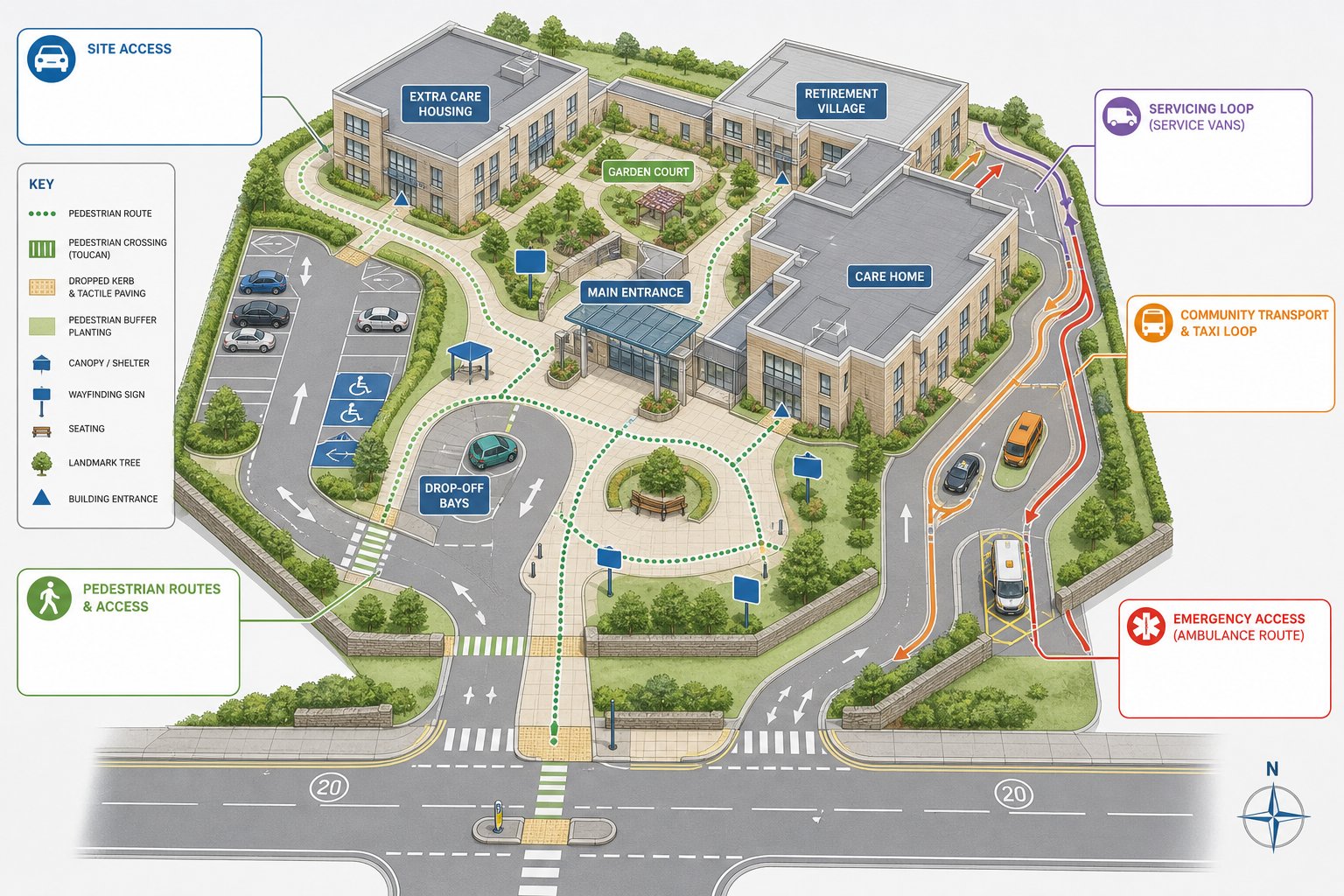
A technically acceptable access point is only the start. On later living and care schemes, the internal layout is just as important because daily movement on site may involve residents with reduced mobility, visiting family members, carers, delivery drivers and emergency vehicles all using the same environment.
The best layouts are simple, legible and forgiving. Main pedestrian routes should be direct, step-free and well lit, with dropped kerbs, tactile paving where appropriate, generous widths and obvious crossings. If residents use wheelchairs or mobility scooters, pinch points quickly become more than an inconvenience: they can become barriers to independence. The route from parking areas and drop-off points to the main entrance should hence feel effortless, not merely compliant.
Vehicle circulation also needs care. Servicing and ambulance access should be possible without awkward reversing, conflict with pedestrian desire lines or obstruction of the principal entrance. Dedicated pick-up and drop-off space matters more than many applications initially assume, particularly where community transport or taxis are part of the site’s day-to-day operation.
And clarity counts. Straightforward signage, recognisable landmarks and uncomplicated geometry can make a real difference for users living with visual impairment or cognitive decline. Where changes to site access or internal roads are more involved, related technical work such as environmental impact assessment transport analysis may also become relevant, especially if highway changes interact with a wider planning package or sensitive surroundings.
Parking Provision For Staff, Visitors And Operational Needs
Parking on later living schemes is rarely about applying a simple ratio and moving on. Resident parking demand is often lower than on standard housing sites, but that reduction does not eliminate the need for carefully planned provision. Some residents will still drive. Others may have regular visitors arriving by car. And operational demand, staff, healthcare professionals, deliveries, minibuses, ambulances, can easily dominate the picture.
Staff parking is frequently the pressure point. Shift changes can produce concentrated demand, especially where public transport is limited or staffing patterns start outside normal bus operating hours. Under-provision in these circumstances tends to spill into neighbouring streets, which is exactly the kind of issue that prompts objection from residents and scrutiny from highway officers.
Visitor parking also needs realism. Family visits are integral to wellbeing, and schemes that make visiting awkward can generate informal stopping close to entrances or on access roads. Dedicated accessible bays near the entrance, along with spaces for GPs, district nurses and other mobile professionals, should usually be identified separately.
Beyond car parking, a credible strategy should address mobility scooter storage and charging, cycle parking for staff and visitors, and any operational lay-bys or service bays. Where parking management will be needed, permits, staff allocation, overspill controls or timed operational bays, that should be set out clearly. Vague references to “management by the operator” rarely reassure decision-makers.
Walking, Wheelchair Access, Public Transport And Inclusive Connectivity
For later living development, accessibility is not a supporting chapter. It is one of the main tests of whether the location is suitable at all. A site may have acceptable highway access in pure engineering terms, but if residents cannot comfortably reach everyday destinations or nearby public transport, the planning case is weaker.
Walking routes should be continuous, level where possible, well maintained and easy to navigate. For older residents, a route that looks short on a plan can be effectively inaccessible if it includes steep gradients, uneven surfaces, missing dropped kerbs or fast crossings with limited refuge. Wheelchair users and mobility scooter users face the same issue, often more sharply.
Public transport appraisal should go beyond counting bus stops within a set radius. We need to ask whether the route to the stop is genuinely usable, whether shelters and seating are present, whether services run at times that suit staff and visitors, and whether destinations connect to town centres, hospitals and local facilities. For many schemes, community transport and dial-a-ride services are part of the real mobility picture and deserve explicit mention.
Inclusive connectivity also means creating an environment that residents can understand and trust: good lighting, landmarks, resting points and crossings that do not feel hostile. In practice, the accessibility chapter is where planning policy, design quality and transport evidence come together most clearly.
Highway Impact, Junction Capacity And Peak Period Assessment
Highway impact assessment for later living schemes needs a tailored peak-period approach. If we only examine conventional weekday commuter peaks, we can miss the periods that actually matter. Staff shift changes, visitor arrivals, servicing windows and school-run interaction on surrounding roads may all be more relevant than a standard residential 08:00 network stress point.
That starts with a sound baseline: existing traffic flows, turning counts, nearby consented development, local collision history and an honest reading of how the surrounding road network performs today. From there, trip generation and distribution should reflect the proposed operation, not generic assumptions. A good report will explain why the selected peaks have been tested and how they relate to staffing patterns and likely visitor behaviour.
Where junction modelling is required, authorities will expect transparent inputs and sensible sensitivity testing. For many teams, tools such as Junctions 11 Software form part of that analysis, but the software output is only as persuasive as the traffic assumptions behind it.
If access alterations are proposed, road safety should be considered alongside capacity. A marginally acceptable junction in operational terms may still perform poorly for vulnerable pedestrians if crossings, visibility or vehicle speeds are not handled well. On schemes serving older residents, that balance between capacity and safety is especially important.
What A Robust Transport Assessment Should Include
A robust transport assessment for extra care housing, retirement villages and large care homes should begin with a precise description of the proposal: unit numbers or bedspaces, care model, staffing levels, shift arrangements, communal facilities, servicing requirements and any healthcare or public-facing uses. Without that operational context, the technical analysis floats free of reality.
The baseline section should cover existing highway conditions, accessibility by all modes, nearby services and known constraints. For later living schemes, it is particularly important to document footway quality, gradients, crossing provision, public transport realism and the practical experience of wheelchair users or less confident pedestrians.
Trip generation should then be broken down by residents, staff, visitors and servicing, ideally drawing on comparable sites as well as recognised databases. Distribution assumptions need to be explained, not guessed. If junctions are sensitive, capacity testing should be proportionate and transparent. Parking demand should be assessed with the same discipline, including staff peaks, visitor demand, blue badge needs, operational vehicles and mobility scooter provision.
A robust submission should also include access and internal layout plans, swept paths where required, and a travel plan that reflects the actual user group. That might mean staff car-sharing, public transport information, community transport coordination, cycle provision for staff, and practical measures to support non-car access for visitors. In broader planning packages, alignment with a Development Transport Assessment: wider framework or even environmental impact assessment transport: linked material can help keep the evidence consistent across disciplines.
Common Planning Risks And How To Strengthen An Application
The most common planning risk is underestimating how the development actually operates. Staff trips are often too low. Visitor demand is treated as an afterthought. Servicing is reduced to a sentence. Then the local authority, neighbours or both spot the gap immediately. Once confidence in the transport evidence slips, it can affect the whole application.
Another regular weakness is overstating accessibility. A bus stop within distance on paper does not necessarily mean a resident with limited mobility can use it safely. If the route is steep, poorly lit or interrupted by missing dropped kerbs, the site may appear far less sustainable than the application suggests. Parking can be another fault line, particularly where shift-change demand pushes staff cars into surrounding streets.
Strengthening an application usually starts with early engagement and better evidence. We are far better placed when we scope the work with the highway authority, use survey data from comparable later living schemes, and explain assumptions in plain language. That same disciplined approach underpins successful transport assessment for developments: planning work generally.
It also helps to show how transport design supports the development’s social purpose. If residents can move safely around the site, visitors can park without conflict, servicing is properly managed and nearby facilities are genuinely accessible, the transport case becomes much more persuasive. For planning teams needing concise, authority-aware reporting, that is where experienced advice can make the difference between a technically adequate submission and one that feels decision-ready.
Conclusion
An effective Extra Care Housing, Retirement Villages and Large Care Homes Transport Assessment is not about forcing a specialist development into standard housing assumptions. It is about understanding how later living really works: lower resident car use in many cases, but more staff travel, more operational activity, stronger accessibility needs and a much sharper focus on safe, inclusive movement.
For architects, planners, developers, lawyers and councils, the best outcomes usually come from treating transport as part of the scheme design from the outset rather than a report to commission at the end. When trip generation is realistic, parking is operationally grounded, walking and wheelchair access are properly tested, and highway impacts are assessed against the right peaks, planning discussions become much more constructive.
In 2026, that practical credibility matters. Authorities want evidence that is proportionate, locally aware and tailored to the people who will actually live, work and visit on the site. If the transport story is clear and defensible, the wider planning case is almost always stronger.
Frequently Asked Questions about Transport Assessments for Later Living Developments
Why are transport assessments important for extra care housing and retirement villages?
Transport assessments ensure safe and convenient access for residents, staff, visitors and healthcare professionals, reflecting varied mobility needs and operational patterns unique to later living developments, thus supporting independent living and easing planning approvals.
When is a transport assessment typically required for large care home or retirement schemes?
A transport assessment is usually needed for schemes exceeding local thresholds (often over 50–80 units or beds), or when the development may significantly impact junctions, parking demand or public transport accessibility on constrained or sensitive sites.
How does trip generation for extra care housing differ from standard residential developments?
Extra care housing has lower resident car use but higher trips from staff shifts, visitors and servicing. Movement patterns are more spread out with distinct shift-change peaks, unlike typical commuter peaks seen in standard housing schemes.
What key transport issues do local planning authorities focus on in these assessments?
Authorities assess traffic volumes versus junction capacity, site access design and safety, parking provisions including for mobility scooters and disabled users, quality of walking routes, public transport accessibility, and cumulative impacts with nearby developments.
How should parking be planned for staff, visitors and residents in retirement villages and care homes?
Parking provision must meet realistic demand for lower resident car use but substantial staff and visitor needs, including dedicated accessible bays, staff parking at shift peaks, and storage with charging for mobility scooters and cycles.
What features make walking and wheelchair access suitable for later living developments?
Suitable access involves step-free, continuous, level, well-lit routes with dropped kerbs and tactile paving, plus accessible bus stops with shelters and seating. Inclusive connectivity also means legible paths with resting points to assist residents with sensory or cognitive impairments.