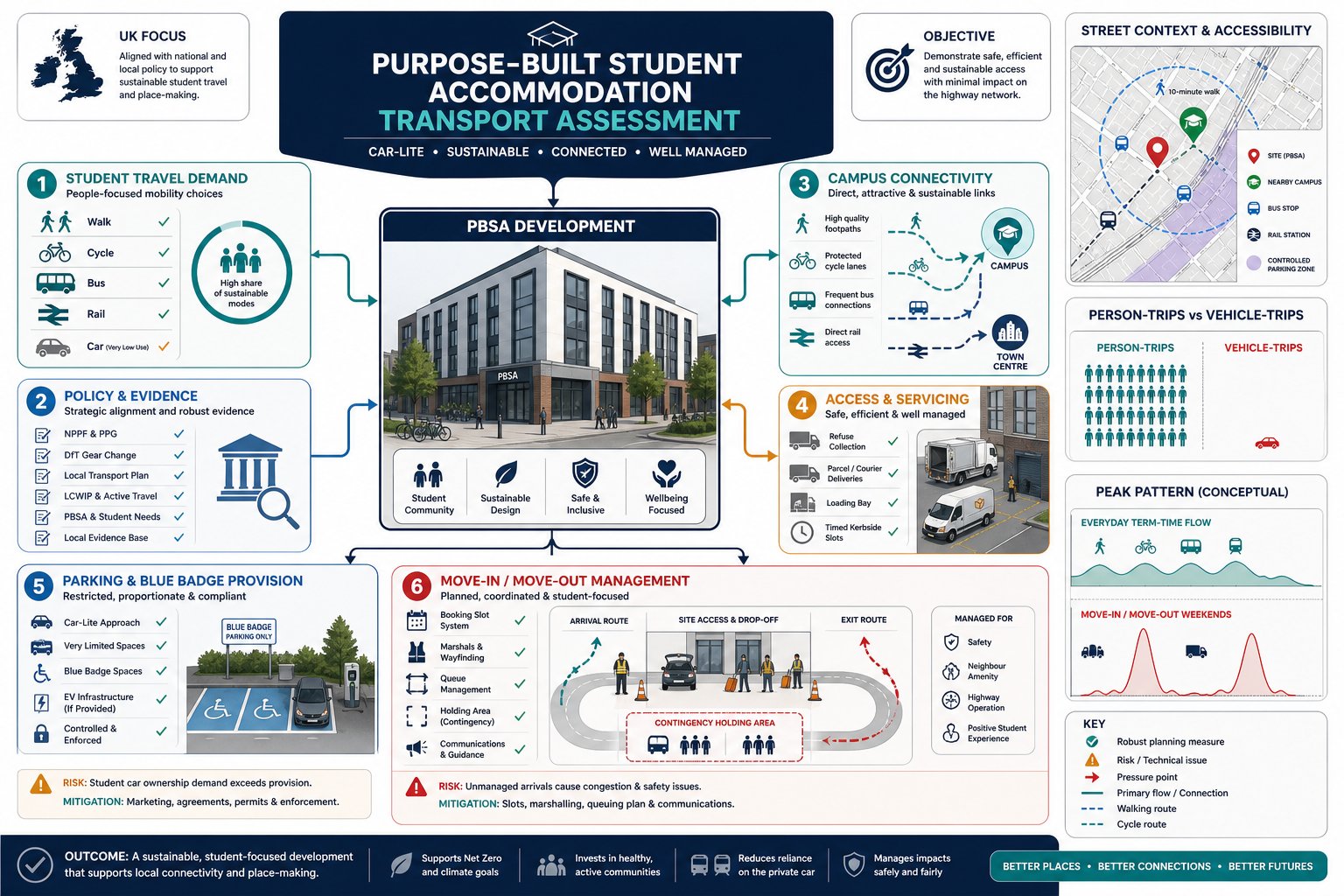
Student accommodation can look deceptively simple from a transport perspective. Fewer private cars, central locations, and a resident population that usually walks, cycles or takes the bus, on paper, that sounds easier than a standard residential scheme. In practice, it rarely is. A Purpose-built Student Accommodation Transport Assessment has to deal with highly concentrated move-in weekends, sharp term-time travel patterns, local authority parking concerns, campus connectivity, servicing constraints, and policy tests that are often far more specific than applicants first expect.
That matters because PBSA schemes are now under closer scrutiny in many university towns and cities. Councils want robust evidence that car-free or car-lite claims will hold up in the real world. Universities want schemes that genuinely connect to campus. Highway authorities want confidence that access, servicing and arrivals can be managed without spilling onto already stressed streets.
In our experience, the strongest reports are the ones that treat student accommodation as its own transport typology, not as a cut-down apartment assessment. They use student-specific trip generation, realistic mode share assumptions, and practical management measures that planners can actually condition and enforce. In this guide, we set out what planning teams need to get right in 2026, from scope and policy through to move-in management and common technical risks.
Key Takeaways
- A Purpose-built Student Accommodation Transport Assessment must address unique student travel patterns, including concentrated move-in periods and term-time peaks, rather than treating student housing like conventional residential developments.
- Robust PBSA transport assessments rely on student-specific trip generation and realistic mode share assumptions supported by local surveys, university data, and relevant census information.
- Effective management plans for move-in, move-out, and servicing are critical to prevent local street congestion and must include staggered arrivals, clear communication, and enforcement mechanisms.
- Sustainable transport connections such as safe pedestrian and cycle routes, frequent public transport, and close campus proximity are fundamental to successful PBSA schemes and low car dependency.
- Car parking strategies in PBSA schemes should be credible and enforceable, including strong tenancy restrictions to support car-free or car-lite operation while providing accessible Blue Badge parking.
- Early engagement with highway authorities and stakeholders is essential for appropriate scope, avoiding last-minute objections, and producing a focused, locally tailored transport assessment.
What A Purpose-Built Student Accommodation Transport Assessment Covers
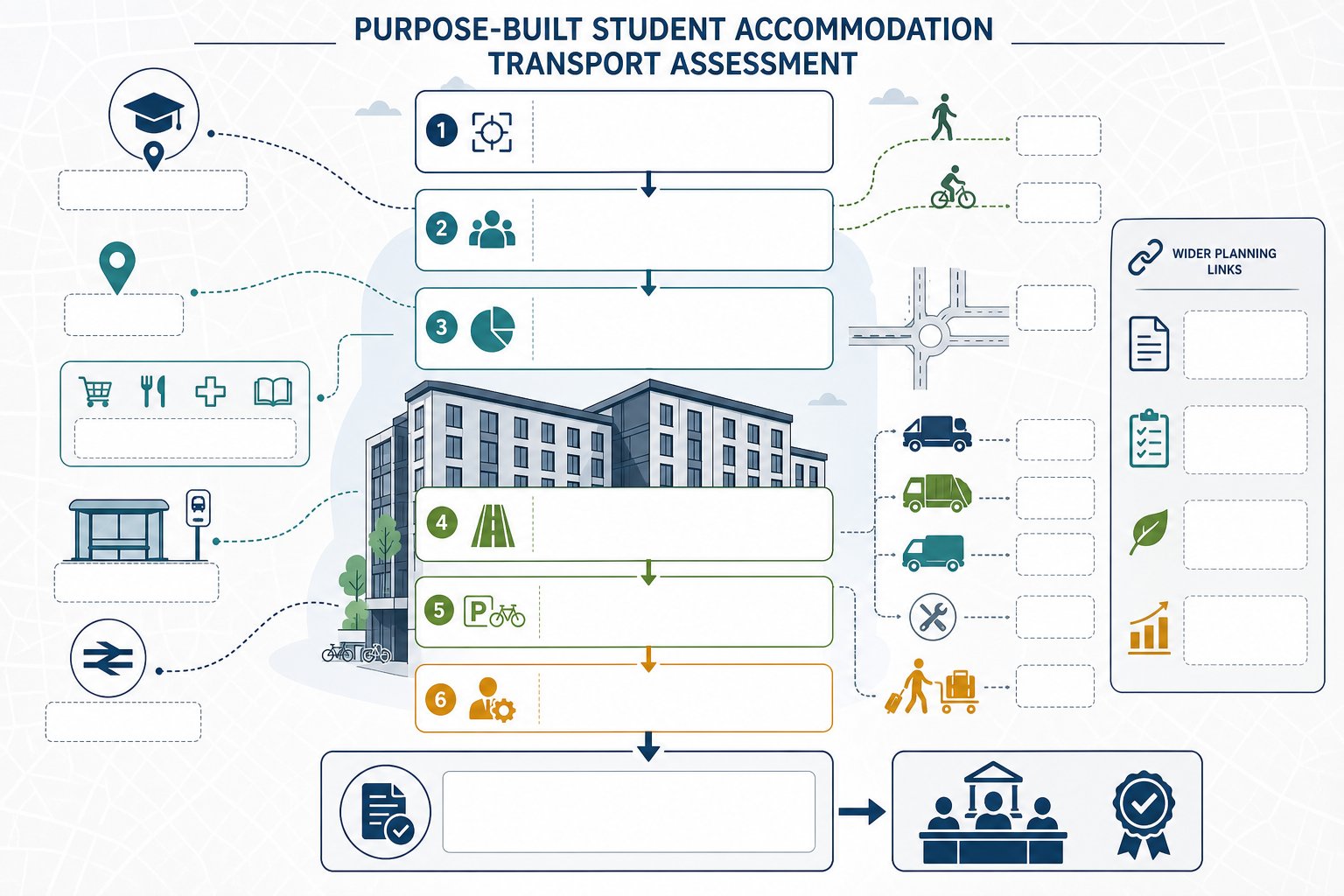
A Purpose-built Student Accommodation Transport Assessment should do more than confirm that students are less car-dependent than typical households. It needs to explain, with evidence, how the scheme will function day to day and at its pressure points.
At minimum, we would expect it to cover development quantum, room types, likely student profile, site context, and the relationship to campus, town centre and local services. It should then move into the transport fundamentals: person-trip generation, mode share, access strategy, highway effects, parking, cycle provision, and servicing.
For PBSA, management detail matters unusually early. That means the assessment often needs to address move-in and move-out operations, delivery activity, refuse collection, maintenance access, and the practical mechanics of any car-free strategy. If those points are left vague, objections usually follow.
Just as importantly, the report should align with the wider planning evidence base. On larger schemes, the PBSA assessment may sit alongside a broader Development Transport Assessment: A approach, and sometimes interacts with an environmental impact assessment where traffic, air quality or cumulative effects are sensitive.
Done properly, the document becomes a planning tool, not just a technical appendix. It shows that student travel demand, access and operations have been thought through in a way that is credible to officers, highway authorities and committees.
When A Transport Assessment Is Needed For Student Accommodation
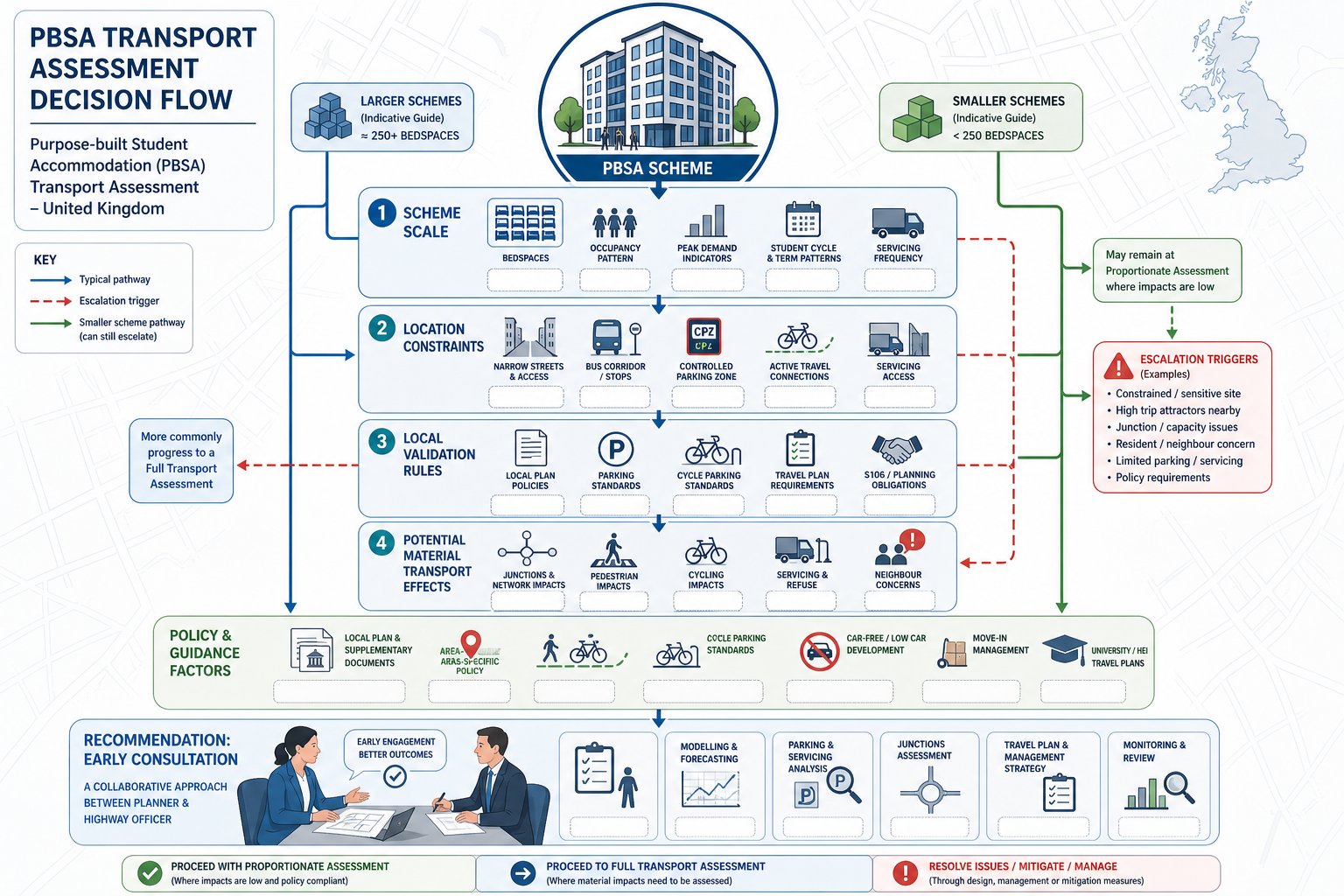
There is no single national threshold that captures every PBSA proposal. In practice, whether a transport assessment is required depends on scale, location, local validation requirements, and the likelihood of material transport effects.
Major schemes are the obvious candidates. In many authorities, developments above roughly 50 to 80 bedspaces will trigger at least a transport statement, and often a full assessment if access, servicing, parking stress or junction performance could become contentious. But smaller proposals can still require detailed transport work where the site sits on constrained streets, near busy bus corridors, within controlled parking zones, or in locations with a history of overspill and neighbour concern.
We also see requirements arise where local plan policy treats PBSA as a distinct use class in practical terms, even if the planning route is broader. Some councils have supplementary guidance on student housing location, cycle standards, car-free expectations or move-in management. In those cases, a generic note won’t be enough.
The safest approach is to agree scope early with the highway authority and case officer. That avoids the familiar problem of submitting a slim report, only to be asked later for surveys, junction modelling, parking analysis and management plans. For teams working across sectors, the principles are similar to a broader transport assessment for planning application, but PBSA usually needs sharper assumptions about student behaviour and term-time variation.
How PBSA Travel Demand Differs From Conventional Residential Development
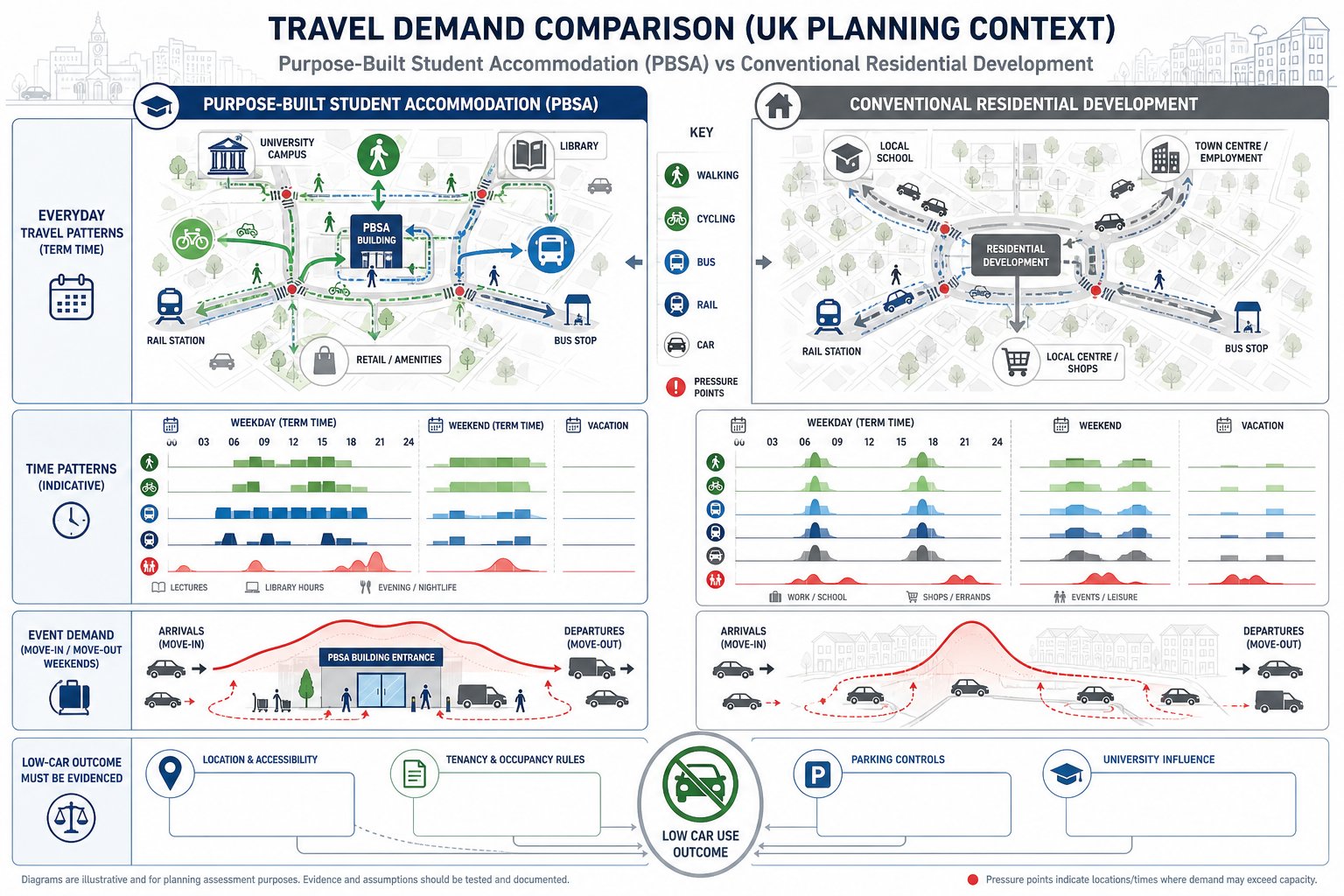
This is where many assessments either win credibility or lose it.
A student accommodation scheme is not simply a flat block with lower parking demand. Its travel behaviour is structurally different. Car ownership is typically much lower, especially in city-centre and campus-adjacent locations. Walking, cycling, bus and rail use are usually much higher. And the daily rhythm of movement is shaped by timetables, seminar slots, library hours, nightlife and term dates rather than the standard nine-to-five commuter profile.
That changes both the data inputs and the narrative. Highway peaks may still matter, particularly for servicing and background traffic, but lecture start times can create their own directional surges on footways, crossings and cycle routes. Weekend activity can also be stronger than on conventional residential schemes, especially near retail cores and stations.
Then there are the exceptional days. Move-in and move-out periods create short, intense waves of activity that bear little resemblance to normal occupation. One badly planned September weekend can generate more local complaint than months of ordinary operation.
So we need to separate everyday demand from event-style demand. We also need to test whether the low-car proposition is genuinely secured by location, tenancy terms, parking controls and university culture, not just assumed. That distinction is central to a robust Residential Development Transport comparison and, more importantly, to a report that local authorities will trust.
Core Policy And Planning Considerations For PBSA Schemes
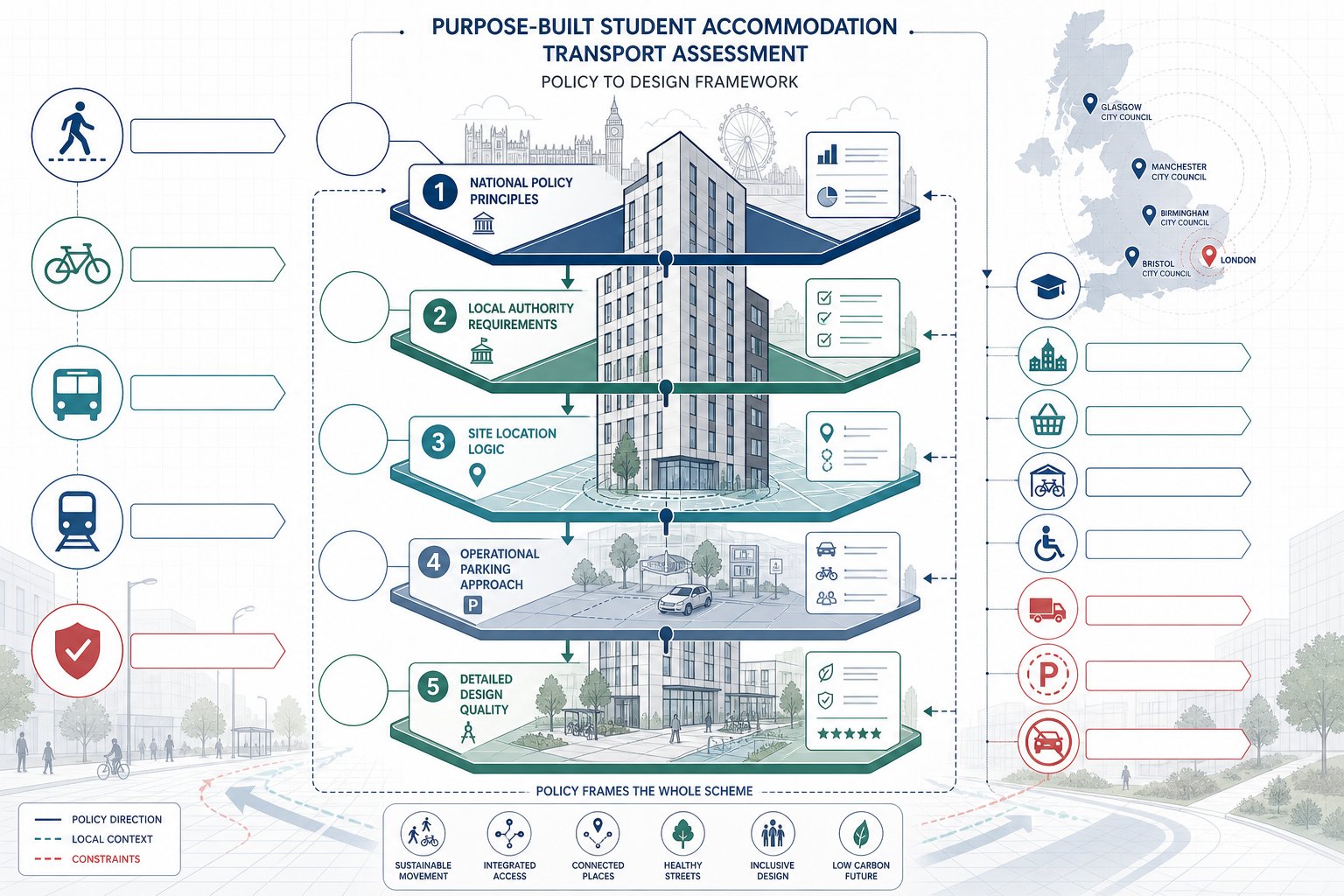
In 2026, policy compliance is not a box-ticking exercise for PBSA transport work. It is often the frame through which the whole scheme is judged.
Nationally, the key themes remain familiar: sustainable transport, safe and suitable access, opportunities to promote walking, cycling and public transport, and proportionate mitigation where impacts are material. But local policy is usually where PBSA applications become more exacting. Many authorities now have clear expectations on location relative to campus, town centre accessibility, cycle parking standards, disabled access, servicing, and car-free or car-lite operation.
London boroughs are an obvious example, but similar patterns now appear well beyond the capital. Some councils expect student accommodation to demonstrate a sequential logic: near campus, near high-frequency public transport, and within easy walking distance of everyday needs. Others place heavy weight on controlled parking zones, street capacity, and whether lease clauses can support a no-car model.
Design guidance matters too. Cycle stores that technically meet numbers but are awkward to use will attract criticism. Blue Badge provision that is remote from entrances or poorly designed can undermine an otherwise strong transport case.
From a planning strategy perspective, we usually advise teams to map the national policy tests first, then build in local plan, SPD, design code and parking-standard requirements around them. On more complex schemes, that thinking can sit alongside a mixed use masterplan movement strategy so access and placemaking are aligned from the outset.
Trip Generation And Mode Share Assumptions For Student Accommodation
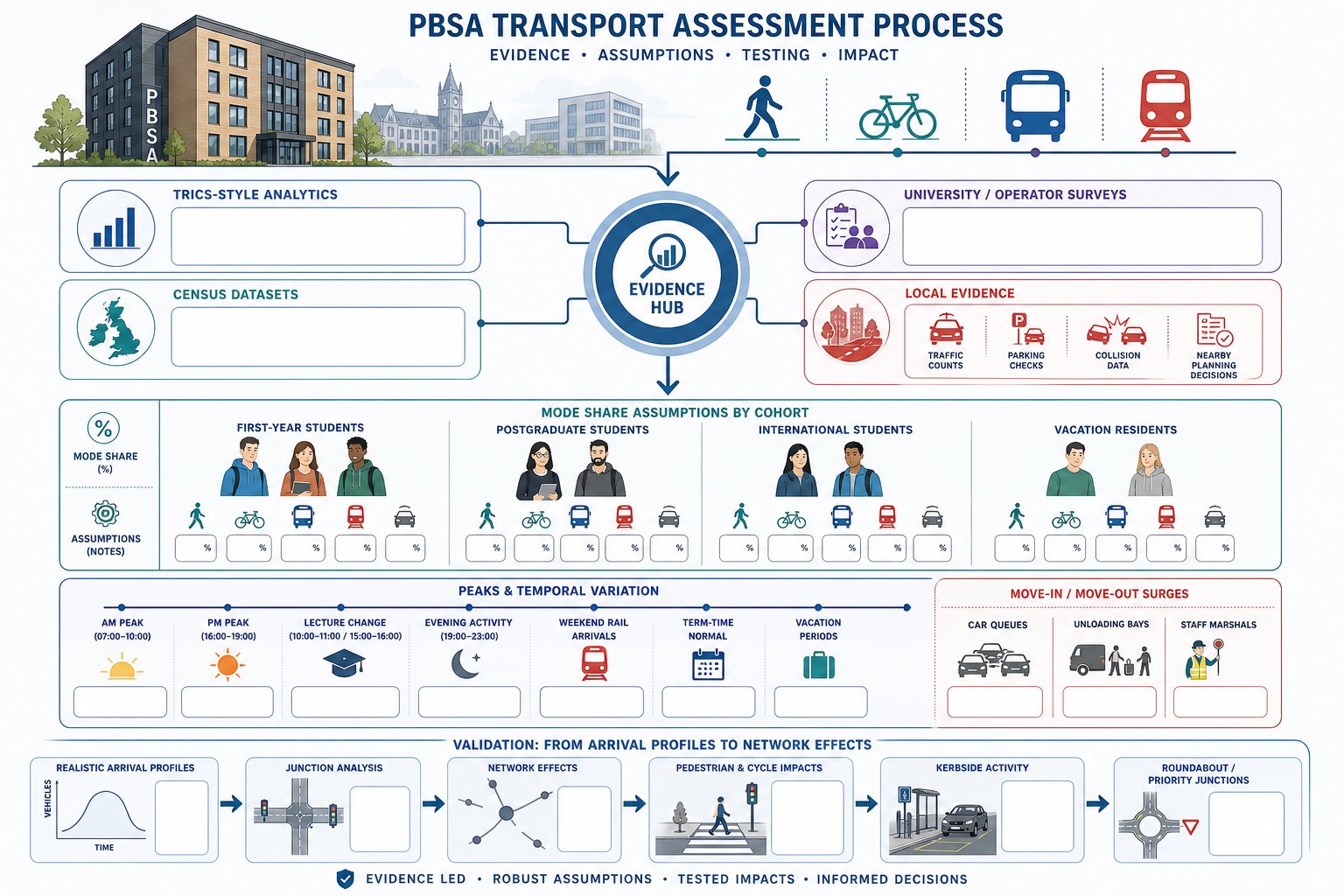
Trip generation is often the most scrutinised part of a PBSA assessment because weak assumptions ripple through almost everything else: junction impact, servicing conflict, parking risk and travel plan credibility.
For student accommodation, we should usually focus on person trips first and vehicle trips second. That sounds obvious, but many poor reports still foreground cars in a way that distorts how the building will actually operate. The task is to estimate how students travel during term time, outside term, at weekends and during move-in or move-out periods, and then translate that into realistic network effects.
Mode share assumptions need to reflect the specific offer. A scheme one short walk from campus with strong bus and rail links, secure cycle parking and no general parking will perform very differently from a peripheral site with patchy evening bus service. The assumptions should also recognise different cohorts: first-year undergraduates, postgraduates, international students, and residents staying through vacation periods may all travel differently.
This is also where local authority trust is earned. If the report simply states “students don’t drive”, officers will probe. If it evidences low car ownership, validates likely travel choices and explains the controls that support them, the assessment becomes much more defensible.
Using Census, TRICS, Surveys, And Local Evidence
No single data source is enough on its own. The strongest PBSA assessments triangulate.
TRICS remains useful for comparable student halls and PBSA sites, particularly for person-trip rates and observed mode splits. But raw outputs need careful filtering by location type, accessibility and scale. A suburban comparator can mislead badly if the application site is central and campus-linked.
Census data can then provide a broader sense-check on student travel behaviour and local car ownership patterns, especially where there is clear evidence about journeys to higher education or relevant demographic proxies. University or operator surveys are often the missing piece. They can reveal timetable-led peaks, cycle demand, rail use by international students, and the real rate of car arrivals during term starts.
Local evidence matters just as much: traffic counts, parking beat surveys, collision records, bus service data and existing planning decisions nearby. In practice, we often combine these strands in the same way a wider Purpose-built Student Accommodation Transport Assessment is built, not by relying on one dataset, but by creating a coherent evidence story that officers can audit.
Peak Periods, Term-Time Variation, And Arrival Patterns
The phrase “peak hour” can be a trap in PBSA work.
Yes, we still need to test the network in recognised AM and PM highway peaks where required by the authority. But student activity often peaks around lecture starts, lunchtime class changes, evening leisure periods and rail arrivals at weekends. A highway model that only looks at a standard commuter peak may miss the practical stress points on footways, crossings, cycle access and kerbside activity.
Term-time variation is also important. Early autumn can be intense: exam periods may produce different campus movement patterns: and vacation periods can reduce occupancy but increase irregular servicing or visitor activity. Move-in and move-out need their own assumptions entirely: arrival rates per hour, car occupancy, unloading dwell times, staff presence and holding arrangements.
If junction assessment is required, the software choice and modelling assumptions should be transparent. For priority and roundabout access, tools such as Junctions 11 Software may support the evidence base, but the numbers are only as credible as the arrival profile sitting behind them.
Site Access, Highway Impact, And Servicing Requirements
PBSA access design needs to work for three overlapping systems at once: everyday student movement, operational servicing, and occasional high-intensity arrivals.
Pedestrian access usually comes first. Desire lines to campus, town centre, bus stops and rail stations should be direct, legible and safe, with crossing provision considered where natural routes meet traffic. Cycle access should avoid awkward dismount points and pinch points at entrances. If the access strategy asks students to use a route they plainly won’t choose, the report should expect challenge.
Vehicular access may be minimal in car-free schemes, but it still matters for refuse, maintenance, removals, Blue Badge users and emergency arrangements. Visibility, swept path design, gate positions, servicing headroom and interaction with buses or existing cycle lanes all need to be resolved. On constrained urban sites, the friction between delivery vehicles and active travel routes is often the real issue, not junction capacity in isolation.
Where traffic effects could be material, junction modelling may be needed using tools such as PICADY, ARCADY or LINSIG, depending on context. But for many PBSA schemes, a clear qualitative explanation of limited vehicle generation, coupled with robust servicing management and move-in controls, is just as influential.
And if servicing is hand-waved away as “standard van activity”, expect objections. Officers want to know who arrives, when, where they stop, how long they stay, and how conflicts are prevented.
Walking, Cycling, Public Transport, And Campus Connectivity
For PBSA, sustainable travel isn’t an add-on chapter. It is the core planning argument.
We need to show not just that the site is near a campus or bus stop, but that the routes are genuinely usable. A ten-minute walk on paper can be a poor route in reality if it involves severance, poor lighting, hostile crossings or steep gradients. The same goes for cycling: a route may technically exist, but if it disappears into a multi-lane gyratory or lacks secure destination parking, students may default to buses or ride-share instead.
Public transport analysis should cover frequency, span of service, reliability where possible, interchange quality and journey times to campus and the wider city. In larger university cities, rail can also be important for weekend travel and international arrivals. Where a local metric such as PTAL or equivalent accessibility mapping is used, it should support, not replace, a real-world assessment of routes.
Good reports tie the scheme into broader travel behaviour too: university travel plans, local active-travel corridors, nearby cycle hire, and future highway or streetscape improvements. That shows the proposal is part of a movement network rather than a standalone building.
For applicants, this is often the section that helps a scheme feel planning-ready. It also reflects the sort of concise, authority-focused reporting we value in a Purpose-built Student Accommodation Transport Assessment prepared to local context rather than generic national wording.
Car Parking, Blue Badge Provision, And Car-Free Development Issues
Most PBSA schemes now propose very limited general parking, and many are effectively car-free. That can be entirely appropriate, but only if the strategy is credible and enforceable.
The first test is locational. A low-parking proposal is much easier to defend where the site is close to campus, shops and frequent public transport. The second is operational. Councils will want to know how residents are prevented from bringing cars, whether tenancy agreements restrict permits, how any controlled parking zone operates, and what happens if overspill starts appearing on nearby streets.
Then there is accessibility. Even the most car-lite scheme still needs to deal properly with Blue Badge parking, set-down and step-free access. Provision should be close to entrances, well-signed, safe and available when needed. Treating disabled access as an afterthought is one of the quickest ways to weaken the application.
Cycle parking often sits in the same policy conversation. Quantity matters, but quality matters more than applicants sometimes think: security, weather protection, ease of use, natural surveillance and space for adapted cycles can all become planning issues.
In short, a car-free claim is not a slogan. It is a package of location, design, management and enforcement. If any one of those is missing, neighbours and officers will notice.
Student Move-In, Move-Out, And Servicing Management Plans
If there is one section that separates a merely adequate PBSA transport report from a genuinely planning-savvy one, it is this.
Move-in and move-out periods create concentrated demand in a way normal residential occupation rarely does. Families arrive with loaded cars and vans, students need time to unload, and everyone wants to stop as close to the entrance as possible. Without a management plan, nearby streets can gridlock very quickly.
A proper strategy should set out staggered arrival booking slots, likely arrival profiles by hour, expected vehicle occupancy, unloading dwell times, marshal roles, signage, temporary traffic management where needed, and contingency arrangements if cars arrive early or queue. Some sites benefit from off-site holding areas or one-way internal circulation. Others need strict kerbside controls and coordination with neighbouring uses.
Communication is part of the transport solution too. Residents, parents, universities, neighbours, the highway authority and servicing operators should all know how the system works before term starts.
Servicing then needs its own ongoing plan: refuse collection points, parcel delivery arrangements, maintenance access, loading restrictions and preferred time windows. On urban sites, parcel volumes alone can become significant.
This is also where experienced input helps. Teams often benefit from working with Transport Assessment Consultants: who can translate a broad management idea into something officers can condition, monitor and rely on.
Common Risks In PBSA Transport Assessments And How To Avoid Them
The most common problems are surprisingly consistent.
First, underestimating trip generation or relying on generic residential assumptions. Student accommodation may generate fewer car trips, but it can produce intense person-trip movement and very sharp operational peaks. The fix is straightforward: use PBSA-specific comparators, local surveys and a clear explanation of why the assumptions fit the site.
Second, treating low car ownership as self-evident. It usually isn’t. Authorities want evidence of local student behaviour and practical controls such as lease restrictions, parking management and strong campus connectivity.
Third, ignoring walking and cycling quality. A report that lists distances but says little about route comfort, crossings, gradients or conflict points will feel thin. Students choose routes based on convenience and safety, not just mapping software.
Fourth, leaving move-in and servicing too late. By the time objections are raised, retrofitting a management strategy can look reactive. It is far better to address those issues at application stage.
And finally, weak scoping. Early engagement with the highway authority, university stakeholders and the design team saves a great deal of friction later. Where technical evidence needs to be produced quickly, a focused Purpose-built Student Accommodation Transport Assessment approach, tailored to local thresholds and planning expectations, tends to produce stronger, faster outcomes than a generic template report.
Conclusion
A strong PBSA transport assessment is evidence-led, student-specific and grounded in how the building will actually operate, not how we wish it would operate. The recurring themes are clear: realistic mode share assumptions, careful treatment of term-time and move-in peaks, safe and direct active-travel access, workable servicing, and a parking strategy that can be enforced in practice.
For planning teams, the key in 2026 is to avoid generic residential thinking. Student accommodation has its own movement profile, its own policy sensitivities and its own operational flashpoints. When those are addressed early, and backed by local data, clear management plans and proportionate mitigation, the transport case becomes far more resilient.
That is eventually what decision-makers are looking for: confidence that the scheme supports sustainable travel, protects the surrounding network, and can function smoothly from opening day onwards.
Frequently Asked Questions About Purpose-Built Student Accommodation Transport Assessment
What is a Purpose-Built Student Accommodation Transport Assessment?
It is a detailed report supporting planning applications that demonstrates how student travel demand, access, parking and servicing will be safely and sustainably managed for a student housing development.
When is a transport assessment required for student accommodation developments?
Typically, major schemes exceeding 50 to 80 bedspaces or projects likely to impact local junctions, parking, or bus corridors require a transport assessment, as do those triggered by specific local planning or transport policies.
How does travel demand for Purpose-Built Student Accommodation differ from regular residential developments?
Student housing usually involves very low car ownership, with high walking, cycling and public transport use. Travel peaks align with lecture times and term dates rather than typical commuter hours, requiring distinct trip generation and mode share assumptions.
What key elements should a PBSA transport assessment cover?
It should address development size, student profiles, trip generation, mode share by time period, access strategies, parking, servicing, move-in/out management, and alignment with local and national transport policies.
How can move-in and move-out periods be managed to avoid local disruption?
By implementing staggered arrival slots, on-site marshals, clear signage, temporary traffic measures, and communication with stakeholders, which are all detailed in robust management plans within the assessment.
Why is it important to consider walking, cycling, and public transport connectivity in a PBSA transport assessment?
Because sustainable travel options form the core planning argument, ensuring safe, direct, and convenient routes to campus and town centres supports car-free strategies and overall scheme acceptance by authorities.