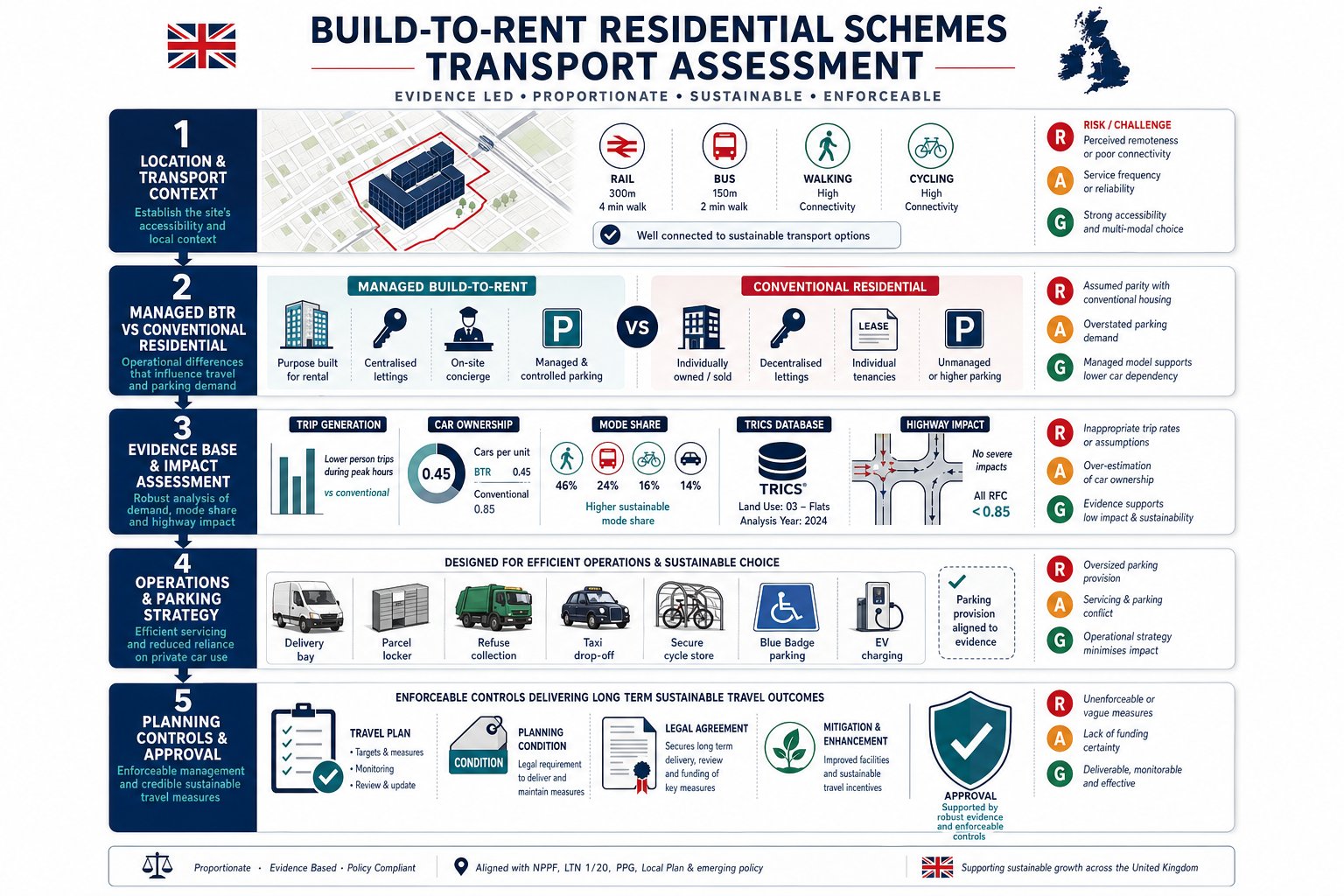
Build-to-rent has matured fast in the UK. What was once treated as a niche residential product is now a mainstream delivery model in city centres, regeneration areas, and increasingly in suburban growth locations too. But planning teams still run into the same problem: transport evidence is often prepared as if BtR were just another C3 housing scheme with a different brochure.
That usually doesn’t hold up for long. Local planning authorities and highway officers are asking sharper questions about tenure, operational management, parking restraint, delivery demand, and whether the proposed mode share is genuinely realistic for the site. In other words, a Build-to-Rent Residential Schemes Transport Assessment can’t simply recycle assumptions from a for-sale apartment block and expect no challenge.
We’ve found the strongest submissions do two things well. First, they follow standard UK transport assessment methodology properly. Second, they explain, with evidence, how BtR occupancy, management and travel behaviour differ from conventional residential development. That means tighter trip generation logic, clearer servicing strategies, and a much more robust link between what the operator says will happen and what planning controls can actually secure.
In this guide, we set out what planning teams need to get right in 2026: when a full TA is needed, what local authorities expect, where trip rate arguments often fall apart, and how to present a BtR transport case that is credible from first review rather than after three rounds of technical queries.
Key Takeaways
- Build-to-Rent (BtR) transport assessments must follow UK TA standards but explicitly address BtR operational differences to be credible.
- Effective BtR transport assessments account for lower car ownership, specific mode share, managed servicing, and enforceable travel plans linked to management.
- A full Transport Assessment is often required for BtR schemes earlier than expected due to servicing, refuse, delivery demand, and access complexity.
- Robust trip generation for BtR relies on layered evidence including TRICS data, comparable schemes, local surveys, and management impacts rather than generic residential rates.
- Access design, junction capacity, and pedestrian safety are critical to prevent objections despite low vehicle trip generation in BtR developments.
- Parking strategies should balance local standards with BtR management controls, covering Blue Badge, cycle parking, and micro-mobility to ensure practical sustainable transport.
- Strong Travel Plans utilising BtR operator control provide enforceable sustainable travel measures, supported by clear mitigation and appropriate planning conditions or S106 obligations.
- Common failures include unsupported mode share or car ownership claims, weak servicing evidence, inconsistent documents, and lack of enforceable management strategies, which should be avoided for smoother planning approval.
What A Transport Assessment For Build-To-Rent Schemes Needs To Cover
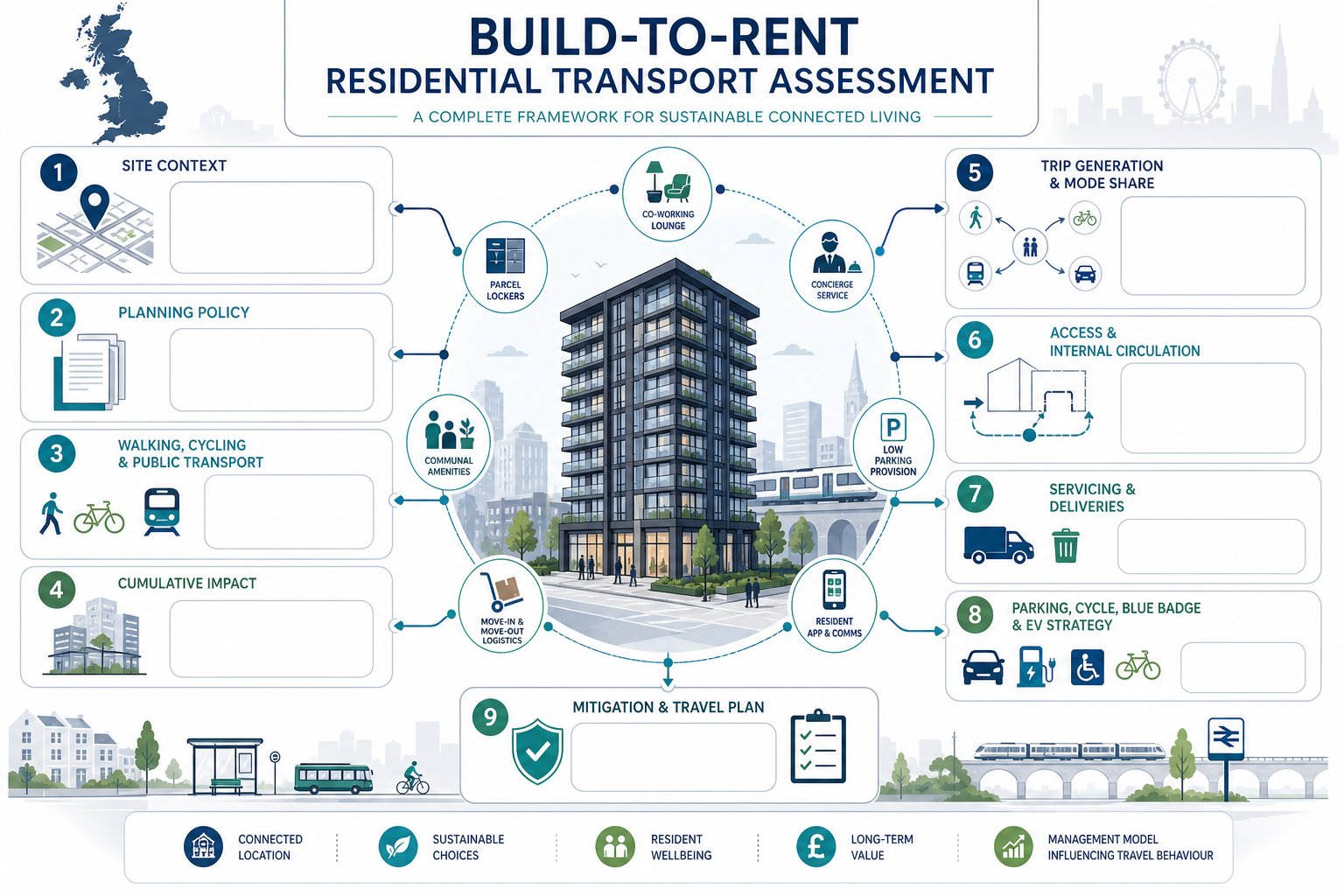
A transport assessment for a BtR scheme should still follow established UK TA structure, but the content needs to be explicitly tailored to the way the development will operate. That starts with a clear description of the proposal: unit numbers, mix, tenure model, affordable provision where relevant, communal areas, on-site staff, concierge arrangements, move-in management and resident amenities.
Those details aren’t background colour. They shape travel behaviour. A scheme with co-working lounges, parcel storage, managed refuse, low parking provision and strong rail access may perform very differently from a conventional private sale block in the same borough.
A sound assessment should cover:
- site location and surrounding transport context
- relevant planning policy and local standards
- existing highway, walking, cycling and public transport conditions
- committed development and cumulative impact where required
- trip generation, mode share and car ownership assumptions
- access arrangements and internal circulation
- servicing, refuse collection and delivery demand
- parking, cycle storage, Blue Badge spaces and EV strategy
- mitigation, Travel Plan and any likely condition or S106 triggers
For planning teams already preparing wider residential evidence, a BtR submission usually sits best within a broader transport assessment for the whole scheme rather than as an isolated appendix. But the tenure-specific narrative must be visible. If it’s buried, reviewers often assume it hasn’t really been tested.
How Build-To-Rent Differs From Conventional Residential Development
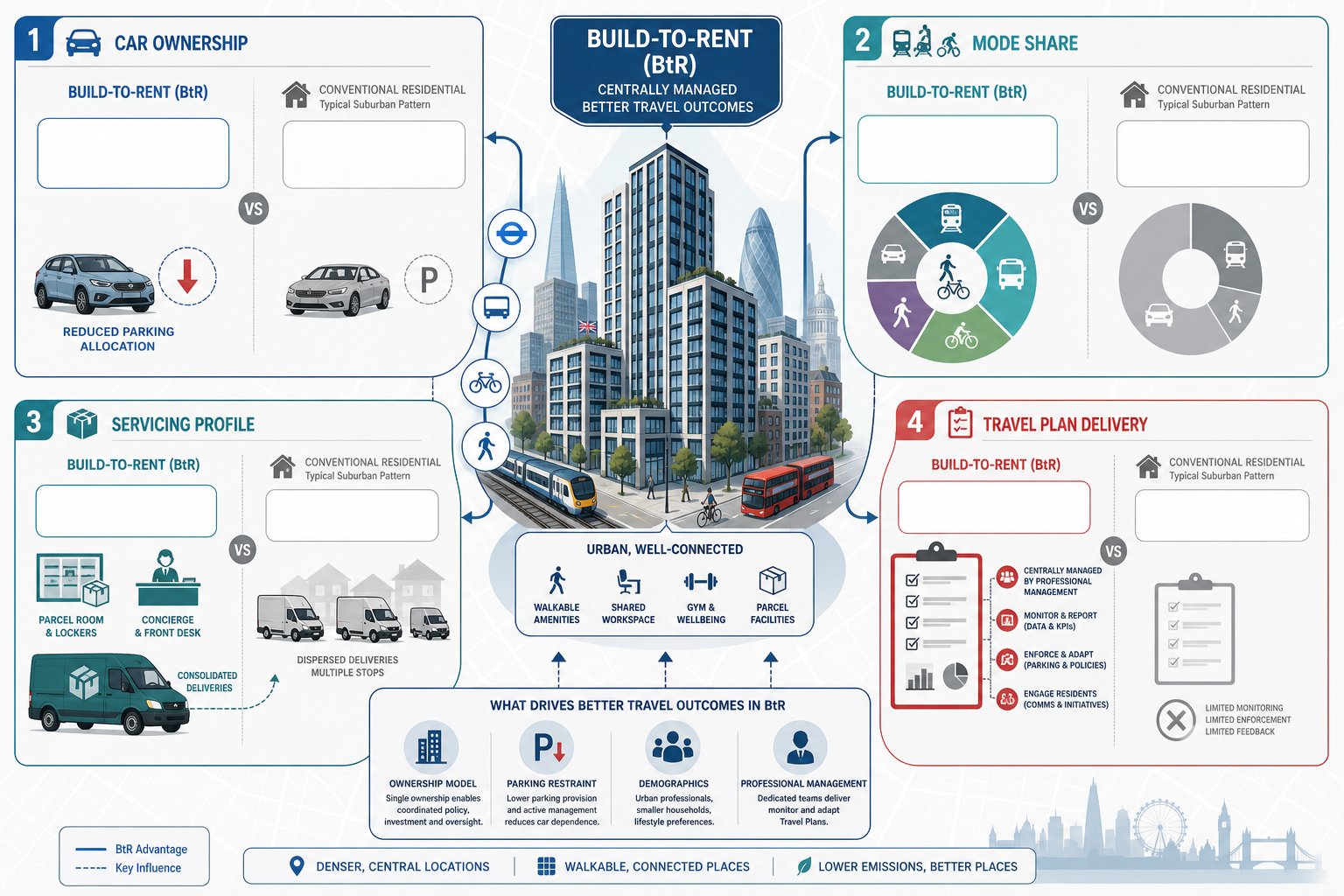
BtR differs from conventional residential in ways that matter directly to transport planning. The biggest distinction is operational: single ownership, professional management and long-term rental. That changes how parking is allocated, how leases are enforced, how servicing is organised and, sometimes, who chooses to live there.
In practice, many BtR schemes are denser, more centrally located and more deliberately linked to public transport, employment centres and walkable services. Resident amenities can suppress some off-site trips while increasing others at different times of day. A gym, parcel room or shared workspace may reduce outbound movements in one peak but create different internal activity patterns.
That doesn’t mean every BtR scheme automatically generates fewer vehicle trips than a conventional C3 development. That’s where some applications overreach. The argument only works when location, parking restraint, demographics and management arrangements all point in the same direction.
We normally expect key differences to influence four areas:
- Car ownership – often lower where leases restrict parking and alternatives are strong.
- Mode share – rail, bus, walking and cycling may capture a higher proportion of trips.
- Servicing profile – managed deliveries and concierge functions can change daily activity.
- Travel Plan delivery – operator control makes monitoring and behavioural measures more enforceable.
A useful benchmark is to compare the scheme against a wider Residential Development Transport evidence base, then explain precisely why the BtR product should depart from conventional assumptions.
When A Full Transport Assessment, Transport Statement, Or Supporting Note Is Needed
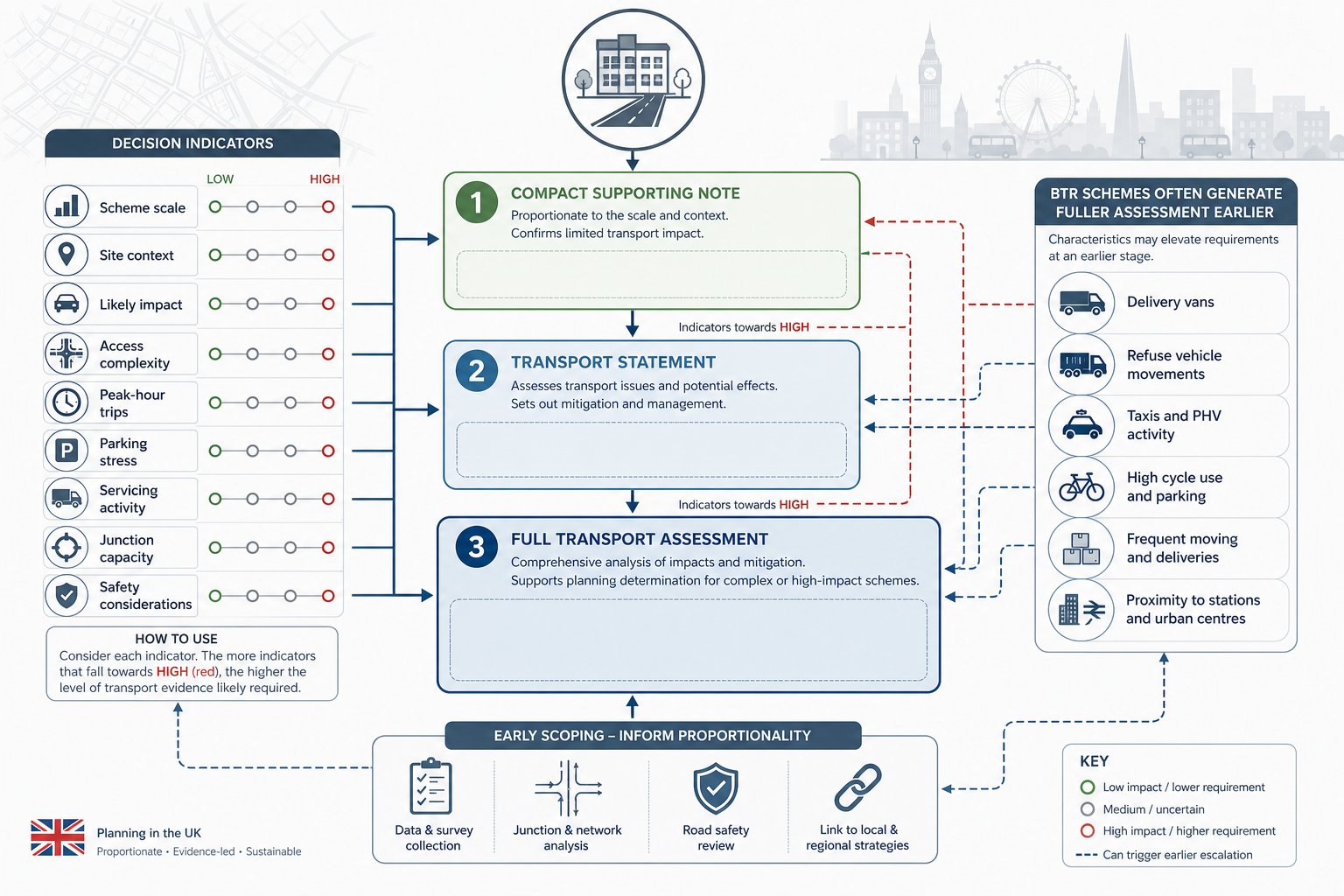
This is still driven by scale, context and likely impact rather than by tenure alone. National policy and Planning Practice Guidance set the broad framework, but each local highway authority will have its own thresholds and expectations. Some rely mainly on unit numbers: others look more closely at peak-hour trips, access complexity, parking stress or whether the site sits on a constrained urban network.
As a rule of thumb:
- Supporting Note: suitable for small schemes with negligible transport effects, straightforward access and no meaningful highway or servicing concerns.
- Transport Statement: suitable for medium-sized proposals where impacts are limited but still need structured evidence on access, parking, sustainable travel and trip generation.
- Full Transport Assessment: needed for larger schemes, high-density urban blocks, sensitive sites, proposals with servicing complexity, or any development likely to affect junction capacity, safety or local parking conditions.
For BtR, the case for a fuller assessment often arises earlier than applicants expect. Why? Because even if private car trip generation is low, highway officers may still want proper evidence on deliveries, refuse, taxis, drop-off activity, cycle numbers, move-in operations and cumulative impacts near stations or busy mixed-use corridors.
Where modelling is likely, the scope should be agreed early. That can include surveys, junction assessment, road safety review and links to a wider Development Transport Assessment: A planning strategy so the transport workstream isn’t left trying to catch up after layout has been fixed.
Key Planning Policy And Local Authority Expectations
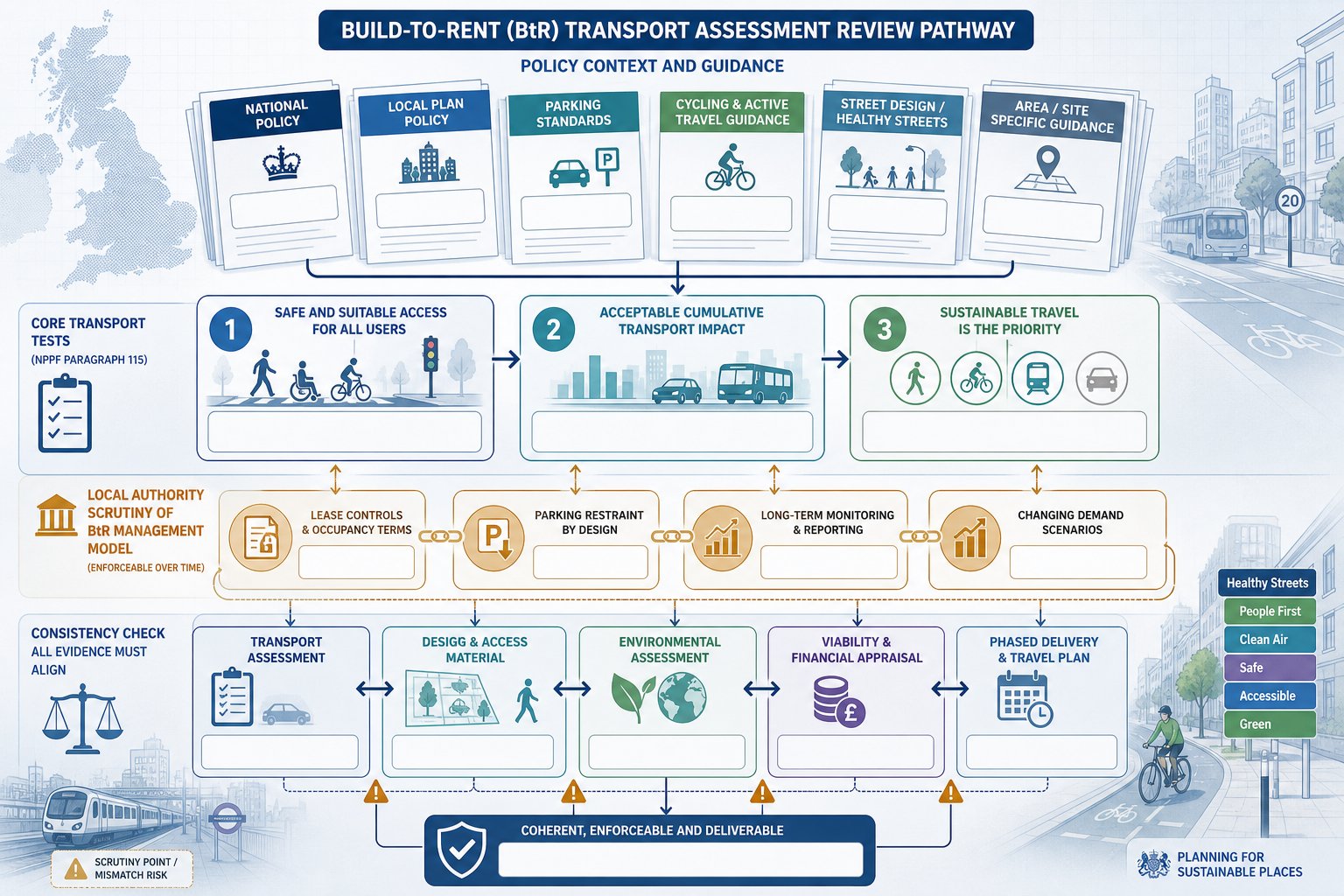
In 2026, highway authorities are still testing BtR proposals against the same core transport questions: is there safe and suitable access for all users, can the residual cumulative impacts be shown to be acceptable, and does the scheme genuinely prioritise sustainable travel rather than just describing it nicely?
The policy stack usually includes the National Planning Policy Framework, Planning Practice Guidance, the local plan, parking standards, cycling standards, street design guidance and any relevant area-specific SPD. In London and some larger cities, applicants may also need to respond to more developed policy on car-free housing, healthy streets, urban logistics and accessibility metrics.
For BtR specifically, local authorities tend to focus on whether the management model is real, durable and enforceable. A statement that parking demand will stay low because residents will be “encouraged” not to own cars usually isn’t enough. Officers want to know what is secured through lease terms, what is physically constrained by design, and what happens if demand shifts over time.
We also see more scrutiny where transport reasoning interacts with viability or wider environmental effects. On larger mixed-use or phased schemes, transport evidence may need to align with environmental impact assessment work and with the applicant’s broader programme for delivery. Consistency matters. If the TA says one thing about parking restraint and the Design and Access Statement implies another, the technical case starts to wobble very quickly.
Core Trip Generation And Mode Share Evidence For Build-To-Rent
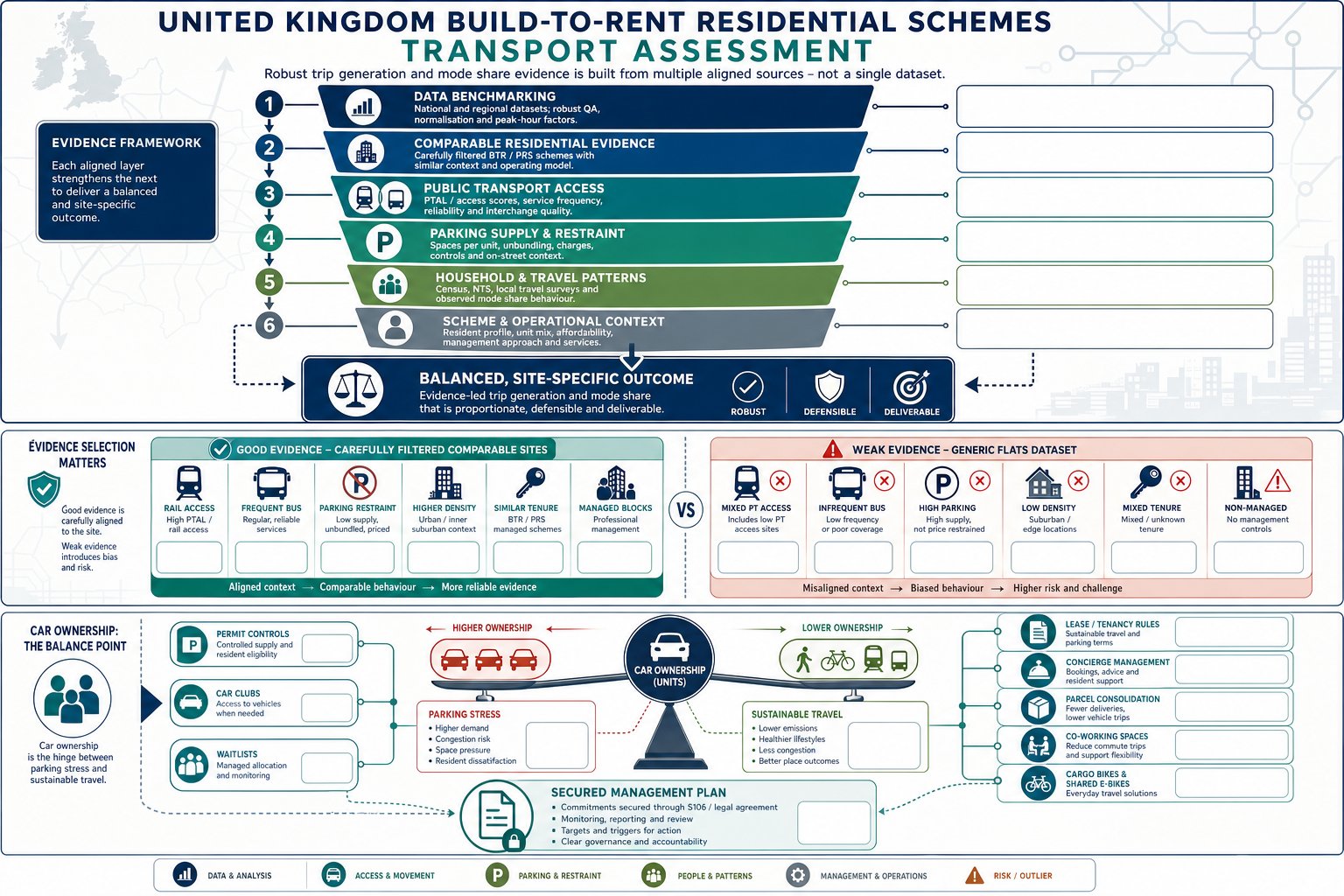
Trip generation is where many BtR transport assessments are won or lost. Generic residential rates can be a starting point, but they are rarely the whole answer. The aim is to build a proportionate evidence base that reflects site context, public transport accessibility, parking provision, resident profile, unit mix and operational management.
The best approach is layered rather than single-source. We typically combine TRICS, comparable development evidence, Census or journey-to-work data where still useful, local travel surveys, and a clear explanation of how the scheme’s management model affects outcomes. That way, even if one evidence strand is imperfect, the overall conclusion remains robust.
Crucially, mode share assumptions should be internally consistent. A scheme cannot sensibly claim very low car ownership, very low parking provision and also a weak walking/cycling/public transport offer unless there is compelling local evidence. Likewise, on-site amenities may reduce some external trips, but that needs to be reasoned carefully rather than treated as a blanket reduction factor.
Using Comparable Sites And TRICS Data Effectively
TRICS remains an important tool, but BtR analysis lives or dies on filtering and interpretation. The temptation is to pull generic flats data, remove obvious outliers, and present reduced peak-hour trip rates. Highway officers spot that pattern immediately.
A better method is to select sites that are genuinely comparable in:
- urban or suburban context
- rail and bus accessibility
- parking restraint
- block form and density
- unit profile
- tenure and managed operation, where known
Where specific BtR survey data is available from operators or comparable consented schemes, it can materially strengthen the case. But comparables need to be explained, not just listed. Why this scheme? Why this catchment? Why this parking level? Those questions should be answered in the text.
On more complex applications, supporting trip evidence may sit alongside a residential traffic impact review so that rate selection and network effects are tied together rather than treated as separate exercises.
Accounting For Car Ownership, Tenure, And Managed Operations
Car ownership is often the hinge point for the whole BtR transport strategy. If projected ownership is too low, parking stress objections appear. If it is too high, the sustainable transport story falls apart. So the evidence needs to be careful, local and realistic.
We generally test car ownership against comparable BtR schemes, local Census car availability, parking permit controls, PT accessibility, unit mix and lease arrangements. Managed operations matter a lot here. A professionally run scheme can control parking allocation, run waitlists, restrict second-car parking, support car clubs and manage resident communications in ways a conventional private sale block often cannot.
That said, management claims need planning hooks. If a concierge-led parcel strategy or car-free tenancy approach forms part of the transport case, it should be capable of being secured through condition, legal agreement or an approved management plan.
It also helps to consider operational details that change travel patterns at the margins but meaningfully so over a year: move-in bookings, visitor management, parcel consolidation, co-working space use, and the availability of cargo bikes or shared e-bikes. Small levers, used together, often make the strongest evidence.
Access, Highway Impact, And Junction Capacity Considerations
Even on low-car schemes, access design still matters. A BtR development needs to show that resident vehicles, servicing, refuse, emergency access, taxis, cycles and pedestrians can all operate safely without awkward conflict points or unrealistic manoeuvres.
Most highway officers will expect a clear access strategy covering visibility, swept paths, gradients, pedestrian priority, cycle crossing movements and any kerbside interaction. On constrained urban sites, that often means spending as much time on the street interface as on the internal layout. A technically compliant access that creates delivery conflict outside the entrance every evening is unlikely to feel acceptable in practice.
Junction capacity assessment may be required where forecast trips, local sensitivity or committed growth trigger it. For larger schemes, that can include priority junction modelling, signal assessment and review of nearby network nodes rather than just the immediate site access. When modelling is necessary, methodology and scenario assumptions should be agreed early, particularly if using tools such as Junctions 11 Software.
Road safety should not be bolted on at the end. Collision analysis, desire line review and an understanding of how vulnerable users actually move around the area are essential. Many objections arise not because the vehicle numbers are huge, but because the access design feels hostile or unresolved for people walking and cycling.
Walking, Cycling, Public Transport, And Sustainable Travel Requirements
BtR schemes are often promoted on the strength of their sustainable location. That may be true, but the assessment has to demonstrate it properly. We need more than a map with a few circles around stations.
A robust active travel and public transport chapter should audit:
- pedestrian routes to shops, schools, open space, bus stops and stations
- crossing quality, footway width, lighting and personal security issues
- cycling connectivity, route comfort and network gaps
- public transport service frequency, journey times and interchange quality
- accessibility for disabled users and inclusive design barriers
In London, PTAL may be relevant: elsewhere, isochrones, timetable analysis and walk-time mapping often work better. The real question is whether day-to-day journeys are attractive enough to support the claimed mode split.
Mitigation might include new crossings, widened footways, dropped kerbs, improved wayfinding, cycle links, stop upgrades, real-time information or contributions to nearby public realm schemes. Where these measures sit within a larger regeneration framework, they should align with an end to end transport strategy rather than appearing as a last-minute shopping list.
And one practical point: sustainable travel measures are more persuasive when they are tied to management. Welcome packs, cycle maintenance support, public transport discounts, car club credit and resident communications work better in BtR precisely because an operator is there to keep them alive after occupation.
Servicing, Refuse Collection, And Delivery Demand In Managed Residential Blocks
Servicing is one of the most under-estimated elements of BtR transport work. A managed residential block may have lower resident car use than conventional housing, but it often generates more structured servicing activity: parcel deliveries, grocery drop-offs, maintenance visits, linen or cleaning services in some models, resident move-ins, and regular refuse operations.
A credible strategy should explain where vehicles stop, how long they stay, who manages the process, what happens if bays are occupied, and how pedestrian safety is maintained at the entrance. Parcel rooms, concierge desks and timed delivery windows can reduce failed deliveries and kerbside churn, but only if the building is designed and managed to support them.
Refuse is equally important. The TA should align with the waste strategy on store locations, collection frequencies, bin presentation, drag distances and vehicle access. Swept-path analysis is often essential, especially on tight urban plots or where refuse collection occurs from a shared street.
We also advise teams to address abnormal but predictable operations: student move-in style peaks are less common in mainstream BtR, yet first occupation periods, tenancy turnovers and bulk furniture deliveries can still create temporary pressure. If the operational plan ignores these realities, reviewers tend to question whether the rest of the transport case has been tested with enough honesty.
Car Parking, Blue Badge Provision, Cycle Parking, And Micro-Mobility
Parking strategy for BtR needs balance. Too much parking can undermine sustainable transport policy and scheme viability: too little, without credible evidence and controls, invites objections about overspill and practicality.
The starting point should always be local standards, then a reasoned response to site context and the BtR operating model. In many urban locations, reduced parking provision is entirely defensible. But the argument should cover permit eligibility, lease restrictions, allocation principles, visitor parking, EV charging, car club provision and local on-street conditions.
Blue Badge provision deserves particular care. It should respond to Building Regulations, local standards and the actual management of accessible units and visitor demand. Treating it as an afterthought is a common error.
Cycle parking has become much more exacting too. Authorities increasingly expect convenient, secure, step-free and user-friendly storage, not simply enough Sheffield stands in a basement corner. Resident and visitor cycle parking should reflect current design guidance, likely cycle type and access ease. For BtR, that often means planning for non-standard cycles, cargo bikes, adapted cycles and charging for e-bikes.
Micro-mobility is moving from nice extra to practical expectation in some locations. If e-bikes or scooters are part of the offer, the scheme should show where they are stored, charged and managed safely. These details often strengthen the wider transport narrative because they show how low-car living will work day to day, not just in theory.
Travel Plans, Mitigation Measures, And Section 106 Or Condition Triggers
BtR schemes usually have an advantage here: the operator can carry out and monitor a Residential Travel Plan more consistently than in fragmented private-sale developments. That’s valuable, and planning teams should use it.
A strong Travel Plan sets out baseline assumptions, targets, measures, management responsibilities, resident engagement, monitoring periods and review triggers. It should explain who funds the measures, who reports to the authority and what happens if targets are missed. Vague commitments to encourage sustainable travel no longer satisfy most officers.
Typical measures include:
- personalised resident travel information
- cycle training and maintenance offers
- public transport ticket discounts or introductory incentives
- car club membership or credit
- monitoring of cycle store occupancy and parking demand
- delivery management protocols
- welcome packs and digital travel information through resident apps
Mitigation can then be split between physical works and operational measures. Physical works may include crossings, footway upgrades, junction changes, stop improvements or cycle links. Operational measures may sit in management plans, tenancy controls or monitored Travel Plan actions.
On larger or more sensitive applications, some of this will be secured through planning conditions and some through S106 obligations. That package needs to be proportionate and clearly drafted. Where network effects are wider, it may also connect with a broader traffic impact assessment so mitigation is tied to actual forecast impacts rather than generic asks.
Common Reasons Build-To-Rent Transport Assessments Are Challenged
Most challenged BtR transport assessments fail for familiar reasons. Not because BtR is inherently difficult, but because the evidence doesn’t match the claims.
The most common issues we see are:
- Generic trip rates used without explaining why conventional C3 flats are comparable.
- Over-optimistic mode share assumptions unsupported by local walking, cycling or public transport conditions.
- Weak car ownership evidence, especially where on-street parking pressure already exists.
- Management claims without planning control, such as saying parking will be restricted or deliveries managed without showing how.
- Underplayed servicing demand, particularly parcels, taxis and turnover activity.
- Insufficient junction or safety analysis where local constraints are obvious.
- Non-compliance with local standards for parking, cycle provision or accessibility.
- Poor consistency between TA, site layout, servicing drawings, Travel Plan and Design and Access Statement.
A good rule is this: if a reduced-impact argument depends on BtR management, the assessment should prove that management is credible, resourced and enforceable. If a low-car strategy depends on excellent alternatives, the site audit should show those alternatives genuinely exist. And if the development team wants a quicker planning path, transport work needs to start early, not after the architecture is effectively fixed.
That’s where concise, locally tuned reporting tends to make the difference. The strongest submissions are rarely the longest: they are the ones that anticipate authority concerns and answer them before the first consultation response lands.
Build-to-Rent Residential Schemes Transport Assessment FAQs
What key elements should a Build-to-Rent transport assessment include?
A Build-to-Rent transport assessment must follow UK TA methodology but tailor content to BtR specifics. It should cover site context, trip generation, mode share, parking, servicing, access, sustainable travel measures, and a robust Travel Plan aligned with operator management and planning policies.
How does Build-to-Rent differ from conventional residential in transport planning?
BtR schemes feature single ownership, professional management, and long-term rental, resulting in lower car ownership, stricter parking controls, and different trip patterns. They often have higher density, are near transport hubs, and include amenities that influence travel behaviour differently from conventional C3 developments.
When is a full Transport Assessment required for a Build-to-Rent development?
A full Transport Assessment is needed for large, high-density or sensitive BtR sites, or where impacts affect junction capacity or safety. Smaller schemes may require a Transport Statement or Supporting Note. Local thresholds based on unit number and peak trips determine the assessment level, with early scoping advised.
How should trip rates and mode share be determined for Build-to-Rent transport assessments?
Trip rates and mode share should be based on layered evidence, including TRICS data filtered for comparable BtR sites, local census or travel-to-work data, and operator surveys. The assessment must justify any reduction from conventional rates by explaining site-specific context, management, and amenities.
What role does management play in parking and travel behaviour in Build-to-Rent schemes?
Professional management enables lease enforcement, parking allocation, parking restrictions, and delivery coordination. This control can lower car ownership and trip generation. Transport assessments must show management claims are enforceable through planning conditions or legal agreements to be credible.
Why is servicing and refuse collection critical in BtR transport assessments?
BtR schemes usually generate more structured servicing activity including parcel deliveries and refuse. Assessments must detail vehicle access, stopping points, timing, and management to prevent conflicts and ensure safety. Swept-path analysis and alignment with waste strategy are essential for credible delivery demand evidence.