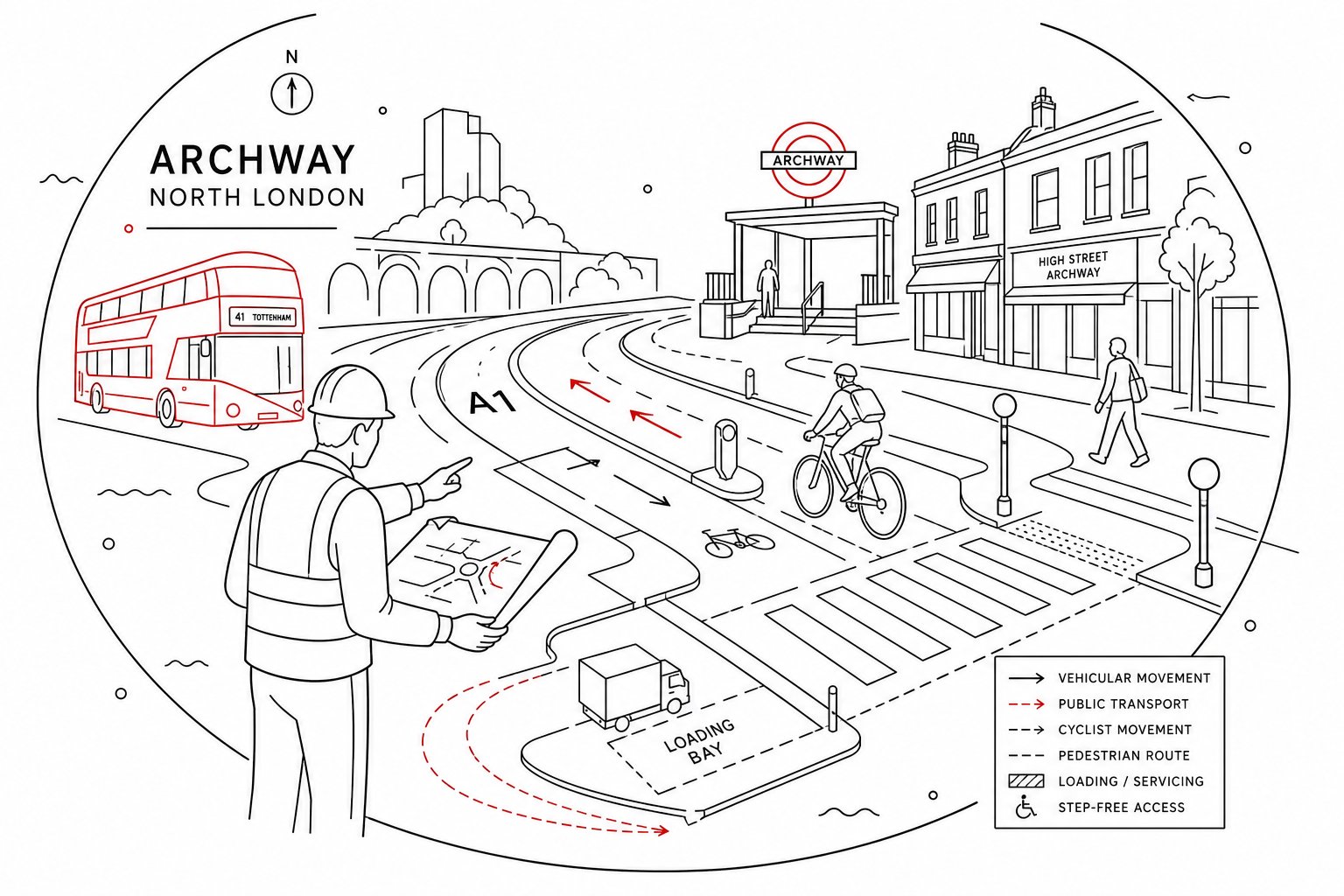
Archway looks straightforward on a map. In practice, it rarely is. The area sits on one of north London’s most sensitive movement corridors, where the A1, major bus routes, Underground access, town centre activity and dense residential streets all compete for limited space. Add a new development into that mix and even a modest change in access, servicing or trip demand can ripple well beyond the site boundary.
That is why transport input matters early. A traffic engineer in Archway does far more than count vehicles or produce a report for a planning file. We help development teams understand how people, deliveries, refuse vehicles, cyclists, buses and general traffic actually move through the area, then turn that understanding into planning evidence and practical design solutions. In Archway, that often means balancing policy pressure for sustainable travel with very real questions about loading, kerbside management, visibility, safety and network impact.
For architects, planners, surveyors, lawyers, developers and councils, the challenge is usually the same: what level of transport work is proportionate, what the local authority and TfL are likely to scrutinise, and how to avoid avoidable objections. This guide sets out how we approach planning, access and transport assessments in Archway for 2026 schemes, what constraints tend to arise, and where specialist traffic engineering advice can save both time and redesign later on.
Key Takeaways
- A traffic engineer in Archway plays a crucial role early in development projects by assessing how people, deliveries, and vehicles move through the area to create practical and compliant planning solutions.
- Transport assessments in Archway must address complex constraints like limited kerb space, busy bus routes, pedestrian flows, and safety, affecting site layout, servicing, and access design.
- Developments likely require a Transport Statement or a Transport Assessment based on trip generation, access changes, and servicing demands, ensuring tailored scrutiny aligned with Islington and TfL policies.
- Specialist traffic engineering advice helps reconcile multi-authority requirements, balancing local street function with strategic network impacts to reduce planning objections and delays.
- Early traffic input improves planning success by identifying issues such as unsafe access or over-optimistic parking assumptions before submission, saving time and costs.
- Effective access design for pedestrians, cyclists, and vehicles in Archway enhances safety and usability by removing conflicts and considering real street conditions rather than idealised layouts.
Why Transport Input Matters For Development In Archway
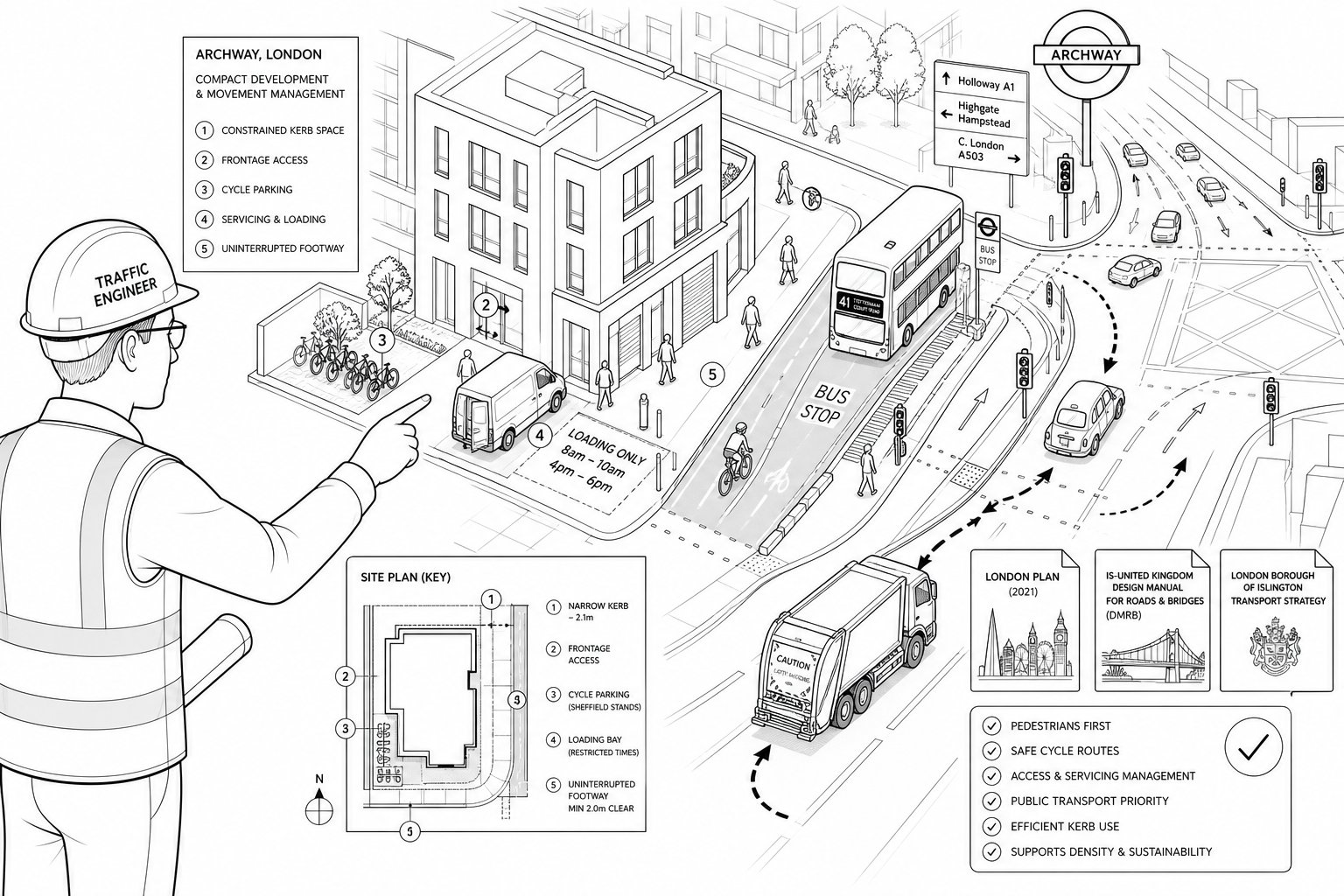
Archway is not the kind of place where transport can be treated as a late-stage planning appendix. It is a dense urban centre within Islington’s strategic context, with a road network that carries through-movement, a busy public transport interchange, strong walking demand and significant cycle activity. That combination makes the area highly responsive to even small development changes.
The planning issue is not simply whether a site can be reached. It is whether a proposal can function safely and efficiently without creating knock-on problems for the surrounding network. A new crossover might interfere with footway continuity. A servicing strategy that looks fine on a drawing could fail once bus stops, waiting restrictions and peak loading pressure are taken into account. A seemingly low-car scheme may still generate concentrated delivery, taxi and refuse movements that need careful management.
In Archway, transport input supports compliance with the London Plan, Islington policy and TfL expectations. It also gives the wider team a practical framework for decision-making. We often find that early transport review helps determine site layout, frontage treatment, cycle provision, servicing arrangements and whether a scheme should be assessed through a proportionate statement or a fuller assessment.
That is especially important on constrained sites. In a location with limited kerb space and heavy multi-modal demand, transport is often where an otherwise promising scheme becomes either deliverable or problematic.
The Role Of A Traffic Engineer In Planning Applications
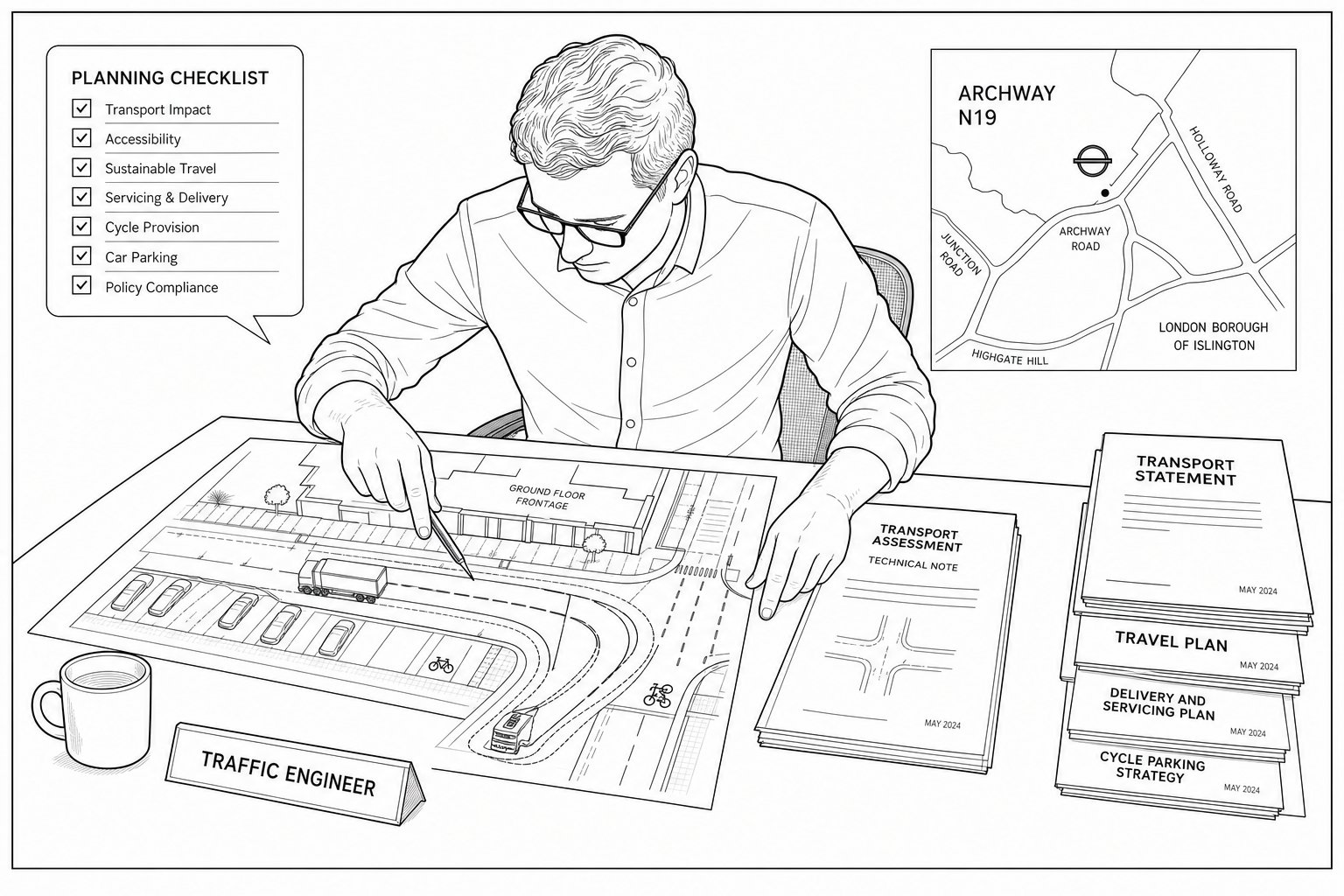
The role is part analyst, part designer and part negotiator. For planning applications in Archway, we typically start by identifying what the authority is likely to need and what the scheme itself genuinely requires. That scoping stage matters. Too little evidence invites objections: too much can waste time and cost without improving the outcome.
We prepare the core transport documents used in planning, including Transport Statements, Transport Assessments, Travel Plans, Delivery and Servicing Plans and Construction Logistics Plans. We also review access geometry, visibility, swept paths, road safety implications, parking strategy, cycle provision and likely effects on nearby junctions or kerbside operations.
Just as importantly, we translate technical findings into planning language the rest of the consultant team can use. Architects need to know whether a loading bay can actually work. Planning consultants need defensible policy arguments. Solicitors and developers need clarity on risk. A good transport submission is not just technically correct: it must also be proportionate, readable and aligned with the decision-making priorities of Islington and TfL.
For broader context, our work often sits alongside wider Traffic Engineering and Transportation advice and the kind of local authority-facing support covered in Traffic Engineer In London:.
In short, we help move a scheme from transport uncertainty to a planning position that can be tested, discussed and approved.
Key Highways And Movement Constraints Around Archway
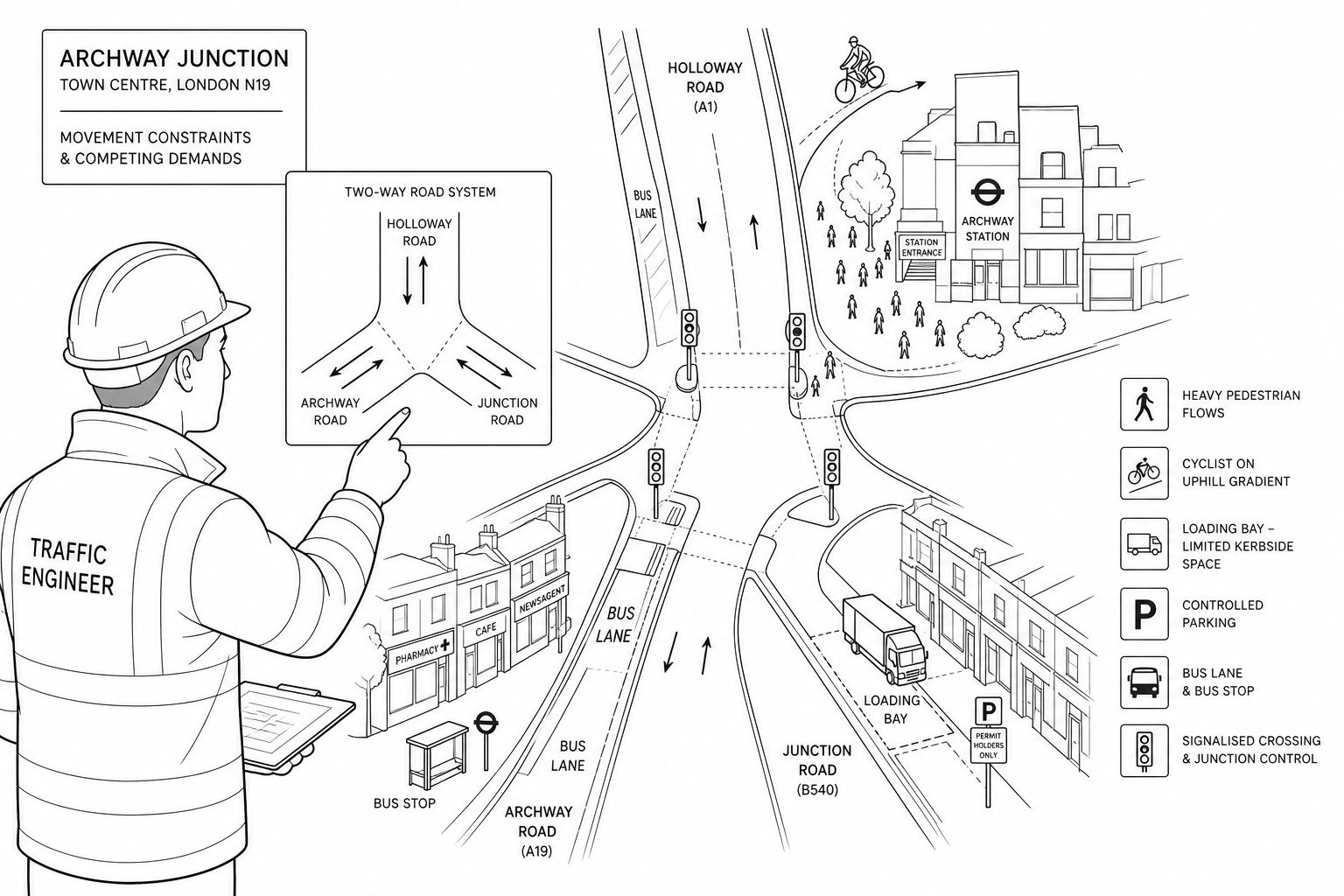
Any serious transport appraisal in Archway has to begin with the network itself. The A1 Archway Road and Holloway Road form part of the TfL Road Network, which means strategic traffic considerations, bus reliability and corridor management are central issues. Junction Road and the surrounding local streets add another layer of sensitivity, particularly where residential frontages, schools, shops and pedestrian desire lines overlap.
The old gyratory changes are still relevant because they reshaped how movement works in the town centre. The move to a two-way system improved legibility and public realm in many respects, but it also created a network where junction efficiency, crossing movements and kerbside activity need close attention. That is not a criticism: it is simply the reality of a place trying to serve through-traffic and local urban life at the same time.
Typical constraints include:
- limited frontage for loading and refuse collection
- controlled parking zones and restricted parking supply
- heavy bus activity and bus priority measures
- significant pedestrian flows around the station and town centre
- cycle routes and informal cycle desire lines
- steep gradients that affect walking, cycling and servicing behaviour
- signalised junctions where new access movements can be difficult to justify
These are exactly the kinds of issues that make Highway And Traffic Engineering input valuable. In Archway, constraints are rarely isolated. Parking affects servicing: servicing affects buses: buses affect junction operation: and all of it affects planning risk.
Common Transport Reports Needed For Archway Schemes
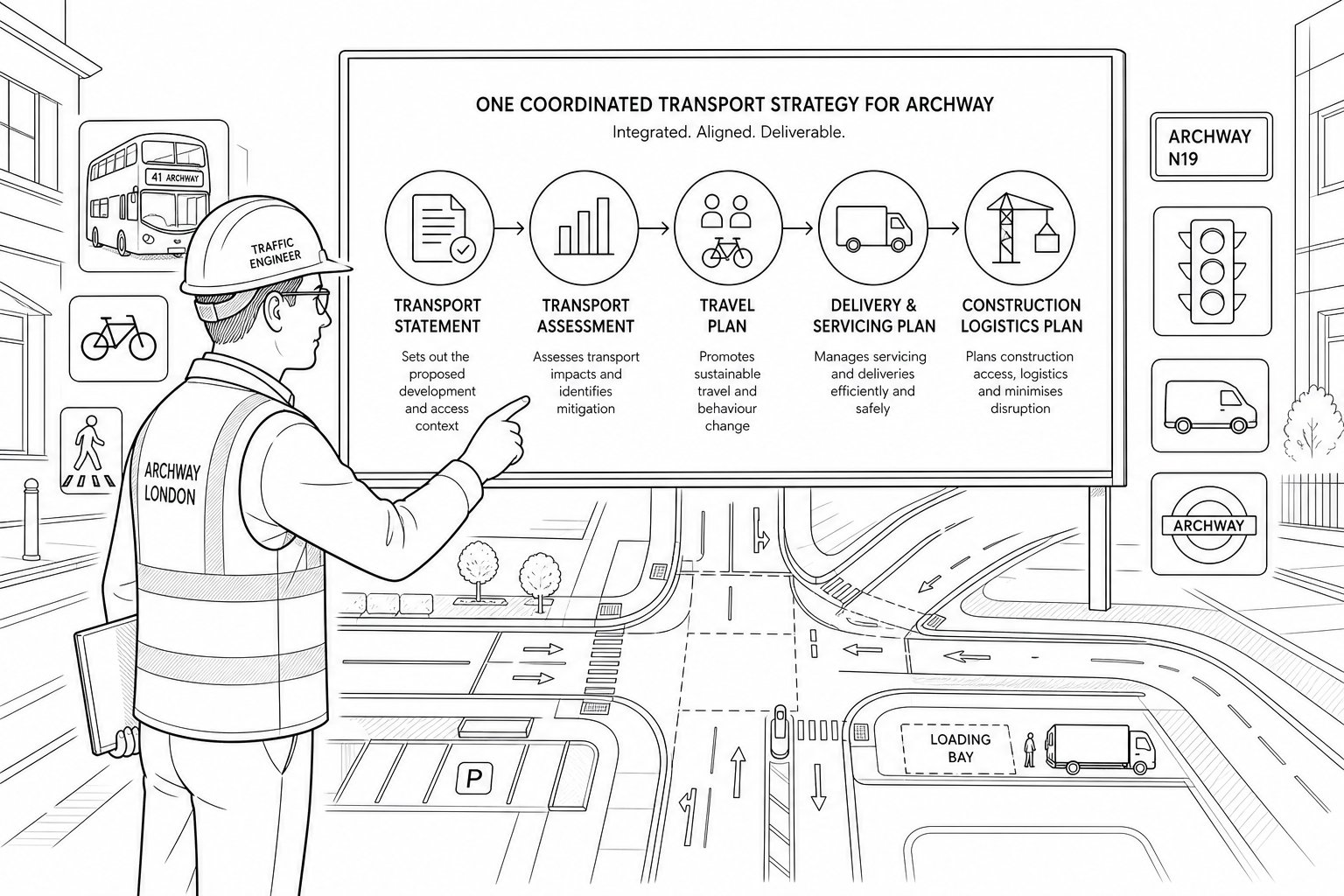
Most Archway developments do not need every possible transport document, but many need more than one. The right package depends on scale, land use, access conditions and the authority’s likely concerns. In practice, the common reports are fairly predictable: a Transport Statement or Transport Assessment, a Travel Plan, a Delivery and Servicing Plan, and for active build phases, a Construction Logistics Plan.
Supporting technical material may also be required. That can include parking beat surveys, cycle parking audits, junction capacity modelling, swept-path drawings, visibility checks, road safety review or occasionally a Road Safety Audit where physical highway works are proposed. The important point is that these documents should not be treated as separate silos. They need to align.
A weak planning submission often shows internal contradictions: a transport note assuming low delivery activity while the operational strategy suggests frequent servicing, or a car-free statement that fails to address blue badge provision and moving-in logistics. We avoid that by making the reports speak to each other.
For development teams dealing with employment, retail or mixed-use schemes, the issues often overlap with broader Commercial Traffic Engineering In practice, particularly where servicing and frontage management become central planning questions.
Transport Statement And Transport Assessment
A Transport Statement, or TS, is usually suitable for smaller or less transport-intensive schemes where impacts are likely to be limited and can be assessed proportionately. It normally covers existing conditions, accessibility, expected trip generation, parking, servicing and access arrangements, with a reasoned conclusion on whether material effects are likely.
A Transport Assessment, or TA, goes further. It is generally needed for larger developments, more sensitive uses, or sites where interaction with the surrounding network is a live concern. In Archway, that may include proposals close to the A1, signalised junctions, bus corridors or heavily used pedestrian and cycle routes. A TA can involve multi-modal analysis, future-year assessments, queue or capacity modelling, and a more developed mitigation package.
The difference is not just length. It is the level of scrutiny. A TS says, in effect, this scheme is modest and understood. A TA says, this scheme has meaningful impacts and we have tested them properly.
Travel Plans, Delivery Plans, And Construction Logistics
Travel Plans are often essential in Archway because policy expectations strongly favour sustainable travel. A good Travel Plan does not simply promise residents or staff will walk, cycle or use public transport. It sets out realistic measures, targets, monitoring arrangements and management responsibilities. In a high-PTAL area, authorities will expect that strategy to be credible.
Delivery and Servicing Plans deal with the operational reality many planning submissions underplay. When do deliveries happen? Where do vehicles stop? How is waste collected? Can loading be accommodated on site, or must it be managed from the kerbside under restrictions? In Archway, these questions can become decisive.
Construction Logistics Plans matter for buildability and neighbour impact. They cover routeing, contractor management, timing restrictions, vehicle sizes, holding arrangements and how construction traffic avoids creating unnecessary conflict with buses, schools, cyclists and peak pedestrian periods. On constrained sites, a robust CLP can make the difference between confidence and objection.
When A Development In Archway Is Likely To Need A Traffic Assessment
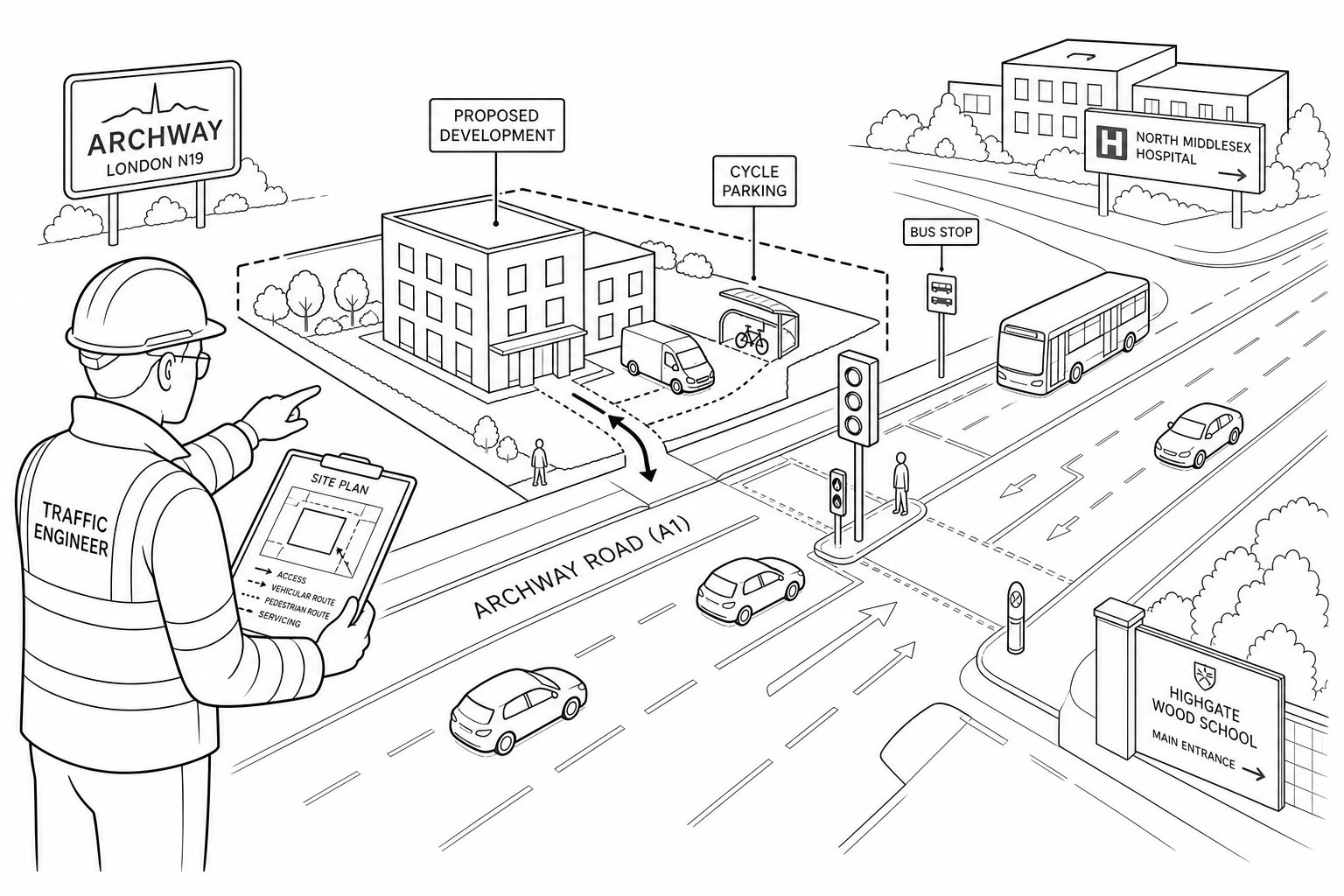
There is no single universal threshold that answers this for every site, but there are clear indicators. In Archway, a development is likely to need a traffic assessment when it creates material trip generation, changes access in a sensitive location, or introduces servicing and parking demands that could affect the surrounding network.
Large residential schemes are obvious candidates, but they are not the only ones. Student accommodation, offices, healthcare, education, retail, leisure, hotel and mixed-use proposals can all trigger a TA, particularly where peaks align with busy network periods or where servicing demand is concentrated. Even a medium-sized scheme may require fuller analysis if it sits near a signalised junction, bus stop, school frontage, hospital access or strategic route.
Location often matters as much as scale. A compact site fronting a quiet side street may be manageable through a TS. A smaller proposal directly affecting a constrained frontage on or near the A1 may need more detailed work because the operational consequences are sharper.
Pre-application engagement usually helps confirm scope. We use that stage to test whether the authority is likely to focus on access safety, junction impact, deliveries, cycle parking, blue badge provision or construction traffic. That approach reflects how experienced Traffic Engineering Consultants: tend to work: define the real planning issue first, then prepare evidence to match it.
In our experience, the schemes that struggle most are not always the biggest. They are the ones that underestimate local sensitivity and submit transport work that is too thin for the site context.
How Trip Generation, Parking, And Servicing Are Assessed
Trip generation is rarely assessed by guesswork anymore, and it should not be. We typically start with TRICS data, then sense-check it against comparable London sites, local mode share patterns, census information and London-wide travel data. In Archway, those figures must be adjusted for context. High public transport accessibility, car-free or low-car policy expectations, and strong walking and bus use can all reduce private car trip rates while increasing attention on taxi, delivery and cycle activity.
That matters because the planning question is not just how many trips a scheme generates, but what kind of trips, at what times, and on which modes. A residential proposal may produce very low car ownership yet still require careful thought about moving-in, supermarket deliveries, refuse collection and occasional accessible parking demand.
Parking is assessed against the London Plan and Islington standards or maximums, with a particular focus on car-free principles, blue badge provision, cycle parking quality and operational practicality. This is where a sound parking strategy traffic approach can prevent trouble later. Numbers alone are not enough: layout, management and enforceability matter too.
Servicing is then tested through vehicle tracking, loading duration assumptions, kerbside constraints, refuse strategy and time-of-day management. We ask basic but often neglected questions: can the vehicle physically enter and leave? Is loading safe without reversing onto a busy frontage? Will deliveries block a cycle route or bus stop? In Archway, those operational details are often where planning officers and TfL focus their comments.
Working With Islington And Nearby Highway Authorities
In Archway, transport planning rarely sits with one stakeholder alone. Islington Council is the local highway authority for most streets, but TfL has a critical role wherever the A1, bus operations or the wider strategic network are affected. Depending on the site, there may also be cross-boundary considerations involving Camden, Haringey or Barnet, especially if traffic reassignment, servicing routes or cumulative impacts extend beyond the borough line.
That multi-authority context changes how reports should be written. A submission aimed only at local streets can miss TfL concerns about bus reliability, signal operation or strategic route management. Equally, a technically sound network appraisal can still run into trouble if it does not address borough policy around public realm, active travel and local street function.
We hence align transport material with Islington planning and transport policies, relevant street design guidance, cycle design expectations and TfL tools where applicable. The value here is not simply technical compliance. It is presenting evidence in the language and structure officers recognise.
There is also a practical diplomacy to it. Highway officers want concise answers to real operational questions. TfL wants confidence that strategic impacts are understood and mitigated. Development teams want a pathway to consent, not a drawn-out exchange of clarifications. Solid Traffic Engineering: Your practice helps bridge those needs.
Where early discussions are available, we generally advise using them. They can narrow the scope, identify authority concerns early and reduce the chance of a submission being bounced back for more evidence.
Designing Safe Access For Pedestrians, Cyclists, And Vehicles
Access design in Archway has to be more than technically passable. It must work for a street environment where pedestrian movement is intense, cycle activity is growing and vehicle access is often physically constrained. That means balancing geometric standards with place-sensitive judgement.
We typically draw on Manual for Streets, relevant DMRB principles where applicable, London cycling guidance and current best practice for inclusive movement. The design questions are practical. Are sightlines realistic given frontage activity and parked vehicles? Does the access interrupt a busy footway in a way that increases conflict? Can people using wheelchairs, mobility aids or prams move comfortably across the frontage? Does cycle parking sit where people will actually use it rather than where it merely fits?
Vehicle access needs the same level of realism. Swept-path analysis, refuse access, loading manoeuvres, fire access and turning arrangements must all be tested against the street as it exists, not an idealised blank plan. For many urban sites, the best answer is not a bigger access opening but fewer vehicle movements and tighter management.
This is where access design highway thinking becomes central. Small layout choices can materially improve safety and planning prospects: clearer pedestrian priority, better crossing definition, protected cycle storage, rationalised loading arrangements, and frontage designs that support step-free movement.
Good access design does not always look dramatic. Often, it simply removes avoidable conflict before anyone else spots it.
Typical Archway Projects That Benefit From Specialist Traffic Engineering
Some project types in Archway almost always benefit from specialist traffic engineering input, even where the headline scale appears modest. Mixed-use and residential redevelopment around Archway station is the obvious example. These schemes often combine constrained access, high public transport accessibility, low-car expectations and significant delivery or refuse demands.
Purpose-built student accommodation, co-living and hotel projects can be especially sensitive because they tend to generate concentrated arrival patterns, taxi activity, servicing pressure and intensive cycle parking demand. Office and healthcare schemes raise different questions, often around staff and visitor mode split, blue badge access, ambulance or patient drop-off arrangements, and interactions with surrounding peak-hour conditions.
Retail, leisure and community uses also deserve careful scrutiny. Their impacts are not always constant: they can be highly time-specific. A food-led unit, gym or late-opening venue may place pressure on kerbside space at exactly the times surrounding streets are already busy.
Then there are public realm and highway-led interventions: altered junctions, new crossings, cycle schemes, changes to waiting and loading restrictions, and frontage redesigns. These can trigger transport work even when there is no conventional building floor area increase.
Across these project types, the common thread is complexity rather than size. Where movement patterns are mixed, frontage space is limited and authority scrutiny is likely, specialist transport advice helps teams avoid making design assumptions that later prove impossible to support in planning.
How Early Traffic Advice Can Reduce Planning Delays And Objections
Early traffic advice is one of the cheapest forms of risk reduction in the planning process. That may sound self-serving, but anyone who has had to redesign a frontage after submission knows it is true. In Archway, transport objections often arise from issues that were visible from the start: an unsafe or impractical access, a weak servicing plan, over-optimistic parking assumptions, or a failure to appreciate TfL sensitivity on the strategic network.
When we are involved early, we can test those pressure points before the design hardens. Sometimes that means confirming a straightforward route to submission. Other times it means changing the site layout, reducing vehicular dependence, relocating loading, or reframing the planning strategy around a proportionate but credible evidence base.
That early work also helps with programme certainty. Reports are scoped correctly, surveys are commissioned at the right stage, and the authority receives a submission that anticipates the obvious questions. For busy consultant teams, that can remove weeks of back-and-forth.
The benefit is not only technical. Residents and local stakeholders often respond strongly to perceived traffic and safety impacts, even on low-car schemes. A clear explanation of access, servicing and sustainable travel strategy can reduce room for misunderstanding and strengthen the planning narrative.
Put simply, early transport advice helps identify show-stoppers while they are still solvable. By the time a formal objection lands, the cheapest fix has usually gone.
Conclusion
Archway is one of those locations where transport detail genuinely shapes planning success. With the A1 corridor, heavy bus activity, strong walking and cycling demand, constrained kerbside conditions and close policy scrutiny, development proposals need more than generic transport text. They need evidence that reflects how the area actually works.
That is where a traffic engineer in Archway adds value. We help development teams decide what level of assessment is needed, prepare robust TS or TA material, design workable access, address parking and servicing realistically, and engage with Islington and TfL in a way that reduces uncertainty. For 2026 schemes, the advantage of doing that early is simple: fewer surprises, fewer objections and a much better chance of reaching a planning outcome that is both compliant and deliverable.
In a constrained town-centre environment, transport is rarely just a supporting chapter. More often, it is the thread that holds the application together.
Frequently Asked Questions about Traffic Engineering in Archway
What role does a traffic engineer play in planning applications in Archway?
A traffic engineer in Archway identifies authority requirements, prepares Transport Statements, Travel Plans, and assesses access, visibility and parking. They ensure plans meet Islington and TfL policies, smoothing planning consent by aligning technical evidence with local priorities, as detailed in Traffic Engineering Consultants: What They Do, When You Need One, And How They Support Planning Success In 2026.
When is a Transport Assessment needed for a development in Archway?
Developments generating significant trips, especially near the A1 or signalised junctions, require a Transport Assessment. This detailed analysis covers multi-modal impacts and mitigation. Smaller sites may use a Transport Statement. Early scoping with authorities helps define the scope, as explained in Traffic Engineering and Transportation Planning: A Practical Guide for Development Success.
How do traffic engineers assess trip generation and parking for Archway schemes?
They use TRICS data adjusted for local public transport accessibility and car-free policies, modelling realistic trip types and times. Parking strategies follow London Plan and Islington maximums, including blue badge and cycle parking standards, ensuring practical and enforceable layouts as described in parking strategy traffic engineering: Parking Strategy In Traffic Engineering: A Practical Guide For Planning, Capacity, And Compliance In 2026.
What are the key movement constraints affecting traffic in Archway?
Constraints include limited kerb space, heavy bus activity on the A1 TfL network, controlled parking zones, busy pedestrian and cycle flows, and steep gradients. Managing these demands careful design of access and servicing to prevent conflicts, aligning with local policy and good practice found in Highway And Traffic Engineering Consultants: What They Do And Why They Matter For Planning Success In 2026.
How can early traffic engineering advice reduce planning objections in Archway?
Early advice helps identify and address design or operational issues before submission, refining access, servicing, parking, and sustainable travel strategies. This reduces time and costs by avoiding redesign or obstacle-driven refusals, promoting smoother dialogue with Islington and TfL as detailed in Traffic Engineer In London: Planning Support, Transport Reports, And Local Authority Insight In 2026.
How is safe access design achieved for pedestrians, cyclists, and vehicles in Archway developments?
Design follows standards like Manual for Streets and London cycling guidance to ensure sightlines, footway continuity, step-free crossings, and secure cycle parking. Vehicle manoeuvres consider swept path, refuse access, and turning heads, balancing technical criteria with place-sensitive judgement, as outlined in access design highway engineering: Access Design In Highway Engineering: A Practical Guide For Planning Applications In 2026.