
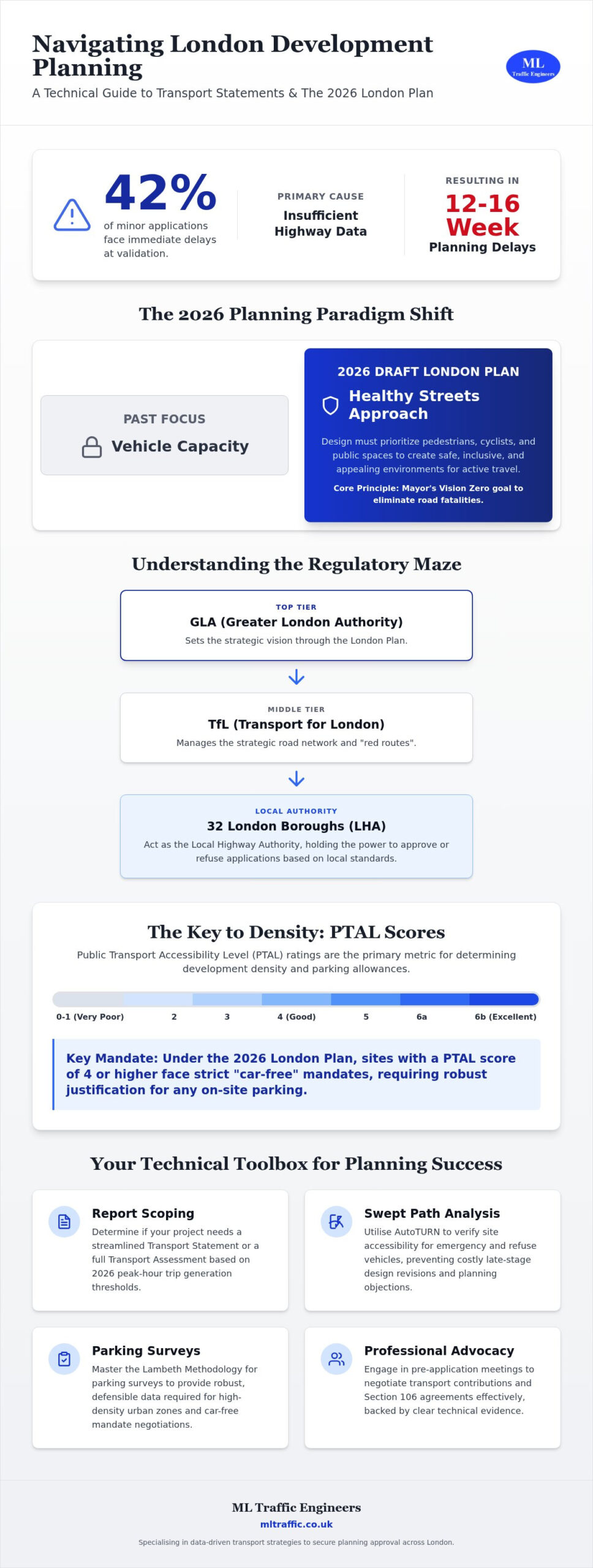
Did you know that 42% of minor development applications in London face immediate delays at the validation stage because they lack sufficient highway data? In the current 2026 planning climate, submitting a transport statement for new developments london is no longer a mere formality. It’s a high-stakes technical negotiation. With the Draft London Plan 2026 now in consultation, the friction between Transport for London (TfL) requirements and local borough mandates has never been more complex.
We recognise that managing conflicting PTAL ratings and car-free mandates often feels like an expensive hurdle. You’re likely focused on avoiding the 12 to 16 week delays that follow a transport objection. This guide provides the strategic insight you need to secure planning approval with technical precision while optimising your site capacity. We’ll examine the latest 2026 thresholds, the shift toward Healthy Streets metrics, and how to use data-driven design to bypass common planning bottlenecks.
Key Takeaways
- Understand the regulatory hierarchy between the GLA, TfL, and local boroughs to ensure your project aligns with the 2026 London Plan pillars.
- Identify whether your project requires a full Assessment or a streamlined transport statement for new developments london based on 2026 peak-hour movement thresholds.
- Utilise technical tools like AutoTURN Swept Path Analysis to verify site accessibility for emergency and refuse vehicles, which prevents costly design revisions.
- Master the Lambeth Methodology for parking surveys to provide the robust data required for high-density urban zones and car-free mandates.
- Learn how professional advocacy in pre-application meetings helps you negotiate transport contributions and Section 106 agreements more effectively.
Defining London Transport Planning for New Developments
While most Londoners view transport planning through the lens of a Transport for London (TfL) journey app, developers face a much stricter statutory reality. Statutory transport planning isn’t about finding the quickest route; it’s about proving that a new building won’t break the existing network. In 2026, a transport statement for new developments london acts as the primary gatekeeper for planning approval. Without a robust technical justification for site access and trip generation, even the most architecturally sound projects fail at the validation stage.
The current Draft London Plan 2026 shifts the focus from vehicle capacity to the “Healthy Streets” approach. This framework uses ten specific indicators to ensure public spaces are safe, inclusive, and appealing for active travel. For developers, this means site design must prioritise pedestrians and cyclists over private car storage. Successful planning applications now use transport data to facilitate higher urban density, proving that sustainable infrastructure can support more residents without increasing local congestion.
To better understand how these technical requirements influence your application, watch this helpful video:
The Core Objectives of a Development Transport Strategy
Safe, multi-modal access is the foundation of any modern development. Your strategy must achieve several critical goals to pass borough scrutiny:
- Demonstrate safe, accessible entry points for residents, visitors, and commercial deliveries.
- Mitigate the cumulative impact of new trips on the local London road network using up-to-date TRICS data.
- Align site layouts with sustainable transport goals to reduce reliance on private vehicles.
Under the Mayor’s Vision Zero goal, 2026 site layouts must eliminate all potential conflict points between vulnerable road users and heavy service vehicles to ensure zero fatal incidents.
Early-Stage Integration: Why Timing Matters
Retrofitting access solutions after a design is finalised is a costly mistake. Early-stage transport feasibility studies identify constraints before they become planning objections. This data directly influences internal site layouts and unit capacity, ensuring you don’t lose valuable square footage to inefficient vehicle tracking. Commissioning a transport statement for new developments london during the pre-planning phase allows us to identify these risks early. Explore our project types to see how early-stage integration secures smoother approvals across diverse London sites.
The Regulatory Framework: TfL, Boroughs, and the London Plan
Success in London planning requires a clear understanding of the three-tier regulatory system. The Greater London Authority (GLA) sets the strategic vision through the London Plan, while Transport for London (TfL) manages the strategic road network and red routes. However, the 32 London Boroughs act as the Local Highway Authority (LHA) for most development sites. This hierarchy creates a complex environment where national standards, such as the UK Government Planning Practice Guidance, are filtered through specific regional mandates. The LHA holds the power to recommend refusal if your proposal doesn’t meet local safety or capacity standards.
The 2026 London Plan draft, published in July 2026, reinforces the “car-free” mandate for areas with high public transport accessibility. Developers often face tension between these strategic goals and the practical parking needs of local residents. While TfL pushes for zero on-site parking in most zones, some boroughs maintain specific requirements for blue-badge holders and essential service vehicles. A technical transport statement for new developments london must bridge this gap, justifying site-specific deviations through robust data and professional advocacy.
PTAL Scores: The DNA of London Development Density
PTAL (Public Transport Accessibility Level) ratings from 0 to 6b are the primary metric for determining development density and parking allowances. In 2026, any site with a PTAL score of 4 or higher is typically mandated as “car-free,” with the exception of essential disabled parking. This “car-capped” status is a non-negotiable pillar of the current planning framework. Because transport networks evolve, you must verify your PTAL scores against the latest 2026 database to ensure your application uses current accessibility metrics. An inaccurate rating can lead to an immediate rejection of your parking strategy at the validation stage.
Borough-Specific Nuances and Local Plans
Local policies often supersede general London Plan guidance when specific urban constraints exist. For instance, high-density boroughs like Tower Hamlets enforce strict cycle parking ratios and delivery requirements that differ significantly from the suburban standards found in Richmond or Bromley. If you are working in East London, our guide on Transport Planning Consultants Tower Hamlets provides specific insights into these local variations. Understanding these nuances ensures your transport statement for new developments london addresses the exact concerns of the borough’s planning officers, reducing the risk of costly revisions.
Essential Technical Reports: Statements vs. Assessments
Choosing the correct technical report is a critical decision that determines your project’s timeline and budget. A transport statement for new developments london serves as a concise evaluation for projects with a limited impact on the local highway network. In contrast, a Transport Assessment is a comprehensive study required for major schemes that could significantly alter traffic patterns or public transport capacity. Both documents rely on precise baseline data collection to establish a “nil-detriment” position. This technical benchmark proves that your proposal won’t negatively affect the safety or capacity of the existing infrastructure.
Establishing nil-detriment requires comparing the existing site usage against the proposed development’s impact using industry-standard TRICS data. If the new project generates fewer or equivalent peak-hour movements, we can argue that the development has a neutral impact. This technical advocacy is essential for securing approval in high-density areas where road capacity is already at its limit. We use these findings to justify site density while ensuring the project remains compliant with the latest 2026 safety standards.
Report Thresholds: Which Documentation Do You Need?
Report thresholds are generally determined by unit count, floor space, and predicted trip generation. In 2026, a full Transport Assessment is typically mandatory for residential developments of 80 or more units or commercial spaces exceeding 2,500 square metres. However, some boroughs have lowered these thresholds to 30 or 40 units in Air Quality Focus Areas. A robust Transport Statement London can often satisfy the Local Highway Authority for mid-sized projects. Providing high-quality data early can prevent the need for a more expensive and time-consuming full Assessment, keeping your planning application on track.
The Anatomy of a 2026 London Travel Plan
A 2026 London Travel Plan isn’t just a document; it’s a long-term commitment to sustainable movement. It must include SMART targets (Specific, Measurable, Achievable, Relevant, and Time-bound) to encourage walking, cycling, and public transport use. These plans are frequently tied to Section 106 transport obligations, meaning failure to meet targets can lead to financial penalties or monitoring fees. Boroughs now demand detailed strategies for active travel integration to align with the Mayor’s Healthy Streets indicators. For a deeper look at these requirements, see our London Travel Plans guide.
Technical Precision: Swept Path Analysis and Survey Data
Technical precision forms the backbone of a successful transport statement for new developments london. Without empirical data, your application rests on assumptions that planning officers will quickly challenge. We use advanced modelling and rigorous survey techniques to transform subjective design choices into objective, defensible facts. This approach doesn’t just satisfy regulatory requirements; it protects your project from the high costs of late-stage redesigns. By proving that your site can physically accommodate its required functions, you remove the primary grounds for highway objections.
Data-driven advocacy allows us to justify “spare capacity” in the local street network. When residents object based on perceived congestion, we provide the hard numbers that demonstrate the network can handle the additional load. We focus on establishing a clear technical narrative that aligns with borough expectations while maximising your site’s operational potential. If you need technical certainty for your next project, contact ML Traffic Engineers UK for a comprehensive data assessment.
Swept Path Analysis: Eliminating Design Risk
Architects should integrate Swept Path Analysis (SPA) during the initial feasibility phase to avoid “landlocked” site layouts. Using AutoTURN software, we simulate the movements of standard London vehicle templates, including 12m refuse lorries and fire tenders. This ensures that essential service vehicles can enter, turn, and exit the site in forward gear, which is a non-negotiable safety standard for most boroughs. Proving this access early prevents the need to move structural columns or widen access gates after the design is locked. For a detailed breakdown of this process, read our AutoTURN Swept Path Analysis Guide.
Data-Driven Advocacy: Parking and Traffic Surveys
Addressing resident concerns about parking “overspill” requires the industry-standard Lambeth Methodology for parking surveys. This rigorous approach measures parking stress within a 200-metre walking distance of the site over two consecutive weekday nights. In 2026, these surveys must now account for increased EV charging dwell times, as longer stays at public charging points affect local parking availability. Accurate traffic data collection has also evolved, moving from manual counts to Automated Traffic Counts (ATC) to provide 24/7 reliability. This level of detail is essential for proving that your development won’t cause a “severe” impact under the National Planning Policy Framework (NPPF), a label that frequently leads to immediate planning refusal.
Securing Approval: The Path to Planning Success
Securing planning permission in London’s competitive property market requires more than just submitting data. It’s about strategic negotiation and professional advocacy. While previous sections detailed the technical requirements of a transport statement for new developments london, this final stage focuses on turning that data into a formal approval. Planning officers at TfL and local boroughs deal with hundreds of applications. Your project needs a clear, technically sound narrative to move through the system without friction; additionally, ensuring the local community is well-informed through services like LeafletPro UK can be a vital part of your broader engagement strategy.
Negotiation is a vital component of the approval path, particularly regarding Section 106 and Section 278 agreements. These legal frameworks dictate your financial contributions toward local infrastructure and the specific highway works you must fund. We advocate on your behalf to ensure that Community Infrastructure Levy (CIL) payments and transport contributions are proportionate to your project’s actual impact. Our technical authority allows us to challenge over-specified requirements, protecting your project’s viability while meeting all safety benchmarks.
Navigating the Pre-Application Process
We recommend engaging in pre-application meetings to identify potential “show-stoppers” before you commit to a formal submission. This early dialogue allows us to narrow the scope of required transport modelling, which saves you significant time and consultancy fees. By agreeing on the methodology and baseline data with the highway officer upfront, we reduce the risk of unexpected objections later. Learn more about what we do to secure these early wins for our clients.
The ML Traffic Advantage: Precision and Compliance
Our team manages the full project lifecycle, from initial site inception through to the final implementation of S278 and S38 highway designs. We specialise in solving complex access issues for constrained Central London sites where traditional solutions often fail. Whether you’re navigating car-free zone expansions or the latest 2026 PTAL threshold updates, our round-the-clock reliability ensures your project stays on schedule. We provide the technical precision required to meet strict highway design standards, ensuring that adopted roads and site access points are safe and compliant.
Precision isn’t just a functional necessity; it’s your best defence against planning delays. By partnering with experts who understand the intricate regional regulations, you can focus on your development’s vision while we handle the regulatory pressure. We take pride in our adherence to industry benchmarks and our ability to deliver results in high-stakes environments.
Contact ML Traffic Engineers for a London Transport Planning Quote to secure expert advocacy for your next development application.
Optimising Your Development for 2026 Planning Success
London’s planning environment demands technical excellence and strategic foresight. We’ve explored how accurate PTAL verification and the Healthy Streets approach define modern site capacity. Securing a transport statement for new developments london isn’t just about meeting a threshold; it’s about providing the technical justification that planning officers require to approve your vision. Technical precision in swept path analysis and parking surveys remains your strongest tool to bypass regulatory bottlenecks and secure your project’s timeline.
Since 2014, we’ve specialised in navigating London Borough statutory requirements to deliver successful submissions. We manage the full project lifecycle from initial inception to complex S278 implementation, ensuring your project remains compliant and cost-effective. Our proven track record in pre-application negotiations helps reduce regulatory friction and avoids expensive planning stalls. This technical authority protects your site capacity and simplifies the path to approval.
Secure Your London Planning Approval with Expert Transport Planning. Let’s ensure your development moves forward with unwavering reliability and precision.
Frequently Asked Questions
What is the difference between a Transport Statement and a Transport Assessment in London?
The primary difference lies in the scale of the development and its predicted impact on the highway network. A Transport Statement is a streamlined report for developments with minor impacts, typically those generating between 30 and 50 vehicle movements during peak hours. In contrast, a Transport Assessment is a comprehensive study required for major London projects, such as residential schemes with 80 or more units or commercial spaces exceeding 2,500 square metres. Both documents justify the site’s impact, but the Assessment requires deeper modelling of public transport capacity and junction performance.
When is a Travel Plan mandatory for a new London development?
A Travel Plan is mandatory for all major developments in London and any project where the Local Highway Authority identifies a need to manage long-term modal shift. These plans are essential for developments exceeding 80 residential units or significant commercial floor space. They include SMART targets to reduce private car use and promote walking, cycling, and public transport integration to align with the Mayor’s Healthy Streets indicators. Failure to meet these targets can lead to financial penalties under Section 106 monitoring obligations.
How does a PTAL score affect my allowable parking permit allocation?
Your PTAL score directly determines the maximum allowable parking provision and whether residents can apply for local on-street permits. Under the 2026 London Plan, sites with a PTAL score of 4 or higher are mandated as “car-free,” meaning no on-site parking is permitted except for blue-badge holders. Boroughs often use Section 106 agreements to legally restrict residents of these developments from obtaining local Controlled Parking Zone (CPZ) permits, ensuring the development doesn’t increase local parking stress.
What is Swept Path Analysis and why is it required for fire access?
Swept Path Analysis (SPA) is a computer-aided simulation that tracks the path of a vehicle’s body and wheels during a manoeuvre. It’s a mandatory requirement for proving that emergency vehicles, such as a 12-metre fire tender, can safely enter and turn within your site. Proving this physical feasibility early prevents design objections from the London Fire Brigade and ensures compliance with Building Regulations Part B. It also verifies that refuse vehicles can service the site in forward gear, which is a standard borough requirement.
How long does it take to complete a London parking survey using the Lambeth Methodology?
A standard London parking survey using the Lambeth Methodology typically takes two consecutive weekday nights to complete, usually between 00:30 and 05:30. This timeframe captures the peak period of residential parking demand when most residents are at home. The resulting data provides an empirical measure of “parking stress,” which is vital when submitting a transport statement for new developments london to justify on-street parking capacity. We provide the final analysis shortly after the data collection is finalised to keep your application moving.
What are the 2026 London Plan requirements for EV charging points in new builds?
As of 2026, the London Plan requires that 100% of any permitted parking spaces in new developments must include active electric vehicle (EV) charging points. This mandate ensures that all parking infrastructure is ready for immediate use rather than relying on passive provision. Developers must also demonstrate that the site’s electrical capacity can support simultaneous rapid charging without straining the local grid. This requirement applies to both residential and commercial permitted spaces, including disabled parking bays.
Can I build a car-free development in a low PTAL zone?
You can build a car-free development in a low PTAL zone, but it requires robust technical justification to prevent “overspill” into neighbouring streets. Boroughs will typically demand a detailed parking survey to prove there is sufficient spare capacity on the local road network to accommodate any displaced parking. Successfully delivering a car-free project in PTAL 0-2 areas often depends on professional advocacy and a strong Travel Plan that provides viable alternatives to private car ownership, such as car club memberships. For residents who still require a personal vehicle, providing resources to explore Vehicle History and Advisory Reports can help them choose safer and more reliable used cars that align with modern safety standards.
How do I deal with a transport-related objection from a London Borough?
Dealing with a transport objection requires a precise technical rebuttal supported by empirical data or revised modelling. We often resolve these issues by conducting a targeted Swept Path Analysis or updated parking survey to address the specific concerns of the highway officer. Engaging in professional advocacy during pre-application meetings is the most effective way to narrow the scope of objections. If an objection arises after submission, we negotiate directly with the borough to find a design-led or data-driven solution that satisfies their safety and capacity concerns.

Disclaimer
The content on mltraffic.co.uk, including all technical articles, guides, and resources, is provided for general informational and educational purposes only. It is not intended to constitute professional advice in traffic engineering, transportation planning, development approvals, or any other technical or legal field.
While ML Traffic Engineers makes every reasonable effort to ensure the accuracy, completeness, and timeliness of the information published, we do not provide any warranties or representations (express or implied) regarding its reliability, suitability, or availability for any particular purpose. Any reliance you place on the content is strictly at your own risk.
In no event shall ML Traffic Engineers, its directors, employees, authors, or affiliates be liable for any direct, indirect, incidental, special, consequential, or punitive damages (including, without limitation, loss of profits, data, or business opportunities) arising out of or in connection with the use of, or inability to use, any information provided on this website.
The articles and guides on this site are not a substitute for engaging a qualified, professional traffic engineer to assess your specific project requirements. For tailored advice, compliance assessments, or traffic engineering services, please contact a competent professional.
This disclaimer may be updated from time to time without notice. By accessing or using this website, you agree to be bound by the most current version of this disclaimer.