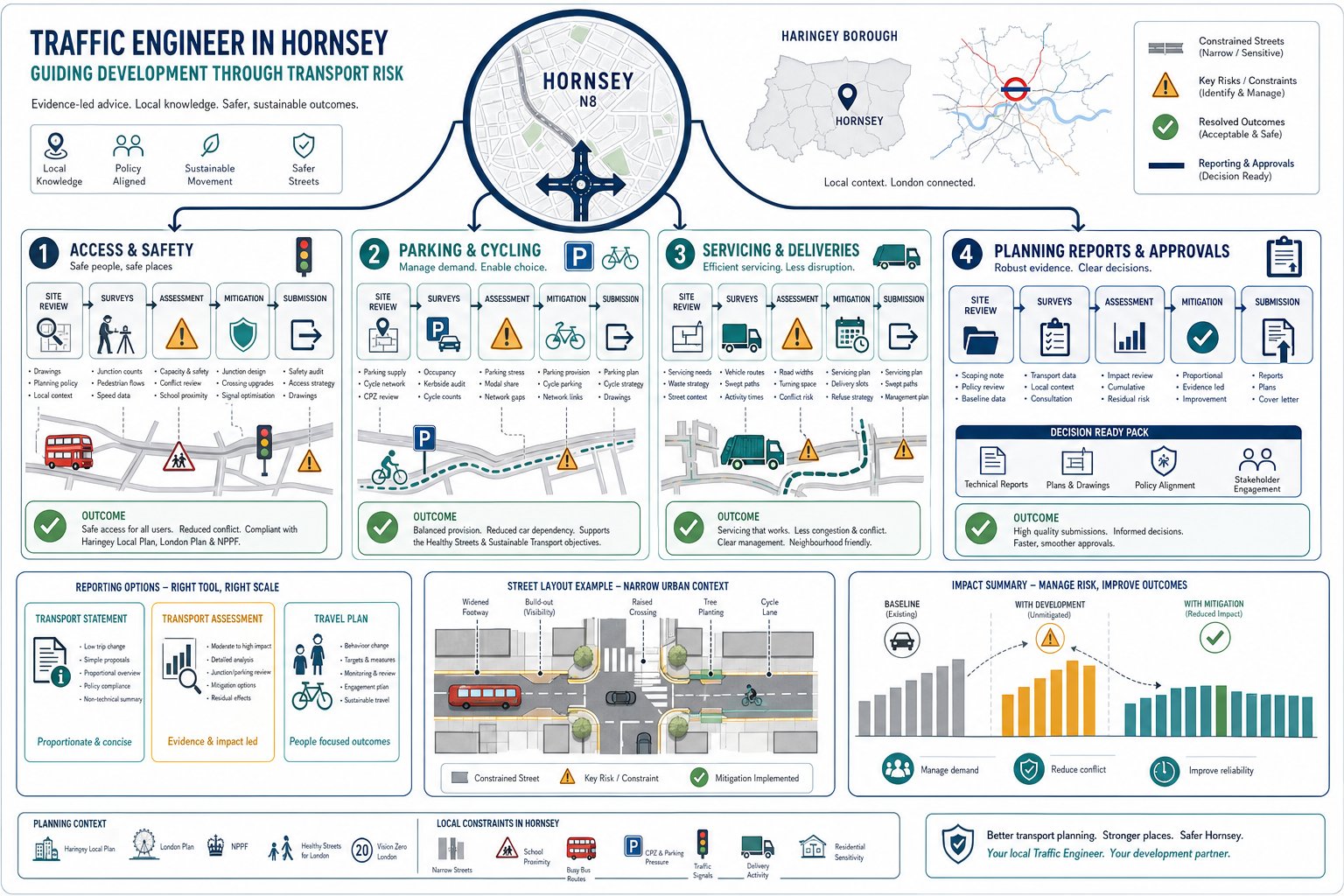
Hornsey schemes rarely sit in a vacuum. A modest infill plot can front a busy bus corridor. A change of use can intensify servicing on a constrained street. A residential proposal that looks straightforward on the architect’s drawings may, once tested properly, raise questions about parking stress, visibility, refuse access, cycle provision, school-street timing, or cumulative traffic effects. That’s usually where a Traffic Engineer In Hornsey becomes central to the planning process.
We work with architects, planning consultants, developers, surveyors and legal teams to turn transport risk into something measurable and manageable. In practice, that means assessing how a proposal will affect the highway network, whether access is safe, whether parking and servicing arrangements are credible, and what level of reporting Haringey Council or Transport for London may expect. It also means framing evidence in a way that is proportionate. Not every site needs a full Transport Assessment, but plenty of applications run into trouble because the transport case was too light, too late, or too generic.
In Hornsey, local detail matters. Controlled parking zones, bus operations, cycling links, constrained junctions, and London Plan policy can all influence what is acceptable. The aim of this guide is simple: explain what transport engineers actually do, when you need one, what reports may be required, and how to give your project the best chance of a smooth planning journey in 2026.
Key Takeaways
- A Traffic Engineer In Hornsey plays a crucial role in ensuring development proposals safely and efficiently integrate with local transport networks, addressing issues such as parking, access, and servicing.
- Early involvement of a traffic engineer can shape scheme design to prevent objections, saving time and costs during the planning process.
- Transport reports must be proportionate, evidence-led, and aligned with Hornsey’s local policies, including the London Plan and Haringey standards, to withstand scrutiny.
- Accurate, timely traffic surveys and thorough site assessments are essential for credible transport evidence supporting planning applications.
- Collaborative work with architects, planners, and developers ensures transport issues are addressed proactively, enhancing the likelihood of smooth project approval.
- Selecting a traffic engineer with local London experience and planning understanding is critical to producing clear, relevant, and effective transport reports for Hornsey developments.
What A Traffic Engineer In Hornsey Does For Planning And Development
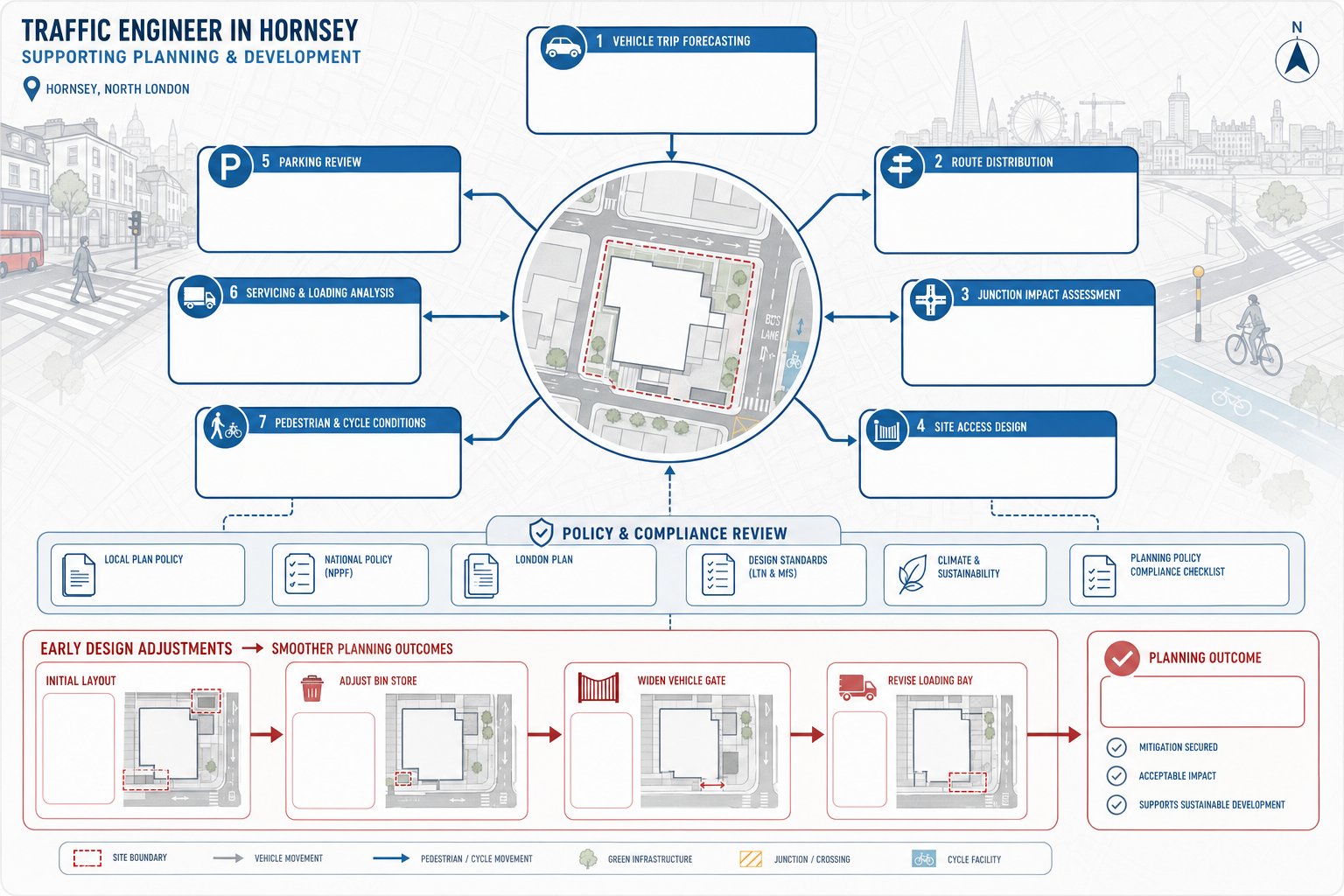
A transport engineer’s role is broader than many teams expect at the outset. We do not simply count vehicles and produce a report. We examine how a development interacts with the surrounding street network and whether that interaction is acceptable in planning and highway terms.
For Hornsey projects, that often includes trip generation forecasting, distribution and assignment, junction impact review, access design, parking assessment, servicing analysis, and review of pedestrian and cycle conditions. We also test whether the proposal aligns with policy and accepted technical guidance, including the National Planning Policy Framework, Manual for Streets, relevant DMRB principles where they apply, the London Plan, and local Haringey standards.
At early stage, our input can influence the scheme itself. A bin store moved 8 metres, a gate widened slightly, or a loading arrangement rethought at concept design stage can prevent months of avoidable objection later. That practical side matters. So does the planning narrative. Decision-makers need clear evidence showing that highway safety is not compromised and that any transport impacts are acceptable or can be mitigated.
For teams working across boroughs, wider London context also helps. Our approach to a Hornsey site usually sits within the same disciplined framework used on broader Traffic Engineer In London: instructions, but with local thresholds, borough expectations and site constraints built in from the start.
When You May Need A Transport Engineer For A Hornsey Project
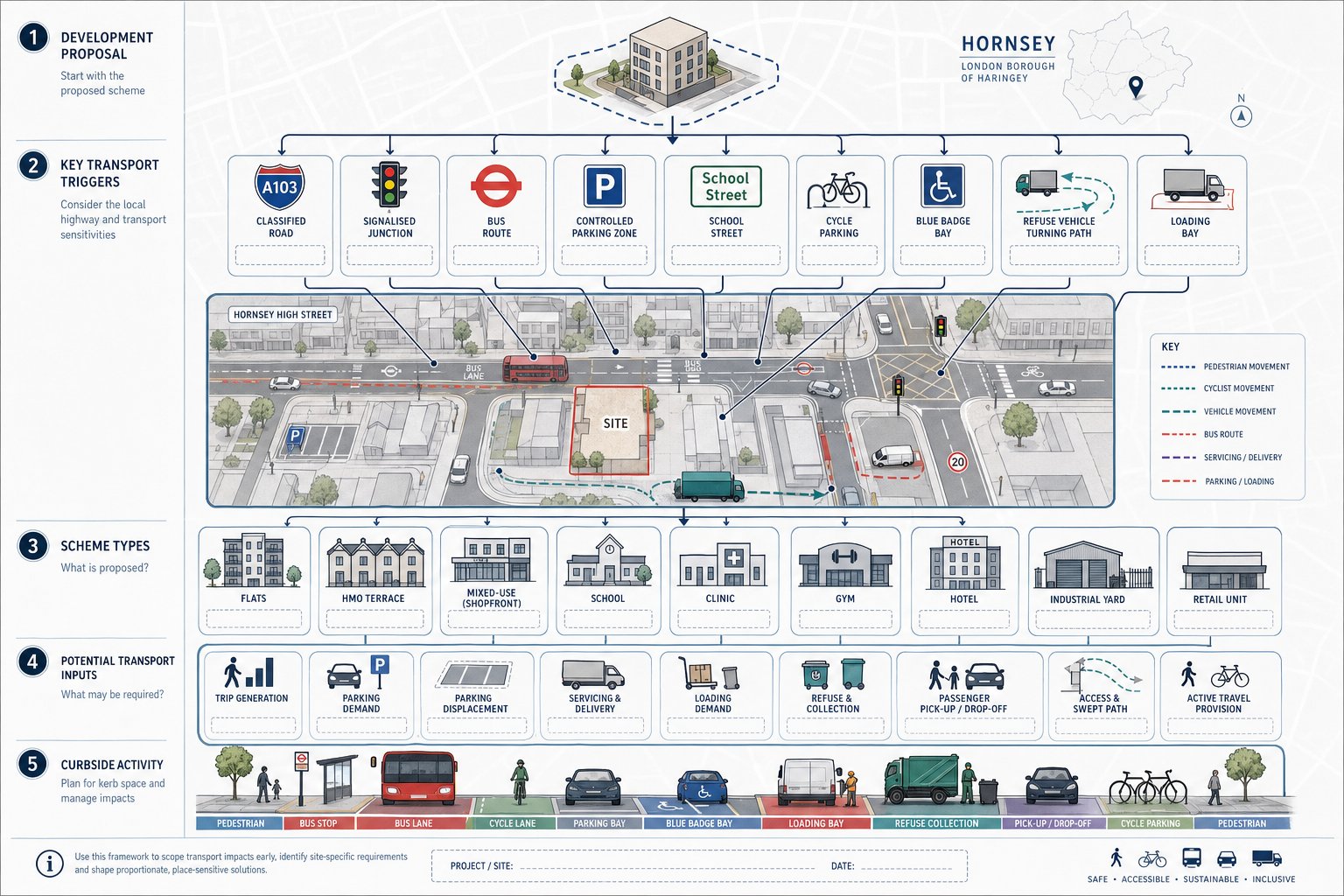
Not every planning application requires specialist transport input, but many more benefit from it than applicants first assume. In Hornsey, the trigger is often not just development size. It is sensitivity.
A relatively small scheme may need a traffic or transport engineer if it sits on a classified road, near a signalised junction, within a constrained controlled parking zone, on a bus route, or in an area with known school-street restrictions. Equally, a change of use from low-intensity retail to a gym, medical use, food-led operation or educational use can materially change arrivals, departures, deliveries and pickup activity.
Residential proposals are a common example. New-build flats, HMOs, mews developments and mixed-use infill schemes can all prompt questions about trip generation, cycle parking, blue-badge provision, refuse vehicle access and parking displacement. Car-free or low-car proposals need especially careful justification in London because the policy direction may support restraint, but only where the practical operation works.
We are often brought in after a pre-app response has flagged the issue, but earlier is better. A short strategic review can identify whether the application is likely to need a statement, a more detailed assessment, swept-path analysis, parking survey work, or direct engagement with highways officers. That can save redesign costs later and reduce the risk of validation or consultation delays.
Typical Schemes That Require Traffic And Transport Input
Typical schemes include residential and mixed-use developments, schools and nurseries, healthcare premises, retail and foodstore formats, gyms, industrial yards, student accommodation, hotel and aparthotel uses, and employment-led sites with servicing demand. Commercial proposals in particular often need robust servicing and loading analysis: the same issues arise repeatedly in Commercial Traffic Engineering work where turnover, delivery timing and kerbside management become decisive.
Even where no formal Transport Assessment threshold is obvious, a well-judged transport note can still make the planning case more resilient.
Local Planning And Highway Considerations In Hornsey
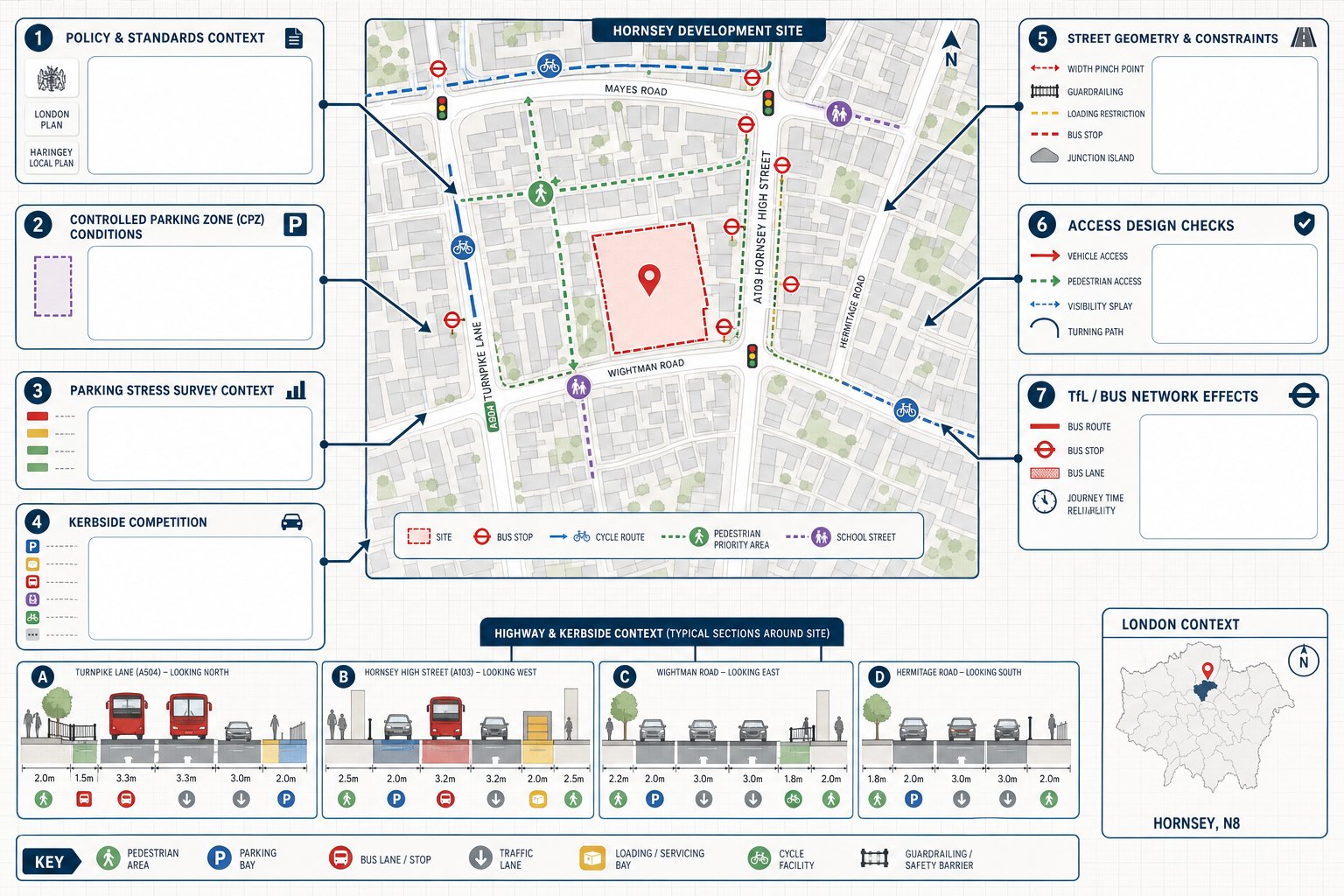
Hornsey sits within a planning and highway environment that is unmistakably London in character: dense streets, competing kerbside demands, strong sustainable transport policy, and a close relationship between borough and TfL expectations. That means local context is not background detail: it is part of the technical case.
At policy level, we usually need to consider the London Plan, Haringey’s local planning framework, parking standards, cycle parking requirements, street design expectations, and any site-specific planning history. On some sites, impacts on the TfL Road Network or bus operations will be relevant even if the scheme itself is not fronting a strategic road. Nearby cycle routes, pedestrian priority measures, low-traffic interventions and school-street operations can also shape what is acceptable.
Controlled Parking Zones matter a great deal in Hornsey. If a proposal relies on low car ownership, reviewers will often test whether surrounding parking controls support that claim and whether permit restrictions are secured or already embedded in the area. Parking beat surveys may be needed where stress is likely to be disputed.
Local junctions and street geometry matter too. A site may appear accessible on plan, yet be awkward in reality because of width restrictions, existing guardrailing, bus stop locations, loading bans, or difficult turning patterns. This is why desk review alone is rarely enough.
When access is a live issue, design work needs to be grounded in recognised principles rather than optimistic drafting. That is where practical access design highway input becomes critical, especially on tight urban frontages where a few centimetres can alter whether a layout functions acceptably.
Transport Statements, Transport Assessments, And Travel Plans Explained
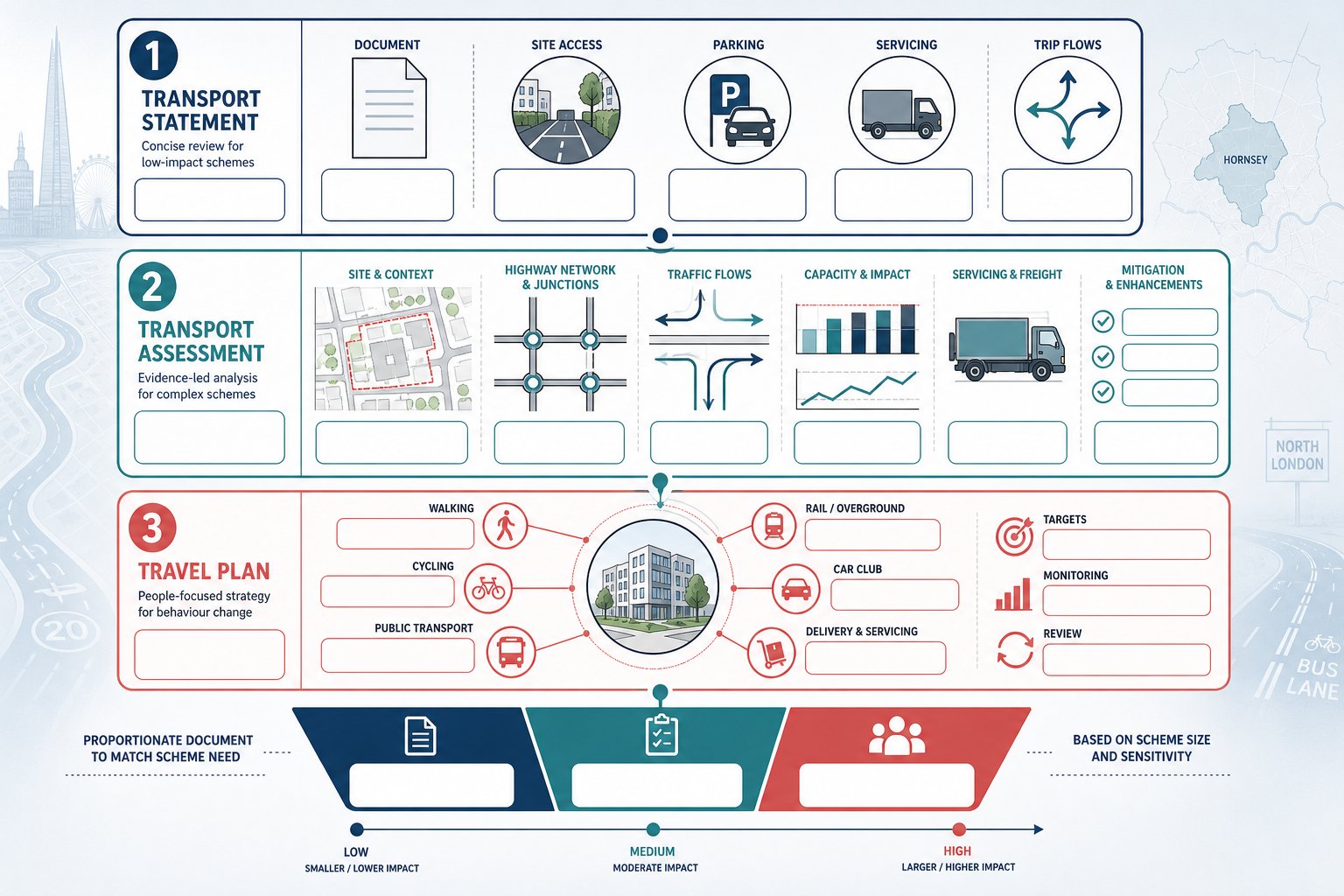
These documents are often mentioned together, but they do different jobs.
A Transport Statement is usually the proportionate response for smaller or lower-impact schemes. It sets out the existing transport context, describes the development, summarises likely trip generation, reviews access arrangements, and considers parking, servicing and sustainable travel opportunities. A good statement is concise but not thin. It answers the obvious questions before an officer or consultee has to ask them.
A Transport Assessment goes further. It is the detailed evidence base for larger, more complex, or more sensitive developments. That may include junction capacity analysis, distribution assumptions, committed development review, cumulative impact consideration, robust servicing evidence, and mitigation proposals. If a site is near a stressed junction or likely to draw technical challenge, a TA needs to be methodical and transparent.
A Travel Plan is different again. It is a strategy document aimed at influencing how people travel to and from the site. Measures might include cycle facilities, car club membership, welcome packs, public transport information, delivery management, targets, monitoring and review mechanisms. In London, travel plans can be especially important where car restraint is part of the planning rationale.
The art lies in matching the document to the scheme. Over-scoping wastes time and budget: under-scoping invites objection. Our work in Traffic Engineering and Transportation repeatedly comes back to this same point: the strongest submissions are proportionate, evidence-led and aligned with local expectations from the outset.
How Traffic Surveys And Site Assessments Support An Application
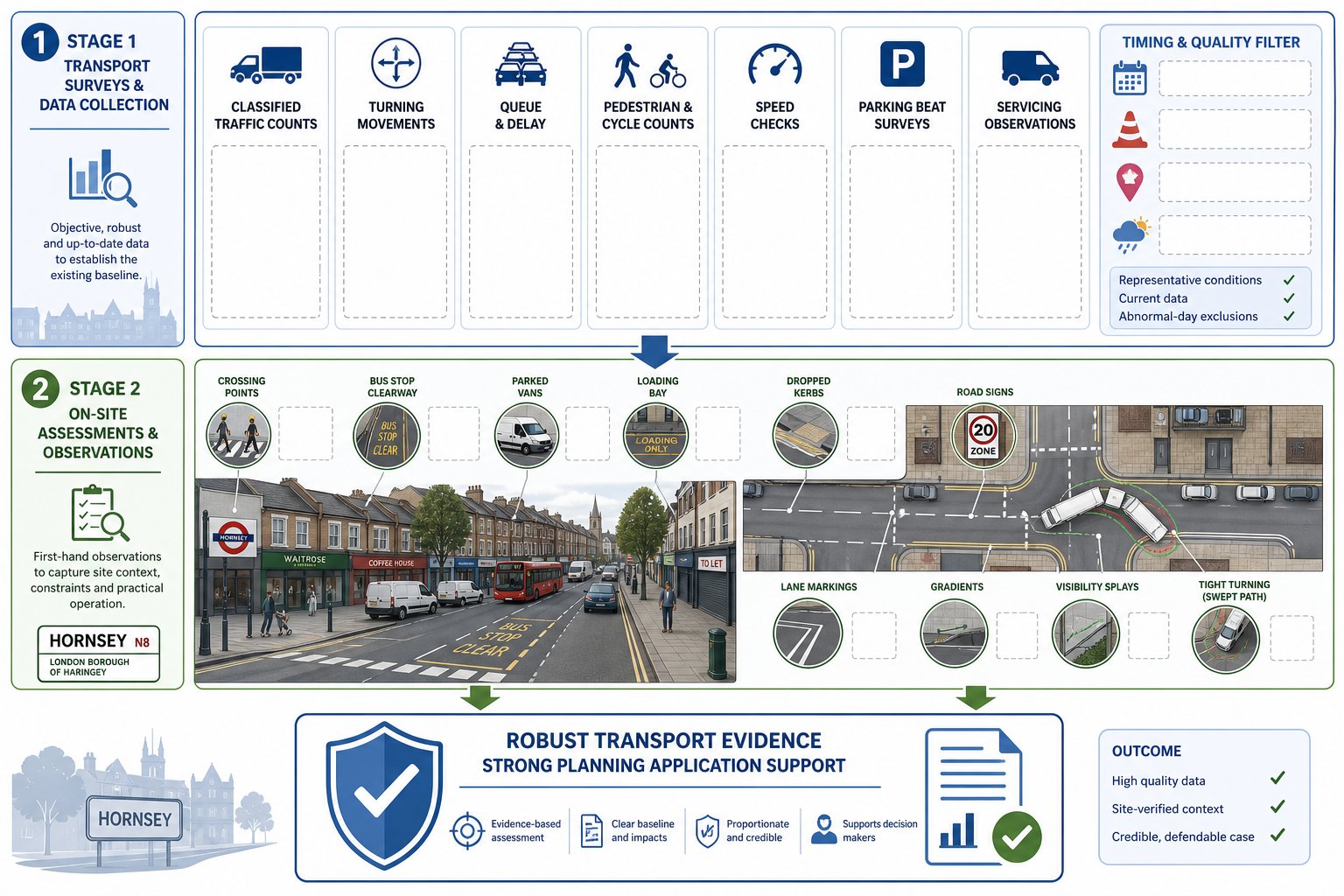
Transport evidence is only as persuasive as the data behind it. That sounds obvious, but weak or outdated survey work is still one of the most common reasons a report is challenged.
Depending on the site and proposal, surveys may include classified traffic counts, queue and delay surveys, turning counts, pedestrian and cycle counts, speed surveys, parking beat surveys, or servicing observations. The right survey is driven by the question being asked. If parking stress is the concern, a turning count will not solve it. If access visibility or manoeuvring is disputed, a simple narrative note is not enough.
Timing matters as much as type. Surveys should reflect representative conditions and be current enough to withstand scrutiny. Holiday periods, abnormal network conditions, temporary roadworks and unusual event days can all weaken the usefulness of a dataset if not explained properly.
Site assessments then bring the numbers back to real life. We walk the route, inspect crossing points, review street width, note bus stop clearways, loading restrictions, gradients, visibility splays, dropped kerbs, signs, lining and collision-sensitive features. Often, the decisive issue is something you only notice on site: a habitual informal loading point, a tight refuse turn, a misleading sightline caused by parked vans.
That combination of survey evidence and professional observation is what makes transport reporting credible. It is also why experienced Traffic Engineering Consultants: rarely treat the site visit as a formality.
Key Access, Parking, Servicing, And Highway Safety Issues
These are the subjects that most often determine whether a planning application proceeds smoothly or stalls under highways scrutiny.
Access comes first. Can vehicles enter and leave safely? Is visibility acceptable for the road environment and expected speeds? Are pedestrian movements protected? Can the design accommodate the vehicles that will actually use it, not just the smallest vehicle the applicant hopes for? In urban Hornsey locations, this may involve balancing vehicle access against active frontage, cycle parking and footway continuity.
Parking is rarely just about counting spaces. The real questions are whether provision accords with policy, whether disabled parking is properly considered, whether cycle parking is secure and convenient, and whether any shortfall is justified by PTAL, CPZ controls or a wider low-car strategy. A robust parking strategy traffic approach can be the difference between a persuasive case and a speculative one.
Servicing is where many apparently tidy schemes unravel. Retail units, food uses, apartment blocks and mixed-use schemes all need realistic delivery, refuse and emergency access arrangements. Swept-path analysis should reflect real constraints and likely vehicle types.
Highway safety ties everything together. Existing collision patterns, pedestrian conflict points, reversing movements, school-route sensitivity and bus interactions all matter. Where issues are identified, mitigation may include lining, signing, localised widening, crossing improvements, mirrors only in rare and suitable contexts, or operational controls. The key is not to pretend risk away but to show that it has been understood and addressed.
Working With Architects, Planning Consultants, And Developers
Good transport input is collaborative, not bolt-on. The strongest projects are usually those where we are involved early enough to shape the scheme rather than merely defend it.
With architects, that often means testing access geometry, servicing yards, refuse collection points, cycle stores, level changes and frontage arrangements while the layout is still flexible. A small plan amendment at RIBA Stage 2 can avoid a painful redesign after consultation.
With planning consultants, our role is to align the technical evidence with the wider planning strategy. If the case for the development rests partly on sustainable location, regeneration benefits or low-car credentials, the transport documents need to support that logic with hard evidence, not broad assertions. We also help feed transport content into Design and Access Statements, committee responses and, where necessary, appeal material.
Developers and project managers usually want clarity on risk, programme and scope. We can advise whether a brief note is enough, whether pre-application engagement is worthwhile, or whether a scheme is likely to attract TfL interest. In more complex work, wider Highway And Traffic coordination may also be needed where transport, street design and highway interface issues overlap.
The best results tend to come from honest iteration. Not every first layout works. But when the team is willing to test options early, transport issues become solvable design questions rather than late-stage objections.
The Process From Initial Review To Planning Submission
Most Hornsey transport instructions follow a broadly consistent sequence, even though the detail varies by site.
First, we carry out an initial review of the proposal, the red-line boundary, surrounding highway context, relevant planning history and likely policy issues. This stage is about identifying risk quickly: what reports may be needed, what surveys are likely, and whether the access or parking concept looks viable.
Second comes scoping. On more straightforward schemes, that may be an internal scope agreed with the planning team. On more sensitive sites, we may advise a formal or informal discussion with the local planning authority or highways officers so that survey requirements and report expectations are understood early.
Third is data collection and site assessment. That includes arranging surveys, visiting the site, photographing constraints, reviewing collision context where relevant, and checking practical operation on the ground.
Fourth is the assessment and reporting stage: trip generation, impact analysis, parking review, servicing appraisal, mitigation design and preparation of the Transport Statement, Transport Assessment and/or Travel Plan.
Finally, we support submission and post-submission queries. Validation comments, consultee questions and requests for clarification are common. The process works best when the reports are concise, evidence-backed and responsive. That is a theme across solid Traffic Engineering: Your planning support generally: the technical work should not end the moment the PDF is uploaded.
Common Reasons Transport Reports Are Challenged Or Delayed
Most challenged reports fail for ordinary reasons, not exotic ones.
One of the biggest problems is poor survey evidence: counts that are out of date, parking surveys undertaken at the wrong times, or data collected under non-representative network conditions without explanation. Authorities and objectors notice this quickly.
Another common issue is scoping failure. If the borough or TfL expected a certain analysis and the submission omits it, the resulting debate can delay the application even where the scheme itself may be acceptable. London-specific guidance matters: a generic report recycled from another authority is rarely persuasive.
Trip generation is another pressure point. Overly optimistic assumptions, selective comparator use, or failure to consider peak patterns for the actual land use can undermine confidence in the whole report. The same applies to cumulative impact. A scheme may appear modest in isolation but less so when nearby committed developments are considered.
Technical drawings can also let a project down. Swept-path analysis that ignores real kerb positions, inadequate visibility review, or parking layouts that technically fit on paper but do not work in daily use all invite challenge.
And then there is simple readability. If the report is disorganised, inconsistent, or unclear about what is proposed, officers may have to ask basic follow-up questions. Delay often starts there. Clear structure, current data and disciplined assumptions prevent most of these problems.
How To Prepare A Strong Brief For A Hornsey Traffic Engineer
A strong brief saves time, sharpens advice and reduces the chance of commissioning the wrong scope.
At minimum, we would want the red-line boundary, site address, draft drawings, proposed land uses, quantum of development, and the current programme. Unit numbers, GIA, servicing assumptions and parking aspirations should be set out clearly. If the scheme is changing through design development, it helps to know what is fixed and what is still fluid.
Planning history is equally useful. Previous refusals, pre-app feedback, appeal decisions, and any known highways concerns can materially affect what we recommend. On Hornsey sites, details such as CPZ restrictions, loading bans, bus route frontage, nearby schools, and neighbouring objections are not trivial admin notes: they may be central to the transport case.
It is also worth being explicit about deliverables. Do you need a Transport Statement only, or a package including a Travel Plan, swept paths, access note, parking survey, rebuttal comments, or attendance at meetings? If legal agreements or planning conditions are likely, we should know that early too.
Where project teams want fast, proportionate support, experience matters as much as technical competence. Concise reporting rooted in local authority expectations tends to outperform generic volume. That is the value many clients look for in Traffic Engineering and planning support: not just analysis, but analysis that is precisely scoped to the application.
Choosing The Right Traffic Engineer For A Hornsey Development
The right consultant is not simply the cheapest fee proposal or the longest methodology note. For Hornsey work, we would focus on relevance, judgement and communication.
First, look for London experience, especially with borough-led planning submissions and, where applicable, TfL interface. Hornsey projects are shaped by dense urban conditions, parking restraint, sustainable transport policy and kerbside sensitivity. A consultant who mainly works on out-of-town development may be technically competent yet still miss the nuance.
Second, examine whether the engineer understands planning, not just highways. A good report is not an abstract exercise in transport theory. It must address the real tests applied by officers, committee members and consultees. That includes proportionality, policy alignment and the ability to explain impacts in plain English.
Third, ask about track record with Transport Statements, Transport Assessments, Travel Plans, parking review and swept-path work. Chartered status or equivalent experience is helpful, but so is practical familiarity with recognised software and accepted industry methods.
Finally, responsiveness matters. Planning timetables move, drawings evolve, comments come back late on a Friday afternoon… and someone still has to answer them sensibly. We think the best appointment is a consultant who combines technical depth with concise reporting, local awareness and realistic advice from day one.
Conclusion
For many schemes, transport is not the biggest part of the application package, but it can be the part that quietly decides whether the programme holds together. In Hornsey, that is especially true where access is constrained, parking is politically sensitive, or the site sits within a complicated London street environment.
Bringing in a London-experienced Traffic Engineer In Hornsey early helps us test the design before positions harden, agree the right level of reporting, and present evidence that matches Haringey and wider London expectations. The result is usually a better scheme and a lower planning risk profile.
Whether the project is residential, commercial, mixed-use or a change of use, the principle is the same: proportionate technical work, done early and done properly, gives the application a far stronger footing.
Frequently Asked Questions About Traffic Engineers in Hornsey
What does a Traffic Engineer in Hornsey do for planning applications?
A Traffic Engineer in Hornsey assesses trip generation, access safety, parking, servicing, and highway impacts of developments, ensuring alignment with local policies like the London Plan and Haringey standards. They prepare proportionate transport reports such as Transport Statements or Assessments to support planning approval.
When is it necessary to hire a traffic or transport engineer for a Hornsey project?
You may need a transport engineer if your project involves new residential blocks, significant change of use that affects traffic, or is located near busy junctions, controlled parking zones, or bus routes. They help address transport concerns and prepare required reports for Haringey Council.
What types of reports can a Traffic Engineer in Hornsey provide?
They can prepare Transport Statements for lower-impact schemes, detailed Transport Assessments for complex or high-impact developments, and Travel Plans that promote sustainable travel behaviours. The chosen report depends on the scale and sensitivity of the development.
How do traffic surveys and site assessments support planning in Hornsey?
Traffic engineers conduct surveys like classified vehicle counts, parking beat surveys, and pedestrian counts to collect accurate data. Site visits evaluate visibility, road safety, and real-world constraints, ensuring transport reports are credible and address actual local conditions.
What are key considerations for parking and servicing in Hornsey developments?
Parking must comply with local standards and consider disabled spaces and cycle parking. Servicing arrangements should accommodate delivery and refuse vehicles safely. Controlled Parking Zones and sustainable travel policies require robust justification for car-free or low-car proposals.
How can early involvement of a Traffic Engineer improve planning outcomes in Hornsey?
Engaging a Traffic Engineer early allows them to influence scheme design, identify transport risks, scope necessary reports, and liaise with planning authorities, which can reduce objections, delays, and redesign costs, leading to a smoother planning process.