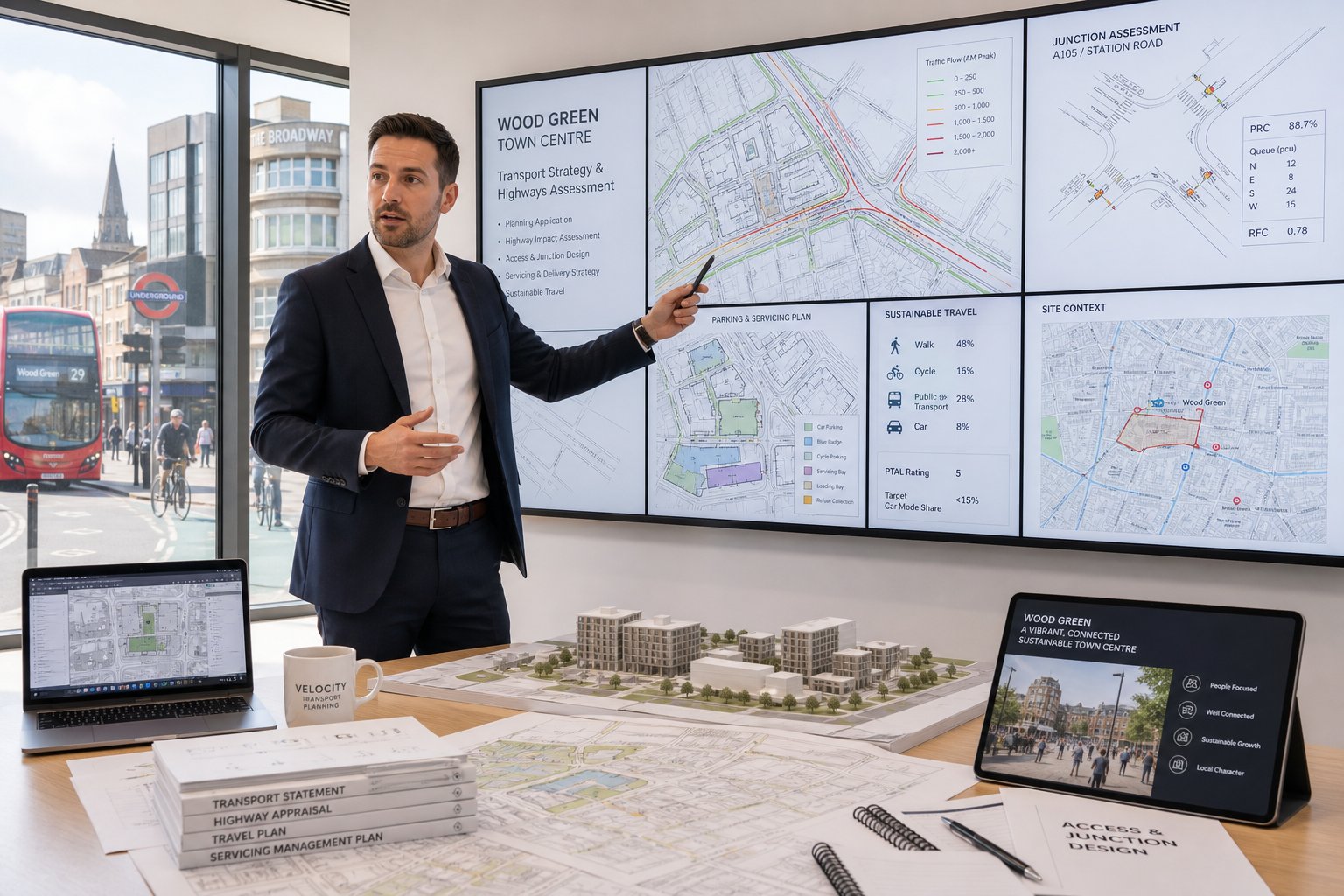
Wood Green looks straightforward on a plan until transport becomes the reason a scheme slows down. A site may sit close to the Underground, on a busy bus corridor and within a highly walkable town centre, yet still raise difficult questions about servicing, parking stress, highway safety, junction performance and policy compliance. That tension is exactly why appointing a Traffic Engineer In Wood Green early matters.
For architects, planners, lawyers, developers and local authorities, transport reporting in this part of Haringey is rarely just a box-ticking exercise. The local context is dense, mixed-use and sensitive. A modest access change can affect pedestrian flows, delivery patterns or cycle movement: a larger residential or commercial proposal can trigger detailed scrutiny from highways officers and, in some cases, Transport for London.
We approach these projects with a simple aim: make the transport case clear, proportionate and defensible. That means understanding not only technical guidance, but also how Wood Green actually operates day to day – from constrained kerb space and controlled parking pressures to peak-time congestion on the A105 and A109 corridors. In the sections below, we break down where traffic engineering input adds value, what reports are commonly needed, and how to keep a planning submission moving rather than getting stuck in avoidable transport queries.
Key Takeaways
- Appointing a Traffic Engineer in Wood Green early in the design process helps address complex local transport challenges and avoids delays in planning applications.
- Wood Green’s dense urban environment requires transport assessments to focus on parking, servicing, pedestrian safety, and sustainable travel provisions aligned with local policies.
- Transport documentation—such as Transport Statements, Assessments, and Travel Plans—must be proportionate, evidence-based, and clearly justified for each development.
- Swept path analysis is essential where vehicle movements are constrained, ensuring access and servicing plans are practical and safe.
- Coordinated consultant teamwork and up-to-date, high-quality survey data are critical to producing credible, consistent transport reports that gain planning approval.
- Understanding and responding realistically to Wood Green’s local transport policies, including car-lite measures and servicing constraints, smooths the transport assessment process.
Why A Traffic Engineer In Wood Green Matters For Planning Applications
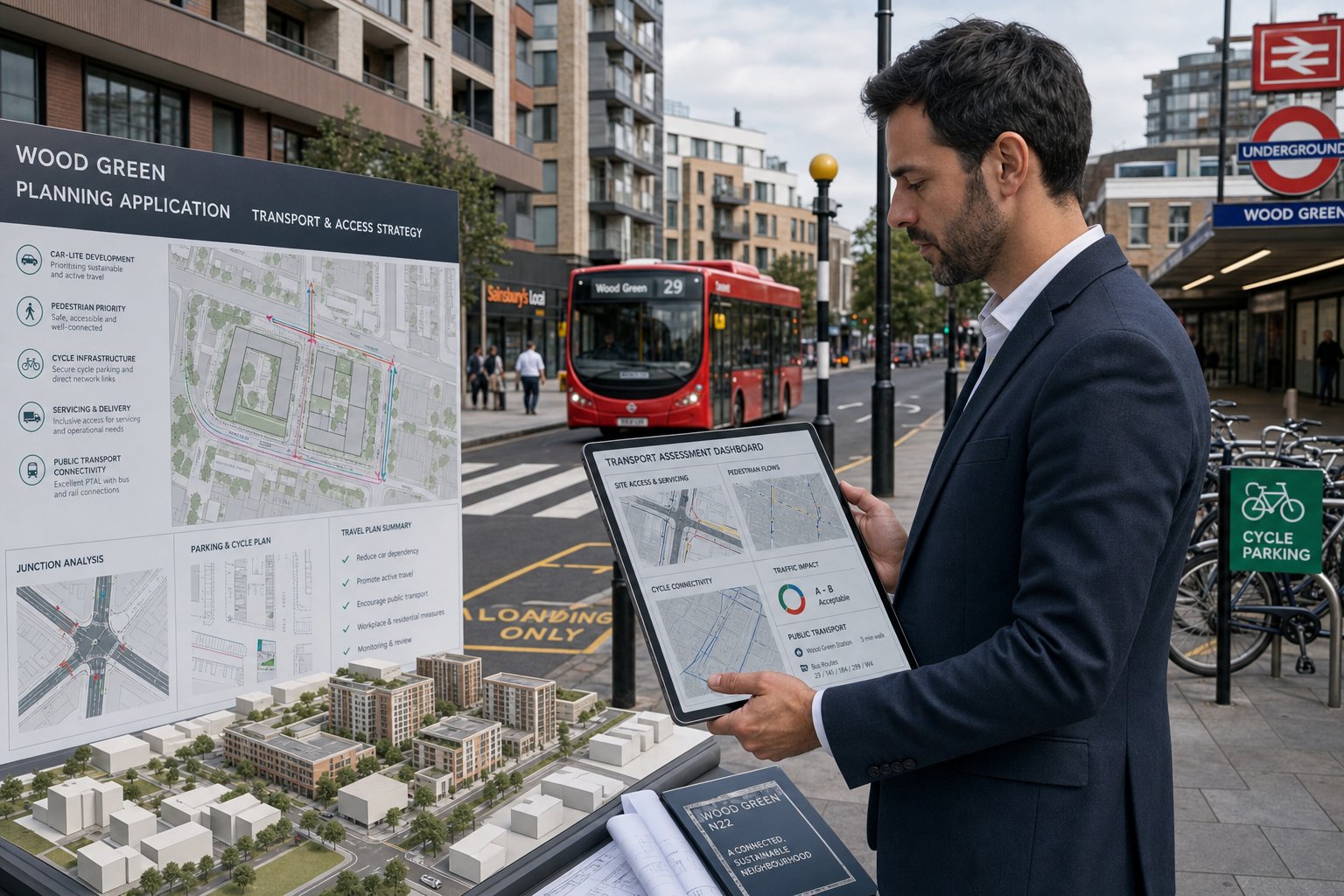
Planning decisions in Wood Green are shaped by more than land use and design. Transport sits near the centre of the conversation because officers need confidence that a development can function safely, efficiently and in line with policy. That applies whether the proposal is a mixed-use redevelopment, a residential infill scheme, a change of use, or a commercial site with new servicing demands.
A traffic engineer helps translate a scheme into transport terms that a planning authority can assess. We examine trip generation, access, parking demand, servicing patterns, road safety, pedestrian movement and the interaction with nearby junctions or public transport. In practice, that often means resolving concerns before they harden into formal objections.
In Wood Green, local knowledge makes a measurable difference. High PTAL levels do not remove transport scrutiny: if anything, they shift the focus. Officers may expect a stronger car-free or car-lite rationale, better cycle provision, and a robust Travel Plan. They may also want reassurance that deliveries, refuse collection and emergency access work on a constrained urban plot.
This is where experienced Traffic Engineering Consultants: add value beyond drafting a report. We can advise on layout choices, testing assumptions and the likely threshold between a short Transport Statement and a fuller assessment. On London schemes generally, the wider planning context covered by Traffic Engineer In London: often applies, but Wood Green has its own local pressure points that need a more tailored response.
Wood Green Planning And Transport Issues That Commonly Affect Development
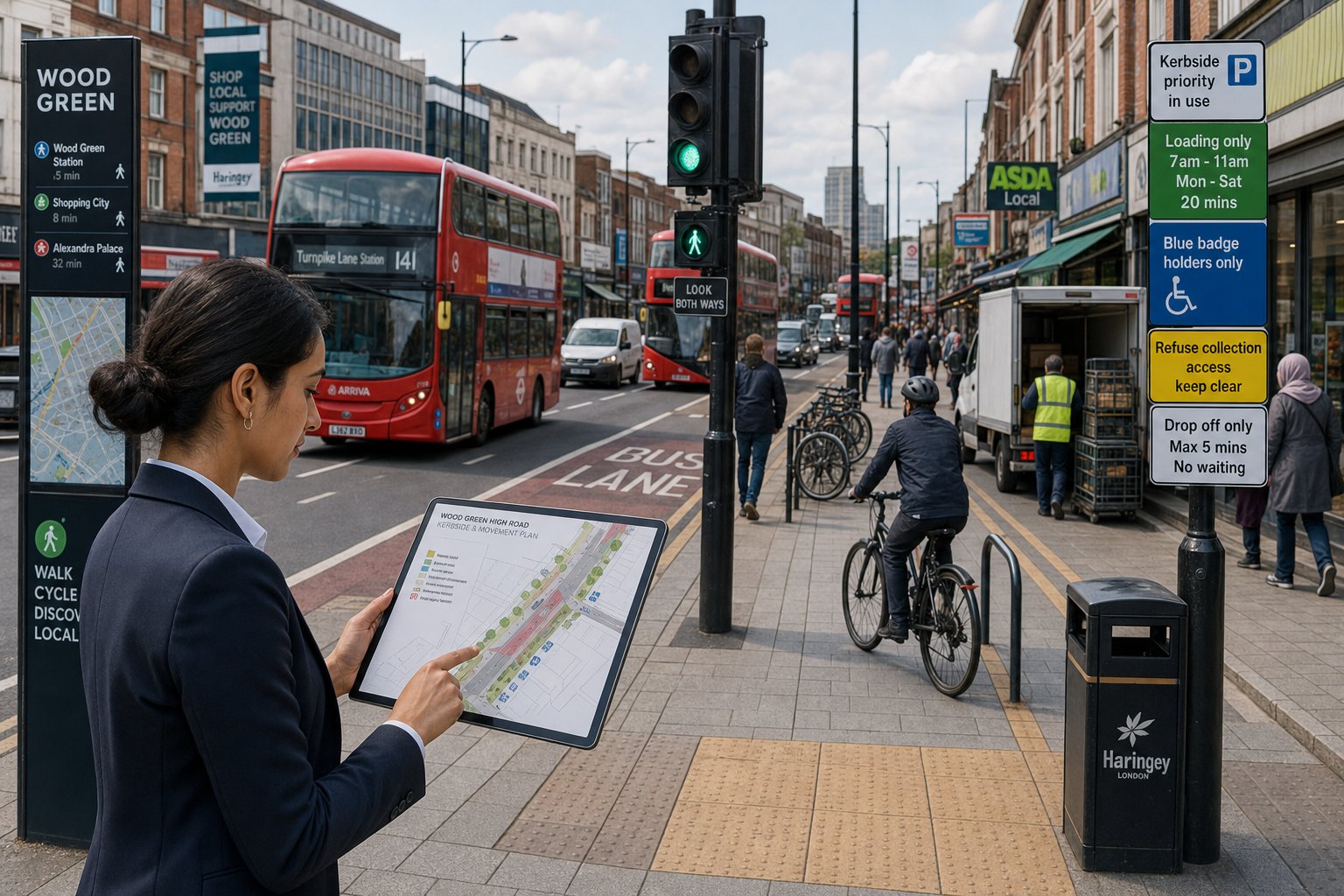
Wood Green combines intense urban activity with limited physical space. That sounds obvious, but it drives most of the transport issues that affect planning applications.
The first is corridor pressure. Roads such as the A105 and A109 carry significant traffic, support bus movements and often sit beside active frontages, side roads and crossing demand. Even where a development generates modest vehicular trips, the authority may ask how those trips interact with existing congestion, bus reliability and pedestrian safety.
The second is kerbside competition. On many sites, the real problem is not the internal layout but what happens at the edge of the highway. Loading, drop-off activity, refuse collection, blue badge parking, cycle stands and general pedestrian movement can all compete for a limited stretch of frontage. If a servicing strategy is vague, the scheme can quickly lose credibility.
Third, Wood Green has strong sustainable transport expectations. Proximity to stations and bus routes supports reduced car parking, but it also means cycle parking, walk routes and step-free access need to be handled properly. A car-free statement on its own won’t satisfy officers if the practical operation of the site remains unresolved.
Air quality, school streets, controlled parking zones and impacts on nearby residential roads also come up regularly. In short, the challenge is rarely one single transport issue. It is the cumulative effect of several ordinary urban constraints sitting on top of each other.
Typical Schemes That Need Traffic Engineering Input
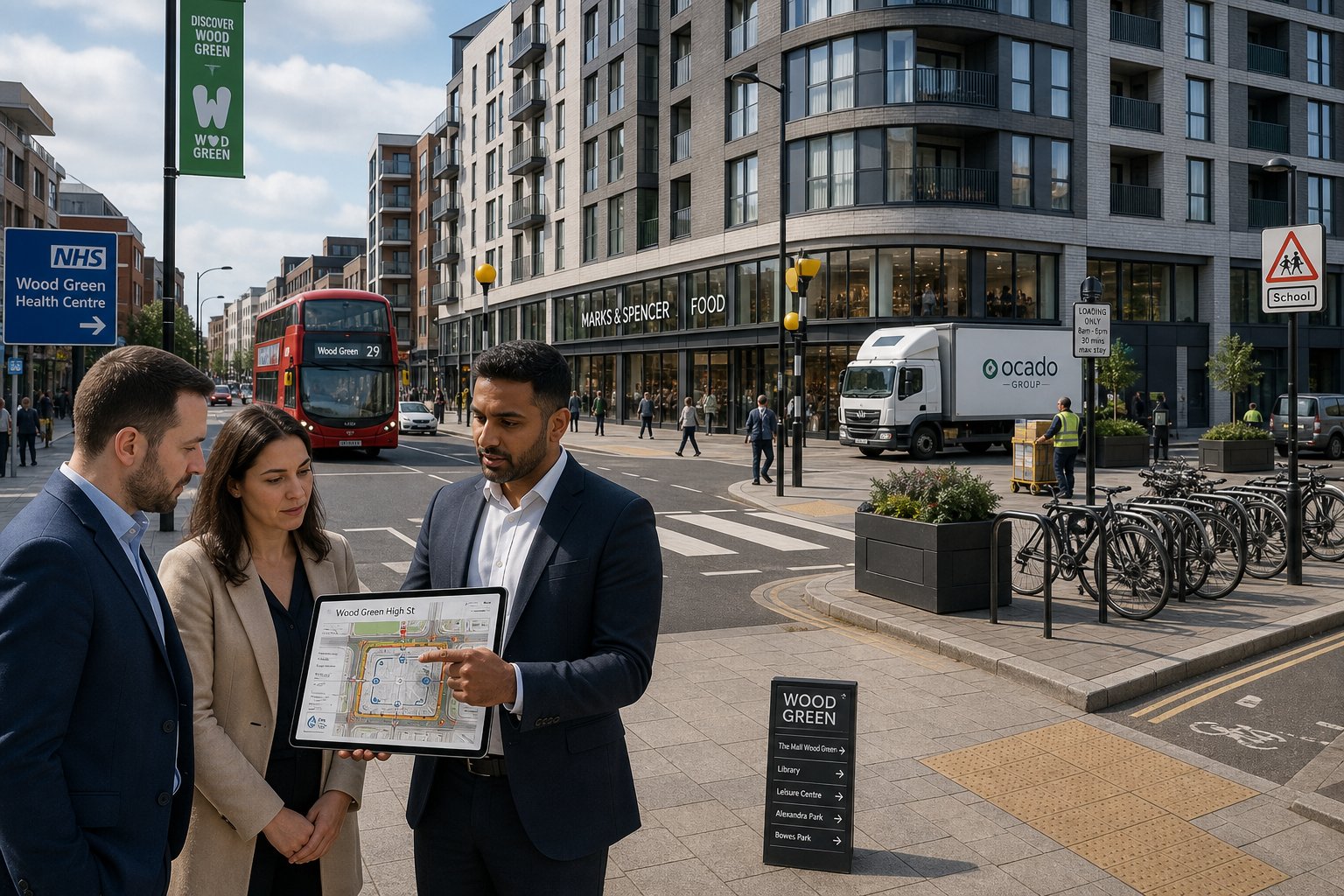
Not every application needs a lengthy transport report, but many more schemes need traffic engineering input than applicants first assume.
In Wood Green, residential developments are the obvious example: flats, HMOs, estate renewal, student accommodation and mixed-use blocks with active ground floors. These schemes often need advice on trip generation, cycle parking, refuse strategy, disabled parking and access geometry. Even a relatively small proposal can raise questions if it changes how vehicles enter the site or where servicing takes place.
Commercial and town centre projects are equally common. Retail units, food and drink uses, gyms, healthcare facilities and workspace can all create peak activity at very different times of day. That matters when neighbouring streets are already busy and kerbside capacity is tight. For developers handling trade-focused proposals, the wider principles discussed in Commercial Traffic Engineering are often relevant, especially where deliveries and customer turnover shape the transport case.
We also see frequent demand from schools, community uses, places of worship and care-related schemes, where safeguarding, pick-up and drop-off behaviour, or accessibility for less mobile users becomes central. And then there are alteration-led projects: new crossover points, basement ramps, reconfigured yards, or changes from on-street to off-street servicing. Those can trigger transport review even when the floor area change is small.
Put simply, if a proposal affects access, parking, loading, traffic generation or movement patterns, it probably benefits from early traffic engineering advice.
Transport Statements, Transport Assessments, And Travel Plans Explained
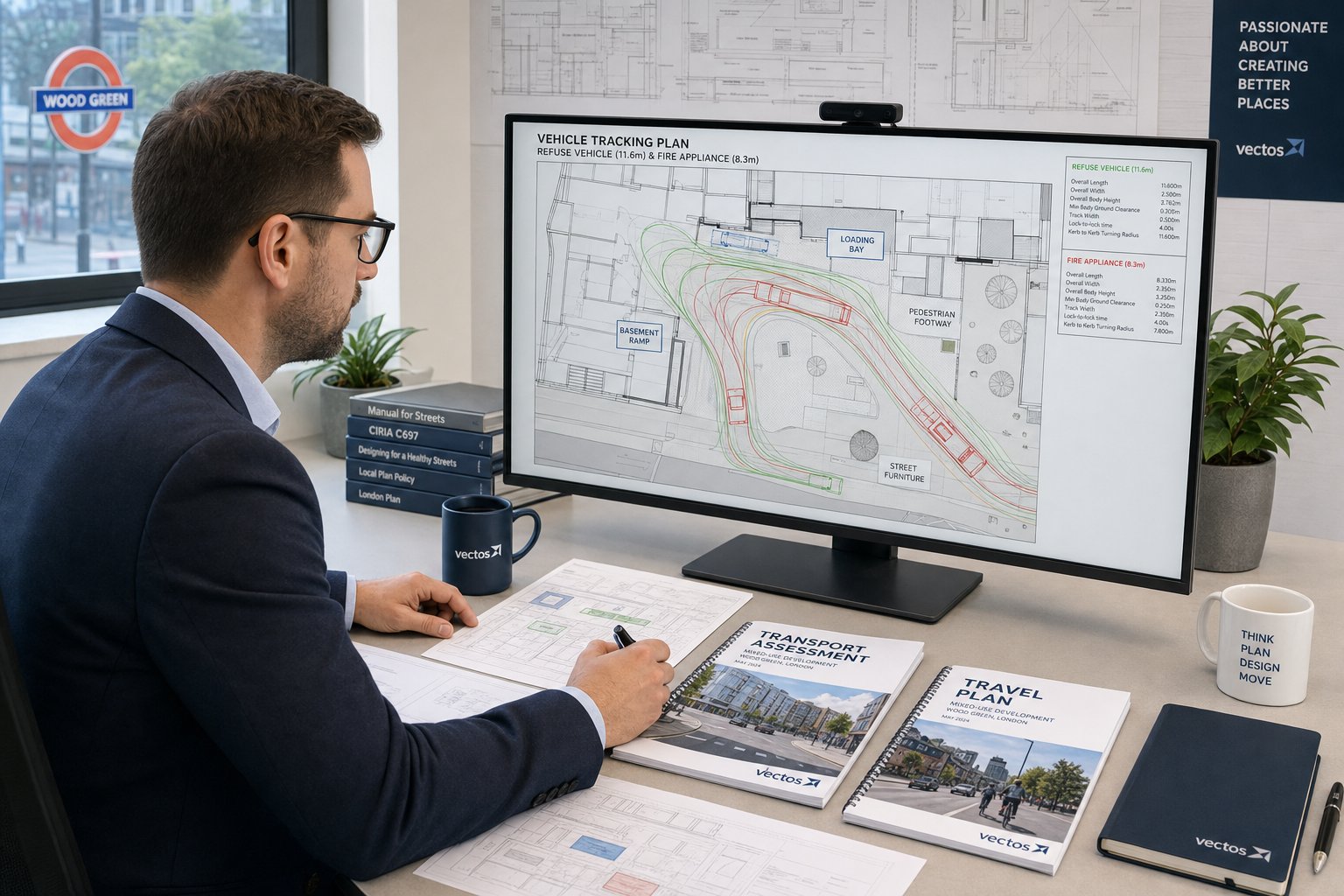
These three documents are often mentioned together, but they serve different purposes.
A Transport Statement is normally used for smaller or lower-impact developments. It describes existing transport conditions, summarises likely trip generation, reviews access and parking, and explains why the scheme’s impact is acceptable. The emphasis is on proportionate evidence. A good statement is concise but not lightweight.
A Transport Assessment goes further. It is usually required where the scale, location or operational complexity of a development justifies deeper analysis. That may include survey data, committed development review, junction capacity testing, servicing assessment, accident data, public transport accessibility and mitigation proposals. In Wood Green, a TA is often the right route where strategic or cumulative impacts could become a concern.
A Travel Plan is different again. It is a management tool rather than a pure impact report. It sets out how residents, staff or visitors will be encouraged to use sustainable modes through measures such as cycle facilities, welcome packs, monitoring, incentives and targets. For many schemes in London, a Travel Plan is expected either as part of the submission or by planning condition.
The real skill lies in judging what level of work is proportionate. Over-reporting can waste time and cost. Under-reporting creates challenge risk. That balance is a core part of practical Traffic Engineering: Your approach, especially on urban sites where transport issues are nuanced rather than dramatic.
When A Swept Path Analysis Or Vehicle Tracking Assessment Is Needed
Swept path analysis becomes necessary where vehicle movement is constrained, unusual or safety-critical. Common examples in Wood Green include basement ramps, tight mews accesses, refuse collection points, loading bays, fire appliance access routes and servicing yards behind mixed-use frontages.
The point is not to produce a drawing for the sake of it. It is to demonstrate that the design actually works with the vehicles that must use it. Can a refuse vehicle enter and exit in forward gear? Can a fire tender reach the building without overrunning footways or striking street furniture? Can a delivery vehicle turn without blocking a pedestrian route or crossing into opposing traffic?
Authorities will usually expect the vehicle type to be justified, the geometry to match the architectural plan, and any assumptions about gate operation or marshalling to be realistic. Poor tracking is one of the quickest ways for a transport submission to lose confidence, because it exposes whether the access strategy has been properly thought through.
Parking, Servicing, And Access Reviews For Urban Sites
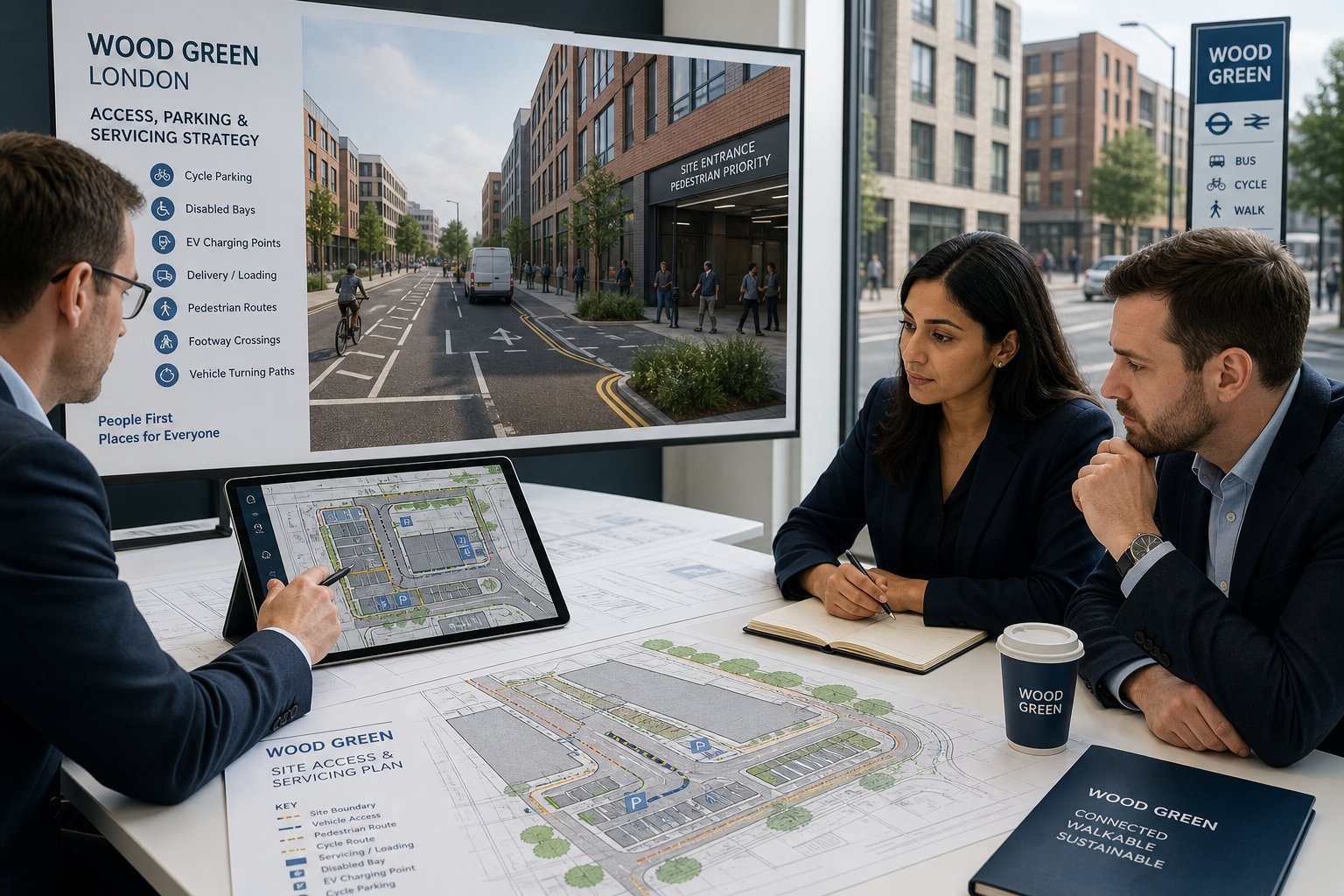
Urban transport review is often won or lost on the practical details of parking, servicing and access. In Wood Green, those details are rarely generous.
Parking assessment needs to align with the London Plan, Haringey expectations and the site’s public transport context. That usually means a careful justification for car-free or low-car provision, proper disabled parking review, EV charging where relevant, and cycle parking that is convenient rather than tokenistic. A drawing can technically meet numbers and still fail operationally if cycle stores are awkward, oversubscribed or inaccessible.
Servicing is even more sensitive. Town centre and mixed-use sites depend on deliveries, refuse collection and occasional maintenance access, but there may be no spare road space to absorb poor planning. We often review vehicle size assumptions, delivery frequency, loading duration, on-street restrictions and whether off-street turning is genuinely feasible. Sometimes the best answer is a timed servicing plan: sometimes it is redesign.
Access design ties it all together. Footway crossings, visibility, pedestrian priority, ramp gradients, entry widths and gate positions can all affect whether an application feels credible to highways officers. There is also a legal dimension where rights of access, servicing obligations or design evidence may support a planning appeal or negotiation. In those cases, transport input needs to be coordinated with the wider consultant team rather than treated as a late-stage appendix.
Junction Capacity And Traffic Impact Assessments
Junction assessment is not required on every scheme, but where it is needed, it must be done properly. In Wood Green, that usually means testing whether development traffic would materially worsen queues, delay, safety risk or bus operation at nearby priority, roundabout or signal-controlled junctions.
The method depends on context. We may use PICADY or ARCADY for priority and roundabout analysis, LINSIG for signal junctions, or more detailed modelling where the network is complex and interactions are closely spaced. The aim is not to bury the reader in software outputs. It is to answer a practical planning question: will this development cause an unacceptable transport impact?
A robust traffic impact assessment starts with sensible scoping. Which junctions matter? What assessment years should be used? What background growth and committed development assumptions are reasonable? If those basics are weak, the modelling rarely survives scrutiny.
Mitigation can range from subtle to substantial: signal timing changes, local widening, access control, revised servicing arrangements, pedestrian crossing improvements or mode shift measures through a Travel Plan. But mitigation only carries weight if it responds to a clearly evidenced issue.
We often remind project teams that capacity work is persuasive only when it fits the whole scheme narrative. A junction model cannot rescue a poor access arrangement, and equally a well-designed site should not be pushed into unnecessary modelling without a genuine evidence basis.
Surveys, Data Collection, And Evidence Needed To Support A Report
Most challenged transport reports have the same weakness: thin evidence. Good professional judgement matters, but in planning, judgement needs data behind it.
For Wood Green applications, the survey package commonly includes traffic counts, turning counts at key junctions, queue observations, parking beat surveys, loading observations, pedestrian and cycle counts, and where relevant, speed data. The right mix depends on the proposal. A change of use with delivery implications may need detailed servicing evidence: a residential scheme near a constrained junction may need peak-hour turning counts.
Collision data, usually from the STATS19 record, is also important for identifying any existing road safety pattern. Public transport accessibility, local bus provision, nearby stations, walking catchments and cycling links help frame the sustainability case. Then there is baseline planning evidence: committed developments, consented schemes and realistic future year assumptions.
Survey quality matters as much as survey quantity. Dates should be recent, weather conditions noted, school holiday periods considered, and methodologies transparent. If a survey was commissioned before the design changed, it may no longer fit the application.
This is one area where speed and quality can coexist if the process is managed well. A structured approach like the one we apply in Traffic Engineer In Manchester: projects elsewhere is just as valuable in Wood Green: scope the evidence early, collect what is defensible, and make sure every data point supports a planning question rather than sitting in the appendix unused.
How Traffic Engineers Support Architects, Planners, Lawyers, And Developers
The best transport input does not arrive at the end of the job. It shapes the scheme while options are still open.
For architects, we test whether layouts work in real movement terms: entrance widths, turning heads, cycle stores, refuse routes, basement ramps and pedestrian desire lines. Small adjustments at concept stage can avoid large planning problems later.
For planning consultants and town planners, we help build a policy-led case that is technically credible. That means matching the transport response to local and strategic policy, pre-empting likely highways comments and keeping the narrative proportionate. One of the most useful things we do is say when a scheme does not need overcomplicated transport work.
Lawyers and appeal teams often need something different: clear evidence, consistency across drawings, and technical positions that will stand up under challenge. Whether the issue is a condition, a Section 106 travel plan obligation, a Section 278 scope or a disputed access point, transport evidence has to be precise.
Developers, meanwhile, need certainty on programme risk. Delays often come from avoidable transport queries that should have been resolved during design. Our role is partly technical and partly strategic: identify risks early, scope the right submission, and avoid spending weeks answering questions that a coordinated team could have closed out at the start.
That joined-up support is why specialist input tends to outperform generic reporting, particularly on dense London sites with little room for transport assumptions to drift.
What Local Authorities Usually Expect From A Transport Submission
Local authorities rarely expect a perfect scheme, but they do expect a coherent one. In Wood Green, that means a transport submission should be policy-aware, evidence-based and consistent with the architectural package.
First, officers usually want a clear explanation of why the chosen report type is proportionate. If the submission is a Transport Statement, it should still address the likely concerns directly. If it is a full assessment, its scope should be justified rather than inflated.
Second, assumptions must be transparent. Trip rates, modal splits, survey dates, servicing demand and parking stress methodology should all be explained in a way that another reviewer can follow. Hidden assumptions create distrust quickly.
Third, drawings matter. Access plans, visibility information, cycle parking layouts, servicing arrangements and swept path drawings should align with each other. A transport report that describes one access strategy while the architect’s plan shows another is asking for trouble.
Authorities also expect policy alignment. That usually means demonstrating consistency with the NPPF, the London Plan, local development plan policies and any relevant transport guidance. For applicants operating across multiple cities, comparisons can be useful internally, but each authority still expects a local response rather than a recycled template. Lessons from Traffic Engineer In Birmingham: or Traffic Engineer In Liverpool: work can inform process, not replace site-specific judgement.
Common Reasons Transport Reports Are Delayed Or Challenged
Most transport delays are not caused by exotic technical disputes. They come from ordinary project coordination failures.
Out-of-date survey data is a frequent culprit. If counts are stale, taken in unusual conditions or disconnected from the final design, officers may ask for re-surveying. That can knock weeks off a programme. Unagreed trip generation is another common issue, especially where a development type is unusual or a consultant relies on benchmark data without explaining local fit.
Inconsistency between documents is just as damaging. We have seen transport reports refer to one parking layout, servicing strategy or access width while the submitted drawing package shows another. Once that inconsistency appears, every conclusion in the report comes under suspicion.
A weaker but still common problem is unsupported optimism. Statements such as “the impact will be negligible” or “servicing can be managed” need evidence. In Wood Green, where kerbside and network conditions are already pressured, bare assertions rarely carry much weight.
Failure to address pre-application comments also slows submissions down. If Haringey officers or TfL have already raised concerns about bus operation, access safety, or parking restraint, those points need to be answered directly. Hoping they disappear in the formal round almost never works.
And sometimes the delay is simply timing: the transport team is appointed after the design has hardened, leaving too little room to fix what the evidence uncovers.
How To Prepare A Wood Green Site For A Smooth Transport Assessment Process
The smoothest transport submissions usually begin before the transport report itself. Preparation is half the job.
Start with early appointment. Bringing in a Traffic Engineer In Wood Green at concept stage allows the team to test access, servicing and parking assumptions before they are embedded in the layout. That is faster than redesigning after pre-app feedback.
Next, scope the work properly. Identify whether the site is likely to need a Transport Statement, full assessment, Travel Plan, swept path review, parking survey or junction modelling. Not every scheme needs everything, but every scheme needs clarity on what is proportionate.
Survey planning comes immediately after that. We recommend agreeing survey needs and timing as early as possible, especially on sites affected by schools, seasonal footfall, operational restrictions or nearby highway changes. Good data collected too late still creates delay.
Coordination across the consultant team is crucial. Architects should share live layouts, planners should flag policy and pre-app issues, and legal teams should identify access or highway agreement constraints early. This is where practical lessons from broader Traffic Engineer In project work are useful: clear scope, early evidence, no surprises.
Finally, be realistic about Wood Green’s policy context. Car-lite expectations, cycle provision, public realm sensitivity and servicing constraints are not side notes. If the scheme acknowledges them honestly and responds with workable measures, the transport assessment process becomes much more straightforward.
Conclusion
In Wood Green, transport is rarely a background issue. It is often one of the main tests of whether a proposal feels workable, policy-compliant and genuinely ready for planning review.
A strong traffic engineer brings more than calculations. We bring local interpretation, proportionate reporting, realistic servicing and access thinking, and evidence that stands up when highways officers start asking detailed questions. For architects, planners, lawyers, developers and councils, that usually means fewer avoidable revisions and a clearer route through the application process.
The earlier transport issues are identified, the easier they are to solve. And in a dense urban centre like Wood Green, that timing can make the difference between a report that merely exists and one that actively helps secure a smoother planning outcome.
Frequently Asked Questions About Traffic Engineering in Wood Green
Why is appointing a traffic engineer in Wood Green important for planning applications?
A traffic engineer in Wood Green ensures developments operate safely and efficiently within the local road network, addressing congestion, parking, highway safety, and policy compliance to reduce objections and support planning approval.
What are common transport challenges faced by developments in Wood Green?
Developments in Wood Green often face issues like congestion on A105 and A109 corridors, limited kerbside parking, servicing restrictions, air quality concerns, and strong sustainable transport expectations due to its dense urban setting.
When is a Transport Statement required versus a Transport Assessment in Wood Green?
Transport Statements suit smaller, lower-impact schemes with a concise review of trip generation and access, while Transport Assessments are needed for larger or complex developments, involving detailed junction modelling and network analysis.
How does swept path analysis assist Wood Green developments?
Swept path analysis demonstrates that vehicles such as refuse trucks and fire tenders can safely manoeuvre in constrained accesses, basements, or loading bays, ensuring compliance and preventing safety risks in tight urban sites.
What should developers consider for parking and servicing in urban Wood Green sites?
Developers need to justify car-free or low-car parking aligned with London Plan standards, provide adequate cycle parking, plan efficient servicing strategies with possible time controls, and ensure safe pedestrian-vehicle interfaces.
How early should a traffic engineer be involved in a Wood Green development project?
Engaging a traffic engineer at the concept stage allows testing of access, parking, and servicing options early, preventing costly redesigns and smoothing the planning process for car-lite and sustainable transport measures.