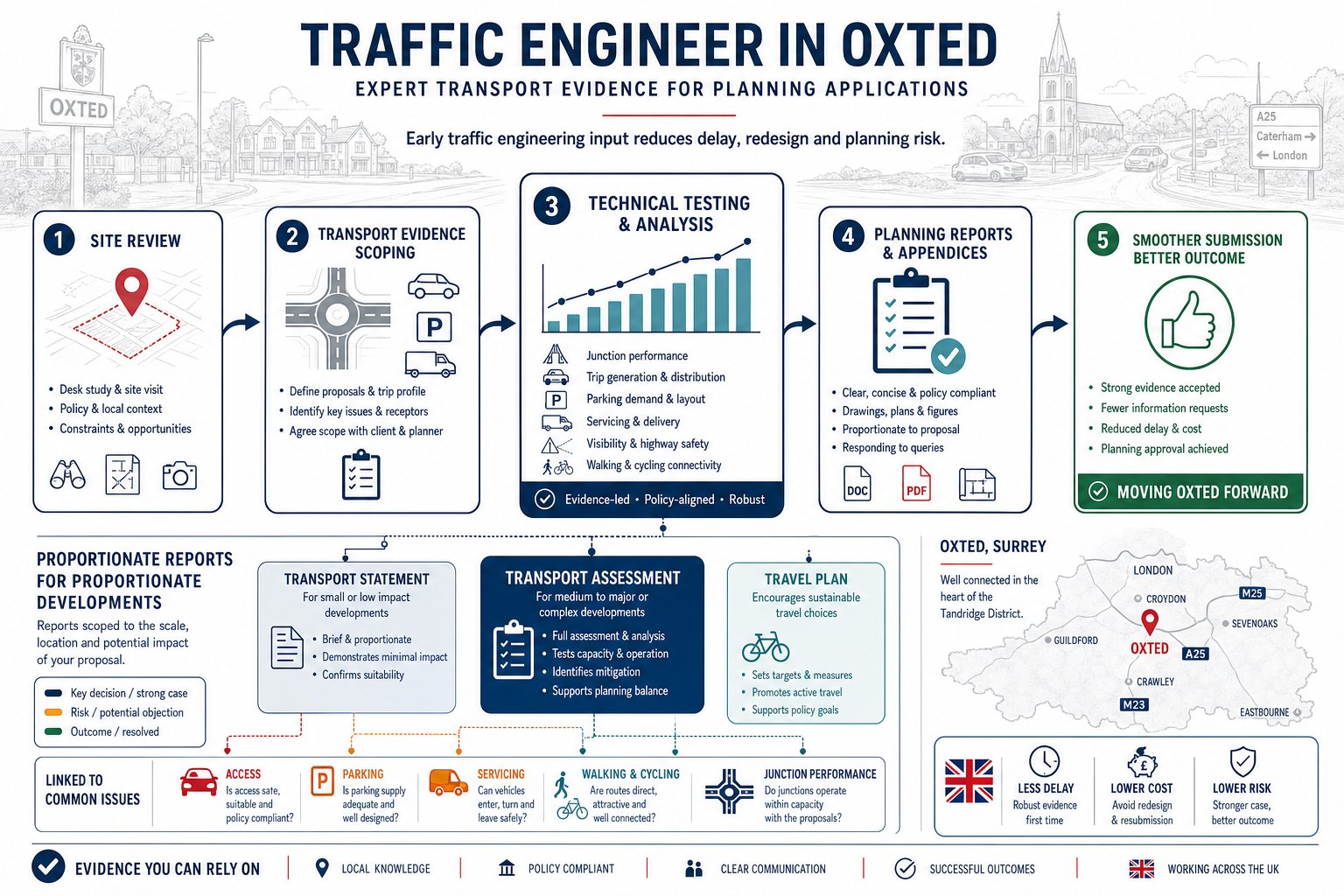
Planning in Oxted rarely turns on architecture alone. A well-designed scheme can still stall if the transport case is weak, the access strategy is unclear, or the local highway issues have not been dealt with properly. That is why a traffic engineer in Oxted often becomes a key part of the planning team early on, not just a technical add-on near submission.
For architects, planners, surveyors, developers, solicitors, and local authorities, the transport question is usually straightforward in principle but messy in practice: will the proposal work safely and acceptably on the surrounding network? The answer depends on trip generation, parking demand, visibility, servicing, pedestrian links, junction performance, and how the site fits local planning expectations.
We approach that problem by producing concise, planning-led transport evidence that is proportionate to the scheme and clear enough for decision-makers to rely on. In Oxted, that means looking closely at the development type, the surrounding road layout, likely concerns from highways officers, and whether the application needs a Transport Statement, a fuller Transport Assessment, a Travel Plan, or supporting technical work.
In this guide, we set out what a traffic engineer in Oxted does, when transport reports are typically required, which local considerations matter most, and how early advice helps reduce objections, redesign, and delay. For teams working to tight programmes, that can make a very real difference.
Key Takeaways
- A traffic engineer in Oxted plays a crucial role early in planning by ensuring transport aspects like access, parking, and junction safety are properly addressed to support planning applications.
- Transport Statements suit smaller developments with limited impacts, while larger or sensitive schemes require detailed Transport Assessments reflecting local road conditions and planning requirements.
- Local highway context—including junction performance, parking pressures, and pedestrian links—significantly influences whether a development proposal is acceptable in Oxted.
- Early involvement of a traffic engineer helps identify and mitigate common transport risks, reducing delays, costly redesigns, and objections during the planning process.
- Choosing a traffic engineer with experience in planning-led transport work and local knowledge ensures concise, effective transport evidence tailored to Oxted’s specific conditions.
- Proportionate, clear, and site-specific transport reports improve chances of smooth planning approvals by addressing the right issues without overcomplication.
What A Traffic Engineer In Oxted Does For Planning Applications
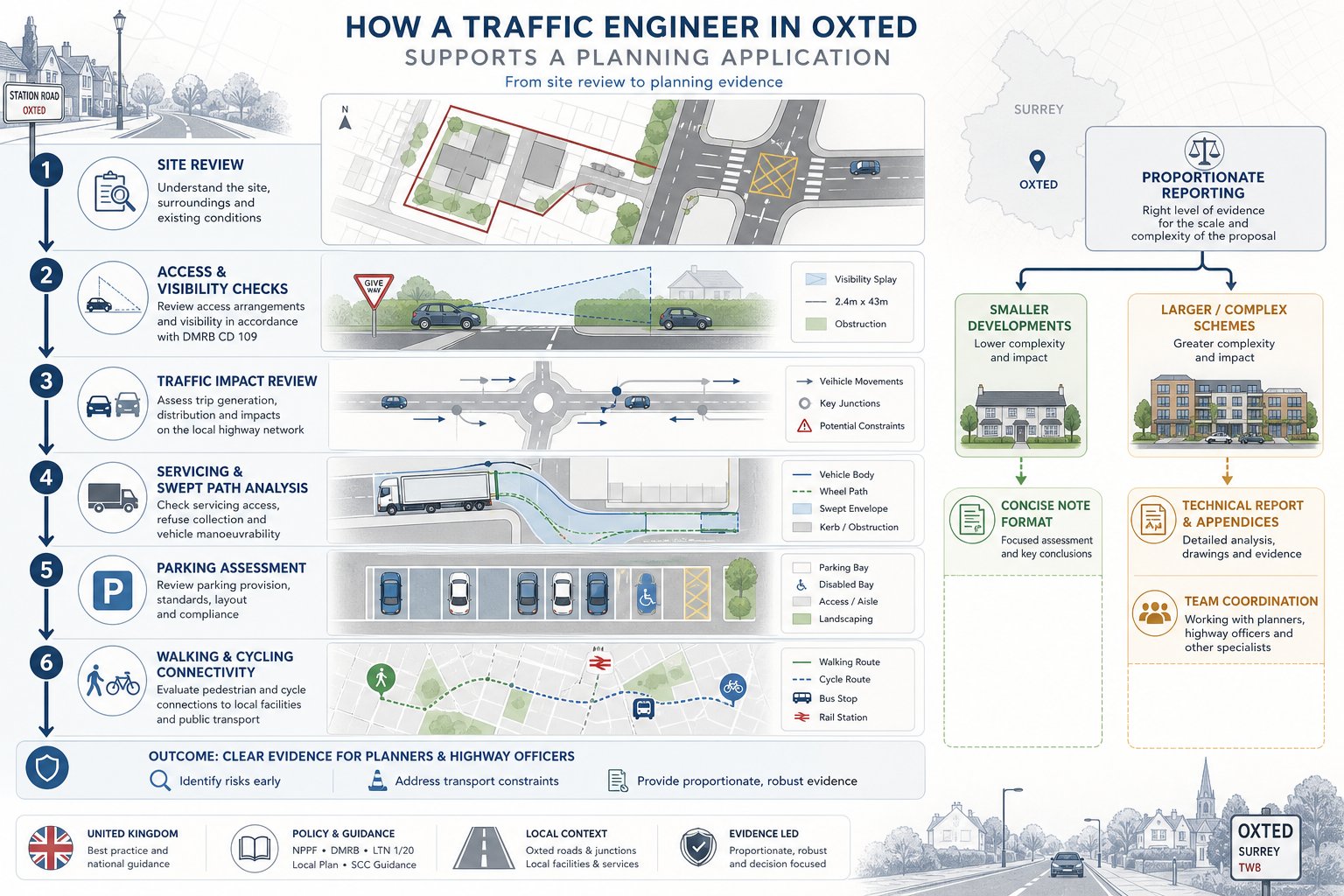
A traffic engineer in Oxted supports planning applications by testing whether a development can be accommodated safely and reasonably on the local transport network. In practical terms, we review access, traffic impact, servicing, parking, walking and cycling links, and any highway constraints that could affect planning outcome.
That work usually starts with the basics: how vehicles enter and leave the site, whether visibility is acceptable, whether swept paths work for refuse or delivery vehicles, and whether the level of traffic generated is likely to create a material issue. From there, we prepare the evidence needed to explain those findings in a form that planners, highway officers, and appeal inspectors can assess.
The role is partly analytical and partly strategic. We are not just producing numbers. We are identifying risks before they become objections. A modest housing scheme, for example, may not need a lengthy modelling exercise, but it may still need a careful access review, parking assessment, and a short technical note that addresses local concerns clearly. Larger or more complex proposals often need broader reporting and closer coordination with architects and planning consultants.
We also help project teams decide what level of transport submission is proportionate. That matters. Over-reporting can waste time and budget: under-reporting can trigger delays. Broader guidance on the role of Traffic Engineering Consultants: What and the planning role of Highway And Traffic aligns with the same principle: evidence should be technically sound, locally aware, and matched to the application.
When A Transport Assessment Or Transport Statement Is Needed In Oxted
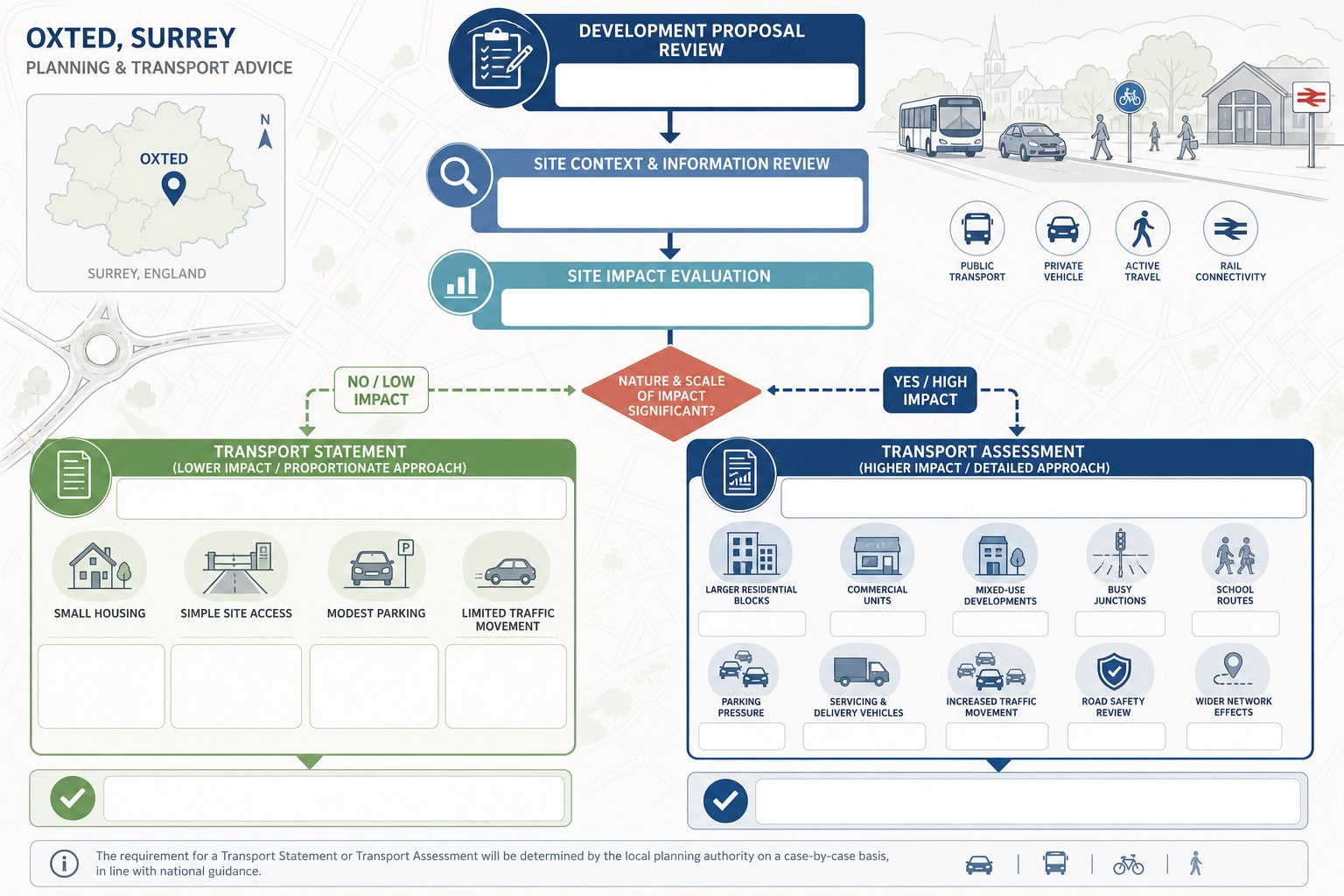
Not every planning application in Oxted needs a full Transport Assessment, but many schemes need at least some transport evidence. The trigger is not simply the size of the development. It is whether the proposal could materially affect travel demand, road safety, access arrangements, parking stress, servicing, or the operation of nearby junctions.
A Transport Statement is generally used for smaller or less intensive schemes where impacts are expected to be limited but still need to be explained. It sets out the site context, expected trip generation, access arrangements, parking provision, and any mitigation or sustainable travel measures. A Transport Assessment is usually required where impacts may be more significant or where the site context is more sensitive. That can include larger residential schemes, commercial floorspace, mixed-use development, or proposals in constrained locations.
In Oxted, the need for one document rather than the other often depends on local road conditions and planning sensitivity as much as headline development numbers. A site on a quiet road with straightforward access may justify a proportionate statement. A site near a busier junction, school route, or established parking pressure point may need more detailed assessment.
We advise clients to make that call early, ideally before the design is fixed. The wider principles discussed in Traffic Engineering and Transportation and examples from a Traffic Engineer In London: context show the same pattern: proportionality works best when it is grounded in site-specific evidence rather than assumptions.
How Local Planning And Highway Considerations Shape Development In Oxted
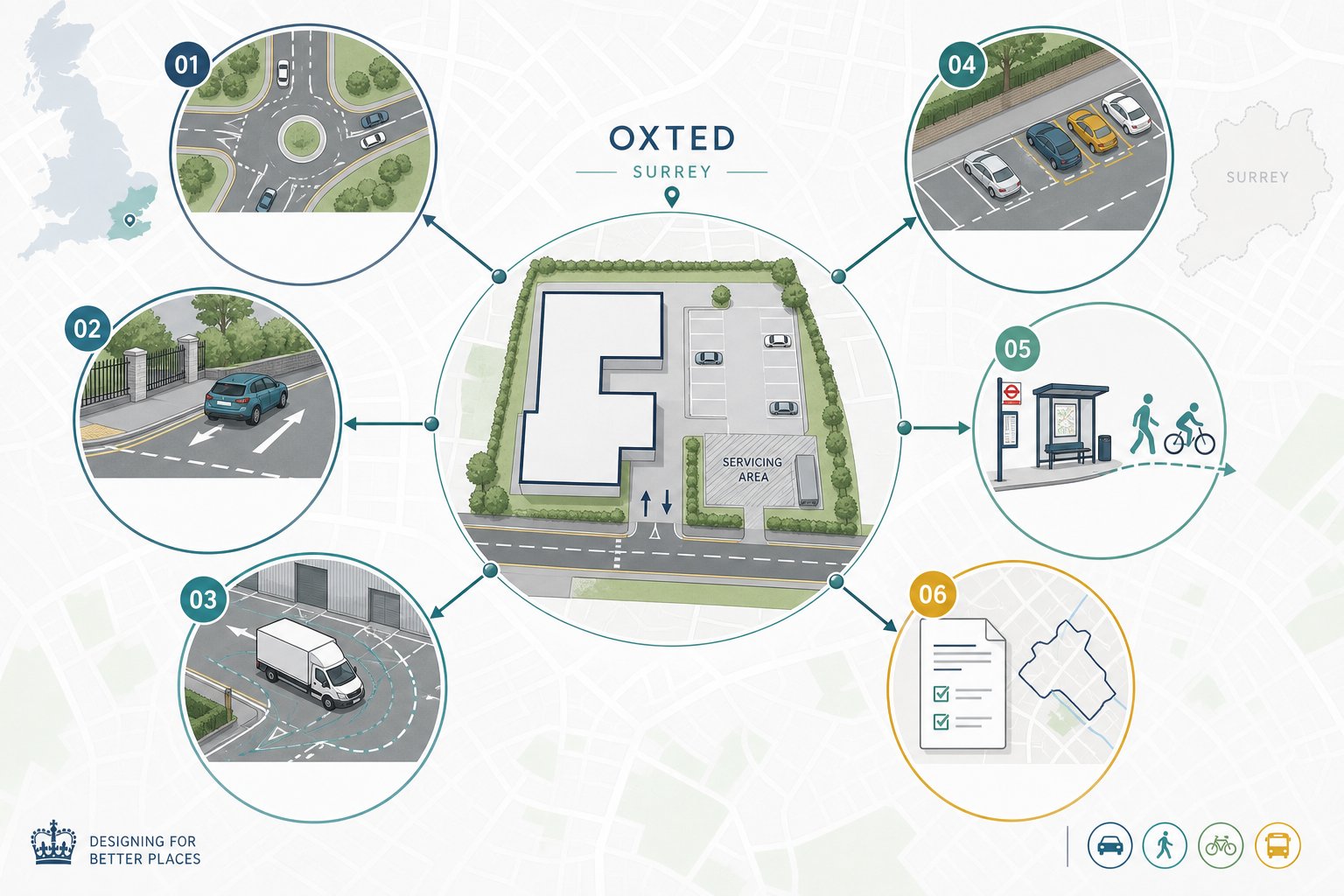
Oxted schemes are shaped by more than generic transport policy. Local highway character, the way streets function day to day, nearby junction conditions, parking demand, and the relationship between the site and walking, cycling, and public transport links can all influence what is likely to be acceptable.
That means the traffic engineering task is often about fit as much as impact. Can vehicles enter and leave in a safe manner? Is there enough room for servicing without awkward manoeuvres? Will the parking layout operate sensibly in practice, not just on a drawing? Does the proposal add pressure to a location where on-street parking is already contested? Those questions can push design revisions long before a planning officer reaches the wider planning balance.
Local authority expectations also matter. Highway officers usually want to see that transport evidence has engaged with the actual conditions around the site rather than relying on standard wording. In our experience, concise reporting that addresses the key local issues directly tends to be more effective than long documents that never quite get to the point.
For development teams, this often affects layout, unit numbers, servicing strategy, and site access geometry. It can also affect whether a change-of-use scheme is genuinely straightforward. Work in Commercial Traffic Engineering and broader thinking in Traffic Engineering: Your Complete both reinforce the same reality: local transport context can quietly determine whether a scheme moves smoothly or gets tied up in avoidable highway concerns.
Typical Development Types That Need Traffic Engineering Input
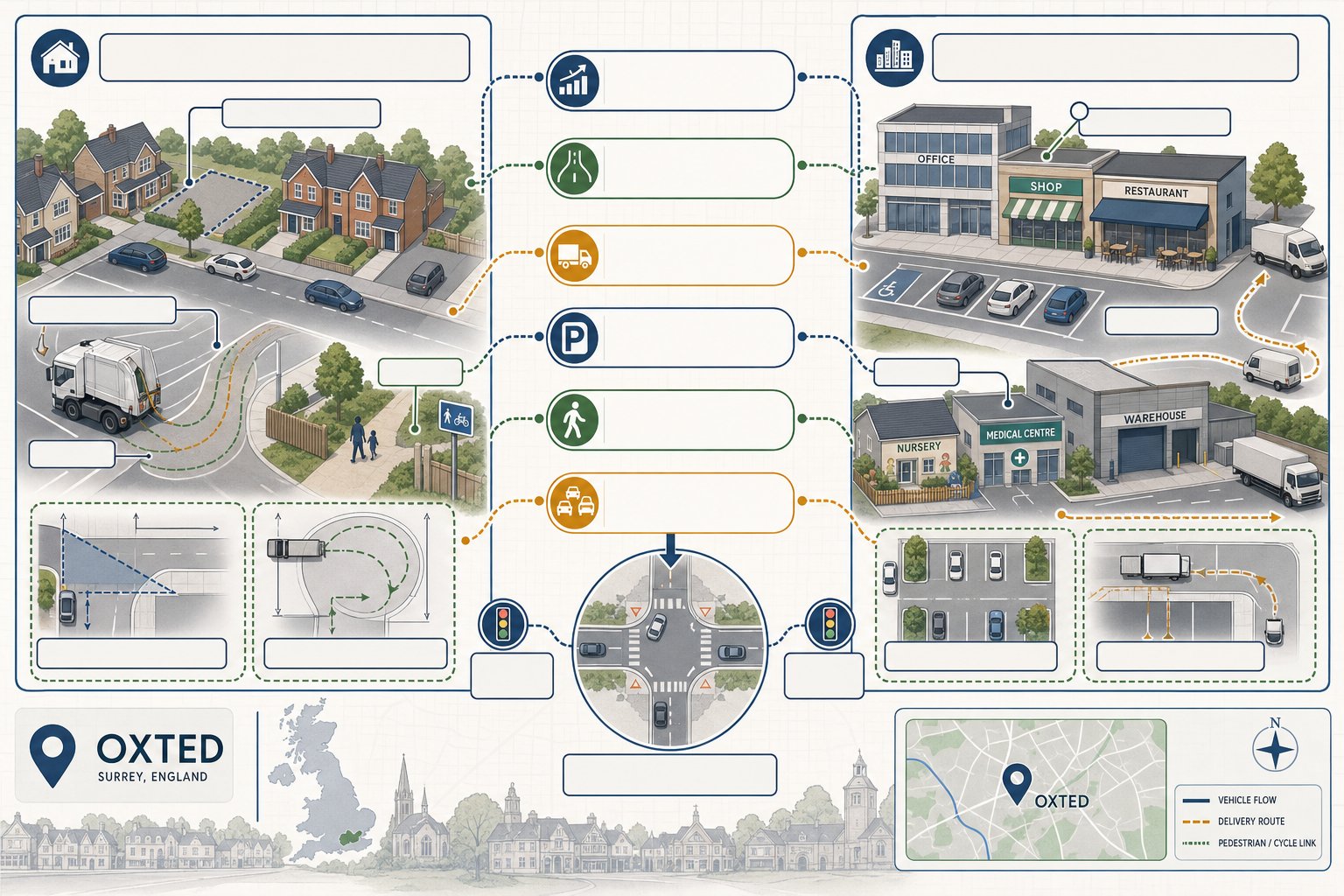
Some schemes obviously require traffic input: others only become transport-sensitive once the design is tested properly. In Oxted, we are commonly asked to support residential development, commercial projects, mixed-use schemes, and change-of-use applications where traffic generation, access design, servicing, or parking could be material to planning determination.
The point is not that every site needs a large report. It is that many sites benefit from early technical review, even when the eventual output is a concise statement rather than a full assessment.
Residential Schemes
Residential proposals are one of the most frequent triggers for transport evidence. Even relatively small schemes can raise questions about access width, visibility splays, parking provision, turning for service vehicles, and the effect of additional vehicle movements on nearby junctions.
Infill sites are a good example. On paper, ten or twelve dwellings may look modest. But if the access sits on a bend, close to a priority junction, or in a street already under parking pressure, the transport issues can become central. We often assess likely trip rates, review whether internal turning is workable, and consider how pedestrians connect to shops, schools, and public transport.
Larger residential schemes usually need more detailed evidence, especially if they generate a noticeable increase in peak-hour traffic or require off-site mitigation. At that point, the transport strategy can influence layout from the outset rather than simply supporting it at the end.
Commercial, Mixed-Use, And Change-Of-Use Proposals
Commercial and mixed-use developments tend to generate a broader spread of transport questions. Servicing becomes more important, parking demand can be less predictable, and the timing of trips may differ sharply from residential patterns. A medical use, nursery, gym, restaurant, or office conversion can each create very different effects, even where floor area is similar.
Change-of-use applications are particularly easy to underestimate. A building may already exist, but the proposed use can alter arrival patterns, delivery activity, and demand for short-stay parking. In those cases, the transport case often turns on comparative trip generation and whether the new use creates materially different highway effects.
For larger employment or mixed-use proposals, access design, delivery routing, and junction performance often become the core issues. That is where lessons from a Traffic Engineer In Manchester: setting or a Traffic Engineer In Leeds: context are useful in principle, but the Oxted application still has to be justified on its own local merits.
Core Traffic Engineering Reports Used To Support Applications
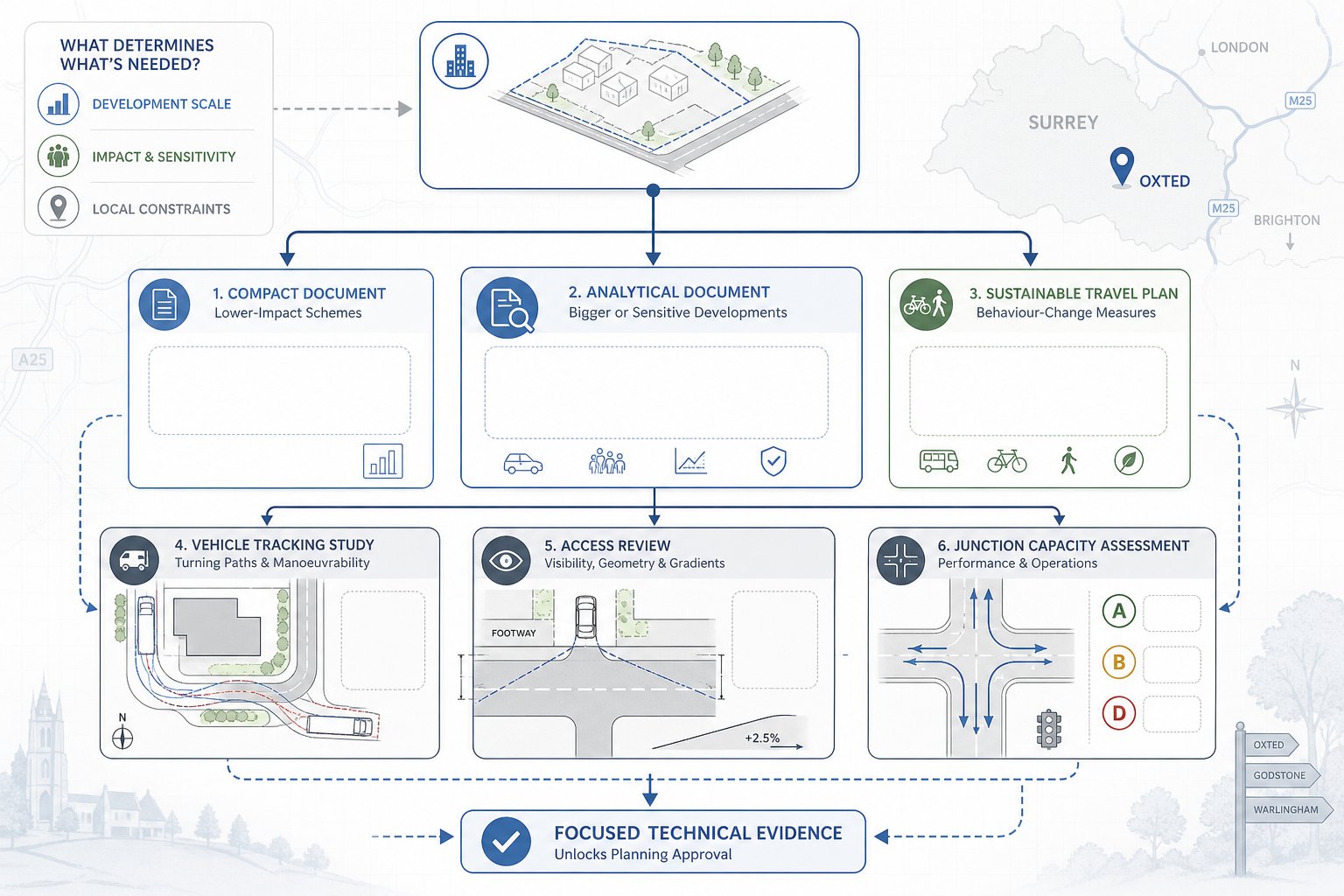
The reports used to support a planning application depend on the development type, scale, and local constraints. In Oxted, the core documents are usually Transport Statements, Transport Assessments, and Travel Plans, sometimes supported by more focused technical exercises such as vehicle tracking, access reviews, and junction capacity assessments.
What matters most is not the title of the report but whether it answers the right planning questions with enough clarity and evidence.
Transport Statements, Transport Assessments, And Travel Plans
A Transport Statement is typically the proportionate option for lower-impact development. It explains the existing transport context, likely trip generation, parking strategy, access arrangements, and any measures needed to make the proposal acceptable. It is often enough where impacts are limited but still need a structured technical justification.
A Transport Assessment goes further. It is used where development is larger, more sensitive, or more likely to affect surrounding network operation. That can include comparative trip analysis, committed development review, junction assessment, sustainable travel options, and mitigation proposals. The stronger the risk of objection, the more important it is that the assessment is both robust and easy to follow.
Travel Plans are sometimes required alongside these documents, especially where encouraging sustainable travel forms part of the planning strategy. A good Travel Plan is practical. It should reflect the actual users of the site rather than recycling generic measures that no one will carry out.
Vehicle Tracking, Access Reviews, And Junction Capacity Assessments
Supporting technical work often carries a disproportionate amount of weight in planning discussions. Vehicle tracking can prove that refuse vehicles, delivery vans, or larger service vehicles can manoeuvre safely within the site and at the access. That is often decisive on constrained layouts.
Access reviews examine geometry, visibility, gradient, and the relationship with pedestrians and nearby highway features. They are especially important where a proposed access is new or materially altered. Junction capacity assessments test whether surrounding junctions can accommodate forecast traffic without severe operational harm.
We regularly find that these focused studies are what unlock a scheme. A concise statement backed by credible tracking and a clear access review can be more persuasive than a long report with weak supporting analysis.
How The Traffic Engineering Process Works From Enquiry To Submission
The process usually starts earlier than many teams expect. Ideally, we are brought in when the scheme is still flexible, because that is when transport advice can improve the design rather than simply defend it.
First, we review the site, proposed development, and likely planning route. That includes a high-level check of access arrangements, local highway conditions, parking pressures, and whether transport concerns are likely to be material. We then scope the work: perhaps a brief technical note, perhaps a Transport Statement, perhaps a fuller package with modelling or tracking.
Next comes data collection and analysis. Depending on the scheme, that may involve site observations, traffic surveys, trip generation research, parking accumulation review, collision data consideration, or a walkover of pedestrian and cycle links. We then test the design assumptions against what the site can realistically support.
After that, we prepare draft outputs and coordinate with the wider consultant team. This stage matters more than people think. If the architect changes the layout, the access geometry may change. If the planner shifts the application strategy, the report emphasis may need to change as well. Good traffic engineering is collaborative, not isolated.
Finally, we issue the submission documents in a planning-ready form. That means clear technical reasoning, proportionate scope, and wording that addresses likely local authority concerns directly. Speed matters, of course, but speed without accuracy is usually what creates the delay later.
Common Planning Risks And How Early Traffic Advice Helps Avoid Delays
Many transport objections are predictable. The trouble is that they are often spotted only after the application has been submitted, when design changes are slower, consultant time is more expensive, and determination deadlines are already under pressure.
Common risks include poor access geometry, inadequate visibility, parking layouts that do not function properly, insufficient turning space for service vehicles, and underestimating the traffic effect of a new use. Another regular problem is simple absence of evidence: the scheme may be acceptable in principle, but the application does not prove it clearly enough for the planning authority or highway officer to sign off.
Early advice reduces that risk by stress-testing the scheme before positions harden. If the access is weak, we can often identify an alternative layout. If parking is marginal, we can review demand assumptions before they are challenged. If a proposed use is likely to prompt servicing concerns, we can address them in the transport submission rather than in a reactive addendum two months later.
This is particularly valuable on tight programmes. A short upfront review can save weeks of redesign, re-consultation, or negotiation. And in appeal-prone cases, it can improve the quality of the evidence from day one. The aim is not to overcomplicate the scheme. It is to remove the avoidable reasons for delay before they become formal objections.
What To Look For When Choosing A Traffic Engineer In Oxted
Choosing the right traffic engineer in Oxted is partly about technical competence and partly about judgement. Plenty of consultants can produce a report. Far fewer know how to pitch the scope correctly, identify the real planning risks, and write in a way that is useful to both clients and decision-makers.
We would look first for experience with planning-led transport work rather than purely operational highway design. Development support is its own discipline. It requires understanding thresholds, trip generation, access standards, parking considerations, highway safety, and the way local authorities assess transport evidence in practice.
Local awareness matters too. That does not always mean being based around the corner. It means understanding how to review an Oxted site in context, what kinds of transport concerns are likely to matter, and how to produce concise evidence that responds directly to them.
Then there is communication. The best consultant for a planning application is not necessarily the one with the densest report. It is usually the one who can explain the issue clearly, coordinate well with architects and planners, and avoid unnecessary overreach. At ML Traffic, our focus is exactly that: concise, accurate reporting delivered quickly and shaped by more than 30 years of transport planning and engineering experience. For clients, that often translates into faster decisions and fewer avoidable rounds of revision.
Conclusion
In Oxted, transport issues can be decisive even on schemes that seem fairly straightforward at first glance. Access design, parking, servicing, trip generation, and local highway context all feed into whether an application feels credible and complete.
That is why the value of a traffic engineer is not limited to writing a report at the end. The real benefit is helping shape a planning strategy early, choosing the right level of evidence, and resolving transport concerns before they slow everything down. For architects, planners, developers, surveyors, lawyers, and public sector teams, that means fewer surprises and a clearer route to submission.
A strong transport case is rarely about producing the longest document. It is about producing the right one: proportionate, technically sound, and tailored to the site. In our experience, that is what gives planning applications the best chance of moving forward efficiently in 2026.
Frequently Asked Questions About Traffic Engineers in Oxted
What does a traffic engineer in Oxted do for planning applications?
A traffic engineer in Oxted assesses site access, trip generation, parking, servicing, and local highway conditions to prepare transport evidence that supports planning applications, helping to identify and resolve potential issues early.
When is a Transport Assessment or Transport Statement required in Oxted?
Transport Statements are used for smaller developments with limited transport impact, while Transport Assessments are needed for larger or sensitive sites where proposals may significantly affect travel demand, road safety, or local junctions.
How do local planning and highway considerations influence development in Oxted?
Developments in Oxted must address local access constraints, parking demand, junction performance, and connections to walking, cycling, and public transport to ensure proposals fit the local transport context and planning expectations.
What types of developments in Oxted typically require traffic engineering input?
Residential schemes, commercial projects, mixed-use developments, and change-of-use applications often need traffic engineering support to address trip generation, access design, servicing, and parking implications for planning.
How can engaging a traffic engineer early help prevent delays in Oxted planning applications?
Early involvement allows for design review and identification of risks like poor access or inadequate parking, enabling adjustments before submission to avoid objections, redesign, and costly delays.
What should I look for when choosing a traffic engineer in Oxted?
Choose an engineer with experience in planning-led transport work, local authority processes, strong communication skills, and the ability to produce concise, proportionate reports tailored to the specific site and scheme.