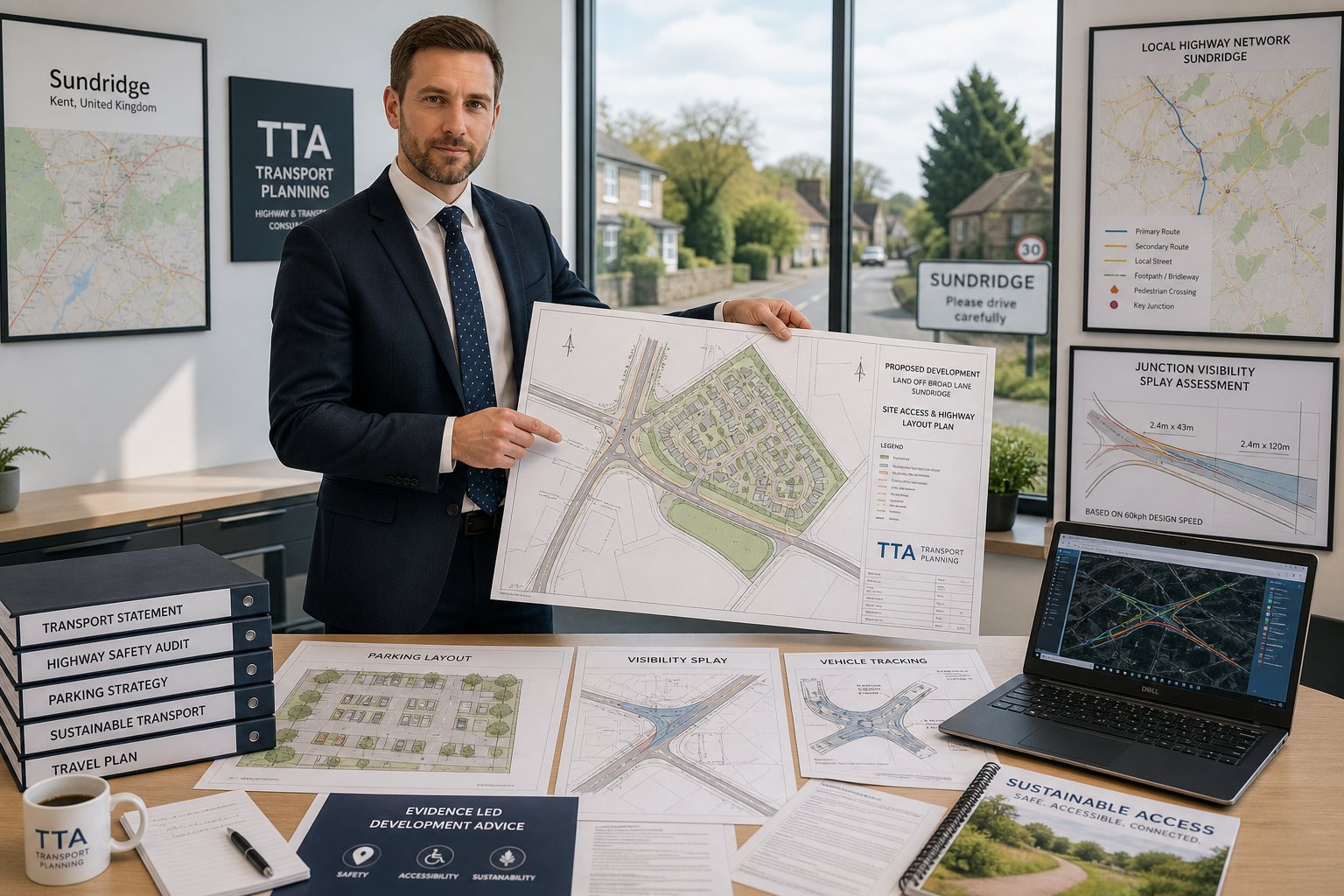
Planning in a village setting is rarely just about the red-line boundary. In places like Sundridge, a proposal can look straightforward on a layout plan and still raise immediate transport questions once it meets the public highway: is the access safe, will visibility work, where will people park, can service vehicles turn, and will the local road network cope without creating unacceptable impact?
That is where a traffic engineer in Sundridge becomes valuable. We help turn transport concerns into evidence-led answers that fit the planning process, local road conditions, and the expectations of the highway authority. For architects, planners, surveyors, developers, legal teams, and councils, that often means getting the right advice early enough to shape the scheme rather than trying to rescue it after objections arrive.
In 2026, that early input matters even more. Planning authorities expect transport submissions to be proportionate, technically sound, and clearly linked to policy, safety, access, servicing, and sustainable travel. A weak report can slow an application. A well-targeted one can remove uncertainty, support negotiations, and improve the odds of consent.
Below, we set out what a traffic engineer in Sundridge actually does, when transport input is usually needed, what reports may be required, and how to choose the right support for a local planning project.
Key Takeaways
- A traffic engineer in Sundridge provides essential early advice on access, visibility, parking, and servicing to ensure development proposals meet local planning and highway authority requirements.
- Transport submissions must be proportionate and technically sound, with appropriate reports such as Transport Statements for smaller schemes or Transport Assessments for larger, more complex developments.
- Village-specific challenges like narrow carriageways, constrained visibility, and parking pressures demand tailored transport assessments to mitigate safety risks and planning objections.
- Collaboration between traffic engineers, architects, planners, and other specialists from the design stage optimises access and circulation solutions and aligns transport evidence with planning policies.
- Selecting a local traffic engineer with experience in village or semi-rural settings and a strong track record ensures relevant, concise, and effective transport advice that improves planning application success.
- Providing detailed site information, pre-application feedback, and programme timelines before instruction enables faster, sharper, and cost-effective transport planning support in Sundridge.
What A Traffic Engineer In Sundridge Does For Planning And Development
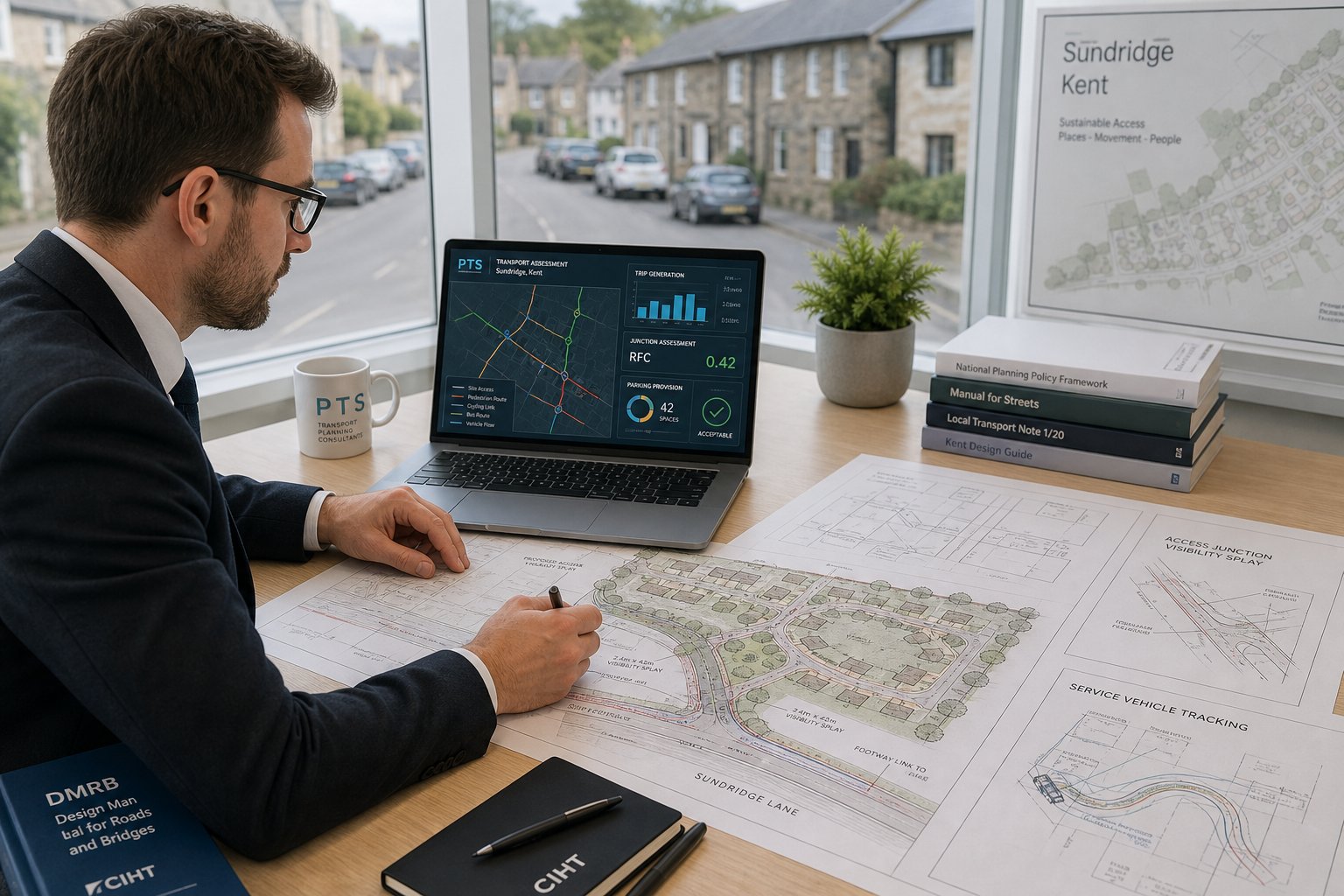
A traffic engineer in Sundridge assesses how a proposed development interacts with the surrounding transport network and whether that relationship is acceptable in planning and highway terms. In practice, we review the site context, the likely scale of vehicle movements, walking and cycling conditions, public transport access, parking demand, servicing needs, and the design of any new or altered access.
We then translate that into planning evidence. That may involve advising whether a scheme needs a brief note, a Transport Statement, a fuller Transport Assessment, or a Travel Plan. It also means testing the proposal against national policy, local planning policy, parking standards, and established design guidance such as Manual for Streets, visibility standards, and where relevant, strategic road criteria.
Just as importantly, we identify risk early. A village site can be constrained by narrow carriageways, frontage parking, bend radii, speed environment, or nearby junction pressure. Spotting those issues before submission often saves time and redesign costs later. Our role is not simply to describe transport effects, but to help shape a workable scheme: access geometry, refuse tracking, delivery arrangements, pedestrian connections, and proportionate mitigation.
For development teams wanting a broader view of how transport input supports planning outcomes, the principles behind Traffic Engineering Consultants: What and Highway And Traffic Engineering apply directly here: good transport advice is part technical discipline, part strategy.
When Transport Input Is Needed For A Sundridge Planning Application
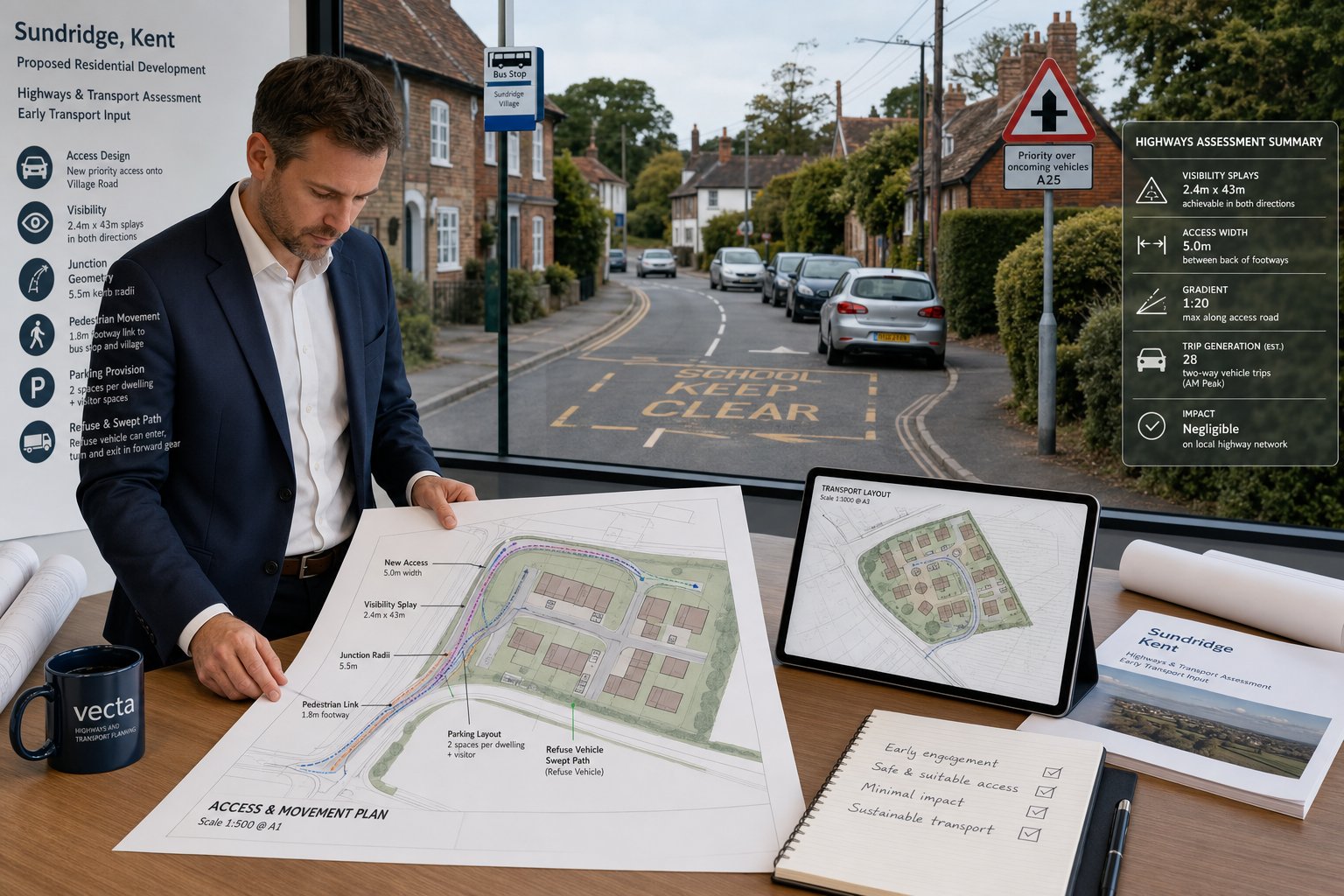
Not every proposal needs a lengthy transport submission, but many schemes in Sundridge need at least some highways input. The most obvious trigger is a new access onto the public highway, or a material change to an existing one. As soon as access location, width, radii, visibility, gates, gradients, or pedestrian interaction become live issues, transport advice is usually warranted.
We are also commonly instructed where an application is likely to intensify use of a site. A small redevelopment may still generate concerns if it adds regular staff trips, customer arrivals, school-related movements, deliveries, or parking demand beyond what the local street can comfortably absorb. That is especially true on constrained village roads or where on-street parking already narrows running lanes.
Sensitive locations raise the need further. Sites close to schools, bus stops, rural bends, high-speed approaches, priority junctions on the A25, or roads with an established collision history often attract more detailed scrutiny from highway officers. Even modest proposals can prompt questions around visibility splays, pedestrian safety, vehicle overrun, and refuse access.
Pre-application discussions, previous refusals, or planning officer concerns are another sign to bring us in early. In many cases, early transport input is less about producing a long report and more about steering the design away from predictable objections. That is often the difference between a smooth submission and a prolonged exchange of technical comments.
Common Types Of Transport Reports Required By Local Planning Authorities

Local planning authorities usually expect transport evidence to be proportionate to the scale and context of the development. In other words, the right report is the one that answers the authority’s likely questions without burying the application under unnecessary paperwork. In Sundridge, where local road constraints can matter more than scheme size alone, choosing the right report type is a strategic step.
At ML Traffic, our approach is to match the report to the planning risk. Some sites only need a concise statement confirming that effects are limited and access can operate safely. Others need fuller traffic forecasting, junction modelling, parking analysis, and sustainable travel measures. And occasionally, a short technical response to a highways consultation comment is enough to unlock progress.
The three report types below are the ones most teams encounter most often.
Transport Statements
A Transport Statement is typically used for small to medium schemes where transport effects are expected to be limited, but where the authority still needs clear evidence on access, safety, parking, servicing, and local movement patterns.
A good TS is not just a lighter version of a Transport Assessment. It is focused. We would normally include a description of the site and proposal, the local highway setting, traffic conditions where relevant, collision history, walking and cycling links, public transport availability, parking provision, and an appraisal of access suitability. If a development is expected to create only modest trip increases, a TS may be sufficient to show that impacts would not be severe in policy terms.
For village locations, the TS often becomes the document that deals with practical concerns planners hear first: can two cars pass, is there enough visibility around a bend, will deliveries block the road, and will parking overspill spill into neighbouring streets? Concise, yes. Superficial, no.
That same proportional approach is discussed in Commercial Traffic Engineering, particularly where smaller commercial or mixed-use schemes need planning-ready transport evidence without drifting into over-assessment.
Transport Assessments
A Transport Assessment is normally required for larger or more sensitive developments where traffic effects may be significant, where junction performance is likely to be questioned, or where the site context is constrained enough to justify a more detailed evidence base.
Compared with a TS, a TA goes further into quantified analysis. We may assess baseline traffic flows, undertake turning counts, estimate trip generation using TRICS or comparable data, distribute those trips across the network, and test impacts at nearby junctions. Depending on the layout and local highway form, that can include PICADY for priority junctions, ARCADY for roundabouts, or LINSIG for signal-controlled nodes. Queueing, delay, reserve capacity, and sensitivity testing may all become relevant.
In Sundridge, a TA is often less about headline traffic growth and more about how modest growth interacts with constrained geometry. A development can be acceptable in broad traffic volume terms but still need careful analysis of access operation, parking stress, or turning movements on a narrow frontage. The TA gives the authority a structured basis for that judgement.
Where clients want a wider technical grounding before commissioning one, Traffic Engineering: Your gives useful context around the role of transport evidence in safer, more defensible planning decisions.
Travel Plans And Technical Notes
Travel Plans and Technical Notes are different tools, but both can be crucial.
A Travel Plan is commonly requested for developments that generate regular staff, visitor, pupil, or member trips, such as offices, schools, leisure uses, healthcare, or larger residential schemes. Its purpose is to encourage sustainable travel through practical measures: cycle parking, walking information, public transport details, car-share initiatives, EV charging, welcome packs, management commitments, and sometimes monitoring targets. A decent Travel Plan is realistic. It reflects what people can actually do from that site, not what looks good in a template.
Technical Notes are shorter, more targeted responses. We often prepare them when a highways officer asks for clarification on trip rates, visibility, parking accumulation, swept-path analysis, or a particular design point. They can also support pre-app discussions or condition discharge submissions. Sometimes a two-page note with the right evidence does more for an application than a 50-page report written too early.
That proportionate mindset matters in every region, whether the issue is a village site in Kent or a denser urban context such as Traffic Engineer In London: or Traffic Engineer In Leeds:.
Key Traffic And Access Issues That Often Affect Sites In Sundridge
Sundridge presents the kind of transport conditions that can make apparently simple schemes more technical than expected. Village-scale roads often have limited carriageway width, irregular frontage conditions, and a mix of local traffic, school activity, servicing, and pedestrian movement that does not always show up neatly in desktop mapping.
One recurring issue is constrained visibility. Accesses near bends, vegetation, boundary walls, or changes in level can reduce sightlines below the standard that highway officers would usually want to see. Whether that becomes fatal to a scheme depends on actual vehicle speeds, traffic character, achievable set-backs, and whether the access can be redesigned. But it needs careful assessment, not assumption.
Parking pressure is another common concern. Existing on-street demand can narrow running lanes and alter how vehicles pass each other, particularly at busier times of day. A proposal that relies on informal kerbside capacity may hence attract criticism even if its internal parking numbers look acceptable on paper.
Walking conditions also matter. In village locations, footways may be narrow, intermittent, or absent on one side of the road. Crossings may be informal, and routes to bus stops or schools may involve pinch points. If a development is expected to generate pedestrian movement, the safety and convenience of those links can become a decisive issue.
Then there is servicing. Refuse vehicles, vans, and occasional larger deliveries need to get in, turn where necessary, and leave safely. If they cannot, the highway authority will usually notice.
How A Traffic Engineer Assesses Vehicle Access, Visibility, And Highway Safety
Our assessment usually begins with the access itself: where it sits, how it connects to the carriageway, whether vehicles can enter and leave in a controlled way, and how that movement interacts with pedestrians, parked cars, and opposing traffic.
Visibility is central. We review measured or surveyed sightlines against the relevant guidance, typically drawing from Manual for Streets for lower-speed environments and, where appropriate, more strategic standards. The detail matters: actual observed speeds may differ from posted limits, and that difference can alter the required visibility splay. We also consider whether obstructions are permanent, seasonal, or removable. A hedge line that can be cut back is a different problem from a listed wall.
We then assess manoeuvrability. Swept-path analysis shows whether cars, refuse vehicles, and delivery vehicles can access the site without excessive overrun or reversing conflict. This is often where layouts need refinement, especially on tight infill sites.
Safety is broader than geometry. We look at collision records, route legibility, pedestrian provision, crossing points, lighting, gradients, and the likelihood of conflict at the site entrance. A technically compliant access can still perform poorly if it channels vehicles into a blind pinch point or forces pedestrians into shared conflict space.
Detailed access strategy often overlaps with access design highway principles, especially where the planning success of a site depends on small but critical design changes.
Trip Generation, Junction Capacity, And Parking Considerations
Once access is established, the next question is usually impact. How many trips will the development generate, where will they go, can nearby junctions absorb them, and is parking provision realistic?
Trip generation is typically estimated using TRICS or a comparable evidence base, adjusted to reflect local context, scale, and likely mode share. That sounds straightforward, but professional judgement is essential. A village-edge scheme in Sundridge should not be treated as if it sits in central London with abundant rail access, nor should every rural scheme be assumed to be entirely car-dependent without evidence.
From there, we assign trips onto the surrounding network and test relevant junctions where required. For some schemes, a simple proportional review is enough. For others, especially where concerns focus on a priority junction, mini-roundabout, or known bottleneck, modelling may be needed to assess queueing and delay in future year scenarios. The key is proportionality: enough analysis to answer the planning question, no more than that.
Parking is often where local objections gather force. We compare proposed provision with adopted standards, but we do not stop there. We also consider likely accumulation, visitor demand, servicing overlap, disabled provision, cycle parking, EV charging, and whether vehicles can use spaces conveniently. A layout with the right number of spaces can still fail operationally if bays are blocked, tandem parking is over-relied upon, or turning is awkward.
The same practical issues appear across wider project types, including Traffic Engineer In Manchester: work where capacity and parking evidence often become central to planning negotiations.
Working With Architects, Planners, And Consultants During The Design Process
Transport input works best when it is embedded in the design process, not bolted on at the end. We often start by reviewing early sketches with architects to test whether the emerging layout can accommodate safe access, vehicle tracking, parking, cycle storage, servicing, and internal circulation without compromising the wider concept.
That collaboration is usually iterative. An architect may be trying to preserve frontage, trees, or unit numbers: we may be flagging the need for a wider bellmouth, better pedestrian visibility, or a bin collection strategy that avoids reversing onto the highway. The right solution is rarely produced by one discipline alone.
With planners and planning consultants, the conversation is more strategic. We help align the transport evidence with local policy, likely consultee concerns, and the application narrative. If pre-app feedback suggests anxiety about parking overspill, school-time conflict, or A25 access safety, the transport submission should address those points directly rather than hiding them in appendices.
We also coordinate with drainage engineers, ecologists, noise consultants, and arboricultural teams because transport design is rarely isolated. A visibility splay can affect planting, a swale can constrain access geometry, and an acoustic fence can become a sightline obstruction. Catching those conflicts early avoids late redesign.
After 30 years in the field, we know that the best planning outcomes usually come from joined-up design, quick reporting, and clear technical judgement rather than the longest report in the room.
What To Prepare Before Instructing A Traffic Engineer
A little preparation makes transport advice faster, sharper, and better value. Before instructing a traffic engineer, it helps to assemble the core information that defines both the site and the planning risk.
Start with the red-line boundary and the latest site layout, even if it is still evolving. We need to understand the proposed use, floorspace, unit numbers, likely occupancy, servicing requirements, and parking intentions. If there are alternative layout options, it is often worth sharing those too: sometimes the transport answer changes materially with a small shift in access position or parking arrangement.
Pre-application feedback is especially useful. Any comments from the local planning authority, highway authority, parish input, or previous appeal or refusal history can save days of duplicated work. We also need to know whether there have been prior objections about speed, visibility, overspill parking, school traffic, or turning provision.
Topographical constraints matter just as much. Trees, levels, ditches, walls, neighbouring accesses, rights of way, protected frontages, and land ownership limitations can all influence what is achievable. If surveys already exist, sharing them early keeps the assessment grounded in reality.
And one practical point: tell us the programme. If the planning team is aiming for a submission in three weeks, the transport scope and survey needs must reflect that. Good technical work can be quick, but only when the brief is clear from day one.
Choosing The Right Traffic Engineer For A Sundridge Project
Not all transport advice is equal, and for a Sundridge project, local judgement matters almost as much as technical competence. We would look for a consultant with clear experience in village, semi-rural, and edge-of-settlement contexts, especially in Kent, Sevenoaks, or comparable authority areas where narrow roads, constrained accesses, and policy-sensitive design are common.
Track record is important, but it should be the right kind of track record. A consultant who routinely handles major urban schemes may be highly capable and still miss the subtleties of a smaller village application where the decisive issue is passing width outside the site or visibility around a soft bend. Ask what comparable schemes they have supported and how they approached similar highway concerns.
Professional standards matter too. Membership of bodies such as CIHT or ICE, use of recognised software, and confidence with TRICS, PICADY, ARCADY, LINSIG, vehicle tracking, and parking analysis all point to a robust service. But responsiveness matters just as much. Planning programmes do not always wait politely.
We also think it is fair to ask how the consultant writes. Highway officers and planners prefer reports that are concise, relevant, and clearly argued. Dense boilerplate tends to slow decisions.
For teams comparing options, the benchmark should be simple: can this consultant give us proportionate, locally aware, planning-focused transport advice that improves the application rather than merely documenting it?
Conclusion
A well-chosen traffic engineer in Sundridge can do far more than produce a report. Early transport input helps shape access, parking, servicing, layout, and mitigation before those issues harden into objections. That matters in a village context, where narrow roads, visibility constraints, school movements, and parking pressure can quickly turn a modest proposal into a contentious one.
For architects, planners, developers, legal teams, and councils, the real value is clarity. We need to know what the highway authority is likely to ask, what evidence is proportionate, and what design changes will genuinely improve the scheme. When those answers are provided early and backed by solid technical work, planning applications tend to move with fewer surprises.
In short: if transport could influence the outcome, involve the right expertise at the start. It is usually the fastest route to a more defensible, workable, and approval-ready proposal.
Frequently Asked Questions about Traffic Engineering in Sundridge
What services does a traffic engineer in Sundridge provide for planning applications?
A traffic engineer in Sundridge assesses how a proposed development affects local transport, including access safety, visibility, parking, servicing, and sustainable travel. They produce proportionate transport reports like Transport Statements or Assessments and advise on design improvements to meet national and local policies.
When is transport input typically required for a Sundridge planning application?
Transport input is usually needed when a development involves new or altered access to public roads, increases traffic or parking demand, or is situated near sensitive locations such as schools, busy junctions like the A25, or constrained village streets prone to safety concerns.
What are the main types of transport reports used in Sundridge planning submissions?
Common reports include Transport Statements for smaller projects with limited impact, Transport Assessments for larger developments requiring detailed traffic analysis, Travel Plans promoting sustainable travel for sites with regular trips, and Technical Notes responding to specific highway queries during the planning process.
How does a traffic engineer assess access and visibility issues in Sundridge?
They evaluate visibility splays against standards like the Manual for Streets, conduct swept-path analyses for vehicles including refuse trucks, consider local vehicle speeds and collision history, and assess pedestrian safety to ensure safe and practical site access within Sundridge’s village road constraints.
Why is early collaboration with a traffic engineer important in Sundridge development projects?
Early input helps identify and resolve transport-related issues before submission, guiding access design, parking, and servicing strategies to avoid objections. Working closely with architects, planners, and other consultants ensures integrated solutions aligned with local policies and site conditions.
How should developers choose the right traffic engineer for a Sundridge project?
They should select consultants experienced in rural and village contexts like Kent and Sevenoaks, who understand local road constraints and policy. Professional memberships, proven local approvals, use of recognised software, and clear, concise reporting are key factors for effective support.