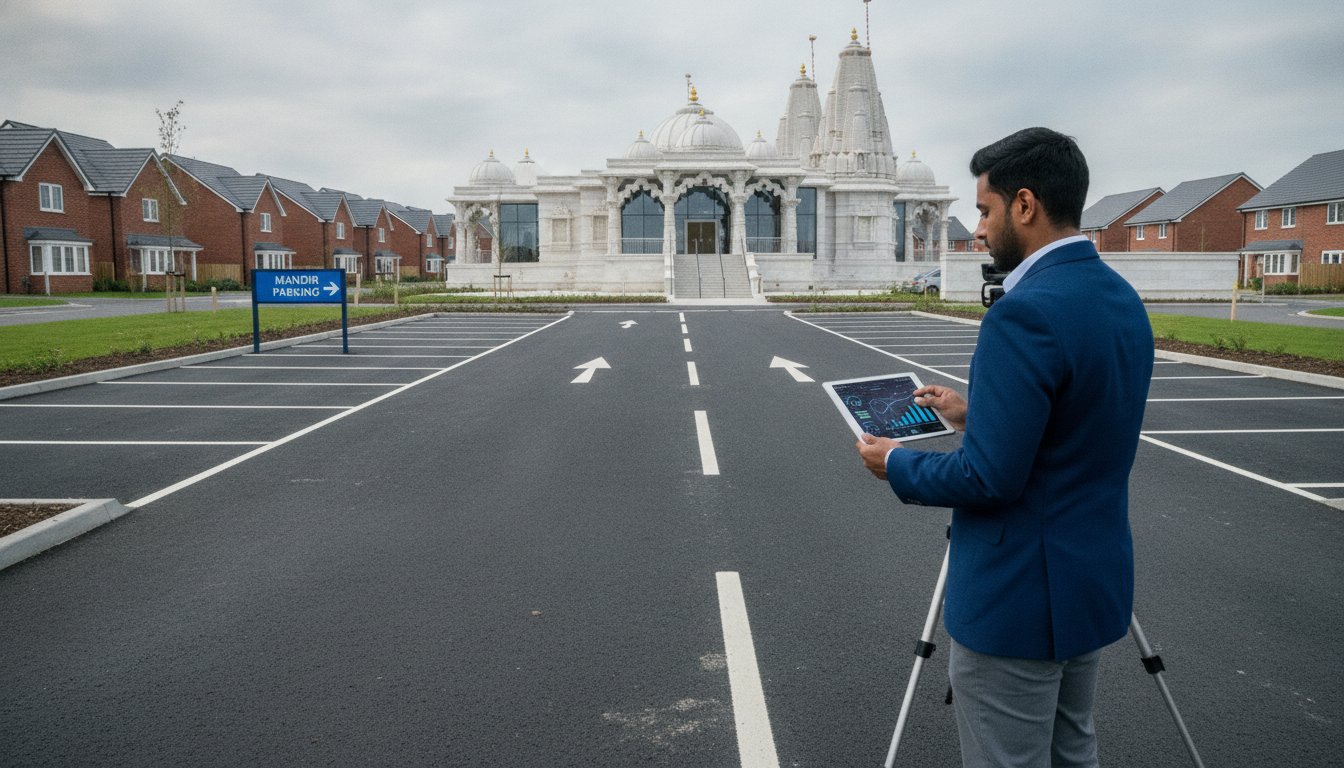
Standard transport models often fail for places of worship because they treat a spiritual community hub like a generic office block. If you’re managing a planning application, you’ve likely encountered the friction between rigid local authority parking standards and the reality of high-intensity traffic peaks during festivals like Diwali or Holi. It’s frustrating when a project that serves the public good is met with resident objections regarding parking overspill and road safety.
We understand that securing a successful Hindu temple transport assessment requires more than just filling out forms; it demands a technical, data-led strategy that reflects the unique peaking patterns of your congregation. This guide provides a comprehensive roadmap to mastering the complexities of planning permission. You’ll learn how to leverage the latest TRICS data and bespoke parking surveys to satisfy the Highway Authority and mitigate local concerns.
We’ll preview the essential steps for building a robust Travel Plan and optimizing your site layout for safe vehicle access. With the National Planning Policy Framework in transition throughout 2026, now is the time to adopt a “vision and validate” approach that ensures your development is both compliant and community-focused.
Key Takeaways
- Differentiate between a Transport Statement and a full assessment to align your application with the latest National Planning Policy Framework standards.
- Utilize the TRICS database and bespoke parking surveys to generate credible trip rates that reflect your temple’s specific attendance patterns.
- Implement tiered mitigation strategies to successfully manage traffic surges during major religious festivals and resolve local resident objections.
- Secure a robust Hindu temple transport assessment by mastering pre-application engagement with Highway Authorities and National Highways.
- Learn how professional traffic modeling optimizes site layouts for safe vehicle access and long-term regulatory compliance.
What is a Transport Assessment for a Hindu Temple?
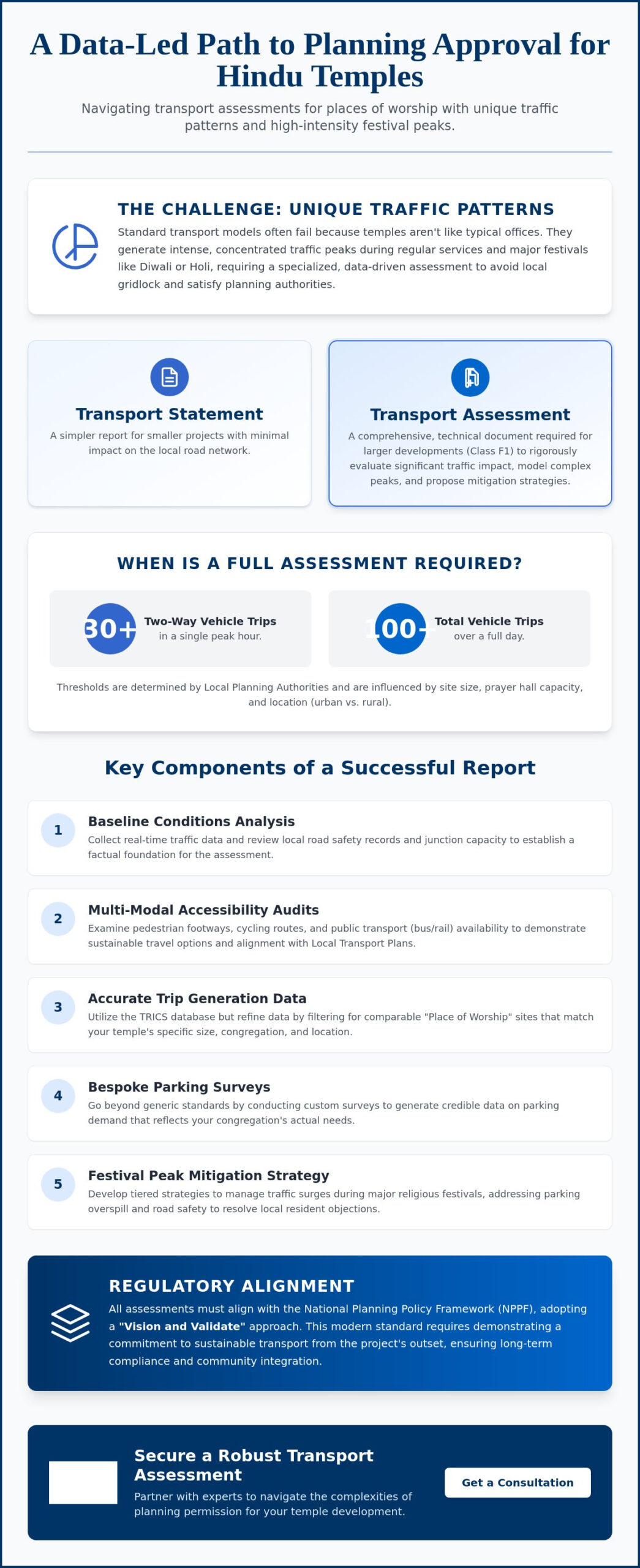
A Hindu temple transport assessment is a specialized technical document required to evaluate the impact of a religious development on the local highway network. It differs significantly from a Transport Statement, which is typically reserved for smaller projects with minimal traffic generation. For Class F1 developments, the planning process in 2026 demands a high level of precision. This is because temples don’t follow the predictable 9-to-5 traffic patterns of an office or retail site. Instead, they produce concentrated peaks of activity that require careful modeling to avoid local gridlock.
The National Planning Policy Framework (NPPF) serves as the primary regulatory anchor for these assessments. Currently, the industry is operating in a transition phase following the major policy review that concluded in March 2026. This means your report must reflect the latest “vision and validate” principles. Rather than just predicting traffic growth, you must demonstrate a commitment to sustainable transport and active travel from the outset. This ensures the site remains functional without placing an undue burden on existing infrastructure.
To better understand the technical depth required for these reports, watch this helpful video:
When is a Full Transport Assessment Required?
Local planning authorities decide the level of reporting based on the scale of the development and its potential impact. While there’s no fixed national law, a full assessment is generally expected if the site generates more than 30 two-way vehicle movements in a single hour or over 100 movements per day. For a temple, these thresholds are often triggered by the size of the main prayer hall or the expected congregation during weekend services.
Location significantly influences the scope of the work. Urban sites often face rigid parking caps and must prioritize public transport links. Conversely, rural developments may need to address vehicle speeds and visibility splays at site entrances. Because requirements vary between counties, we prioritize early engagement with highway officers to agree on the assessment parameters before work begins.
The Core Components of a Temple Transport Report
Every successful report starts with a rigorous analysis of baseline conditions. We collect real-time traffic data to understand how the local road network currently performs. This includes reviewing safety records and junction capacity to ensure the new development won’t compromise public safety. It’s about establishing a factual foundation that can withstand scrutiny from local residents and planning committees.
Accessibility audits are equally vital. We examine the quality of pedestrian footways, the safety of cycling routes, and the frequency of nearby bus or rail services. By proving the site is accessible through multiple modes of transport, we strengthen the case for approval. This alignment with Local Transport Plans is essential for satisfying statutory consultees like National Highways or Transport for London.
Technical Data: Trip Generation and Parking Standards
Accurate data is the foundation of any Hindu temple transport assessment. We utilize the TRICS database to predict vehicle movements, but “Place of Worship” data can be broad and occasionally misleading. Following official government guidance, we ensure the selected data set matches the specific operational characteristics of your site. This involves filtering results to find comparable locations that mirror your temple’s size and geographic setting.
Finding truly comparable sites is often the most significant hurdle in the planning process. A temple in a dense urban center operates differently than a suburban facility. We refine these models by analyzing congregation size and specific catchment areas. This level of precision prevents the Highway Authority from overestimating traffic impact based on generic or outdated data. Our team specializes in identifying these nuances to build a credible case for your development.
Parking accumulation studies are equally vital for a successful application. We don’t just count cars; we analyze how long they stay and when they arrive. If you need to justify a lower number of on-site spaces, professional Parking Surveys provide the evidence required. These surveys prove whether local on-street capacity can safely handle overflow during peak times without causing a nuisance to neighbors. You can view our full range of technical traffic engineering services to see how we support complex applications with site-specific data.
Calculating Trip Generation for Religious Festivals
Standard Sunday peaks don’t represent the full operational reality of a temple. For major festivals like Diwali or Holi, we use survey data from existing temples to demonstrate how car-sharing reduces the total number of vehicles. High vehicle occupancy is a common cultural trait within the Hindu community. By documenting an average of three to four people per car, we can significantly lower trip rate estimates in the Hindu temple transport assessment, making the project more acceptable to planners.
This strong sense of community often extends to shared travel experiences; for those interested in organizing group visits to spiritual landmarks in India or Southeast Asia, you can learn more about Tailormade Journeys Limited.
Meeting (and Challenging) Local Parking Standards
UK planning policy continues to shift toward maximum parking standards to discourage private car use. In high PTAL areas, particularly across London, we frequently justify “Zero-Parking” schemes for new religious developments. However, we must still strictly adhere to 2026 requirements for disabled bays and electric vehicle (EV) charging points. We balance these rigid standards with practical site layouts that prioritize safety and accessibility for all visitors, regardless of how they choose to travel.
Overcoming Objections: Managing Festival Peaks and Congestion
The most frequent objection to new religious developments is the perceived impact on the local road network during major events. While a site might function perfectly on a weekday afternoon, resident concerns focus on the high-intensity peaks of Diwali, Holi, or Janmashtami. A successful Hindu temple transport assessment must address these fears with technical precision rather than vague promises. We utilize site-specific Traffic Surveys to establish exactly how much spare capacity exists at nearby junctions. This data allows us to prove that the network can absorb temporary increases in volume when the right management is in place.
We implement tiered mitigation strategies to separate daily operations from peak festival management. According to official government guidance, mitigation must be proportionate to the impact of the development. For standard days, the focus remains on onsite parking and pedestrian safety. For festivals, we deploy advanced measures such as temporary traffic marshals, off-site parking agreements, and pre-booked arrival slots. This proactive approach reassures the Highway Authority that the community has a clear, actionable plan for every scenario.
The Role of a Robust Travel Plan
A Travel Plan is a dynamic document that sets measurable targets for reducing single-occupancy car journeys. We often propose shuttle bus services from local rail stations during major festivals to intercept visitors before they reach the site. Appointing a Travel Plan Coordinator is a critical step in this process. This individual monitors community compliance and ensures that sustainable travel initiatives remain effective long after the planning permission is granted. It turns a technical report into a living commitment to local road safety and civic responsibility.
Swept Path Analysis for Temple Sites
Temple forecourts are often architecturally complex and space-constrained. We use Swept Path Analysis to simulate the movement of refuse vehicles, fire tenders, and coaches within these tight spaces. It’s vital to demonstrate that emergency vehicles can access the site and exit in a forward gear without requiring dangerous multiple-point turns. We also ensure that delivery vehicles and visitor coaches can complete “In and Out” manoeuvres safely without obstructing the public highway. Our engineers utilize AutoTURN software to verify vehicle swept paths, which prevents costly layout revisions during the late stages of the planning phase.
Navigating the Planning Process and Highway Agreements
Successful planning outcomes depend on early collaboration with the Local Highway Authority. Before submitting your Hindu temple transport assessment, you should engage in pre-application discussions to agree on the study area and the scope of junction modeling. This proactive step prevents the rejection of your technical data later in the process. It also provides a platform to address resident concerns before they escalate into formal objections during the public consultation phase. We manage these early-stage meetings to ensure the assessment parameters are both fair and achievable.
When your site sits near a major A-road or motorway, National Highways will act as a statutory consultee. Their review follows DfT Circular 01/2022, which prioritizes sustainable development over road capacity expansion. If your project is in the capital, Transport for London (TfL) will assess your application against the London Plan healthy streets indicators. We coordinate these high-stakes negotiations on your behalf. Our engineers provide the technical responses needed to satisfy every regulatory body, keeping your project moving through the planning portal without unnecessary friction.
Understanding Section 278 (S278) Requirements
A Section 278 Agreement is necessary when your development requires changes to the existing public highway. This often happens when a new temple needs a safe vehicle entrance or a pedestrian crossing to connect to a nearby bus stop. These agreements are legally binding and involve specific financial obligations for the developer. Common S278 works include:
- New or improved site access points for better visibility.
- Junction widening to accommodate coach turning circles.
- Installation of traffic signals or zebra crossings to protect visitors.
- Footway improvements to enhance pedestrian safety and site accessibility.
Costs for these works include the construction itself, alongside the highway authority’s fees for design checks, legal reviews, and site supervision. You’ll likely need to provide a highway bond to guarantee the works are completed to the required standard. Because these fees are not standardized and are specific to each project, early cost estimation is vital for your project budget.
Securing Approval via Transport Statements
For smaller religious developments, a full assessment might be unnecessary. A well-drafted Transport Statement can often satisfy the planning officer if the expected vehicle movements fall below the 30-per-hour threshold. This shorter report still requires a high level of technical accuracy to be planning-ready. We include a summary of expected visitor numbers, an analysis of local public transport, and a clear description of the proposed temple use. Precision in your data serves as the primary defence against planning appeals and costly delays. If you need professional support for your application, contact our traffic engineers for a detailed project review.
Why Choose ML Traffic Engineers UK for Temple Developments?
Securing planning approval for a place of worship requires a partner who understands the intersection of religious practice and highway regulations. ML Traffic Engineers UK provides a specialized service that bridges the gap between technical engineering and community focused planning. We’ve built a reputation for securing approvals for F1 Class developments by delivering precision led reports that satisfy even the most stringent local authorities. Our team manages every stage of the process in house. From the initial Traffic Surveys to the final submission of your Hindu temple transport assessment, we maintain total control over data quality and technical accuracy.
We prioritize a safety-first approach. This protects the interests of your congregation while addressing the safety concerns raised by planning committees. For many religious organizations, this dedication to safety also involves ensuring that volunteers and staff are prepared for medical emergencies through First Medical Training Ltd. Our experts don’t just provide data; we provide solutions that reduce regulatory pressure on your team. By handling the technical lexicon and highway negotiations, we allow you to focus on the spiritual and community aspects of your development. Our readiness to act and constant availability make us a reliable partner for high-stakes infrastructure projects.
Our Tailored Approach to Religious Sites
Generic engineering firms often miss the nuances of religious peaking patterns. We model these specific surges with accuracy, ensuring that your application reflects the actual behavior of your community. Our extensive experience negotiating with London Boroughs and County Councils across England gives us a distinct advantage. We understand the local variations in parking standards and accessibility requirements that can make or break an application. You can contact ML Traffic Engineers UK today for a bespoke project review to discuss your site’s specific challenges.
Case Studies: Turning Objections into Approvals
Our track record includes numerous urban temple projects where initial resident objections threatened to derail the planning process. Through detailed Swept Path Analysis, we’ve demonstrated that even the most constrained sites can accommodate emergency vehicles and coaches safely. Our robust Travel Plans have successfully shifted the focus from car dependency to sustainable access, often convincing highway officers to support the development.
These technical interventions do more than just secure approval. They often result in significant cost savings for our clients. By proving that certain off-site improvements are unnecessary or by negotiating fairer terms for Section 106 or Section 278 agreements, we reduce the financial burden on the developer. Every client receives direct access to our senior consultants. This ensures that high-level expertise is applied to every Hindu temple transport assessment, providing the unwavering reliability your project demands.
Secure Your Planning Approval with Technical Precision
Securing planning permission for a place of worship requires a strategy that balances technical compliance with community needs. We’ve explored how data-driven trip generation models and tiered festival management plans turn local objections into a clear path for approval. A professional Hindu temple transport assessment provides the technical evidence necessary to satisfy the Highway Authority and protect your development’s future.
Founded in 2014, ML Traffic Engineers UK brings over a decade of UK planning expertise to your project. Our team delivers professional, safety-conscious reporting that meets all statutory requirements, from Swept Path Analysis to detailed Parking Surveys. We manage the full project lifecycle, ensuring your site layout is optimized for safe vehicle access and long-term regulatory compliance. Don’t let complex highway regulations or resident concerns delay your spiritual mission.
Request a Transport Assessment Quote for Your Temple Project to receive a bespoke review from our senior consultants. We’re ready to help you build a lasting, accessible foundation for your congregation.
Frequently Asked Questions
Do I need a Transport Assessment for a small community temple?
Whether you need a full Hindu temple transport assessment depends on the scale of your congregation and the expected vehicle movements. Smaller developments that generate fewer than 30 two-way vehicle movements in any hour typically only require a Transport Statement. However, if your site is in a sensitive area or has limited access, the council might still request a more detailed report to ensure local road safety isn’t compromised.
How does a Travel Plan help in getting planning permission for a place of worship?
A Travel Plan acts as a formal commitment to reducing car dependency and promoting sustainable transport like cycling or public transport. It helps secure planning permission by proving to the Highway Authority that you have a proactive strategy to manage visitor numbers. By setting measurable targets and appointing a coordinator, you demonstrate that the temple won’t cause long-term congestion or parking stress in the neighborhood.
What is the Lambeth Methodology for parking surveys, and does it apply to temples?
The Lambeth Methodology is a standard industry practice used to measure “parking stress” on local streets. While councils originally designed it for residential developments, we often adapt it for temples to prove that enough on-street capacity exists during peak service times. These surveys involve counting parked cars late at night and during your busiest weekend hours to show that visitors won’t block access for residents.
Can the council refuse my temple application based on traffic alone?
The council can refuse an application if the transport impact is considered “severe” under the National Planning Policy Framework. This usually happens when a development causes dangerous levels of congestion or lacks safe access for pedestrians and emergency vehicles. Our role is to provide technical data and mitigation strategies that prove the impact is manageable, preventing a refusal based on anecdotal traffic concerns from local objectors.
How much does a Hindu temple transport assessment typically cost?
The cost of a Hindu temple transport assessment varies significantly based on the project’s scale and the number of junctions we need to model. Factors like the requirement for manual traffic counts, the complexity of the site layout, and the need for multi-day parking surveys will influence the final fee. We provide bespoke quotes that reflect the specific technical requirements of your local highway authority and the size of your development.
What is Swept Path Analysis and why is it required for my site?
Swept Path Analysis uses specialized software like AutoTURN to simulate the movement of large vehicles within your site layout. It’s a mandatory requirement for most planning applications to prove that fire tenders, refuse trucks, and visitor coaches can enter and exit the site safely in a forward gear. This analysis ensures your design functions correctly before construction begins, preventing costly revisions to the site’s physical boundaries or access points.
How do we handle traffic management for Diwali and other major festivals?
We manage high-intensity festival peaks through a tiered Traffic Management Plan that triggers additional measures during major events. This often includes hiring professional marshals to direct cars, using off-site “park and ride” locations, and implementing a pre-booked arrival system for visitors. These measures are detailed in your transport report to reassure planners that your community can handle surges like Diwali without disrupting the wider local road network.
What is the difference between a Transport Statement and a Transport Assessment?
The primary difference lies in the scale of the development and the depth of the technical analysis. A Transport Statement is a concise report for smaller projects with limited traffic impact. In contrast, a full assessment is a comprehensive document that includes detailed junction modeling and a much wider study area. We determine which report you need by reviewing your floor area and expected visitor numbers against local highway authority thresholds.

Disclaimer
The content on mltraffic.co.uk, including all technical articles, guides, and resources, is provided for general informational and educational purposes only. It is not intended to constitute professional advice in traffic engineering, transportation planning, development approvals, or any other technical or legal field.
While ML Traffic Engineers makes every reasonable effort to ensure the accuracy, completeness, and timeliness of the information published, we do not provide any warranties or representations (express or implied) regarding its reliability, suitability, or availability for any particular purpose. Any reliance you place on the content is strictly at your own risk.
In no event shall ML Traffic Engineers, its directors, employees, authors, or affiliates be liable for any direct, indirect, incidental, special, consequential, or punitive damages (including, without limitation, loss of profits, data, or business opportunities) arising out of or in connection with the use of, or inability to use, any information provided on this website.
The articles and guides on this site are not a substitute for engaging a qualified, professional traffic engineer to assess your specific project requirements. For tailored advice, compliance assessments, or traffic engineering services, please contact a competent professional.
This disclaimer may be updated from time to time without notice. By accessing or using this website, you agree to be bound by the most current version of this disclaimer.