
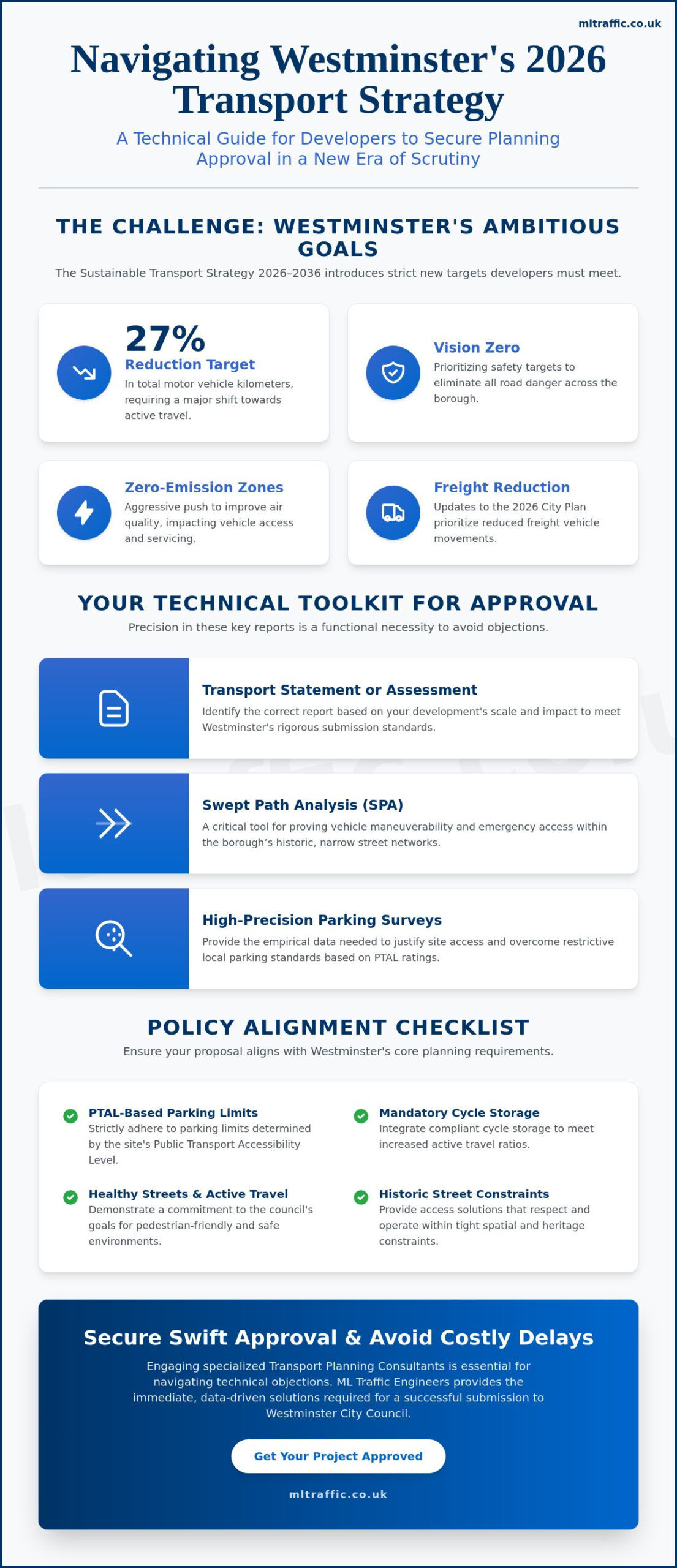
Did you know that Westminster now targets a 27% reduction in total motor vehicle kilometers as part of its new Sustainable Transport Strategy 2026–2036? This aggressive shift toward active travel and zero-emission zones means that traditional site access plans are no longer sufficient to secure approval. Partnering with experienced Transport Planning Consultants Westminster is now a functional necessity for any developer facing the borough’s stringent PTAL-based parking limits and historic street constraints.
We understand that technical objections from the council can stall your project for months, especially with the 2026 City Plan updates prioritizing freight reduction and Vision Zero safety targets. You need a partner who provides immediate, data-driven solutions rather than generic advice. This article provides the technical guidance you need to master Westminster City Council’s latest requirements, ensuring your application meets every regulatory benchmark. We’ll examine the impact of the 2026 transport strategy, explain how to justify site access in high-congestion zones, and outline the essential technical reports, such as Transport Statements and Swept Path Analysis, required for a successful submission.
Key Takeaways
- Identify whether your development requires a Transport Statement or a full Transport Assessment to meet Westminster’s rigorous 2026 submission standards.
- Learn how Swept Path Analysis (SPA) acts as a critical tool for proving vehicle maneuverability and emergency access within the borough’s historic, narrow street networks.
- Align your site proposals with the latest Westminster City Plan updates, specifically regarding PTAL ratings and mandatory cycle storage ratios.
- Utilize high-precision Parking Surveys to provide the technical evidence necessary to overcome restrictive local parking standards and justify site access.
- Understand why engaging specialized Transport Planning Consultants Westminster is essential for navigating technical objections and securing swift planning approval.
The Role of Transport Planning Consultants in Westminster’s 2026 Development Landscape
Transport Planning Consultants Westminster act as the essential technical bridge between complex development goals and the strict regulatory requirements of Westminster City Council (WCC). In a borough where spatial constraints are the norm rather than the exception, the council maintains a level of technical scrutiny that far exceeds most other London authorities. Precision in reporting is not just a preference; it’s a functional necessity for project viability. Professional consultants translate high-level council aspirations into actionable technical data that supports your planning application.
The publication of the Sustainable Transport Strategy 2026–2036 in February 2026 has fundamentally shifted the development landscape. Developers must now navigate ambitious targets, such as the drive toward zero-emission zones and the reduction of freight vehicle movements. Achieving these benchmarks requires a sophisticated approach to transportation planning that prioritizes empirical data and technical authority over generic assumptions. Professional reporting ensures your project aligns with the council’s safety targets, which aim to eliminate road danger while improving air quality across the West End and beyond.
To better understand how urban planning affects transport and life in this specific borough, watch this helpful video:
Navigating the Westminster Planning Portal
Success within the Westminster planning portal requires a clear understanding of the hierarchy between the London Plan and local Westminster policies. The January 2026 partial review of the City Plan has already strengthened policies regarding affordable housing and retrofitting, making the regulatory environment more complex. Early engagement with highways officers is a functional necessity to avoid technical objections. This proactive approach allows developers to address the council’s shift toward “Healthy Streets” and active travel early in the design phase. By demonstrating a commitment to the council’s long-term active travel goals, consultants can reduce the likelihood of costly delays during the formal consultation period.
When to Appoint a Transport Consultant
Identify transport risks during the site feasibility and due diligence stage to protect your investment. Waiting until the architectural masterplan is complete often leads to friction when parking or servicing requirements clash with spatial constraints. Integrating transport design early allows for the inclusion of technical justifications for site access and parking provision. ML Traffic Engineers ensures all statutory requirements, from Transport Statements to Travel Plans, are robust and ready for submission. You can view our full range of services on our what we do page. This readiness minimizes the risk of planning objections and ensures your project moves from inception to completion without unnecessary regulatory pressure.
Essential Transport Documentation for Westminster City Council Applications
Securing planning permission in the West End or surrounding wards requires a rigorous technical approach. Westminster City Council (WCC) distinguishes between reports based on the scale of the proposed development’s impact. Precision in these documents is vital because even minor technical errors can lead to immediate objections from highways officers. Expert Transport Planning Consultants Westminster ensure that every document, from a basic statement to a complex assessment, adheres strictly to Westminster’s planning policies and the 2026 Sustainable Transport Strategy.
The council demands high-level evidence for any project that might influence local traffic flow or pedestrian safety. While smaller residential conversions might only require a concise Transport Statement, larger commercial or mixed-use developments necessitate a full Transport Assessment. These reports must address the borough’s unique challenges, such as restricted servicing windows and the need for consolidated deliveries. Data-driven reporting is the only reliable way to justify departures from standard parking policies, especially in areas with high PTAL ratings where the council enforces car-free development.
Transport Statements for Westminster Projects
A Transport Statement serves as a focused evaluation for smaller-scale projects. It includes a detailed site description, a thorough policy review, and a trip generation analysis. We utilize the TRICS database to provide accurate traffic impact forecasts that satisfy council scrutiny. This document proves that your development won’t negatively affect the local highway network. If your project exceeds specific size thresholds, you’ll likely need a more comprehensive report. You can find detailed technical requirements in our Transport Assessment London guide.
Travel Plans and Sustainability
Travel Plans are now a mandatory component for most Westminster applications. These documents must outline site-specific measures that actively encourage cycling and public transport use. With the council’s 2041 goal of 70% of residents achieving 20 minutes of active travel daily, your plan must be ambitious yet achievable. ML Traffic Engineers designs robust London Travel Plans that include long-term monitoring and management strategies to ensure compliance. If you’re preparing a submission, you can view our technical capabilities on our services overview page. Our reports provide the clarity needed to navigate the 2026 regulatory environment and secure a successful planning outcome.
Overcoming Spatial Constraints: Swept Path Analysis and Parking Surveys in Westminster
Westminster’s street network is one of the most constrained in the UK. In 2023, London’s roads were ranked the most congested in Europe, with drivers spending an average of 99 hours in traffic. This high level of congestion makes site access a primary concern for highways officers during the planning process. With over 2,000 people currently on the waiting list for secure cycle hangar spaces, the pressure on available street space is immense. Developers must prove that their sites can function effectively without obstructing the public highway. This is where Transport Planning Consultants Westminster provide technical authority. We use precise data to navigate the borough’s historic architecture and narrow mews, ensuring your site layout is both functional and compliant.
Proving vehicle access is a mandatory requirement for any site entrance in Central London. In 2023, there were 1,374 casualties on Westminster’s streets, which was the highest number of any London borough. Consequently, the council requires clear evidence that emergency and service vehicles can enter and exit in a forward gear. This involves preparing Essential Transport Documentation that includes detailed computer simulations. Without this level of technical justification, applications often face immediate rejection due to safety concerns. Our reports provide the clarity needed to reduce regulatory pressure and move your project forward.
Technical Precision in Swept Path Analysis
We simulate vehicle movements using industry-standard software to create accurate Swept Path Analysis services. Our technical reports address specific “overhang” and “clearance” issues common in basement car park designs and tight site entrances. We model the exact dimensions of fire tenders and refuse vehicles to ensure compliance with London Fire Brigade and WCC waste collection standards. This precision is non-negotiable for Westminster’s narrow mews, where every centimeter of clearance determines project viability. We provide the technical evidence needed to finalize site layouts without fear of highways objections.
Conducting Parking Surveys in Central London
In high PTAL zones, such as those with ratings of 6a or 6b, the council often mandates car-free developments to reduce local congestion. However, you must still prove that your project won’t increase local parking stress on neighboring streets. We apply the Lambeth Methodology to Westminster’s unique parking zones to gather reliable data. Our Parking Surveys identify overnight parking stress and daytime commercial demand. This data allows us to mitigate council concerns regarding overspill parking by providing an empirical baseline of current street capacity. Our surveys ensure your application meets the council’s strict sustainability and safety benchmarks.
Westminster-Specific Planning Requirements: PTAL, Servicing, and Sustainability
The Westminster City Plan 2019-2040 remains the foundation for development, but the February 2026 Sustainable Transport Strategy has introduced more aggressive benchmarks for compliance. Developers must now account for the council’s target to reduce total motor vehicle kilometers by 27% by 2040. In areas with PTAL ratings of 6a and 6b, which cover much of the borough, Westminster City Council (WCC) effectively mandates car-free developments. These high accessibility levels dictate strict parking and cycle storage ratios. With over 2,000 residents on the waiting list for secure cycle hangar spaces as of 2024, providing high-quality, on-site cycle infrastructure is a functional necessity for planning success.
Sustainability is no longer an optional add-on; it’s a core technical requirement. WCC aims for 98% of all powered vehicles on its roads to be zero-emission by 2040. This goal forces developers to incorporate Electric Vehicle (EV) charging infrastructure into even the most constrained site layouts. Transport Planning Consultants Westminster provide the technical authority needed to integrate these systems without compromising site efficiency. We ensure your proposals align with the council’s air quality goals, which target World Health Organization guideline levels by 2040. Our team prepares the data-driven reports required to prove your site supports a sustainable, low-carbon economy.
Servicing and Waste Management in High-Density Areas
In congested zones like Marylebone, designing on-site loading bays that don’t compromise the public highway is a major hurdle. You must meet Westminster’s strict requirements for refuse collection vehicle (RCV) access, ensuring these large vehicles can maneuver safely without reversing onto busy streets. Consolidated Delivery requirements for WCC commercial sites mandate that multiple suppliers use a single distribution point to minimize the number of individual vehicle trips entering the congestion charge zone. We use technical simulations to prove that your servicing strategy reduces road danger while maintaining operational efficiency. If you need assistance with site access logistics, you can view our full range of technical services.
Highway Design and Section 278 Agreements
Securing planning approval is only the first step; you must also navigate the transition to highway works via Section 278 (S278) agreements. These legal contracts ensure that any modifications to the public road meet Westminster’s high aesthetic and safety standards. Our expertise in Highway Design S278 & S38 ensures that your public realm improvements are technically sound and compliant with the latest 2026 standards. We manage the technical dialogue with highways officers to ensure that your project moves from planning to execution without unnecessary delays. This comprehensive approach reduces the regulatory pressure on your team and guarantees that all statutory technical requirements are met before construction begins.
Expert Transport Consultancy for Westminster: How ML Traffic Engineers Secures Approvals
Securing planning permission in the 2026 regulatory climate requires more than basic technical reports. It demands a partner with the technical authority to stand up to the most rigorous council scrutiny. Westminster City Council’s highways officers are known for their meticulous attention to detail, especially regarding safety and the latest urban mobility standards. We provide the precision needed to satisfy these requirements, acting as a dependable expert for developers who cannot afford delays. Our team manages full project lifecycles, ensuring that every submission is technically sound and aligned with the latest legislative benchmarks.
We reduce the logistical and regulatory pressures on your team by handling the intricate technical details of your application. Whether you require a Transport Statement for a minor conversion or a full Transport Assessment for a large-scale commercial project, we deliver reports that prioritize clarity and rapid delivery. Our expertise extends to providing high-precision Traffic Surveys and Travel Plans that directly address the borough’s specific sustainability targets. We understand that in a high-stakes environment, precision is a functional necessity. By positioning ourselves as a vital guardian of professional standards, we ensure your site access and parking justifications are beyond reproach.
Our Westminster Project Experience
Our team has extensive experience navigating the complexities of Central London’s planning portals. We recently secured approval for a constrained residential site on the Tower Hamlets and Westminster borders, where narrow street access and high PTAL ratings presented significant hurdles. By using data-driven justifications and precise Swept Path Analysis, we overcame technical objections regarding refuse vehicle maneuvering. Our cross-borough expertise is a major advantage for developers working across different jurisdictions. You can learn more about our work in adjacent areas in our guide for Transport Planning Consultants Tower Hamlets. This broad experience allows us to anticipate council concerns before they lead to formal objections.
Get Your Westminster Project Started
Success in Westminster depends on early engagement and technical readiness. Don’t let your project stall due to avoidable technical objections or incomplete documentation. Contact ML Traffic Engineers today for a tailored quote on your Transport Statement, Swept Path Analysis, or Parking Survey. You can explore our full range of professional offerings on our what we do page. We provide professional, safety-conscious advice with constant accessibility for urgent planning needs, ensuring your application remains on track. Our commitment to unwavering reliability makes us the comprehensive partner you need to navigate the complexities of 2026 planning approvals.
Secure Your Westminster Planning Approval with Technical Precision
Navigating the 2026 planning landscape in Central London requires a balance of technical authority and local policy knowledge. You must ensure that every report, from a Transport Statement to a detailed Swept Path Analysis, meets the high-stakes requirements set by the council. Precision in data is the only reliable way to overcome technical objections and secure a successful outcome for your development project. Success depends on aligning your site’s functional needs with the borough’s evolving safety and sustainability benchmarks.
ML Traffic has been a reliable partner for developers since 2014, providing over a decade of London planning expertise. We are specialists in TRICS data and Swept Path Analysis, ensuring your application is robust enough to withstand rigorous scrutiny. Our team also serves as expert witnesses for planning appeals and public inquiries, offering the technical support you need when the stakes are highest. We handle the intricate regulatory details so you don’t have to. Request a Technical Quote for Your Westminster Project today and partner with expert Transport Planning Consultants Westminster to move your project from inception to completion with confidence.
Frequently Asked Questions
Do I need a Transport Statement or a Transport Assessment for my Westminster project?
Your project’s scale determines the report type. Small residential or commercial developments usually require a Transport Statement to evaluate local impact. Larger schemes with significant trip generation necessitate a full Transport Assessment. Transport Planning Consultants Westminster analyze your site against the 2026 Sustainable Transport Strategy to determine the appropriate level of technical scrutiny required by the council.
What is a PTAL rating and how does it affect my planning application in Westminster?
PTAL stands for Public Transport Accessibility Level and measures the density and proximity of the transport network. In Westminster, many sites achieve ratings of 6a or 6b, the highest possible scores. These ratings trigger strict car-free or low-car policies, forcing developers to prioritize cycle storage and active travel infrastructure over traditional parking bays to align with London Plan standards.
Why is Swept Path Analysis required for my narrow site entrance?
Swept Path Analysis is a mandatory requirement to prove that service and emergency vehicles can maneuver safely within constrained spaces. Using computer simulations, we demonstrate that fire tenders and refuse vehicles can enter and exit your site in a forward gear. This technical evidence is vital for Westminster’s narrow mews and historic streets, where clearance and overhang issues often lead to council objections.
How long does it take to prepare a Transport Statement for a Westminster application?
Preparation timelines vary based on site complexity and data availability, but most reports are completed within two to four weeks. This period allows for a thorough policy review, site visit, and trip generation analysis using the TRICS database. We prioritize rapid delivery to ensure your submission meets critical planning deadlines without compromising on technical precision or regulatory compliance.
Can a Transport Planning Consultant help me with a car-free development?
Yes, consultants provide the technical justification needed to satisfy council requirements for car-free schemes. We use Parking Surveys to demonstrate that the development won’t increase on-street parking stress in the surrounding neighborhood. By highlighting high PTAL ratings and designing robust Travel Plans, we help you align with the council’s motor vehicle reduction targets and sustainability goals.
What are the current Westminster parking standards for 2026?
Current standards prioritize car-free development in high PTAL areas to meet the council’s 27% motor vehicle reduction target by 2040. Residential parking is heavily restricted, while commercial parking is generally discouraged in favor of active travel. Any proposed parking must include Electric Vehicle (EV) charging infrastructure and comply with the latest 2026 City Plan updates regarding sustainable transport and air quality.
What is a Section 278 agreement and when is it triggered?
A Section 278 (S278) agreement is a legal contract between a developer and the local highway authority to allow works on the public road. It’s triggered when a planning permission requires modifications to the existing highway, such as new site access or junction improvements. These agreements ensure that all changes meet Westminster’s safety and aesthetic standards before construction begins on the public realm.
How does a Travel Plan help in securing planning permission?
A Travel Plan acts as a long-term strategy to encourage sustainable transport use among site occupants. By outlining specific measures for cycling and public transport, you demonstrate a commitment to the council’s active travel goals. Transport Planning Consultants Westminster design these plans to mitigate the environmental impact of your development, which is a key requirement for securing approval in the 2026 regulatory environment.

Article by
Michael Lee
Transport planner with over 35 years’ experience.
Disclaimer
The content on mltraffic.co.uk, including all technical articles, guides, and resources, is provided for general informational and educational purposes only. It is not intended to constitute professional advice in traffic engineering, transportation planning, development approvals, or any other technical or legal field.
While ML Traffic Engineers makes every reasonable effort to ensure the accuracy, completeness, and timeliness of the information published, we do not provide any warranties or representations (express or implied) regarding its reliability, suitability, or availability for any particular purpose. Any reliance you place on the content is strictly at your own risk.
In no event shall ML Traffic Engineers, its directors, employees, authors, or affiliates be liable for any direct, indirect, incidental, special, consequential, or punitive damages (including, without limitation, loss of profits, data, or business opportunities) arising out of or in connection with the use of, or inability to use, any information provided on this website.
The articles and guides on this site are not a substitute for engaging a qualified, professional traffic engineer to assess your specific project requirements. For tailored advice, compliance assessments, or traffic engineering services, please contact a competent professional.
This disclaimer may be updated from time to time without notice. By accessing or using this website, you agree to be bound by the most current version of this disclaimer.