
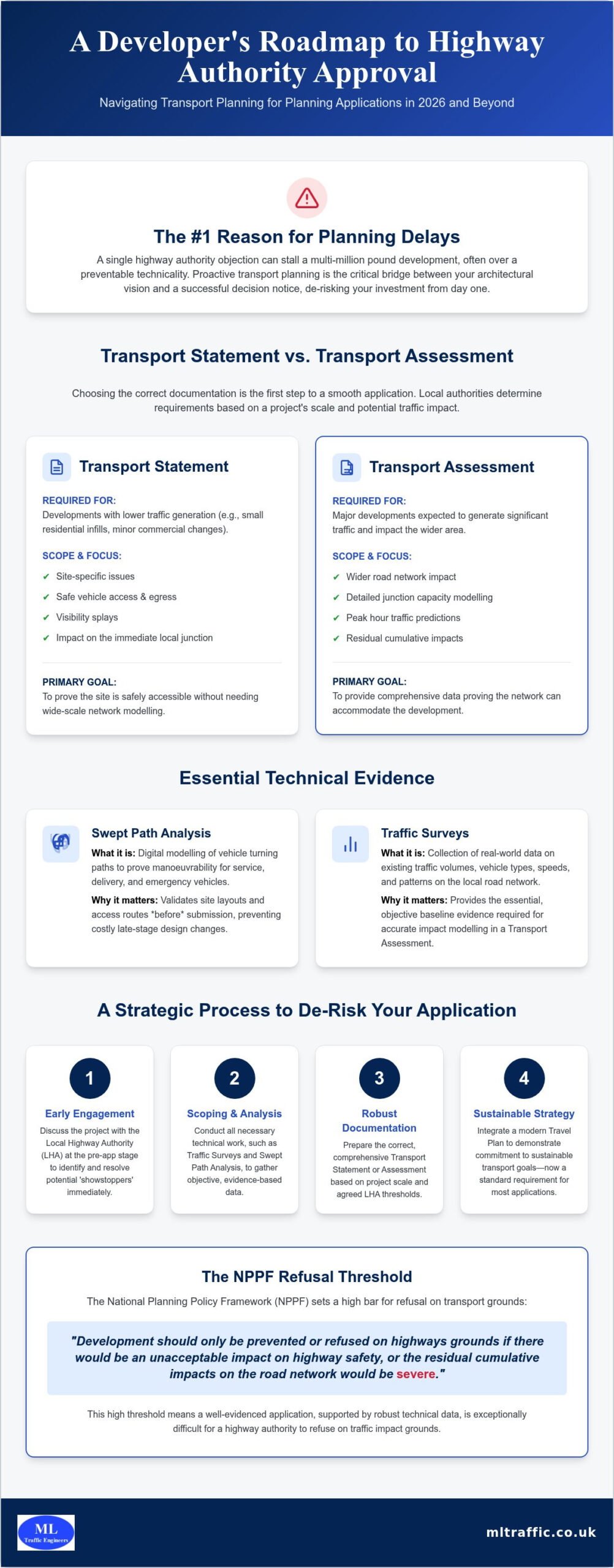
A single highway authority objection can stall a multi-million pound development for months, often because of a technicality that was preventable at the pre-app stage. You’ve likely experienced the frustration of late-stage design changes or the confusion of choosing between a Transport Statement and a full Assessment. In the current regulatory climate, effective transport planning for planning applications is the primary bridge between your architectural vision and a successful decision notice.
We understand that managing the 2026 NPPF reforms and the national shift toward vision-led transport outcomes creates significant pressure on your project timelines. This guide simplifies those technical complexities, offering a professional roadmap to master the documentation required to de-risk your development. You’ll learn how to optimise site layouts through precise Swept Path Analysis and gain clarity on Section 278 requirements before they become costly hurdles. We provide a clear breakdown of the essential reports and surveys needed to secure approval from local highway authorities without the typical delays or objections.
Key Takeaways
- Identify the correct documentation required for your site to ensure effective transport planning for planning applications and avoid costly highway authority objections.
- Distinguish between Transport Statements and Assessments to meet specific NPPF thresholds and local authority requirements for 2026.
- Utilise Swept Path Analysis and Traffic Surveys to validate site layouts and prove vehicle manoeuvrability before submitting your application.
- Engage in pre-application discussions with Local Highway Authorities to resolve potential access or safety issues early in the project lifecycle.
- Master the different types of Travel Plans now required as standard to demonstrate your development’s commitment to sustainable transport goals.
Understanding Transport Planning for Planning Applications
Success in the UK planning system depends on more than just architectural design. It requires a rigorous technical approach to how people and goods move. Modern transportation planning is a multidisciplinary field. It balances civil engineering, environmental science, and urban design to ensure new developments don’t compromise highway safety or network efficiency. For developers, transport planning for planning applications isn’t a box-ticking exercise. It’s a strategic tool used to de-risk investments and secure viable permissions.
Transport issues are often the primary reason for planning refusals. If a Local Highway Authority (LHA) objects based on safety or capacity concerns, the project usually stalls. Addressing these impacts at the pre-application stage allows you to identify “showstoppers” before you’ve committed significant capital. It’s about finding solutions for vehicle access, pedestrian safety, and public transport connectivity early in the project lifecycle to avoid late-stage design changes that inflate costs.
The Legal and Policy Framework in 2026
The National Planning Policy Framework (NPPF), updated in late 2024 and undergoing further restructuring in 2026, sets the benchmark for all UK developments. National policy now prioritises sustainable transport modes like cycling and walking to meet net-zero targets and improve local connectivity. However, the technical threshold for refusal remains high. Under current NPPF guidelines, development should only be prevented or refused on highways grounds if there’d be an unacceptable impact on highway safety, or the residual cumulative impacts on the road network would be severe.
Why Developers Need Proactive Transport Advice
Proactive advice is essential during the due diligence phase. Identifying restricted site visibility or inadequate parking capacity before land acquisition prevents expensive mistakes. High-quality transport planning services can also help you justify higher density developments. By proving that a site is highly accessible by public transport or through a robust Travel Plan, you can often negotiate lower on-site parking requirements. This increases the developable area and maximises your Return on Investment (ROI).
Technical precision reduces the risk of costly planning appeals. When your submission includes detailed data, such as a Traffic Survey or Swept Path Analysis, you provide the LHA with the evidence they need to grant approval. It moves the conversation from subjective opinion to objective fact. Our role is to ensure your project meets these rigid standards from day one, providing a clear path to approval.
Transport Statements vs. Transport Assessments
Don’t guess which document your project requires. Local Highway Authorities (LHAs) use the scale and nature of your project to determine the level of technical scrutiny needed. While national guidance provides a framework, each local council often sets its own specific thresholds, typically based on the number of residential units or gross floor area. Professional scoping at the pre-application stage ensures you submit the correct transport assessments and statements from the outset, which is a vital part of transport planning for planning applications. This early engagement prevents the LHA from requesting additional data weeks after your submission.
When to Prepare a Transport Statement
Transport Statements are generally for developments with low traffic generation, such as small residential infills or minor commercial changes of use. They focus on site-specific issues like safe access, visibility splays, and the impact on the immediate local junction. The goal is to prove the site is safely accessible without needing wide-scale network modelling. For projects in high-density areas, you’ll find regional nuances in our Transport Statement London: A Developer’s Buying Guide.
The Scope of a Full Transport Assessment
Major developments require a full Transport Assessment. This document is far more comprehensive and is triggered when a project is expected to generate significant traffic. It includes detailed junction modelling to predict how your development affects the wider road network during peak hours. Our Transport Assessment London: The Developer’s 2026 Guide provides a deeper look at the multi-modal impact analysis needed for complex urban sites. These reports often involve data from Traffic Surveys to establish a baseline of current road usage.
A professional report for 2026 must include:
- Baseline transport data and existing network capacity analysis.
- Trip generation forecasts using the TRICS database.
- Swept Path Analysis to demonstrate vehicle manoeuvrability for refuse and emergency vehicles.
- Sustainability audits for walking, cycling, and public transport routes.
- Mitigation strategies to offset any identified highways impacts.
Getting the scope right saves time and prevents technical objections. If you’re unsure which report your project needs, our comprehensive support ensures you meet every regulatory requirement from day one. We handle the full project lifecycle, from data collection to expert reporting, reducing the logistical pressure on your team.
Technical Data: Swept Path Analysis and Traffic Surveys
Technical data provides the objective evidence required to move beyond subjective planning debates. In transport planning for planning applications, raw data from Traffic Surveys establishes the baseline for all subsequent impact modelling. These surveys capture existing vehicle movements, pedestrian flows, and cycling activity. By presenting accurate current usage figures, you can effectively counter local resident objections regarding perceived traffic increases. Hard data often proves that a development’s impact is negligible compared to existing network fluctuations.
Swept Path Analysis: Proving Your Site Works
Key technical considerations for your layout include:
- Refuse vehicle turning circles: Ensuring standard 11.4m or 12m vehicles can service the site without mounting kerbs.
- Fire tender access: Verifying that emergency vehicles can reach within 45m of all points within a building.
Our AutoTurn Swept Path Analysis: A Practical Guide explains how this precision modelling de-risks your site layout. Data-driven transport planning for planning applications ensures your design is functional before you commit to construction.
Parking Surveys and the Lambeth Methodology
Securing approval for “car-free” or “car-lite” developments in urban centres depends entirely on the quality of your parking data. Local authorities often apply generic parking standards that don’t reflect actual site conditions. A professional Parking Survey, typically using the Lambeth Methodology, provides a snapshot of “parking stress” in the surrounding streets. This requires overnight surveys to record exactly how many on-street spaces are available within a 200-metre walking distance of the site.
If the data shows significant spare capacity, you can justify lower on-site parking provision. This approach is essential for maximising developable space while maintaining compliance with local plan policies. It’s about using technical precision to override rigid, outdated standards. We handle the full project lifecycle, from on-site data collection to the final expert reporting, ensuring your submission is robust enough to withstand highway authority scrutiny.
Navigating the Planning Process with Highway Authorities
Submitting your documentation is only the first step in the regulatory journey. Success in transport planning for planning applications depends heavily on how you manage the relationship with the Local Highway Authority (LHA) and other statutory consultees. For major projects near the strategic road network, you must also engage with National Highways. In the capital, Transport for London (TfL) applies its own rigorous standards. These bodies act as gatekeepers. Their recommendation to refuse can end a project before it reaches a committee vote.
A critical part of the process involves legal agreements for infrastructure changes. If your development requires alterations to the existing public highway, you will need a Section 278 (S278) agreement. If you are building new roads within the site that you want the council to maintain, a Section 38 (S38) agreement is necessary. Our Highway Design S278 & S38 Guide provides a detailed technical breakdown of these essential requirements.
The Pre-Application Advantage
We recommend formal pre-application discussions for every project. This stage allows us to agree on the scope of work and modelling parameters with the highways officer before you invest in full reporting. It’s the most effective way to identify “deal-breakers,” such as non-compliant junction visibility or inadequate site access, while the design is still flexible. Building this early rapport ensures that the officer understands the project’s constraints and goals, which significantly reduces the likelihood of unexpected objections later.
Managing Post-Submission Negotiations
The period after submission often involves intense technical scrutiny. Highway authorities may issue a “Regulation 25” request for further information or raise specific technical queries regarding your data. You need a consultant who can defend the methodology used in your Traffic Surveys or Swept Path Analysis with evidence-based arguments. We act as your expert representative, attending planning committee meetings and negotiating directly with officers to resolve objections. This proactive management prevents minor technical queries from turning into formal refusals.
Precision and readiness are our hallmarks. If you are facing technical objections or need to secure a scoping agreement, contact our expert team today to ensure your planning submission remains on track.
Travel Plans: Securing Approval through Sustainability
In 2026, a Travel Plan is a non-negotiable requirement for almost all major developments. It functions as a dynamic document that outlines how your site will manage its long-term transport footprint. Within the context of transport planning for planning applications, these plans represent your commitment to the government’s vision-led approach to infrastructure. With domestic transport contributing 30% of total UK emissions, authorities now demand clear strategies for reducing car dependency before granting permission. Authorities don’t just want to see parking spaces; they want to see active mobility.
You must select the correct plan type based on your development stage. A Framework Travel Plan is typically used for outline applications where final occupiers are unknown. A Full Travel Plan provides the granular detail needed for specific residential or commercial sites. For office-based developments, a Workplace Travel Plan focuses on employee commuting habits and corporate sustainability goals. Getting this classification right at the scoping stage prevents delays during the determination period.
Travel Plans as a Mitigation Tool
A robust plan acts as a powerful lever during Section 106 negotiations. By setting realistic targets for reducing single-occupancy car journeys, you can often mitigate the perceived traffic impact of your site. This can lead to a significant reduction in the financial contributions requested by the council for off-site highway improvements. A key factor in this success is the appointment of a Travel Plan Coordinator. This individual ensures long-term compliance through ongoing monitoring and annual reporting to the highway authority. Our Travel Plan Consultants: Strengthening Planning Applications guide details how expert coordination de-risks your project’s post-approval obligations.
Active Travel and 2026 Standards
The 2026 planning landscape prioritises walking and cycling over traditional vehicle access. Modern masterplans must integrate high-quality cycle parking and pedestrian-friendly routes that connect seamlessly to the wider network. This shift aligns with the latest “Manual for Streets” guidance, which moves away from car-centric layouts toward design that fosters community connectivity. Using tools like the government’s “Connectivity Tool” launched in 2025 helps us demonstrate how your site links to essential services without relying on private vehicles.
Your submission should highlight the provision of EV charging infrastructure, which is now a standard expectation for all new parking spaces. By positioning your development as a leader in sustainable transport, you reduce the regulatory pressure from statutory consultees. We provide an all-encompassing, fully-managed service that handles the technical details of these plans, ensuring your project meets every sustainability benchmark without compromising your commercial objectives.
Secure Your Planning Approval with Technical Precision
Mastering transport planning for planning applications is about moving from reactive fixes to proactive strategy. By integrating Swept Path Analysis early and grounding your submission in robust Traffic Survey data, you eliminate the technical ambiguity that leads to highway authority objections. The 2026 landscape demands a dual focus on road safety and sustainable active travel. A well-structured Travel Plan isn’t just a requirement; it’s a tool to reduce S106 burdens and demonstrate long-term site viability.
ML Traffic Engineers UK provides the expert transport documentation and technical analysis needed to navigate these complex London and England-wide regulations. We manage the full project lifecycle, from initial data collection to expert reporting, so you can focus on your development’s core vision. Our team ensures every report meets rigid industry benchmarks and legislative requirements.
Ready to de-risk your next submission? Request a Transport Planning Consultation for Your Project and secure the professional support your development deserves. We look forward to helping you achieve a smooth, objection-free planning process.
Frequently Asked Questions
Do I need a transport statement or a transport assessment for my project?
The document you need depends on the scale and nature of your development. Smaller projects with lower trip generation typically require a Transport Statement. Major developments that significantly impact the road network trigger a full Transport Assessment. Local authorities set specific thresholds based on residential units or floor space. We recommend a scoping discussion with the highway authority to confirm the correct transport planning for planning applications before you begin.
How long does it take to prepare a transport report for a planning application?
Preparation times vary depending on the complexity of the project and the required data collection. A standard Transport Statement might take two to three weeks. A full Assessment involving junction modelling or extensive traffic surveys can take four to six weeks. Securing baseline data from third-party sources or waiting for specific survey windows often dictates the timeline. We prioritise efficiency to ensure your submission meets critical project deadlines.
What is a Swept Path Analysis and is it always required?
Swept Path Analysis is a computer-aided simulation used to prove that specific vehicles can navigate your site safely. It’s often required for any development where refuse vehicles, fire tenders, or HGVs must turn within a restricted space. Local authorities frequently request this data to ensure the development doesn’t cause highway safety issues. Providing this technical evidence early reduces the risk of design-related objections from the highway officer during the determination period.
Can a transport consultant help if the council has already objected to my site access?
Yes, we specialise in resolving existing highway authority objections through evidence-based reporting. We can re-evaluate your access design using technical data or negotiate mitigation measures with the highway officer. By conducting a fresh Traffic Survey or a more detailed Swept Path Analysis, we often find technical solutions that satisfy the council’s safety concerns. Our role is to act as a professional mediator between your architectural vision and regulatory requirements.
What are the typical costs associated with transport planning services?
Costs for transport planning services are determined by the scope of the required reports and the complexity of the data collection. Factors such as the need for multi-day traffic surveys or complex junction modelling will influence the final fee. While we don’t provide generic pricing, we offer tailored quotes based on your specific site requirements. Investing in professional reports early prevents the far higher costs associated with planning delays or appeals.
How does a parking survey influence the number of spaces I can have?
A parking survey provides objective data on local on-street capacity, which can justify a car-lite approach. If the survey proves that the surrounding streets can accommodate overflow parking without exceeding stress thresholds, the council may permit fewer on-site spaces. This is particularly effective for urban developments where space is at a premium. Using the Lambeth Methodology ensures your data meets the standard requirements for transport planning for planning applications.
What happens if my development doesn’t meet local parking standards?
Failing to meet local parking standards doesn’t automatically mean a refusal. You must provide a robust justification within your Transport Statement or Assessment. This often involves highlighting excellent public transport links, proximity to local services, or implementing a comprehensive Travel Plan. We use technical data to demonstrate that the actual parking demand will be lower than the council’s generic standards, protecting your development’s density and its overall commercial viability.
What is a Section 278 agreement and when is it triggered?
A Section 278 (S278) agreement is a legal contract between a developer and the Highway Authority. It’s triggered when a development requires permanent alterations or improvements to the existing public highway. Examples include creating a new site entrance, installing a roundabout, or improving pedestrian crossings. This agreement ensures that the works meet the authority’s safety standards and are completed at the developer’s expense before the site is occupied or brought into use.

Disclaimer
The content on mltraffic.co.uk, including all technical articles, guides, and resources, is provided for general informational and educational purposes only. It is not intended to constitute professional advice in traffic engineering, transportation planning, development approvals, or any other technical or legal field.
While ML Traffic Engineers makes every reasonable effort to ensure the accuracy, completeness, and timeliness of the information published, we do not provide any warranties or representations (express or implied) regarding its reliability, suitability, or availability for any particular purpose. Any reliance you place on the content is strictly at your own risk.
In no event shall ML Traffic Engineers, its directors, employees, authors, or affiliates be liable for any direct, indirect, incidental, special, consequential, or punitive damages (including, without limitation, loss of profits, data, or business opportunities) arising out of or in connection with the use of, or inability to use, any information provided on this website.
The articles and guides on this site are not a substitute for engaging a qualified, professional traffic engineer to assess your specific project requirements. For tailored advice, compliance assessments, or traffic engineering services, please contact a competent professional.
This disclaimer may be updated from time to time without notice. By accessing or using this website, you agree to be bound by the most current version of this disclaimer.