
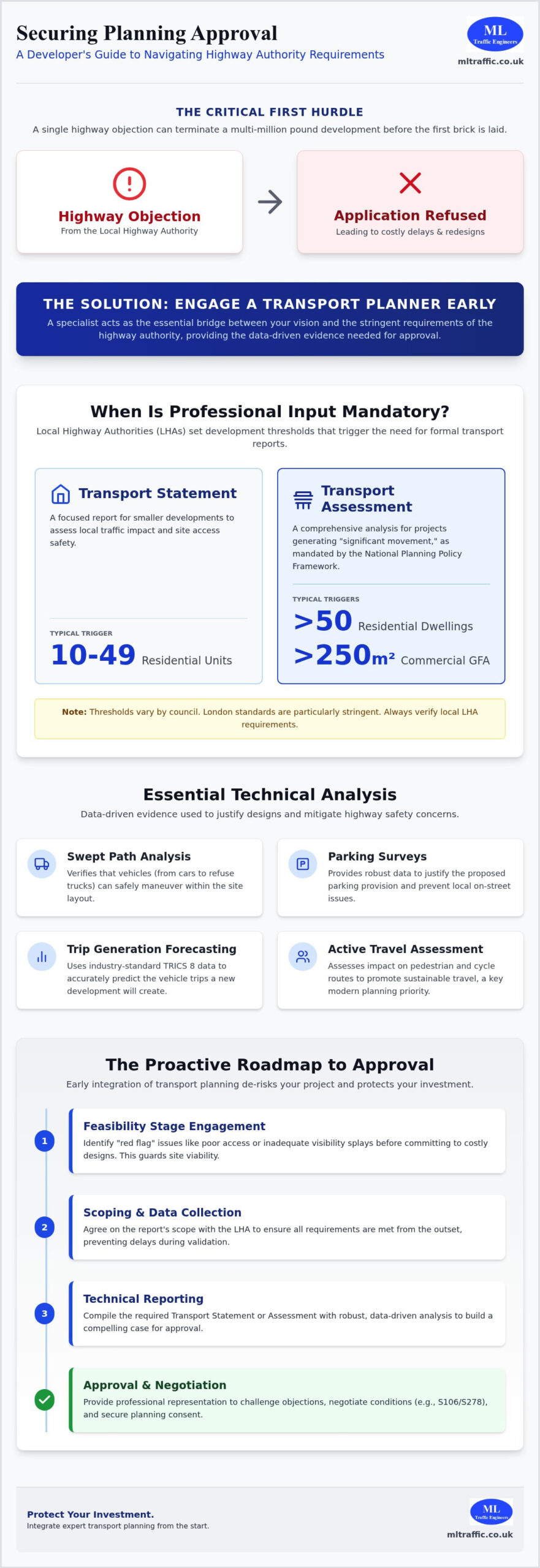
A single highway objection can terminate a multi-million pound development before the first brick is laid. Many developers mistakenly treat highways as a late-stage technicality, only to face immediate refusal from the Local Highway Authority. Understanding exactly when is a transport planner needed within the current planning framework is the difference between a stalled application and a successful site commencement. With the National Planning Policy Framework updated in February 2025 and new TRICS 8 data standards now active, the technical requirements for site access and traffic impact are more stringent than ever.
You probably recognize the confusion that arises when trying to distinguish between a Transport Statement and a full Assessment. It’s a high-stakes environment where uncertainty about local thresholds can lead to expensive redesigns or missed deadlines. This guide provides the clarity you need to navigate these regulatory pressures. We’ll outline the statutory triggers for professional input, identify which specific reports your project requires for 2026, and provide a clear roadmap to securing planning approval without highway objections.
Key Takeaways
- Identify the specific thresholds set by Local Highway Authorities that mandate professional reporting to avoid application refusal.
- Learn exactly when is a transport planner needed to navigate the National Planning Policy Framework and provide technical evidence for site access.
- Distinguish between a Transport Statement for smaller developments and a comprehensive Transport Assessment for complex projects.
- Understand how specialized data like Swept Path Analysis and Parking Surveys justify your design and mitigate highway safety concerns.
- Discover how to streamline the path to planning approval by integrating transport planning at the earliest feasibility stages.
The Role of a Transport Planner in the Planning Process
A transport planner functions as the essential link between a developer’s architectural vision and the stringent safety requirements of the public highway. While architects focus on the building’s aesthetics and structural engineers on its stability, neither is trained to analyze the complex dynamics of transportation planning. Professional transport planners provide the technical evidence required to prove that a new development won’t compromise the safety or efficiency of the surrounding road network. Determining exactly when is a transport planner needed depends on the scale and location of your project, but their input is often the only thing standing between an approval and a refusal.
Local Highway Authorities rely on data-driven justifications rather than subjective design choices. Transport planners use specialized tools like TRICS data and comprehensive support strategies to forecast trip generation and mitigate traffic impacts. Without this specific expertise, a developer lacks the professional representation needed to challenge council objections or negotiate complex highway requirements. Relying on non-specialists for transport evidence is a high-risk strategy that frequently leads to costly delays during the validation process.
To better understand the professional path and expertise involved in this field, watch this helpful video:
Consultancy vs. Public Sector Planners
There’s a fundamental difference between planners who set policy within a local authority and consultants who support private applications. Public sector planners act as gatekeepers, ensuring new developments align with regional transport goals. Private developers need a specialist consultant to “speak the language” of the council and translate technical requirements into actionable site designs. This expertise is vital when negotiating Section 106 contributions or Section 278 agreements, where the consultant ensures that the developer isn’t saddled with disproportionate infrastructure costs.
Reducing Risk and Cost Through Early Engagement
Engaging a specialist at the feasibility stage prevents fundamental design errors that can’t be easily fixed once an application is submitted. If a site layout doesn’t allow for safe vehicle turning or adequate visibility splays, the project may be fundamentally unviable. In 2026, the transport planner’s role is defined as a guardian of site viability. By identifying these “red flag” issues early, you avoid the financial burden of planning appeals and the need for expensive, late-stage redesigns. Proactive transport planning ensures that your site layout is technically sound before it ever reaches the council’s desk.
Statutory Triggers: When Is Professional Input Mandatory?
The National Planning Policy Framework (NPPF), updated in February 2025, mandates that developments generating significant movement must provide technical evidence to support a planning application. This is exactly when is a transport planner needed to interpret official government guidance against specific local requirements. While national rules provide a baseline, individual Local Highway Authorities (LHAs) set their own thresholds. London standards often differ significantly from national ones due to the capital’s unique congestion levels and strict sustainability targets. Modern planning triggers now prioritize “Active Travel,” meaning any project affecting pedestrian or cycle routes faces immediate scrutiny.
Development Size and Trip Generation
Project scale is the most common trigger for mandatory transport reporting. For residential projects, a development exceeding 50 dwellings typically requires a full Transport Assessment. However, many councils now request a Transport Statement for as few as 10 to 49 units to manage cumulative impact. Commercial sites face similar scrutiny based on Gross Floor Area (GFA). For instance, retail developments over 250 square meters in cities like Manchester often trigger the need for a Travel Plan. Transport planners use the TRICS 8 database, which received a major update in June 2025, to predict trip generation accurately. This data allows us to forecast the volume of vehicles and cyclists your site will attract, ensuring your infrastructure meets current benchmarks.
Sensitive Locations and Safety Concerns
Small developments can trigger the need for specialist input if they occupy sensitive locations. If your site is near a school, a busy junction, or within an Air Quality Management Area (AQMA), the council will likely demand a Transport Statement regardless of the unit count. Safety remains the non-negotiable foundation of the work. A minor change to a site access point might seem simple, but if it impacts visibility splays or pedestrian safety, it requires a formal technical review. Proving your site supports sustainable travel is no longer optional; it’s a core requirement for securing approval in 2026. If you’re unsure if your site meets these criteria, reviewing our project types can help identify the specific triggers for your development.
Choosing the Right Report: Statements, Assessments, and Travel Plans
Selecting the correct technical documentation is a critical step in the development lifecycle. Local planning authorities utilize these reports to determine if a project’s impact on the highway is manageable or if it requires significant mitigation. This is exactly when is a transport planner needed to evaluate the specific demands of your site against the professional standards set by the Chartered Institution of Highways & Transportation. Misclassifying your report type often leads to immediate validation failure, which can stall a project before the technical review even begins.
The choice between a Transport Statement, a Transport Assessment, or a Travel Plan depends on the scale of the development and the specific policies of the borough. While national guidelines provide a framework, local authorities have the autonomy to request higher levels of detail based on local congestion or safety concerns. We manage the full project lifecycle by identifying these requirements early, ensuring that the evidence provided is proportionate to the development’s impact.
Transport Statement vs. Assessment
The primary difference between these two reports lies in their scope and the depth of analysis required. A Transport Statement is typically used for smaller developments where the impact on the wider highway network is limited. It focuses on site access, local pedestrian links, and parking provision. In contrast, a Transport Assessment is a comprehensive study required for larger or more complex projects. It often involves sophisticated junction modeling and an analysis of the development’s effect on the wider road network. For developers working in the capital, understanding the Transport Statement vs. Assessment: London Differences is vital, as many boroughs demand full assessments for relatively modest unit counts to address cumulative traffic pressures.
The Necessity of Travel Plans
Councils increasingly demand Travel Plans as a condition of planning, especially for “car-free” or low-parking developments in urban centers. A Travel Plan is not a one-off report; it is a long-term management strategy designed to encourage sustainable travel modes like cycling and public transport. These documents outline specific targets for reducing single-occupancy vehicle trips and include monitoring commitments that can last for several years post-occupation. Our expert London Travel Plans: The Essential Guide helps developers navigate these requirements, ensuring that sustainability targets are both ambitious and achievable. By integrating a Travel Plan early, you demonstrate a commitment to reducing environmental impact, which is a key priority for planning committees in 2026.
Technical Analysis That Requires a Specialist
Precision in technical data is a functional necessity for modern planning applications. Generalist architectural software often lacks the sophisticated algorithms required for regulatory compliance; creating a gap that can lead to immediate highway objections. Determining exactly when is a transport planner needed often comes down to the requirement for forensic technical data that generalist designers cannot provide. We manage full project lifecycles by providing the specialized analysis that proves a site is safe, accessible, and compliant with local standards.
Swept Path Analysis for Fire Tenders and Refuse Trucks
Planning officers prioritize site functionality above all else. If you can’t prove a vehicle can physically enter, turn, and exit your site in a forward gear, your application faces refusal. This is where Swept Path Analysis Services in London become indispensable. We use industry-standard software like AutoTurn to simulate the movement of specific vehicle templates, including:
- Emergency Vehicles: Proving fire tenders can reach all areas of a residential development.
- Refuse Trucks: Ensuring 12m refuse vehicles can maneuver without mounting curbs.
- HGVs: Validating loading bay access for commercial and industrial sites.
This analysis acts as the primary tool for proving site functionality. It eliminates guesswork and provides planning officers with the visual and mathematical evidence they need to approve your layout.
Parking Surveys and the Lambeth Methodology
Justifying parking provision is one of the most contentious aspects of urban planning. In high-density areas, councils often push for “car-free” developments, but they require technical proof that this won’t result in overspill onto local streets. We conduct professional Parking Surveys using the Lambeth Methodology to provide a snapshot of on-street capacity. These surveys are typically conducted over two consecutive weekday nights between 00:30 and 05:30 to capture peak residential parking demand.
Our analysis also incorporates PTAL (Public Transport Accessibility Level) ratings. A high PTAL score allows for lower parking ratios, but this must be justified with data rather than anecdotal evidence. Proving that there is sufficient on-street capacity within a 200-meter walk of the site can mitigate concerns about local congestion. Secure your site’s functionality and justify your parking strategy by commissioning a professional technical assessment today.
Junction Modeling and Visibility Splay Analysis
Safety is the non-negotiable foundation of our work. When a new development increases traffic at a local intersection, we use junction modeling to assess capacity and delay. This ensures the local road network can absorb the additional trips without failing. Similarly, visibility splay analysis is vital for any new or modified access point. We calculate the required sightlines based on recorded road speeds, ensuring that drivers can see and be seen when entering the highway. This level of technical detail is a statutory requirement for securing planning permission in 2026.
Securing Approval with ML Traffic Engineers
Navigating the complexities of UK planning requires more than just submitting documents; it demands a strategic partnership with experts who understand the nuances of highway safety and regulatory compliance. Determining exactly when is a transport planner needed depends on the complexity of your site access and the scale of the proposed works. ML Traffic Engineers UK provides an all-encompassing, fully-managed service that bridges the gap between your development goals and statutory requirements. Our approach prioritizes precision and rapid response, ensuring that your project maintains momentum through every stage of the planning lifecycle.
Beyond the initial application, we provide expert guidance on Section 278 and Section 38 agreements. These legal frameworks govern the design and construction of new or improved highway infrastructure. Our technical reports, including Transport Assessments and Swept Path Analysis, form the non-negotiable foundation for these negotiations. By delivering accurate, data-backed evidence early, we significantly reduce the risk of costly planning delays and highway objections that could jeopardize your site’s viability. ML Traffic Engineers UK acts as a vital guardian of public safety, ensuring that all proposed highway works meet the strict standards required for local authority adoption.
Our Expertise in London and England Planning
Since our founding in 2014, we’ve developed a deep understanding of the specific requirements across different London Boroughs and regional authorities in England. Each jurisdiction has its own benchmarks for trip generation, parking provision, and sustainable travel. We specialize in navigating these intricate regional regulations so that you don’t have to. The unwavering reliability of ML Traffic Engineers UK in high-stakes planning environments makes us a dependable partner for developers facing strict regulatory scrutiny. Our expertise in TRICS 8 data and London-specific policy ensures every report meets the necessary statutory benchmarks for 2026 applications.
Next Steps for Your Development
Securing professional input is a straightforward, sequential process. We recommend providing your site plan for an initial review as early as the feasibility stage. This allows us to identify any immediate red flags regarding visibility splays or vehicle tracking before they become entrenched in your architectural design. The typical timeline for preparing a Transport Statement or Assessment varies based on project complexity, but our efficient workflow ensures rapid delivery to meet your project deadlines. Contact our team to discuss your requirements and receive a bespoke fee proposal. You can get a quote for your Transport Statement today to secure professional input for your 2026 planning application.
Take Control of Your Planning Timeline
Success in the 2026 planning landscape requires more than just a viable site; it requires technical evidence that withstands rigorous scrutiny from Local Highway Authorities. By identifying exactly when is a transport planner needed, you avoid the common pitfalls of application refusal and expensive late-stage redesigns. The right combination of Transport Statements, Travel Plans, and specialized data like Swept Path Analysis ensures your project meets the non-negotiable foundation of highway safety.
ML Traffic Engineers UK has provided comprehensive London planning expertise since 2014. We are specialists in Swept Path Analysis and TRICS data, offering the precision required to navigate intricate regional regulations. Our team understands that precision is a functional necessity in high-stakes environments. We manage the full project lifecycle from initial assessment to execution, providing the unwavering reliability your development deserves.
Don’t let highway objections stall your progress. Request a Transport Planning Quote from ML Traffic Engineers UK today to secure professional, data-backed representation for your application. We’re ready to help you achieve a seamless approval.
Frequently Asked Questions
Do I need a transport planner for a small residential conversion?
Fees for technical reporting vary significantly based on the project’s complexity and the specific data analysis required by the local authority. Every development demands a tailored approach to ensure compliance with Local Highway Authority standards. We recommend requesting a bespoke fee proposal to ensure the scope of work aligns with your site’s unique constraints. This ensures you only pay for the necessary analysis while meeting all statutory benchmarks.
What is the difference between a transport planner and a traffic engineer?
Transport planners focus on the strategic movement of people and policy compliance, while traffic engineers handle the technical design and physical operation of the road network. Planners manage the application process and prepare reports like Transport Assessments. Engineers deal with junction geometry and signal timings. Knowing exactly when is a transport planner needed is vital for navigating the initial planning stages and securing the necessary statutory approvals.
Can an architect complete a Swept Path Analysis?
Architects generally lack the specialized software and verified vehicle templates required for a planning-grade Swept Path Analysis. While some design programs include basic tracking, they rarely meet the rigorous standards set by Local Highway Authorities. Professional planners use dedicated tools like AutoTurn with precise templates for fire tenders and refuse vehicles. This precision is a functional necessity to prove that large vehicles can maneuver safely within your specific site layout.
What happens if I submit a planning application without a required Travel Plan?
Submitting an application without a mandatory Travel Plan usually results in a non-validation or an immediate highway objection. Councils view these documents as essential management strategies for reducing environmental impact and promoting sustainable transport. Failure to provide this evidence can lead to significant delays or an outright refusal. Including a professional Travel Plan from the outset demonstrates your commitment to sustainability and helps streamline the path to planning approval.
How long does it take to produce a Transport Assessment?
A comprehensive Transport Assessment typically takes three to six weeks to produce, depending on the scale of the development and data availability. This timeline accounts for site visits, data collection from the TRICS database, and complex junction modeling. Early engagement is essential to ensure these technical reports are ready for your submission deadline. Our efficient workflow prioritizes the rapid delivery of information to maintain your project’s momentum throughout the process.
Is a transport planner needed for a change of use application?
Determining when is a transport planner needed for a change of use depends on whether the new use generates more trips or different parking requirements. Converting an office into a residential block or a retail unit into a restaurant significantly changes the traffic profile of the site. We analyze these trip generation shifts to justify the change to the council and ensure the local network can accommodate the new demand safely.
Can a transport planner help with a refused planning application appeal?
Transport planners provide vital expert evidence to challenge highway-related reasons for refusal during the appeal process. We review the council’s objections and prepare technical rebuttals, often utilizing more detailed data like Parking Surveys or forensic junction modeling. This professional representation provides the technical authority needed to address safety concerns and demonstrate that your development is fully compliant with national and local planning policies.

Disclaimer
The content on mltraffic.co.uk, including all technical articles, guides, and resources, is provided for general informational and educational purposes only. It is not intended to constitute professional advice in traffic engineering, transportation planning, development approvals, or any other technical or legal field.
While ML Traffic Engineers makes every reasonable effort to ensure the accuracy, completeness, and timeliness of the information published, we do not provide any warranties or representations (express or implied) regarding its reliability, suitability, or availability for any particular purpose. Any reliance you place on the content is strictly at your own risk.
In no event shall ML Traffic Engineers, its directors, employees, authors, or affiliates be liable for any direct, indirect, incidental, special, consequential, or punitive damages (including, without limitation, loss of profits, data, or business opportunities) arising out of or in connection with the use of, or inability to use, any information provided on this website.
The articles and guides on this site are not a substitute for engaging a qualified, professional traffic engineer to assess your specific project requirements. For tailored advice, compliance assessments, or traffic engineering services, please contact a competent professional.
This disclaimer may be updated from time to time without notice. By accessing or using this website, you agree to be bound by the most current version of this disclaimer.