
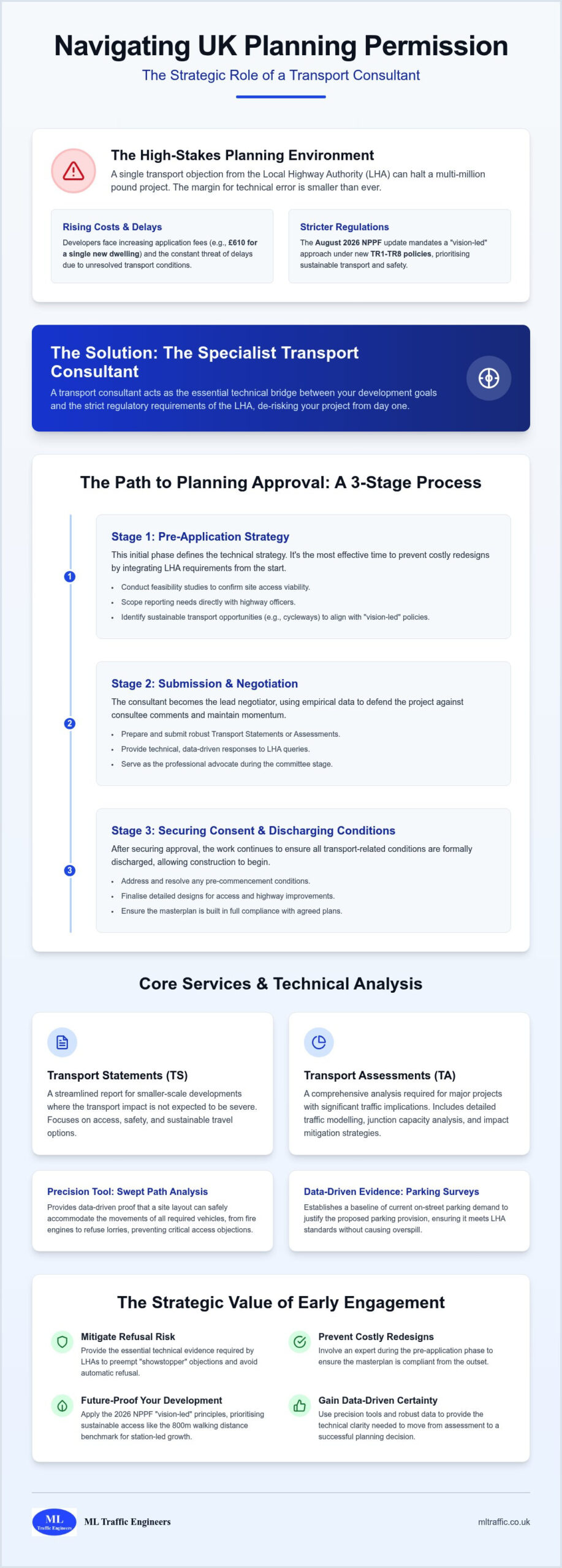
A single transport objection from the Local Highway Authority can halt a multi-million pound project before the first brick is laid. With the August 2026 NPPF update mandating a “vision-led” approach under the new TR1-TR8 policies, the margin for technical error has vanished. Engaging a transport consultant for planning permission is no longer just a box-ticking exercise; it’s a strategic necessity for de-risking your site. You likely feel the pressure of rising application fees, such as the £610 cost for a new single dwelling, and the constant threat of delays due to transport-related conditions.
It’s frustrating when uncertainty over site access safety or compliant layouts keeps your project in limbo. This guide explains how a professional consultant secures your approval by navigating LHA requirements with technical precision. We’ll show you how to satisfy the latest 2026 regulations, including the 800-metre walking distance benchmarks for station-led growth. You will learn how data-driven tools like Swept Path Analysis and Parking Surveys optimise your developable area while ensuring your masterplan meets every safety standard and legislative requirement. We provide the technical clarity needed to move from initial assessment to a successful planning decision.
Key Takeaways
- Learn how a transport consultant for planning permission provides the essential technical evidence required to satisfy Local Highway Authorities and mitigate the risk of automatic refusal.
- Discover why early consultant involvement in the pre-application phase prevents costly redesigns by establishing a clear negotiation strategy with highway officers.
- Identify the specific requirements for Transport Statements and Transport Assessments to ensure your documentation aligns with the scale and traffic impact of your development.
- Understand how to apply the 2026 NPPF “vision-led” principles to your site layout, prioritising sustainable access and public safety from the outset.
- See how precision tools like Swept Path Analysis and Parking Surveys provide the data-driven certainty needed to clear transport objections and secure planning consent.
What Does a Transport Consultant Do for Planning Permission?
A transport consultant for planning permission acts as the technical intermediary between your development goals and the strict regulatory requirements of the Local Highway Authority (LHA). Their primary objective is to evaluate how a proposed site affects the local road network and public safety. By producing data-driven evidence, they justify why a project should receive consent. This professional oversight is a functional necessity in transportation planning, where precision determines whether a project moves forward or stalls at the committee stage.
These experts don’t just write reports; they provide the predictive analysis needed to de-risk a site. Through detailed Traffic Surveys and Parking Surveys, they establish a baseline of current road conditions. They then use this data to model how your development will change traffic flow. A transport consultant functions as the vital bridge between architectural design and regulatory highway standards, ensuring your project is both buildable and compliant.
The Bridge Between Design and Regulation
Architects design for aesthetics and internal function, but a transport consultant ensures those designs meet highway standards. They translate site plans into compliant infrastructure by advising on visibility splays, junction geometry, and pedestrian safety measures. Since the August 2026 NPPF update, this role is even more critical. Consultants must now ensure every layout aligns with “vision-led” policies TR1-TR8, which prioritise walking, wheeling, and public transport over traditional road capacity increases. This ensures the masterplan is safe for all users from day one.
Why Specialist Input is Mandatory
Most UK councils refuse to validate major planning applications without a professional Transport Assessment or Statement. LHAs require technical expertise backed by professional indemnity to ensure public safety isn’t compromised. Engaging a specialist early prevents “showstopper” objections regarding site access or severe traffic impacts. By identifying these risks during the pre-application phase, you avoid expensive redesigns. This proactive approach ensures your project adheres to the latest legislative requirements and builds trust with statutory consultees.
UK Planning Process: From Pre-App to Approval
The planning lifecycle for residential and commercial developments is a high-stakes sequence of regulatory hurdles. Engaging a transport consultant for planning permission at the earliest opportunity is the most effective way to lower the risk of expensive redesigns. While architects focus on the site’s internal layout, consultants manage the critical interface with the public highway. This ensures that Local Highway Authority (LHA) requirements are integrated into the project from the start, avoiding technical conflicts that could stall an application.
During the submission phase, the consultant’s role shifts to lead negotiator. They manage the technical response to statutory consultee comments, defending the project’s impact with empirical data. This professional advocacy is essential for maintaining momentum through the committee stage. By providing clear, technical justifications for access and parking, they reduce the logistical pressures on the development team. If you are preparing a new scheme, you can review our transport planning services to see how we manage these regulatory demands.
The Pre-Application Strategy
The pre-application phase is where the technical strategy is defined. Consultants work directly with highway officers to scope the required level of reporting, ensuring compliance with official UK government guidance. This stage often includes feasibility studies to confirm site access viability before a developer commits to a land purchase or full design. With the 2026 NPPF focus on “Active Travel,” consultants also identify sustainable transport opportunities, such as cycling infrastructure or pedestrian improvements, to satisfy modern “vision-led” requirements.
Securing Permission and Discharging Conditions
Following the formal submission of Transport Statements or Assessments, the consultant addresses any technical objections raised during the consultation period. If the traffic impact is deemed significant, they negotiate proportionate mitigation measures to reach a “Resolution to Grant.” Once permission is secured, the work continues to discharge transport-related planning conditions. This involves finalising Travel Plans and Parking Management Plans. Completing these requirements with technical precision is the final step that allows construction to begin on schedule.
Core Services: Reports and Technical Analysis
Securing planning consent requires a specific suite of technical documents. A transport consultant for planning permission selects the appropriate reporting level based on the development’s scale and the local road network’s existing capacity. These reports serve as the empirical proof that a project is safe and sustainable. Without this technical verification, applications often face immediate rejection from the Local Highway Authority. The core technical services include:
- Transport Statements: Concise reports for smaller developments with limited traffic impact.
- Transport Assessments: Detailed technical documents for larger-scale residential or commercial projects.
- Swept Path Analysis (SPA): Digital simulations proving that service vehicles like fire trucks and refuse lorries can navigate the site.
- Travel Plans: Strategies to encourage sustainable transport and reduce single-occupancy car trips.
Statement vs. Assessment: Which Do You Need?
The distinction between a Transport Statement and a Transport Assessment depends on the projected traffic impact. Smaller developments with limited trip generation typically require a concise Statement. Conversely, larger residential or commercial schemes necessitate a full Assessment. These detailed documents include complex junction modelling and capacity analysis to ensure surrounding infrastructure can handle the new demand. Consultants use the TRICS database to predict trip generation patterns accurately. Local borough standards dictate these thresholds, making early consultation essential to define the required scope.
Data Collection and Design Verification
Technical analysis relies on accurate data collection. Traffic surveys provide the baseline for all predictive modelling, while Parking Surveys, often using the Lambeth Methodology, justify lower parking ratios in dense urban areas. This data supports principles of Smart Growth and Transportation by aligning development density with available public transport. Perhaps the most critical design tool is Swept Path Analysis (SPA). This digital simulation proves that service vehicles can navigate the site safely. SPA is frequently a mandatory requirement for fire safety approval and refuse management strategies. Finally, Travel Plans outline long-term strategies to encourage cycling and walking, reducing reliance on single-occupancy car trips. These services collectively form the technical foundation of a successful planning package.
Strategic Value: De-risking Your Development
The commercial risk of a planning refusal often hinges on a single technical objection from the Local Highway Authority. Under the August 2026 NPPF framework, the “severe adverse effect” test now applies to both the construction phase and the final operational use of a site. A transport consultant for planning permission prevents these “severe” impact rulings by providing empirical evidence that the local network can safely accommodate the development. A professional transport report acts as “planning insurance” for the developer, protecting the project’s valuation and timeline against regulatory challenges.
Beyond securing the initial consent, consultants add value by identifying potential “showstoppers” early in the site acquisition process. By verifying that a site access is safe and compliant before a developer commits to a purchase, they eliminate the risk of owning undevelopable land. This technical foresight ensures that the project remains viable and that the proposed density aligns with the highway’s capacity. If you need to verify the viability of your site layout before submission, you can request a technical review from our team.
Negotiating Legal Agreements (S278 & S38)
Legal agreements represent a significant financial commitment for any developer. Consultants lead the negotiations for Section 278 agreements, which cover essential works on the public highway, such as new junctions or pedestrian crossings. They also manage Section 38 agreements for the adoption of new roads within the development. By providing precise technical justifications, they ensure that the scope of these works is proportionate. This prevents the LHA from demanding over-engineered solutions that add unnecessary costs to the project budget.
Cost Mitigation Through Smart Design
Precision in design is the most effective way to reduce developer contributions. Using accurate traffic data allows consultants to refine junction designs, often avoiding the need for expensive off-site highway works. They also maximise the developable area by optimising car park layouts and access points to meet minimum safety standards without wasting space. Additionally, implementing robust Travel Plans can often offset the need for high parking ratios in urban areas. This sustainable approach satisfies the 2026 “vision-led” planning requirements while protecting the developer’s bottom line.
Why Partner with ML Traffic Engineers UK for Your Project?
ML Traffic Engineers UK has provided specialised transport planning and traffic engineering documentation since 2014. As a dedicated transport consultant for planning permission, we focus on the technical precision required to de-risk developments across England. Our approach balances technical authority with a client-focused strategy. This ensures that every project, from a single dwelling to a large-scale commercial hub, meets the rigorous standards of the Local Highway Authority (LHA).
We pride ourselves on being a dependable, highly organised partner. You receive direct access to senior consultants who manage your project lifecycle from initial assessment to final sign-off. This continuity of service is a hallmark of our brand promise. It allows us to maintain a standard of formal excellence that aligns with the strict regulatory environments in which we operate. Our team takes immense pride in adherence to standards, acting as a vital guardian of public safety while delivering the technical evidence your project needs.
- Comprehensive management of Transport Statements and Assessments.
- Expert Swept Path Analysis for fire safety and refuse access.
- Detailed Parking Surveys using borough-specific methodologies.
- Strategic Travel Plans to satisfy sustainable transport conditions.
Expertise in Local Authority Requirements
Navigating the intricate regional regulations of London and the South East requires deep industry knowledge. We understand the specific highway standards and consultation deadlines introduced by the Planning and Infrastructure Act 2025. Our reports are designed for clarity and rapid delivery of information. This professional integrity builds trust with planning officers, often leading to faster sign-offs and fewer requests for additional information. We ensure your development adheres to the latest 2026 benchmarks, including the “vision-led” principles now central to UK planning policy.
Get a Tailored Quote for Your Application
Every development presents unique logistical challenges. We begin with an initial site review to identify your specific transport planning needs and potential constraints. Our consultants integrate seamlessly with your architect and planning consultant team, ensuring that transport considerations shape the site layout from the earliest design stages. This collaborative approach prevents the need for reactive changes later in the process. Contact us today to discuss your specific Transport Statement or Assessment requirements and receive a technical strategy tailored to your site’s success.
Secure Your Development Strategy with Technical Precision
Navigating the 2026 planning landscape requires more than just a compliant design; it demands data-driven justification that satisfies the Local Highway Authority from the outset. By integrating technical reporting early in the pre-application phase, you prevent the “severe impact” objections that lead to automatic refusal. A professional transport consultant for planning permission acts as your technical negotiator, ensuring that every Swept Path Analysis and Transport Assessment aligns with the latest NPPF requirements.
ML Traffic Engineers UK, established in 2014, provides the expert navigation needed to clear complex transport hurdles. We specialise in high-precision reporting and LHA liaison to secure consent for residential and commercial developers across the UK. Our team manages the full project lifecycle, from initial feasibility and scoping to the final discharge of transport-related planning conditions. This comprehensive support reduces regulatory pressure and keeps your construction timeline on track.
Secure your planning permission with expert transport planning support from ML Traffic Engineers UK.
Your project’s success depends on technical clarity. We provide the evidence needed to move forward with confidence and certainty.
Frequently Asked Questions
When should I hire a transport consultant for my planning application?
You should engage a transport consultant for planning permission during the feasibility or pre-application stage. As discussed in our planning process guide, early involvement allows for the technical scoping of visibility splays and junction geometry before your design is finalised. This proactive step prevents the need for expensive redesigns if the Local Highway Authority raises objections later. It ensures your masterplan is technically sound from the very first submission.
What is the difference between a Transport Statement and a Transport Assessment?
The difference is primarily determined by the scale of your development and its projected traffic impact. A Transport Statement is a shorter report for smaller schemes with minimal trip generation. Conversely, a Transport Assessment is a comprehensive technical document for larger projects. These Assessments require detailed junction modelling and capacity analysis to prove the local road network can safely handle the increased demand without causing “severe” congestion.
Is a Swept Path Analysis mandatory for small residential developments?
While not a statutory requirement for every site, most councils now request Swept Path Analysis (SPA) for any development where service vehicles must enter the site. This includes fire tenders and refuse lorries. SPA provides the digital proof that these large vehicles can turn and exit safely. It’s often a mandatory requirement for fire safety approval and refuse management strategies, even on relatively small residential schemes with tight access points.
How much does a transport consultant cost for a planning application in 2026?
Fees for transport planning vary based on the reporting level and the complexity of the site’s constraints. A full Transport Assessment involving junction modelling will naturally cost more than a standard Transport Statement. Because every project has unique requirements, such as specific Parking Surveys or Traffic Surveys, we provide tailored quotes. This ensures you only pay for the specific technical analysis needed to satisfy your Local Highway Authority’s 2026 benchmarks.
Can a transport consultant help if the council has already objected to my site access?
Yes, we frequently resolve access objections by providing technical design mitigations or empirical data that challenges the council’s assumptions. A consultant acts as a professional negotiator, using tools like Swept Path Analysis to demonstrate that an access point is safe and compliant. We can often find a design solution, such as refined visibility splays or adjusted kerb lines, that satisfies the highway officer while maintaining your project’s developable area.
How long does it take to produce a Transport Statement?
A standard Transport Statement typically takes two to four weeks to complete. This timeline depends on whether we need to conduct fresh Traffic Surveys or if existing data is available. If your project requires complex junction modelling or extensive Parking Surveys, the process may take longer. We recommend starting this work as soon as your initial site layout is ready to ensure the transport documentation is ready for your formal planning submission.
What information do I need to provide for a transport planning quote?
To provide a precise quote, we need your site location, the proposed development type, and the total number of units or floor space. A current site plan is also essential so we can assess access viability. If you’ve already had a pre-application meeting with the council, sharing their feedback helps us scope the exact level of reporting required. This information allows us to identify potential “showstoppers” and provide a clear technical strategy.
Do transport consultants also handle the physical road construction?
No, transport consultants specialise in the planning, design, and technical reporting required to secure consent. ML Traffic Engineers UK focuses on the documentation needed for planning approval, such as Transport Assessments and Travel Plans. While we negotiate the technical details of Section 278 and Section 38 agreements, the actual construction and civil engineering works are handled by separate contractors. For infrastructure projects moving into street works and highway excavation, teams can explore Specialist advisory and technical testing services to maintain statutory compliance. Our role is to ensure your designs are approved and adopted by the highway authority.

Disclaimer
The content on mltraffic.co.uk, including all technical articles, guides, and resources, is provided for general informational and educational purposes only. It is not intended to constitute professional advice in traffic engineering, transportation planning, development approvals, or any other technical or legal field.
While ML Traffic Engineers makes every reasonable effort to ensure the accuracy, completeness, and timeliness of the information published, we do not provide any warranties or representations (express or implied) regarding its reliability, suitability, or availability for any particular purpose. Any reliance you place on the content is strictly at your own risk.
In no event shall ML Traffic Engineers, its directors, employees, authors, or affiliates be liable for any direct, indirect, incidental, special, consequential, or punitive damages (including, without limitation, loss of profits, data, or business opportunities) arising out of or in connection with the use of, or inability to use, any information provided on this website.
The articles and guides on this site are not a substitute for engaging a qualified, professional traffic engineer to assess your specific project requirements. For tailored advice, compliance assessments, or traffic engineering services, please contact a competent professional.
This disclaimer may be updated from time to time without notice. By accessing or using this website, you agree to be bound by the most current version of this disclaimer.