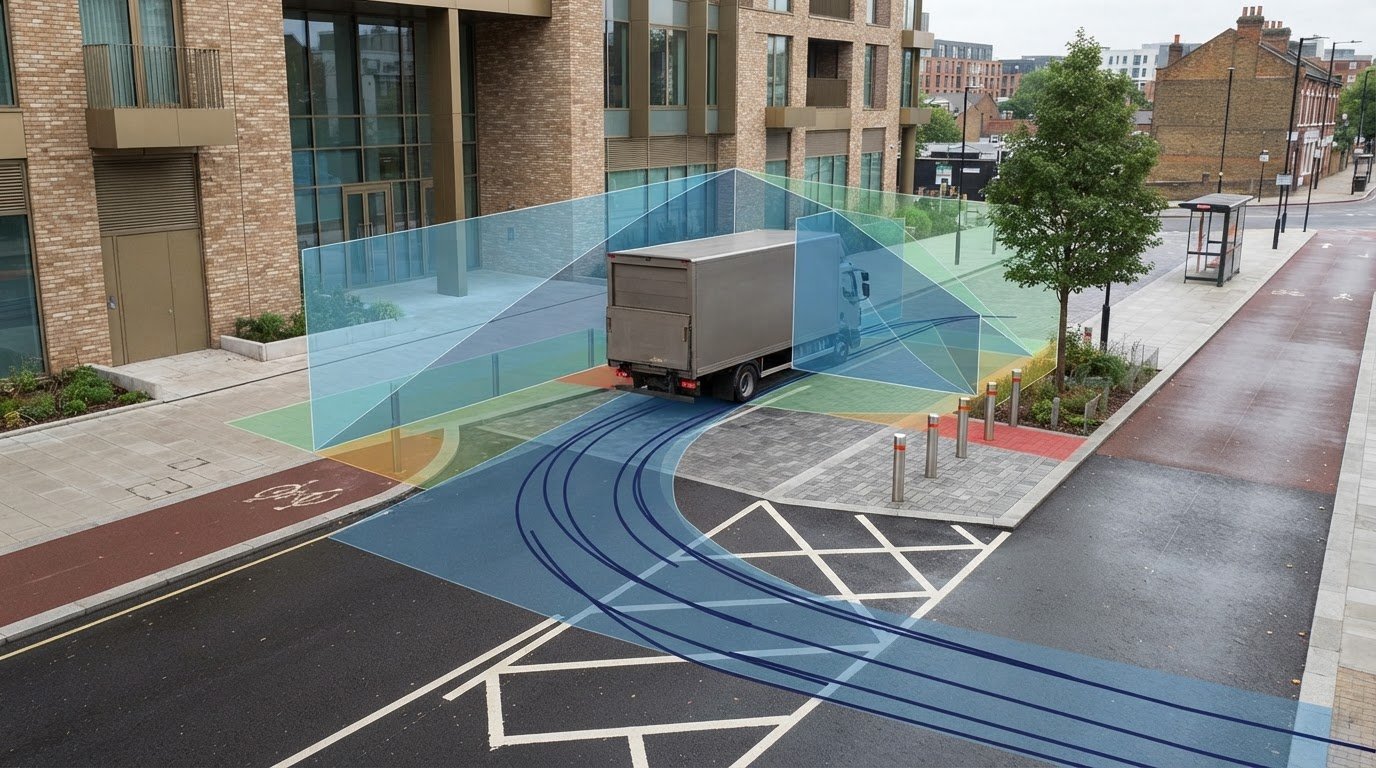
What if a loading bay fits neatly on the plan but a delivery vehicle can’t reach it without crossing a pedestrian route or striking an obstruction? Swept path analysis for loading bays tests whether vehicles can enter, manoeuvre into position and leave within the proposed layout. The result depends on one crucial choice: modelling a vehicle that reflects the site’s actual operations.
It’s understandable to want certainty early. A design based on an unsuitable or undersized vehicle can conceal access problems until later reviews, when changing the layout may be more difficult. The assessment also needs clear drawings and agreed assumptions, so the results answer the right operational question instead of simply showing a vehicle moving across a plan.
This guide explains how vehicle tracking can help test a loading-bay layout, how to choose a suitable design vehicle and what information to provide when commissioning an assessment. It also explains what the analysis can show, and where its limits lie, giving developers a practical framework for reviewing access and manoeuvring before design decisions are fixed.
Key Takeaways
- Check whether the vehicle can complete the full arrival, positioning and departure sequence, not just reach the site entrance.
- Choose a design vehicle that reflects the site’s expected operations. One vehicle type won’t suit every loading bay.
- Use consistent vehicle and manoeuvre assumptions to compare layout options and identify fixed constraints.
- For useful swept path analysis for loading bays, prepare clear operational requirements and current site drawings before commissioning.
- An independent assessment can help the project team review vehicle access and manoeuvring, but it doesn’t guarantee planning approval or compliance.
Why swept path analysis matters for a loading bay
A vehicle may be able to reach a site entrance but still be unable to line up with a loading bay or leave without conflicting with fixed features. Swept path analysis for loading bays is a drawing-based assessment that plots a selected vehicle’s movement through a proposed layout, following specified manoeuvres.
A swept path drawing shows the vehicle’s body and wheel paths as it moves. The plotted envelope can be compared with kerbs, walls, columns, doors and other fixed constraints. This tests geometric fit, but it isn’t a complete assessment of how loading operations will work in practice.
For a visual example of a vehicle manoeuvring with a large load, watch this video:
What does a loading-bay swept path drawing show?
The vehicle’s turning radius and dimensions affect the space its body and wheels occupy during a manoeuvre. For background on the geometry, see the explanation of a vehicle’s turning radius. The assessment overlays the movement envelope on the site drawing to help identify potential clashes or tight clearances.
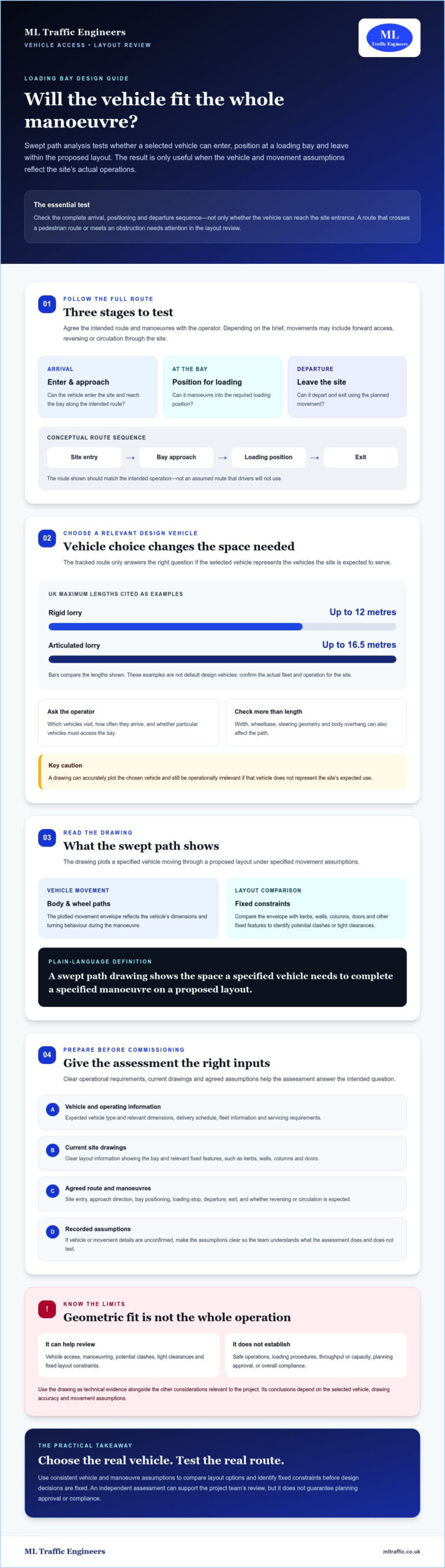
Quotable definition: A swept path drawing shows the space a specified vehicle needs to complete a specified manoeuvre on a proposed layout. It doesn’t prove the site is safe to operate or that the entire loading process will work. Its conclusions depend on the selected vehicle, the accuracy of the drawing geometry and the movement assumptions.
Which loading-bay access questions can it help answer?
The assessment can test whether the selected vehicle can approach the bay, enter the site, position for loading and leave. Depending on the operating brief, movements may include forward access, reversing or circulation through the site. The route shown should reflect the intended operation, not an assumed route that drivers won’t use.
Vehicle manoeuvrability is only one part of the design. The drawing doesn’t assess loading procedures, throughput or capacity, and it doesn’t replace wider transport planning. Nor does it establish safe operations or secure planning approval. Use it as technical evidence to review vehicle access and layout constraints alongside the other considerations relevant to the project.
How vehicle choice and manoeuvres shape loading-bay swept paths
The tracked route is useful only if it represents the vehicles the site is expected to serve. A residential development with refuse collections and occasional deliveries may have different access needs from a logistics site receiving articulated lorries. UK maximum lengths illustrate the difference: a rigid lorry may be up to 12 metres long, while an articulated lorry may be up to 16.5 metres. These are examples, not default design vehicles. Confirm the actual fleet and operation before selecting a vehicle for assessment.
An unsuitable design vehicle can make a technically accurate swept path drawing operationally irrelevant. A model can faithfully plot the selected vehicle yet fail to represent the vehicle that will use the bay. For reliable swept path analysis for loading bays, establish the vehicle type and relevant dimensions with the client or operator. Start with their delivery schedule, fleet information and servicing requirements. If details remain unconfirmed, record the assumptions clearly so the project team understands what the assessment does and doesn’t test.
How should a project select its design vehicle?
Ask the operator which vehicles visit, how often they arrive and whether particular vehicles must access the bay. Consider the largest vehicle the site is genuinely expected to accommodate, rather than choosing one simply because it appears to fit the current plan. Vehicle length is only one factor: width, wheelbase, steering geometry and body overhang can also affect the path. Verify the available vehicle information for the assessment instead of relying on an unconfirmed template.
Which manoeuvres should the loading-bay assessment test?
Define the complete route: site entry, approach, bay entry, loading position, departure and exit. Establish whether the vehicle is expected to enter or leave in reverse, and where it stops during loading. The approach direction and available turning space affect the tracked envelope. Testing only the final turn into the bay can miss a constraint earlier in the route.
Show relevant features on the layout, including gates, barriers, kerbs, columns and any parked vehicles or circulation routes that could affect movement. Test the operating sequence the site is intended to use. If a route works only when a gate is open, a parking space is empty or other traffic is absent, review the drawing against those assumptions. The Health and Safety Executive’s guidance on safety in loading areas provides relevant workplace context, but a swept path drawing alone doesn’t establish safe operations.
For project-specific support testing proposed vehicle access and manoeuvring, consider ML Traffic Engineers UK’s Swept Path Analysis service.
How to assess loading-bay swept path drawings and design options
A swept path drawing is most useful when you review it against the design it is intended to test. Check that the vehicle is identified, its direction of travel is clear and the manoeuvre reflects the intended site operation. Then compare the plotted envelope with the current layout, not an earlier plan that may show different boundaries or obstructions.
For swept path analysis for loading bays, distinguish vehicle clearance from the space needed to carry out loading. A plotted path may appear to avoid a wall, but the drawing won’t necessarily show whether doors can open, people can move safely around the vehicle or loading can take place without obstructing circulation. Review those practical requirements separately with the relevant design and operations teams.
What should a reviewer check on the drawing?
Verify that the vehicle type and movement sequence are clear, then check that the site geometry reflects the latest design information. Pay particular attention to boundaries and fixed features near turning points, such as kerbs, columns, gates and barriers. Note unclear clearances, conflicts or missing assumptions, then ask the designer to confirm whether these are intentional or need further assessment.
How should teams compare alternative bay layouts?
Compare options using the same confirmed vehicle and movement criteria. Otherwise, a layout may appear to perform better simply because it was tested with a different vehicle or an easier manoeuvre. Record any extra turns or reversing required, and flag options that depend on unconfirmed conditions, such as a gate being open or an adjacent area being clear. Coordinate proposed changes with the architect and relevant transport or highway advisers.
Record a short review list for each option to make the comparison clear:
- Design option: Identify the layout revision being assessed.
- Vehicle: Record the vehicle used and whether its details are confirmed.
- Manoeuvre: Note the route and any additional movements required.
- Constraints: Identify nearby fixed features and any apparent conflicts.
- Unresolved assumptions: List information that needs confirmation before the option can be judged.
This approach makes differences easier to explain at design reviews. It also helps the team distinguish a genuine layout improvement from a change in assessment assumptions, and directs follow-up questions to the right project participants.
What information to prepare before commissioning loading-bay analysis
A useful assessment starts with a clear brief, not just a plan. For swept path analysis for loading bays, the engineer needs to understand the intended operation and test it against the current site design. If some details are preliminary, identify them openly so assumptions can be recorded and checked before the results inform design decisions.
Which drawings and operational details should you provide?
Work through this preparation sequence before commissioning:
- Define the operation. Explain what the bay will serve, how loading will take place and any relevant servicing requirements.
- Confirm the vehicles. Ask the operator to identify expected vehicle types and provide dimensions where available. Include delivery frequency and any differences between routine and occasional visits.
- Describe the route. Mark the intended approach, site entry, bay manoeuvre and exit. Note whether reversing is expected and where vehicles will stop.
- Identify restrictions. Flag gates, access controls, parking, operating hours or other known conditions that could affect vehicle movements.
- Send current drawings. Provide the latest site layout with dimensions, access points, kerbs and fixed obstructions. Make sure relevant boundaries and design features are shown.
Consistent, current information helps the engineer assess the layout you intend to build. If vehicle dimensions, site details or operating arrangements are missing, say so. The assessment may need to proceed on stated assumptions. The project team should review and confirm those assumptions rather than treat them as verified facts.
For more background on swept-path methods used in planning applications, read this practical AutoTURN swept path guidance.
How does the assessment fit into the design and planning process?
Arrange the review while the layout can still be coordinated and revised. If a manoeuvre reveals a constraint, the design team can consider it alongside other project requirements before plans are finalised. For a London scheme, confirm directly with the relevant planning or highway authority what project-specific information it expects. Requirements can vary, so don’t assume one assessment format or set of inputs will suit every application.
Before commissioning, agree the assessment scope, vehicle information, proposed manoeuvres and drawing revision with the engineer. ML Traffic Engineers provides Swept Path Analysis to assess vehicle manoeuvrability and access feasibility within site designs. Discuss your loading-bay assessment requirements with ML Traffic Engineers.
Commission a loading-bay swept path assessment for your project
An independent review can help when a proposed bay has tight geometry, the intended vehicle route is uncertain or the design team wants to test access before fixing the layout. Swept path analysis for loading bays assesses vehicle manoeuvrability and access feasibility against the site information and movement assumptions provided. It can help identify constraints for the team to review, but it doesn’t guarantee planning approval or establish that every aspect of site operation is suitable.
ML Traffic Engineers provides Swept Path Analysis as independent technical support for testing vehicle access and manoeuvring within site designs. Before appointing a consultant, make sure the proposed scope addresses the actual operation and the questions the project needs answered.
What to ask a swept path consultant before appointing?
Clarify the assessment basis before work starts. Ask which design vehicle and manoeuvres will be tested, and how the assessment will record assumptions, constraints and any design changes. Confirm that the proposed scope reflects the operational brief and any relevant feedback from the planning or highway authority. If vehicle details or drawings are provisional, agree how those uncertainties will be identified and reviewed.
Also confirm the project-specific scope and intended deliverables directly with the consultant. These should be clear enough for the design team to understand what the assessment covers and what information it relies on.
How can a project team take the next step?
Prepare a concise brief before opening the discussion. Include:
- The latest site layout, showing dimensions, access points and fixed features.
- The vehicle type and dimensions, if confirmed by the operator.
- A short description of delivery operations, including the approach, bay manoeuvre, loading position and exit route.
- Any known constraints, authority feedback or assumptions that still need confirmation.
This gives the consultant a basis for discussing the assessment scope and any information gaps. ML Traffic Engineers’ Swept Path Analysis service can support project teams testing proposed vehicle manoeuvrability and access feasibility. Share your operational brief, vehicle information and current drawings to discuss a loading-bay swept path assessment.
Test your loading-bay layout with confidence
A reliable assessment starts with the right design vehicle and a realistic account of how it will enter, position and leave the bay. Swept path analysis for loading bays can help the project team test proposed manoeuvres against the layout and identify constraints for review. Findings depend on the vehicle, drawing information and assumptions used, so confirm these before treating a drawing as a basis for design decisions.
Prepare the operator’s requirements, vehicle details and latest site drawings to support a focused assessment. Vehicle tracking tests manoeuvrability and access feasibility, but it doesn’t by itself confirm that loading operations are safe or secure planning approval.
ML Traffic Engineers provides Swept Path Analysis and supports development projects across Greater London, Manchester, Birmingham, the West Midlands, Liverpool, Surrey, East Sussex, West Sussex, Hampshire, Berkshire and Buckinghamshire. If you’re reviewing a proposed bay or need independent technical input on vehicle access, discuss a swept path assessment for your loading bay. Share a clear brief and current information to help your team make informed decisions and move the design forward with greater confidence.
Frequently Asked Questions
What is swept path analysis for a loading bay?
Swept path analysis for a loading bay is a drawing-based assessment of how a specified vehicle moves through a proposed site layout. It plots the vehicle’s body and wheel paths along an agreed route, helping the design team review manoeuvres against features such as kerbs, walls, columns and gates. The result depends on the vehicle, drawing geometry and movement assumptions, and doesn’t assess every aspect of loading operations.
Which vehicles should be included in a loading-bay swept path analysis?
Include vehicles that reflect the site’s intended operations, as confirmed by the operator or client. Consider regular deliveries, waste collection, servicing and any larger vehicles the site is expected to accommodate. A logistics site and a residential development may need different design vehicles. Provide vehicle types and dimensions where available. If details aren’t confirmed, make sure the assessment records the assumptions so the team can check them.
Can swept path analysis show whether a vehicle can reverse into a loading bay?
Yes. The assessment can plot a reversing manoeuvre if that movement is part of the intended operation and the route is specified. The brief should identify the site entrance, approach, reversing path, loading position and exit route, along with relevant fixed features. A drawing can help reveal geometric conflicts, but it doesn’t by itself establish that reversing or other site operations are safe in practice.
What drawings and information are needed for a loading-bay swept path assessment?
Provide the latest site layout, with dimensions, boundaries, access points, kerbs and fixed obstructions. Include the vehicle type and dimensions if known, plus a brief describing delivery frequency, approach routes, loading arrangements and whether reversing is expected. Flag gates, access controls, parking and operational restrictions. Preliminary or missing details may require assumptions, so identify these clearly and arrange for the project team to confirm them.
Does a loading-bay swept path drawing guarantee planning approval?
No. A swept path drawing tests specified vehicle movements against the proposed layout. It doesn’t guarantee planning approval or prove that every planning, highway or operational requirement has been met. The relevant planning or highway authority may have project-specific information requirements. Treat the assessment as technical evidence for design review, and confirm the wider requirements for your site with the appropriate authority and project advisers.
When should a project commission swept path analysis for a loading bay?
Commission an assessment while the layout can still be reviewed and coordinated, particularly if vehicle access or bay manoeuvres are uncertain. Early testing can help the team identify constraints before plans are finalised, though it can also inform review of an existing proposal. ML Traffic Engineers provides Swept Path Analysis for projects across Greater London, Manchester, Birmingham, the West Midlands, Liverpool, Surrey, East Sussex, West Sussex, Hampshire, Berkshire and Buckinghamshire.
How do you compare two loading-bay layouts using swept path analysis?
Test both layouts with the same confirmed design vehicle, route and manoeuvre assumptions. Then compare whether each option accommodates the movement, what extra turns or reversing it requires, and whether its path conflicts with fixed features. Record any unresolved assumptions, such as a gate being open or a parking area being clear. This keeps the comparison fair and helps the design team identify which differences need further review.

Disclaimer
The content on mltraffic.co.uk, including all technical articles, guides, and resources, is provided for general informational and educational purposes only. It is not intended to constitute professional advice in traffic engineering, transportation planning, development approvals, or any other technical or legal field.
While ML Traffic Engineers makes every reasonable effort to ensure the accuracy, completeness, and timeliness of the information published, we do not provide any warranties or representations (express or implied) regarding its reliability, suitability, or availability for any particular purpose. Any reliance you place on the content is strictly at your own risk.
In no event shall ML Traffic Engineers, its directors, employees, authors, or affiliates be liable for any direct, indirect, incidental, special, consequential, or punitive damages (including, without limitation, loss of profits, data, or business opportunities) arising out of or in connection with the use of, or inability to use, any information provided on this website.
The articles and guides on this site are not a substitute for engaging a qualified, professional traffic engineer to assess your specific project requirements. For tailored advice, compliance assessments, or traffic engineering services, please contact a competent professional.
This disclaimer may be updated from time to time without notice. By accessing or using this website, you agree to be bound by the most current version of this disclaimer.