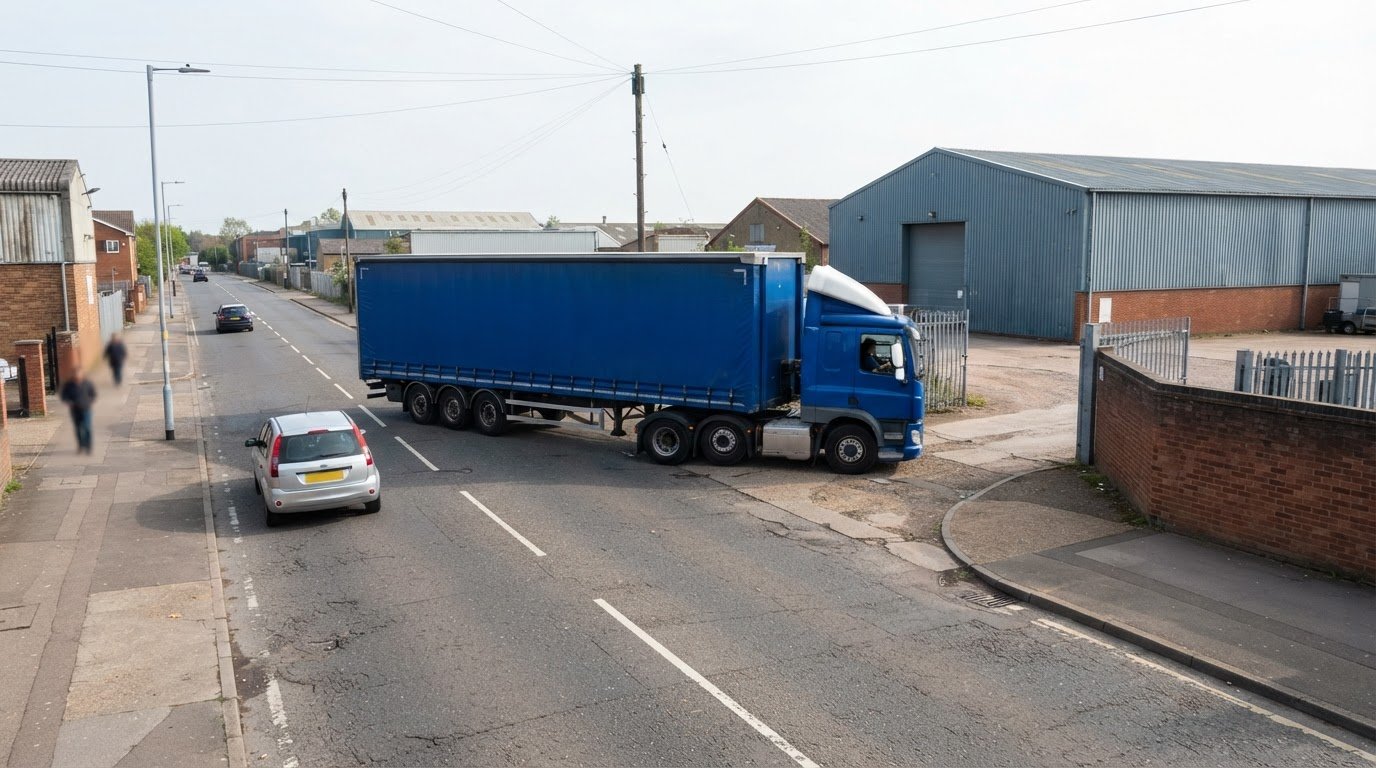
A transport assessment for a distribution hub in Bexley examines how the proposed development’s trips could affect road safety, junctions, parking and travel, and how vehicles and people will access the site. The report title can vary, but its purpose is practical: to assess the transport effects of the specific proposal.
It is understandable to ask whether a Transport Statement or Travel Plan is simply another name for the same document. These are related planning documents, but a Transport Assessment focuses on the transport effects of the proposed development. The appropriate scope depends on the hub’s operation and the issues that need to be assessed.
This article explains what a transport assessment covers and how it can address site access, deliveries, refuse collection and public transport in Bexley. It also clarifies the terminology, so you can see how these documents relate to one another and what transport information is relevant to a distribution hub proposal.
Key Takeaways
- Understand how local planning context can shape the transport evidence a distribution hub needs.
- See which servicing and delivery movements, including refuse collection, should be considered in site planning.
- Learn how a transport assessment evaluates the effects of development traffic on the surrounding network.
- Identify how site access and public transport connectivity fit into the wider assessment.
- Distinguish transport assessments from related planning documents and understand when each may be relevant.
Bexley transport and planning context
A distribution hub can generate a different pattern of movement from housing or smaller commercial premises. Its transport assessment should relate the proposed operation to site access, surrounding roads and likely travel demand. The relevant context is not just the borough: it is how the hub’s activities interact with the streets and transport connections around its particular site.
Recent planning decisions show the range of development types considered in Bexley. An application for eight dwellings was decided in January 2026, while an HMO conversion was decided in March 2026. In June 2026, decisions covered an application for seven dwellings and a hotel bedroom extension with restaurant reconfiguration. An EV charging substation and ancillary cabinets application was decided in August 2026.
Examples from other types of development cannot establish the transport effects of a logistics proposal. An assessment needs to respond to the development being proposed. For a hub, it should examine vehicle movements, employee travel and servicing in relation to the site access and surrounding network. It should identify relevant routes, consider where trips may interact with other road users, and explain the assumptions behind its conclusions.
Local planning activity also provides useful context, but not a substitute for site-specific analysis. A directory covering planning work within three miles of Bexley lists 26 companies that produced transport assessments for recent applications. That figure describes the directory’s coverage, not the number of assessments required for a particular hub. Scope depends on the proposal and the transport questions raised by its location.
- Define the proposal: describe the hub’s intended use and the movements associated with its operation.
- Set the site context: identify access points, nearby roads and relevant transport connections.
- Assess the effects: explain how development trips could affect road safety, junctions, parking and travel.
- Present clear assumptions: connect the assessment’s conclusions to the development and its local setting.
This process helps distinguish broad borough context from the evidence relevant to one planning application. The assessment should make clear why its chosen scope fits the site and proposal, rather than relying on unrelated decisions as direct comparisons. For wider planning context, the London transport assessment guide for developers provides a related overview. A Bexley proposal still needs analysis grounded in its own location and anticipated activity.
Patrick Parsons produced transport assessments for 3 recent planning applications around Bexley. This offers a further point of local planning context, but the figure does not indicate how many assessments a distribution hub needs or what its conclusions should be. For a proposed hub, the useful question remains whether the evidence addresses its access, expected movements and effects on the surrounding network.
Servicing, deliveries and refuse collection
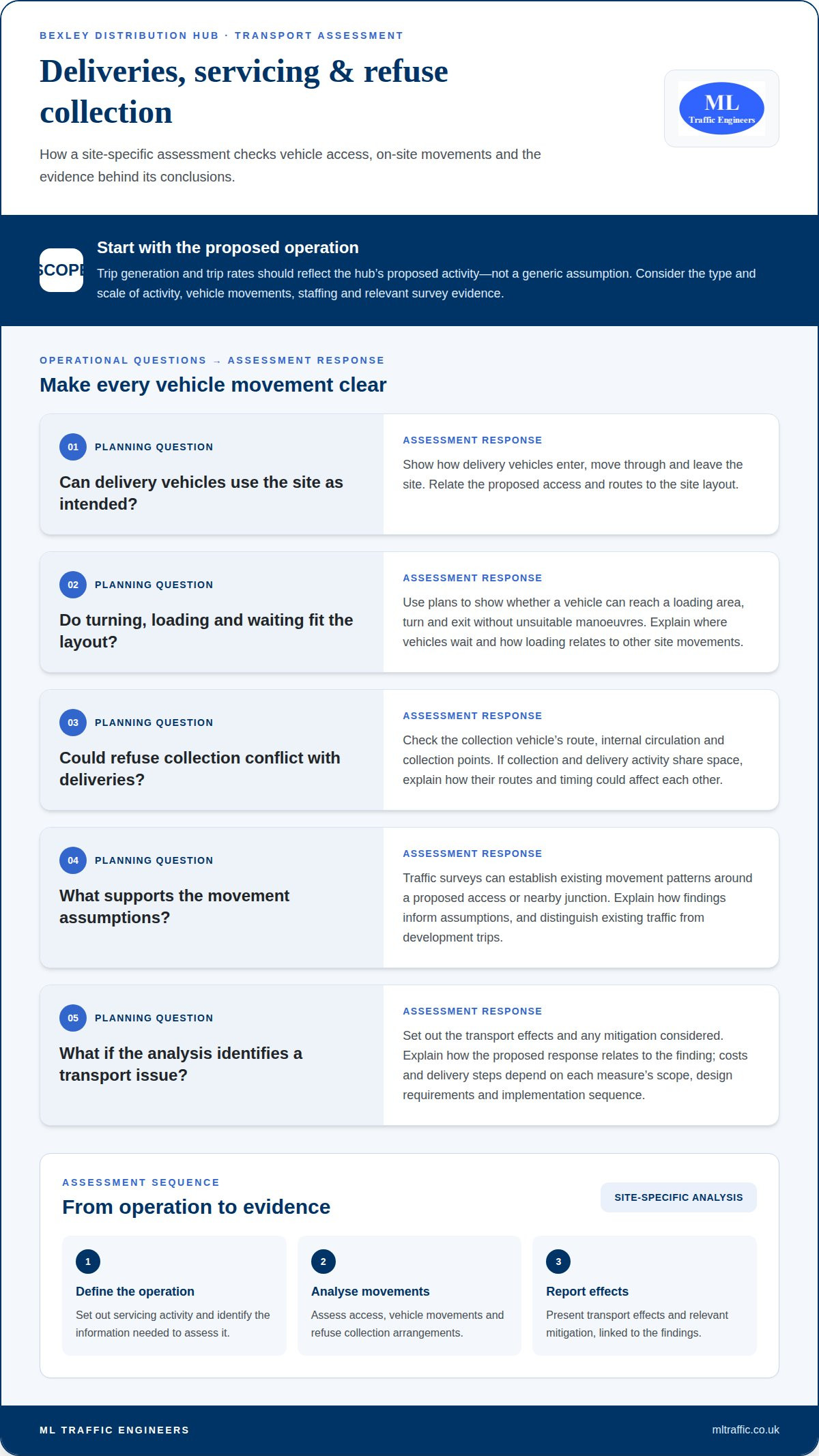
Traffic generation and trip rates for a distribution hub in Bexley should reflect its proposed operation, not a generic assumption. The assessment considers the type and scale of activity, vehicle movements, staffing and relevant survey evidence.
Mitigation measures depend on the effects identified, site constraints and the chosen response. Their costs and delivery steps depend on the scope of each measure, its design requirements and implementation sequence.
Servicing analysis should explain how delivery vehicles enter, move through and leave the site. Plans can show, for example, whether a vehicle can reach a loading area, turn and exit without unsuitable manoeuvres. The assessment should also consider where vehicles wait and how loading interacts with other site movements.
Refuse collection needs a separate operational check. Consider the collection vehicle’s route alongside delivery access, internal circulation and collection points. If both activities use the same space, explain how their routes and timing could affect each other. This helps identify operational conflicts before the site layout is finalised.
Traffic Surveys can establish existing movement patterns around a proposed access or nearby junction. The assessment should explain how survey findings inform its assumptions, rather than present trip estimates without context. Evidence should distinguish existing traffic from development trips and describe the reasoning behind forecast movements.
Useful assessment outputs for a distribution hub bring together the site layout, servicing assumptions and transport analysis. A clear report sets out the proposed access, expected vehicle activity, relevant survey evidence and identified transport effects. Where the analysis identifies an issue, it should explain the mitigation considered and how it responds to the finding.
- Access: show delivery and refuse vehicles’ routes through the site.
- Manoeuvres: assess turning, loading and exit movements against the proposed layout.
- Interaction: identify possible conflicts between deliveries, collections and other site users.
- Evidence: connect trip assumptions and mitigation proposals to survey findings and site conditions.
The delivery sequence should follow the assessment’s findings. First, define the proposed servicing operation and identify the information needed to assess it. Next, analyse access, vehicle movements and refuse collection arrangements. Then present any transport effects and relevant mitigation in the report. If traffic survey evidence would help establish the local movement pattern, consider traffic survey support as part of the assessment process.
Use trip rates based on the hub’s proposed operation, including the scale of activity, vehicle movements and staffing, and support them with relevant survey evidence. Explain the assumptions and distinguish forecast development trips from existing traffic.
Patrick Parsons has over 50 years of experience as an engineering consultancy, while servicing, delivery and refuse collection arrangements should be assessed in light of the proposed site operation.
What is a transport assessment?
A transport assessment examines how development trips could affect road safety, junctions, parking and travel. For a Bexley distribution hub, it connects those effects to the site layout, vehicle activity and surrounding transport network.
Parking Provision and Demand
Parking analysis compares the proposed spaces with the needs of staff, visitors and operational activity. For a distribution hub, assess how shift patterns, workforce travel and site operations affect demand, rather than treating every space as interchangeable. Explain the assumptions behind parking demand and consider whether parked vehicles could affect access, circulation or delivery areas.
Parking surveys can describe existing conditions near a site, while the proposal’s operating assumptions inform future demand. Together, these inputs help distinguish current parking pressure from the hub’s expected requirements. The analysis should show how parking fits within the site plan and whether space locations conflict with vehicle manoeuvres, loading or safe pedestrian movement.
Parking, Loading and Cycle Standards
Consider the applicable parking, loading, servicing and cycle provision against current Bexley planning requirements and the proposed layout. A transport assessment should identify the relevant provisions, explain how the design responds, and show how staff and visitors can reach cycle parking without unnecessary crossings of loading areas.
No single provision figure applies to every distribution hub without consideration of its location and operation. The assessment should make clear which standards inform the proposal and how loading spaces, parking and cycle facilities work together. For example, a loading area should not depend on vehicles occupying parking or circulation space.
Survey Data and Traffic Modelling
A Bexley transport assessment can use traffic surveys to establish existing movement patterns on relevant roads or at junctions. The evidence required depends on the access arrangements and transport effects being assessed. Useful inputs may include vehicle counts, turning movements and observed site conditions.
Modelling then tests how development trips interact with the existing network. The report should explain its trip assumptions, the routes assessed and the junctions selected, linking each modelling choice to the proposal. A directory covering planning work within three miles of Bexley lists 26 companies that produced transport assessments for recent applications. That context does not determine the survey scope for an individual hub.
Safety, Air Quality and Construction Risks
The assessment should examine road safety around site access, vehicle routes and points where different road users may interact. It should also consider whether development traffic could affect air quality or noise near sensitive locations, describing relevant exposure and transport activity without assuming an impact.
Construction traffic involves different movements from the hub’s operational activity. The assessment should identify likely construction vehicle routes, access constraints and potential conflicts with road users. Its conclusions should connect each identified risk to relevant evidence and explain how the site layout or proposed transport arrangements address it.
Accessibility and public transport connectivity
A distribution hub’s transport assessment should consider how staff, visitors and drivers reach the site. In Bexley, the analysis needs to relate public transport, walking and cycling connections to the actual site entrance and working pattern.
Map the site against nearby public transport stops and walking routes. Then assess whether those routes provide a practical connection to the entrance, rather than relying on distance alone. A nearby stop may still involve an indirect approach, a difficult crossing or a route separated from the site by busy roads.
Shift times matter. If employees start or finish outside the hours served by available public transport, the assessment should explain how this affects realistic travel choices. Staff travel assumptions should reflect the proposed operating pattern, not assume that every employee can use the same mode.
Walking and cycling access also needs a site-specific review. Consider the route from the public highway to staff entrances, cycle parking and visitor access. For example, a path that ends at the vehicle entrance may create a conflict if people must cross a delivery route to reach the building. The layout should make these movements clear and separate them where practicable.
Accessibility means more than identifying a bus or rail connection. The assessment should consider the full journey between transport facilities and the site, including route continuity, crossings and entrance locations. It should also show how visitors and staff can move around the site without passing through loading or vehicle manoeuvring areas.
- Map connections: show public transport stops, walking routes, cycle approaches and site entrances.
- Relate access to shifts: compare employee travel assumptions with the hub’s operating hours.
- Review site circulation: consider how pedestrians and cyclists reach entrances safely alongside vehicle activity.
- Explain constraints: identify gaps between a transport connection and the final route to the site.
A transport assessment for a distribution hub in Bexley should connect these observations to likely travel demand. If public transport or active travel offers a practical option for some journeys, the assessment can explain how that affects trip assumptions. If access limitations make certain modes less workable, describe the constraint clearly and avoid unrealistic assumptions.
The final report should bring together route mapping, site access and employee travel assumptions. This helps readers see how the proposal accounts for people arriving by different modes, not only goods vehicles. A clear explanation can also show whether changes to entrances, pedestrian routes or cycle access would better support the hub’s operation and local connectivity.
Alternative names for transport assessments
Planning discussions in Bexley may use several transport-related terms, but they do not all mean the same thing. For a distribution hub, identify the document by its purpose and evidence, not its title alone.
Transport Assessment describes analysis of a development’s transport effects. It considers how proposed trips relate to access, road safety, parking and travel. A report with this title should connect its evidence and conclusions to the specific proposal. For example, a hub’s vehicle activity and staff journeys need analysis suited to that operation.
Transport Statement is another document name used in planning. It should not automatically be treated as an exact synonym for a Transport Assessment. Scope and level of analysis matter more than the label: consider what the document evaluates, which assumptions it uses, and whether it addresses the transport issues relevant to the site.
Travel Plan is related but serves a different purpose. It focuses on how journeys to and from a development can be supported or managed. For a Bexley hub, it might address staff travel choices, while the Transport Assessment examines the proposal’s broader transport effects. One document does not become another simply because both discuss journeys.
Other terms describe parts of the supporting work rather than alternative report names. A traffic survey gathers evidence about movement patterns. A parking survey examines parking conditions. Swept Path Analysis considers whether a vehicle can manoeuvre through a proposed layout. These inputs may inform a wider assessment, but each answers a narrower question.
- Check the purpose: is the document assessing transport effects, staff travel, parking, or vehicle manoeuvres?
- Review the scope: does it address the hub’s access, operation and relevant transport impacts?
- Follow the evidence: are survey findings and assumptions connected to the report’s conclusions?
- Separate supporting studies: identify surveys or layout analysis as evidence, not automatically as the main assessment.
For example, a document titled “Transport Report” could contain assessment work, but the title alone cannot show whether it addresses a distribution hub’s needs. Read its scope and conclusions. In Bexley, the useful distinction is between the main assessment, a focused statement, a travel plan and supporting evidence. Get help identifying the right transport document for your proposed development.
ML Traffic Engineers UK: Transport Assessments
ML Traffic Engineers UK prepares Transport Assessments and Transport Statements for development proposals, including major logistics and distribution hubs. Turn to this service when you need transport evidence relating the proposed operation to site access, vehicle movements, parking and travel. The report can bring together relevant analysis and clearly explain its assumptions and findings.
Where supporting evidence is needed, Swept Path Analysis can assess vehicle manoeuvres against the proposed layout, while Parking Surveys can inform consideration of parking demand. The appropriate scope depends on the planning questions raised by the proposal. Contact ML Traffic Engineers UK to discuss a transport assessment for your distribution hub.
Move your Bexley proposal forward
Use the next planning step to turn your distribution hub’s operating assumptions into a clear transport brief. A well-defined scope keeps the analysis focused on the questions that matter for your site, from vehicle access to how staff and visitors will travel. It also gives the planning submission a consistent basis for explaining the proposal’s transport effects.
If you’re preparing a transport assessment for a distribution hub in Bexley, ML Traffic Engineers UK can develop the supporting transport work. Depending on the project, this may include a Transport Assessment or Transport Statement, with Parking Surveys or Swept Path Analysis supporting specific evidence needs.
Bring your site details and proposed operating arrangements into the discussion, so the scope can reflect the development rather than a generic template. Contact ML Traffic Engineers UK to discuss the transport work for your proposal and take the next planning step with confidence.
Frequently Asked Questions
What is a transport assessment for a distribution hub in Bexley?
A transport assessment is a planning document that evaluates the proposed hub’s transport implications using its expected operations and site details. For example, it can explain how staff arrivals, goods vehicle movements and site access relate to the surrounding network. Its scope should reflect the proposal’s characteristics and the transport issues raised by its location, rather than rely on a generic warehouse template.
What are the peak-hour traffic impacts of a proposed distribution hub in Bexley?
Peak-hour impacts depend on how the hub’s vehicle and staff trips overlap with existing traffic. The analysis compares expected development movements with observed baseline conditions and considers effects on relevant junctions and routes. A shift change that coincides with busy background traffic may create a different pattern from deliveries spread across the day. The assessment should make its operating assumptions clear.
Which roads, junctions and access routes near the Bexley site need capacity assessment?
Assess the proposed site access and the roads and junctions likely to carry additional trips. Route selection should follow expected vehicle destinations and access arrangements, not an arbitrary boundary around the site. For instance, include a junction where delivery vehicles must turn or merge, then consider whether onward routes connect the site to the wider network without overlooking relevant constraints.
What HGV, van and staff travel assumptions are appropriate for a Bexley distribution hub?
Use assumptions that match the hub’s proposed operation and distinguish HGVs, vans and staff journeys. Explain expected delivery activity, vehicle types, shift arrangements and workforce travel patterns. Separating goods vehicle trips from employee arrivals, for example, helps show which movements affect access at different operating periods. Survey evidence and the development brief should support the assumptions.
What public transport, walking and cycling options serve the proposed Bexley site?
Identify the public transport stops and active travel routes that connect with the actual site entrance. Consider the complete journey, including route continuity, crossings and how staff reach the building from a stop or cycle route. A nearby stop may not provide a practical staff route if the final walk is indirect or crosses vehicle access. Relate available options to the hub’s shift patterns.

Disclaimer
The content on mltraffic.co.uk, including all technical articles, guides, and resources, is provided for general informational and educational purposes only. It is not intended to constitute professional advice in traffic engineering, transportation planning, development approvals, or any other technical or legal field.
While ML Traffic Engineers makes every reasonable effort to ensure the accuracy, completeness, and timeliness of the information published, we do not provide any warranties or representations (express or implied) regarding its reliability, suitability, or availability for any particular purpose. Any reliance you place on the content is strictly at your own risk.
In no event shall ML Traffic Engineers, its directors, employees, authors, or affiliates be liable for any direct, indirect, incidental, special, consequential, or punitive damages (including, without limitation, loss of profits, data, or business opportunities) arising out of or in connection with the use of, or inability to use, any information provided on this website.
The articles and guides on this site are not a substitute for engaging a qualified, professional traffic engineer to assess your specific project requirements. For tailored advice, compliance assessments, or traffic engineering services, please contact a competent professional.
This disclaimer may be updated from time to time without notice. By accessing or using this website, you agree to be bound by the most current version of this disclaimer.