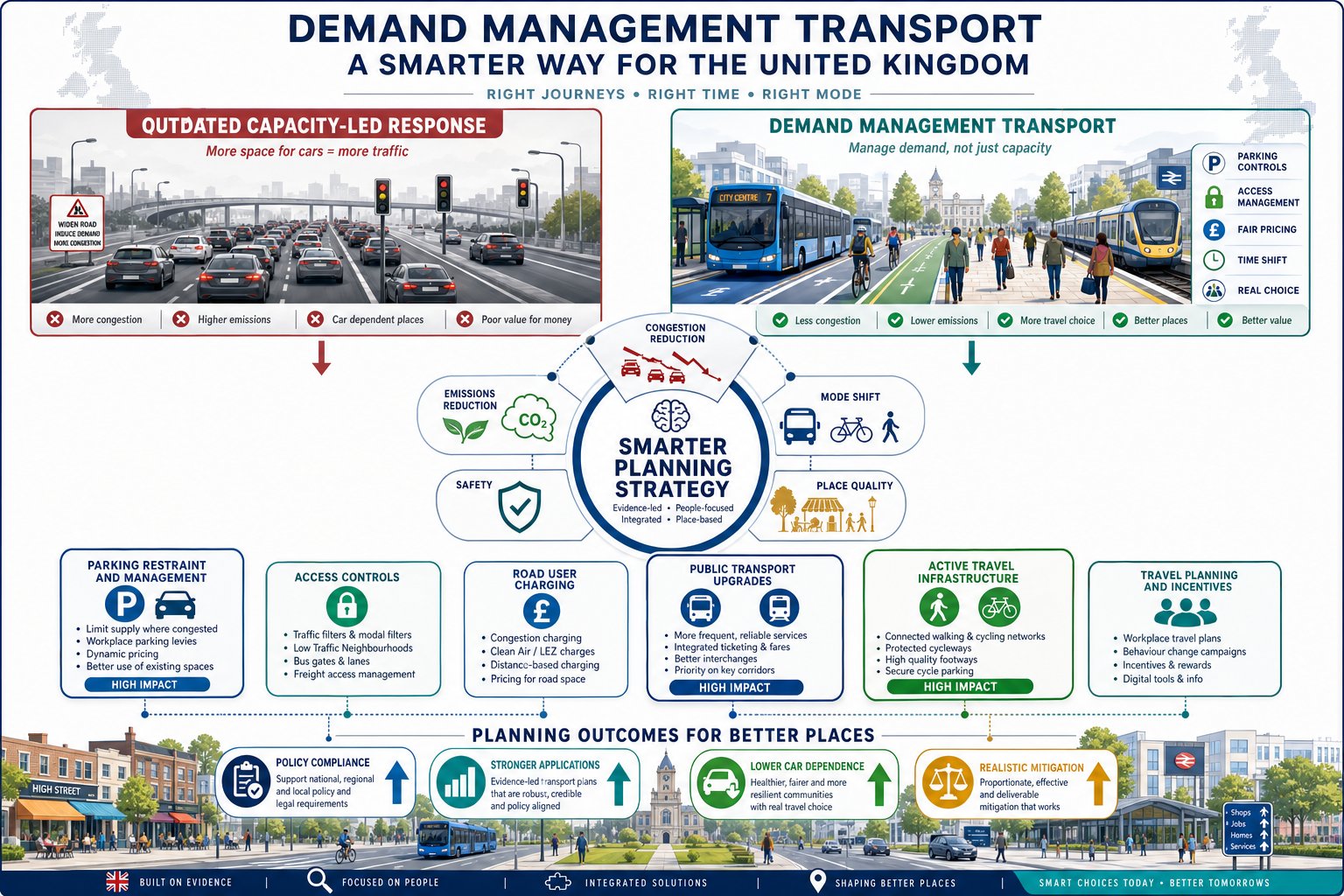
In UK planning, one of the most persistent mistakes is treating congestion as a pure capacity problem. If queues form, the instinct is often to widen, add, or signalise. But that approach only takes us so far. In many locations, especially town centres, growth areas and constrained urban networks, we simply cannot build our way out of traffic pressure.
That is where demand management transport thinking becomes essential. Rather than assuming every forecast car trip must be accommodated, demand management in transport asks a sharper question: how can we reduce, redistribute or shift travel demand so the network works better overall? For architects, planners, developers, local authorities and legal teams, that question now sits at the heart of credible planning strategy.
In practice, transport demand management is not a single policy. It is a package of measures that influences when people travel, how they travel, where they park, and whether some trips can be avoided or shortened altogether. It supports lower-carbon development, stronger planning applications and more realistic mitigation strategies.
From our perspective, this matters because planning decisions are increasingly judged against mode shift, place quality, safety, emissions and policy alignment, not just junction capacity. A robust approach to demand management can hence make the difference between a scheme that merely adds traffic and one that demonstrates genuine transport sustainability. The sections below set out what demand management means, the objectives behind it, the measures most commonly used, and how it supports transport assessments in 2026.
What Demand Management In Transport Means And Why It Matters
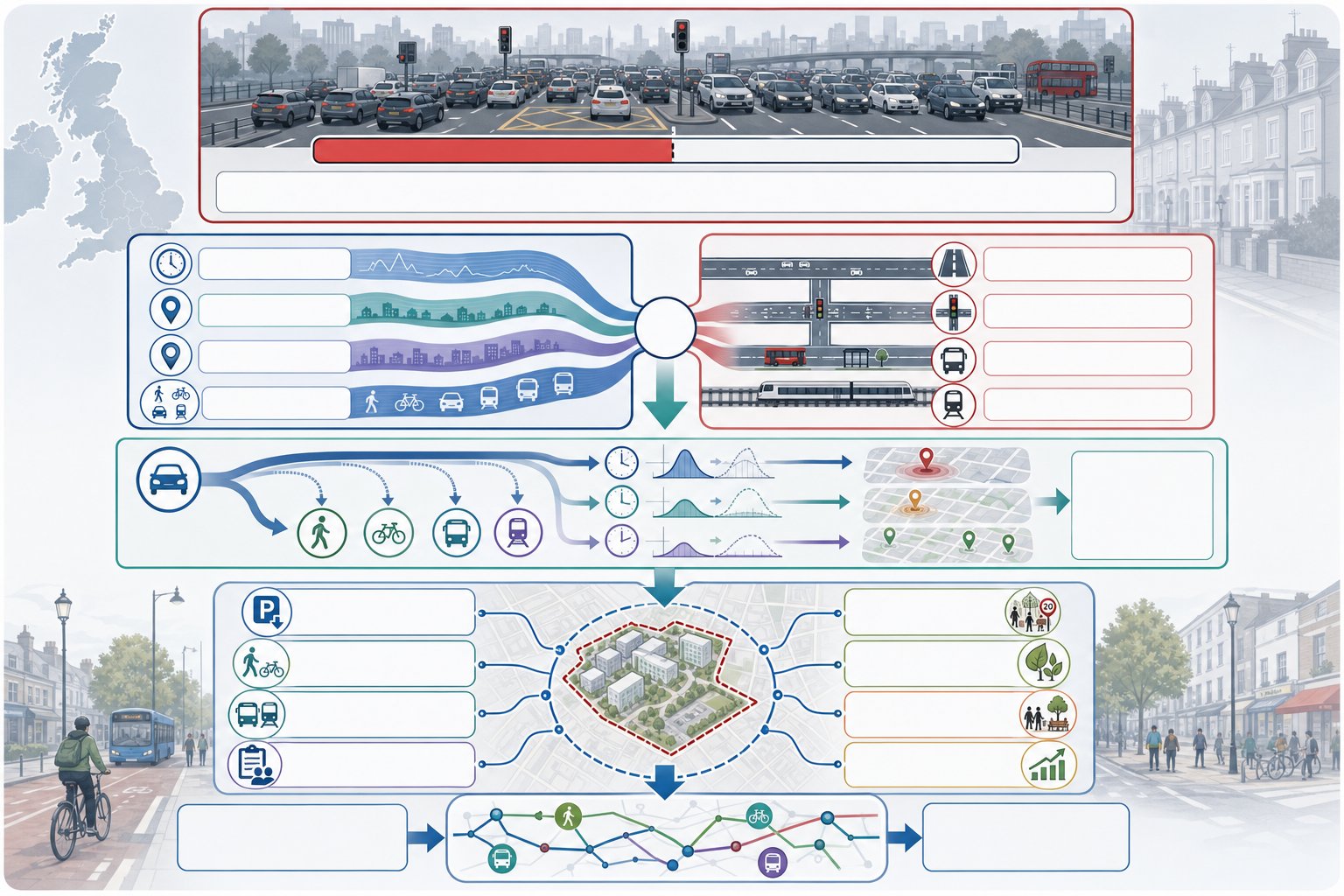
Demand management in transport, often shortened to TDM, is the deliberate use of policies, design choices and operational measures to influence travel behaviour. The aim is not simply to move more vehicles. It is to make better use of the network by reducing unnecessary car trips, shifting journeys to more sustainable modes, and spreading demand away from the busiest times and locations.
For planning teams, that distinction is critical. A road network may be constrained physically, environmentally or politically. In those cases, the old predict-and-provide model tends to fail because added capacity is expensive, slow to deliver and often self-defeating. New road space can attract new traffic. Demand management offers a more practical route: shape travel choices before impacts materialise.
That is why TDM now sits alongside wider planning concepts such as healthy streets, net zero, place-making and decide-and-provide. It supports development that functions within a realistic transport envelope rather than relying on ever-larger highway interventions. In our work, that often means combining parking restraint, active travel access, public transport connectivity and travel planning into one coherent mitigation package.
For applicants and councils alike, the point is simple: demand management is no longer an optional extra. It is increasingly part of what makes a transport strategy policy-compliant, defensible and deliverable.
How Travel Demand Differs From Traffic Capacity
Travel demand and traffic capacity are related, but they are not the same thing. Travel demand is about the number of trips people want to make, their origins and destinations, the time they choose to travel, and the mode they use. Capacity, by contrast, is the amount of movement a road, junction, corridor or public transport route can accommodate while still operating acceptably.
That difference matters because congestion occurs when demand exceeds capacity at a specific place and time. Morning peak delays on a town-centre arm, for example, may reflect concentrated school, commuter and servicing trips rather than a permanent all-day shortage of carriageway. If so, widening the road may be disproportionate, while targeted demand management could remove or reschedule enough trips to stabilise operation.
This is especially relevant in development planning. A site may generate a manageable number of person trips overall, yet still create pressure if most of them arrive by single-occupancy car in the same peak hour. Equally, the same site can perform very differently where demand is shifted towards bus, rail, walking and cycling. That is why a good transport assessment for development does more than count vehicles: it tests whether demand can be influenced before impacts hit the network.
Why Demand Management Is Central To Modern Planning Policy
Modern planning policy has moved well beyond the idea that every forecast vehicle movement should be accommodated on demand. In the UK, national and local policy increasingly prioritises sustainable transport, climate resilience, healthier places and development that reduces reliance on private car use.
That shift is visible in parking standards, low-car housing models, active travel investment, bus-priority measures, clean air policy and the growing influence of vision-led design. It is also reflected in the move from predict-and-provide to decide-and-provide: first establish the place and transport outcomes we want, then shape the network and travel behaviour to support them.
For developers and consultants, this means demand management is central not only in principle but in evidence. Authorities increasingly expect applicants to show how mode share targets will be achieved, how parking demand will be managed, and how peak-hour vehicle trips will be minimised. In complex schemes, that logic often sits within broader vision led transport work, where movement strategy is aligned with the desired character and function of the place.
In short, TDM matters because policy now expects transport planning to shape demand, not merely react to it.
The Main Objectives Of Transport Demand Management
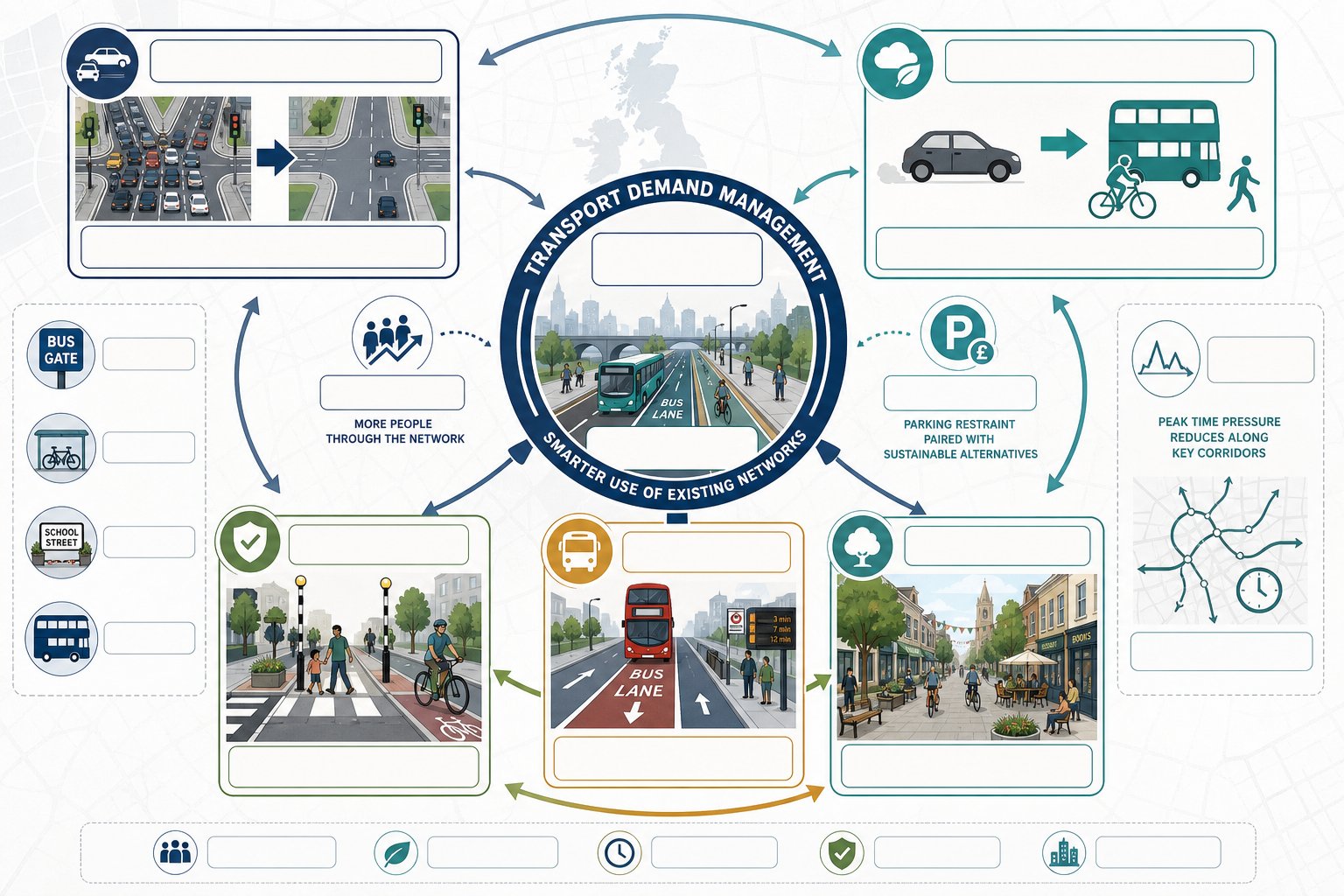
Transport demand management has several objectives, but they all come back to one core principle: use existing networks more intelligently while achieving better planning outcomes. That means less congestion where it is most damaging, fewer emissions, safer streets, stronger public transport viability and places that function for people rather than just vehicle flow.
For our audience, the practical value is obvious. A scheme that relies solely on highway capacity improvements can be costly, uncertain and vulnerable in policy terms. A scheme supported by targeted demand management often has a broader and more defensible mitigation strategy. It can show not only that impacts are acceptable, but that the development actively supports local transport policy.
The objectives also work together. Reducing peak car trips helps congestion, but it also improves bus reliability. Better walking and cycling access may reduce parking demand, improve health outcomes and support more attractive streets. Reallocating road space can sometimes appear restrictive in vehicle terms, yet increase person-throughput and make a centre function better commercially.
In that sense, demand management is not about suppressing movement for its own sake. It is about managing movement in a way that better serves economic activity, environmental limits and place quality.
Reducing Congestion, Emissions And Car Dependence
One of the clearest objectives of demand management is reducing traffic pressure in the places and periods where the network is most sensitive. Peak spreading, mode shift and shorter trip lengths can all remove stress from junctions and corridors without major new road construction.
This matters because congestion is not just inconvenient. It affects delivery reliability, bus punctuality, emergency access, fuel consumption and local air quality. Vehicle stop-start conditions also increase emissions per trip. So when demand management reduces single-occupancy car use or shifts trips out of the busiest hour, the benefits are wider than journey time alone.
The same is true for car dependence. In many developments, especially those in accessible urban locations, a design that bakes in high parking provision and weak sustainable links almost guarantees car-led trip patterns. By contrast, a package of restraint and alternatives can change travel behaviour materially. Parking pricing, car club spaces, cycle storage, direct pedestrian routes, bus information and travel plan incentives all play a role.
For larger schemes, this sits naturally within end to end transport strategy, where access, servicing, parking and mitigation are planned as one system rather than as isolated fixes. Done properly, demand management reduces both immediate traffic impacts and longer-term car reliance.
Improving Network Efficiency, Safety And Place Quality
A useful way to think about TDM is that it improves not just flow, but function. Roads and streets serve many purposes at once: movement, access, social interaction, servicing, commerce and public life. If we judge success only by vehicle throughput, we can miss the bigger planning picture.
Demand management helps by improving network efficiency in person terms rather than vehicle terms alone. A bus lane, for example, may reduce road space for general traffic, yet move far more people per hour. School streets can create short-term access restraint but cut conflict at the school gate. Bus gates and filtered permeability can remove through traffic from streets that were never meant to operate as distributor roads in the first place.
Safety is another major objective. Lower traffic volumes and lower speeds generally reduce collision risk and severity. Better conditions for walking and cycling also widen travel choice for children, older people and less confident users. That has obvious social value, but it also supports more realistic mode shift.
And then there is place quality. Cleaner air, quieter streets, safer crossings and reduced parking dominance make centres and neighbourhoods more attractive. In a mixed use masterplan, these outcomes are often as important as raw capacity because they influence viability, footfall and long-term urban character.
Common Demand Management Measures Used In Development And Local Transport Planning
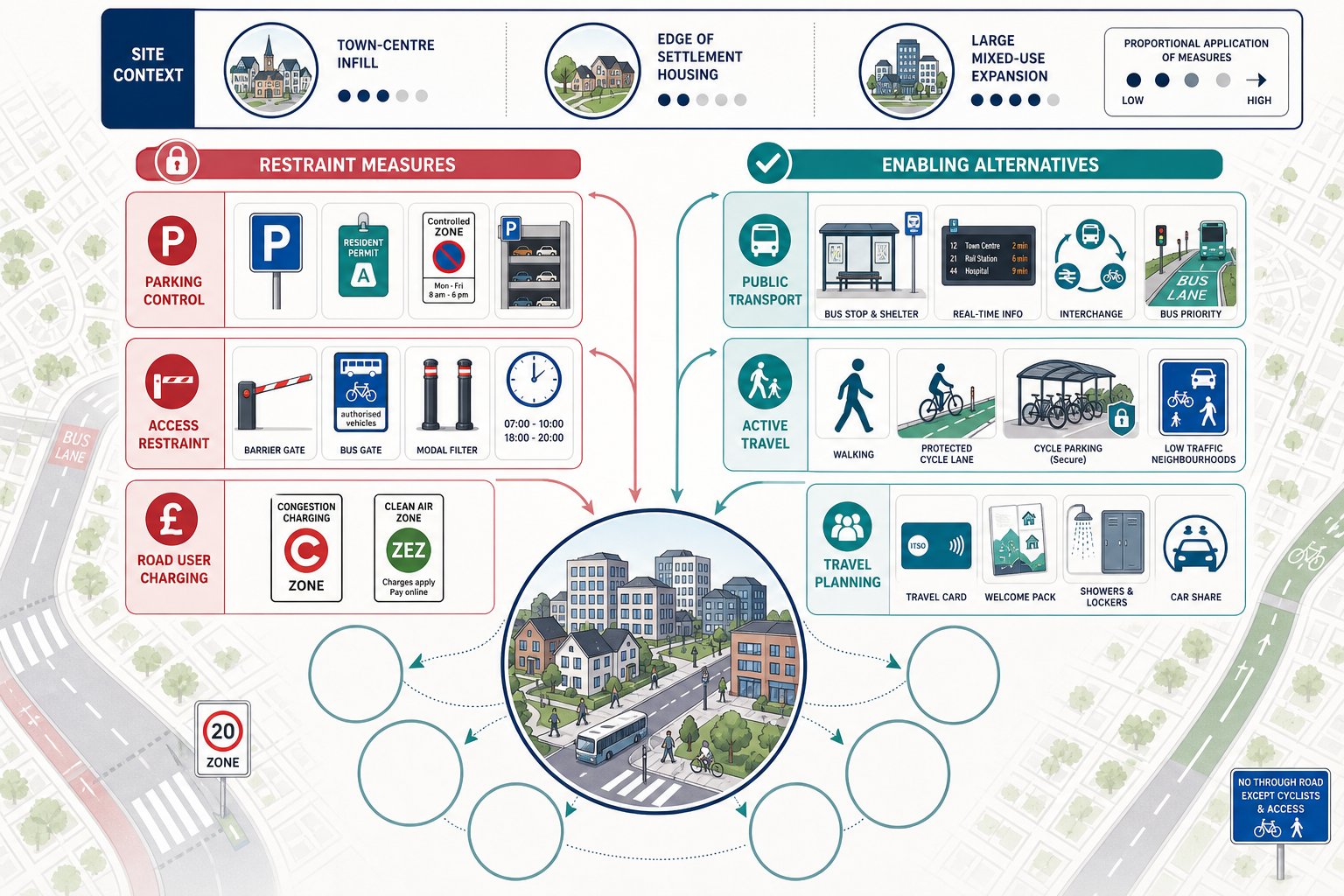
Demand management measures are rarely effective in isolation. The strongest results usually come from a package that combines restraint, incentives and better alternatives. In planning terms, that package must also be proportionate to the scale and context of the proposal. A town-centre infill site, an edge-of-settlement housing scheme and a large mixed-use expansion area will not need the same tools.
Still, there are common themes. Parking management is often the most immediate lever because it directly shapes car ownership and use. Access management can protect sensitive streets or prioritise certain users. Charging mechanisms can tackle congestion or emissions where network pressure is acute. Alongside these, public transport improvements, active travel infrastructure and travel plans give people workable alternatives.
The best packages are grounded in evidence. They respond to local policy, accessibility, existing mode shares and observed constraints. And crucially, they are deliverable. There is little value in promising ambitious mode shift if the walking route is indirect, the cycle parking is tokenistic or the bus service is too infrequent to be credible.
Parking Control, Access Restraint And Road User Charging
Parking is one of the most powerful demand management tools because it influences travel choices before the trip even starts. High parking provision tends to support higher car ownership and greater car use. Limited supply, pricing and allocation controls can produce the opposite effect, especially where sustainable alternatives are reasonably good.
In development planning, that may mean maximum parking standards rather than minimum ones, unbundled parking for residential schemes, managed permit systems, shared spaces for mixed-use sites, and EV provision that supports policy without encouraging unnecessary car trips. Workplace parking restraint is equally important on employment-led schemes.
Access restraint works slightly differently. Instead of targeting parking, it controls where and when vehicles can move. Examples include bus gates, modal filters, school streets, freight time windows, loading restrictions and low-traffic neighbourhood treatments. These measures can protect town centres and residential streets from rat-running or reduce conflict in sensitive locations.
Road user charging adds another layer. Congestion charging, clean air zones and more sophisticated time-distance-place charging all aim to reflect the real external cost of driving in constrained networks. Not every development is directly subject to these tools, but many must account for them. In some cases, the analysis may need support from Traffic Flow Management evidence to understand how restrictions, rerouting and local network conditions interact.
Public Transport, Active Travel And Travel Planning Measures
If parking and access restraint are the stick, then public transport, active travel and travel planning are the means of making lower-car travel realistic. Without them, demand management quickly becomes punitive rather than effective.
Public transport measures can include new or diverted services, stop upgrades, real-time information, improved waiting environments, better interchange and ticketing initiatives. The value is not merely capacity. Reliability, legibility and directness often matter more to mode choice than raw timetable frequency. A modest service improvement paired with better walking access to stops can outperform a more expensive intervention that leaves the first and last leg awkward.
Active travel measures are just as important. Continuous footways, high-quality crossings, direct cycle routes, secure cycle parking, showers, lockers and well-designed public realm all affect whether walking and cycling feel normal rather than aspirational. For many shorter trips, especially in urban areas, these details decide mode share.
Travel plans tie the package together. They turn physical infrastructure into behavioural change through welcome packs, personalised travel advice, cycle vouchers, monitoring, car-share databases, season ticket support and targeted communication. In a planning application, those measures help quantify how demand will be managed over time rather than assumed away in principle. That is a key part of effective demand management transport strategy in 2026.
How Demand Management Supports Transport Assessments And Planning Applications
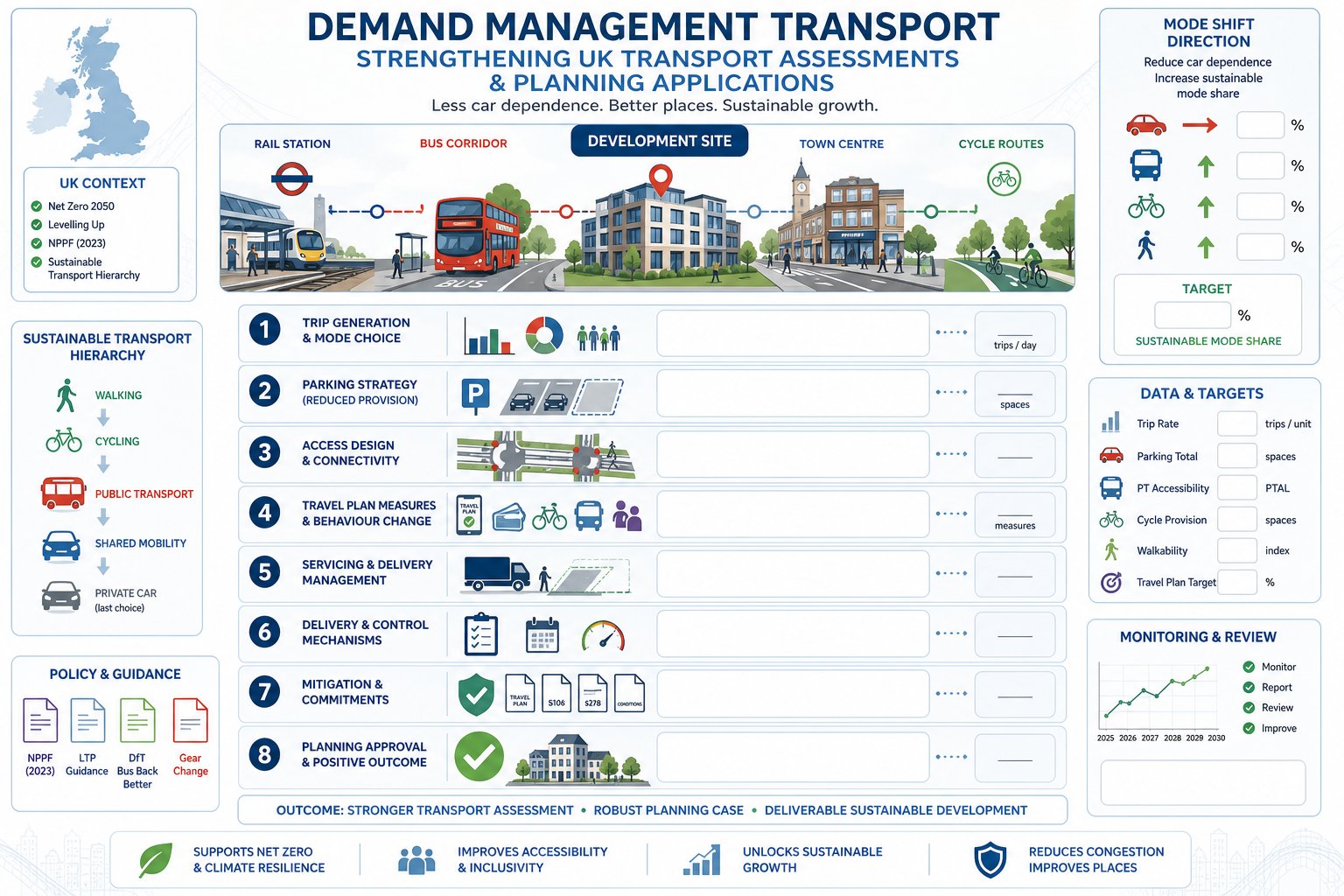
Demand management supports transport assessments by making them more realistic, policy-aligned and solution-focused. A conventional assessment that forecasts high car trip rates and then searches for junction mitigation can feel disconnected from modern planning policy, especially in locations where sustainable travel is expected. By contrast, a TDM-led assessment shows how trip generation, parking demand and network effects can be shaped from the outset.
That matters because planning authorities increasingly test not only whether residual cumulative impacts are severe, but whether applicants have genuinely prioritised sustainable modes. If the proposal sits in a town centre, near rail, on a strategic bus corridor or within a growth area with clear mode shift policy, a car-dominant evidence base is unlikely to land well.
In practice, demand management may influence several parts of the submission: trip generation assumptions, parking strategy, access design, travel plan commitments, delivery and servicing controls, and mitigation packages secured by condition or obligation. It can also strengthen the planning narrative. Instead of simply defending traffic impacts, the application demonstrates that it actively supports local transport objectives.
For us, this is often where concise technical reporting matters most. Local authorities want evidence that is proportionate, robust and tailored to threshold requirements. A well-structured demand management case can do a great deal of work in relatively few pages if the assumptions are credible and the commitments are clear.
When Demand Management Evidence Is Needed For Development Proposals
Demand management evidence is usually needed when a scheme is likely to generate significant trips, parking demand or pressure on a constrained network. That includes obvious cases such as major residential, commercial, education, healthcare and mixed-use proposals. But smaller schemes can trigger the same need if they are in sensitive locations or raise policy concerns around congestion, air quality or car dependency.
Town centres are a common example. So are edge-of-centre sites with good public transport access, corridors with existing peak-hour stress, and authorities pursuing low-car or car-lite growth strategies. In these contexts, decision-makers often expect quantified evidence showing how vehicle trip rates, parking accumulation and mode share will be influenced by the proposed measures.
That evidence may sit across the transport assessment, travel plan and design response. We would normally expect it to address parking supply and control, accessibility by non-car modes, site layout, servicing strategy, delivery timing, incentives, monitoring and fallback arrangements if targets are not met. The stronger submissions are specific. They do not just say cycling will be encouraged: they explain how many spaces are provided, where they are located, what facilities support them, and how uptake will be reviewed.
For planning teams operating to tight programmes, this is where experience helps. The key is to provide enough detail to satisfy the authority without drowning the application in generic text. In 2026, demand management evidence is increasingly not supplementary material but part of the core case for why a development is acceptable.
Conclusion
Demand management in transport has become a core part of credible planning, not a side note added after the traffic modelling is finished. For developers, planners, architects, surveyors, lawyers and councils, the message is fairly clear: successful schemes are increasingly the ones that manage demand intelligently rather than assuming every car trip can or should be accommodated.
The practical implication is that transport strategy now needs to do more than measure impact. It needs to shape behaviour, support policy, and show how a development will function within a constrained and increasingly sustainability-led network. Parking restraint, active travel, public transport support, access controls and travel planning are no longer isolated measures: together, they form a planning toolset.
When applied proportionately and evidenced properly, demand management can reduce risk, strengthen applications and produce better places. And in 2026, that is exactly what smarter planning decisions require.
Frequently Asked Questions about Demand Management in Transport
What is demand management in transport and why is it important?
Demand management in transport (TDM) involves policies and measures to reduce or reshape travel demand rather than just increasing road capacity. It improves network efficiency, reduces congestion, cuts emissions, and supports sustainable planning and healthier places in constrained urban areas.
How does travel demand differ from traffic capacity?
Travel demand refers to the number, timing, mode, and origins of trips people want to make, while traffic capacity is the amount of movement a road or transport route can accommodate effectively. Congestion arises when demand exceeds capacity at specific times or places.
Why is demand management central to modern UK planning policy?
Modern UK planning policy prioritises sustainable transport, net zero goals, and healthy streets, recognising that unfettered car demand cannot be met. Demand management transport aligns with these by shaping travel behaviour and supporting mode shift, making transport strategies policy-compliant and sustainable.
What are common measures used in demand management transport?
Common measures include parking control (maximum standards, pricing), access restraint (bus gates, school streets), road user charging (congestion charges, clean air zones), public transport improvements, active travel infrastructure, and travel plans encouraging behavioural change.
How does demand management support transport assessments for developments?
Demand management makes transport assessments more realistic and policy-aligned by showing how trip generation and car impacts will be managed. It helps demonstrate mode share targets, parking demand control, and mitigation strategies, strengthening planning applications and compliance with policy.
When is demand management evidence needed for a development proposal?
Evidence is typically required for schemes generating significant trips, parking demand, or impacting congested locations. This includes major residential, commercial or mixed-use developments in town centres or areas with policies favouring mode shift and low-car lifestyles, supported by detailed transport assessments and travel plans.