
Planning applications rarely fail because a drawing set looked untidy. More often, they stall because a scheme can’t clearly show how people will reach it without leaning too heavily on the private car. That’s where public transport strategy consultants come in.
For architects, planners, developers, solicitors and local authorities, the issue is no longer simply whether a bus stop exists somewhere nearby. In 2026, the real test is more demanding: Is the site genuinely accessible? Are services frequent enough at the right times? Can the network absorb demand? And, if not, what realistic mitigation can be secured through design, funding or operation?
We’ve seen time and again that strong public transport input at the right moment can change the trajectory of an application. It helps teams spot weaknesses before an objection letter does, frame evidence in a way local authorities can work with, and connect transport strategy to the wider planning story around sustainability, accessibility and deliverability.
In this text, we’ll look at what public transport strategy consultants actually do, when their advice is needed, how their work supports planning applications, and what to look for when appointing a consultant. The focus is practical: how to get from policy expectation to an application package that stands up under scrutiny.
What Public Transport Strategy Consultants Do And When Their Input Is Needed
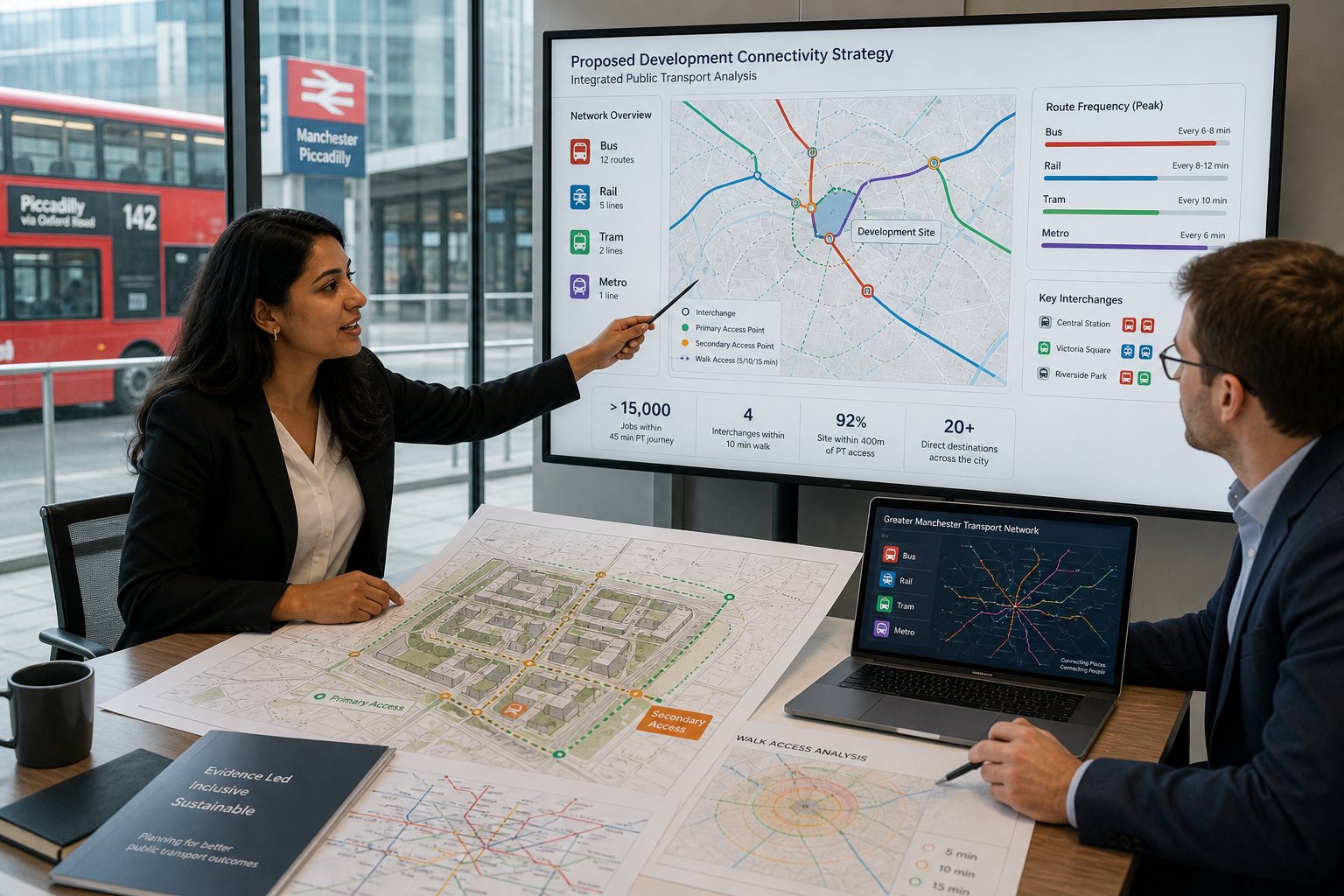
Public transport strategy consultants assess how well a site is served by bus, rail, tram, metro and interchange networks, then translate that evidence into planning-ready advice. In practice, that means reviewing routes, frequencies, hours of operation, network directness, interchange quality, peak crowding risks, walk access, barriers to movement, and the likely travel patterns generated by the proposed development.
Their role sits somewhere between technical transport assessment and planning strategy. They are not just counting services: they are asking whether the public transport offer is good enough for the land use proposed, the policy tests that apply, and the travel behaviours the development is expected to support. On a residential site, that may mean proving realistic commuter access to nearby employment centres. On a school or healthcare scheme, it may mean testing whether timed arrivals can be accommodated safely and reliably.
Input is usually most valuable at pre-application stage or during early design development. That’s when layout, access points, trip assumptions and mitigation options are still flexible. If consultants are brought in only after objections arise, the team is often forced into reactive work, redesign, or awkward negotiations over contributions.
For schemes moving through broader end to end transport workstreams, public transport strategy also helps align transport evidence from the outset rather than patching it together later. And that usually saves time, not to mention stress.
How Public Transport Strategy Supports Planning Applications And Local Authority Requirements
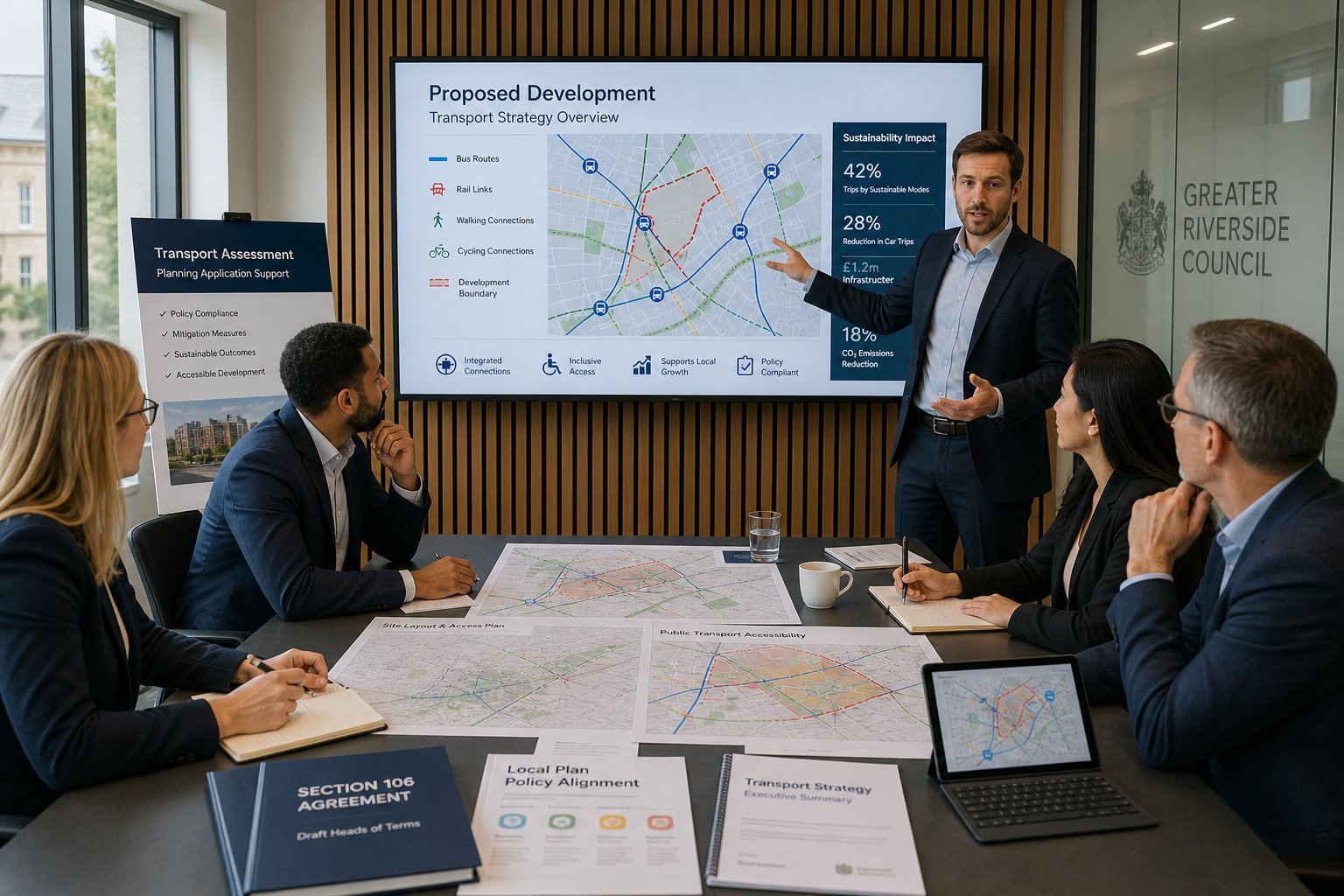
A robust public transport strategy gives decision-makers something they can test, rather than something they have to assume. Local planning authorities want to understand how a development will function in the real world: who will use it, how they will arrive, whether existing networks are adequate, and what commitments are needed if they are not.
This matters because policy is increasingly framed around sustainable transport outcomes, not just highway impact. National and local policy typically expects developments to promote walking, cycling and public transport, reduce unnecessary car dependence, and place major trip-generating uses where sustainable modes are credible. A site may be technically developable and still face resistance if the transport narrative is weak.
Public transport strategy supports applications by documenting baseline conditions, identifying gaps, and proposing proportionate responses. It can feed directly into site selection, parameter plans, access strategy, section 106 discussions and committee reporting. It also helps planning officers and consultees understand whether mitigation is operationally realistic or merely aspirational.
In many cases, this work sits alongside broader Transport Planning Consultants: input and can be closely linked to a Transport Policy Review where local plan wording, parking standards, accessibility thresholds and sustainable travel policies need to be interpreted carefully.
For councils, a well-prepared strategy also reduces uncertainty. It shows that the applicant has tested the site properly, understands the local network, and is willing to commit to measures that can actually be delivered.
Core Elements Of A Robust Public Transport Strategy

A convincing strategy is not a glossy statement saying a bus route exists within walking distance. It needs to explain existing conditions, likely demand, constraints, opportunities and delivery mechanisms in a form that planners, highway authorities and operators can interrogate.
At a minimum, we would expect the strategy to cover baseline provision, accessibility, service quality, likely user demand by land use, constraints on the surrounding network, required mitigation, phasing, responsibilities and how all of this links back to policy. The best documents are specific. They identify which stops matter, which services matter, what time periods matter, and why.
Accessibility And Catchment Analysis
Accessibility analysis tests whether people can realistically walk to stops and stations, not whether a point on a map falls inside a neat radius. That means measuring actual routes, gradients, crossing points, lighting, wayfinding and barriers such as severance from major roads, gated edges or poor footway continuity.
Catchment analysis usually considers standard walk thresholds, but the smarter approach is contextual. A five-minute walk along a direct, overlooked route feels very different from the same distance via a hostile road crossing and an unlit path. For older users, school pupils, disabled passengers or patients, those differences are critical.
Good analysis also looks outward. It asks what destinations can be reached from the site within reasonable journey times, with how many interchanges, and at what times of day. That is why public transport strategy often overlaps with vision led transport thinking: accessibility is about lived experience, not just geometry.
Service Frequency, Capacity And Connectivity Review
Once access to the network is understood, the next question is whether the network itself is good enough. Frequency matters because infrequent services sharply reduce convenience and resilience. A route running twice an hour may satisfy a basic policy claim, yet still perform poorly for shift workers, college arrivals, hospital appointments or linked trips.
Capacity matters too. If buses are already heavily loaded in the peak, adding new demand without evidence or mitigation invites objection. Rail stations may be nearby but offer poor step-free access, constrained platforms or weak onward interchange. Connectivity is equally important: direct services to local centres, employment areas and education hubs usually carry more planning weight than an impressive timetable to places residents rarely need.
A thorough review tests weekdays, Saturdays and evenings, and distinguishes between headline frequency and genuinely usable service patterns. On larger schemes, this assessment may sit within wider regional transport planning considerations where strategic corridors, growth allocations and neighbouring developments influence future demand.
Mitigation, Enhancement And Delivery Measures
If existing provision is marginal or insufficient, the strategy needs to move from diagnosis to delivery. Mitigation can include new or upgraded stops, shelters, raised kerbs, real-time information, improved crossings, footway links, travel information packs, demand management, operator engagement, service pump-priming or financial contributions secured through planning obligations.
The key word is deliverable. Authorities are rightly sceptical of vague promises to “encourage bus use” without a budget, trigger, responsible party or implementation mechanism. Strong strategies set out what will be done, when, by whom, and under what legal or commercial arrangement.
This is where work often aligns with broader Sustainable Transport Initiatives and with site-specific design changes that make public transport the easy choice rather than the worthy choice. If the route to the stop feels awkward, people won’t use it, regardless of how polished the strategy document looks.
How Consultants Assess Existing Public Transport Conditions Around A Site
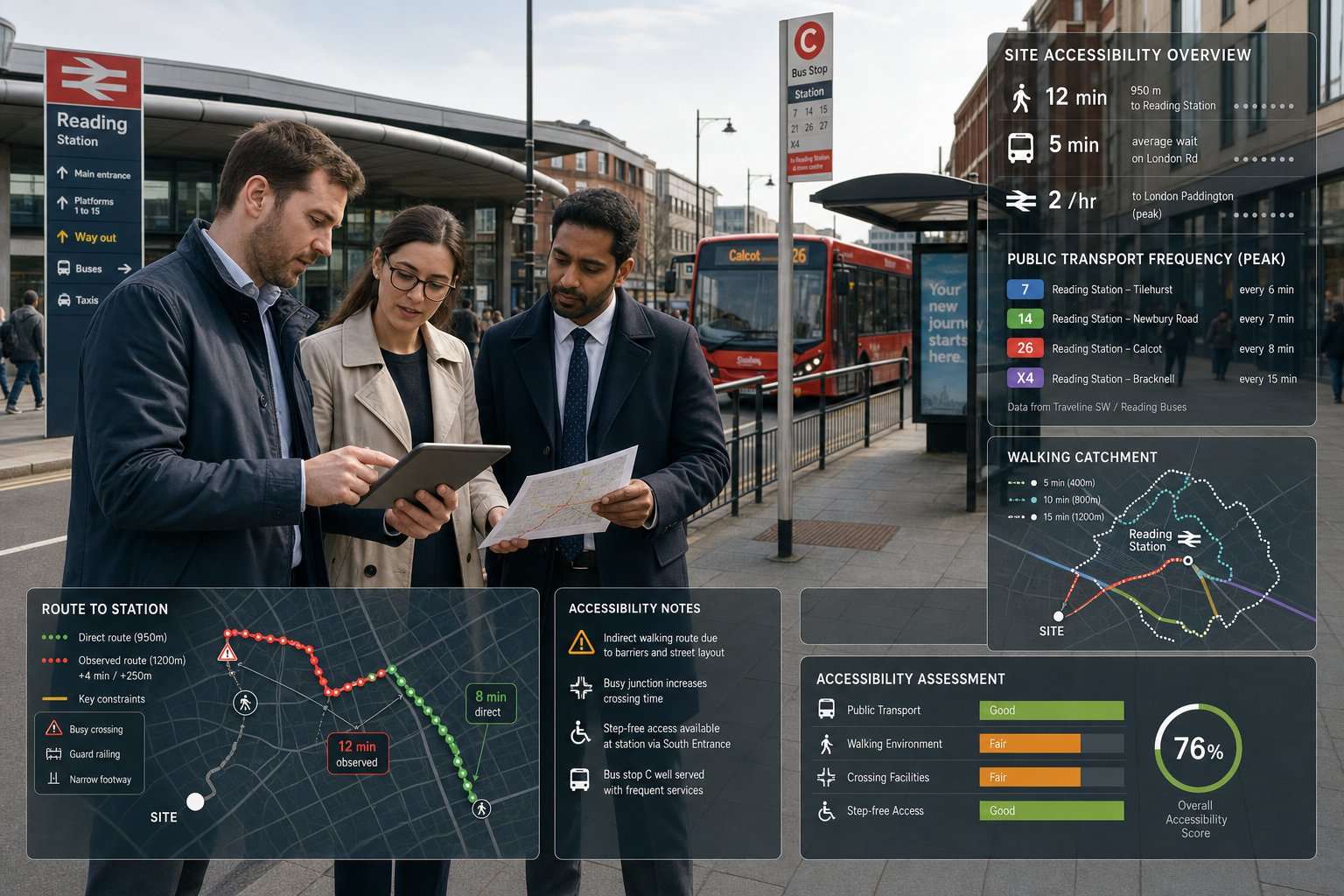
The assessment usually starts with a desk-based review, but it should not end there. Timetables, route maps, operator data, station facilities information and policy documents provide the baseline, yet site reality often tells a different story. We regularly find that mapped provision looks acceptable until on-site work reveals indirect walking routes, poor crossing opportunities, cluttered stops, or interchanges that are technically present but practically unattractive.
A sound assessment hence combines mapping, timetable review and field observation. Consultants will normally identify the nearest stops and stations, measure actual walking distances, review service span and frequency, check key destination links, and note barriers such as severance, steep topography or gaps in pedestrian infrastructure. On more sensitive schemes, they may also consider crowding patterns, school peak conflicts, interchange delays and network reliability.
The output should explain not just what exists, but how useful it is for the proposed land use. A residential development may need strong morning and evening commuter links. A logistics or industrial site may depend on early and late services for shift changeovers. A clinic, civic building or community hub may require all-day access for users who cannot drive.
This diagnostic stage also feeds neatly into related work by Sustainable Transport Consultants, especially where mode choice, active travel and public transport need to be considered as one joined-up accessibility picture. That joined-up view is often what makes the planning case feel credible.
Developing A Strategy For Different Types Of Development

Not all developments place the same demands on the public transport network, so the strategy has to reflect the use class, user profile, operational hours and likely trip patterns. A generic statement copied from another scheme is usually easy to spot and rarely persuasive.
Residential, Mixed-Use And Commercial Schemes
Residential schemes tend to focus on day-to-day accessibility: commuting, education, shopping, healthcare and leisure. The central question is whether future residents can live reasonably without high car dependence. That means looking at service quality across the day, not simply whether one bus route exists at the edge of the site.
Mixed-use schemes are more complex because they generate layered trip patterns. Residents, staff, visitors and deliveries may all place different demands on the network at different times. Public transport strategy hence needs to test multi-directional movement and consider whether a development can support local centres while reducing pressure on parking and highway capacity.
Commercial developments often bring a sharper focus on workforce access, peak spreading and staff travel behaviour. Office sites may align well with rail and frequent bus corridors, while industrial and warehouse uses can be much harder because shift times often fall outside strong service windows. In those cases, Modal Shift Consultants: style thinking becomes important, combining operational measures with realistic changes to access and travel behaviour.
Education, Healthcare And Community Developments
Education, healthcare and community uses raise distinct planning issues because arrivals can be concentrated, vulnerable users may be involved, and accessibility is often a core public interest issue rather than a secondary benefit.
Schools and colleges may need analysis of start and finish peaks, school bus interaction, crossing safety and the management of parent trips. Hospitals, clinics and care settings require a more inclusive approach, accounting for patients, visitors, staff, mobility-impaired users and appointments spread through the day. Community buildings often serve varied age groups and can generate unpredictable demand around events.
For these schemes, the strategy should test whether public transport is understandable, legible and manageable for people who may be unfamiliar with the area or unable to tolerate difficult walking conditions. Timing matters enormously. A half-hourly service that misses a clinic’s appointment rhythms can be less useful than a simpler but well-aligned route.
We’ve found that the strongest strategies avoid overclaiming. They acknowledge genuine shortcomings and then set out proportionate, fundable measures to improve access, often as part of a wider public transport strategy consultants approach to planning evidence.
The Link Between Public Transport Strategy, Travel Plans And Transport Assessments
These documents are closely related, but they do different jobs. The public transport strategy explains the accessibility context, tests network quality, and sets out required improvements or commitments. The Transport Assessment examines the wider transport effects of the development, including trip generation, distribution, junction performance and multi-modal access. The Travel Plan then focuses on how sustainable travel will be encouraged, managed and monitored once the site is occupied.
Problems arise when teams treat them as separate silos. If the Transport Assessment assumes low car mode share, but the public transport strategy shows weak service provision and no mitigation, the application looks inconsistent. Likewise, a Travel Plan that promises bus use growth without evidence on routes, frequencies, fare arrangements or information measures will feel generic.
The better approach is integration. Public transport findings should inform trip assumptions, parking strategy, accessibility statements and Travel Plan measures from the start. That can include discounted tickets, resident welcome packs, staff travel coordinators, stop upgrades, wayfinding, mobility hubs or monitoring triggers linked to occupation.
On policy-led schemes, this integrated method also strengthens the argument that the development has been designed around sustainable access rather than retrofitted with token measures. That is one reason many applicants now combine public transport strategy with public transport strategy consultants input from policy and planning specialists so the evidence stack remains coherent from pre-app to determination.
Common Risks, Objections And How To Avoid Delays In The Planning Process
The most common risk is overstatement. Applicants sometimes present a site as highly sustainable because a bus stop is nearby, only for consultees to point out that services are infrequent, indirect, overcrowded or absent in the evening. That kind of mismatch can undermine confidence in the whole submission.
Other familiar problems include weak walking links to stops, poor interchange quality, inaccessible station facilities, lack of evidence on peak capacity, and mitigation measures that are mentioned but not secured. For some developments, especially edge-of-settlement or employment schemes, the biggest issue is timing: public transport simply does not align with the operating day.
To reduce delay, we need to identify these issues early and address them honestly. Site audits matter. So does speaking the language of the authority and understanding what its policies, thresholds and committee concerns are likely to be. Generic text borrowed from another borough rarely survives scrutiny.
It also helps to define mitigation with precision. If a stop upgrade is required, where is it, who delivers it, when is it triggered, and is there land control? If service support is proposed, how long will funding last and what happens afterward? Those details are where applications either gain credibility or lose it.
For firms handling planning evidence at pace, such as MLTraffic, the advantage is often the ability to produce concise, authority-aware technical material quickly while still grounding recommendations in practical delivery. In difficult cases, that blend of clarity and realism can be the difference between a manageable planning dialogue and months of drift.
How To Choose Public Transport Strategy Consultants For Your Project
Not every transport consultant is equally strong on public transport strategy. Some are excellent at highway modelling but less comfortable with accessibility analysis, operator engagement or the planning nuances around sustainable location and mitigation. So selection should be based on relevant evidence, not just a familiar name.
First, look for planning experience on comparable schemes. A consultant should be able to show how they have supported residential, mixed-use, commercial or community applications facing similar policy tests. Second, check local knowledge. Understanding authority expectations, local plan wording, committee sensitivities and regional network issues is hugely valuable. Third, ask how they assess deliverability. Good consultants do not simply list possible improvements: they test whether those improvements can actually be funded, secured and implemented.
It is also worth asking about analytical capability. Can they map catchments properly, review service patterns in detail, coordinate with Transport Assessments and Travel Plans, and explain findings clearly to both technical officers and non-technical decision-makers? Bigger firms such as WSP, Arup, Deloitte, Bain and Kittelson all operate in adjacent transport or transit consulting space, but the right choice depends on project scale, geography and planning context.
For many applicants, the best fit is a consultant with strong planning instincts, local authority awareness and a reputation for concise, decision-useful reporting. That matters because the aim is not to produce a longer document. It is to produce one that gets read, trusted and acted on.
And in 2026, that is exactly why public transport strategy consultants remain such a valuable part of the planning team.
Public Transport Strategy Consultants: Frequently Asked Questions
What is the role of public transport strategy consultants in planning applications?
Public transport strategy consultants assess a site’s accessibility via bus, rail, tram, and other networks, evaluating service frequency, connectivity, and capacity. They advise on realistic mitigation measures, helping applicants demonstrate sustainable transport access aligned with policy expectations to support planning consent.
When should developers seek input from public transport strategy consultants?
Consultants should be involved early at the pre-application or design development stages. Early input allows flexible layout and access planning, helping avoid later objections by identifying transport weaknesses and proposing deliverable mitigation aligned with local policies.
How do public transport strategies support planning applications and local authority requirements?
A robust strategy provides evidence on baseline conditions, accessibility, likely demand, and needed improvements. It enables planning officers to test operational realism, informs Transport Assessments and Travel Plans, and aligns with broader transport policy reviews and sustainable transport initiatives.
What core elements are included in a robust public transport strategy?
Key elements include detailed accessibility and catchment analysis considering walk routes and barriers, service frequency and capacity reviews, connectivity to key destinations, demand forecasts by land use, and clearly defined mitigation, enhancement, and delivery responsibilities to ensure measures are practical and fundable.
How do public transport strategy consultants tailor strategies for different development types?
Strategies reflect the development use class and trip patterns: residential schemes focus on commuter and local access; mixed-use developments address varied trips; commercial sites consider workforce peak access; education and healthcare require timed, accessible services for vulnerable users. This ensures transport solutions are user-appropriate and policy-compliant.
What should be considered when choosing a public transport strategy consultant?
Choose consultants with proven planning experience on similar schemes, deep local policy knowledge, strong analytical and modelling capabilities, and a track record of delivering viable, policy-aligned strategies. Their ability to integrate with Transport Planning Consultants and align public transport with planning evidence is vital.