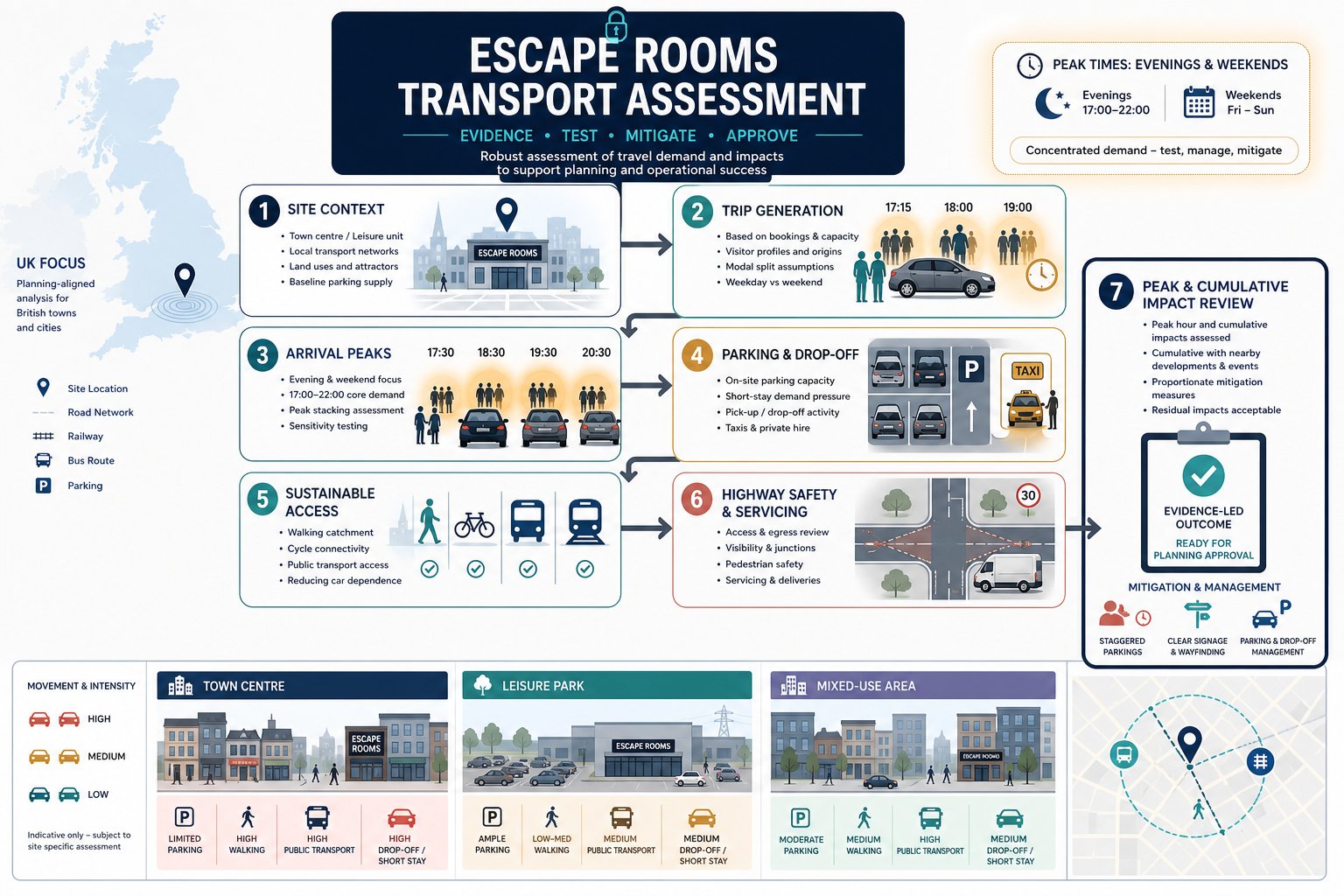
Escape rooms rarely look like high-traffic development at first glance. They often occupy former retail units, leisure park suites, upper-floor town-centre space, or parts of mixed-use schemes. But from a planning and highways perspective, they can raise very specific questions. Visitors tend to arrive in groups, often close to fixed booking times, and that creates short, concentrated peaks rather than a smooth spread of trips through the day. In the wrong location, even a modest venue can generate parking stress, awkward drop-off activity, or pressure on already sensitive evening networks.
That is why an Escape Rooms Transport Assessment needs to do more than recycle assumptions from generic leisure uses. Planning authorities in 2026 expect a proportionate but evidence-led review of how the site will actually work: who arrives, when they arrive, how they travel, where they park, whether the access is safe, and how the use fits with local policy and surrounding streets.
For architects, planners, surveyors, lawyers, developers, and local authorities, the real issue is usually not whether an escape room creates some movement. It is whether those impacts are understood, realistic, and acceptable. In our experience, robust transport evidence helps avoid vague objections, late information requests, and weak assumptions that can slow an application down. The sections below set out what planning officers and highway authorities usually expect, and how to prepare an assessment that stands up to scrutiny.
Key Takeaways
- An Escape Rooms Transport Assessment must provide clear, evidence-based insights into visitor arrival patterns, parking demand, and site accessibility rather than rely on generic leisure assumptions.
- Because escape rooms generate concentrated, time-specific visitor peaks, assessments should focus on managing these waves to prevent parking stress and traffic congestion.
- Location and scale greatly influence transport needs; town-centre sites typically require less car-based travel evidence compared to edge-of-centre or leisure park venues.
- Robust assessments include realistic trip generation based on booking data, group sizes, and local travel habits, ensuring authorities get transparent and credible evidence.
- Parking, drop-off activity, and sustainable travel options such as walking, cycling, and public transport need thorough evaluation to meet 2026 planning expectations.
- Early engagement and proportionate reporting tailored to local context help avoid objections and delays by addressing practical planning risks effectively.
What An Escape Rooms Transport Assessment Covers
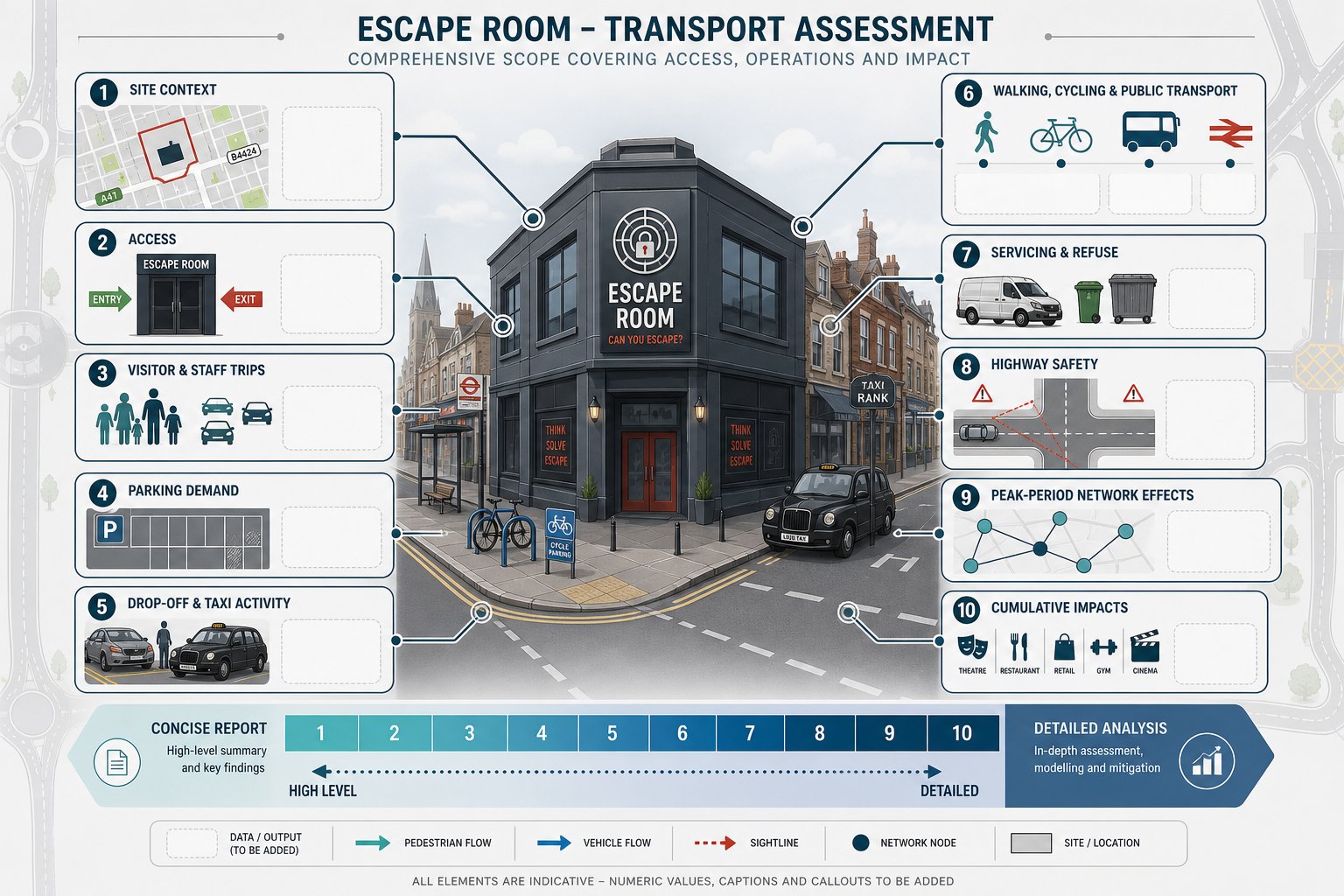
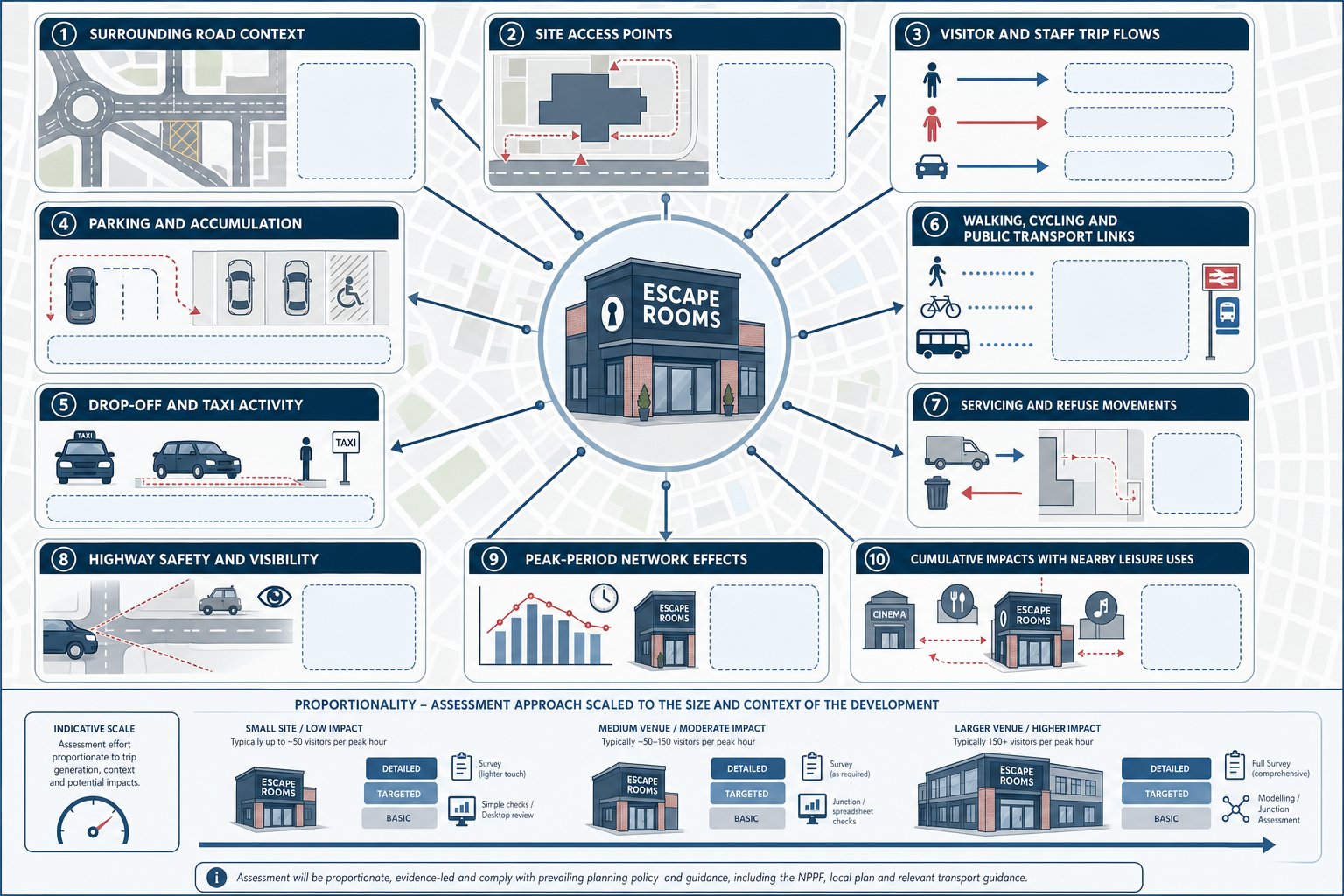
An Escape Rooms Transport Assessment usually examines the likely transport and highway effects of the proposed use in a way that is proportionate to scale, context, and local authority requirements. The core purpose is straightforward: we need to show whether the development would create acceptable movement patterns and, where necessary, what mitigation would address any concern.
In practice, the assessment normally covers:
- site location and surrounding highway context
- existing and proposed access arrangements
- expected visitor and staff trips
- parking demand and parking accumulation
- drop-off, pick-up, taxi, and private-hire activity
- pedestrian, cycle, and public transport accessibility
- servicing, deliveries, refuse collection, and operational needs
- highway safety and visibility considerations
- network effects during relevant peak periods
- cumulative impacts with nearby leisure or town-centre uses
The level of reporting varies. A small change of use in a highly accessible centre may only require a concise statement. A larger venue with multiple game rooms, licensed ancillary space, or constrained parking may need fuller modelling, surveys, and mitigation proposals. The key is proportionality, but “proportionate” does not mean superficial.
For many projects, the document sits alongside a broader transport assessment for scheme documentation package, particularly where the local planning authority is already focused on movement, access quality, or sustainable travel outcomes. A sound assessment explains not just the number of trips, but the character of those trips and how the site will function in real life.
When An Escape Room Development Needs A Transport Assessment Or Statement
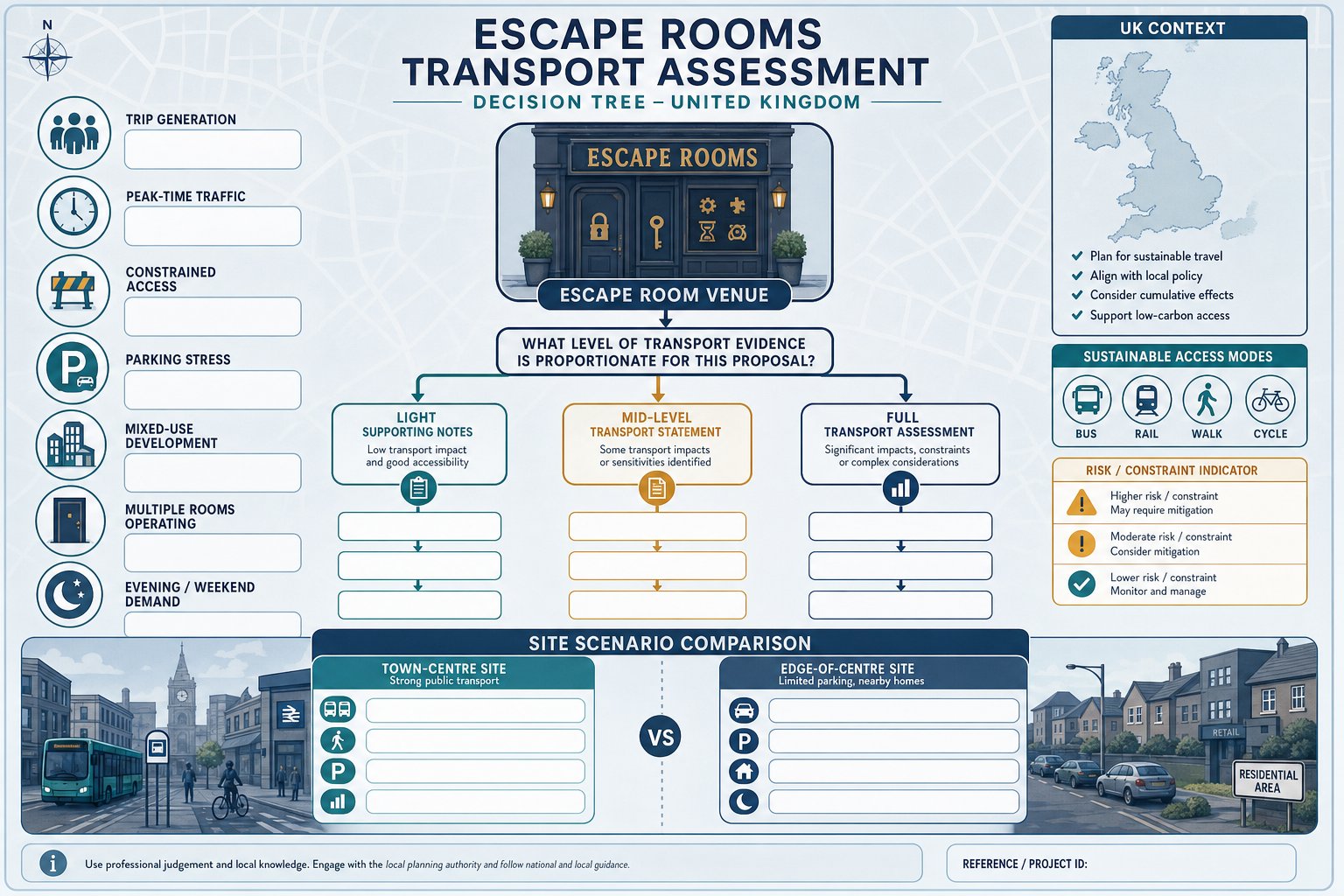
Whether an escape room needs a Transport Assessment, a Transport Statement, or sometimes only supporting transport notes depends on the proposal’s likely material effect. There is no single national trigger that applies neatly to every venue. Local validation requirements, development plan policy, parking standards, and highway authority practice all matter.
As a rule, a fuller assessment becomes more likely where the proposal:
- introduces a notable change in trip generation compared with the lawful use
- increases peak-time arrivals in a sensitive network location
- relies on constrained or substandard access
- sits in an area already experiencing parking stress
- forms part of a larger leisure or mixed-use development
- includes several escape rooms operating simultaneously
- expects significant evening or weekend demand
A modest town-centre conversion with strong public transport links may only justify a Transport Statement. But an edge-of-centre unit with limited parking, nearby residential streets, and concentrated booking slots can attract closer scrutiny, even if the floorspace is not huge.
Authorities also look at practical planning risk. If local members or neighbours are likely to raise parking, noise linked to arrivals, or traffic concerns, submitting transport evidence early is usually sensible. We often find that a short, well-targeted report is more effective than waiting for a highways objection and then trying to retrofit evidence later.
Where wider planning effects are in play, transport can also intersect with topics covered in an environmental impact assessment, particularly on larger leisure-led schemes, although most standalone escape room applications remain far below formal EIA thresholds.
How Escape Room Use Class, Scale, And Location Affect Transport Requirements
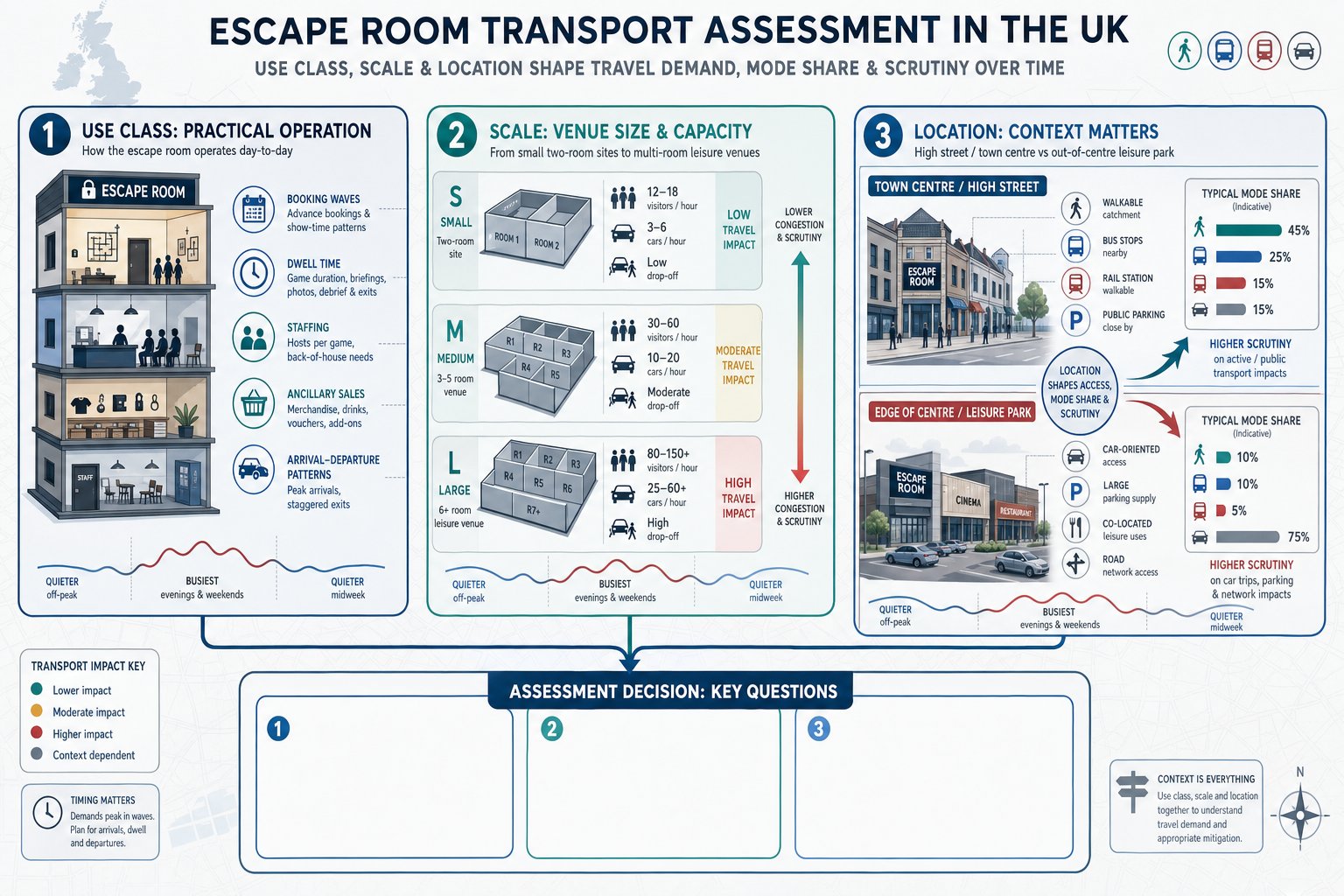
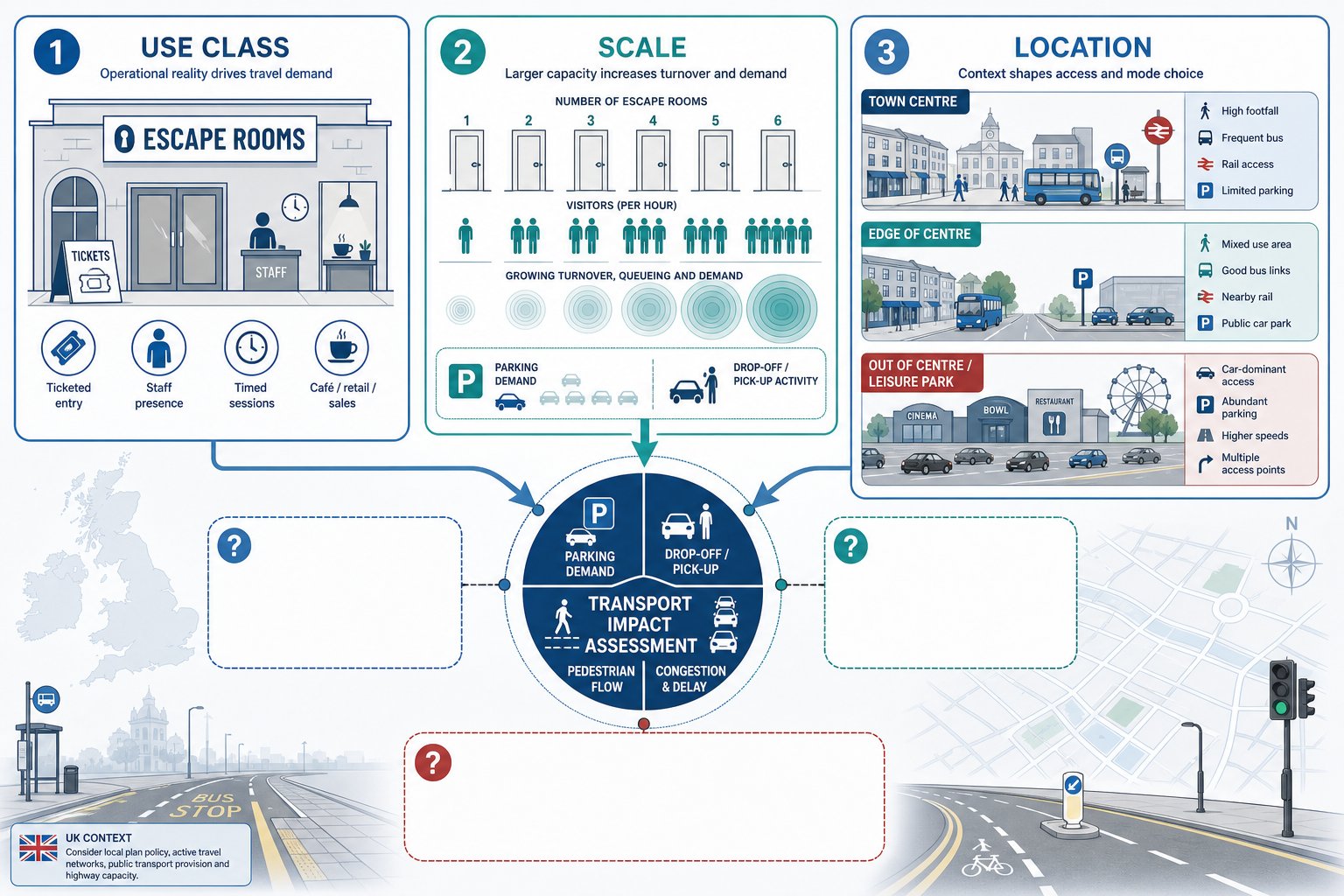
Use class is often the starting point, but it is never the whole story. Escape rooms do not behave exactly like standard retail, office, or even every other leisure use. Planning authorities tend to focus less on labels and more on operational reality: booking profile, dwell time, staffing, ancillary sales, and the pattern of arrivals and departures.
Scale matters because a single small venue with one or two rooms can produce manageable waves of visitors. A larger offer with five or six rooms, party packages, food and drink, corporate events, or late-evening trading can create multiple overlapping turnovers. That changes parking demand, drop-off frequency, and the risk of queueing or pavement congestion.
Location is equally important. A town-centre site close to bus routes, rail stations, public car parks, and walkable catchments may support lower car mode share and lighter supporting evidence. Edge-of-centre and out-of-centre locations generally require more scrutiny because visitors are more likely to arrive by car and in groups. Leisure parks can work well operationally, but shared peaks with cinemas, restaurants, and trampoline parks often complicate the assessment.
We hence frame the transport response around three linked questions:
- What is the lawful and proposed use in practical terms?
- How many people are likely to attend, and in what temporal pattern?
- How does this specific location absorb those movements?
That approach is usually more persuasive than relying on broad land-use comparisons alone.
Typical Trip Generation For Escape Rooms
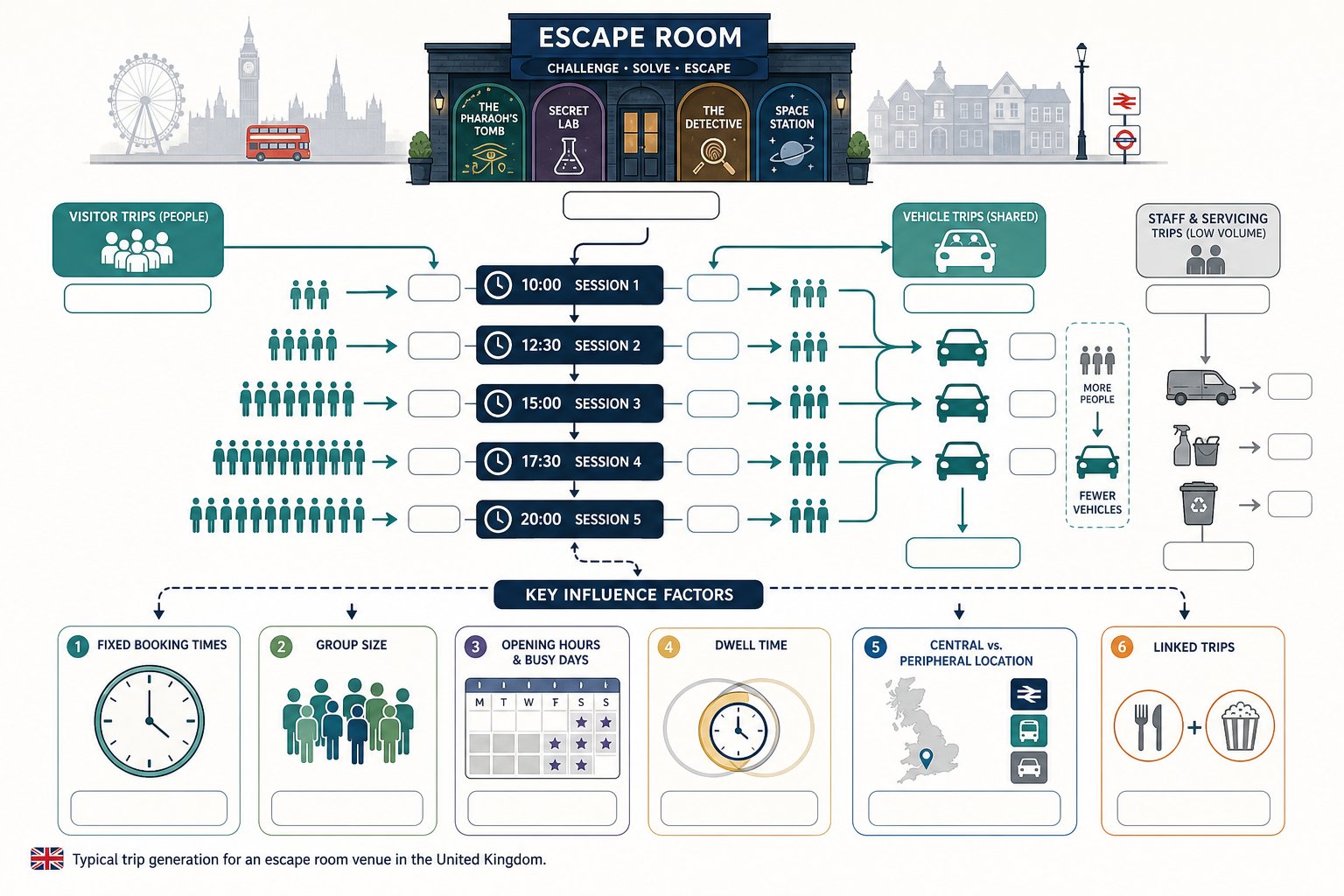
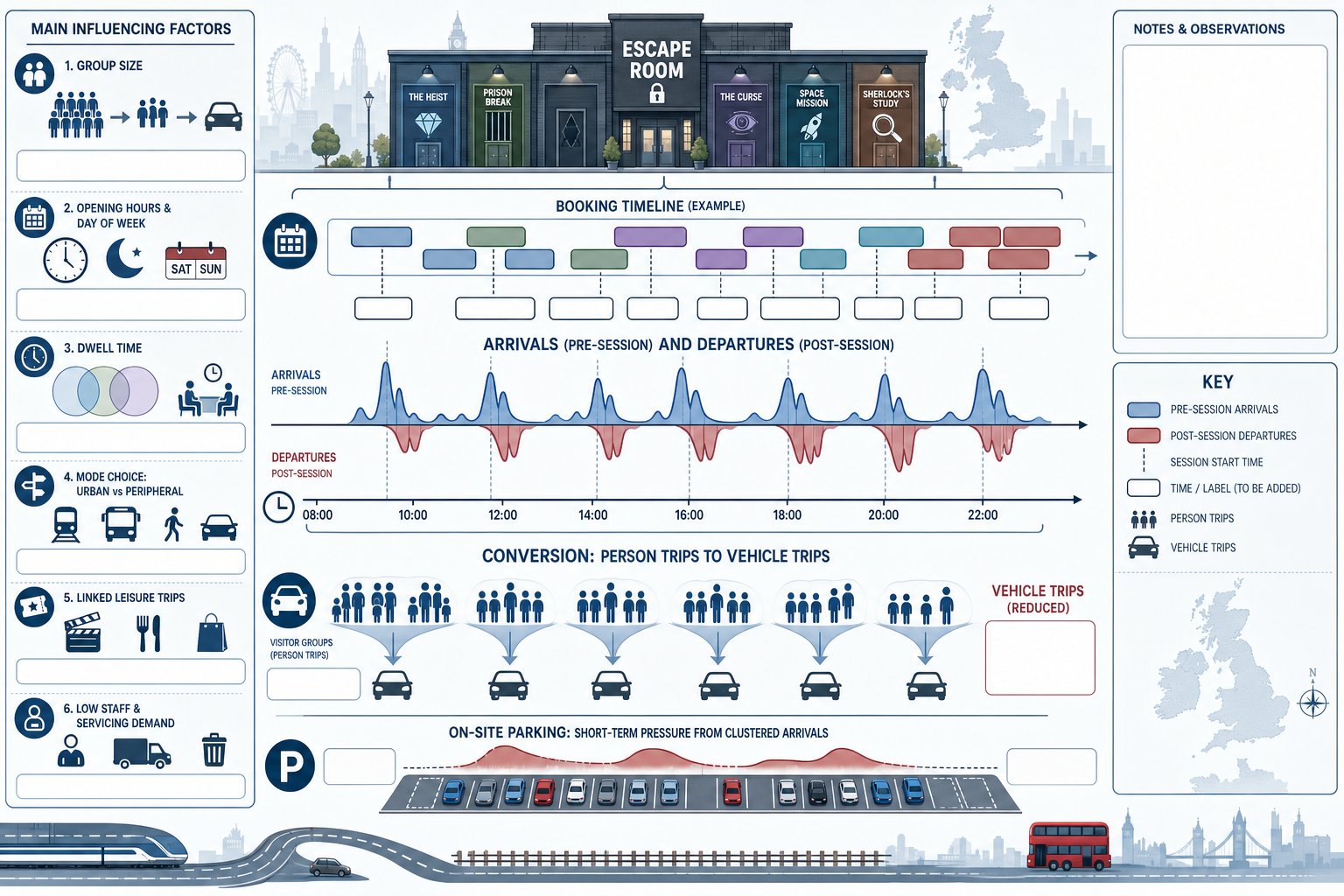
Trip generation for escape rooms is usually modest in daily terms but uneven in hourly terms. That distinction matters. These are not uses that necessarily drive high all-day traffic flows: instead, they generate pulses of arrivals before session start times and pulses of departures at the end. If several rooms run on staggered or simultaneous bookings, those pulses can become quite visible.
A typical assessment estimates person trips and then converts those into vehicle trips using realistic assumptions about group size and mode share. Escape rooms are group-based by nature, so vehicle occupancy is often higher than for many retail or office uses. Four or five visitors may arrive in one car, not four or five separate cars. That can moderate traffic generation, although it does not remove parking pressure if arrivals cluster too tightly.
Staff trip generation is usually low. Servicing trips are also limited, often consisting of light deliveries, consumables, cleaning supplies, and routine waste collection. For that reason, the main analytical focus tends to be customer arrivals and departures.
Where there is no directly comparable survey data, we usually build a reasoned forecast from booking capacity, room turnover, session lengths, occupancy assumptions, and local travel patterns. Authorities generally accept this approach when the assumptions are transparent and tested sensibly. The critical mistake is treating the use as either negligible or identical to every other leisure operator. It is neither.
Key Factors That Influence Visitor Arrival Patterns
Several factors shape the arrival profile and should be stated clearly in the assessment.
Booking structure: Fixed start times are the biggest driver. If sessions begin on the hour, vehicles may bunch sharply. If start times are staggered every 15 or 20 minutes, impacts are often easier to absorb.
Group size: Larger team bookings can reduce vehicle trip numbers through shared travel, but they can intensify short-term drop-off activity, especially for younger visitors or corporate events.
Opening hours and day of week: Friday evenings, Saturdays, school holidays, and wet-weather weekends can produce very different conditions from a Tuesday afternoon.
Dwell time: Most visitors arrive shortly before a session and leave soon after, but ancillary waiting areas, bars, or event spaces can lengthen stays and create overlap between cohorts.
Location and mode choice: Central urban sites may attract rail, bus, and walking trips. Peripheral sites lean more heavily toward private car use.
Linked trips: In leisure parks and mixed-use centres, escape room visits often combine with dining or cinema trips, which can affect both arrival timing and parking duration.
Assessing Parking Demand, Drop-Off Activity, And On-Street Pressure
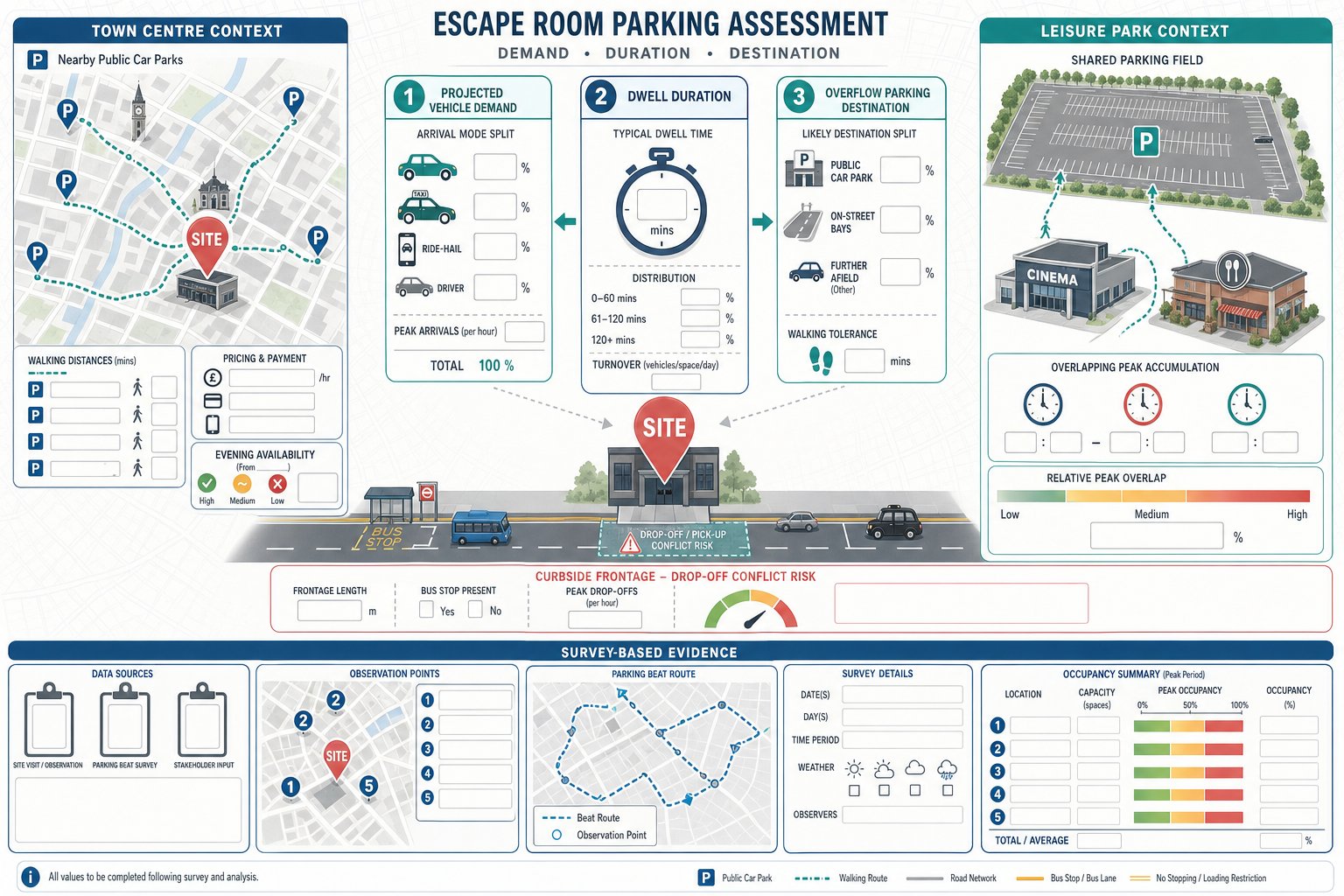
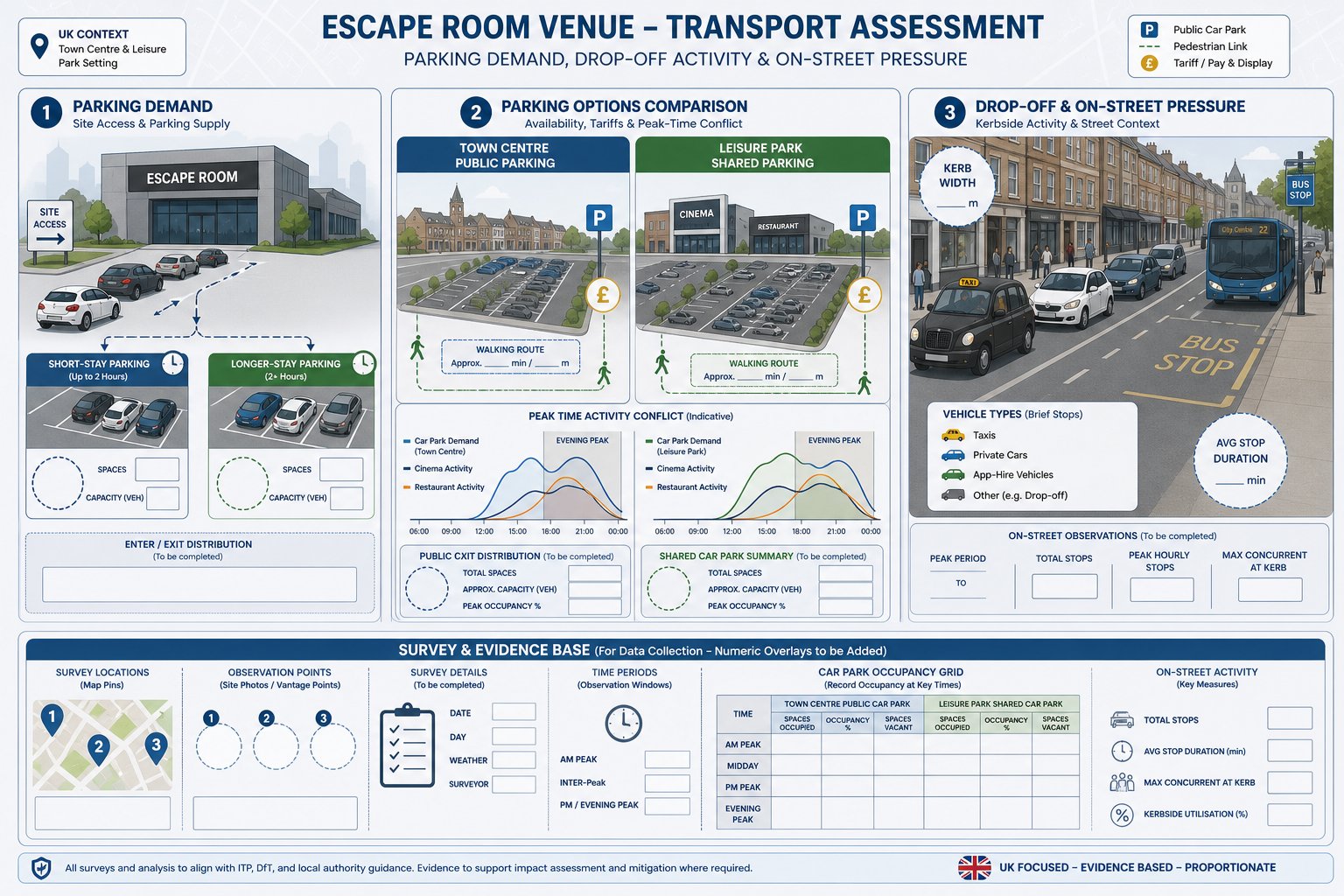
Parking is often the issue that decides whether an escape room application runs smoothly or attracts objection. Even where trip generation is modest, concentrated arrivals can create the perception of stress if several groups reach the site within a short period.
A robust assessment distinguishes between three related but different questions:
- how many vehicles are likely to be generated
- how long those vehicles stay
- where any excess demand would go if on-site capacity is full
For town-centre sites, the answer may be public parking supply rather than dedicated spaces. In that case, we need to review nearby public car parks, walking routes, charging regimes, evening availability, and whether the proposal would materially worsen existing pressure. For leisure parks, the issue is often shared parking accumulation. The total stock may look generous, but conflicts arise if escape room session peaks line up with cinema or restaurant peaks.
Drop-off and pick-up activity deserves separate attention. Private cars, taxis, and app-based hire vehicles can create short dwell events outside the site, sometimes more disruptive than parked vehicles. If a frontage is narrow or the road already carries buses, those movements need careful review.
On-street pressure should not be handled with guesswork. Parking beat surveys, evening observations, and a realistic catchment review are usually far more persuasive than broad statements that “sufficient parking exists nearby”. Authorities want evidence. And neighbours do too.
Walking, Cycling, And Public Transport Accessibility For Escape Room Sites
Planning policy in 2026 continues to push hard on sustainable travel, so escape room assessments should not treat walking, cycling, and public transport as a token section. Even where car travel remains dominant, the report should demonstrate that we have properly tested realistic alternatives.
For walking, the assessment should cover directness, route quality, crossing points, lighting, personal security, gradients, and footway continuity. Evening operation matters here. A route that feels acceptable at 2pm can feel much less suitable at 9pm if lighting is poor or pedestrian desire lines involve awkward crossings.
Cycling review should address local network connections, available parking, and whether staff or some visitors are reasonably likely to cycle. Escape rooms are not usually cycle-heavy destinations, but that does not mean the mode can be ignored. In urban locations, staff cycling can be quite plausible.
Public transport analysis should include nearby bus stops, rail or tram access where relevant, service frequency, span of service, and whether later evening departures support the proposed closing times. There is little value in citing a bus route if the last practical service has already gone before the final booking ends.
Where appropriate, we also align the narrative with wider environmental impact assessment transport: principles around sustainable movement and reduced dependency on private cars. Even for smaller schemes, showing that the site is genuinely accessible can make a significant difference to how proportionate the development appears.
Highway Safety, Access Design, And Servicing Considerations
Highway safety review should be practical and site-specific. Escape rooms rarely need major junction works, but smaller design flaws can still become planning obstacles: poor visibility at an access, conflict between pedestrians and reversing vehicles, unclear servicing arrangements, or doors spilling visitors directly into constrained forecourts.
The assessment should explain how customers reach the entrance safely from parking areas, public footways, and public transport stops. If the proposal uses an existing access, we still need to consider whether the change in activity profile introduces different risks, particularly in the evening or at times when visitors are unfamiliar with the site.
Servicing is often light, but it should never be left vague. The report should identify:
- likely delivery vehicle types
- delivery frequency and timing
- refuse and recycling arrangements
- where vehicles load, unload, and turn
- whether servicing conflicts with customer arrival periods
For constrained urban sites, the answer may be a managed servicing plan rather than physical redesign. For leisure parks, the focus may be on internal circulation and making sure delivery activity does not obstruct shared aisles or pedestrian routes.
If accident data or local safety concerns exist, they should be acknowledged directly. A concise review of personal injury collision records, site observations, and access geometry helps demonstrate that the proposal has been tested properly. Authorities are much more comfortable where operational details are clear rather than deferred into ambiguity.
How Peak Hours And Cumulative Impacts Are Assessed
Peak-hour assessment for escape rooms is rarely as simple as using the standard weekday network peak and moving on. The relevant peak for the development may be an evening or weekend leisure period, while the relevant peak for the surrounding highway network may still be the traditional commuter hour. Good assessments test both where necessary.
First, we identify the likely busiest arrival and departure windows created by the booking schedule. Then we compare those with local network conditions, parking accumulation, and nearby land uses. If the site sits in a town centre with active food, drink, and entertainment uses, the cumulative picture can matter more than the escape room in isolation.
Cumulative assessment may consider:
- nearby committed developments
- adjacent leisure operators with similar peaks
- shared car park demand across a wider site
- event-related surges
- interaction with school pick-up, commuter, or evening economy flows
This is especially important where an application forms part of a broader regeneration or intensification strategy. In those cases, a standalone conclusion that the escape room itself generates “only limited trips” may not satisfy the authority if background conditions are already tight.
We often find that a transparent worst-case scenario works best. If the use remains acceptable when tested against overlapping leisure peaks and realistic parking stress, the assessment becomes much harder to challenge. That is one reason a tailored Escape Rooms Transport Assessment is usually more effective than recycling generic leisure commentary.
Data, Surveys, And Evidence Commonly Used In The Assessment
The quality of an assessment depends heavily on its evidence base. Planning authorities are generally less interested in polished wording than in whether the numbers and observations are credible.
Common inputs include:
- site location plans and proposed layouts
- local highway network plans and access drawings
- parking beat surveys and parking accumulation counts
- traffic counts at nearby junctions or accesses where relevant
- pedestrian and cycle observations
- public transport service data
- collision history from available records
- local census or travel-to-work context for staff trips
- comparable leisure trip data, where suitable
- booking-capacity analysis and operator information
- policy review against local plan and parking standards
For many escape room proposals, the most useful evidence is surprisingly simple: well-timed parking surveys, realistic schedule analysis, and clear site observations. Overcomplicating the report with unnecessary modelling can sometimes obscure the real issue, which is often parking turnover or evening arrivals rather than network capacity.
That said, the evidence should be current and proportionate. If conditions have changed, older survey material may not carry much weight. We hence prefer a direct, site-led methodology that aligns with authority expectations and the development’s actual characteristics. The goal is not to produce the longest report. It is to produce one that answers the right planning questions with enough measurable support.
Common Planning Issues For Town Centre, Leisure Park, And Mixed-Use Locations
Different site typologies tend to generate different transport concerns.
Town centre locations usually benefit from strong accessibility and nearby public car parks, but they can run into evening parking stress, taxi activity on narrow streets, and tension with residential amenity if visitors gather outside between sessions. Authorities may also look closely at walk routes from remote parking.
Leisure parks often have ample parking on paper, yet shared demand is the recurring issue. A cinema, restaurant cluster, bowling venue, and escape room can all peak within the same broad evening window. Internal circulation, crossing points, and wayfinding also matter more than applicants sometimes expect.
Mixed-use developments can be the trickiest because parking and access are often shared between residential, commercial, and leisure users. Here, even a small escape room can become contentious if there is concern about visitors occupying resident bays, causing repeated drop-offs, or extending activity into late evening periods.
In each case, authorities want the applicant to understand context rather than rely on abstract averages. That means acknowledging local constraints, not brushing past them. A candid assessment that identifies a pressure point and explains why it remains manageable usually performs better than an over-optimistic document that claims there is no issue at all.
That same principle applies across wider transport assessment for developments: work: context beats generic assumption, every time.
How To Prepare A Robust Escape Rooms Transport Assessment For A Planning Application
A robust Escape Rooms Transport Assessment starts with scoping the real planning risks early. Before drafting begins, we need to understand the local authority threshold position, parking standards, surrounding uses, likely objections, and whether the proposal is a simple change of use or part of a wider development package.
From there, the most reliable process is usually:
- Define the operation clearly. Set out room numbers, booking capacity, session duration, opening hours, staffing, and any ancillary uses.
- Establish the baseline. Review the current lawful use, local highway conditions, parking supply, public transport access, and any site constraints.
- Quantify trips realistically. Use booking-led assumptions, sensible occupancy rates, and transparent vehicle mode share estimates.
- Assess parking and drop-off honestly. Support the narrative with observations and surveys rather than assumptions.
- Review active travel and public transport properly. Demonstrate real accessibility, not a token map exercise.
- Address safety and servicing. Explain exactly how the site will function day to day.
- Test peak and cumulative conditions. Particularly for evenings, weekends, and shared leisure locations.
- Include mitigation if needed. This might involve booking management, staggered start times, travel information, staff parking controls, servicing restrictions, or signage.
Fast, concise reporting is useful, but only when it remains accurate and tailored. With over 30 years of sector experience, we know that authorities respond best to assessments that are proportionate, locally grounded, and operationally realistic. That is what turns transport from a planning risk into a solvable technical issue.
Conclusion
Escape room proposals are often transport-light in absolute terms, but they are not transport-neutral. Their impacts tend to be concentrated, time-sensitive, and highly dependent on context. That is why planning authorities in 2026 expect more than a generic statement that the use is “low traffic”. They expect evidence on how visitors arrive, whether parking works, how access operates safely, and whether nearby streets can absorb the pattern of activity.
For applicants and consultants, the best approach is a proportionate one: detailed where the site is constrained, concise where the context is clearly sustainable, and always grounded in realistic operational assumptions. When the assessment covers trip generation, parking, accessibility, safety, servicing, and cumulative effects properly, it gives decision-makers what they need to judge acceptability with confidence.
And that is really the point of a strong Escape Rooms Transport Assessment: not paperwork for its own sake, but a clear demonstration that the development can function well in its setting.
Frequently Asked Questions about Escape Rooms Transport Assessment
What does an Escape Rooms Transport Assessment typically cover?
It examines visitor and staff trips, parking demand, drop-off activity, access arrangements, pedestrian, cycling, and public transport accessibility, servicing needs, highway safety, and peak period network effects to evaluate transport impacts comprehensively.
When is a Transport Assessment necessary for an escape room development?
A Transport Assessment is usually needed when the development materially changes trip generation, occurs in sensitive locations, involves constrained access, faces parking stress, or is part of a larger leisure or mixed-use scheme.
How do booking patterns affect transport impacts of escape rooms?
Fixed session start times cause concentrated arrival peaks, generating short bursts of traffic that can strain parking and drop-off areas, making staggered starts or management important to ease pressure.
Why is parking demand assessment critical for escape rooms?
Escape rooms create short, intense parking demand near session times; assessing how many vehicles arrive, duration of stay, and local parking capacity helps address potential overspill and neighbour concerns.
How does the location of an escape room influence its transport assessment?
Town-centre sites with strong public transport usually require lighter assessment, while edge- or out-of-centre sites rely more on private cars, often needing detailed parking and access scrutiny.
What mitigation measures can be included to address transport concerns for escape rooms?
Mitigation may involve managing booking times, providing travel information, controlling staff parking, implementing servicing restrictions, and improving signage to ensure safe and acceptable transport impacts.