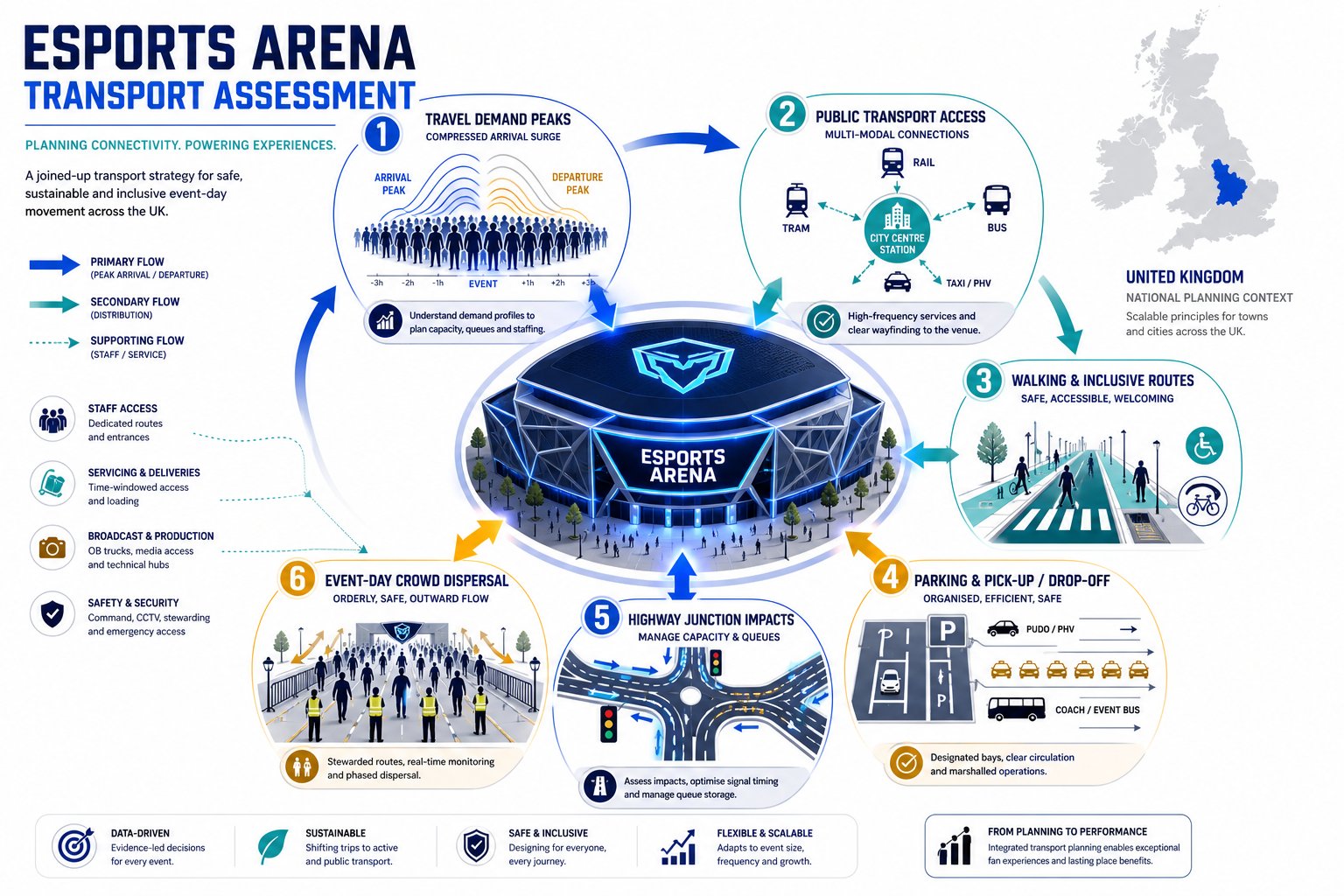
A serious esports arena proposal can look deceptively straightforward on paper. The floor area may not seem unusual, the site may sit in a city centre already geared toward leisure, and the audience is often assumed to behave like any other entertainment crowd. In practice, that assumption is where planning risk starts.
Esports venues generate highly concentrated travel demand. Spectators tend to arrive in a compressed pre-event window, leave quickly after finals, and often depend heavily on rail, metro, bus, taxis and managed pick-up activity. Add broadcast crews, team logistics, hospitality, servicing and late-evening operations, and the transport picture becomes much more complex than a standard leisure use.
That is why an Esports Arena Transport Assessment needs to do more than estimate car trips. It must explain how the venue will function on ordinary days, on sold-out event days, and on the awkward edge cases that local authorities worry about most: late finishes, station crowding, residential overspill, blocked junctions and poor crowd dispersal.
In this guide, we set out what planning teams need to cover in 2026. We focus on the issues architects, planners, lawyers, developers, surveyors and local authorities are most likely to scrutinise, from trip generation and public transport access through to operational plans, mitigation and the common weaknesses that delay approval.
Key Takeaways
- Esports arena transport assessments must address intense, peak travel demand characterised by compressed arrival and departure times to ensure safe and efficient venue operation.
- A successful assessment treats the arena as a complex transport system involving spectators, staff, teams, and logistics, considering different event types and scales beyond mere daily trip counts.
- Public transport accessibility requires detailed analysis of capacity, frequency, route quality, and operating hours, especially for late evening events to validate mode share assumptions.
- Comprehensive plans for walking, cycling, inclusive access, parking, and pick-up/drop-off areas are essential to manage crowd safety, minimise residential impact, and control vehicle behaviour.
- Robust event-day operational planning, including crowd dispersal strategies and coordination with local authorities, underpins transport resilience and smooth venue functioning.
- Reports must be evidence-based, locally tailored, and clearly communicate scenarios, mitigations, and operational controls to meet planning authority expectations and avoid approval delays.
Why Esports Arenas Need A Transport Assessment
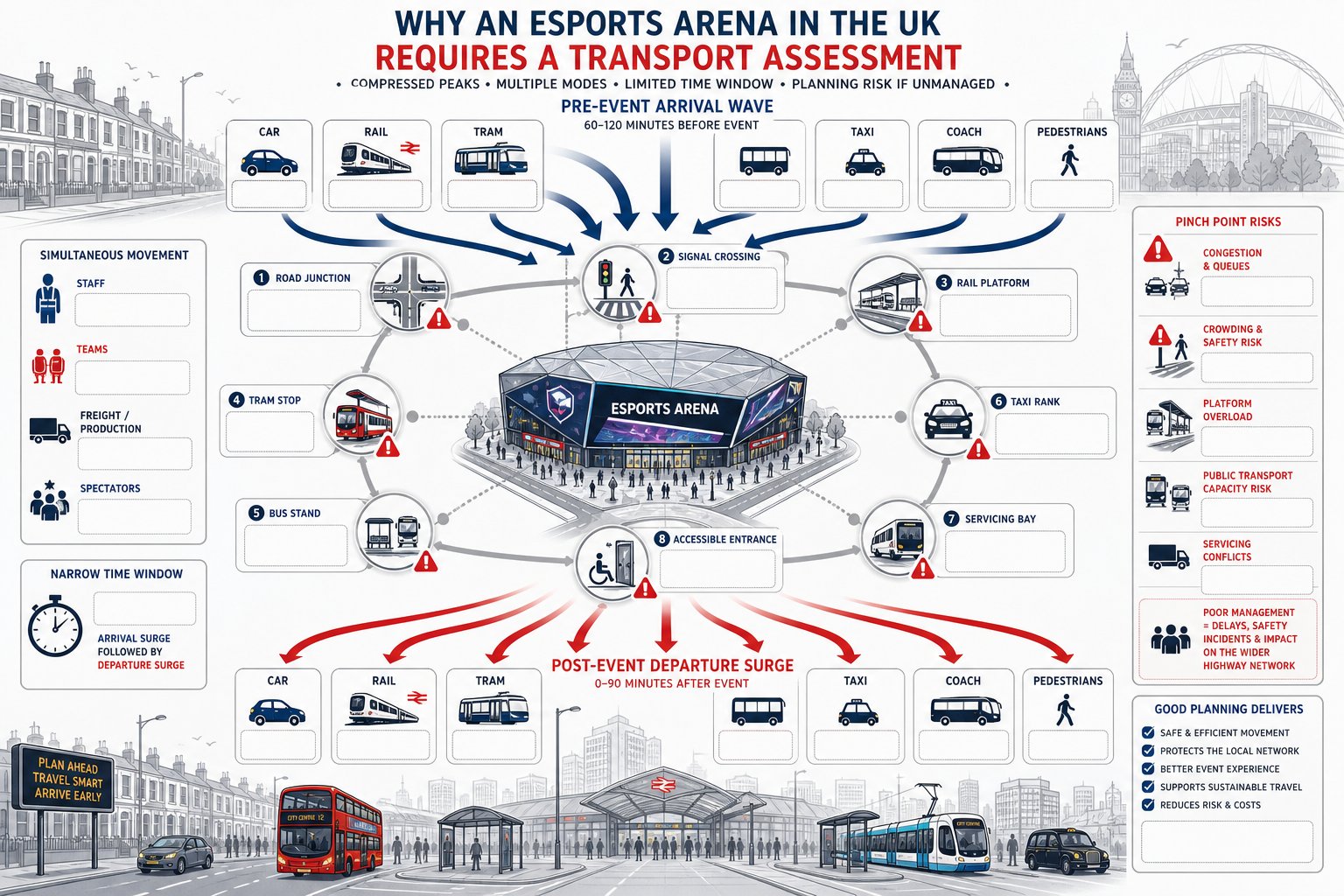
Esports arenas need a transport assessment because they behave like major event venues, even when the building itself looks closer to a theatre, exhibition hall or mixed-use leisure space. The key issue is not simply total daily demand. It is the timing, intensity and direction of travel demand over short periods.
A sold-out tournament can produce steep arrival peaks in the one to two hours before doors close, followed by a sharp departure wave after the final. Those flows can place pressure on nearby junctions, footways, crossings, railway stations, tram stops, bus stands and taxi ranks all at once. And unlike many daytime leisure uses, esports events often finish later in the evening, when public transport frequency may have reduced and local residential sensitivity is higher.
For planning purposes, authorities want evidence that the development will operate safely and efficiently across all modes. That usually means showing not only forecast traffic impact but also pedestrian capacity, mode share assumptions, servicing arrangements, accessible access, coach activity and event-day management. A broad transport assessment for developments: approach is especially important where the arena sits in a constrained urban setting.
In our experience, the strongest reports frame the arena as a transport system in miniature: audience, staff, teams, freight and public realm all interacting in a narrow time window. If that interaction is not tested early, planning objections tend to appear later.
How Venue Type, Scale, And Event Profile Affect Transport Impacts
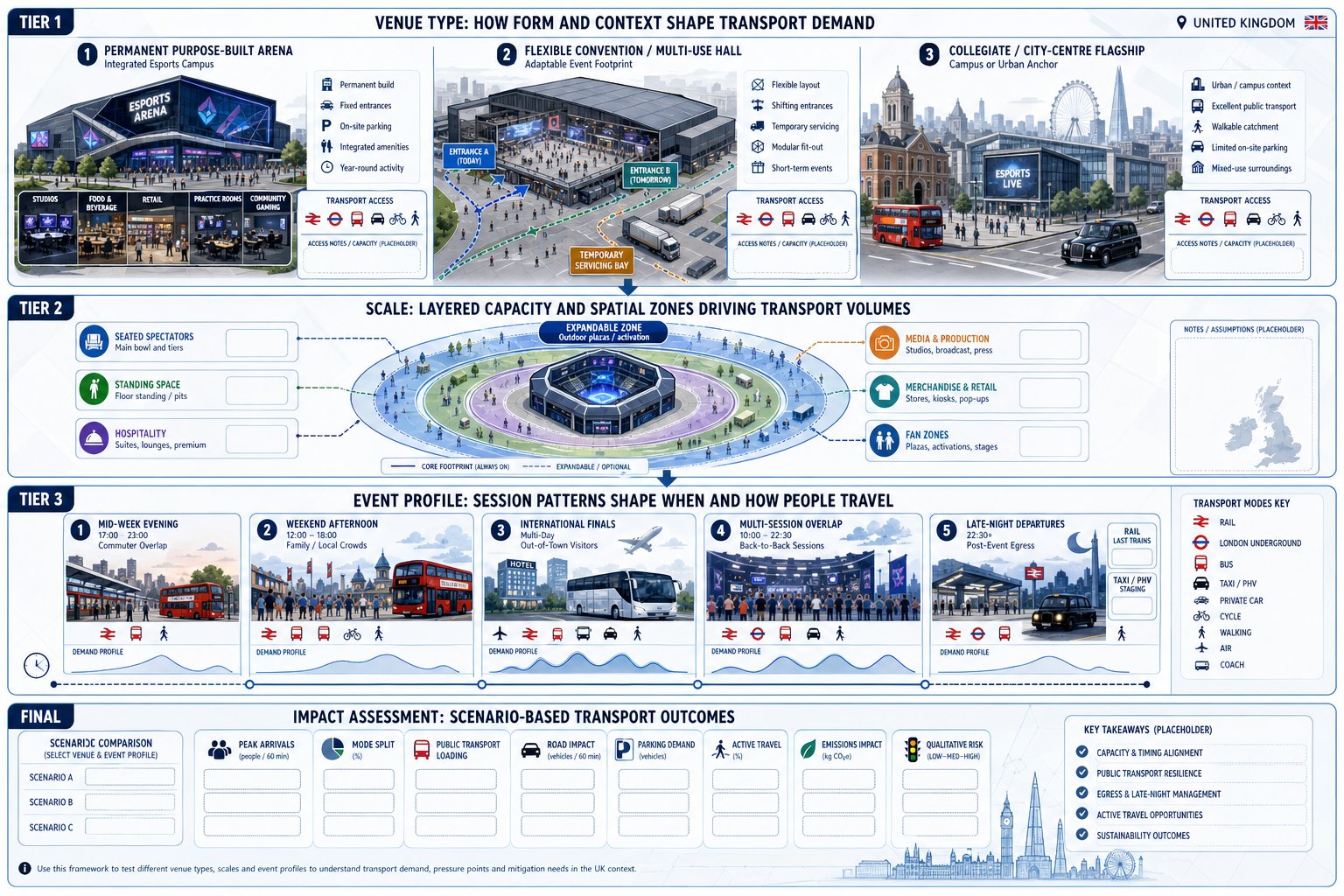
Not all esports venues generate the same impacts, and local authorities know that. A permanent purpose-built arena differs materially from a convention hall hosting occasional tournaments. A collegiate training venue differs again from a city-centre flagship staging international finals.
Venue type matters because it affects regularity, supporting uses and operational complexity. A permanent arena may include studios, food and beverage floorspace, retail, practice rooms and community gaming space. That broadens the trip profile well beyond headline event attendance. A multi-use hall might have fewer non-event trips but more variable layouts, changing entrance points and temporary servicing needs.
Scale matters too. Seated capacity is the obvious starting point, but it is rarely the whole story. Standing areas, hospitality lounges, media spaces, merchandise sales, fan zones and ancillary uses all influence arrivals, dwell times and departures. A 4,000-seat venue with active pre-show space can generate a very different external impact from a 4,000-seat bowl with limited ancillary activity.
Then there is event profile. Mid-week evening fixtures create a different interaction with commuter peaks than weekend afternoon sessions. International events may increase coach demand, airport-related movements and hotel-linked trips. Multi-session days can create overlapping arrivals and departures. Late-night finals can expose weak assumptions about last-train availability and taxi staging.
This is why a robust assessment cannot rely on a single average day. It needs event typologies, realistic peak scenarios and a planning methodology tailored to the actual programme.
When A Transport Assessment Is Required For Planning
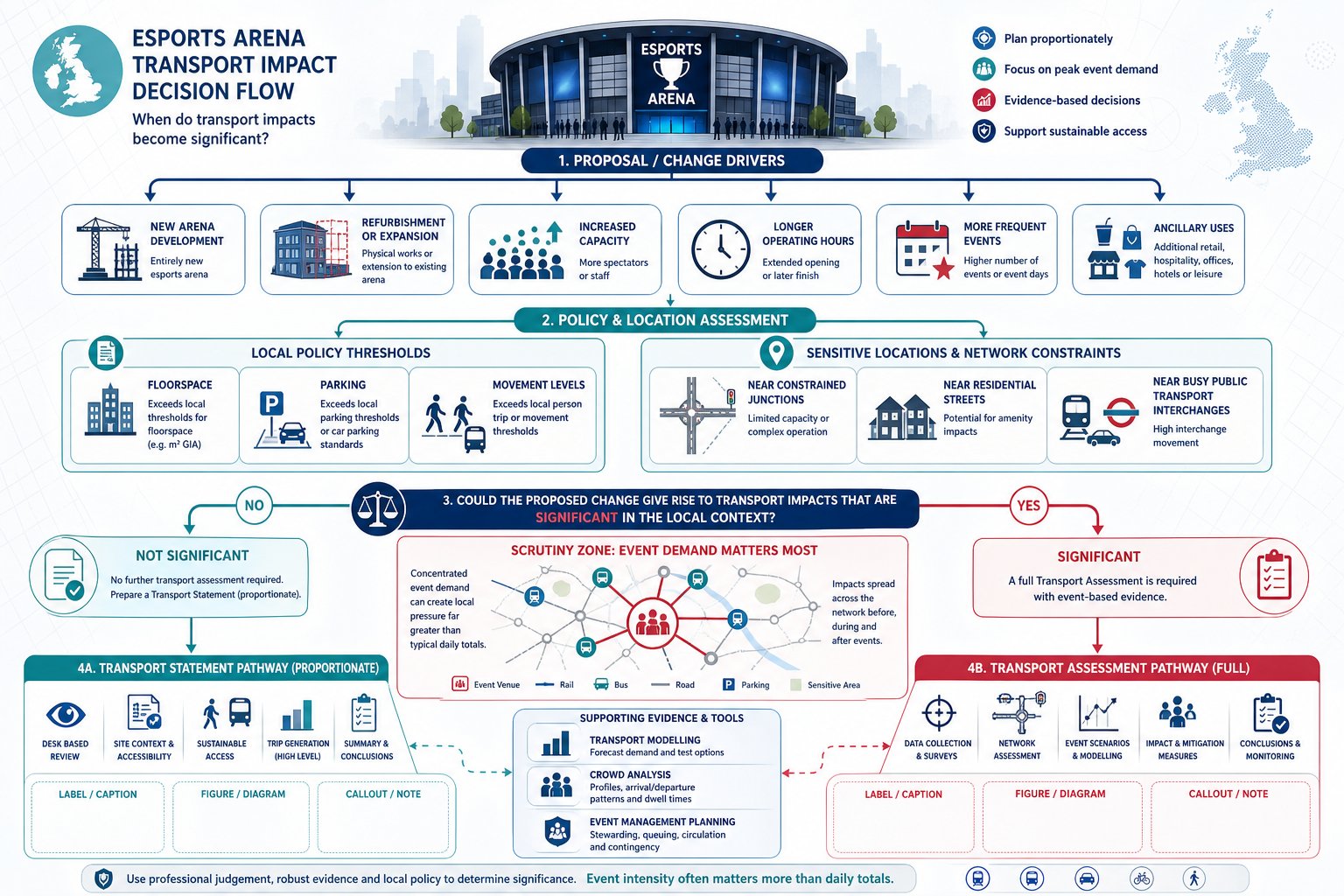
In planning terms, a transport assessment is usually required when the scale or nature of development is likely to create significant transport effects. For esports arenas, that threshold is often met because event-based demand is intense, highly concentrated and capable of affecting the wider network even where daily trip totals do not look extraordinary.
New arena proposals will commonly require a full assessment. So will major refurbishments or expansions that increase capacity, change operating hours, intensify event frequency or introduce ancillary uses that materially alter demand. Some schemes trigger the requirement through local threshold policies based on floorspace, parking provision or expected movements. Others do so because of location: a constrained urban site near sensitive junctions, residential streets or already busy public transport interchanges.
The practical answer is that planning teams should test the requirement early against local validation lists, development plan policies and highway authority expectations. A venue that sits just below a nominal threshold can still attract scrutiny if its event pattern raises obvious concerns. Authorities are often less interested in labels than in consequences.
That is where experienced Transport Assessment Consultants: make a difference. They can identify whether a concise transport statement is defensible or whether the scheme really needs a fuller assessment with modelling, crowd analysis and a draft event management framework. Waiting until submission to resolve that point usually costs time.
Key Trip Generation Factors For Esports Venues
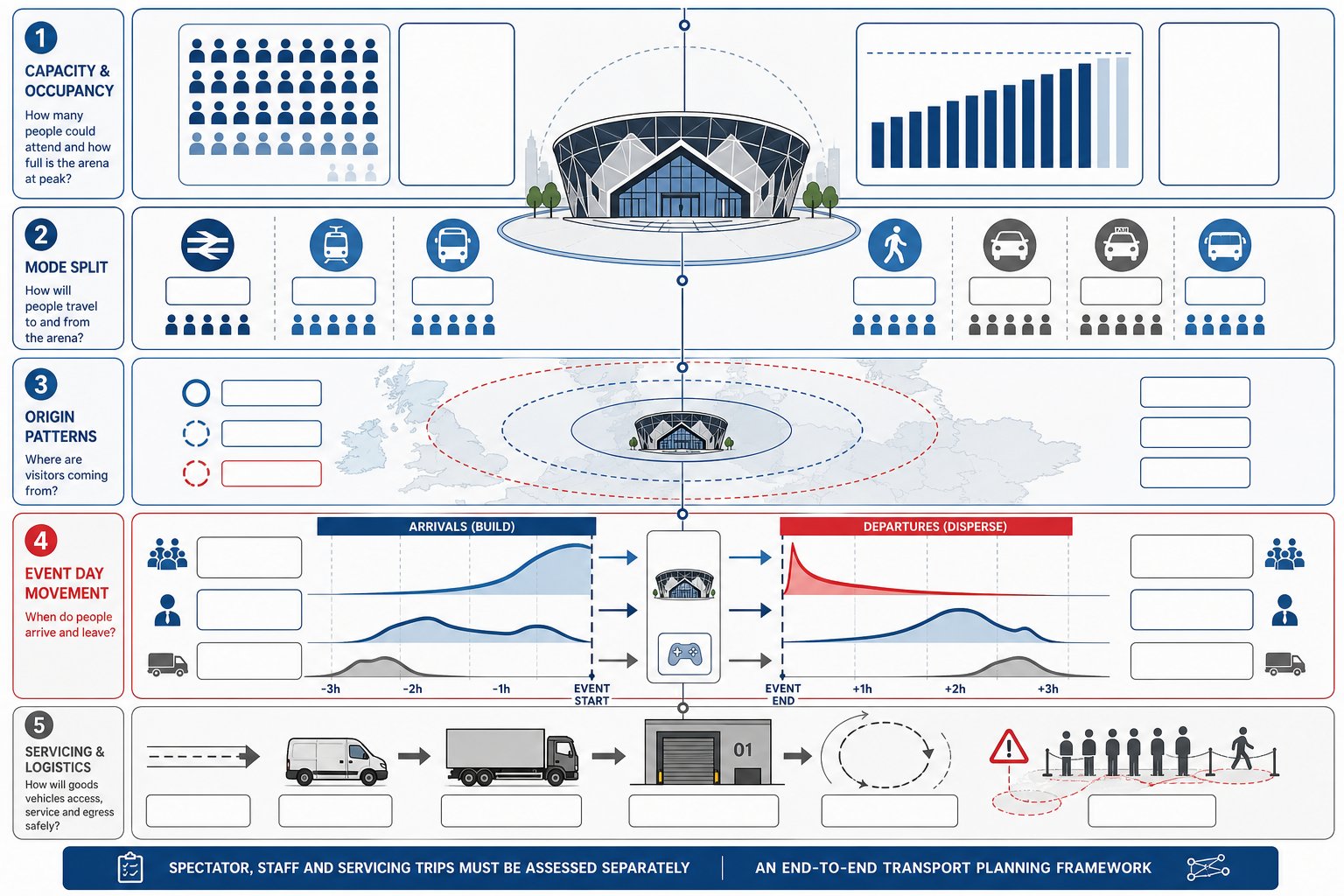
Trip generation for esports venues is easy to oversimplify and surprisingly easy to get wrong. Standard land-use databases rarely capture the blend of spectator, leisure, production and event servicing demand that these schemes create. So the assessment needs a reasoned methodology built around venue operation, comparable evidence and local context.
The first variables are capacity and occupancy. We need to understand not just the maximum number of seats, but expected attendance by event type, from routine local fixtures to sold-out international tournaments. A venue may operate at modest utilisation most of the week and then experience extreme peaks during headline events.
Mode split is the next major factor. In city-centre locations, rail, tram, bus and walking may dominate. In edge-of-centre or out-of-town settings, the private car, taxi and coach share may be higher. Those assumptions need evidence, not optimism. Comparable venues, ticketing postcodes, local census data, existing spectator surveys and public transport accessibility all help build a defensible picture.
Origin patterns matter as well. Local audiences behave differently from regional or international visitors. Some combine the trip with retail, bars, restaurants or overnight stays. Non-event activity can also be material: training sessions, educational uses, community gaming, conferences or streaming production.
For larger schemes, the trip generation chapter should sit within a wider end to end transport process so assumptions on access, parking, servicing and mitigation align from the start.
Audience Peaks, Staff Movements, And Servicing Demand
Audience movement is highly peaky. Arrivals often build steeply in the 60 to 120 minutes before the main session, with earlier waves for hospitality, fan activation or security screening. Departures are often even more concentrated, especially after a single-session final when thousands leave within half an hour.
Staff patterns are different. Event staff, security teams, catering workers, cleaners, production crews and broadcast specialists usually arrive earlier and leave later. Shift changes can create smaller but important secondary peaks. Those movements may not dominate junction modelling, but they can affect public transport demand, parking stress and servicing conflicts.
Servicing is another area that gets underestimated. Esports events can generate substantial van and HGV activity linked to staging, set build, power, IT equipment, broadcasting, catering and merchandise. Even if most deliveries are scheduled off-peak, routeing, waiting space and turning arrangements must be demonstrated. A service yard that works at 10am may become unsafe if it conflicts with queueing spectators at 5pm.
The best assessments separate these trip types clearly rather than rolling them into one headline figure.
Assessing Public Transport Access And Mode Share
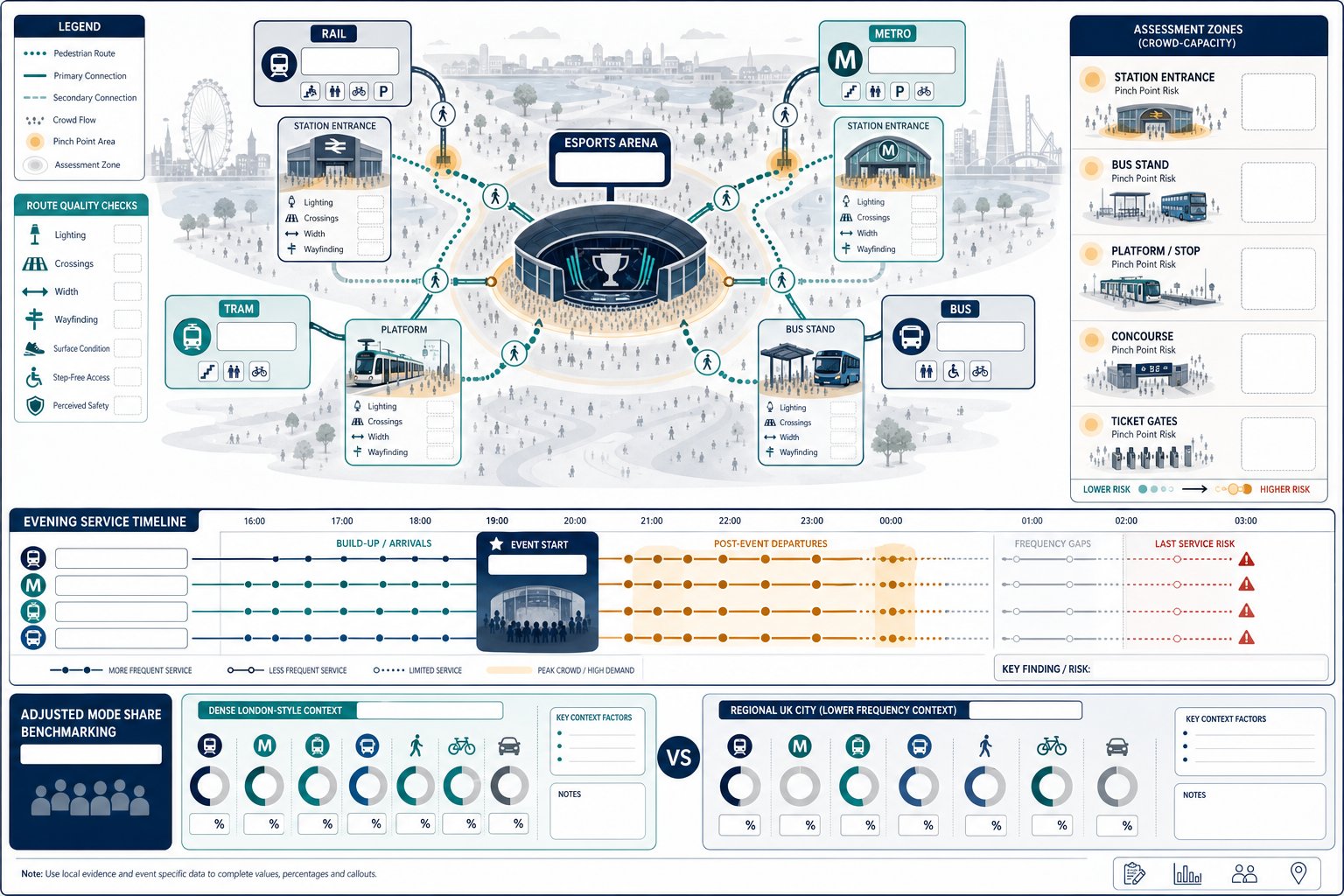
For many esports arenas, public transport is the backbone of the planning case. But proximity to a station is not enough. We need to test whether the network can absorb the specific demand profile created by the venue, at the times the venue actually operates.
That means mapping the walk routes to rail, metro, tram and bus stops, then looking beyond distance to quality and capacity. Are those routes direct, legible and well lit? Do crossings have enough width and green time? Is there crowd pinch-point risk near station entrances or bus stands? Can platforms, concourses or ticket gates manage a concentrated post-event surge?
Service frequency and operating hours matter just as much. A venue with 10.30pm or 11pm finishes may be viable on paper but weak in practice if the final trains are infrequent, the bus network winds down early, or interchange times are unrealistic. Authorities will often challenge mode share assumptions if they depend on special services that are unfunded or not agreed with operators.
Comparable benchmarking helps, but it must be adjusted for local reality. The mode share from a central London arena cannot simply be transplanted to a regional city with lower late-evening service levels. Where public transport is central to the strategy, a sound evidence base may also sit alongside an environmental impact assessment if broader transport and environmental effects are being considered.
A strong report explains not just expected mode split, but why people will genuinely choose those modes on busy event days.
Walking, Cycling, And Inclusive Access Considerations
Walking is often the dominant final leg of the journey for esports spectators, even when rail or bus carries most of the trip. That makes the public realm around the site a core planning issue rather than a side note.
We need to assess route directness, footway width, crossing provision, lighting, surveillance, gradients and wayfinding. For event venues, capacity matters as much as convenience. A route that feels acceptable for daily background use may become uncomfortable or unsafe when several thousand people are arriving in a short period. Gate locations, security search areas, crowd waiting zones and adjacent junction operation all need to work together.
Cycling should not be treated as symbolic. In accessible urban locations, good cycle links and secure parking can remove a useful proportion of shorter local trips. Provision should be convenient, covered where possible, overlooked and separated from heavy pedestrian desire lines. Staff cycle parking and changing facilities may be just as important as spectator provision, especially where shift patterns support year-round use.
Inclusive access deserves much more than a compliance paragraph. Authorities will expect step-free routes from public transport nodes and car parks, suitable kerb design, rest points where appropriate, clear wayfinding, accessible drop-off arrangements and parking spaces close to entrances. They will also expect the operational side to be considered: stewarding, queue management and evacuation for disabled visitors.
In short, accessibility is not an appendix to the transport case. It is part of whether the venue works at all.
Parking Strategy, Pick-Up And Drop-Off, And Taxi Demand
Parking strategy for esports arenas is often less about maximising supply and more about controlling behaviour. In dense urban locations, too much on-site parking can undermine sustainable mode share. Too little, or poorly managed provision, can produce overspill, illegal stopping and residential conflict.
A credible strategy should define the role of on-site spaces, nearby public car parks, accessible bays, staff permits and any event-day restrictions. If parking is intentionally limited, the report needs to show that this is a managed outcome supported by location, pricing, travel information and enforcement, not simply an omission.
Pick-up and drop-off demand deserves special attention. Taxi and private hire vehicle demand can spike hard after late finishes, especially when public transport frequencies fall away. Without properly designed PUDO space, drivers circle local streets, block junctions and create pedestrian risk outside the venue. This is one of the most common weak spots in event venue applications.
Coach activity also needs a proper plan. Team coaches, VIP transport and supporter coaches may need separate arrival, layover and departure arrangements. Mixing them casually with public drop-off is rarely successful.
We usually advise planning teams to define controls in operational terms: who can use each area, when, under what supervision and with what overflow arrangement. That level of detail often matters more than the raw number of spaces.
Traffic Impact On Junctions And The Local Highway Network
Even where sustainable travel is expected to carry a high share of demand, local highway impact still needs rigorous testing. The planning question is not whether every spectator drives. It is whether the car, taxi, coach, servicing and background traffic that do occur can be absorbed without unacceptable effects on safety, delay, bus reliability or access.
The first step is choosing the right scenarios. Event arrivals may coincide with the PM peak on a weekday. Departures may sit outside standard commuter periods but create sharper localised surges. A sensible assessment tests realistic worst cases, not just average conditions. Nearby stadiums, retail parks, concert venues or committed developments should also be considered so cumulative effects are not missed.
Critical junctions then need modelling using an agreed method, with clear reporting of queue lengths, reserve capacity, practical impacts and sensitivity testing. Priority junctions, signalised junctions, roundabouts, access points and internal circulation can all be relevant depending on site context. In many cases, microsimulation or dedicated software helps planning teams understand interactions that spreadsheet-style calculations can miss: that is why tools such as Junctions 11 Software feature so often in modern event-venue work.
The strongest chapter does not drown readers in outputs. It translates modelling into planning consequences: what happens on event days, where pressure appears, and what mitigation or management keeps the network functioning acceptably.
Event Day Management, Crowd Dispersal, And Operational Planning
A good transport assessment for an esports arena should never stop at forecast tables. Event venues succeed or fail operationally, and local authorities know it. That is why an Event Transport Management Plan, or equivalent, is often essential.
The plan should explain how people arrive, queue, enter, leave and disperse. That includes signed walking routes from stations and car parks, steward deployment, barriers, crossing management, taxi marshalling, coach controls and the interface with security search areas. If temporary traffic management is needed, the report should identify likely road closures, diversions, suspension of parking, bus stop changes or contraflow pedestrian arrangements.
Crowd dispersal after the event is particularly important. A sudden egress can overwhelm nearby junctions and stations if everyone is released at once. Sometimes the answer lies in staggered egress, managed dwell time in fan areas, phased closing of food and beverage offers, or live public transport information that directs spectators to different nodes. The detail will vary, but the principle is constant: dispersal should be planned, not hoped for.
Resilience also matters. What happens if a key station is partly closed, a tram line is disrupted, or severe weather affects walking routes? Authorities are increasingly alert to fallback arrangements and emergency access.
For planning teams, this is where transport strategy becomes operational credibility. And that credibility is often what unlocks confidence from both highways officers and elected members.
What Local Planning Authorities Typically Expect In The Report
Most local planning authorities are not looking for a glossy narrative. They want a report that is clear, evidence-based and proportionate, but also detailed enough to support a lawful planning decision.
At minimum, that means a precise description of the development: capacities, uses, event frequency, hours of operation, site access, servicing arrangements and any phasing. Baseline conditions should be set out using relevant traffic counts, junction observations, public transport information, parking surveys and where needed pedestrian data. For event venues, context matters, so nearby generators and committed development should not be ignored.
Trip generation and mode share need transparent methodology and justification. Authorities will usually expect forecasting scenarios, network impact testing, parking and servicing strategy, public transport appraisal, walking and cycling assessment, and inclusive access measures. They will also expect a coherent package of mitigation. That may include physical works, travel planning, event-day controls, monitoring and planning obligations.
Just as important is presentation. Busy case officers and consultees need to understand what the scheme does on a sold-out night, not hunt through appendices to piece it together. Where schemes are complex, a concise technical narrative supported by robust appendices is often far more persuasive than volume alone.
For teams managing multiple interlinked reports, consistency with wider planning evidence is critical. We often find lessons from a Residential Development Transport methodology still apply here: clear assumptions, traceable evidence and mitigation that can actually be delivered.
Common Risks That Delay Approval For Esports Arena Applications
The most common delays are rarely caused by the existence of transport impacts alone. They happen because the submitted evidence feels incomplete, untested or overly optimistic.
Weak trip generation is a frequent problem. If attendance assumptions, occupancy rates or mode shares are not grounded in real evidence, consultees will challenge the entire assessment. The same goes for late-evening public transport assumptions that rely on service uplifts with no commitment behind them.
Taxi and PUDO demand is another classic blind spot. A report may assume high public transport use, then devote only a paragraph to the intense post-event taxi wave that everyone knows will happen. Coach routing, layover and staff parking can be similarly undercooked.
Pedestrian analysis is often thinner than it should be. Authorities are increasingly sensitive to crowding at station gates, narrow footways, uncontrolled crossings and pressure around venue entrances. A road junction can operate within capacity while the public realm still fails operationally.
Operational governance matters too. If there is no agreed framework with the highway authority, public transport operators, police or venue management, mitigation can look theoretical rather than enforceable. In larger schemes, appointing the right team early and following an end to end transport approach usually reduces those risks.
And then there is residential amenity: overspill parking, noise from late-night departures, idling vehicles and crowd management. Ignore nearby residents, and objections tend to multiply quickly.
Conclusion
An effective Esports Arena Transport Assessment treats the venue as a major event generator, not a generic leisure use with a few extra taxi trips. In 2026, planning teams need to show how the arena will function across all modes on typical days, busy event days and awkward worst-case scenarios.
That means credible trip generation, realistic mode share, tested junction performance, proper pedestrian and station analysis, robust parking and PUDO controls, inclusive access, and an event-day management framework that can actually be implemented. Just as importantly, the report needs to be locally grounded. Thresholds, sensitivities and authority expectations vary, and a generic template is easy to spot.
When the evidence is coherent and operationally realistic, transport does not have to be the issue that stalls consent. It can become one of the areas where the application feels most complete, most professional and easiest for decision-makers to trust.
Frequently Asked Questions about Esports Arena Transport Assessment
Why is a transport assessment essential for esports arenas?
Esports arenas generate highly concentrated travel demand with sharp arrival and departure peaks that strain local transport networks, requiring a transport assessment to ensure safe, efficient operation across all modes on event days and prevent planning delays.
How do venue type and event profile impact transport assessment requirements?
Venue type (permanent arena vs convention hall) and event profile (session timing, international vs local) affect trip generation, mode share, and operational complexity, influencing transport impact and the scope of assessment needed for planning approvals.
When is a transport assessment typically required for esports arena developments?
Transport assessments are usually required for new arenas, major refurbishments increasing capacity or event frequency, or when local policies set thresholds for floorspace, parking, or trip numbers, especially for sites in constrained urban locations.
What are the key factors considered in trip generation for esports arena transport assessments?
Key factors include venue capacity and expected occupancy, modal splits between car, public transport, walking, cycling, visitor origins, staff shift patterns, and non-event uses like training or community activities to accurately forecast transport demand.
How does public transport accessibility affect the transport assessment for esports arenas?
Assessments evaluate not just proximity but quality, capacity, service frequency and operating times of public transport, particularly for late finishes, ensuring networks can handle event surges without overcrowding or service failures.
What strategies are recommended for managing parking, pick-up/drop-off, and taxi demand at esports arenas?
Effective strategies balance on-site and off-site parking, regulate pick-up/drop-off (PUDO) zones to prevent junction blocking, provide designated coach parking, and implement controls to avoid residential overspill, supporting sustainable transport patterns and operational safety.