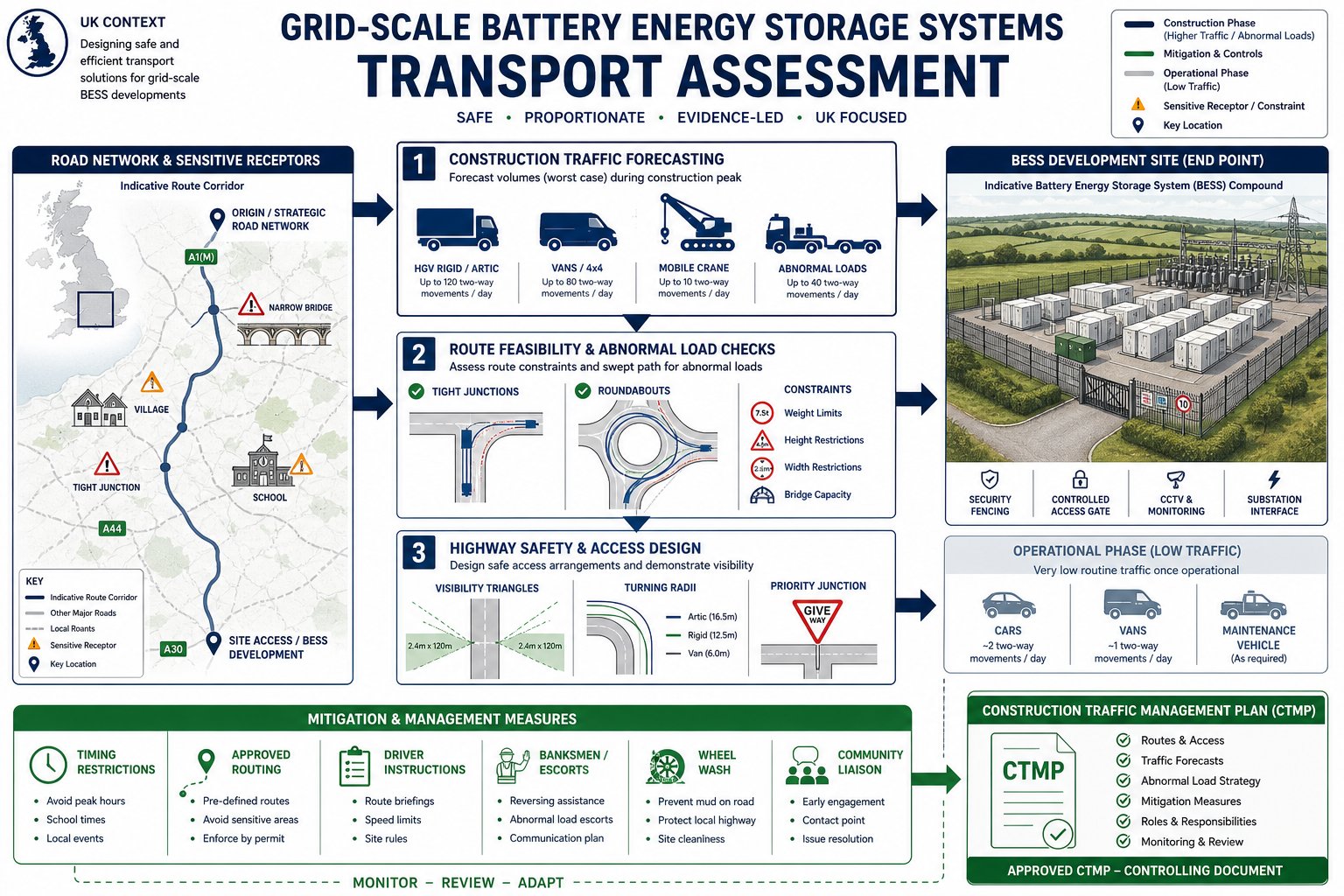
Battery storage schemes can look deceptively simple on a red line plan. They are often remote, lightly staffed and operationally quiet, so it is easy for teams to assume transport will be a minor planning issue. In practice, that is rarely the whole story. A grid-scale Battery Energy Storage System (BESS) may generate very few day-to-day trips once commissioned, yet its construction phase can place real pressure on local roads through concentrated HGV activity, abnormal indivisible loads, crane deliveries, and temporary access demands.
That is exactly why a Grid-Scale Battery Energy Storage Systems Transport Assessment matters in 2026. Planning authorities are increasingly focused on evidence: not broad assurances, but clear forecasts, route testing, visibility checks, collision review, and a Construction Traffic Management Plan that stands up under scrutiny. For architects, planners, solicitors, surveyors, developers and local councils, the transport case often turns less on permanent trip generation and more on whether the temporary impacts have been identified honestly and managed properly.
In our experience, the strongest submissions do two things well. First, they recognise how BESS sites differ from housing, logistics or employment schemes. Second, they build a proportionate but robust evidence base around construction traffic, access design and routing. The sections below set out what a transport assessment for battery storage usually needs to cover, when it is likely to be required, and how planning teams can avoid the common gaps that lead to delay, objection or awkward requests for further information.
Key Takeaways
- A Grid-Scale Battery Energy Storage Systems Transport Assessment focuses chiefly on managing the intense but temporary construction traffic rather than ongoing operational trips.
- Accurate trip forecasting and route feasibility studies for abnormal loads, such as battery units and transformers, are crucial to avoid delays and objections in planning applications.
- Early engagement with highway authorities and clear, enforceable Construction Traffic Management Plans (CTMPs) enhance the credibility and acceptability of the transport assessment.
- Unlike typical developments, BESS sites generate minimal operational traffic but require detailed analysis of peak construction vehicle movements and sensitive routing through rural or constrained areas.
- Consistent alignment of the transport assessment with environmental and planning documents prevents conflicts and strengthens the overall planning submission.
- Addressing common concerns like HGV traffic through villages, school-time conflicts, and specialist deliveries upfront improves local authority support and community acceptance.
What A Transport Assessment For A Grid-Scale Battery Energy Storage System Covers
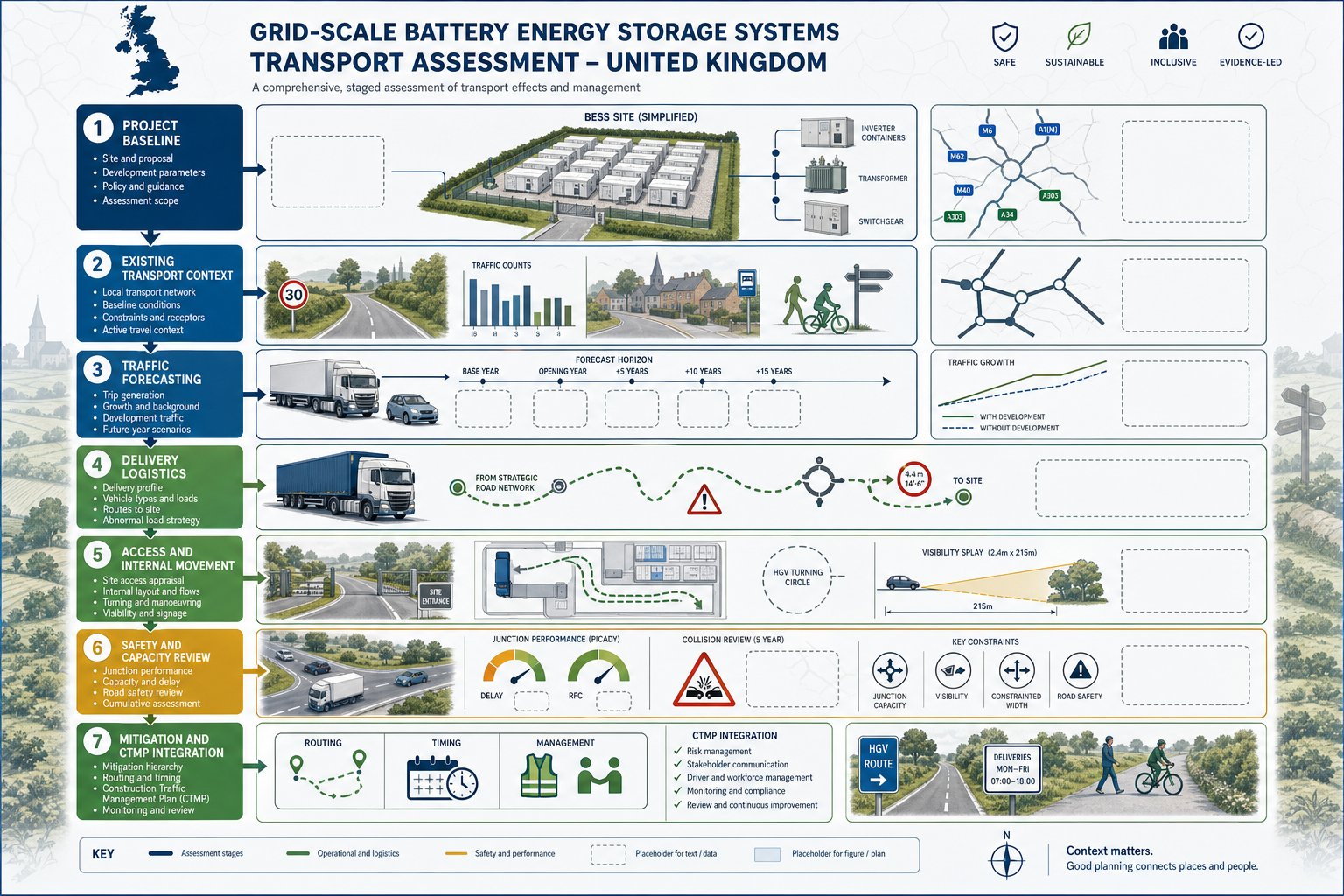
A transport assessment for a grid-scale BESS is a planning document that quantifies likely transport effects, tests highway impacts and sets out mitigation. The purpose is straightforward: to show the proposal accords with national and local transport policy, and that any residual effects on safety or network operation are acceptable.
For battery storage, the scope normally starts with the development description. We need the site location, generating capacity, equipment layout, access points, construction programme, likely phasing and any unusual delivery requirements. Without that baseline, trip forecasting becomes guesswork.
The next layer is existing transport context: road hierarchy, access constraints, nearby settlements, active travel conditions, baseline traffic flows and local highway character. On constrained rural sites, that context matters more than raw traffic numbers.
From there, the assessment usually covers:
- construction traffic forecasts, including staff vehicles, HGVs and peak periods:
- delivery strategy for batteries, transformers, inverters and cranes:
- operational and maintenance trips, which are often very low:
- visibility, access geometry and internal turning:
- highway safety review, including recent collision data:
- junction or network capacity testing if traffic uplift warrants it: and
- mitigation, usually tied together through a CTMP.
For many projects, the transport chapter also needs to align with the wider planning pack. That may include a broader transport assessment for developments: approach, environmental reporting and construction management documents. The best BESS assessments are not generic templates: they are tightly matched to the construction reality of the specific site.
When A Battery Storage Development Is Likely To Need A Transport Assessment
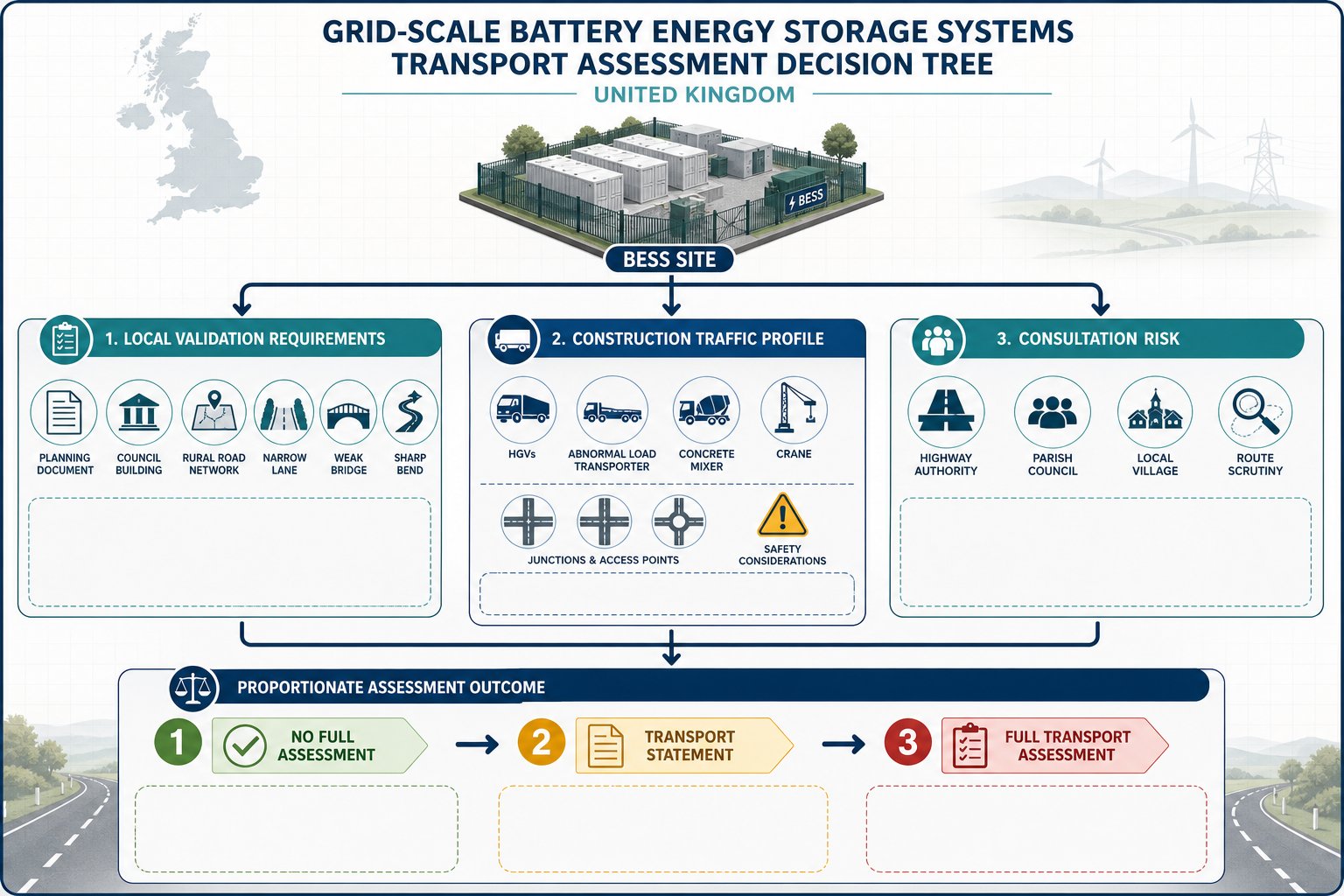
Not every battery storage proposal will need a full transport assessment, but many will need at least a transport statement, and a fair number will justify the fuller document because of construction impacts alone.
The first trigger is local validation requirements. Some authorities identify thresholds for major development, energy infrastructure or schemes on sensitive rural networks. Others are less prescriptive, so judgement becomes important. If the site is reached via narrow lanes, passes schools or villages, or depends on roads with weak bridges or awkward bends, a TA is far more likely to be expected.
The second trigger is the profile of construction traffic. BESS developments often have negligible operational trips, but that does not remove the need for assessment. Decision-makers are interested in what happens during the months when civils works, concrete pours, plant deliveries and abnormal loads are using the network. If those flows could materially affect safety, amenity or junction performance, a TA is usually the prudent route.
A third trigger is consultation risk. Where National Highways, the county highway authority, parish councils or local members are likely to focus on routing and HGV movements, submitting a weak transport case can slow the entire application.
In practice, we advise planning teams to ask an early question: is transport one of the few technical topics that could create avoidable friction? If yes, a proportionate TA often saves time later. That is especially true where the proposal may also sit within a wider environmental impact assessment framework and transport effects need to be described consistently across documents.
How BESS Sites Differ From Other Planning Applications In Transport Terms
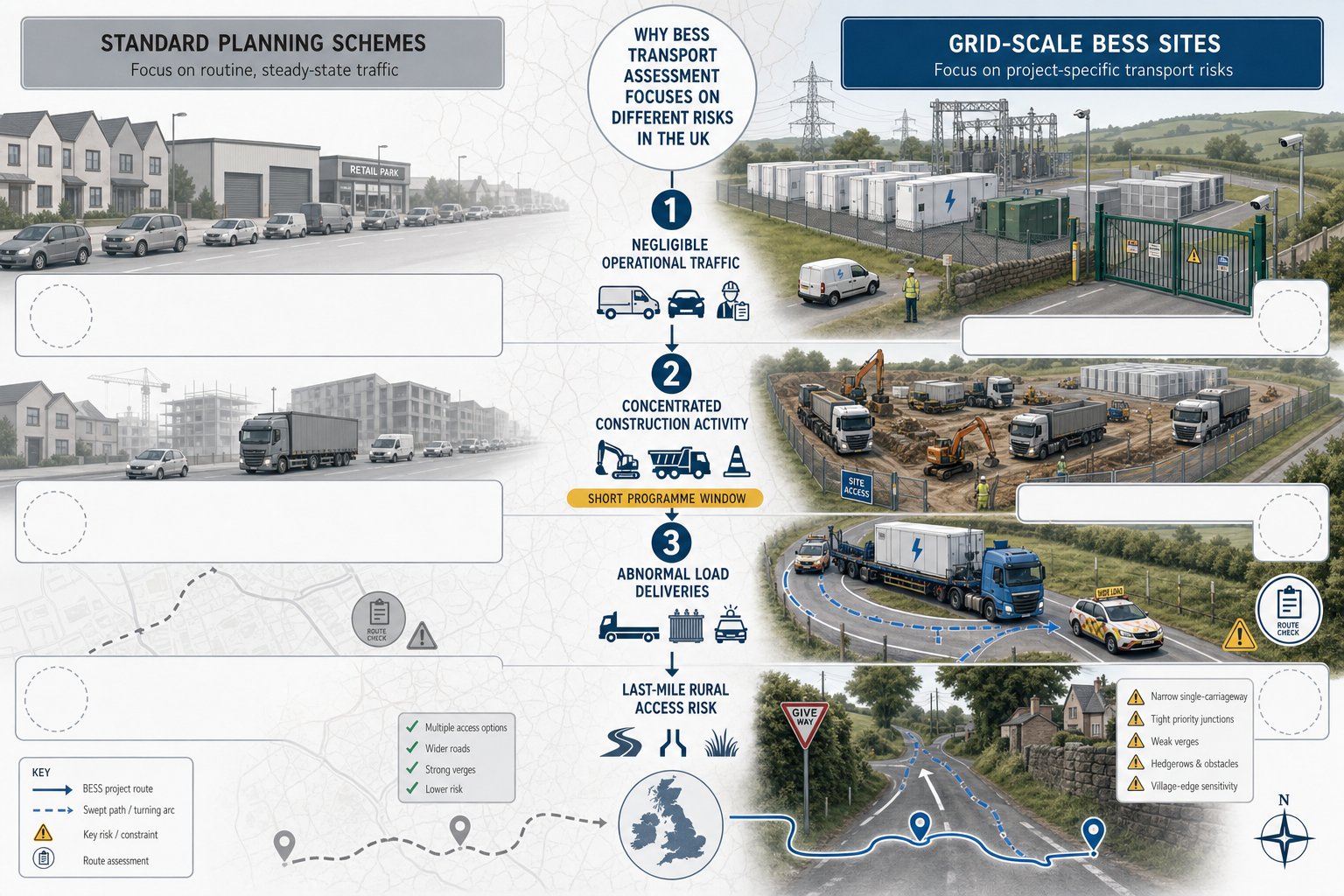
Battery storage sites do not behave like housing estates, industrial parks or retail schemes. That sounds obvious, but it is a point many reports still underplay.
The biggest difference is trip profile. A housing scheme creates permanent daily movements. A warehouse may intensify HGV activity year after year. A BESS site, by contrast, is usually remote, secure and largely unmanned once operational. Routine movements often amount to periodic inspections, occasional maintenance vans and infrequent replacement visits. In transport terms, operational traffic is commonly negligible.
The real issue is concentration. Construction traffic is temporary, but it can be intense. There may be months of earthworks, access formation, trenching, surfacing, fencing and equipment installation, followed by specialist deliveries in narrow windows. That means the TA must pay disproportionate attention to programme sequencing and peak construction days rather than annualised averages that tell nobody very much.
The other major difference is abnormal loads. Battery containers, transformers, substations and associated plant may travel on low-loaders with escort or notification requirements. That introduces route feasibility questions that do not arise on many standard applications.
There is also a spatial difference. BESS proposals are often in rural or edge-of-settlement locations close to grid infrastructure rather than established employment areas. The last mile can hence be the problem: single carriageways, weak verges, limited passing opportunity, tight priority junctions and community sensitivity. A good Grid-Scale Battery Energy Storage Systems Transport Assessment reflects that reality instead of assuming low operational trips equal low transport risk.
Typical Vehicle Movements During Construction, Delivery, Operation, And Maintenance
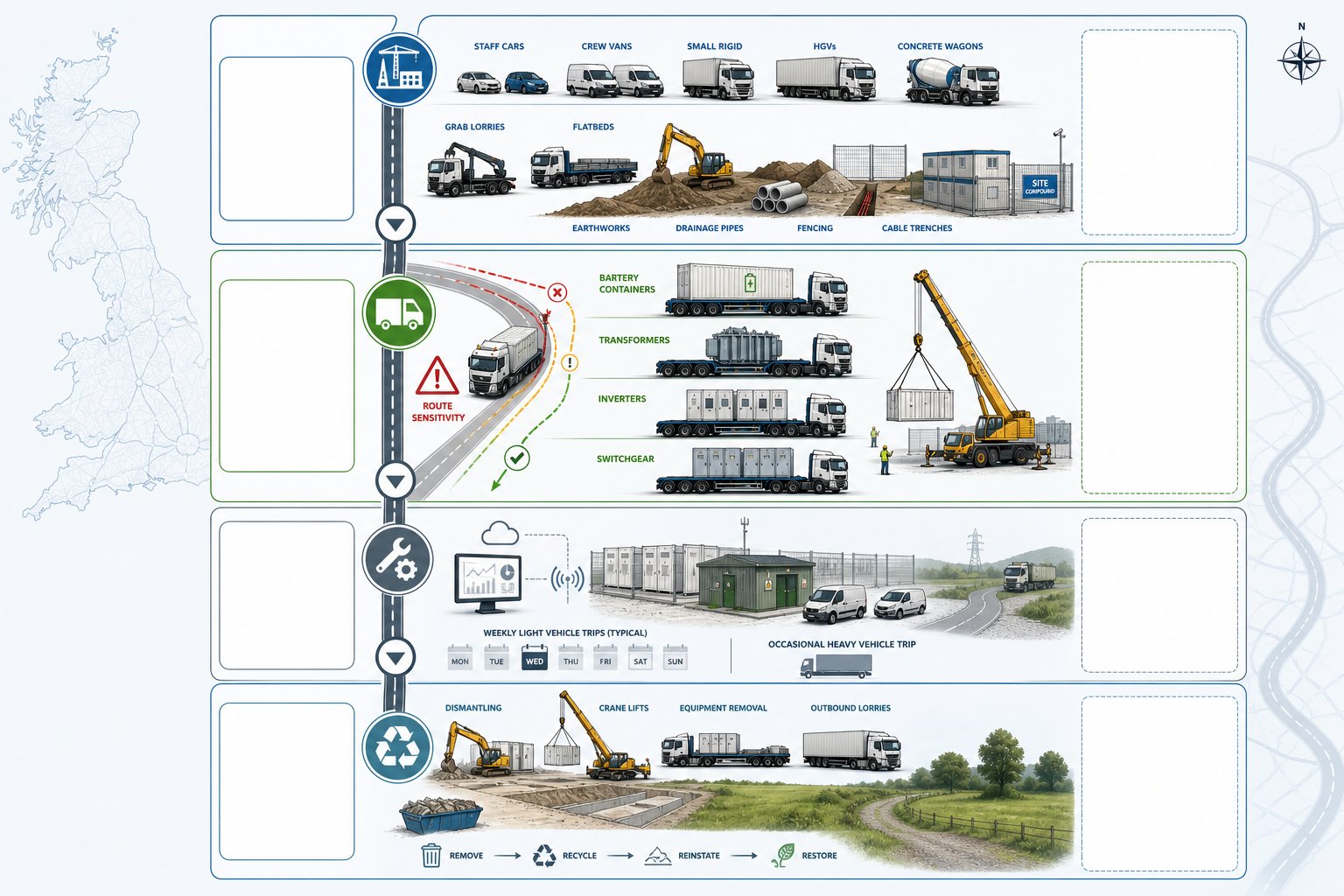
For planning purposes, it helps to break BESS traffic into phases rather than treating the development as one static land use.
During construction, we typically see a mix of staff cars, crew vans, small rigid vehicles and a meaningful proportion of HGVs. Early works may include site clearance, access creation, temporary compounds, drainage and earthworks. Then come foundations, cable trenches, control building works, fencing and surfacing. Depending on scale, concrete wagons, grab lorries, flatbeds and articulated deliveries can all feature.
Delivery traffic is often the most sensitive element. Battery units, transformers, inverters and switchgear may arrive on specialist trailers. Cranes or lifting plant may also need separate access arrangements. These movements are fewer in number than bulk construction traffic, but each one can carry more planning risk because route constraints become critical.
Once the site is operational, trip rates fall sharply. Many facilities are unmanned, monitored remotely and visited only for scheduled inspections or reactive maintenance. That can mean a handful of light vehicle trips in a typical week, sometimes less. Occasional HGV activity may occur if major components are replaced, but it is not a daily characteristic of the use.
Decommissioning should not be ignored, even if it sits years ahead. Authorities increasingly expect an acknowledgment that traffic effects at end of life broadly mirror construction, with removal of equipment and restoration works. The precise detail can remain outline level, but the TA should show the issue has been thought through.
Construction Traffic Impacts And Access Routing Strategy
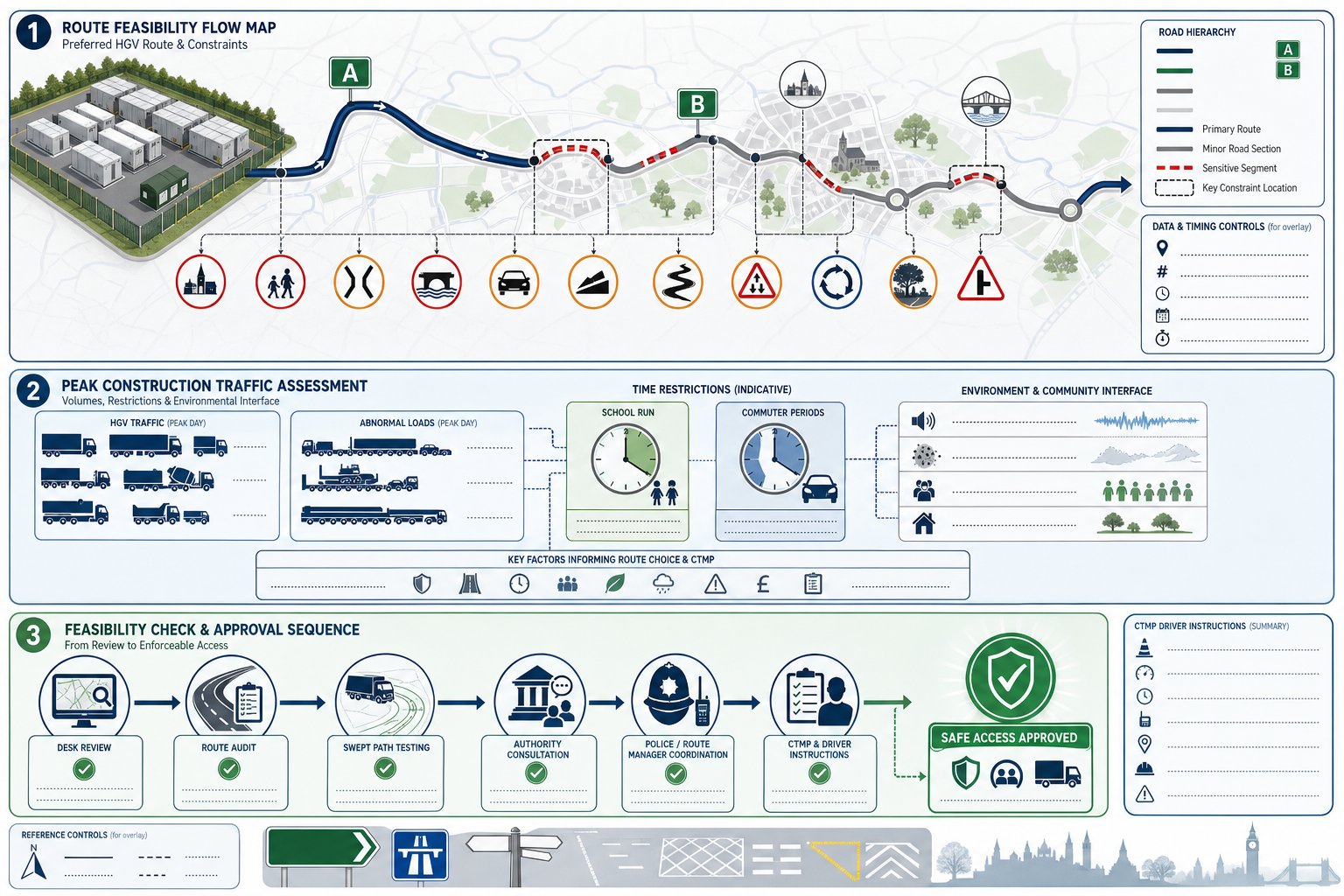
Construction traffic is usually the heart of the assessment. We need to identify not only how many vehicles are likely to travel to and from the site, but where they will go, when they will travel and which parts of the route are genuinely sensitive.
A sound routing strategy starts with hierarchy. Wherever possible, HGVs should approach from A and B roads, with the shortest practical distance on minor roads. That sounds neat on paper: the challenge is often that grid-connected sites sit beyond the comfortable part of the network. So the strategy has to confront awkward facts early: village centres, school frontages, pinch points, weak bridges, parked cars, steep gradients or substandard junction geometry.
We normally test peak construction scenarios rather than average days. Authorities want to know the worst credible case, because that is what drives safety and amenity impacts. We also assess whether timing controls are needed to avoid school drop-off periods, commuter peaks or local event days.
On more sensitive schemes, the routeing narrative should be supported by a plan, driver instructions and contractual obligations through the principal contractor. It is much easier to defend a route when it is enforceable through the CTMP.
Where the transport effects overlap with wider environmental topics such as noise, dust or settlement amenity, the transport evidence should align with the project’s environmental impact assessment transport: assumptions. Inconsistency between documents is one of those small errors that creates surprisingly large planning headaches.
Abnormal Loads, Heavy Goods Vehicles, And Route Feasibility Checks
Abnormal load work is often what separates a routine report from a robust one. If transformers or battery modules require specialist trailers, we need to know whether the route is physically passable and legally workable.
That usually means a desk-based review followed by route audit where necessary. We look at bridge limits, width restrictions, vertical clearances, tight bends, roundabout geometry, overhanging vegetation, gradients, temporary traffic management and any structures that might be vulnerable. Swept path analysis is then used at the site access and at key junctions where manoeuvrability is doubtful.
Early engagement with the highway authority matters here. If National Highways is relevant, or if the route crosses authority boundaries, consultation should happen before assumptions harden into application documents. Police notification and route manager coordination may also be needed for abnormal indivisible loads.
Crucially, route feasibility is not just about whether a vehicle can scrape through. It is about whether it can do so safely, without repeated overrun, unsustainable traffic management or unacceptable disruption to local communities.
Traffic Surveys, Trip Generation, And Evidence Base Requirements
A BESS transport assessment still needs evidence, even if the eventual operational trips are tiny. In fact, low day-to-day traffic makes the quality of construction evidence more important, not less.
Survey requirements depend on site context. For many schemes, automatic traffic counts on access roads and classified turning counts at key junctions will be enough to establish baseline conditions. On more constrained rural routes, we may also need frontage observations, width checks, parking surveys or video review to understand how vehicles actually pass one another in practice.
Trip generation should be built from the construction programme, not borrowed lazily from unrelated land uses. We typically derive forecasts from likely labour numbers, delivery schedules, earthworks quantities and equipment installation phases, then identify peak day and peak hour scenarios. That matters because a weekly average can hide short periods of very high HGV demand.
Authorities generally respond well to transparent assumptions. If battery unit deliveries are uncertain at submission stage, say so and test a conservative case. If construction phasing may change, explain the range and identify controls in the CTMP.
Methodology agreement can also save trouble. A brief scoping discussion with the highway authority often clarifies whether capacity modelling is likely to be needed, which junctions are critical and how survey data should be timed. As with any transport assessment for planning application, the report becomes stronger when the evidence base is proportionate, current and easy to audit.
Highway Safety, Visibility, And Site Access Design Considerations
Access design can look like a detail until it becomes the reason for an objection. For BESS developments, the key question is usually whether the access can safely accommodate construction vehicles and occasional specialist loads without creating conflict on the public highway.
We normally review visibility splays, junction spacing, carriageway width, radii, gradients, drainage and verge condition against the relevant standards, whether that is DMRB, Manual for Streets or a local highway design guide. The correct benchmark depends on context: a rural access onto a faster road is not assessed in quite the same way as a lower-speed urban junction.
Visibility is often the first pressure point. Vegetation, boundary banks, ditches and level differences can all reduce achievable splays. If improvement works are needed, the TA should be clear about land control and deliverability. Authorities are understandably wary of proposals that rely on visibility over third-party land without certainty.
Internal design matters too. Gates should be set back far enough to avoid vehicles waiting on the carriageway. Turning space should allow larger vehicles to enter and leave in forward gear. If banksmen or temporary controls are required during specific deliveries, say so explicitly.
A safety review should also consider collision history on the local network and whether the development could aggravate known issues. That does not mean every recorded collision becomes a reason to refuse. It means the report should show we have looked properly at patterns, context and whether the proposed access or routing strategy introduces additional risk.
Junction Capacity, Routing Impacts, And Local Network Assessment
Not every battery storage application needs formal junction modelling. If construction traffic is modest against a robust network, a qualitative assessment may be enough. But where HGV uplift is material, or where the route passes through constrained junctions, capacity and network effects should be tested rather than assumed away.
The starting point is proportionality. A rural priority junction with low background flow may not require software modelling if the issue is geometry rather than capacity. Conversely, if a site route uses a signal junction, roundabout or strategic road connection already operating near practical capacity, even a temporary increase can matter.
Beyond capacity, we also consider routing impacts on communities. This is often where local objections gather pace. Village main streets, pedestrian activity near schools, cyclist comfort, amenity and severance all sit slightly outside pure traffic engineering metrics, but they are very much planning considerations. If ten extra HGVs an hour pass through a narrow settlement for a limited period, residents will feel that even if the junction model remains technically acceptable.
Mitigation hence needs to be realistic. In some cases that means timing restrictions, temporary passing places, localised widening, edge strengthening or marshalling at specific points. In others, it means accepting a longer strategic route because it avoids a sensitive corridor. The strongest assessments do not chase the shortest haul route at all costs: they justify the route that creates the least overall planning harm.
Construction Traffic Management Plan And Related Planning Documents
For many BESS schemes, the CTMP is where the transport assessment becomes operational. The TA explains impacts and principles: the CTMP translates them into rules that a contractor can follow and an authority can condition.
A credible CTMP typically covers:
- approved construction routes:
- hours of movement, including any school-time restrictions:
- HGV booking and delivery management:
- driver briefings and code of conduct:
- signage, banksmen and temporary traffic control:
- wheel washing and road cleanliness measures:
- on-site parking and turning arrangements:
- complaint handling and community liaison: and
- monitoring, review and escalation procedures.
The level of detail can vary at application stage, especially where a principal contractor is not yet appointed. But the framework still needs teeth. Vague wording such as “vehicles will avoid sensitive times where possible” does not reassure anyone.
It is also important to align the CTMP with other planning documents. A framework CEMP may deal with dust, noise and construction compounds: the CTMP should mirror its assumptions about programme and working hours. If there is staff travel planning, that should not conflict with site parking arrangements or access controls.
In our work, this joined-up drafting is often what distinguishes a smooth consultation from a messy one. Highway officers, environmental health teams and case officers do compare notes. If the documents point in different directions, they will spot it quickly.
Common Planning Risks, Local Authority Concerns, And How To Address Them
Most objections to BESS transport arrangements are predictable. That is useful, because predictable risks can be dealt with early if the team is honest about them.
The first recurring concern is HGV traffic through villages. Residents worry about noise, vibration, parked-car conflict and the simple feeling that large vehicles do not belong on local roads. We address that with clear route plans, realistic flow forecasts, timing controls and, where needed, physical mitigation at pinch points.
The second is school-time conflict. Even a small number of HGVs can become politically and practically problematic if they coincide with drop-off and pick-up periods. A straightforward restriction in the CTMP often carries more weight than paragraphs of reassurance.
Third, authorities worry about underestimating specialist deliveries. If abnormal loads are treated as an afterthought, confidence in the whole report drops. Better to state early that route testing is needed and either provide it at submission or secure it through a precise condition.
Another risk is overclaiming the insignificance of impacts because the site will be unmanned in operation. That may be true later, but the application will be judged on construction effects too. We find it is better to acknowledge that temporary impacts can be intense, then show why residual effects are not severe once routing and management are in place.
And finally, there is document quality. Local authorities are more likely to support concise, technically grounded reporting than generic text that could apply to almost any energy project.
Preparing A Robust Battery Storage Transport Assessment For Planning Submission
A robust submission is usually the product of good timing rather than last-minute drafting. By the time the planning application is assembled, the transport strategy should already have informed site layout, access design, construction assumptions and consultant coordination.
We normally start by scoping the likely transport issues against local policy, validation requirements and route sensitivity. That tells us whether the project needs a full TA, a lighter statement, abnormal load work, junction modelling or simply a stronger CTMP. Early contact with the highway authority can be invaluable, particularly where the route is constrained or crosses multiple jurisdictions.
The report itself should be clear and conservative. Explain the development in plain language. Use current survey data. Show how trip forecasts were derived. Test peak construction scenarios. Include route plans, visibility information and swept path work where relevant. If assumptions remain provisional, identify the controls that will manage that uncertainty.
For planning teams, one practical point matters: consistency across the application set. The transport narrative should match the Design and Access Statement, planning statement, construction documents and any environmental reporting. Where projects fall within a broader environmental impact assessment process, discrepancies between chapters can undermine confidence faster than the underlying impacts themselves.
This is also where experienced reporting helps. On schemes with tight programmes, authorities rarely want volume for its own sake. They want an assessment that is concise, accurate, locally aware and tailored to likely consultation questions. That is exactly the type of planning-focused transport work we aim to deliver.
Conclusion
A Grid-Scale Battery Energy Storage Systems Transport Assessment is rarely about proving high operational traffic. More often, it is about demonstrating that a short, intensive construction period can be planned and controlled without creating unacceptable effects on highway safety, capacity or local amenity.
In 2026, that means planning teams need more than broad statements that a BESS site is “low traffic”. They need evidence: realistic construction trip forecasts, route feasibility for HGVs and abnormal loads, access design that works in practice, and a CTMP with enforceable controls. When those pieces are aligned, battery storage proposals are usually far easier for highway officers and planning authorities to support.
For developers, architects, lawyers, surveyors and councils, the practical lesson is simple. Treat transport as an early design and consenting issue, not a late technical appendix. If we frame the temporary impacts honestly and manage them properly, the transport case becomes much easier to defend.
Frequently Asked Questions about Grid-Scale Battery Energy Storage Systems Transport Assessment
What does a transport assessment for a grid-scale Battery Energy Storage System (BESS) typically include?
A transport assessment for a grid-scale BESS covers site description, baseline highway conditions, vehicle movement forecasts during construction, delivery, operation, decommissioning, highway safety and access design reviews, junction capacity assessments if needed, and mitigation measures including a Construction Traffic Management Plan (CTMP).
When is a transport assessment required for a Battery Energy Storage System development?
A transport assessment is required when local validation guidelines specify thresholds, when construction HGV or abnormal load traffic could impact safety or capacity, or when route sensitivity such as narrow rural roads, village centres, or school zones may lead to concerns during the intensive construction phase.
How do transport impacts of BESS sites differ from those of housing or industrial developments?
BESS sites generate very low operational traffic since they are often remote and largely unmanned, but they have temporary, intensive construction traffic dominated by HGVs and abnormal loads. This contrasts with housing or industrial sites that create ongoing daily vehicle movements.
What are the key considerations for managing abnormal loads in a BESS transport assessment?
Key considerations include conducting route feasibility checks with swept path analysis and on-site audits, assessing bridge limits, road widths, vertical clearances, tight bends, and gradient challenges. Early consultation with highway authorities and notification to police and route managers ensures safety and compliance.
How can construction traffic impacts be mitigated during a BESS project?
Mitigation strategies involve selecting preferred routes prioritising A/B roads, avoiding sensitive areas like schools or villages during peak times, implementing timing controls, enforcing driver instructions via a CTMP, and employing physical measures such as temporary passing places or localised road improvements.
What role does the Construction Traffic Management Plan (CTMP) play in a BESS transport assessment?
The CTMP operationalises transport assessment findings by detailing approved routes, movement hours, driver briefings, signage, traffic controls, wheel washing, on-site parking, community liaison and monitoring, ensuring that construction traffic is managed effectively to protect highway safety and local amenity.