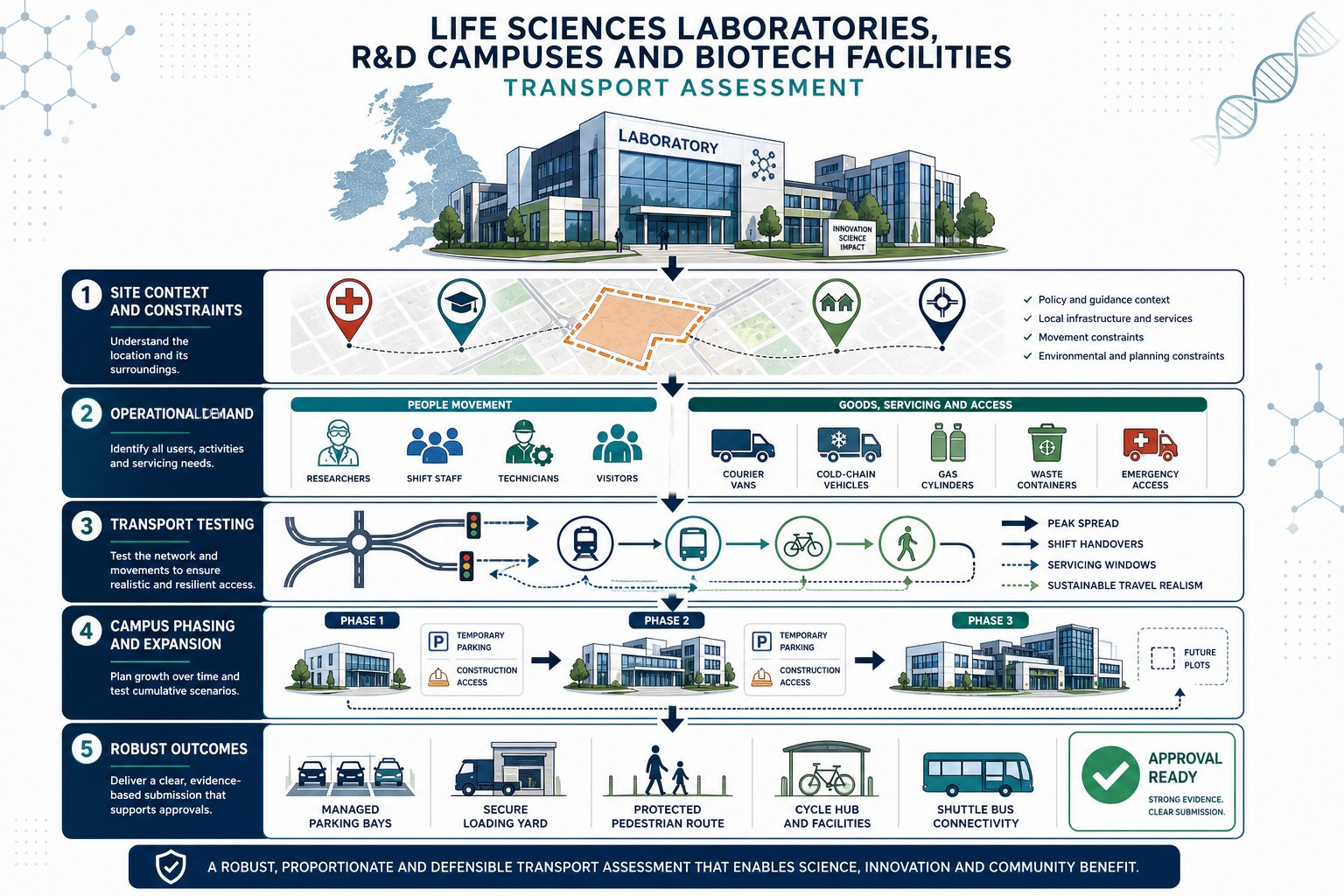
A life sciences scheme can look straightforward on a red-line plan and become anything but straightforward once transport is tested properly. A wet-lab building with office-style assumptions applied to it may appear policy-compliant on paper, yet the real-world pattern can be very different: earlier starts, late finishes, shift handovers, controlled deliveries, waste collections, temperature-sensitive logistics, and occasional specialist loads that don’t behave like ordinary B1 traffic at all.
That is exactly why a Life Sciences Laboratories, R&D Campuses and Biotech Facilities Transport Assessment needs a more tailored approach than a generic employment study. For architects, planners, lawyers, surveyors, developers and local authorities, the key issue is rarely just total trip numbers. It is whether the assessment reflects how the site will actually operate, expand and interact with the surrounding network over time.
In 2026, that bar is getting higher. Planning authorities are looking harder at sustainable travel credibility, cumulative growth, servicing realism and on-site movement design, particularly where life sciences development sits near sensitive junctions, residential streets, hospitals, universities or constrained urban corridors. From our perspective, the strongest applications are the ones that deal with those operational specifics early, not after an objection lands. This article sets out what planning teams need to get right, where the common weak points sit, and how to build an assessment that stands up under scrutiny.
Key Takeaways
- A tailored Life Sciences Laboratories, R&D Campuses and Biotech Facilities Transport Assessment must reflect actual site operations, including shift patterns, specialist deliveries, and phased campus growth, rather than relying on generic employment assumptions.
- Robust transport assessments provide evidence on how staff, visitors, goods, and vehicles safely and efficiently access the site, addressing local highway capacity, sustainable travel options, and servicing realism to meet stricter 2026 planning policies.
- Accounting for diverse travel behaviours, such as early starts and late finishes, is essential for accurate trip generation models, which should be built from operational data and comparable site evidence rather than standard office benchmarks.
- Comprehensive servicing and waste management plans are critical, specifying vehicle types, delivery timings, and manoeuvring space to ensure reliable scientific operations and avoid disruptions.
- Parking, access, and on-site movement plans must consider allocation and control for varied user groups and emergency scenarios to prevent conflicts and overspill into residential areas.
- Early engagement with planning authorities and using data-driven, scenario-tested transport strategies enhances the credibility and resilience of life sciences transport assessments, reducing objection risks and supporting sustainable travel measures.
Why Transport Assessments Matter For Life Sciences And Biotech Development

Life sciences and biotech schemes are rarely judged purely as buildings. They are assessed as operating environments, often with demanding technical, regulatory and servicing requirements. A transport assessment matters because it shows whether people, goods and vehicles can reach the site safely, efficiently and in a way that aligns with planning policy.
For this sector, the stakes are higher than with a standard office development. Staffing can include researchers, lab technicians, facilities engineers, GMP manufacturing teams, contractors, clinical staff and specialist visitors. Their travel behaviour may stretch beyond the classic 8:30 to 9:00 commuter peak. Add courier activity, cold-chain logistics, gas deliveries, hazardous waste movements and emergency access requirements, and a generic desktop exercise quickly starts to look thin.
A robust assessment also helps planning teams answer the questions authorities are increasingly asking in 2026: can the local highway network absorb growth: is public transport realistically usable for shift-based staff: will walking and cycling measures genuinely work: and how will future phases affect parking, servicing and junction operation? Those issues often connect with wider reports too, including a broader transport assessment for major development and, where relevant, an environmental impact assessment.
Put simply, the document is not a formality. It is the evidence base that can either reassure decision-makers or expose unrealistic assumptions.
How These Facilities Create Distinct Travel And Servicing Demands

What makes a life sciences transport assessment different is not one single trip type. It is the mix. These developments often blend research, write-up space, administration, pilot production, storage, plant, amenity areas and highly controlled environments on one site. Each component generates a different pattern, and planning teams need to model that pattern as an operational whole rather than as a broad employment average.
A city-edge biotech facility near a rail station may support a strong non-car mode share for researchers, but still rely on tightly managed van activity for samples, reagents and temperature-controlled consumables. A campus outside a town may need shuttles, phased parking controls and carefully timed servicing windows to avoid defaulting back to private car dependence. In both cases, the answer lies in understanding the occupier profile and operating model, not in lifting rates from an office benchmark.
That is why the best evidence tends to combine survey data, operator input, comparable site observations and policy context. We have found that local authorities respond far better when the narrative explains why a facility will travel differently, rather than simply presenting tables of trips without operational reasoning.
Laboratories, Cleanrooms And Research Spaces
Laboratories and cleanrooms bring servicing requirements that can be easy to underestimate. Wet labs may need routine chemical deliveries, specialist gases, controlled storage arrangements and segregated waste collections. Cleanroom operations may also impose stricter separation between staff entrances, secure deliveries and waste exits, which has direct implications for access design and yard management.
The transport consequences are practical, not theoretical. Can delivery vehicles reach the correct point without crossing pedestrian desire lines? Is there enough space for secure unloading, short-term holding and reversing-free movement? Can emergency access be maintained when service vehicles are on site? These questions matter because scientific operations often depend on reliability. A missed or delayed delivery is not just inconvenient: it can disrupt testing windows, research programmes or production batches.
There is also a tendency to underplay the support functions around research space. Plant maintenance teams, calibration specialists, compliance auditors and equipment engineers can produce a steady stream of non-routine visits. On higher-specification sites, those visitors do not behave like ordinary office guests. The transport assessment should say so clearly.
Multi-Building Innovation Campuses And Phased Expansion
Many life sciences schemes now come forward as campuses rather than single buildings. That means multiple plots, shared access roads, centralised parking, internal shuttle movement, phased utilities and overlapping construction periods. A transport assessment that only tests the first building can quickly become obsolete.
Phasing is especially important where early buildings rely on temporary parking, interim servicing yards or construction access that later phases will displace. Authorities will want to know how the site works at each stage, not just at final completion. That includes cumulative trip growth, changing peak patterns, temporary pedestrian routes and the impact of occupied phases sitting beside active construction.
Innovation campuses also tend to attract varied occupiers over time. A building initially marketed for R&D may later accommodate a blend of lab, office and light production. So flexibility needs to be built into the assessment. A sensible strategy is to test realistic parameter scenarios and define management controls in a way that remains usable if occupier details evolve. In larger cases, a Development Transport Assessment: framework supported by staged monitoring is often more defensible than a single fixed forecast.
When A Transport Assessment Is Likely To Be Required

A formal transport assessment is likely to be required where a life sciences or biotech proposal is major in scale, materially intensifies an existing site, or sits on a constrained network. In practice, that can include a new research building, expansion of an established science park, conversion of commercial floorspace into labs, or a phased campus with mixed R&D, office and production elements.
Thresholds vary by local authority, so there is no single national trigger that covers every case neatly. But the need becomes more likely where the proposal would generate noticeable staff, visitor or servicing traffic: where access sits close to sensitive junctions, schools, hospitals or residential streets: where parking demand is likely to be contentious: or where public transport accessibility is limited compared with policy expectations.
Authorities also tend to expect transport evidence where the scheme could have cumulative effects with nearby development. That point is particularly relevant in science clusters around university districts, hospital campuses and strategic employment zones, where several medium-sized applications can collectively affect the same network.
The sensible move is to scope early. A brief discussion with highways officers can establish whether a transport statement is enough or whether a full assessment, travel plan, delivery and servicing plan, construction traffic management plan, or junction modelling will be needed. On more technical schemes, working with experienced Transport Assessment Consultants: early can prevent a lot of expensive redesign later.
Key Trip Generation Factors For Labs, R&D And Biotech Sites

Trip generation for this sector should be built from the operation outward. Gross internal area still matters, of course, but floor area alone is a weak predictor where a building contains very different functions. A 10,000 sq m site with mostly write-up and office accommodation behaves very differently from one with high-intensity labs, GMP suites, specialist storage and a heavy technical support presence.
The core variables usually include floorspace by use: staffing numbers by role and shift: visitor categories: contractor activity: public transport accessibility: car parking restraint: and the intensity of servicing. Clinical trial activity, training events or collaboration space can add intermittent peaks that will not appear in a simplistic daily average.
Data quality is where many assessments either gain authority or lose it. Comparable benchmarks should be relevant to modern lab and R&D uses, not generic business park rates from another era. Where an existing occupier, nearby facility or portfolio asset can provide observed information, it is usually worth incorporating. The same goes for parking beat surveys, staff postcode analysis and timetable checks for shift compatibility.
The goal is not to inflate numbers for safety. It is to present a believable picture. Decision-makers can usually tell when trip generation has been derived from assumptions that do not match the way a science building actually works.
Staffing Profiles, Shift Patterns And Peak Travel Behaviour
Life sciences development often breaks the standard commuter template. Researchers may work long experimental windows. GMP or pilot manufacturing staff may operate shifts. Facilities and maintenance teams can arrive early. Security, cleaning and support staff may overlap with technical staff at handover times. The result is a travel profile with broader shoulders and, sometimes, peaks outside the traditional network high points.
That matters for both highways and sustainable travel analysis. A station that looks well connected at 8:30 may offer much poorer practical options for a 6:00 start or a 22:00 finish. Likewise, a junction impact assessment focused only on classic AM and PM peaks may miss concentrated traffic around shift changeovers.
For that reason, we generally prefer explicit shift modelling where operations suggest it. Staff numbers should be broken down by role and by likely arrival/departure band, with assumptions tested against operator evidence. On larger sites, sensitivity testing can be useful too: what happens if manufacturing expands faster than office-based functions, or if contractor activity rises during commissioning? The answers often shape parking, shuttle provision and highway mitigation more than headline daily trip totals.
Deliveries, Specialist Equipment, Waste Streams And Servicing Activity
Servicing is one of the most underestimated parts of a Life Sciences Laboratories, R&D Campuses and Biotech Facilities Transport Assessment. These sites can generate a regular flow of courier vans, temperature-controlled deliveries, specialist consumables, gas cylinder movements and regulated waste collections. Some also require occasional deliveries of large plant, lab fit-out modules or abnormal loads.
The planning issue is not just volume. It is control. Hazardous, biological or chemical waste streams may need licensed carriers, fixed collection procedures and defined vehicle routes. Inbound and outbound flows may need to avoid conflict with staff arrivals, clinical visitors or sensitive internal areas. And if there is no adequate turning space, a relatively low number of service trips can still create a serious operational problem.
A credible assessment should hence quantify servicing as far as possible, identify vehicle types, explain timing assumptions and set out how loading, waiting and circulation will be managed. Where abnormal loads are possible, swept paths and route checks may be needed. If junction performance is sensitive, tools such as Junctions 11 Software can help demonstrate whether access arrangements remain robust under realistic service and staff scenarios.
Parking, Access And On-Site Movement Considerations

Parking on life sciences and biotech sites is rarely a simple numbers exercise. Quantity matters, but so does allocation, control and layout. Different user groups often need to be separated: staff, visitors, blue badge users, service vehicles, emergency access, clinical attendees, car-share spaces and electric vehicle charging. On larger campuses, there may also be tension between early-phase temporary parking and the final movement strategy.
A common planning mistake is to apply a single parking ratio and stop there. In reality, operational resilience depends on who parks where, when and under what controls. Shift-based staff may need access at times when public transport is sparse. Visitors may need highly legible short-stay parking close to reception. Service vehicles may require secure yards and waiting space that cannot be informally absorbed into general parking. If overspill risk exists, nearby residential streets will become a material planning concern very quickly.
Access design deserves the same level of attention. Can articulated vehicles enter and leave in forward gear where needed? Is there enough stacking space to prevent vehicles waiting on the highway? Are pedestrian routes protected from loading manoeuvres? Can waste and service areas operate without crossing clean or secure zones? These are often decisive details for officers and consultees.
On-site movement should also reflect emergency and incident scenarios. A layout that works on a normal day but fails when a delivery overruns, a gate is controlled, or a contractor van blocks a turning area is not really a robust layout.
Sustainable Transport, Travel Planning And Mode Shift Expectations
In 2026, policy expectations around mode shift are not getting lighter. For life sciences development, the challenge is to show that sustainable travel measures are both ambitious and believable. Authorities are increasingly sceptical of travel plans that promise reduced car use without accounting for shift work, specialist staff catchments or constrained public transport at non-standard hours.
The strongest approach usually starts with honest baseline analysis: where staff are likely to come from, what public transport actually offers across the operating day, and how safe walking and cycling routes really are. From there, measures can be targeted rather than generic. That may include station shuttles, secure cycle parking, showers and lockers, guaranteed ride-home measures, car-share management, phased parking restraint, season ticket support or collaboration with local operators on timetable improvements.
For campus sites, internal walkability matters too. A rail-connected site still underperforms if people have to cross vehicle-heavy service roads or navigate unclear routes between buildings. Likewise, cycle parking tucked behind plant enclosures tends not to drive meaningful uptake.
Travel plans should also be monitored and adaptable. Occupiers change, buildings phase in, and staffing profiles shift. We often find that a site-specific plan linked to occupation triggers is more credible than boilerplate wording. Broader guidance on Development Transport Assessment: A planning strategy can help frame that, even where the final measures must be tailored to a science-based occupier profile.
One caution: reduced parking can support policy compliance, but only if it is matched by realistic alternatives. Otherwise the pressure simply moves off-site.
Common Planning Risks And How To Strengthen An Application
The most common risk is using the wrong comparator. If trip rates are borrowed from ordinary office or industrial uses without explaining the science-specific operation, the whole assessment becomes vulnerable. Authorities, neighbours and highway consultees will quickly challenge figures that ignore shifts, specialist servicing or phased campus growth.
Another frequent weakness is under-specifying servicing. We still see applications that describe deliveries in broad terms without identifying waste collections, gas movements, courier frequency, abnormal loads or secure unloading arrangements. On a lab-led scheme, that omission can be enough to trigger requests for more information or conditions that are far more restrictive than they needed to be.
Parking is another pressure point. Too little evidence on staff catchments, shift compatibility with public transport and overspill risk can make a restrained parking strategy look aspirational rather than workable. Too much parking, on the other hand, can undermine policy alignment and weaken mode shift claims. The answer is usually a staged, managed strategy rather than a blunt maximum or minimum.
To strengthen an application, we should scope with the authority early, use tailored benchmarks, explain operational assumptions in plain English and test realistic scenarios for both occupation and servicing. If the scheme forms part of a broader portfolio, experience from other sectors can help sharpen method, even where the land use differs: a well-structured Residential Development Transport study, for example, still teaches useful lessons about parking evidence, phasing and local sensitivity. And where planning teams need concise, authority-aware reporting, practice built around local thresholds and quick turnaround can make a real difference.
Conclusion
A strong Life Sciences Laboratories, R&D Campuses and Biotech Facilities Transport Assessment is not built from generic employment assumptions. It is built from the realities of how scientific sites operate: specialist staffing, shift patterns, regulated servicing, secure access, future phasing and credible sustainable travel measures.
For planning teams, getting this right in 2026 means moving early, scoping properly and treating transport as part of operational design rather than a late-stage planning attachment. The applications that perform best are usually the ones that explain the site clearly, test realistic scenarios and show how people, goods and vehicles will move safely from day one through to future expansion.
Where that evidence is tailored, proportionate and locally grounded, it does more than satisfy a validation requirement. It reduces objection risk, strengthens negotiations and gives decision-makers confidence that the development can function in the real world, not just in a spreadsheet.
Life Sciences and Biotech Transport Assessment FAQs
Why is a tailored transport assessment crucial for life sciences laboratories and biotech facilities?
A tailored transport assessment reflects the specialised travel and servicing patterns of life sciences sites, including shift work, regulated deliveries, hazardous waste handling, and phased campus expansion, ensuring safe and efficient access beyond generic office assumptions.
When is a transport assessment typically required for life sciences developments?
A transport assessment is generally required for large-scale projects, significant site intensifications, developments near sensitive receptors, or constrained networks. Early scoping with authorities helps determine if a full assessment, travel plan, or servicing plan is needed.
How do shift patterns at life sciences campuses affect transport planning?
Staff shifts often extend beyond typical office hours with multiple changeovers creating travel peaks outside normal commuter times. Assessments must model these to accurately predict traffic and sustainable travel needs, including public transport at non-standard hours.
What are the key servicing considerations for life sciences labs and cleanrooms?
These facilities require frequent deliveries of chemicals, gases, temperature-controlled supplies, and secure waste collections. Transport plans must ensure safe access, segregation of vehicle routes, sufficient unloading space, and emergency access to accommodate specialist servicing safely.
How can sustainable transport measures be effectively incorporated at life sciences R&D campuses?
Effective measures include targeted shuttle services, secure cycle parking, car-share schemes, and travel plans that consider shift patterns and site-specific public transport availability. Mode shift ambitions must be credible and supported by onsite walkability and practical alternatives to car use.
What common mistakes weaken life sciences transport assessments, and how can they be avoided?
Common errors include using generic trip rates ignoring specialised operations, underestimating servicing demands, and simplistic parking strategies. Strengthening assessments involves using tailored data, explicit shift and servicing modelling, robust travel plans, and early liaison with transport assessment consultants.