If a development needs changes to the public highway, getting planning permission is only part of the job. The real bottleneck often appears later, when the required highway works have to be designed, checked, legally agreed, and delivered to the satisfaction of the highway authority. That is where section 278 design becomes critical.
We see this regularly across planning applications for residential, commercial, mixed-use and roadside schemes: a transport assessment identifies mitigation, everyone nods at the principle, and then the programme starts slipping because the detailed highway design was underestimated. A new access, altered junction, crossing, footway widening or signal upgrade may sound straightforward on a layout plan. In practice, each one sits inside a web of standards, safety audits, utilities, approvals, legal agreements, bonds and construction constraints.
In simple terms, section 278 design is the detailed engineering process used to secure approval for permanent works on the existing adopted highway under a Section 278 agreement in the Highways Act 1980. For developers, planners, architects and legal teams, understanding that process early can save months.
In this guide, we explain what Section 278 design means, when it is needed, what works it usually covers, why schemes get delayed, and how it connects with transport assessments and planning support. We also look at what a well-prepared technical team does differently to move approvals along faster.
What Section 278 Design Means In The Planning And Highway Approval Process
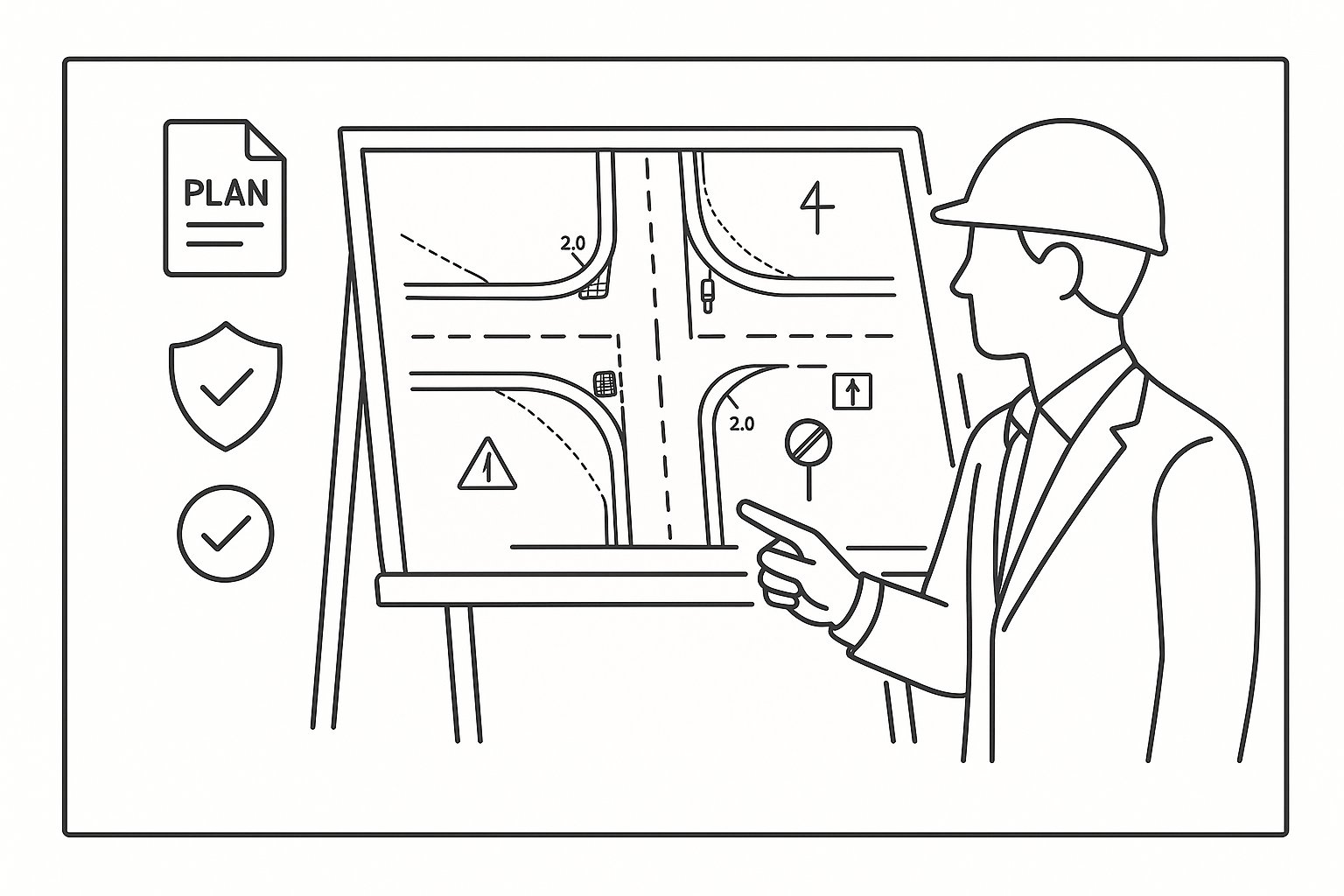
A Section 278 agreement is the legal mechanism that allows a developer to fund and carry out works to the existing public highway. The design element is the technical package behind that agreement: drawings, geometry, levels, drainage, signs, lining, visibility, safety checks and supporting evidence that show the proposed highway works can be delivered properly and safely.
That matters because planning permission often says, in effect, “this development is acceptable provided certain off-site highway improvements are delivered.” The transport assessment or transport statement may identify the mitigation in broad terms, but the highway authority still needs a buildable, standards-compliant design before those works can be approved.
So, in the planning and highway approval process, Section 278 design usually sits between planning strategy and physical delivery. It translates policy and mitigation into something the highway authority can technically approve. No technical approval, no signed agreement. No signed agreement, no lawful highway works.
In practical terms, the authority will review whether the design complies with the relevant standards, whether all road users are considered, whether drainage and lighting are resolved, whether safety audits have been completed, and whether the proposal can be maintained and adopted. Different authorities have different pro formas and review stages, but the principle is consistent.
For project teams, the key point is this: section 278 design is not just “the road drawing.” It is the approval pathway for development-related highway works, and it needs to be treated as a live part of the planning programme from the start.
When A Section 278 Agreement Is Required For A Development
A Section 278 agreement is typically required whenever a development needs permanent alterations to the adopted highway outside the site boundary. If the scheme affects the existing road network and those works will be delivered on publicly maintained highway land, Section 278 is usually the route.
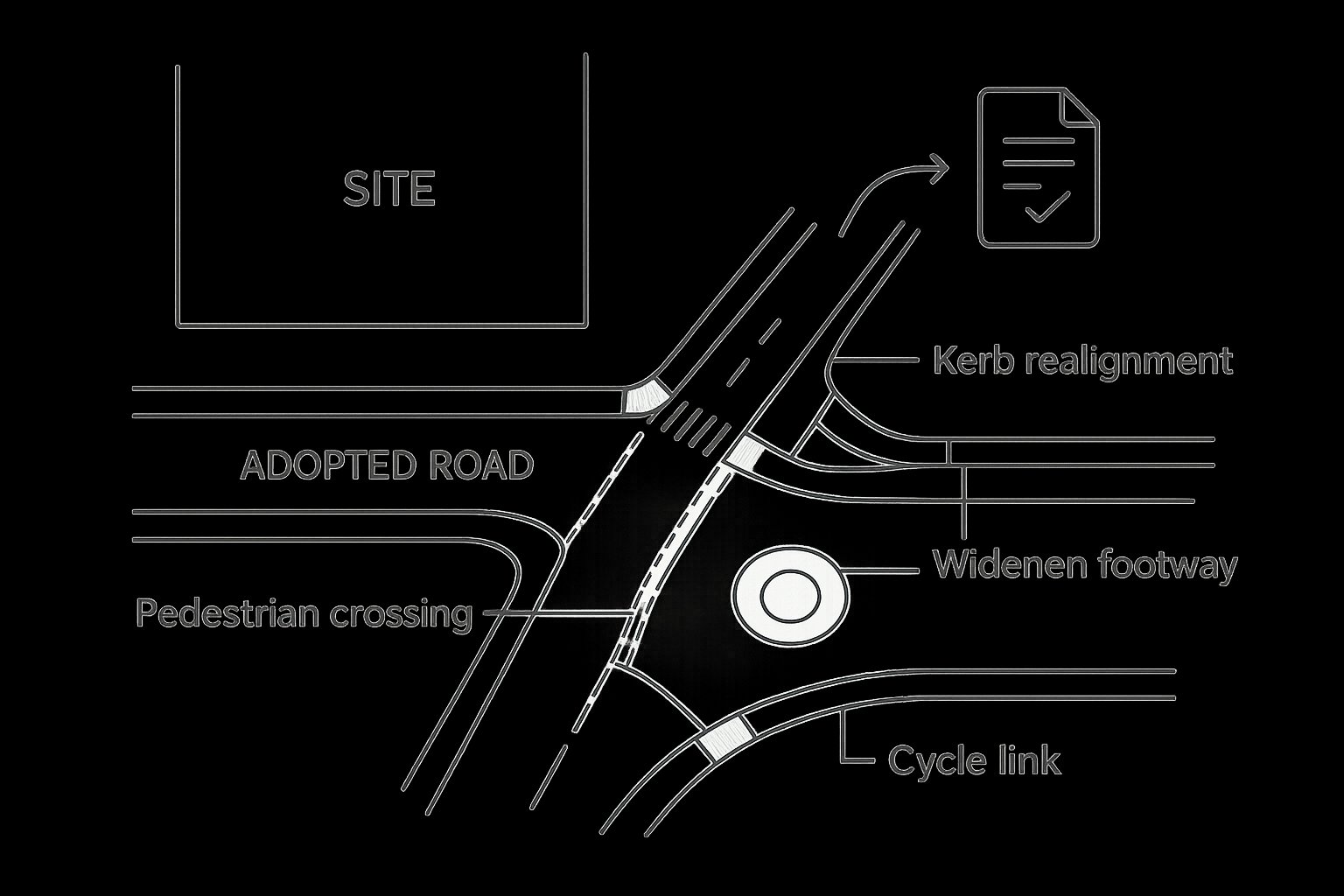
Common triggers include a new site access onto an existing road, changes to a priority junction, a ghost island right-turn lane, a mini-roundabout, traffic signal amendments, a pedestrian crossing, kerb realignment, footway widening, cycle connections or traffic calming linked to the development. Even works that seem minor can still need a formal agreement if they sit within the highway boundary.
This is also why legal and planning teams need to be alert early. It is not lawful to simply appoint a contractor and start altering the public highway because planning permission has been granted. The highway authority must consent to the works, approve the design and enter into the Section 278 agreement.
In many planning permissions, the need for the agreement is baked into conditions or linked to obligations. A development may be prohibited from commencing above a certain phase, from occupying units, or from opening for trade until the off-site works are completed or substantially completed.
The practical test is straightforward: if development mitigation requires works to the existing adopted highway, assume Section 278 may be needed and confirm that position with the local highway authority as early as possible. Waiting until after consent is one of the easiest ways to lose time.
The Main Highway Works Typically Covered By Section 278 Design
Section 278 design is used for a wide range of off-site highway interventions, from relatively simple frontage works to complex junction remodelling. The unifying theme is that the works happen on the adopted highway and are needed to make the development acceptable in traffic, access or safety terms.
For most schemes, the required works are identified first through access strategy, junction capacity work, road safety considerations, active travel requirements or planning negotiation. The Section 278 process then turns those mitigation measures into a deliverable package.
Below are the types of works we most often see included.
Junction Alterations, Access Improvements, And Traffic Signal Changes
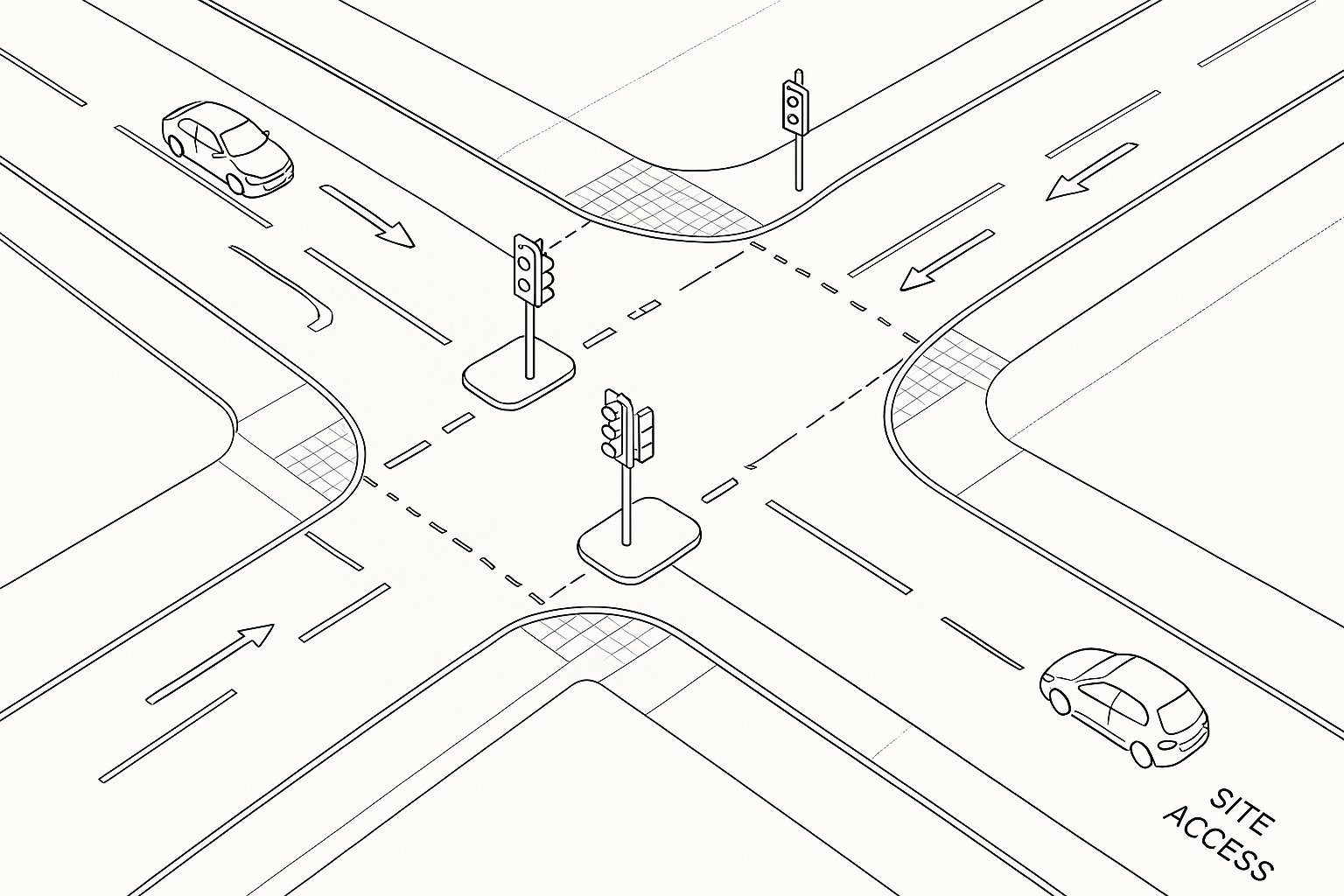
Junction works are probably the most recognisable part of Section 278 design. A development may need a new priority access, a modified bellmouth, a right-turn lane, a roundabout upgrade or a fully signalised junction to handle forecast traffic safely.
In these cases, the design has to prove more than basic geometry. The authority will want confidence that turning movements work, queuing can be managed, pedestrians are protected, visibility is adequate and the layout ties into the existing network without creating new hazards. Signal changes can be especially involved, because detector loops, controller changes, staging, ducting and electrical design all come into play.
Access improvements can also extend beyond the site entrance itself. We often see requirements for verge adjustments, central islands, lane widening, relocation of bus stops, amendments to waiting restrictions or new splitter islands to channel movements correctly.
This is where early coordination pays off. What looks efficient on a concept plan can unravel once utilities, retaining features, mature trees or nearby private accesses are mapped properly. Good Section 278 design anticipates that before the authority does.
Footways, Crossings, Cycle Facilities, And Public Realm Works
Not every Section 278 package is vehicle-led. Many are driven by walkability, accessibility and local placemaking requirements. New and widened footways, tactile paving, dropped kerbs, uncontrolled crossing points, signalised pedestrian crossings, shared-use links, cycle tracks and public realm upgrades commonly sit within the scope.
These features often look simple, but they are where authorities tend to be exacting. Widths, gradients, crossfalls, tactile arrangements, drainage, street furniture clearances, lighting, guardrailing, surfacing and inclusive access all need to be right. If a route is intended to connect the development to schools, bus stops, town centres or rail stations, the authority will usually examine continuity and usability rather than just whether a strip of paving exists.
Public realm works may also include kerb realignment, tree pits, seating, bollards, planters, resurfacing and drainage changes. That can bring a wider set of consultees into the process, especially on town centre schemes.
In other words, Section 278 design is not only about cars getting in and out. It is often about making the highway work better for everyone who uses it.
The Core Stages Of A Section 278 Design Project
Most Section 278 projects follow a recognisable sequence, even though each authority has its own forms, review periods and technical preferences.
First comes the planning stage. The transport assessment or statement identifies the access strategy and any off-site mitigation likely to be required. Sometimes the principle is agreed at application stage: sometimes the detail is deferred by condition.
Next, we move into early discussions with the highway authority and concept design development. This is where the obvious conflicts should be surfaced: land ownership, highway extents, existing constraints, potential departures from standards, drainage outfalls, utility diversions and whether the authority is likely to support the broad approach.
After that, the formal Section 278 application or authority-specific submission is made, usually with the relevant fee. Detailed design then progresses to Technical Approval. That package can include general arrangement drawings, construction details, levels, drainage design, signs and lines, vehicle tracking, visibility checks, road safety audit input and utility information.
Running alongside or just behind the technical review is the legal agreement itself. That typically covers the works description, bond, fees, commuted sums where applicable, programme obligations and responsibilities during construction and maintenance.
Once approved and signed, the project moves into permitting, construction, inspection and a maintenance period before final adoption or release. And yes, this is the stage people forget to programme. On many schemes, the maintenance period alone can run for 12 to 24 months.
Key Design Standards, Safety Checks, And Technical Requirements
Section 278 design sits inside a technical framework, not a blank sheet. Depending on the road type and authority, the design may need to align with the Design Manual for Roads and Bridges, Manual for Streets, local highway design guides, adoption standards, accessibility requirements and authority-specific details.
The review is usually broad. Highway engineers will check carriageway geometry, junction radii, lane widths, levels, drainage strategy, materials, kerb details, tactile paving, signs, road markings, lighting, visibility, non-motorised user provision and tie-ins to the existing network. If the authority considers the package incomplete, it can stall quickly.
That is why a compliant Section 278 submission is less about one clever drawing and more about technical completeness. The strongest packages are coordinated from the start, with surveys, utility intelligence, safety input and planning assumptions all lined up before detailed design races ahead.
Topographical Surveys, Utilities, And Existing Site Constraints
A surprising number of avoidable design problems start with poor baseline information. Without a reliable topographical survey of the highway frontage and tie-in areas, levels can be wrong, drainage assumptions can fail, visibility can be misstated and construction extents can drift outside available land.
For Section 278 design, we generally need accurate survey coverage not just at the access point, but across all affected highway features: kerbs, channels, covers, gullies, signs, columns, trees, boundary treatments, retaining structures, bus stops and crossing points. If the scheme touches a junction, the survey area usually needs to be wider than the first issue plan suggests.
Utilities are the other major constraint. Statutory undertakers’ apparatus can radically change cost, programme and even design feasibility. A seemingly modest kerb line adjustment becomes far less modest if it conflicts with fibre, gas, water or high-voltage assets. Diversions, protections and trial holes may be needed, and associated costs are often captured in the overall delivery and bond planning.
Then there are the real-world constraints: tree roots, third-party land, narrow verges, private accesses, visibility obstructions and uncertain highway boundaries. Good teams identify these early, because the authority definitely will.
Road Safety Audit, Swept Path Analysis, And Visibility Requirements
Road Safety Audit is a normal part of the Section 278 process and, for many authorities, not optional. Depending on project stage, audits may be required from Stage 1 through to Stage 4. Their purpose is not to redesign the scheme for you, but to identify collision risks and safety concerns for all users, including pedestrians, cyclists and motorcyclists.
A well-managed audit process helps schemes move faster because risks are addressed early, not after technical positions have hardened. But it only works if the design team responds properly. Ignoring an audit issue without evidence or rationale is a reliable route to delay.
Swept path analysis is another recurring requirement, particularly where large vehicles need to turn through constrained geometry. Junctions, accesses, servicing routes and internal-external transitions all need to demonstrate that design vehicles can manoeuvre without overrun into unsafe areas.
Visibility is equally fundamental. Junction visibility splays, stopping sight distance and intervisibility at crossings must meet the relevant standards and reflect actual site conditions, not optimistic assumptions. Walls, planting, vertical alignment and parked vehicles can all become sticking points.
Put simply, these are not box-ticking exercises. They are some of the first things authorities use to judge whether a scheme is genuinely ready.
Common Reasons Section 278 Designs Are Delayed Or Rejected
Most delayed Section 278 schemes are not delayed by one dramatic flaw. They are delayed by accumulation: incomplete drawings, unresolved utilities, unclear land ownership, weak visibility evidence, a missing audit response, drainage left for later, or a concept that never really aligned with local standards.
One common issue is failure to engage with the authority’s preferences early enough. Designers sometimes work up a detailed layout based on general guidance, only to discover that the local authority expects a different approach to radii, crossing placement, active travel provision, materials or technical submission format.
Another recurring problem is under-scoped evidence. A design may look acceptable visually but still be rejected because there is no robust swept path analysis, no proper topographical basis, no utility assessment, or no Road Safety Audit at the required stage. Authorities need evidence, not just confidence.
Legal and land issues also cause major slippage. If works extend beyond land that can be dedicated or lawfully altered, the technical design may be fine but undeliverable. Bond values, commuted sums, drafting delays and unclear obligations between developer, landowner and contractor can hold up signature long after the drawings are “done”.
In our experience, the fastest route is not speed for its own sake. It is coordination. A technically complete package, aligned with planning assumptions and local authority expectations, almost always outperforms a rushed one.
How Section 278 Design Fits With Transport Assessments And Planning Support
Section 278 design should never be treated as a detached engineering afterthought. It sits directly downstream of the transport assessment or transport statement and, ideally, is anticipated while planning strategy is still being shaped.
The transport assessment identifies the impact of the development and the mitigation needed to make it acceptable. That may include a new access arrangement, junction mitigation, pedestrian links, crossing upgrades, cycle improvements or network management measures. Section 278 design is then the detailed implementation of those measures on the public highway.
That link matters because inconsistency creates risk. If the planning drawings, capacity modelling and technical highway design point in slightly different directions, the authority will notice. Conditions may become harder to discharge, reserved matters can be complicated, and legal wording may need revisiting.
For that reason, we usually see the best outcomes where transport planners and highway designers work closely rather than in sequence. The planning case informs the engineering, and the engineering reality tests the planning assumptions. On complex sites, that joined-up approach can also help legal teams by clarifying trigger points, delivery responsibilities and whether works need to be completed before occupation, phased occupation or a later milestone.
For firms like ours at ML Traffic, this is where experience adds practical value: concise reporting is useful, but the real benefit is making sure the planning evidence and the eventual Section 278 package are telling the same story.
Choosing The Right Technical Team And Preparing For Delivery
Section 278 projects move fastest when the team has done them before. That sounds obvious, but it is amazing how often highway works are left with a general design team that understands planning drawings but not adoptable highway detail, technical approval culture, audit coordination or permit sequencing.
The right team usually includes transport planners, highway designers, Road Safety Audit coordinators, drainage input where needed, utility specialists for more constrained schemes, and legal support that understands bonds, commuted sums and agreement drafting. Not every project needs a huge consultant line-up, but every project needs the right experience.
Early preparation makes a disproportionate difference. Obtain the topographical survey promptly. Confirm highway boundaries. Commission utility searches. Engage with the authority before fixing the layout. Check whether a Stage 1 RSA is needed at concept stage. Understand local review times. And build a programme that includes technical revisions, legal drafting, permit lead-in, construction windows, inspections and the maintenance period.
This is also the moment to be realistic with clients and stakeholders. Section 278 delivery is rarely “just a condition discharge.” It is a mini infrastructure project attached to the development. If everybody understands that from the outset, decision-making gets sharper and approvals usually come through with fewer surprises.
Conclusion
Section 278 design is the mechanism that turns development-related highway mitigation into approved, deliverable works on the existing public highway. It sits at the junction of planning, transport evidence, technical design, legal agreement and construction delivery.
For developers and their advisers, the lesson is simple: start earlier than you think you need to. The schemes that move well are usually the ones that treat Section 278 as part of the planning strategy from day one, not a post-consent add-on. They secure good surveys, test constraints early, align the transport assessment with the engineering reality, and engage a team that knows how Technical Approval actually works.
In 2026, with authorities under pressure and approval pathways rarely getting simpler, that preparation matters even more. If the required off-site works are known, the quickest route is a coordinated one: clear mitigation, robust technical evidence, realistic programming and a Section 278 design package the authority can approve with confidence.
Section 278 Design Frequently Asked Questions
What is Section 278 design in the context of highway works?
Section 278 design refers to the detailed engineering process enabling developers to obtain approval for permanent alterations to the existing public highway under a Section 278 agreement, as required by planning permission and governed by the Highways Act 1980.
When is a Section 278 agreement required for a development?
A Section 278 agreement is needed whenever a development requires permanent changes to an existing publicly maintained highway, such as new access points, junction alterations, crossings, or traffic mitigation, and it is illegal to carry out such works without this agreement.
What types of highway works are typically covered by Section 278 design?
Typical works include junction and access modifications, pedestrian crossings, footway widening, cycle tracks, traffic calming measures, street lighting, drainage, and other related public realm improvements necessary to support the development safely and accessibly.
How does Section 278 design relate to transport assessments and planning permissions?
Transport assessments identify necessary off-site highway mitigation measures for a development, and Section 278 design converts these into detailed, standards-compliant engineering plans that the highway authority can approve and implement in line with planning conditions.
What are common reasons Section 278 designs face delays or rejections?
Delays often result from incomplete drawings, inadequate evidence like missing Road Safety Audits or swept path analyses, failure to comply with local design standards, unresolved utility conflicts, unclear land ownership, or improper engagement with highway authorities early in the process.
What key steps and standards must be followed in the Section 278 design process?
The process includes pre-application discussions, detailed design with technical approval submission, Road Safety Audits at stages 1 to 4, compliance with standards like the Design Manual for Roads and Bridges, and completion of legal agreements, followed by construction permits, inspection, and a maintenance period before final adoption.