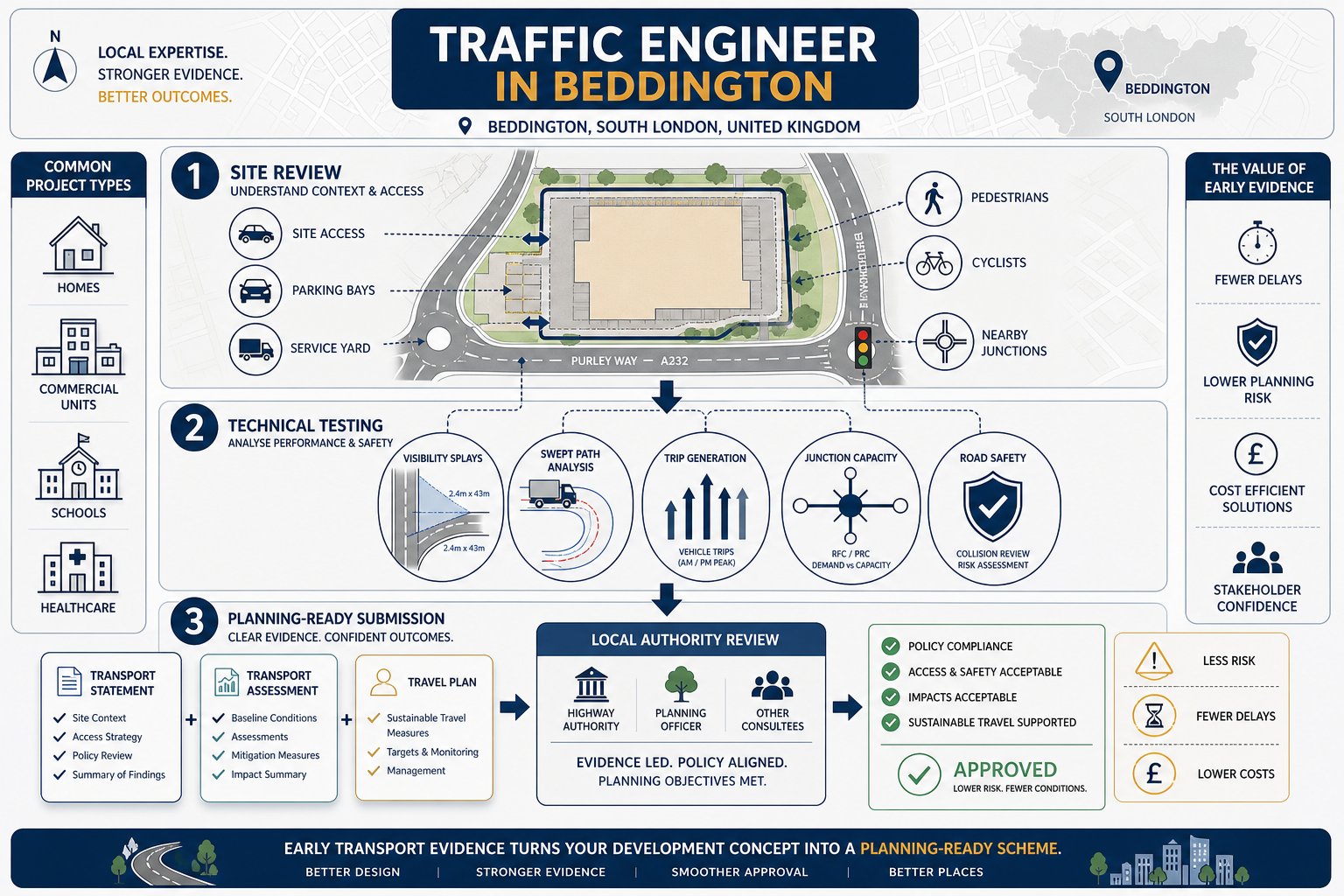
A planning application can look solid on paper and still stumble once highways issues are raised. In Beddington, that happens more often than many project teams expect. A site may seem straightforward, yet questions around access geometry, parking pressure, servicing, junction performance, pedestrian safety, or vehicle tracking can quickly become the part of the application that slows everything down.
That’s why a traffic engineer in Beddington is rarely an optional extra on anything beyond the simplest proposal. We’re usually brought in to answer the questions local planning officers, highway officers, developers, and design teams all need resolved before a scheme can move forward with confidence: can vehicles get in and out safely, will the surrounding network continue to operate acceptably, is the parking realistic, and does the evidence meet planning expectations?
In our experience, strong transport input is less about producing paperwork for its own sake and more about reducing avoidable planning friction. When reports, drawings, and assumptions are aligned early, applications tend to be clearer, more robust, and easier for decision-makers to review. For architects, planners, lawyers, surveyors, builders, developers, and public-sector teams working in and around Beddington, that can make a meaningful difference to programme risk, redesign costs, and eventually permission itself.
Key Takeaways
- A traffic engineer in Beddington is essential for demonstrating safe access, realistic parking, and acceptable impact on the local road network to secure planning approval.
- Early collaboration with architects, planners, and developers ensures transport input aligns with design proposals, reducing redesign costs and planning delays.
- Transport assessments in Beddington must be practical, site-specific, and proportionate, incorporating local standards for visibility, servicing, and junction performance.
- Swept path analysis is crucial for verifying whether vehicles, including refuse and emergency services, can safely manoeuvre within constrained development layouts.
- Clear, concise transport reports that pre-empt local authority questions significantly improve the likelihood of planning application success in Beddington.
- Providing detailed site information before instructing a traffic engineer helps tailor the assessment scope, avoiding under or over-specification and expediting the process.
Why A Traffic Engineer Matters For Development In Beddington
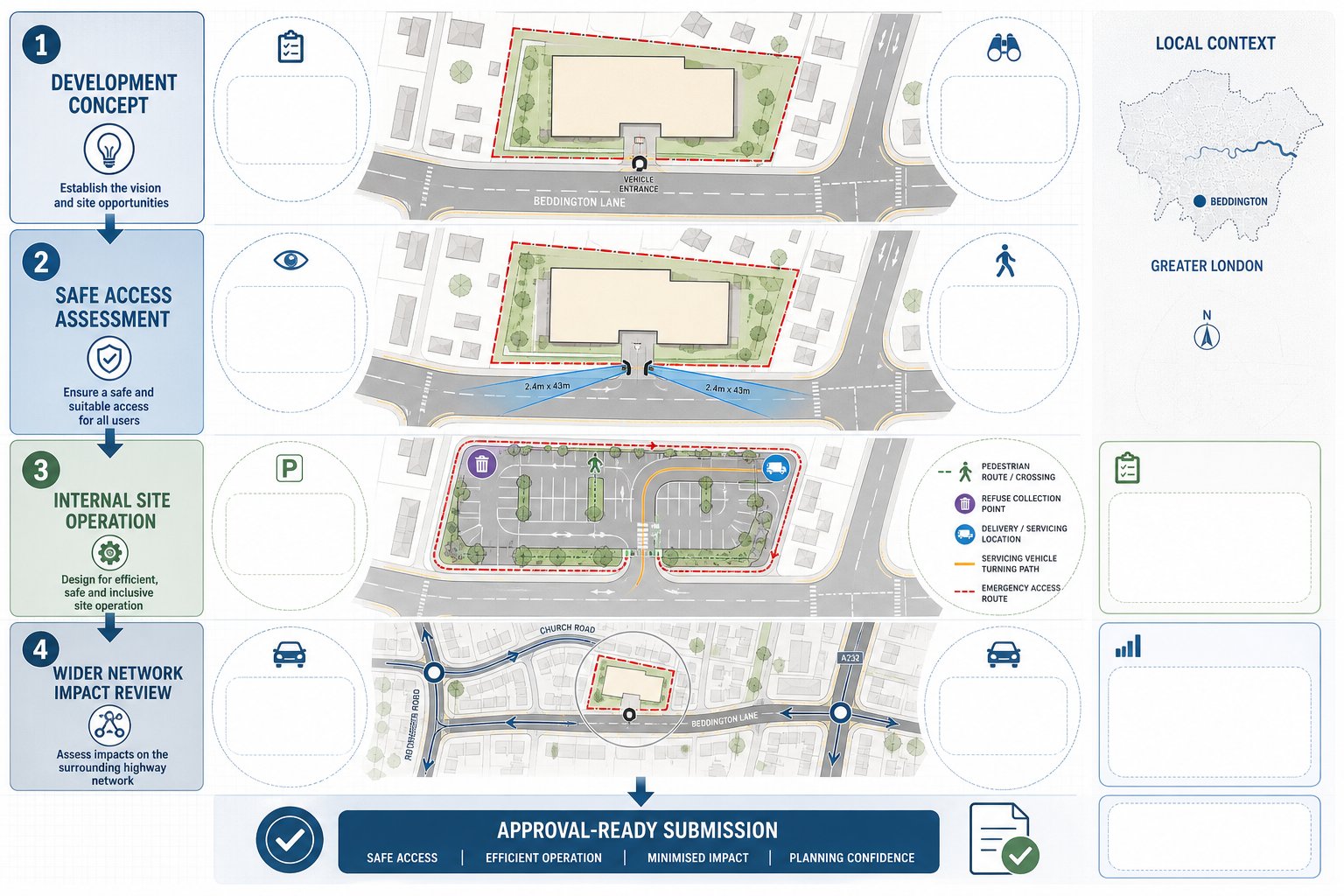
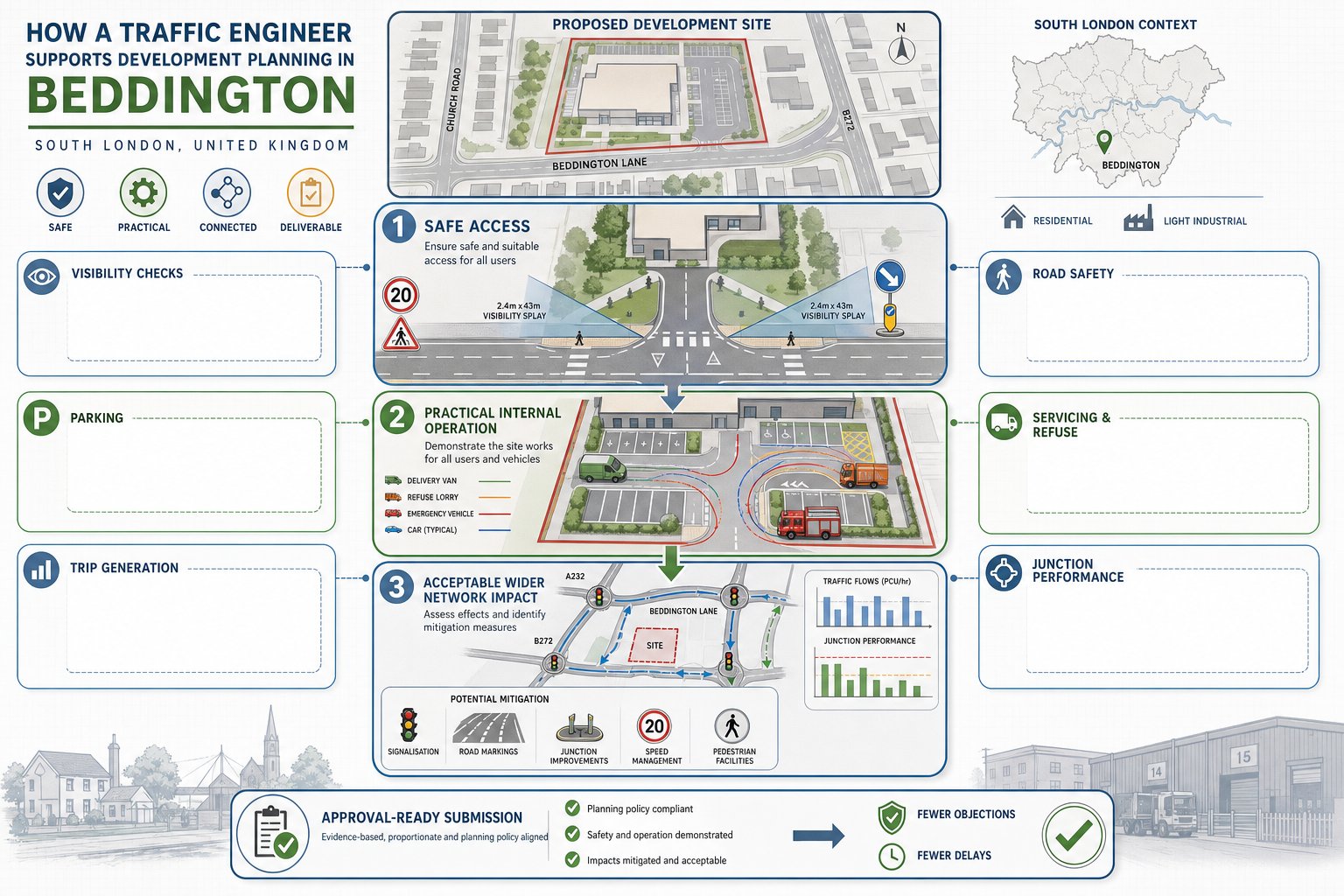
Development in Beddington doesn’t sit in a vacuum. Even modest schemes can affect how people arrive, depart, park, service buildings, cross roads, and interact with existing traffic conditions. That is exactly where a traffic engineer adds value: we turn a set of design proposals into technical evidence the planning system can test.
At application stage, the core job is usually to demonstrate three things. First, the scheme can be accessed safely. Second, it can function internally in practical day-to-day terms. Third, its wider effect on the road network is acceptable or can be mitigated. If any one of those is weak, objections or delay are much more likely.
For Beddington sites, the detail matters. A proposed access may need visibility checks. Parking may need to reflect local expectations rather than generic assumptions. Servicing might be the real issue, especially where delivery or refuse vehicles have limited room to manoeuvre. On larger sites, trip generation and nearby junction performance can become central.
We also find that transport input often saves time upstream. If a layout won’t support refuse tracking, emergency access, or workable turning, it’s far better to identify that before submission than after a planning response lands. Broader Traffic Engineering and Transportation principles are useful here, but local context is what turns theory into an approval-ready submission.
In short, a traffic engineer helps convert a development concept into something the local authority can assess with fewer unknowns and fewer avoidable concerns.
The Local Planning And Highway Context In Beddington
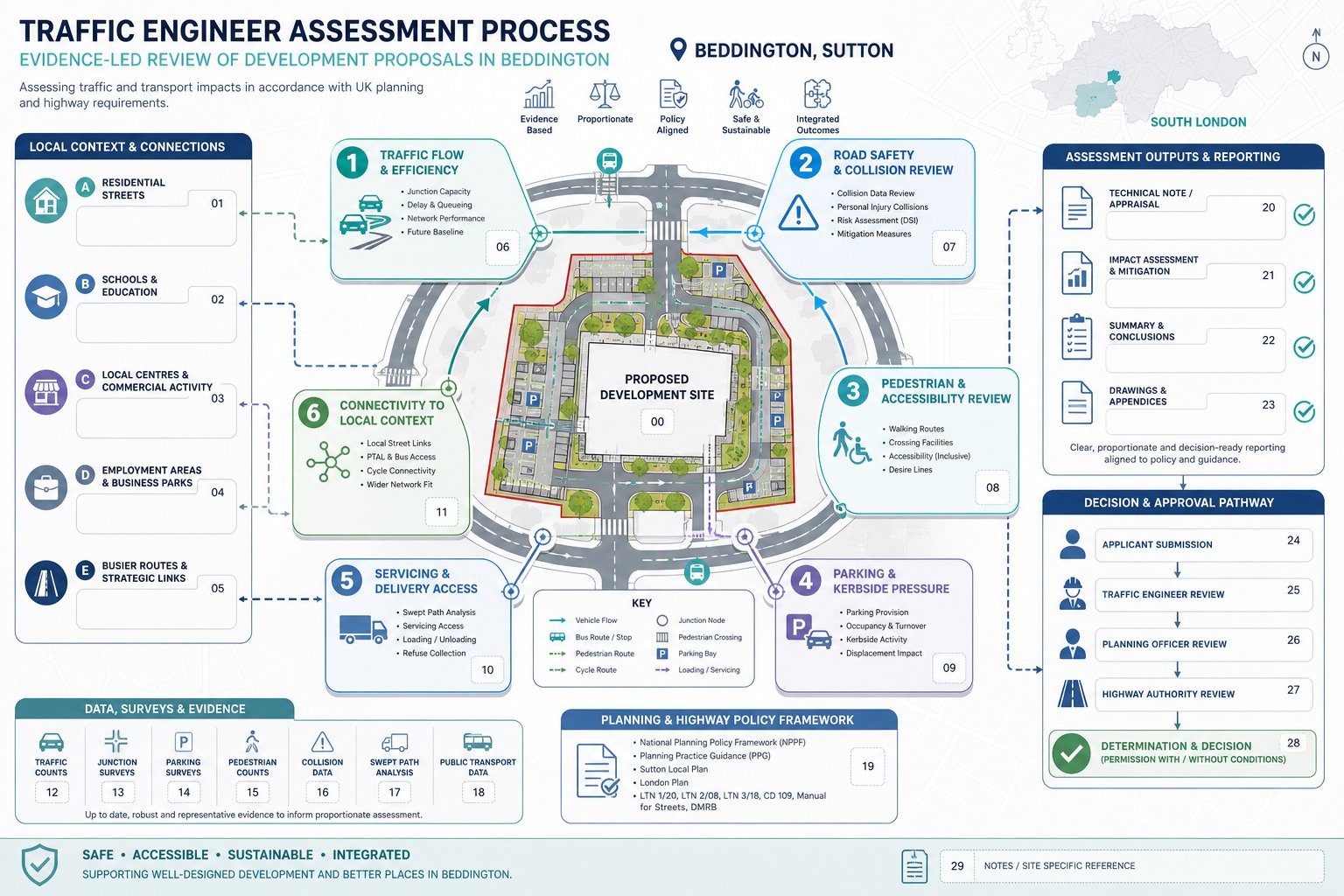
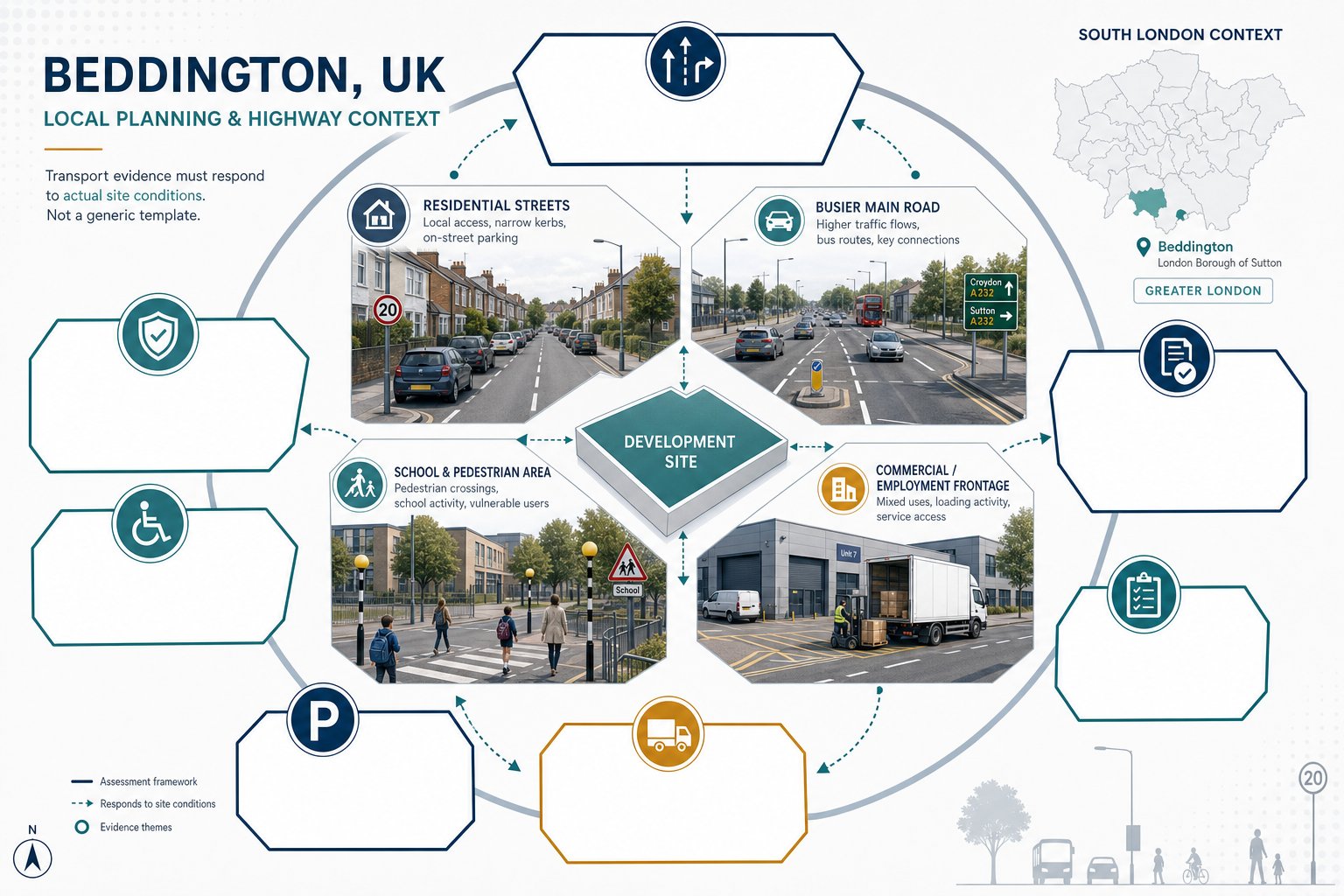
Beddington sits within a planning environment where transport evidence needs to be practical, policy-aware, and proportionate to the proposal. Local authorities are not simply asking whether a development is desirable in planning terms: they are also testing whether it works on the highway. That includes the efficiency of movement, user safety, accessibility, parking provision, servicing arrangements, and the relationship between the site and nearby roads.
In real applications, this means officers often want clear evidence rather than broad claims. Saying that traffic impact is “minimal” is rarely enough on its own. The submission should show how that conclusion was reached, what data was used, whether surveys are current, and how design standards or local expectations have been applied.
Beddington schemes can also vary significantly in context. Some are influenced by residential street constraints and kerbside pressure. Others sit closer to busier routes, employment areas, schools, or commercial activity where peak-hour conditions, servicing demand, and pedestrian movement become more sensitive. So the transport strategy has to respond to the actual site, not a template.
This is where experience helps. Our approach is to align reports with the likely concerns of planning and highway reviewers from the start, rather than treating transport as a late-stage add-on. That local-authority-led mindset is similar to what we discuss in Traffic Engineering Consultants: work more generally.
Put simply, the local context in Beddington shapes what evidence is needed, how much detail is proportionate, and which issues are likely to determine whether an application progresses smoothly.
Common Project Types That Need Traffic Engineering Input
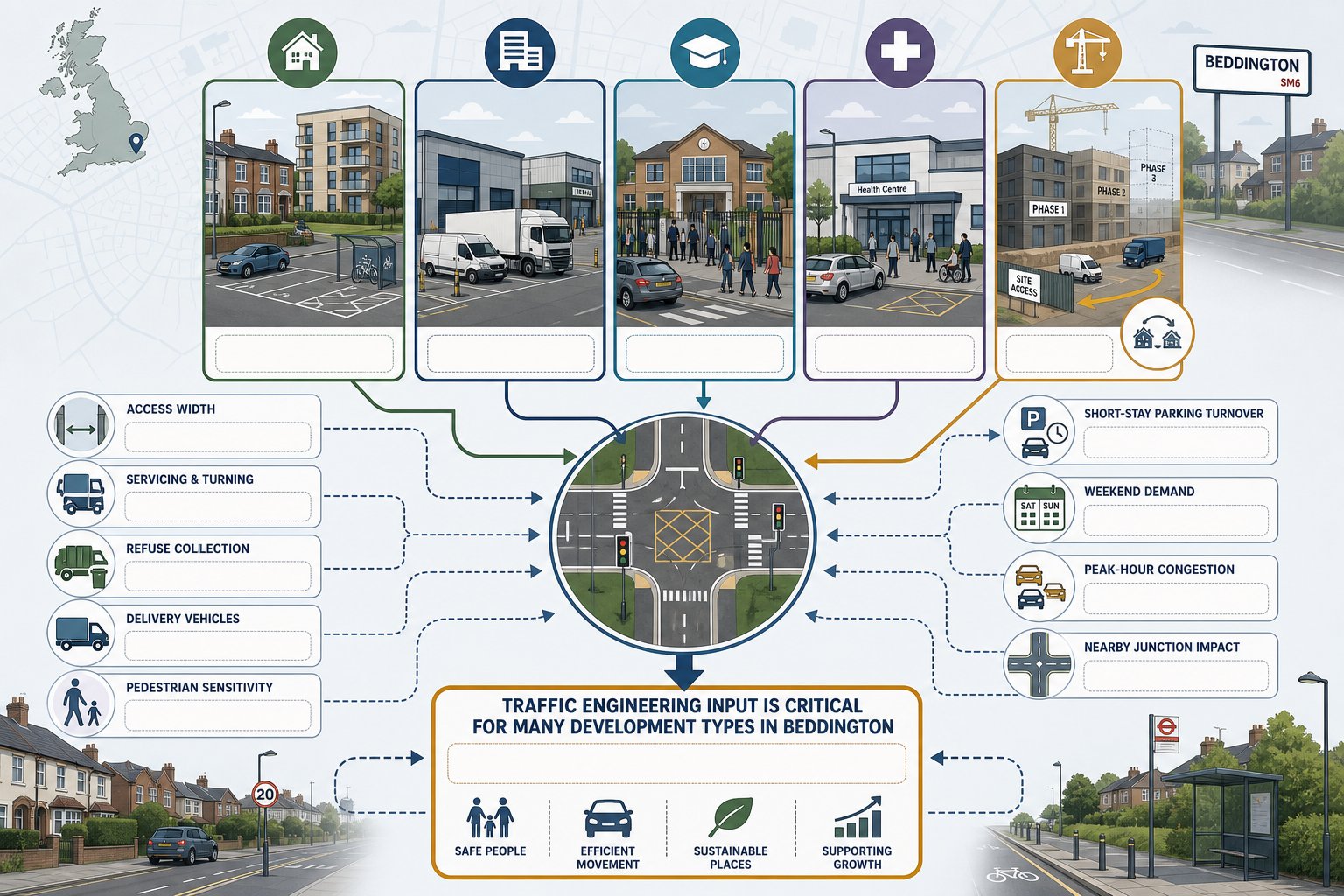
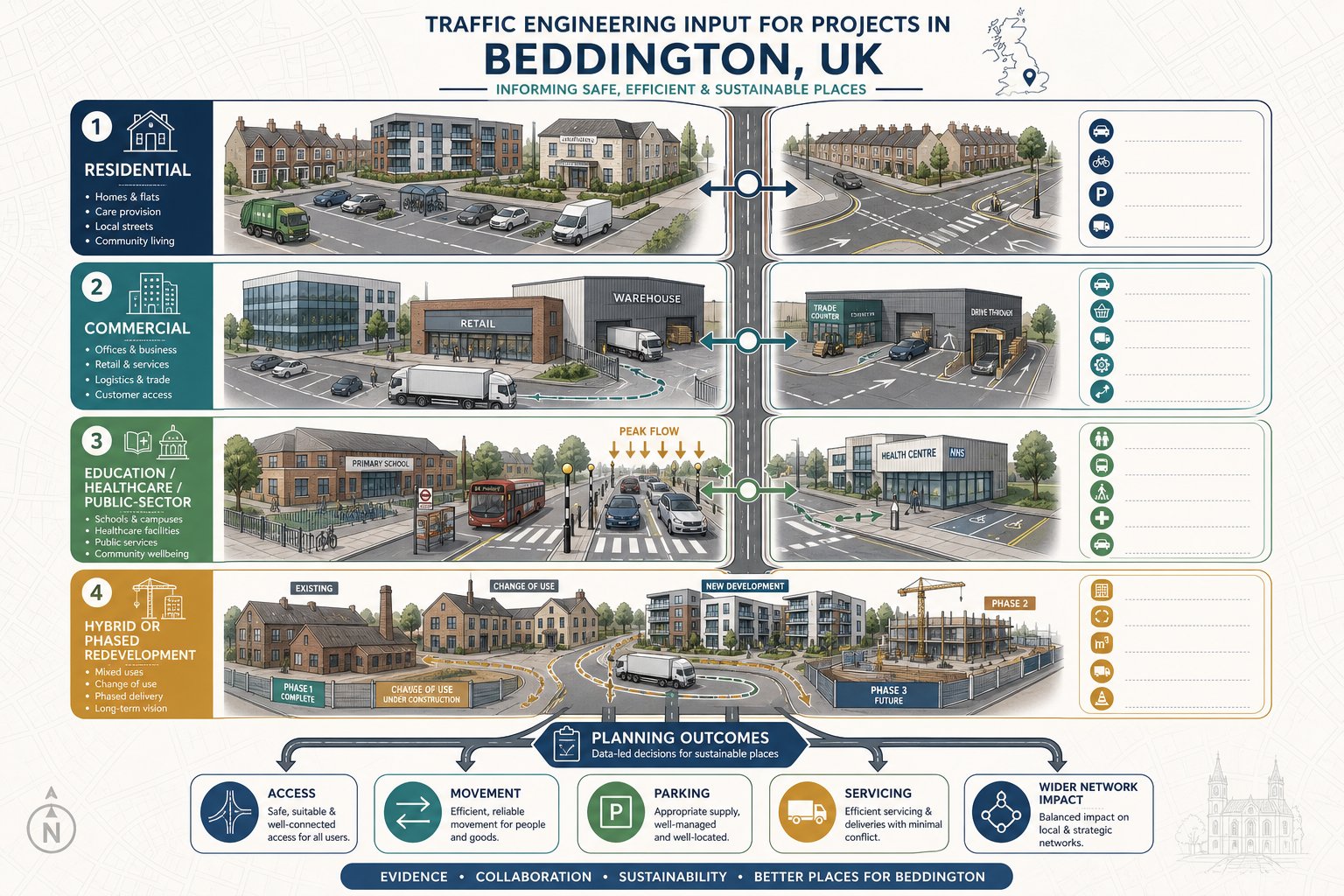
Not every development needs a full-scale transport assessment, but a surprisingly wide range of projects benefit from traffic engineering input in Beddington.
Residential schemes are the most obvious example. New houses, flats, care accommodation, and estate reconfigurations often raise questions about parking numbers, access width, refuse collection, delivery activity, cycle provision, and the effect of additional vehicle trips on nearby junctions.
Commercial development is another regular trigger. Offices, industrial units, trade counters, retail premises, drive-through formats, and storage uses can each generate very different traffic and servicing patterns. A warehouse may be defined less by staff arrivals than by HGV movement. A retail or mixed-use site may be shaped by short-stay parking turnover and weekend demand. That’s why Commercial Traffic Engineering input is often central to the planning case.
Education, healthcare, and public-sector schemes also need careful assessment. Schools and clinics can create sharp peak periods, informal stopping activity, and heightened pedestrian sensitivity. Even relatively small changes can attract scrutiny where existing road conditions are already tight.
Then there are hybrid or phased proposals: redevelopment of existing land, change of use, yard intensification, extra floor area, or revised site circulation. These are sometimes assumed to be simple because “something is already there”. In reality, the transport position may still need to be tested properly.
Across all of these project types, the common thread is straightforward: once access, movement, parking, servicing, or network impact could influence planning outcomes, traffic engineering becomes part of the critical path.
What A Traffic Engineer In Beddington Typically Assesses
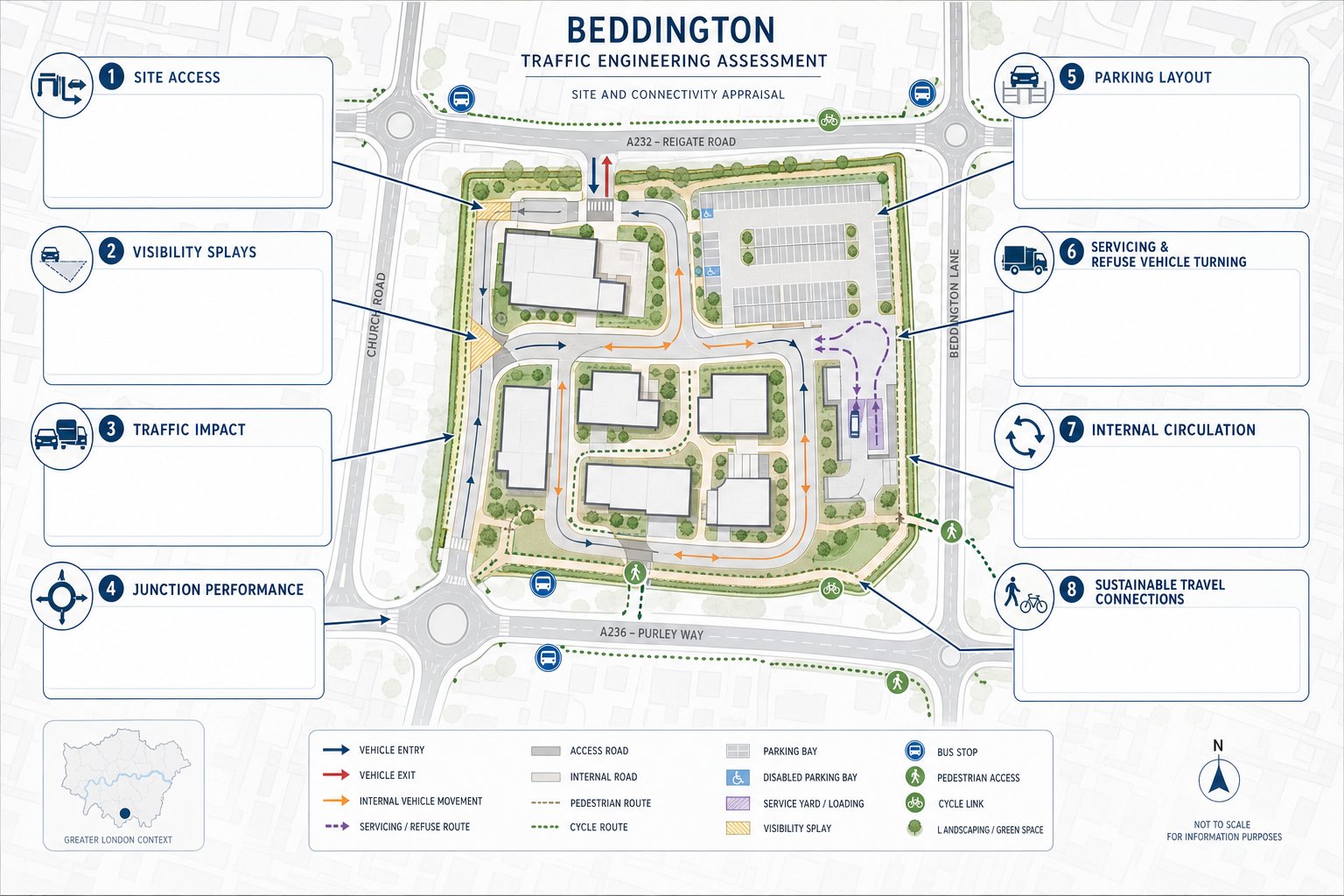
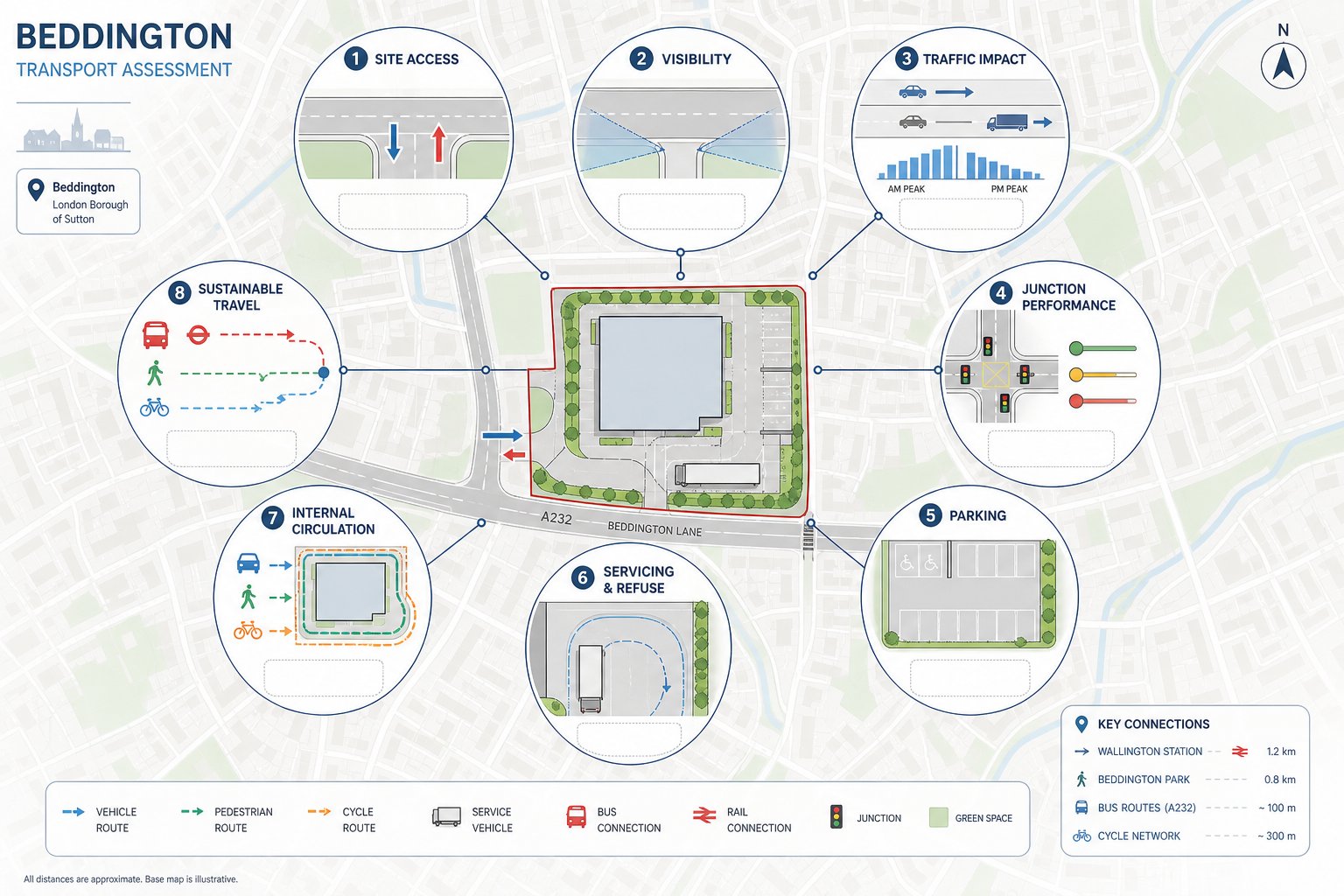
A traffic engineer in Beddington is usually looking at both the site itself and its relationship with the surrounding transport network. That sounds broad because it is broad. A scheme may stand or fall on one issue, but we need to understand the whole picture before we know which issue that will be.
Typical assessments include:
- Site access: Is the access location suitable? Can vehicles enter and leave safely? Is the geometry workable?
- Visibility: Are splays achievable and clear, and do they reflect road conditions and user behaviour?
- Traffic impact: How many trips is the development likely to generate, and when?
- Junction performance: Can nearby junctions continue to operate acceptably with forecast development traffic?
- Parking: Is the quantity and layout realistic for the proposed use?
- Servicing and refuse: Can delivery, waste, and emergency vehicles manoeuvre safely without creating conflict?
- Internal circulation: Will vehicles, cyclists, and pedestrians move through the site without avoidable friction?
- Sustainable travel: Are walking, cycling, and public transport connections sufficient for the scale and type of development?
The exact scope depends on the proposal. Some applications need a concise technical note. Others need surveys, modelling, drawings, and a full transport package. Either way, we are translating site constraints into evidence-based planning advice.
For teams working across multiple locations, the process is comparable to wider Traffic Engineer In London: planning support, but the thresholds, local sensitivity, and officer expectations still need a Beddington-specific response.
Transport Statements, Transport Assessments, And Travel Plans Explained
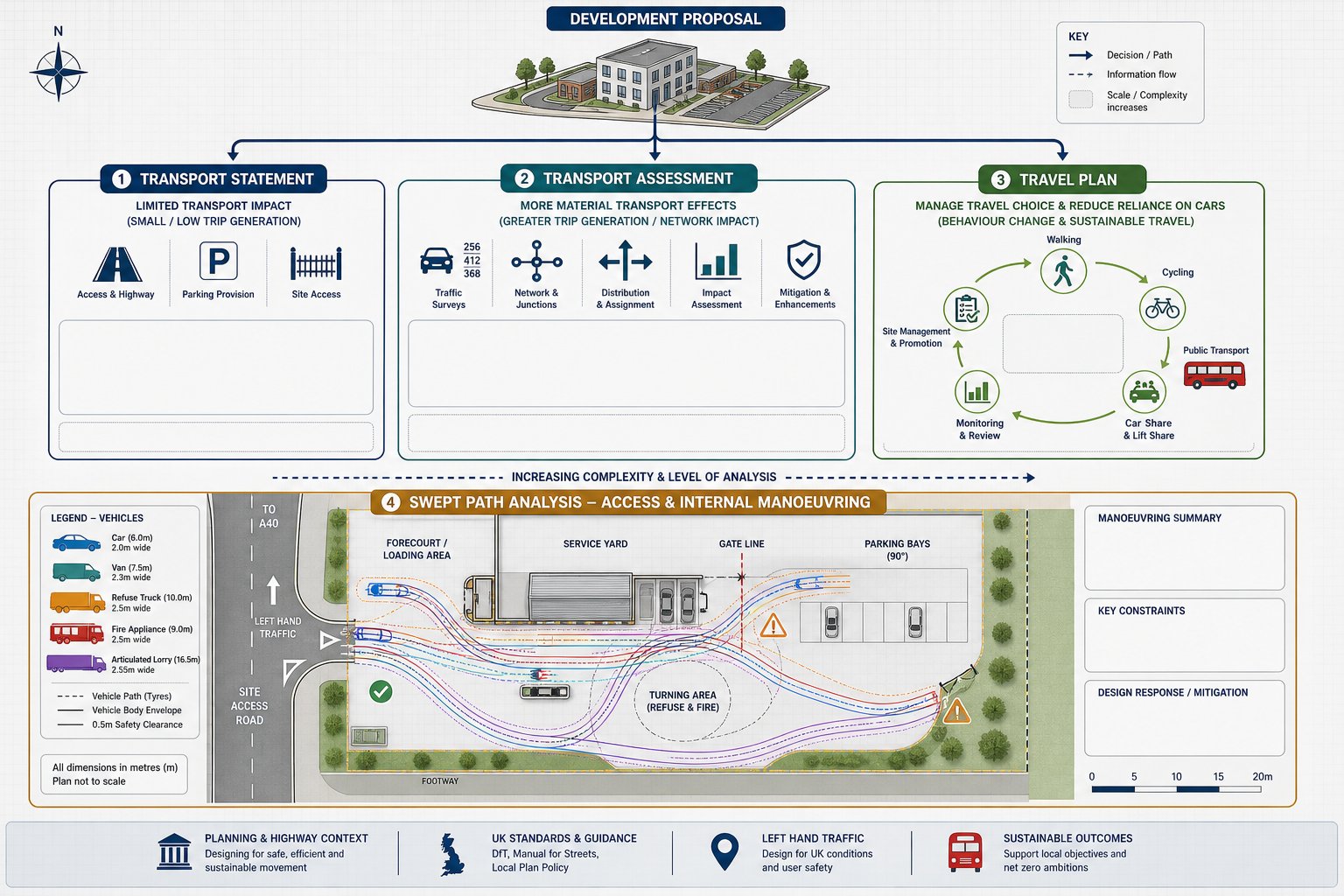
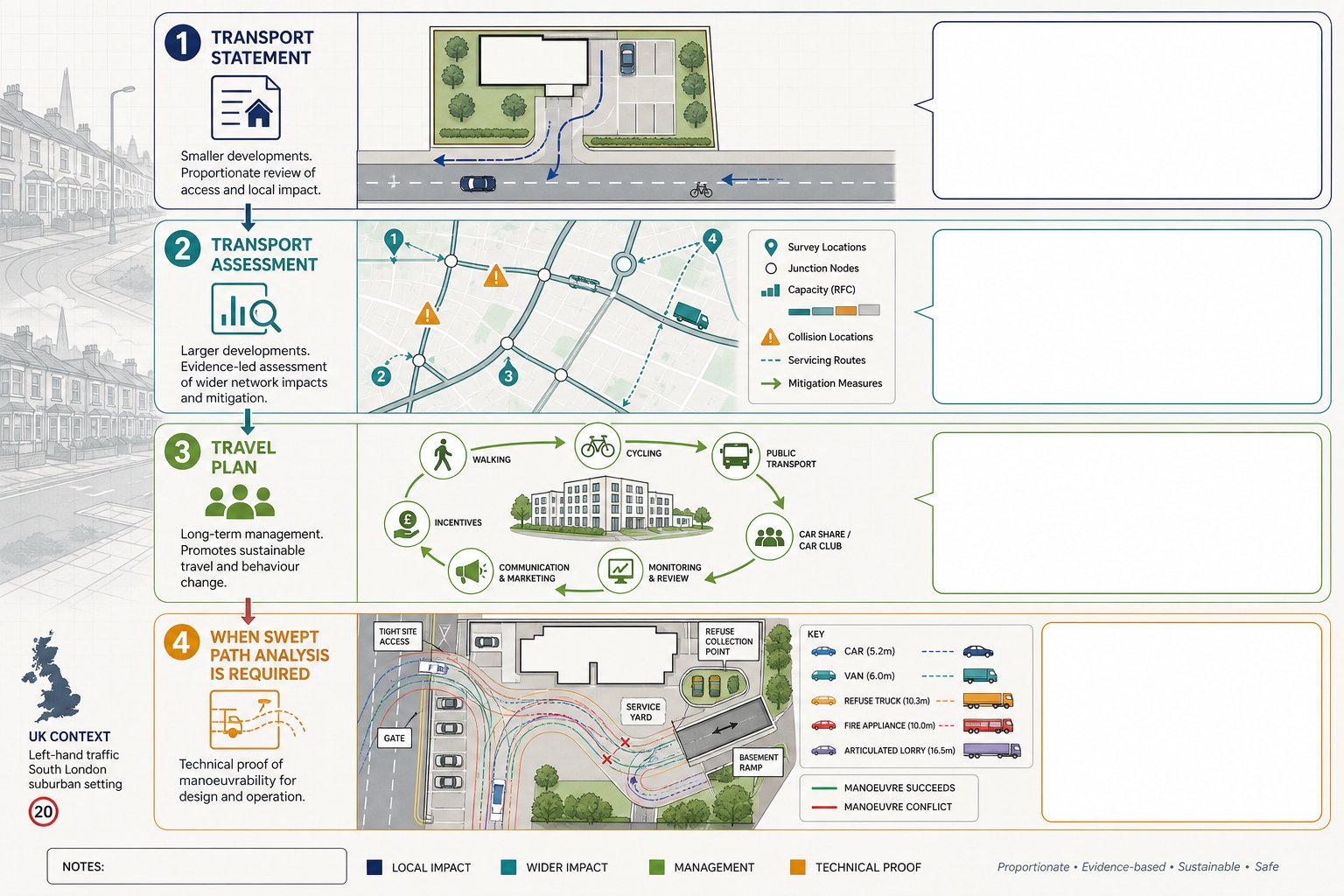
These documents are often mentioned together, but they do different jobs.
A Transport Statement is usually used for smaller or less intensive developments where the likely transport effects are limited. It explains the existing site context, the proposal, expected trip patterns, access arrangements, parking, servicing, and any modest mitigation that may be needed. The purpose is to show that the scheme is acceptable without turning the exercise into a disproportionate technical study.
A Transport Assessment is broader and more analytical. It is typically required where a proposal has more material transport implications. That might involve higher trip generation, more sensitivity around junctions, larger servicing demand, or a more complicated relationship with the surrounding road network. A Transport Assessment may include survey data, distribution and assignment of trips, capacity testing, collision review, and mitigation measures.
A Travel Plan focuses on how travel behaviour can be managed over time. It sets out practical measures to encourage sustainable travel, such as walking, cycling, public transport use, car sharing, monitoring, and site management actions. For some applications, especially employment, education, or larger mixed-use schemes, it forms a useful part of the planning package rather than a standalone afterthought.
The challenge is not just producing one of these documents: it’s choosing the right level of reporting. Over-specifying can waste time and cost. Under-specifying can create objections. Our Traffic Engineering: Your Complete approach is usually to match the scope tightly to local authority expectations and the actual scale of the scheme.
When A Swept Path Analysis Is Required
Swept path analysis is needed when vehicle movement cannot be assumed to work safely without proof. In practice, that often means tight accesses, constrained forecourts, basement ramps, service yards, refuse collection points, or developments where larger vehicles must enter, turn, load, and leave in forward gear.
The test is visual and technical at the same time. We use recognised vehicle types to check whether cars, vans, refuse trucks, fire appliances, or articulated delivery vehicles can manoeuvre within the available geometry without mounting kerbs, striking structures, or conflicting with other users.
It becomes particularly important where a layout looks plausible in plan form but is actually too tight in operation. That happens a lot. A few extra parking spaces can accidentally remove the turning area needed for waste collection. A gate position can restrict an HGV swing. An access that works for a car may fail completely for emergency use.
For planners and highway officers, swept path drawings provide quick clarity. They show whether a scheme functions in the real world, not just on an architect’s layout.
How Parking, Servicing, And Access Are Evaluated
Parking, servicing, and access are often reviewed together because they interact constantly. A site can have enough parking numerically and still fail because vehicles cannot reach spaces comfortably, service vehicles block circulation, or the access point creates conflict with passing traffic or pedestrians.
Parking evaluation starts with quantity, but it does not end there. We look at the likely demand by land use, local standards, practical occupancy, disabled provision, cycle parking, and whether spaces are usable rather than just drawn. Tight bays, awkward aisles, or tandem arrangements can undermine an otherwise compliant schedule.
Servicing needs a separate lens. Deliveries, refuse collection, maintenance, and emergency access all bring different vehicle requirements. The real question is whether these operations can happen routinely and safely without overspill onto the highway or disruption within the site. On mixed-use developments, the answer may depend on timing restrictions or management plans as much as geometry.
Access assessment then ties it together. We consider location, width, radii, visibility, approach speeds, pedestrian desire lines, and whether vehicles can enter and exit in a manner the highway authority is likely to accept. If an access feels marginal, it usually needs stronger evidence or redesign.
This is where concise technical work can save a project. Clear drawings, realistic assumptions, and properly tested manoeuvres tend to carry more weight than broad assurances. The same planning-first logic underpins our work as a Traffic Engineer In other urban locations as well, even though the local detail always changes.
Junction Capacity And Trip Generation: What Planners Need To See
If a development is likely to add noticeable traffic, planners will usually want to know two things: how many trips it will generate, and whether the surrounding junctions can absorb them acceptably.
Trip generation is normally estimated using comparable development data, existing site conditions, and professional judgement. That sounds simple, but it is one of the areas where weak assumptions can damage credibility. A forecast needs to reflect the land use, scale, local travel characteristics, and whether there is already an active lawful use on site. For redevelopment, the net effect often matters more than the gross headline number.
Once trips are established, they need to be assigned onto the network in a way that makes sense geographically and operationally. Then, where proportionate, nearby junctions are reviewed to understand whether queues, delays, or reserve capacity are likely to worsen materially.
Planners are not necessarily looking for perfection. They are looking for evidence that the likely effect has been understood and that any pressure points have been identified honestly. In some cases, the result will show negligible impact. In others, modest mitigation may be enough: lining changes, access amendments, delivery controls, or travel plan measures.
What tends to reassure reviewers most is transparency. If inputs, assumptions, and conclusions are clear, the technical case is much easier to follow. That is a consistent theme across Traffic Engineer In Bristol: and similar planning work elsewhere: believable evidence travels further than optimistic language.
Road Safety, Visibility, And Highway Design Considerations
Safety is rarely one single issue. It is usually the combined effect of layout, driver behaviour, visibility, speed environment, pedestrian activity, signage, markings, lighting, and how intuitive the access arrangement feels in practice.
Visibility is often the first test. Can drivers emerging from the site see approaching traffic clearly enough? Can pedestrians be seen where crossings or footway continuity are affected? If boundary features, parking, planting, or street furniture compromise sightlines, that may need redesign rather than explanation.
But visibility alone is not the whole story. We also look at whether the proposed access sits in a sensible position relative to bends, junctions, bus stops, crossing points, and existing turning movements. A technically measurable splay can still feel uncomfortable if the design creates conflict or ambiguity.
Highway design considerations can include carriageway width, corner radii, tracking space, gradient, drainage interaction, surface treatment, and the relationship between vehicles and vulnerable users. On some sites, a minor amendment to kerb alignment or internal layout makes the difference between an objection and an acceptable scheme.
Collision history may also be relevant where there is concern about an existing road safety pattern. If there is a known issue nearby, the development should not appear to ignore it.
At its best, traffic engineering is preventive. We identify where a layout might generate avoidable conflict before it reaches committee papers or technical consultation responses. That’s not glamorous, admittedly, but it is often where planning risk is reduced the most.
Working With Architects, Planning Consultants, And Developers
The strongest planning submissions are usually collaborative rather than sequential. If the architect draws a layout, the planning consultant writes the statement, and the transport input arrives at the end, problems tend to surface late and cost more to fix.
We prefer to work with the wider team early. Architects need to know whether an access is likely to be supportable before the layout hardens. Planning consultants need transport evidence that aligns with the planning narrative rather than sitting beside it awkwardly. Developers need clarity on what level of technical work is actually necessary, what risks exist, and where design changes will have the biggest payoff.
Lawyers, surveyors, and builders also play a role. Rights of access, land constraints, servicing practicality, and construction logistics can all affect how a planning submission should be framed. A transport report is stronger when it reflects those real-world constraints instead of pretending they don’t exist.
This coordination matters especially on live projects with tight programmes. A quick, concise report is useful only if it is also accurate and defensible. With more than 30 years of combined practical perspective behind many planning-led transport instructions, we’ve found that early coordination usually reduces redesign cycles and weakens fewer applications on avoidable technical points.
In that sense, transport is not a bolt-on discipline. It is part of the design conversation. And when the whole team treats it that way, submissions tend to be cleaner, clearer, and easier for local authority reviewers to process.
Preparing For Local Authority Review And Planning Submission
By the time an application reaches local authority review, transport issues should already be organised into a coherent and proportionate evidence package. That usually means the submission is not just technically correct, but also easy to follow.
A good planning transport package commonly includes the right report type, current survey information where needed, access drawings, tracking plans if relevant, parking and cycle details, servicing strategy, and a clear explanation of likely impacts and mitigation. If there are constraints, it helps to address them directly rather than hoping they will be overlooked. They won’t be.
Reviewers tend to respond better when the report answers obvious questions in advance: Why is this level of assessment proportionate? How were trips forecast? Why is the parking acceptable? Can refuse vehicles turn? Are pedestrian routes protected? Is there any material impact on nearby junctions? Clear structure matters almost as much as technical content.
That is why we focus on concise, planning-led reporting rather than unnecessary bulk. Submissions should be robust, but they should also be readable. Our wider Birmingham Transport Consultant: Planning-Led approach reflects the same principle: make the evidence clear enough that officers can understand it quickly and trust it.
What To Provide Before Instructing A Traffic Engineer
A better brief usually leads to a better report. Before instructing a traffic engineer, it helps to provide:
- site address and location plan
- existing and proposed land use
- proposed unit numbers, floor areas, or operational details
- layout drawings and access arrangements
- parking and cycle numbers
- servicing, refuse, and delivery information
- any known planning history
- existing transport surveys or technical reports
- target submission timetable
- details of any pre-application advice already received
If some of that information is missing, we can often still advise on the likely scope. But the more complete the starting pack, the faster we can identify whether the scheme needs a Transport Statement, Transport Assessment, Travel Plan, swept path analysis, junction review, or simply targeted technical notes.
That early clarity tends to prevent two common problems: under-scoping the work and producing transport evidence too late to influence the design.
Conclusion
In Beddington, transport evidence is often the difference between a scheme that feels uncertain and one that is clearly planning-ready. Safe access, workable parking, realistic servicing, junction performance, and road safety are not side issues: they are central to whether development can be supported.
For architects, planners, developers, lawyers, surveyors, builders, and local authority teams, the practical aim is usually the same: remove avoidable doubt before the application is tested. That means proportionate reporting, credible assumptions, and transport advice that responds to the real site rather than a generic template.
We see the best outcomes when traffic engineering is brought in early enough to shape the proposal, not just defend it. In a place like Beddington, that early planning-focused approach can lead to faster submissions, stronger evidence, and fewer technical surprises when the application is under review.
Frequently Asked Questions About Traffic Engineering in Beddington
Why is a traffic engineer essential for development projects in Beddington?
A traffic engineer provides crucial technical evidence showing that a development can be accessed safely, has realistic parking and servicing arrangements, and will not unduly impact the local road network, supporting smoother planning approval.
What types of developments typically require traffic engineering input in Beddington?
Projects like residential schemes, commercial developments, education and healthcare facilities, and phased redevelopments commonly need assessments covering parking, access, servicing, and traffic impact to meet planning requirements.
How does a traffic engineer assess parking, servicing, and site access for new developments?
They evaluate parking numbers against local standards, ensure service vehicles can manoeuvre safely without blocking site circulation, and assess access points for safe vehicle entry and exit considering local traffic conditions.
What is a swept path analysis and when is it necessary in Beddington?
Swept path analysis checks if vehicles like refuse trucks or emergency services can manoeuvre safely within site layouts, especially where space is limited. It’s required to validate tight accesses, service yards, or complex turning areas.
How do traffic engineers determine if nearby junctions can handle additional development traffic?
They forecast trip generation based on the development’s characteristics, assign these trips to the network logically, and assess junction operation to ensure queues or delays won’t worsen unacceptably, recommending mitigation if needed.
What should be provided before instructing a traffic engineer in Beddington?
Supplying the site location, proposed use, layout drawings, access plans, parking numbers, servicing details, any existing transport surveys, and submission timelines allows quicker, more tailored traffic assessment aligned with local authority expectations.