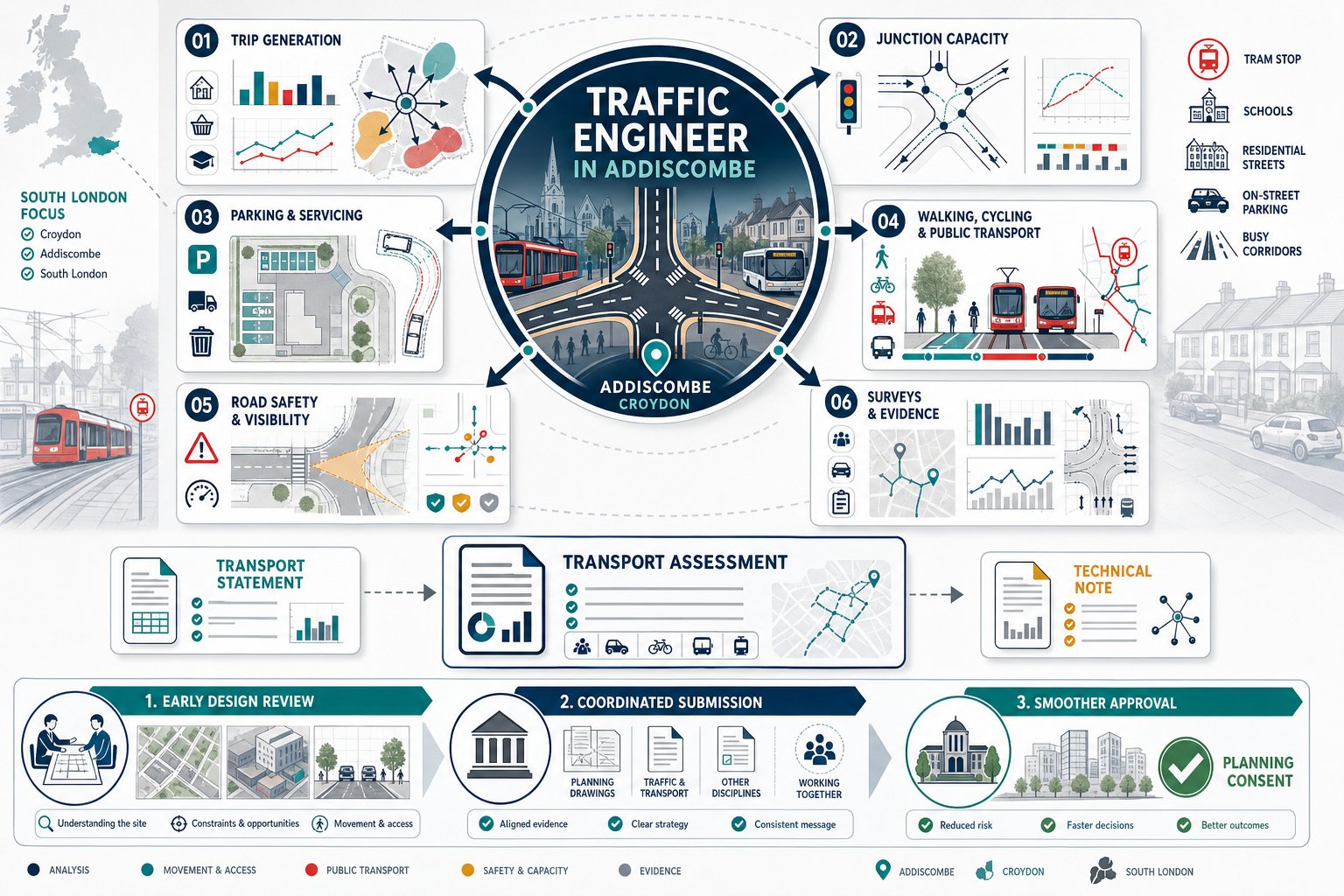
Planning in Addiscombe rarely fails because of one dramatic highways issue. More often, schemes stall because the transport case isn’t tight enough: trip rates feel optimistic, parking pressure has been brushed aside, a visibility check is incomplete, or Croydon’s likely concerns haven’t been anticipated early. That’s where a traffic engineer in Addiscombe becomes central to the planning team rather than a late-stage add-on.
We work with architects, planning consultants, developers, solicitors and local authorities to turn transport risk into clear evidence. In practice, that means testing how a proposal affects local roads, junctions, access, servicing, road safety and sustainable travel, then presenting the findings in a form planning officers and highway officers can actually use. In a place like Addiscombe, with tram influence, busy bus corridors, school traffic, constrained residential streets and real parking stress, generic transport reporting often doesn’t go far enough.
A good report is not just technically competent. It is locally aware, proportionate to the scale of development, and aligned with Croydon and London policy. In 2026, that still means the fundamentals matter: robust survey data, realistic assumptions, recognised modelling tools and drawings that match the written case. But it also means moving quickly, coordinating with the wider design team and resolving issues before they turn into objections.
Below, we set out what a traffic engineer in Addiscombe actually does, when different report types are needed, and how to avoid the common transport mistakes that slow planning decisions down.
Key Takeaways
- A traffic engineer in Addiscombe plays a crucial role in preparing robust, locally informed transport evidence that supports planning applications and anticipates Croydon’s specific concerns.
- Selecting the appropriate report type—Transport Assessment, Transport Statement, or Technical Note—depends on the development’s scale, location sensitivity, and expected transport impact, ensuring proportional and effective submissions.
- Accurate trip generation, parking stress analysis, junction capacity reviews, and safety assessments must reflect Addiscombe’s unique traffic patterns, parking pressures, tram and bus influence for credible transport cases.
- Early collaboration between traffic engineers, architects, planning consultants, and local authorities helps identify and resolve transport issues quickly, reducing delays in planning approvals.
- Transport evidence should not rely on generic templates but integrate real local conditions, sustainable travel considerations, and consistent, clear reporting aligned with Croydon and London policies.
What A Traffic Engineer In Addiscombe Does For Planning Applications
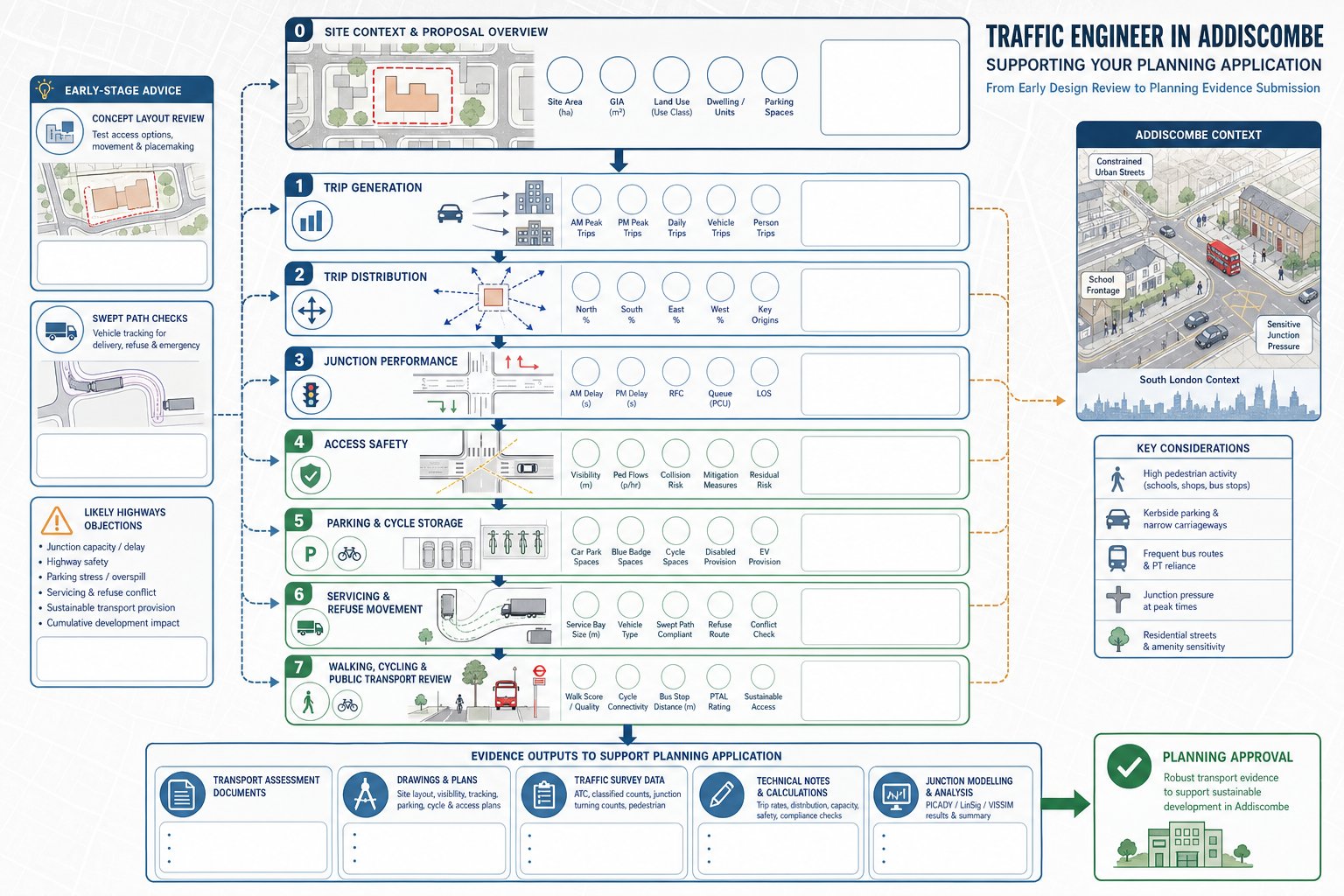
A traffic engineer in Addiscombe assesses whether a proposed development can function safely and acceptably within the surrounding highway network, and whether the planning submission includes the right evidence to prove it. That sounds simple. It rarely is.
In most planning applications, we are asked to answer a cluster of linked questions. How many trips will the scheme generate? Where will those trips go? Will nearby junctions continue to operate acceptably? Is the access safe? Is there enough parking, cycle storage and servicing space? And does the proposal support walking, cycling and public transport in a way that aligns with policy?
The output usually takes the form of a Transport Assessment, Transport Statement or targeted Technical Note, supported by drawings, survey data and, where needed, junction modelling. Our role often starts well before submission. We review concept layouts, flag likely highways objections, advise on swept paths, parking strategy and refuse collection, and help shape a scheme before design choices harden.
That early-stage input matters because planning transport work is rarely just about calculation. It is also about judgement. Local authorities want concise, defensible evidence, not a stack of generic text. Our approach is similar to the wider principles discussed in Traffic Engineering Consultants: practical planning support, where the best outcomes usually come from integrating highways advice with architecture and planning strategy from the outset.
In Addiscombe, local context sharpens every one of those tasks. A seemingly modest infill scheme can trigger serious scrutiny if it sits on a constrained street, near a school, or close to a sensitive junction already under pressure.
When A Transport Assessment, Transport Statement, Or Technical Note Is Needed
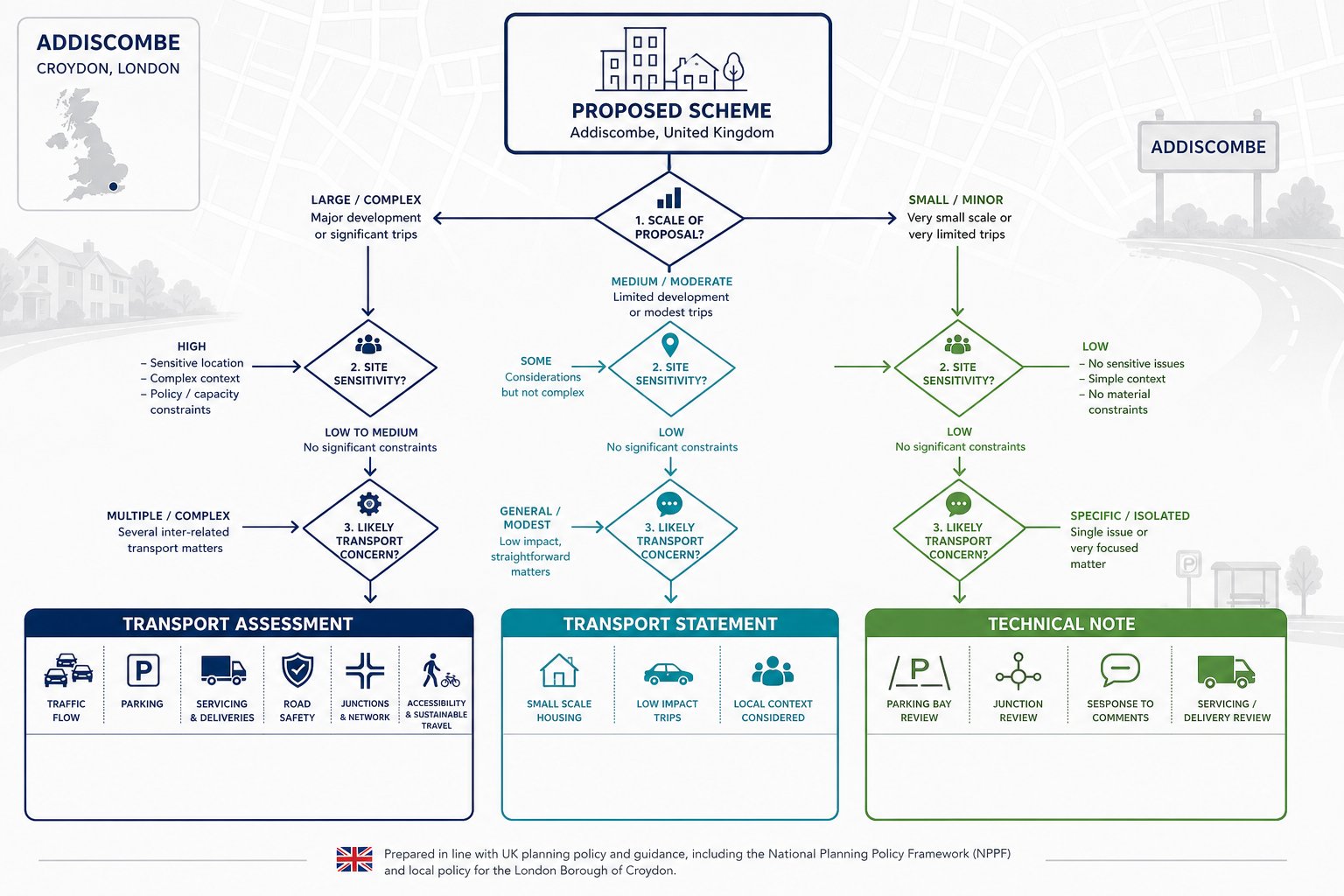
The right report depends on the scale of the proposal, the sensitivity of the location and the type of concern likely to arise.
A Transport Assessment (TA) is typically needed for schemes with potentially material effects on traffic, parking, servicing or safety. In Addiscombe, that can include larger residential schemes, education uses, food retail, healthcare, places of worship, or mixed-use proposals with noticeable arrival peaks. A TA is broader and more detailed: it usually covers existing conditions, trip generation, distribution and assignment, sustainable travel, collision review, parking, servicing, accessibility and junction impact.
A Transport Statement (TS) suits smaller developments where impacts are expected to be limited. It is still evidence-based, but more proportionate. For example, a modest residential conversion or a small infill scheme may not justify extensive modelling if the access arrangements are straightforward and the trip impact is low.
A Technical Note is narrower. It may respond to one transport issue only: perhaps a parking stress review, a junction sensitivity test, a rebuttal to consultee comments, or a clarification of servicing arrangements. Technical Notes are often the difference between a validation-ready submission and a delayed one because they let us address a precise concern without overcomplicating the wider application.
The choice should never be arbitrary. National planning guidance expects evidence to be proportionate, while Croydon’s local context often pushes teams to justify assumptions properly. We often draw on the broader approach outlined in Traffic Engineering and development planning guidance: choose the lightest report that still answers the real transport questions. Under-cooking the evidence is usually more expensive than preparing the right document first time.
Addiscombe Planning Context And Why Local Highway Knowledge Matters
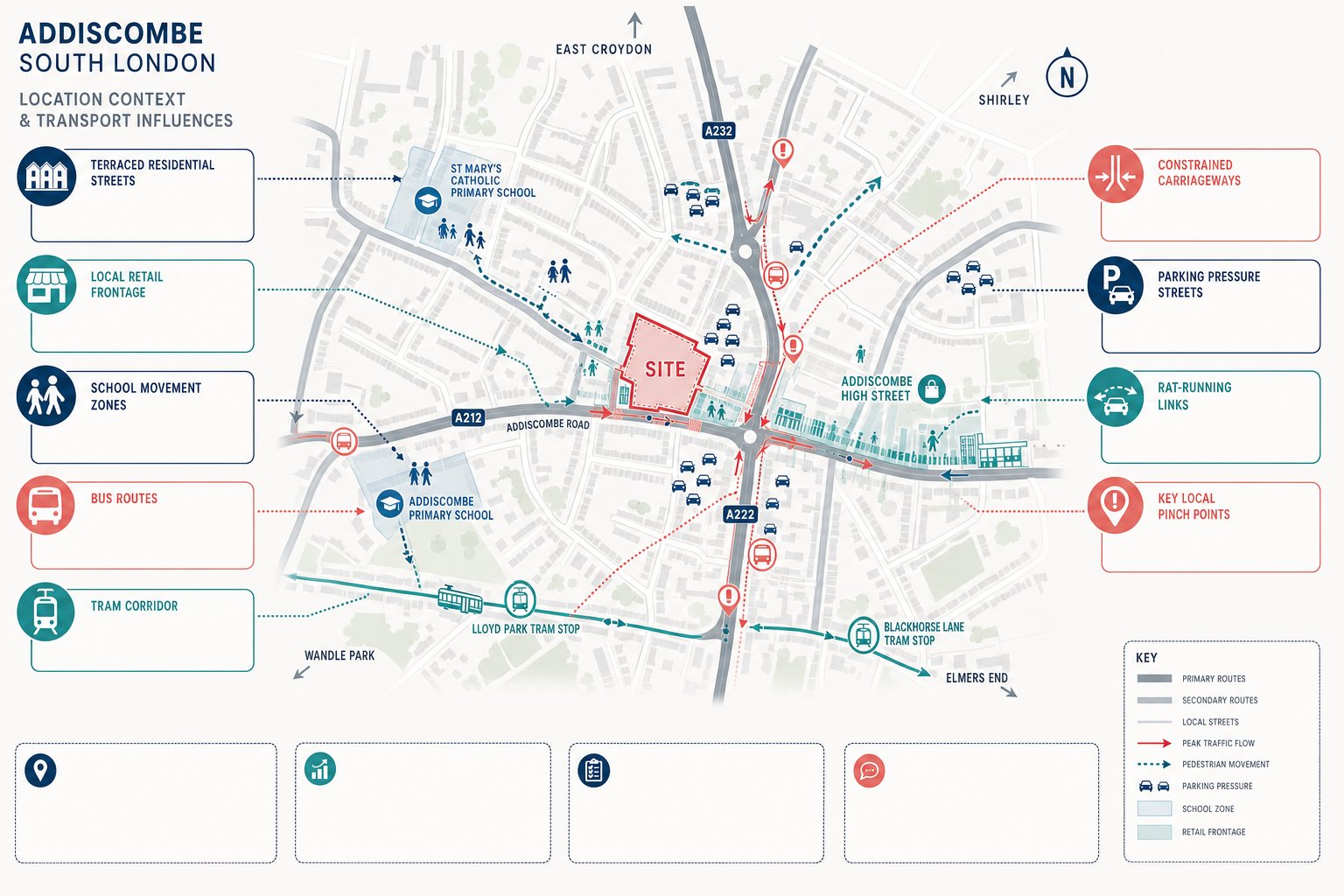
Addiscombe is one of those places where local knowledge changes the credibility of the entire assessment. On paper, two sites with the same land use and floor area might look similar. On the ground, they can behave very differently.
The area combines terraced residential streets, local shopping frontage, school movements, bus activity and the operational influence of the tram network. Peak periods are not only commuter-led. School drop-off and pick-up patterns can dominate certain roads. Parking demand can spill unpredictably into nearby side streets. Some corridors experience rat-running when conditions worsen elsewhere. And residents are usually very aware of existing pressure points.
That matters because Croydon officers and local stakeholders tend to spot weak assumptions quickly. If a report treats Addiscombe like a generic suburban location, it can lose authority fast. We hence look beyond standard desktop review. We consider Controlled Parking Zones, known traffic management changes, local implementation priorities, street hierarchy, frontage activity, and how people actually move through the area.
This is where a locally informed Traffic Engineer In London: context helps. London boroughs share policy themes, but each one has its own thresholds, officer expectations and local pinch points. In Addiscombe, issues such as tram accessibility, constrained carriageways and on-street parking pressure can become central even for relatively modest schemes.
A robust transport case should hence sound like it belongs to the site. The assumptions, survey timing, mitigation and narrative all need to reflect the real operating conditions around the development, not a borrowed template.
Key Trip Generation And Traffic Impact Issues In Addiscombe
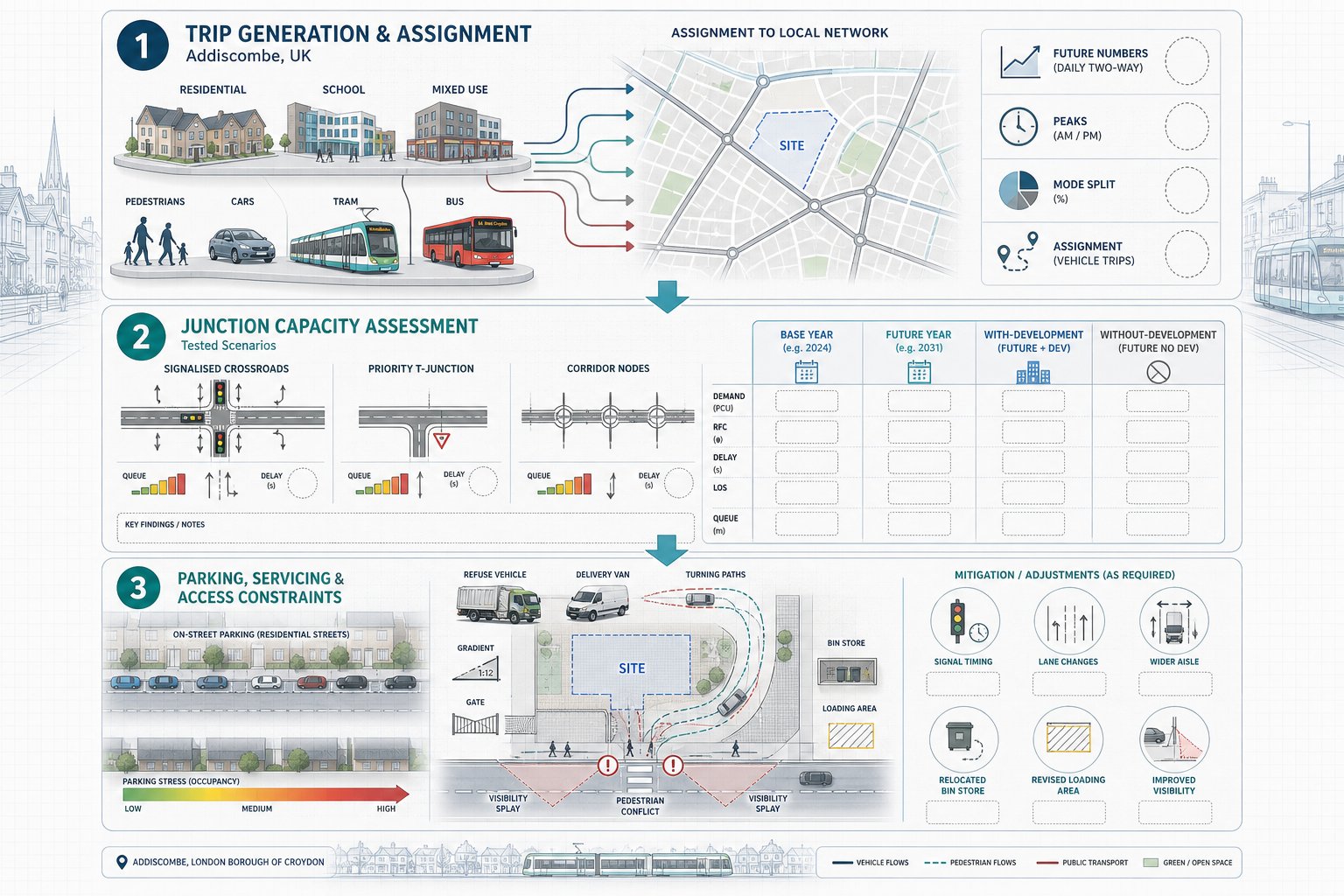
Trip generation is often the point where transport reports either become persuasive or start to wobble. We estimate how many person trips and vehicle trips a development is likely to create, when those trips happen, how they split by mode, and where they load onto the local network.
That process usually starts with recognised databases and comparable sites, but Addiscombe rarely rewards a copy-and-paste approach. Residential schemes may show lower car-driver rates in locations with strong tram and bus access, yet that does not remove the need to test servicing, visitor activity, delivery demand and parking displacement. A nursery or school expansion can produce short but intense peak effects. Small mixed-use schemes can create overlapping travel patterns that are modest in total but awkward in timing.
We hence sense-check every forecast against local reality. Are public transport links genuinely attractive for the target users? Is there a meaningful difference between weekday AM peak and school-start conditions? Are there nearby controls, filters or turning constraints that alter assignment? Where justified, local surveys help calibrate assumptions.
Impact assessment then follows the trips through the network. The broader discipline described in Highway And Traffic planning work is relevant here: numbers alone are not enough: what matters is whether they change operation, safety or amenity in a material way.
Junction Capacity And Network Performance Considerations
Nearby junctions are often the first formal test of whether a scheme is acceptable. We review which nodes are genuinely sensitive, gather traffic counts, and assess operation using established tools such as ARCADY, PICADY, LINSIG, Synchro or, for more complex cases, microsimulation.
The aim is not to model everything in sight. It is to identify the junctions where additional demand could worsen queueing, delay or reserve capacity in a way officers will care about. In Addiscombe, that may include signalised corridors, school-influenced side roads, priority junctions with difficult right turns, or locations already operating close to practical capacity.
We normally test base year and future year scenarios, with and without development, and include committed development where relevant. If the results show pressure, mitigation may be possible through signal timing review, lane discipline changes, access amendments or a more realistic trip strategy.
Good capacity work also requires honesty. Over-smoothing traffic growth or selecting an unrepresentative survey day tends to come back later in review comments.
Parking Stress, Servicing, And Access Design Constraints
Parking and servicing are where smaller schemes often hit resistance. Addiscombe contains streets where overnight occupation is already high and informal parking behaviour tells you more than a standards table ever will. So we do not stop at policy maximums or minimums: we examine actual demand and likely displacement.
Parking stress surveys, usually undertaken overnight and sometimes at additional peak periods, help show whether residual on-street capacity exists. That evidence is especially important for car-free or low-parking schemes in areas where residents already perceive stress. We then compare the findings with London Plan and Croydon expectations.
Servicing is equally important. Refuse vehicles, delivery vans and occasional larger vehicles all need to enter, manoeuvre and leave safely. Access geometry, turning paths, gates, gradients and pedestrian conflict points can all become reasons for challenge. Practical access design highway advice is often what turns a problematic layout into a workable one.
Small changes can make a big difference: bin store relocation, a wider internal aisle, better visibility, or a revised loading arrangement that avoids reversing onto the highway.
Walking, Cycling, And Public Transport Considerations For New Development
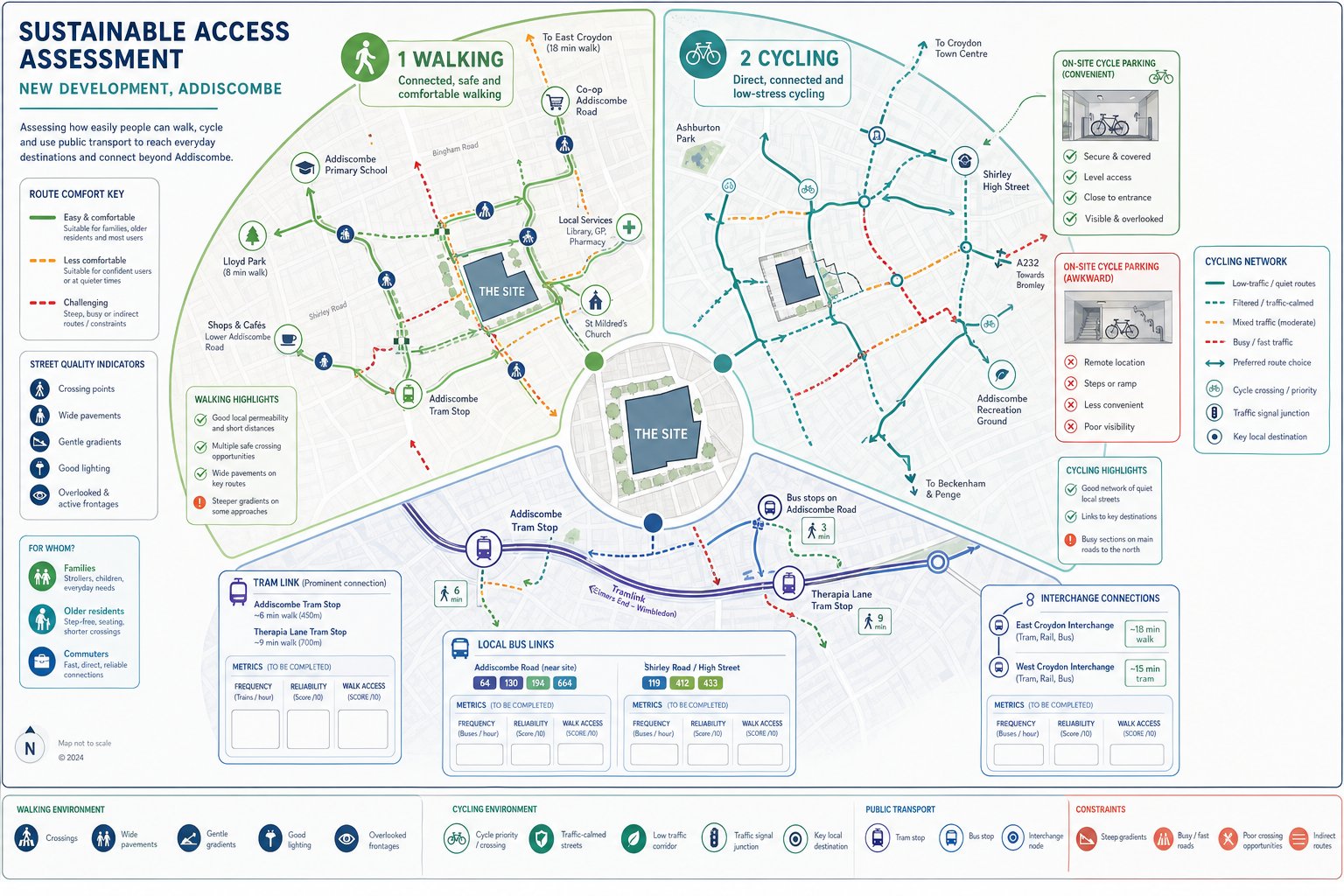
Transport evidence in 2026 is not credible if it looks only at cars. In Addiscombe, the sustainable travel case is often one of the strongest parts of an application, but only if it is grounded in real conditions rather than policy slogans.
We review pedestrian routes to nearby shops, schools, tram stops, bus stops and local services. That includes crossing opportunities, footway width, gradients, lighting, natural surveillance and whether the route is genuinely comfortable for the likely users of the site. A route that works for a fit commuter may be much less convincing for families with buggies or older residents.
Cycling needs the same realism. We assess local route quality, available connections, traffic environment and the quantity and usability of cycle parking within the scheme. Poorly placed or awkward cycle storage can undermine otherwise positive modal assumptions. Where Low Traffic Neighbourhood measures, filters or corridor changes influence route choice, they should be reflected.
Public transport appraisal often goes beyond simple distance bands. Frequency, reliability, interchange quality and the attractiveness of tram versus bus options all matter. In parts of Addiscombe, tram accessibility is a genuine planning strength. But it should not be overstated if the walking route is indirect or if likely users have different travel habits.
For development teams handling broader commercial or mixed-use proposals, the principles are similar to those discussed in Commercial Traffic Engineering work: sustainable modes must be assessed as active parts of demand management, not as a token paragraph added after the highway analysis.
Road Safety, Visibility, And Highway Design Checks
Safety review is one of the clearest ways to strengthen a planning submission, because it translates technical transport work into a question everyone understands: will this proposal make movement safer, remain neutral, or create new risk?
We usually start with collision data, site observations and a close reading of the access arrangement. Patterns matter more than raw totals. A cluster of turning collisions, pedestrian incidents near a crossing point, or repeated shunt-type incidents at a nearby junction can shape both the design response and the report narrative.
Visibility is another frequent issue. Splats on a drawing are easy to produce: demonstrating that they are achievable on the ground is the harder part. Boundary walls, parked vehicles, vegetation, street furniture, gradients and carriageway alignment all affect the real outcome. For constrained urban sites, the question is often whether the proposed access is appropriate for the likely speed environment and vehicle type, rather than whether a textbook rural standard can be met literally.
Highway design checks may cover access width, radii, pedestrian intervisibility, internal tracking, ramp gradients, refuse strategy and emergency access. We tie these points back to recognised standards and local practice, but we also explain why the design works in context. The wider principles behind Traffic Engineering: Your safer planning approach apply directly here: good highway design is not just compliant, it is legible and forgiving.
Where issues are identified, targeted mitigation often resolves them, improved sightlines, crossing upgrades, better signing, speed management or revised geometry.
How Traffic Surveys And Transport Evidence Are Prepared
Most transport reports are only as good as the evidence underneath them. If the survey base is weak, the conclusions usually are too.
We begin by agreeing what data is actually needed. For some applications, that may be classified turning counts at nearby junctions, automatic traffic counts on surrounding roads and parking beat surveys. Other schemes need queue length data, speed surveys, pedestrian and cycle counts, or public transport observations. The survey package should fit the planning question.
Timing is critical. Surveys are usually undertaken on neutral weekdays and outside abnormal periods such as school holidays, major roadworks or unusual weather where possible. In Addiscombe, school influence can be decisive, so survey windows need careful thought. We also check whether any temporary traffic management, diversions or local events could distort the baseline.
After collection, raw data has to be cleaned, reviewed and reduced into a form suitable for modelling and reporting. That means checking turning movements, peak hour selection, directional splits, queue consistency and any anomalies that need explanation. Then we use the data in trip generation analysis, assignment, capacity modelling and parking assessment, presenting it clearly in appendices, plans and concise written commentary.
This is where experience matters. Fast reporting only helps if the numbers are dependable. At ML Traffic, our focus is on producing concise evidence that is technically sound and tailored to the relevant authority threshold, rather than drowning the reader in unnecessary appendices.
Working With Architects, Planning Consultants, And Local Councils
The strongest transport submissions are collaborative. Not because everyone agrees on day one, but because problems are identified while there is still time to redesign them.
With architects, we usually work iteratively on site access, internal circulation, cycle storage, bin collection strategy and parking layout. A few metres of repositioning on a plan can remove a refusal risk that would otherwise sit unresolved until consultation. With planning consultants, we help judge what level of evidence is proportionate, how transport matters interact with policy, and whether pre-application engagement is likely to pay off.
Lawyers and appeal teams often need something slightly different: a clear technical position, a transparent methodology and a report that can stand up to scrutiny without becoming overblown. Surveyors and developers typically focus on programme risk. They want to know what is essential, what is negotiable and where highways issues could affect viability or timing.
Engagement with Croydon highways officers, and with TfL where relevant, can be especially useful on more sensitive sites. Early dialogue may clarify whether junction testing is expected, whether parking evidence needs to be site-specific, or whether a proposed access onto a particular road is likely to attract concern. That can save weeks later.
The technical liaison role is often understated. Yet in practice, much of a traffic engineer’s value lies in translating between design, planning and highways language so the application moves forward rather than sideways.
Common Development Types That Need Traffic Engineering Input In Addiscombe
Not every planning application in Addiscombe needs a full Transport Assessment, but many more schemes need traffic input than applicants first assume.
Residential development is the obvious one. Flatted infill, backland schemes, conversions and HMOs can all raise issues around parking accumulation, access width, refuse collection and servicing. Even low-trip schemes may need transport evidence if neighbours already experience parking pressure or if the access is constrained.
Schools, nurseries and education uses often require particularly careful analysis because their peak demand is sharp, highly visible and sensitive from a road safety perspective. Parent pick-up patterns, walking routes and crossing points can matter more than total daily traffic.
Healthcare, community and religious uses can be similarly complex. Their arrival patterns may be concentrated around certain times, with a mix of short-stay, blue-badge, taxi and occasional coach or minibus demand.
Retail, cafés, takeaways and small commercial units also trigger transport questions, especially where servicing is awkward or where short-stay parking demand could spill into nearby streets. For broader context, issues affecting local schemes often overlap with those covered by Traffic Engineer In Bristol: comparable authority-based planning discussions, even though local thresholds and officer expectations differ.
And then there are mixed-use proposals, which can be deceptively tricky. One use may look manageable on its own: the combined demand pattern may tell a different story.
Avoiding Delays: Common Reasons Transport Submissions Are Challenged
Most challenged submissions are not rejected because transport engineering is impossibly complex. They are challenged because a few predictable weaknesses undermine confidence in the whole package.
The first is poor survey data. Counts that are too old, taken in odd conditions, or not representative of school and commuter effects will attract questions quickly. The second is thin impact analysis. If a site clearly sits near a pressured junction but no proper capacity review has been carried out, the omission is hard to defend.
Third, we often see unrealistic trip generation or modal split assumptions. Optimism about tram use or cycling uptake might sound policy-friendly, but if it is not evidenced, officers may simply discount it. Fourth is parking underestimation. In parts of Addiscombe, local residents understand parking conditions intimately, and councillors often do too. Ignoring that context is risky.
Another common problem is inconsistency. The site plan shows one servicing arrangement, the report describes another, and the swept path drawing suggests something else again. Once those contradictions appear, review comments tend to widen.
Finally, submissions are often weakened by failing to align with London and Croydon standards or by missing the chance to explain why a site-specific departure is still acceptable. A concise, coordinated report usually performs better than a longer but generic one. We would always rather submit a proportionate case that answers the real concerns than a bulky document that leaves obvious gaps.
Choosing The Right Traffic Engineering Support For An Addiscombe Scheme
Choosing support for an Addiscombe planning scheme is partly about qualifications, but mostly about judgement, local familiarity and reliability under programme pressure.
We would look for a team that understands Croydon and wider London planning expectations, knows when a TA is warranted rather than a TS, can commission and interrogate survey data properly, and is comfortable using recognised modelling tools where the site demands it. Just as important, they should be able to write clearly. A technically correct report that is difficult for officers to navigate is weaker than it needs to be.
Past experience with similar schemes matters. So does the ability to coordinate with architects and planning consultants without turning every design iteration into a delay. For many clients, speed is important, but speed without proportionality is a false economy. The aim is to prepare exactly the evidence needed to de-risk the application, not to generate paper for its own sake.
We also think responsiveness matters more than people admit. Transport issues often emerge late: a consultee query, an access amendment, a parking objection from neighbours, a request for sensitivity testing. The right consultant can deal with that quickly and calmly.
In short, a traffic engineer in Addiscombe should bring three things: robust technical evidence, practical local insight and the ability to keep the planning team moving. When those are in place, approvals tend to be faster, not because standards are lowered, but because the transport case is harder to challenge.
For applicants, that is usually the difference between a report that merely accompanies the planning submission and one that actively helps secure consent.
Frequently Asked Questions About Traffic Engineering in Addiscombe
What does a traffic engineer in Addiscombe do for planning applications?
A traffic engineer in Addiscombe assesses how a development affects local roads, junctions, safety, parking, and sustainable travel. They prepare Transport Assessments or Statements using local data and policies, ensuring planning submissions meet Croydon and London requirements with realistic transport evidence.
When is a Transport Assessment (TA) required in Addiscombe planning?
A TA is needed for medium to large developments with material effects on traffic or parking, such as bigger residential schemes, schools, or supermarkets. It provides detailed analysis of trip generation, junction impacts, parking, and sustainable travel aligned to local guidance and is essential for credible transport submissions.
Why is local highway knowledge important for a traffic engineer working in Addiscombe?
Addiscombe’s unique context, including tram routes, congested corridors, school traffic, and parking pressures, means local knowledge helps create transport reports that reflect real conditions. This ensures assumptions and mitigation proposals align with Croydon policies and stakeholder expectations, improving the credibility of planning submissions.
How do traffic surveys support transport assessments in Addiscombe?
Traffic engineers commission classified turning counts, parking occupancy, and pedestrian surveys at neutral times reflecting typical conditions. These surveys provide the data foundation for trip generation, capacity modelling, and parking stress analysis, ensuring the transport evidence is accurate and robust for planning decisions.
What are common reasons transport submissions get challenged in Addiscombe?
Submissions often face delays due to outdated or inadequate survey data, missing junction capacity analysis, unrealistic trip generation or parking assumptions, ignoring local parking stress, or inconsistencies between plans and reports. Ensuring alignment with Croydon and London standards is crucial to avoid objections.
How does a traffic engineer in Addiscombe address sustainable travel in new developments?
They audit pedestrian access, cycling routes and parking, and public transport options, considering route quality, safety, lighting, and local low traffic neighbourhoods. This approach ensures developments support walking, cycling and public transport in line with London cycling design guidance and local travel policies.