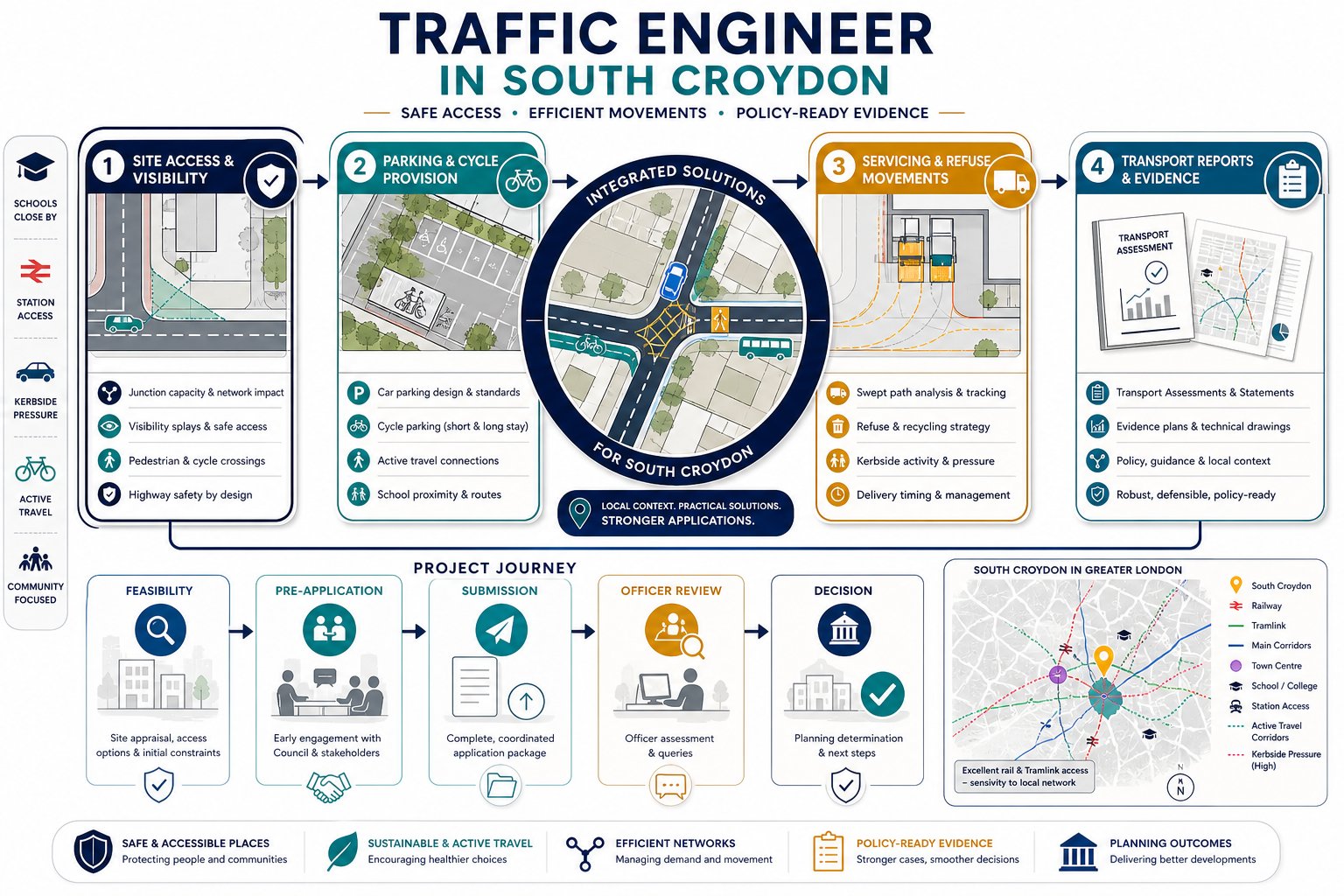
Planning applications in South Croydon rarely fail because of architecture alone. More often, transport is the pressure point: access arrangements that don’t quite work, parking that doesn’t align with policy, servicing that looks fine on paper but not on a constrained street, or trip impacts that haven’t been evidenced properly. In a London borough context, those gaps can slow validation, trigger objections, or push a scheme into rounds of avoidable revision.
That’s where a traffic engineer in South Croydon becomes essential. We help development teams translate a proposal into transport terms that planning officers, highway officers and consultees can assess with confidence. That means looking beyond a basic traffic count. We review how people will actually arrive, how vehicles will enter and leave, whether refuse and delivery operations are workable, and whether a proposal fits the wider policy picture shaped by the London Plan, Croydon’s local requirements and, in some cases, TfL expectations.
For architects, planners, solicitors, surveyors, developers and local authorities, the value is straightforward: clear evidence, early risk spotting, and reports that are proportionate to the scheme. In South Croydon, where street conditions, public transport access and local sensitivities vary sharply from one site to the next, that local planning-focused input can make the difference between a smooth application and a drawn-out one.
Key Takeaways
- A traffic engineer in South Croydon is crucial for translating development proposals into transport evidence that satisfies local planning and London-wide policies.
- Local transport and highway assessments address practical site-specific issues like access safety, parking, servicing, and impact on nearby sensitive locations, preventing delays and objections.
- Early engagement of a traffic engineer during feasibility or pre-application stages allows design adjustments that reduce costly revisions and smooth the planning process.
- Transport reports, including Transport Assessments, Transport Statements, Travel Plans, and Delivery and Servicing Plans, must be tailored to the scheme’s scale and local context to effectively address planning concerns.
- Developments near schools, stations, or on constrained urban sites require detailed traffic engineering to manage complex movement patterns and ensure safety for all users.
- Ongoing traffic engineer support through planning stages and post-approval implementation ensures that transport solutions remain practical and compliant, accelerating approval and delivery.
What A Traffic Engineer Does In South Croydon Planning Projects
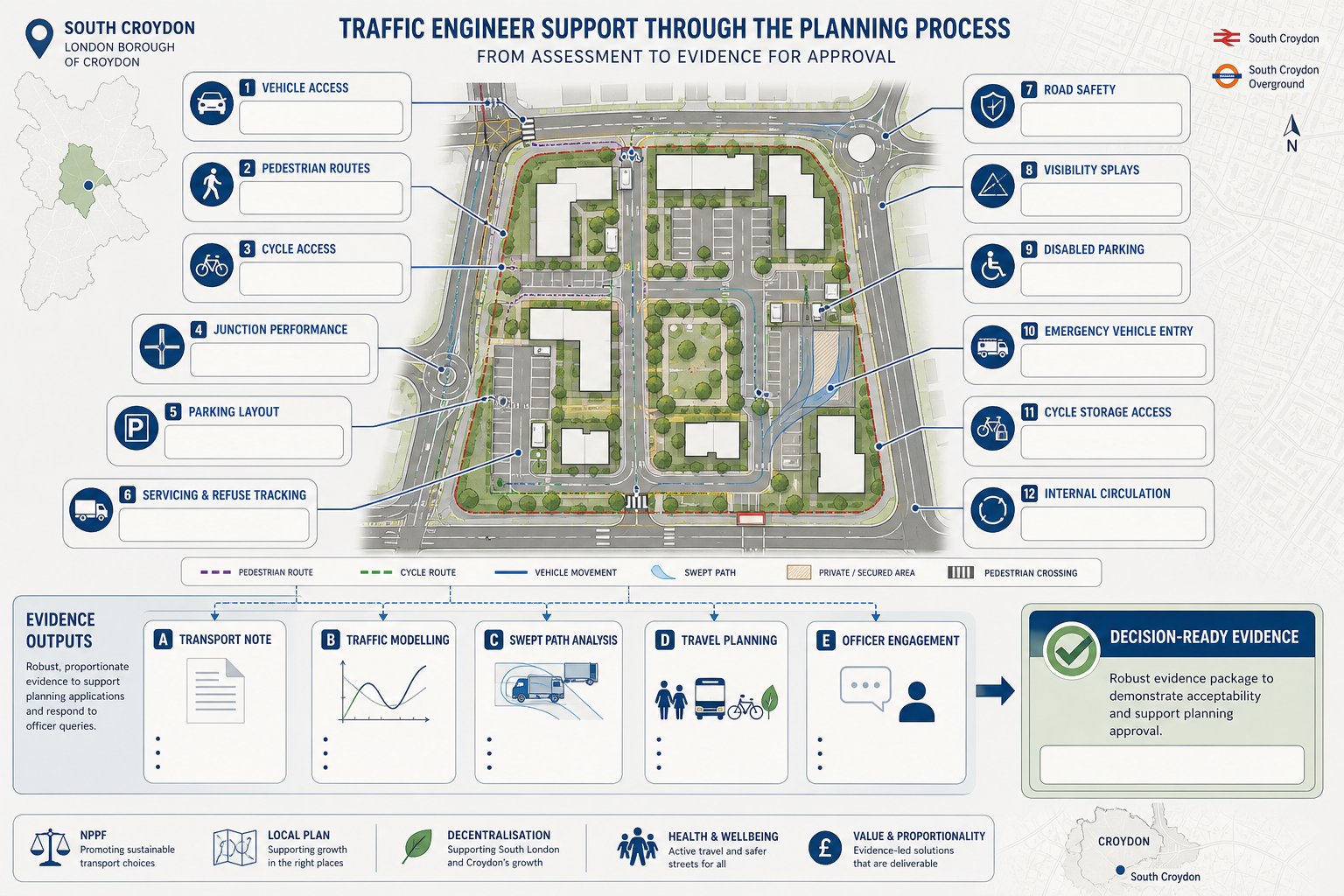
A traffic engineer working on a South Croydon planning project does far more than calculate vehicle movements. Our role is to test whether a development can function safely and acceptably within the surrounding transport network, and then present that evidence in a form the planning process can use.
In practice, we assess site access for vehicles, cyclists and pedestrians: review junction operation: examine parking supply and layout: check servicing arrangements: and consider road safety. On some schemes, that means preparing a concise transport note to support a modest application. On others, it means a full evidence package with modelling, swept path analysis, travel planning and ongoing negotiations with officers.
We also look closely at geometry and usability. A technically possible access isn’t always a planning-friendly one. Visibility splays, refuse tracking, disabled parking, cycle storage access, emergency vehicle entry and internal circulation all matter. If those pieces don’t fit together early, design teams often end up redesigning later at greater cost.
For applicants operating across multiple locations, the wider context matters too. A broader grounding in Traffic Engineering and helps teams understand how local reports tie into overall scheme strategy, while more general advice from Traffic Engineering Consultants: can be useful when scoping support. In South Croydon specifically, though, the key task is always the same: produce clear, policy-aware transport evidence that removes uncertainty for decision-makers.
Why South Croydon Sites Need Local Transport And Highway Input
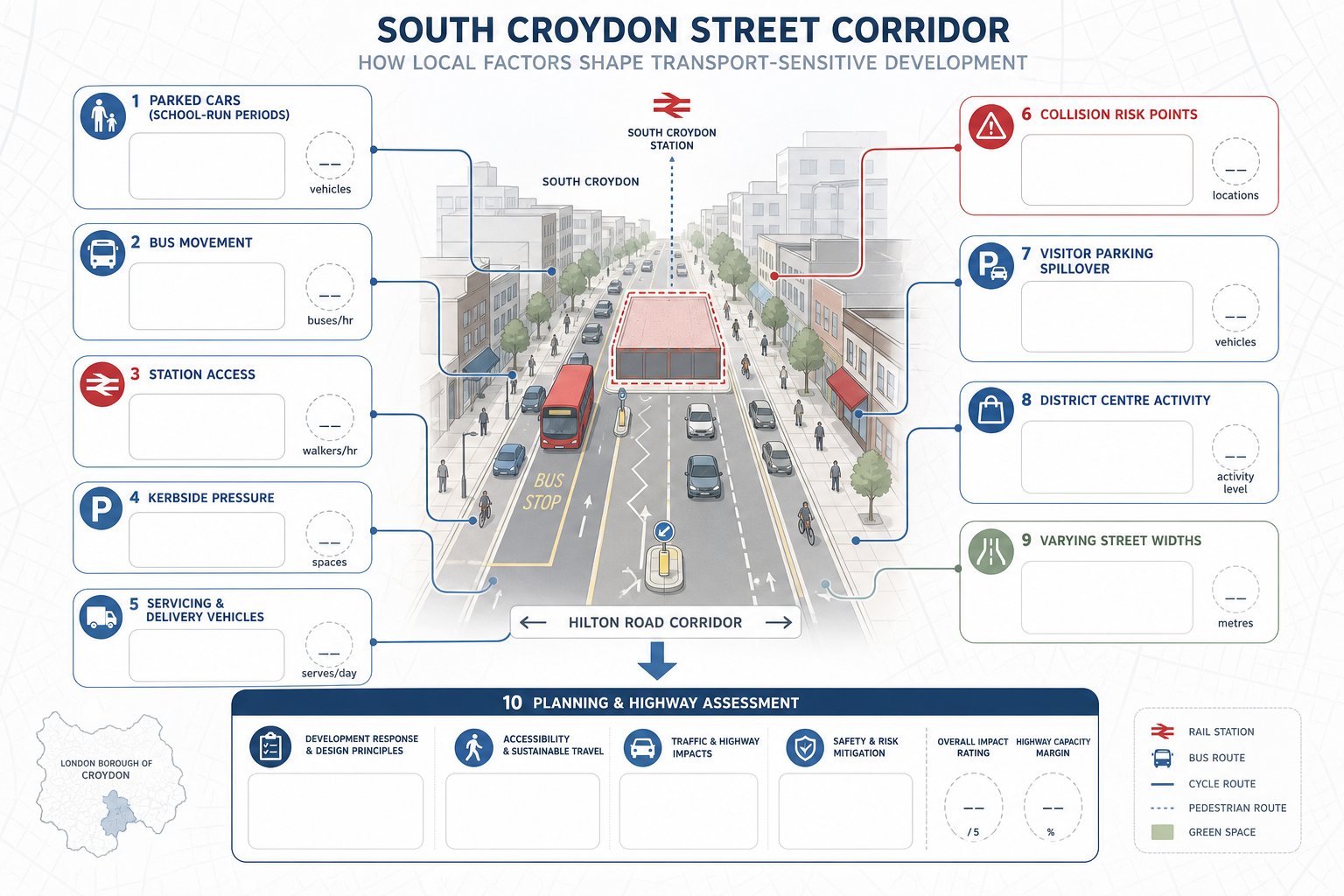
South Croydon sits within a planning and transport environment that is distinctly London in character, but highly local in its day-to-day constraints. That combination matters. A scheme may appear modest in development terms and still raise detailed transport questions because of frontage conditions, nearby schools, bus movements, station access patterns, or pressure on kerbside space.
Local input helps because policy is only one part of the picture. Yes, developments must respond to the London Plan, Croydon’s planning policies and transport expectations around mode share, parking restraint, active travel and safety. But officers also want to know how a proposal fits the actual street. Is the road heavily parked at school-run times? Is servicing likely to block traffic? Is there a history of collisions nearby? Will short-stay visitor demand spill into neighbouring residential roads? Those are practical questions, not just policy ones.
South Croydon also includes sites affected by busy local corridors, district centre activity, rail access, and varying street widths that can quickly turn a straightforward scheme into a transport-sensitive one. We often find that early local review identifies issues long before they become formal objections.
That’s one reason teams often compare local needs against wider Traffic Engineer In London: expectations. London boroughs share strategic policy themes, but South Croydon applications still need site-specific judgement. And where highway design implications become central, insight from Highway And Traffic work is often what turns a broad planning concept into an approvable transport solution.
Common Planning Reports Required For South Croydon Developments
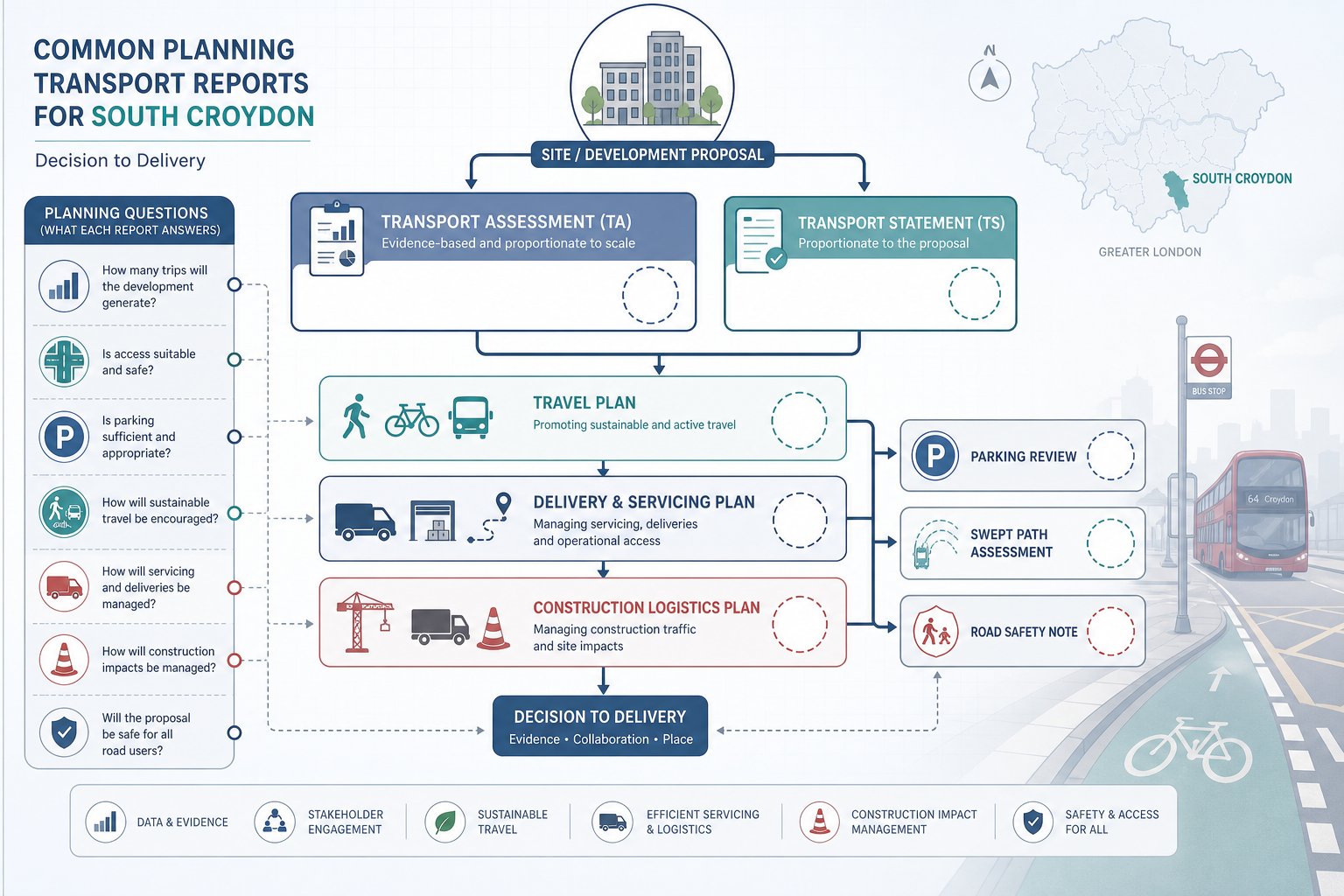
The right report depends on the scale of development, the sensitivity of the site and what Croydon Council or TfL are likely to ask for. In South Croydon, the common mistake is either overproducing an overly technical package for a small proposal or, just as often, under-scoping transport work and leaving obvious gaps.
Most schemes fall into a recognisable set of report types. Larger or more impactful developments usually need a Transport Assessment. Smaller schemes with material transport effects often need a Transport Statement. Depending on use and location, that may be supported by a Travel Plan, Delivery and Servicing Plan, Construction Logistics Plan, parking review, swept path drawings or a road safety note.
The objective isn’t paperwork for its own sake. Each document answers a different planning question: how many trips will be generated, whether the network can accommodate them, how sustainable travel will be encouraged, how deliveries will operate, and how construction activity will be managed without undue harm.
For commercial or operationally complex sites, the discipline overlaps with wider Commercial Traffic Engineering work, especially where freight, shift patterns or customer turnover are key parts of the planning case.
Transport Assessments And Transport Statements
A Transport Assessment, or TA, is normally prepared for larger schemes where transport effects are likely to be significant enough to require detailed evidence. A Transport Statement, or TS, is usually a more proportionate document for smaller developments that still need structured analysis.
Both documents examine trip generation, likely distribution and mode split. They assess access arrangements, parking demand, cycle provision, servicing implications and, where necessary, nearby junction performance. In South Croydon, they also need to respond to London policy on sustainable travel, reduced car dependence and safe access for all users.
The difference is usually one of scale and depth, not professionalism. A well-scoped TS can be entirely sufficient for a smaller infill scheme, while a TA may be essential for a larger residential, mixed-use or education project. The real skill is matching the evidence to the proposal.
A good assessment doesn’t just identify impact: it explains mitigation where required. That might include access amendments, revised parking layouts, servicing controls, travel plan measures, junction changes, or financial contributions tied to planning obligations.
Travel Plans, Delivery And Servicing, And Construction Logistics
Travel Plans are often crucial in South Croydon because mode shift is not a theoretical policy goal: it is part of how schemes become acceptable in lower-car or car-free terms. A Travel Plan sets out practical measures to encourage walking, cycling and public transport use, with targets, monitoring and management arrangements. For schools, care uses and larger residential or commercial schemes, this can be a core planning document rather than a side note.
Delivery and Servicing Plans, or DSPs, show how goods, refuse and servicing activity will work safely and efficiently. On constrained sites, they can be the difference between a credible operational strategy and one that officers immediately question. They address vehicle types, timing, loading locations, routing and conflict with pedestrians or general traffic.
Construction Logistics Plans, or CLPs, deal with the temporary but often sensitive construction phase. In built-up parts of South Croydon, HGV routing, contractor parking, delivery timing and neighbour impact all matter. A realistic CLP can reassure officers and residents that disruption will be controlled rather than simply acknowledged.
When You Need A Traffic Engineer For A Planning Application
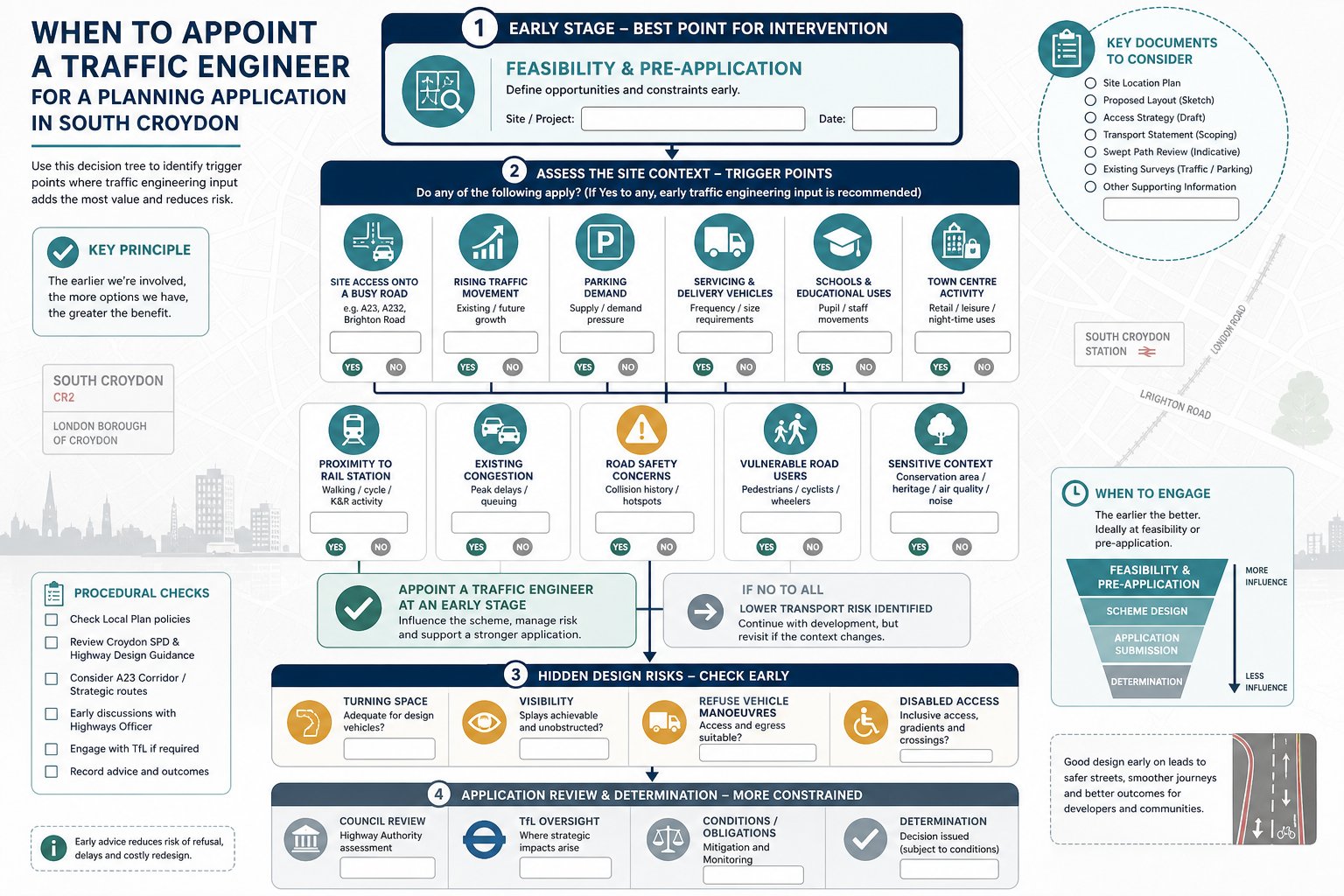
The short answer is earlier than most teams think. By the time transport concerns appear in officer feedback, design options are often narrower and revisions more expensive. We usually add most value at feasibility or pre-application stage, when access principles, parking assumptions and servicing strategy can still be adjusted without redrawing the whole scheme.
Typical triggers are easy to recognise. A new or intensified access onto an A-road or busy local street is one. A material increase in trip generation, parking demand or servicing activity is another. So is development near sensitive land uses such as schools, district centres, stations or locations with known congestion and road safety concerns.
Sometimes the need is more procedural. Croydon Council may request a TA, TS, Travel Plan, DSP or CLP through validation requirements or pre-application advice. TfL may also need to be satisfied where a site affects strategic movement or bus operations. In those cases, transport input is not optional: it is part of what makes the application complete and credible.
We also find that a traffic engineer is useful when the planning risk is hidden rather than obvious. A small change-of-use can alter delivery patterns. A seemingly simple residential conversion can create awkward refuse manoeuvres. A compact urban site can meet floor area goals yet fail on turning, visibility or disabled access. Early transport review spots those issues before they harden into objections.
Typical Development Types That Require Transport Input
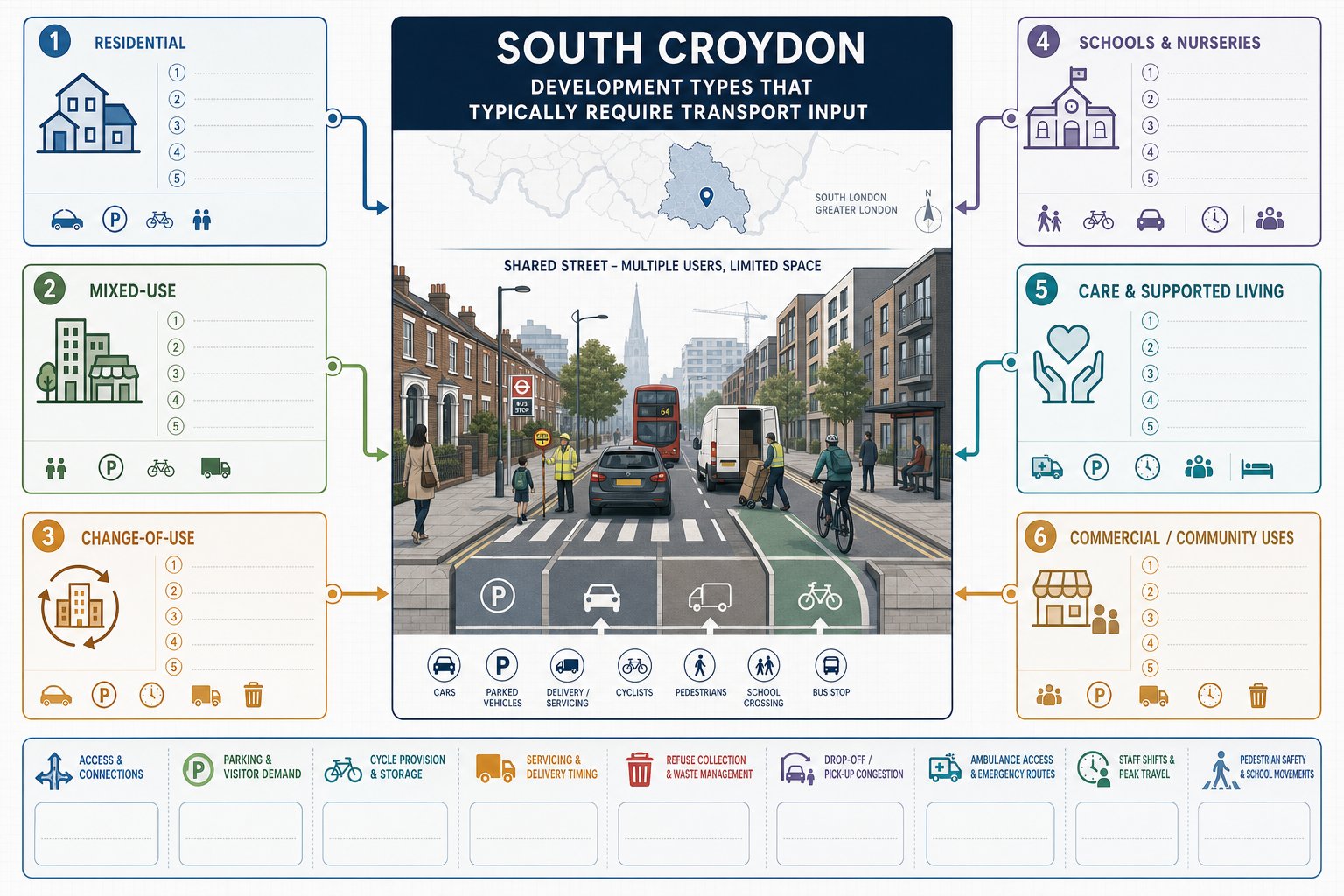
Not every proposal in South Croydon needs the same level of transport work, but many more schemes need some form of highway or transport evidence than applicants first assume. The deciding factor is usually not headline size alone. It is whether the proposal changes movement patterns, creates operational pressure, or introduces safety and access issues that the planning authority will need properly addressed.
That is especially true in urban locations where streets already serve multiple functions: movement corridor, parking supply, delivery space, school access route and residential frontage all at once. In those conditions, even moderate changes can have planning consequences.
Residential, Mixed-Use, And Change-Of-Use Schemes
Residential development is one of the most common triggers for transport input. Flatted schemes, estate redevelopment, infill sites and low-car housing proposals all need careful review of access, parking, cycle provision, servicing and refuse collection. In South Croydon, where many sites are constrained, design efficiency can clash with transport practicality surprisingly fast.
Mixed-use development adds another layer because residential and non-residential demands don’t always align. Ground-floor commercial uses may need morning deliveries, short-stay visitor access or dedicated servicing space that conflicts with residential amenity or circulation.
Change-of-use schemes are often underestimated. An office-to-residential conversion may reduce peak commuter trips but increase visitor parking or refuse demands. A retail unit changing to café or restaurant use can generate entirely different dwell times, servicing patterns and evening activity. These are exactly the kinds of shifts a planning authority expects to be evidenced, not assumed.
Schools, Care, Commercial, And Community Developments
Schools, nurseries and colleges often require detailed transport input because drop-off behaviour, school-run parking and pedestrian safety can become the defining planning issue. The transport case must be realistic about human behaviour: a plan that ignores parent parking pressure usually doesn’t survive scrutiny.
Care homes, extra-care schemes and supported living developments also need tailored assessment. Ambulance access, staff shift changes, visitor arrivals and service vehicle movements all shape how the site functions. Trip rates may differ from standard housing, so assumptions need care.
Commercial and community uses are equally varied. Offices, gyms, cafés, trade counters, retail units, warehouses, health centres, places of worship and halls all bring different operating profiles. Teams handling multi-city portfolios sometimes compare lessons from Traffic Engineer In Manchester: or Traffic Engineer In Bristol: assignments, but South Croydon still demands local judgement because the same land use can perform very differently depending on street conditions, PTAL context and nearby sensitivities.
Key Transport Issues Reviewed For South Croydon Sites
When we review a South Croydon site, we are usually testing one central question: can this development operate safely and acceptably for all users, in policy terms and in real life? The answer depends on several linked issues.
First is access. We assess whether vehicles, pedestrians, cyclists, disabled users, refuse vehicles and emergency services can enter, move within and leave the site safely. That sounds basic, but access is where many applications unravel. A gate set back that is too shallow, a turning space that only works on a perfect line, or visibility affected by parking pressure can all become serious planning concerns.
Second is network impact. We consider trip generation, likely routeing, junction capacity, queuing and local congestion. Not every site requires heavy modelling, but every site needs a proportionate view of how it affects surrounding streets.
Third is parking and servicing. Car and cycle parking have to align with London Plan and local standards, while also being practical to use. Servicing, deliveries and refuse storage must work without creating conflict or unsafe manoeuvres. In many urban schemes, the kerbside question is as important as the building.
We also review walking, cycling and public transport connectivity, collision history, and policy themes such as Vision Zero and Healthy Streets. In other words, the task is not simply to prove that cars can get in and out. It is to show that the development contributes to a safer, workable transport environment overall.
How A Traffic Engineer Supports The Planning Process From Feasibility To Decision
The strongest planning outcomes usually come from transport input that starts early and stays involved through the application journey. We see our role as part technical adviser, part problem-solver and part translator between design intent and planning evidence.
At feasibility stage, we test whether the broad development concept is likely to work. That may involve a high-level access strategy, early trip estimates, parking and servicing review, or a quick appraisal of likely policy issues. This stage is often where the biggest value sits because small design adjustments can remove later conflict.
During pre-application and application stages, the work becomes more formal. We prepare the required TA or TS, travel planning material, DSPs, CLPs, swept path drawings and supporting notes. We also help teams respond to comments from planning and highway officers. Often, that means refining assumptions, adjusting layouts or clarifying how the scheme will operate day to day.
This is where concise, decision-focused reporting really matters. Our approach mirrors the principles behind Traffic Engineering: Your practice generally: be proportionate, accurate and practical. And when schemes involve broader strategic transport questions, the thinking set out in Traffic Engineering and Transportation becomes relevant too.
After permission, support often continues. Conditions may require final Travel Plans, CLPs, access details, Section 278 design work or further technical approval. So the traffic engineer’s role does not end at committee or decision notice: it often carries through to implementation, helping ensure the approved scheme can actually be delivered on the highway as intended.
Conclusion
In South Croydon, transport is rarely a box-ticking exercise. It is one of the main ways a planning authority judges whether a development is workable, safe and policy-compliant. For medium and larger schemes, that is obvious. But smaller applications on constrained streets, near schools, around stations or with awkward servicing demands can be just as dependent on good transport evidence.
A traffic engineer in South Croydon helps bring that evidence together early, in the right level of detail and with a clear understanding of local and London-wide expectations. For architects, planners, legal teams, surveyors, developers and councils, that usually means fewer surprises, clearer negotiations and stronger planning submissions.
The practical benefit is simple: resolve highway concerns before they become planning obstacles. When transport strategy, access design and technical reporting are aligned from the outset, applications tend to move faster and stand up better under scrutiny.
Frequently Asked Questions about Traffic Engineer Services in South Croydon
What does a traffic engineer in South Croydon do for planning applications?
A traffic engineer in South Croydon assesses vehicle, cycle, and pedestrian access, parking, servicing, and road safety. They prepare technical reports compliant with London and Croydon policies, ensuring developments fit local street conditions and transport networks.
When should I engage a traffic engineer for a planning application in South Croydon?
Engage a traffic engineer early, ideally at feasibility or pre-application stage, especially if your development involves new or intensified access, increased trip generation or parking demand, or proximity to sensitive sites like schools or stations.
What are the common transport reports required for developments in South Croydon?
Typical reports include Transport Assessments for larger schemes, Transport Statements for smaller but impactful proposals, Travel Plans, Delivery and Servicing Plans, Construction Logistics Plans, as well as parking reviews and swept-path analysis tailored to the development.
Why is local transport input vital for South Croydon sites?
South Croydon has unique street constraints, bus corridors, and school zones. Local transport input ensures compliance with London Plan and Croydon policies, while addressing practical issues like congestion, parking pressures, and safety specific to the area.
How do Travel Plans support sustainable development in South Croydon?
Travel Plans set targets and practical measures that encourage walking, cycling, and public transport use. This helps reduce car dependency, aligning with London’s sustainability goals and improving the acceptability of developments in South Croydon.
How does a traffic engineer help ensure safe and efficient servicing for developments?
Traffic engineers create Delivery and Servicing Plans that detail vehicle types, timing, and loading locations to prevent conflicts and ensure refuse and deliveries operate safely and efficiently on constrained South Croydon streets.