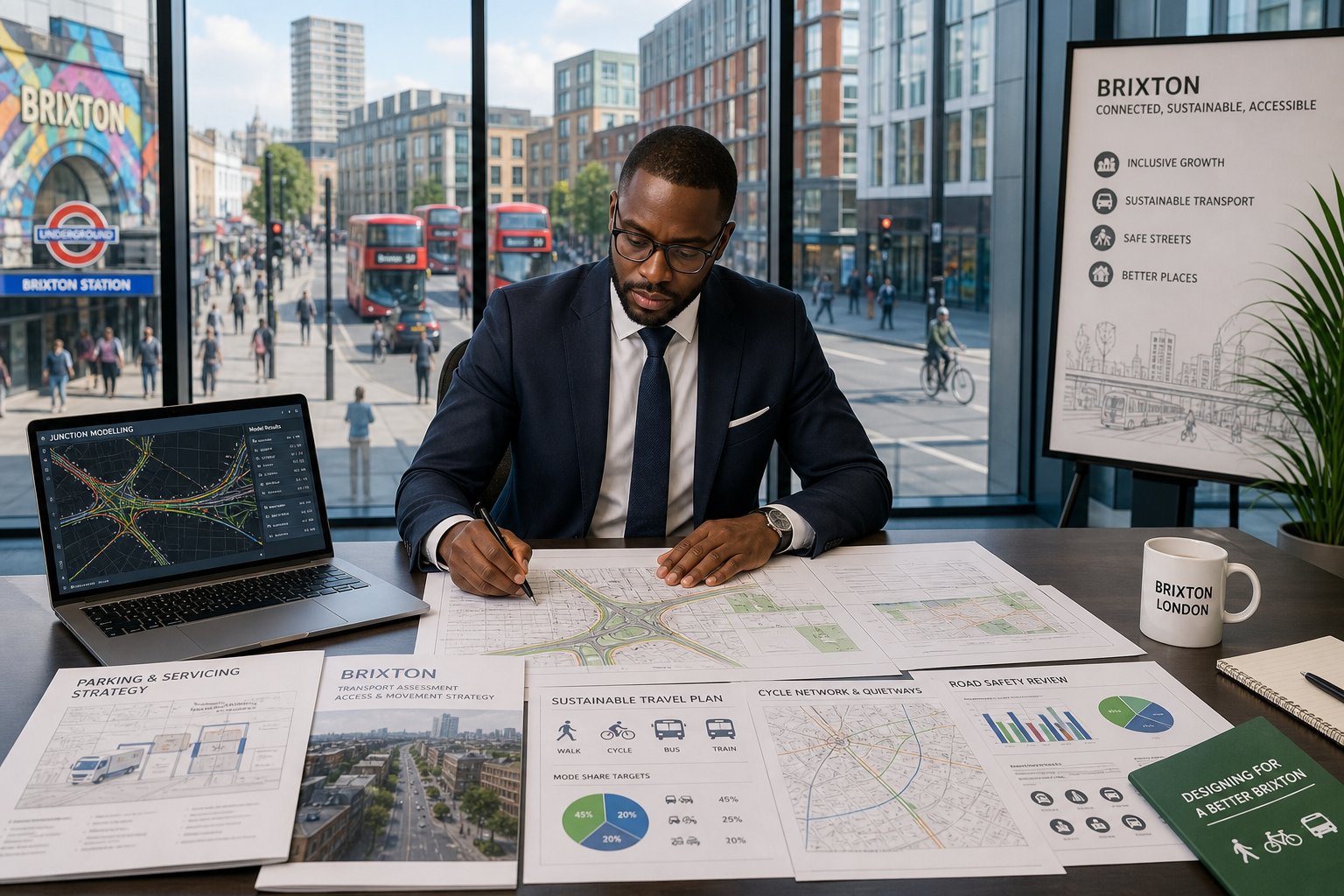
Brixton is not the sort of place where transport issues can be treated as a planning afterthought. Streets are busy, bus movements are constant, walking and cycling flows are high, and even a modest scheme can raise sharp questions about access, servicing, safety, parking pressure, and junction performance. In practice, that means a traffic engineer in Brixton often becomes central to whether an application moves smoothly through planning or gets dragged into rounds of technical queries.
For architects, planning consultants, developers, solicitors, surveyors, and public-sector teams, the challenge is rarely just producing a report. It’s producing the right report, at the right level, with evidence that reflects Lambeth’s policies, London-wide transport expectations, and the very local realities of Brixton town centre and its surrounding neighbourhoods.
We’ve seen the difference early transport input makes. It can reshape an awkward access arrangement before it becomes a refusal reason, identify whether a simple Transport Statement will do or whether a full assessment is needed, and help teams anticipate concerns from Lambeth Highways or Transport for London before formal consultation starts. That matters in 2026, when planning scrutiny around sustainable travel, road safety, and highway impact is only getting tighter.
In this guide, we set out what a traffic engineer in Brixton actually does, which applications usually need transport evidence, and how to prepare the technical case so a scheme is realistic, policy-aware, and far easier to defend.
Key Takeaways
- A traffic engineer in Brixton plays a crucial role in securing smooth planning approvals by providing transport evidence tailored to Lambeth’s local policies and London’s transport context.
- Early involvement of a traffic engineer can prevent costly redesigns by addressing issues such as access, servicing, and parking before submitting planning applications.
- Transport assessments in Brixton must consider intense local transport factors, including bus corridors, pedestrian flows, and controlled parking zones, ensuring reports reflect site-specific realities rather than generic assumptions.
- Typical developments requiring traffic engineering input include residential blocks, mixed-use schemes, and proposals affecting bus routes or junctions, with documentation ranging from Transport Statements to detailed Travel Plans.
- Delivery and Servicing Plans and Construction Traffic Management Plans are essential for managing operational impacts, ensuring safe and efficient freight and construction vehicle movements in Brixton’s busy streets.
- Collaborating early with Lambeth planning and highways officers and other stakeholders helps define the right scope of transport evidence, reducing delays and improving the credibility of the application.
What A Traffic Engineer In Brixton Does For Planning And Development

A traffic engineer in Brixton supports planning by translating design proposals into transport evidence that a local authority can actually assess. That usually starts with understanding the site: existing highway conditions, nearby junctions, walking routes, bus stops, cycle links, parking controls, servicing constraints, and any obvious safety concerns. From there, we review how a proposal is likely to function once occupied, not just how it looks on a layout drawing.
The work is broader than many teams expect. We may commission or interpret traffic counts, undertake swept path analysis, review collision history, assess access geometry, estimate trip generation, test junction capacity, or prepare a Transport Statement or Transport Assessment. For some schemes, the main issue is parking and servicing. For others, it’s whether a narrow frontage can safely accommodate deliveries, refuse collection, and disabled access without causing conflict on the highway.
We also help knit transport strategy into the wider planning case. A residential scheme may need a car-free approach with strong cycle provision and a credible Travel Plan. A commercial proposal may need a more detailed servicing strategy. On more complex projects, that technical role overlaps with broader Traffic Engineering Consultants: support, especially where several transport documents need to align.
Just as important, we respond to officer comments and negotiate practical mitigation. In Brixton, that can mean refining access, adjusting loading arrangements, or demonstrating that a development will not materially worsen local highway conditions.
Why Brixton Developments Need Location-Specific Transport Input
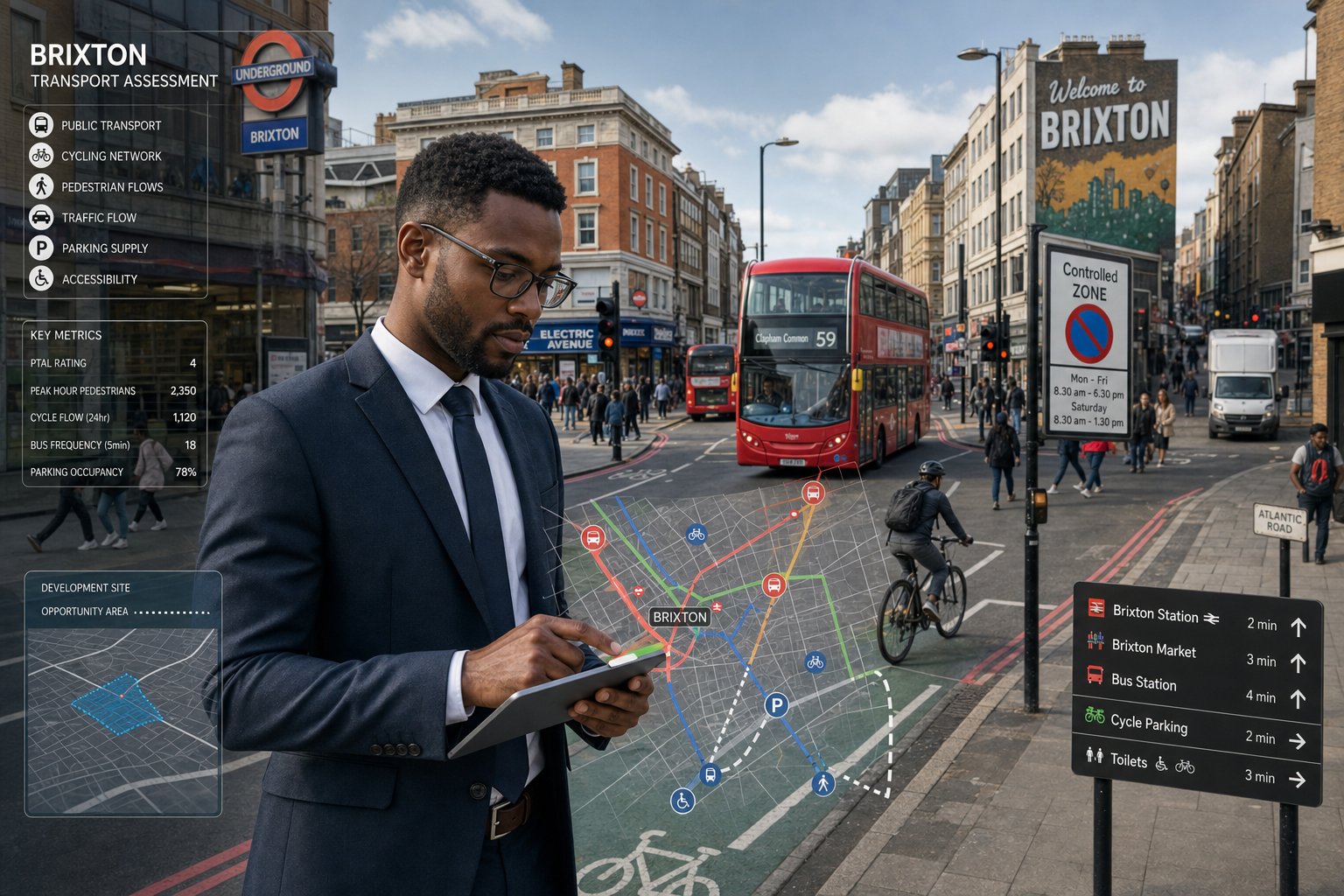
Brixton is not a place where generic trip rates and standard assumptions are enough. Its transport character is unusually intense and layered: major bus corridors, Underground and rail access nearby, heavy pedestrian activity, controlled parking zones, narrow side streets, town-centre servicing pressure, and road space that is already doing a lot of work. That combination changes how development impact should be assessed.
A site two streets apart can have very different transport implications. One may sit near strong public transport links and support a low-car model comfortably. Another may face a constrained junction, school pick-up activity, or awkward servicing conditions that make even light-touch development more sensitive. Lambeth officers will usually expect those differences to be recognised rather than brushed aside.
Local policy reinforces that. The Lambeth Local Plan and London Plan both push hard on sustainable travel, active travel, and safe street design. So a traffic engineer in Brixton needs to examine not only vehicle impact, but also walking, wheeling, cycling, public transport accessibility, and the practical effect of changes at street level. That’s why broader Traffic Engineering and Transportation planning principles matter, but they still need local calibration.
In short, Brixton-specific input reduces the risk of producing a technically correct report that is locally unconvincing. And that’s often the difference between a smooth consultation and a difficult one.
Planning Applications That Commonly Require Traffic Engineering Evidence

Not every application needs a full transport package, but plenty do. In Brixton, transport evidence is commonly required where a proposal introduces new trips, changes how a site is accessed, affects parking demand, or creates servicing and highway safety questions that officers cannot ignore.
Typical examples include:
- new residential blocks and estate infill schemes
- HMOs or co-living proposals with intensified occupation
- retail, food, leisure, education, healthcare, and community uses
- places of worship with concentrated peak arrivals
- mixed-use schemes combining residential and commercial activity
- changes of use that materially increase trip generation
- proposals on or near bus routes, signalised junctions, or strategic roads
- car-free or car-lite developments needing robust justification
Even smaller schemes can trigger technical transport input if the frontage is constrained or if there is a need for a new crossover, altered kerbside controls, or regular deliveries. Commercial schemes often need especially careful review because their operational patterns differ from headline floor area assumptions. That is one reason Commercial Traffic Engineering In practice tends to focus heavily on servicing, peak timing, and street management rather than just raw traffic volume.
The core question is simple: will the development change how people, vehicles, deliveries, or vulnerable road users interact with the local network? If the answer is yes, some level of traffic engineering evidence is usually sensible, whether it is formally mandated or not.
Transport Statements, Transport Assessments, And Travel Plans Explained
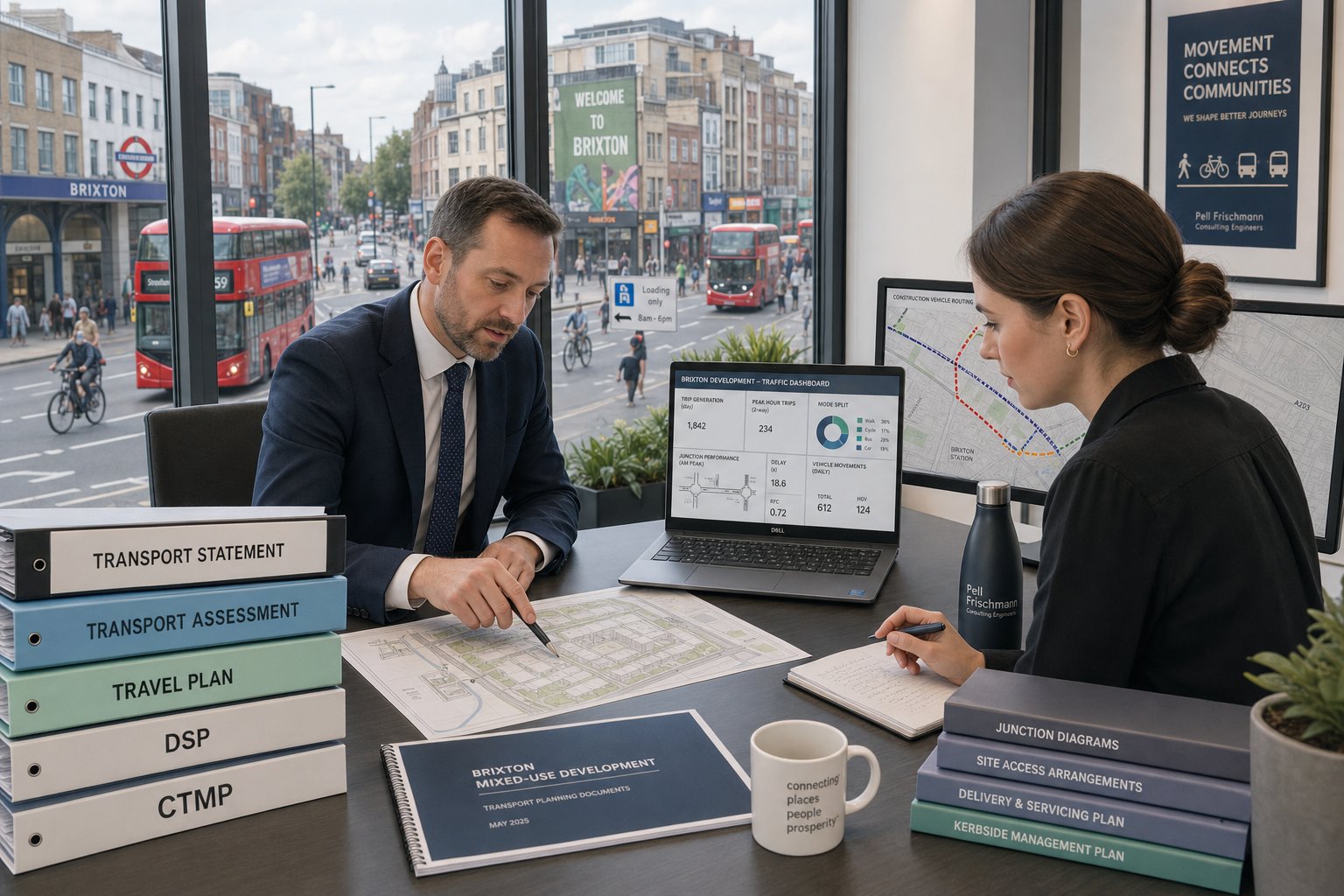
These documents are often mentioned together, but they do different jobs.
A Transport Statement (TS) is generally used for smaller or less traffic-intensive proposals. It gives a concise picture of existing conditions, site accessibility, access arrangements, parking, servicing, and likely transport impact. If the scheme is modest and the highway effects are limited, a well-judged TS may be enough.
A Transport Assessment (TA) goes further. It is the fuller technical document for larger, more complex, or more sensitive sites. It can include surveys, baseline analysis, multi-modal trip generation, junction modelling, safety review, mitigation proposals, and scenario testing. Brixton schemes near busy corridors or constrained junctions often move into TA territory quickly.
A Travel Plan (TP) is different again. It is not mainly about measuring impact: it is about managing it. A TP sets out practical measures, targets, and monitoring to reduce private car use and encourage walking, cycling, wheeling, public transport, and shared mobility. For Lambeth, that is often central to policy compliance rather than a box-ticking exercise.
For clients comparing report types across authorities, a wider Traffic Engineer In London: perspective can be useful, because thresholds and expectations vary by context. In Brixton, though, the right choice usually depends less on development size alone and more on street conditions, sensitivity, and likely stakeholder concern.
When A Delivery And Servicing Plan Is Needed
A Delivery and Servicing Plan is usually needed where routine goods movement could affect traffic flow, kerbside operation, or road safety. Think supermarkets, hotels, offices, student accommodation, healthcare uses, larger residential blocks, or mixed-use developments with active ground floors.
A good DSP identifies likely vehicle types, expected frequency, routing, loading locations, time windows, and operational controls. In Brixton, that detail matters because badly timed deliveries can interfere with buses, general traffic, cycle movement, and pedestrian activity very quickly. If there is no off-street loading, the plan must be especially realistic about kerbside management.
It should also tie into refuse collection, courier demand, and any site-specific restrictions. Officers tend to be sceptical of vague commitments here, and fairly so.
How A Construction Traffic Management Plan Supports Approval
A Construction Traffic Management Plan helps demonstrate that a scheme can be built without causing unacceptable harm before it is ever occupied. For many urban sites in Brixton, construction impact is one of the first concerns raised by neighbours and consultees.
A CTMP typically addresses construction vehicle routing, booking systems, site access, waiting and unloading arrangements, workforce travel, temporary traffic management, banksmen or marshals, and safeguards for pedestrians and cyclists. Where schools, bus routes, or narrow streets are nearby, timing restrictions may be crucial.
In practical terms, a credible CTMP can defuse objections by showing the development team has thought beyond the red line boundary. It does not solve every issue, but it often turns a perceived risk into a manageable one.
Access Design, Parking, And Highway Considerations In Brixton
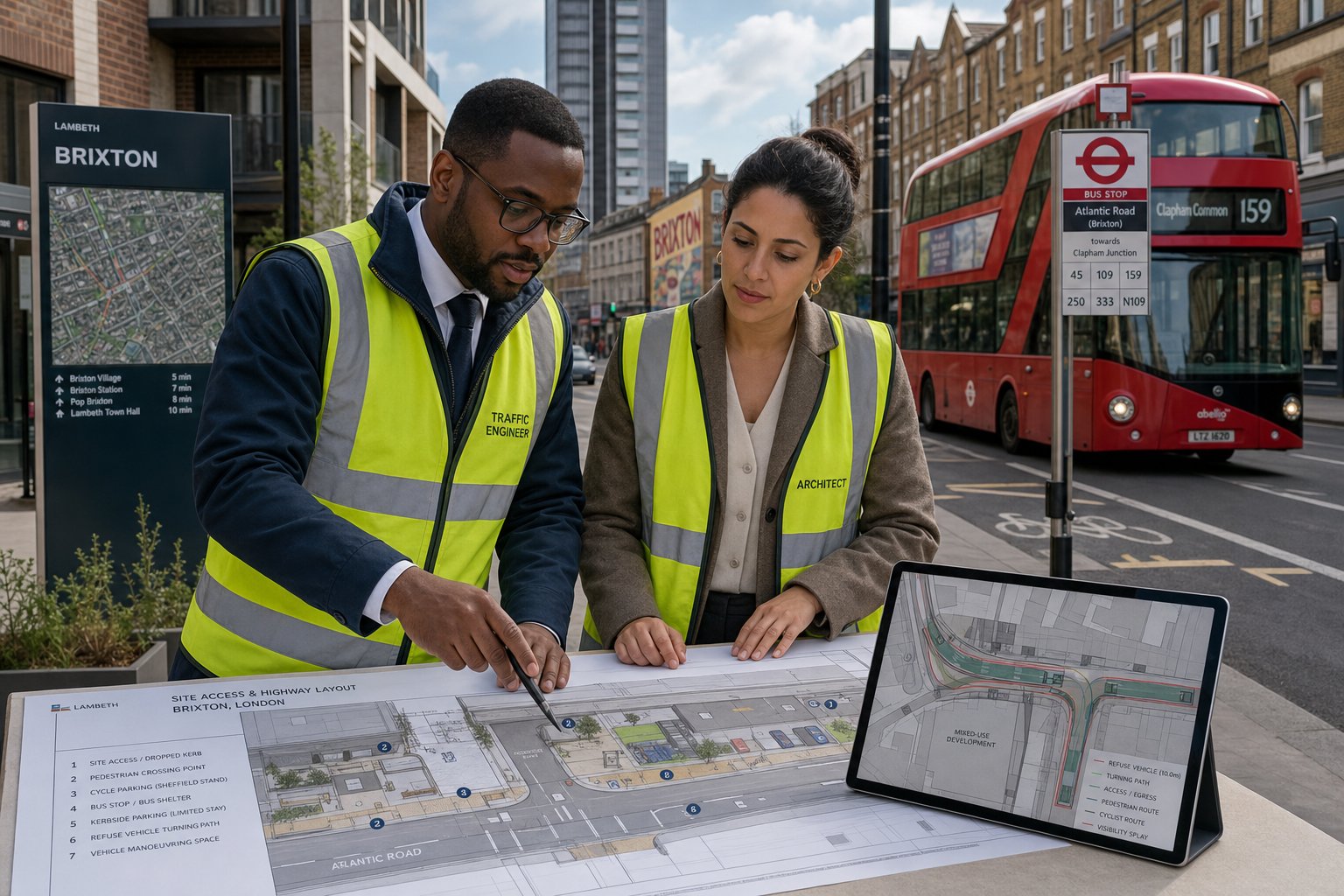
Access design in Brixton is rarely just about whether a vehicle can physically enter a site. It is about whether the arrangement is safe, legible, policy-compliant, and workable alongside the pressures already present on the street. That means we look closely at visibility, manoeuvring, gradients, refuse access, pedestrian desire lines, cycle movement, and the relationship between the site frontage and the wider highway.
For many developments, crossover design and kerbside impact are key. A proposed access may remove on-street parking, affect loading space, or conflict with bus operations or crossing points. In dense urban locations, even a minor change to frontage management can trigger wider questions from Lambeth Highways.
Parking is similarly nuanced. Some schemes will be expected to be car-free or car-lite, particularly in highly accessible locations. Others may justify blue-badge provision, operational parking, or specialist spaces, but only with a clear rationale. Cycle parking is no longer an afterthought either: officers expect it to meet London standards in quantity, type, security, and usability.
Where projects extend beyond a simple layout check, wider Highway And Traffic input can be essential to align access geometry with policy, safety, and operational needs.
The main objective is straightforward: make sure the site works in the real world, not just on a drawing package prepared under time pressure.
Junction Capacity, Trip Generation, And Traffic Impact Analysis
This is the part of transport work many applicants expect to dominate, but in Brixton it has to be handled with care. Raw traffic numbers matter, yes, yet they only become persuasive when the assumptions behind them are credible and site-specific.
Trip generation normally starts with established databases and survey evidence, then gets refined to reflect land use, public transport accessibility, local car ownership, active travel opportunities, and comparable development patterns. A central Brixton site with strong PTAL characteristics should not be assessed like an edge-of-town scheme somewhere with weak sustainable transport.
From there, we examine distribution and assignment: where trips are likely to come from and go to, which junctions may experience change, and whether any increase is materially significant. Capacity testing may use recognised software to assess queues, delays, reserve capacity, and operational stress under future-year scenarios. The with-development case is usually compared with a baseline and, where necessary, a mitigation case.
But analysis is not simply about proving the numbers are tiny. Sometimes impact exists, and the task is to show it can be managed through layout changes, servicing controls, signal adjustments, or travel demand measures. That broader analytical discipline sits at the heart of Traffic Engineering: Your work.
Done properly, traffic impact analysis does two jobs at once: it identifies genuine risks and prevents speculative objections filling the space where evidence should be.
Road Safety, Visibility, And Active Travel Requirements
In 2026, road safety and active travel are not secondary matters sitting at the end of a transport report. In many Brixton applications, they are near the top of the agenda from the start. Lambeth and London-wide policy place strong weight on safe movement for pedestrians, cyclists, wheelchair users, and other vulnerable road users, especially in dense mixed-use environments.
A proper safety review may consider personal injury collision data, access conflict points, visibility splays, vehicle speeds, crossing opportunities, footway width, cycle interactions, and servicing behaviour. If a site access creates reversing movements across a footway, or if visibility is compromised by frontage constraints, those issues will attract attention quickly.
Active travel requirements go beyond simply counting cycle stands. Officers increasingly want to know whether walking and cycling routes are attractive and direct, whether cycle parking is convenient and secure, and whether end-of-trip facilities are appropriate for the use class. For larger schemes, links to nearby public transport and local destinations need to be clear and practical.
In Brixton, this often means balancing the needs of all users in a very tight highway environment. The strongest submissions are honest about those trade-offs. They do not pretend constraints do not exist: they explain how the design responds to them in a way that improves safety rather than merely tolerating risk.
Working With Lambeth And Other Local Planning And Highway Stakeholders
A technically solid report can still run into trouble if stakeholder engagement is poorly timed. In Brixton, the main public bodies are often Lambeth planning and highways teams, but depending on the site, Transport for London may also need to be involved, particularly where bus operations, strategic roads, or wider network effects are relevant.
Early dialogue matters because it helps define the scope before everyone is committed to the wrong one. We often find that a brief pre-application conversation can clarify whether officers are likely to expect a Transport Statement, a full assessment, a Travel Plan, servicing detail, junction modelling, or all of the above. That is far better than guessing and being asked to retrofit technical work later.
Stakeholder management may also involve utilities, neighbouring boroughs, schools, residents’ groups, emergency services, or local businesses where access and servicing impacts are sensitive. None of that changes the evidence base, but it does affect how the scheme is understood.
For teams working across multiple cities, examples from a Birmingham Transport Consultant: Planning-Led or Traffic Engineer In Bristol: context can be useful as contrasts, because each authority has its own emphasis. Brixton requires a distinctly local reading of policy, pressure points, and consultation dynamics.
Common Planning Risks When Transport Issues Are Addressed Too Late
Late transport input nearly always costs more than early transport input. Sometimes it costs time. Sometimes redesign fees. Sometimes the planning outcome itself.
One common problem is discovering too late that the access arrangement shown on the architect’s drawings is not workable for refuse vehicles, deliveries, or emergency access. Another is assuming a site can be treated as low impact, only for Lambeth or TfL to request surveys, modelling, or a stronger Travel Plan after submission. At that point, the programme starts slipping.
There is also a strategic risk. When transport evidence arrives late, it is often bolted onto a design that has already hardened. That makes mitigation harder. A loading bay may not fit. Cycle parking may end up compromised. A car-free argument may be weakened by unresolved blue-badge provision or poor public realm connections.
And then there is credibility. Officers can usually tell when transport has been considered from the outset and when it has been drafted in as a defensive exercise. The latter tends to invite more questions, not fewer.
For planning teams under deadline pressure, the most damaging phrase is often: “we need to revise the layout first.” That single sentence can trigger new drawings, fresh consultation, and weeks of avoidable delay.
What To Prepare Before Instructing A Traffic Engineer
Good instructions lead to faster, better transport advice. Before appointing a traffic engineer in Brixton, it helps to gather the core project information in one place rather than sending fragments over several weeks.
At minimum, we would want:
- the site address and red-line boundary
- an indicative layout or existing/proposed drawings
- a schedule of accommodation or floor areas
- the proposed land use and likely hours of operation
- any planning history or pre-application feedback
- known site constraints, including parking stress or servicing issues
- programme milestones and target submission dates
- clarity on whether the scheme is intended to be car-free or car-lite
If there are already architectural or planning concerns about access, disabled parking, refuse collection, cycle provision, or neighbour sensitivity, it is better to flag them early. The same applies if the site sits near a school, a busy bus corridor, or a junction with known delay problems.
A concise project brief saves time because the first review can then focus on strategy instead of basic fact-finding. For a specialist practice with local-authority experience, that usually means identifying the likely report suite, the surveys needed, and any highway risks that could influence design before the application is locked down.
Conclusion
Brixton demands transport advice that is grounded in how the area actually works, not how a generic template says it should work. For planning teams, that means bringing in traffic engineering support early enough to influence layout, servicing, access, cycle provision, and the overall development strategy before small issues become expensive ones.
The value of a traffic engineer in Brixton is not just in producing a Transport Statement or Transport Assessment. It is in helping the whole team make better planning decisions: choosing the right level of evidence, anticipating Lambeth and TfL concerns, and shaping mitigation that is both policy-compliant and operationally credible.
When transport is handled properly from the start, schemes are easier to explain, easier to defend, and far more likely to move through planning without avoidable friction. In a location as constrained and closely scrutinised as Brixton, that early clarity is rarely optional: it is often what keeps a project on track.
Frequently Asked Questions about Traffic Engineering in Brixton
What does a traffic engineer in Brixton do for planning and development?
A traffic engineer in Brixton analyses site conditions, traffic patterns, and local policies to produce transport evidence supporting planning applications. They assess access, parking, servicing, and safety to ensure proposals comply with Lambeth and London-wide transport requirements.
Why is location-specific transport input crucial for Brixton developments?
Brixton’s intense transport environment, including busy bus corridors, pedestrian flows, and constrained streets, requires tailored assessments. Generic assumptions are insufficient; site-specific analysis ensures compliance with local policies like the Lambeth Local Plan and helps address unique junction and servicing challenges.
Which planning applications in Brixton typically require traffic engineering evidence?
Applications such as new residential blocks, HMOs, retail, leisure, healthcare facilities, mixed-use developments, changes increasing trip generation, and projects near bus routes or strategic roads usually need transport evidence to address trip impact, access changes, or highway safety concerns.
How do Transport Statements, Transport Assessments, and Travel Plans differ in Brixton?
Transport Statements provide concise impact reviews for smaller schemes, Transport Assessments offer detailed multi-modal analysis and modelling for larger or sensitive sites, and Travel Plans focus on managing travel behaviour through measures to reduce car use and promote active and sustainable travel modes.
When is a Delivery and Servicing Plan necessary for Brixton developments?
A Delivery and Servicing Plan is essential for developments with routine goods movement, such as supermarkets, hotels, or student accommodation. It details vehicle types, routing, loading, and timing to minimise congestion and safety risks on Brixton’s busy streets.
How can early involvement of a traffic engineer reduce planning risks in Brixton?
Engaging a traffic engineer early helps identify access, parking, and safety issues before submission, ensuring reports meet Lambeth’s expectations. This reduces redesign costs, avoids late objections, and improves chances of smooth planning approval in Brixton’s scrutinised transport context.