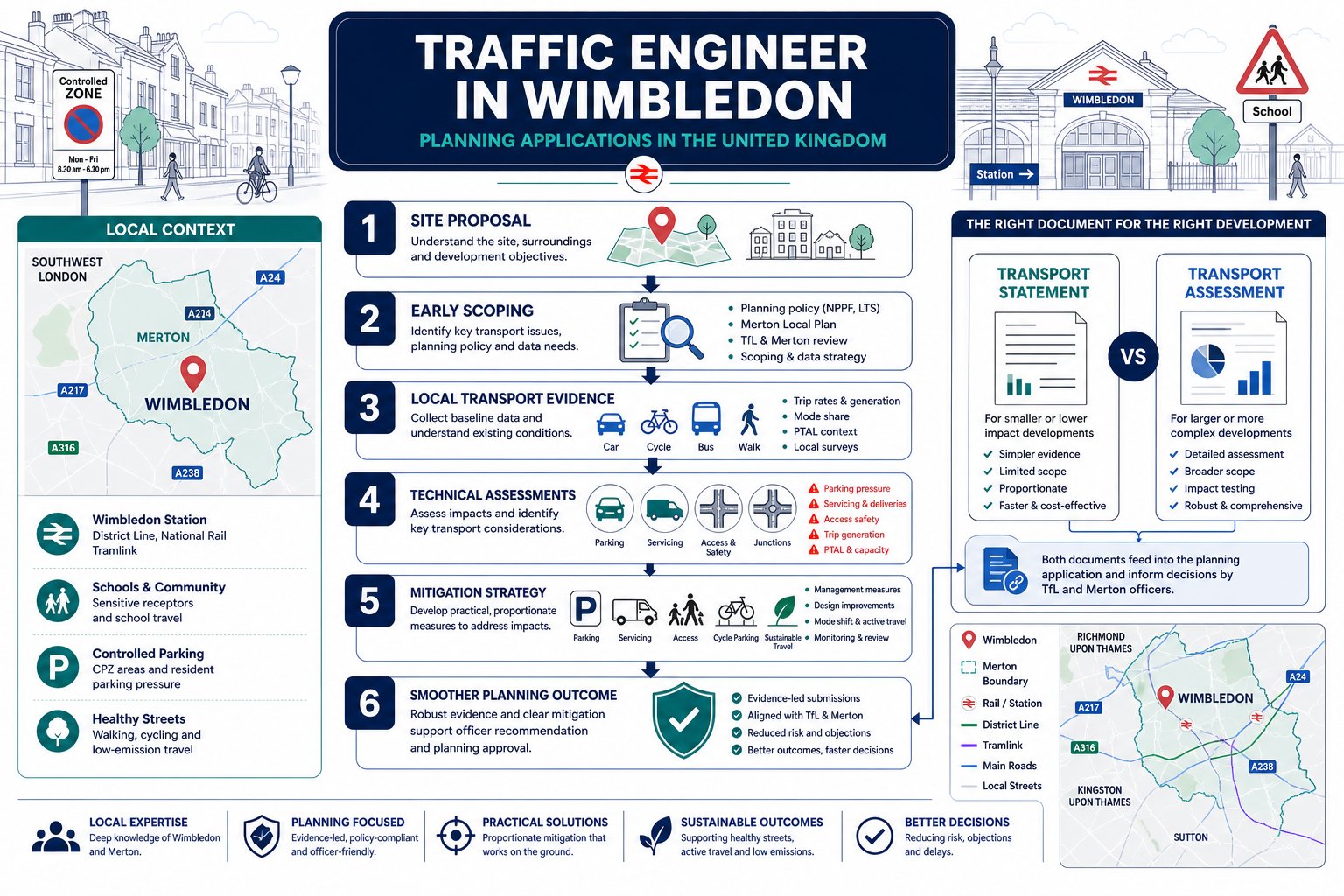
Planning in Wimbledon rarely gets judged on architecture alone. A scheme can look sensible on paper, meet a market need, and still stall because the transport case is thin, generic, or out of step with local expectations. In Merton, that usually means questions about parking pressure, servicing, cycle provision, access safety, trip impact, or whether a proposal really fits a high-accessibility London location.
That’s where a traffic engineer in Wimbledon becomes valuable. We’re not just producing a report to tick a validation box. We translate a development into transport terms that planning officers, highway officers, and sometimes TfL can assess with confidence. That means evidence on likely vehicle trips, mode share, access arrangements, delivery activity, visibility, swept paths, and the wider policy position under the London Plan and Merton’s local framework.
For architects, planners, solicitors, surveyors, developers and councils, the practical question is usually the same: what level of transport input is needed, when should it start, and how do we avoid avoidable objections? The answer depends on scale, use, context and local street conditions around the site.
In this guide, we set out what a traffic engineer in Wimbledon typically does for planning applications in 2026, when a Transport Assessment or Transport Statement is likely to be needed, how local highway context affects the strategy, and what helps applications move through the system faster and with fewer transport-related surprises.
Key Takeaways
- A traffic engineer in Wimbledon is essential for translating development proposals into credible transport terms that align with local planning expectations and policies.
- Transport Assessments or Statements should be scoped proportionately based on site sensitivity, scale, and local highway context to avoid delays and objections.
- Site-specific transport strategies that reflect Merton’s parking controls, active travel aims, and road safety concerns are crucial in Wimbledon’s planning process.
- Early involvement of a traffic engineer helps identify and mitigate transport issues such as parking demand, servicing arrangements, and access safety before finalising planning submissions.
- Supporting documents like parking surveys, swept path analysis, and delivery reviews strengthen applications by providing concrete evidence of transport impacts.
- Coordinating transport reports with planning drawings and offering specific, measurable mitigation measures improves the likelihood of smoother and faster planning approval.
Why A Traffic Engineer Matters For Wimbledon Planning Applications
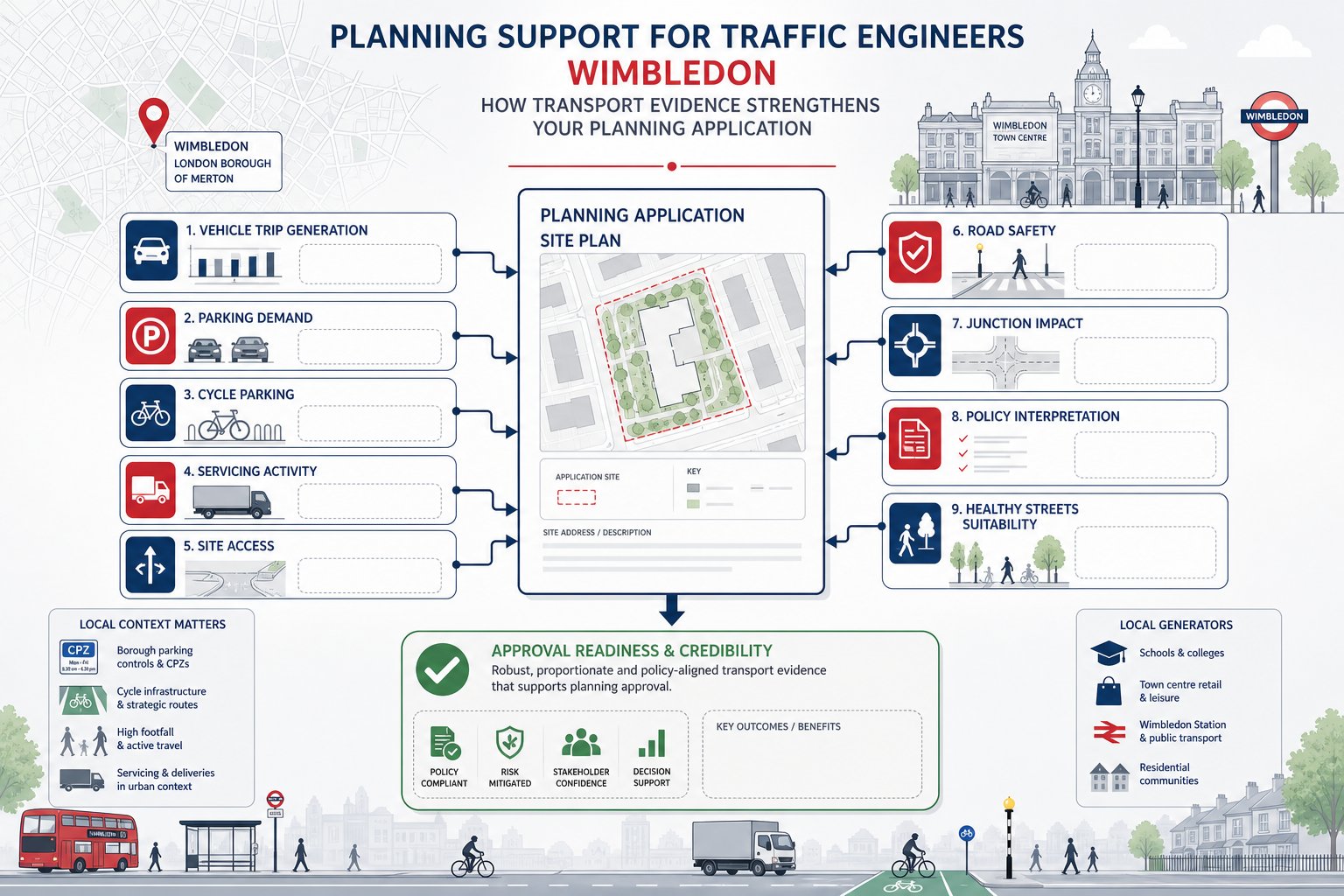
In Wimbledon, transport is often one of the deciding layers in a planning submission rather than a late technical add-on. A planning officer may be broadly supportive of land use, design and massing, but if the highway impacts are uncertain, the application can slow down quickly. We regularly see this with residential intensification, town-centre schemes, school-related changes, and sites where servicing looks straightforward until the detail is tested.
A traffic engineer in Wimbledon helps quantify the things that planning teams should not leave vague: trip generation, parking demand, cycle parking needs, servicing frequency, access suitability, road safety implications and, where needed, junction impact. That evidence matters because Merton and TfL are not simply asking whether traffic increases: they are asking whether the increase is material in context, whether the site is appropriate for lower-car living, and whether the design supports healthy streets principles.
Just as important, we interpret policy. The London Plan, local parking standards, active travel expectations and borough-specific highway concerns all shape what is acceptable. Generic wording copied from another borough tends to stand out for the wrong reasons. A locally tuned report is far stronger.
For teams working across multiple authorities, that local tuning becomes even more important. The same broad principles may apply in Traffic Engineer In London: work, but Wimbledon sites need arguments matched to Merton’s streets, parking controls and town-centre conditions.
In practice, our role is part analyst, part strategist. We help decide what must be assessed, what can be scoped proportionately, and how to present the transport case so the application feels credible from the outset.
When A Transport Assessment Or Transport Statement Is Needed
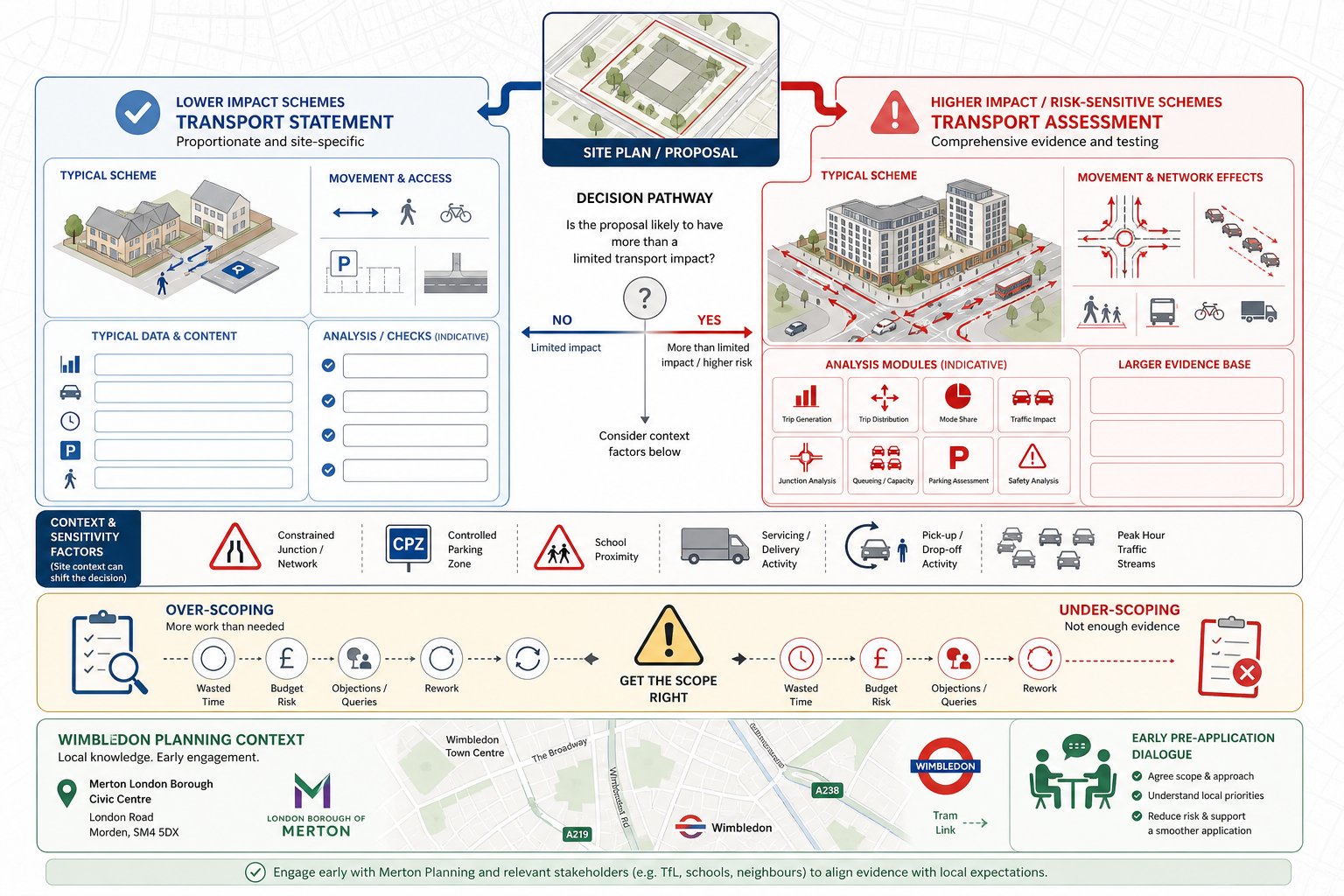
The choice between a Transport Assessment and a Transport Statement comes down to likely impact, sensitivity and planning risk. Broadly, larger or more trip-intensive proposals tend to require a Transport Assessment, while smaller schemes with limited effects can often be supported by a Transport Statement. But the line is not purely about unit numbers or floorspace. Context matters.
A site beside a constrained junction, within a busy controlled parking zone, or close to a school can justify more transport evidence than a similar-sized proposal on a less sensitive street. Likewise, a change of use that appears modest on paper may still need robust analysis if delivery activity, pick-up and drop-off patterns, or peak-hour movements are likely to change materially.
A Transport Statement usually suits developments where impacts are expected to be limited and can be explained clearly through policy review, trip forecasts, parking analysis, access review and proportionate mitigation. A full Transport Assessment is more detailed. It may include multi-scenario trip generation, committed development review, junction capacity testing, queue analysis, mode split assumptions, accident review and a fuller mitigation package.
What we try to avoid is over-scoping and under-scoping. Over-scoping wastes time and budget: under-scoping invites objections and repeat work. Experienced Traffic Engineering Consultants: support planning success by matching the report type to the real planning exposure.
In Wimbledon, pre-application dialogue can be especially useful where there is any doubt. If Merton or TfL is likely to have a view on parking restraint, servicing, road safety or local capacity effects, scoping those issues early often saves weeks later.
How Local Planning And Highway Context Shapes Development In Wimbledon

Wimbledon sits in a part of London where transport assumptions can’t be imported lazily from suburban edge-of-borough sites. Public transport accessibility is often relatively strong, many streets are subject to parking controls, pedestrian activity is high around the town centre and station, and some corridors already operate under pressure in the peaks. That changes both design and evidence.
Planning policy pushes schemes toward lower-car patterns, stronger cycle provision, walkable access and street environments that align with healthy streets principles. Yet that does not mean every proposal can simply claim low car ownership and move on. Officers still expect a believable explanation of who will travel, how servicing will work, whether disabled parking is handled correctly, and what happens if on-site provision is restrained.
On some sites, the decisive issue is not network capacity at all. It may be a narrow access, poor visibility, refusal to accommodate waste collection safely, conflict with pedestrians, or likely overspill parking on already stressed streets. In other words, local highway context shapes what “acceptable” looks like.
That’s why we favour site-specific transport strategy over boilerplate. It is the same principle that underpins broader Traffic Engineering: Your Complete approach to safer roads and smarter planning: evidence must reflect how streets actually function, not how a template assumes they function.
Common Triggers For Traffic Engineering Input
Some triggers appear again and again in Wimbledon applications. A new vehicular access is an obvious one, especially where the frontage sits on a busier road, visibility is constrained, or manoeuvring within the site is tight. Intensification of an existing access is another common trigger, even where no major physical changes are proposed.
Material increases in traffic, servicing or parking demand also tend to bring transport matters to the front. That can include a modest commercial intensification, a conversion that increases unit count, or a use class change that alters the timing and nature of arrivals. Streets near schools, stations, retail parades or community facilities are particularly sensitive because relatively small changes can interact with existing congestion and pedestrian movement.
We also watch for sites where policy aspirations and physical conditions are slightly at odds. A car-light development may be supportable in principle, but if cycle access is awkward, servicing is unresolved and surrounding parking stress is already high, the case needs more work.
Residential Schemes, Flat Conversions, And Mixed-Use Proposals
Residential schemes in Wimbledon often turn on three practical questions: how many trips the development will create, whether parking provision is justified, and whether the site can operate with a low-car or car-free approach. Flat conversions are especially sensitive because they can appear minor while still generating objections about overspill parking, bin collection, cycle parking or substandard access.
For new-build residential and mixed-use schemes, we typically test the transport case against PTAL, parking controls, nearby services, station access, cycle links and likely resident travel behaviour. If on-site parking is limited, the supporting evidence must be realistic rather than aspirational. That may mean parking stress surveys, car ownership comparisons, permit restriction strategy and a strong Travel Plan.
Mixed-use proposals add another layer because residential, retail and workspace peaks do not always align neatly. Delivery windows, servicing bay use and internal circulation need to be thought through early. This is where lessons from Commercial Traffic Engineering become relevant even on schemes that are not purely commercial.
Change Of Use, Commercial Sites, Schools, And Community Developments
Change-of-use applications can be transport-light or surprisingly transport-heavy. A switch from office to residential may reduce some trip types while creating different parking and servicing patterns. A café, nursery, place of worship, medical use or community venue can alter peak periods, dwell times and kerbside pressure in ways that trigger local concern quickly.
Commercial sites in Wimbledon often need careful review of delivery and servicing. Not because every scheme is large, but because constrained frontages and busy streets leave little room for vague assumptions. If a delivery vehicle cannot enter, turn or load safely, that issue will not disappear at determination stage.
Schools and community developments are even more context-sensitive. Pick-up and drop-off behaviour, coach movements, event traffic, safeguarding of walking routes and conflict with existing peak conditions all matter. In those cases, a proportionate report can still be detailed, because the pattern of activity is the real issue rather than gross floor area alone.
What A Traffic Engineer In Wimbledon Typically Prepares
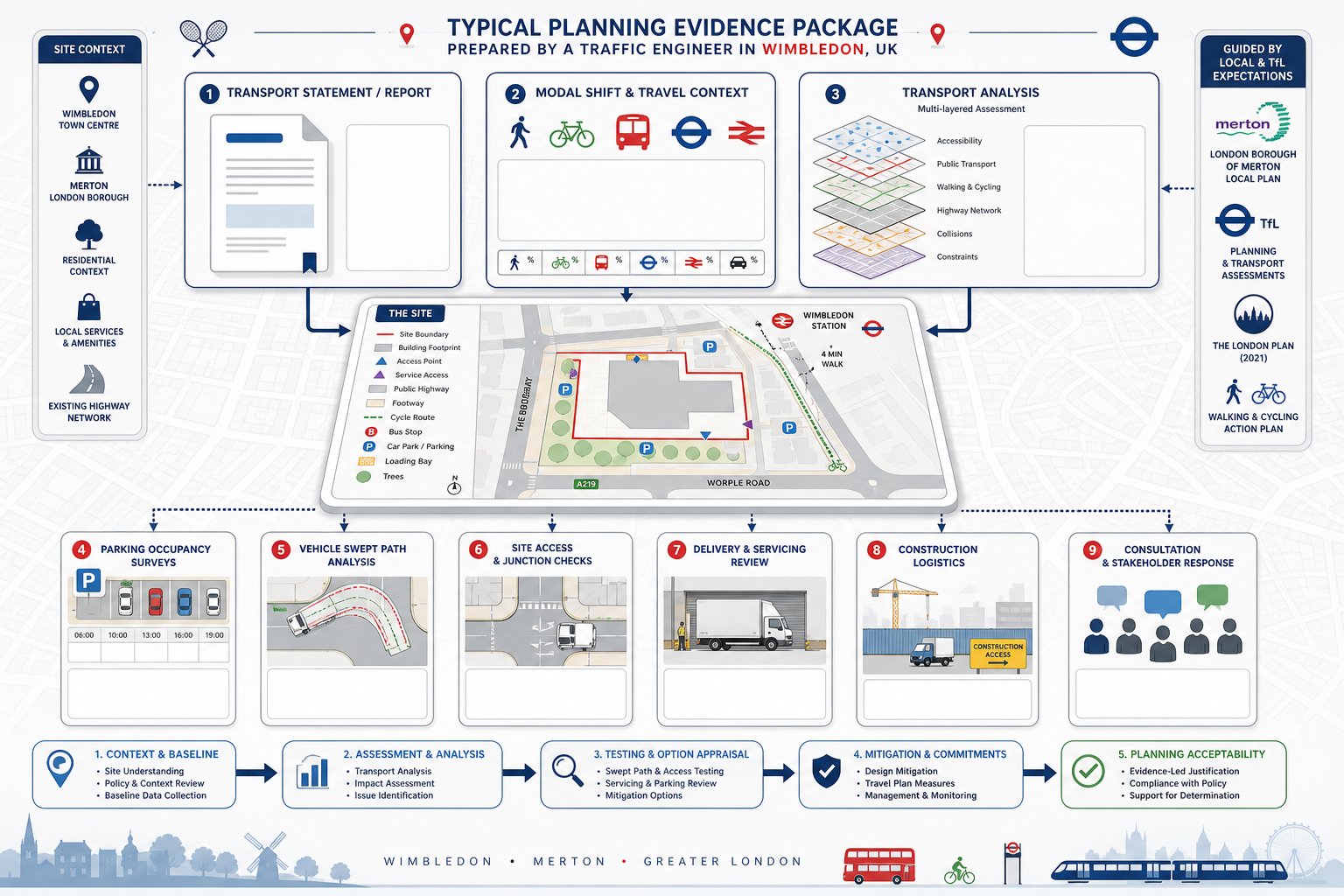
Most planning teams first think of a transport report. In reality, a traffic engineer in Wimbledon may prepare a package of linked documents and technical drawings, each answering a different planning question. The exact mix depends on the use, scale and site constraints, but the aim is consistent: give the local planning authority enough evidence to conclude that the proposal is acceptable, or acceptable with clear mitigation.
That package can include a Transport Statement or Transport Assessment, a Travel Plan, parking beat surveys, swept path analysis, access reviews, delivery and servicing assessments, construction logistics input, and technical responses to consultation comments. Sometimes the most valuable part of our work happens before the report starts, identifying what not to promise, what assumptions need evidence, and which issues will attract scrutiny.
For teams working in more than one city, consistency of method matters but local application matters more. The approach used in Traffic Engineer In Bristol: or other authorities can inform the workflow, yet Wimbledon reports still need to speak directly to Merton and, where relevant, TfL expectations.
Transport Statements, Transport Assessments, And Travel Plans
Transport Statements and Transport Assessments are the core planning documents. They usually set out the site context, planning history, policy review, baseline transport conditions, trip generation, trip distribution, parking position, active travel accessibility, road safety review and any mitigation. A Travel Plan often sits alongside them, particularly where mode shift is part of the planning justification.
Good reports do two things at once. They provide technical evidence, and they tell a coherent planning story. If a development is intended to be low-car because of location and design, the report should show why that is credible through PTAL, nearby services, local parking controls, high-quality cycle parking and clear resident information. If servicing is retained on-street, the report should explain how that operation remains safe and practical.
We also try to be proportionate. Not every Wimbledon site needs full junction modelling. But where trip effects are disputed, peak conditions are sensitive, or the proposal sits near a known pinch point, a more detailed assessment may be the difference between a manageable query and a formal objection.
Parking Surveys, Swept Path Analysis, And Delivery And Servicing Reviews
These supporting pieces often carry more weight than teams expect. Parking surveys can demonstrate whether surrounding streets have capacity, whether permit controls affect real-world parking behaviour, and whether objections about overspill are evidence-based or speculative. In dense London locations, that can be pivotal.
Swept path analysis is equally important where access geometry is tight. Refuse vehicles, vans, fire appliances and service vehicles need to enter, manoeuvre and exit in a way that accords with design standards and real operating conditions. CAD tracking can expose problems early, before an architect freezes a layout that looks elegant but does not work on the ground.
Delivery and servicing reviews are particularly useful for mixed-use, commercial and constrained urban sites. They test who arrives, when they arrive, where they stop, how long they dwell and whether the operation conflicts with pedestrians, cycles or general traffic. Comparable issues arise on projects outside London too, as seen in Traffic Engineer In Birmingham: and Traffic Engineer In Manchester: work, but Wimbledon tends to add tighter kerbside and parking constraints to the mix.
The Process From Initial Enquiry To Planning Submission
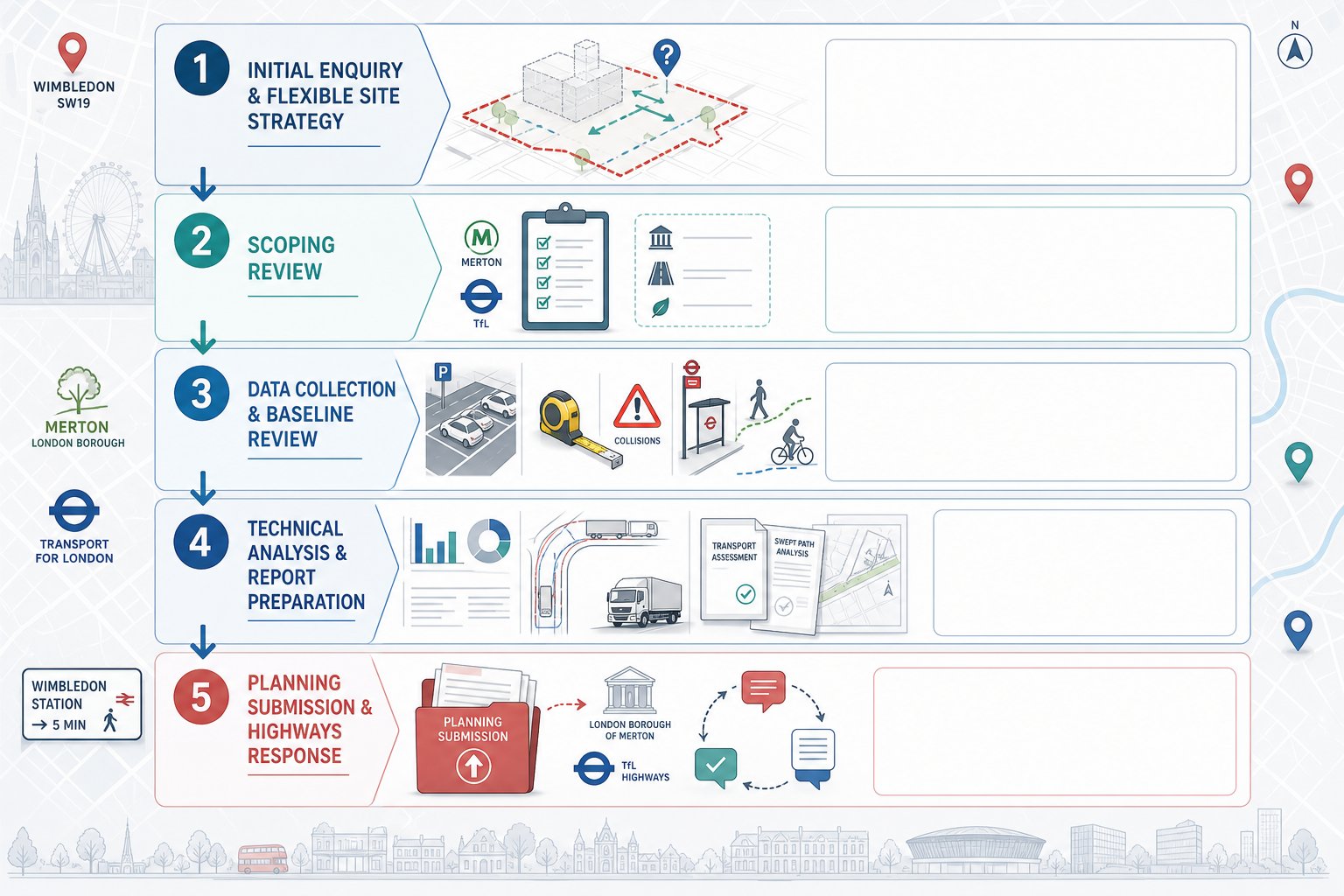
A strong transport submission usually starts earlier than clients expect. By the time a scheme reaches final drawing stages, transport choices on access, parking, servicing and cycle provision are often harder to fix. We prefer to get involved when the site strategy is still flexible enough to respond to evidence.
The first step is scoping. We review the proposal, planning status, likely transport issues, local constraints and whether Merton or TfL input is likely. At this point we decide what the application probably needs: a concise statement, a fuller assessment, parking surveys, vehicle tracking, a Travel Plan, or some combination. We also flag issues that may need design changes rather than report wording.
Next comes data collection and baseline review. That may include site visits, parking beat surveys, collision data review, access measurements, public transport accessibility review, and analysis of nearby walking and cycling connections. For larger or more sensitive schemes, we may agree scope points through pre-application discussion so expectations are clearer before drafting begins.
Then we move into technical analysis and report preparation. We forecast trips, test assumptions, review servicing, prepare swept paths, write the planning narrative and coordinate with the architect and planner so the submission reads as one joined-up case. If highways comments come back after validation, we respond in the same evidence-led way.
Our experience across places such as Traffic Engineer In Leeds: and wider London work helps with method, but the real advantage is knowing when Wimbledon-specific detail will make or break the application.
How To Strengthen Your Application And Avoid Common Transport Objections
Most transport objections are not caused by one catastrophic issue. More often, they arise from small gaps that add up: unsupported parking claims, unclear servicing, missing vehicle tracking, generic policy references, or assumptions that sound reasonable but have not been evidenced. The best way to strengthen an application is to remove those gaps before submission.
Early scoping is the first win. If the site is likely to raise concern on access, overspill parking, pick-up and drop-off, or junction impact, we would rather test that issue honestly at concept stage than defend a weak position later. A brief pre-app discussion can also clarify whether Merton expects a Statement or a full Assessment and whether TfL involvement is likely.
Realistic evidence matters more than optimistic wording. If a scheme depends on low car ownership, support it with location analysis, parking controls, local services, cycling provision and, where useful, parking stress data. If deliveries will be infrequent, define what “infrequent” means. If a refuse vehicle can turn on-site, show it. Planning officers and highway officers tend to respond well when claims are measurable.
Mitigation should also be specific. That may include car-free agreements, permit-free obligations, improved cycle parking, revised access geometry, delivery booking systems, staff travel measures or a management plan for school drop-off activity. Vague commitments rarely calm concerns.
And one last point: align the transport report with the drawings. We still occasionally see applications where the statement promises one servicing arrangement and the site plan shows another. Those inconsistencies create avoidable doubt, and doubt is expensive in planning.
Conclusion
A well-prepared transport case can do far more than satisfy a validation requirement. In Wimbledon, it often shapes whether a planning application feels robust, policy-aware and genuinely deliverable. The difference usually comes down to timing, local understanding and the quality of the evidence behind the submission.
When the transport strategy reflects Merton’s planning context, TfL expectations, parking realities and the practical operation of the site, objections become easier to answer and approvals tend to move more smoothly. That applies whether the scheme is a flat conversion, a mixed-use redevelopment, a school project or a commercial change of use.
For architects, planners, developers and councils, the smartest approach is simple: scope transport work early, keep it proportionate, and make sure the report is grounded in how Wimbledon streets actually work. That is what turns a transport document from a box-ticking exercise into a tool that helps planning decisions happen with more confidence.
Frequently Asked Questions About Traffic Engineering in Wimbledon
What role does a traffic engineer in Wimbledon play in planning applications?
A traffic engineer in Wimbledon provides critical transport analysis and strategy to support planning applications, ensuring compliance with the London Plan, Merton Local Plan, and TfL guidance by assessing trip generation, parking demand, and road safety specific to Wimbledon’s local context.
When is a Transport Assessment or Transport Statement required for Wimbledon developments?
Transport Assessments are typically needed for larger or trip-intensive proposals, like major residential or schools, whereas smaller schemes often use a Transport Statement. The decision depends on site sensitivity, scale, and local highway conditions, considering parking controls and pedestrian safety.
How does local context in Wimbledon affect transport planning for new developments?
Wimbledon’s high public transport accessibility, controlled parking zones, and busy corridors mean developments must provide evidence for low-car usage, adequate cycle parking, safe servicing, and justified parking provision, aligned with healthy streets and active travel policies under the London Plan.
What types of projects commonly require traffic engineering input in Wimbledon?
Projects such as new vehicle accesses, increases in traffic or parking demand, residential intensifications, commercial changes, schools, and community facilities often trigger traffic engineering input to address local network impacts and ensure safe, practical access and servicing arrangements.
How can applicants strengthen their planning applications to avoid transport objections in Wimbledon?
Early scoping with highways authorities, providing realistic trip forecasts, thorough parking and swept path evidence, clear mitigation measures like car-free agreements, and aligning transport reports with site plans improves credibility and reduces risks of objections during Wimbledon planning.
What documents does a traffic engineer in Wimbledon typically prepare for planning submissions?
They prepare Transport Statements or Assessments, Travel Plans, parking surveys, swept path analyses, and delivery and servicing reviews, often incorporating CAD tracking and local policy interpretation to provide comprehensive transport evidence specially tailored for Wimbledon’s conditions.