
Kennington is the sort of place where transport detail can make or break a planning application. A site may look straightforward on a location plan, but once you factor in bus routes, busy junctions, constrained frontages, servicing pressure, controlled parking zones, cycling movements and road safety, the transport picture gets complicated very quickly. That is exactly where a traffic engineer in Kennington adds value.
For architects, planners, developers, lawyers and surveyors, transport input is rarely just a technical add-on. It often shapes whether an application feels credible to highway officers, whether objections can be answered cleanly, and whether a scheme moves forward without avoidable delay. In dense London locations, weak assumptions on trip generation, access or parking are usually spotted fast.
We approach this work with a planning-first mindset. That means understanding not only vehicle impact, but also walking, cycling, public transport access, servicing practicality and the policy expectations that come with urban development in 2026. With more than 30 years of experience preparing concise, accurate transport reports, we know that the strongest submissions are the ones that are clear, evidence-led and tailored to local authority thresholds from the outset.
Below, we break down what a traffic engineer in Kennington actually does, when transport reports are needed, what issues are scrutinised most closely, and how to choose support that improves the odds of a smoother planning process.
Key Takeaways
- A traffic engineer in Kennington plays a crucial role by providing detailed transport assessments that consider local conditions such as bus routes, parking zones, and cycling movements to support credible planning applications.
- Early involvement of a traffic engineer helps identify and resolve access, parking, and servicing issues before design layouts are finalised, reducing delays in the planning process.
- Transport reports in Kennington must be tailored to urban complexities and align with local policies, ensuring accuracy in trip generation, safety, and sustainable transport measures.
- Choosing the right traffic engineer requires urban experience, high-quality report writing, practical judgement on assessment scope, and responsiveness to tight planning schedules.
- Transport assessments, statements, and travel plans each serve different purposes and choosing the appropriate one depends on the development’s scale and impact on local transport networks.
What A Traffic Engineer Does In Kennington Planning Projects
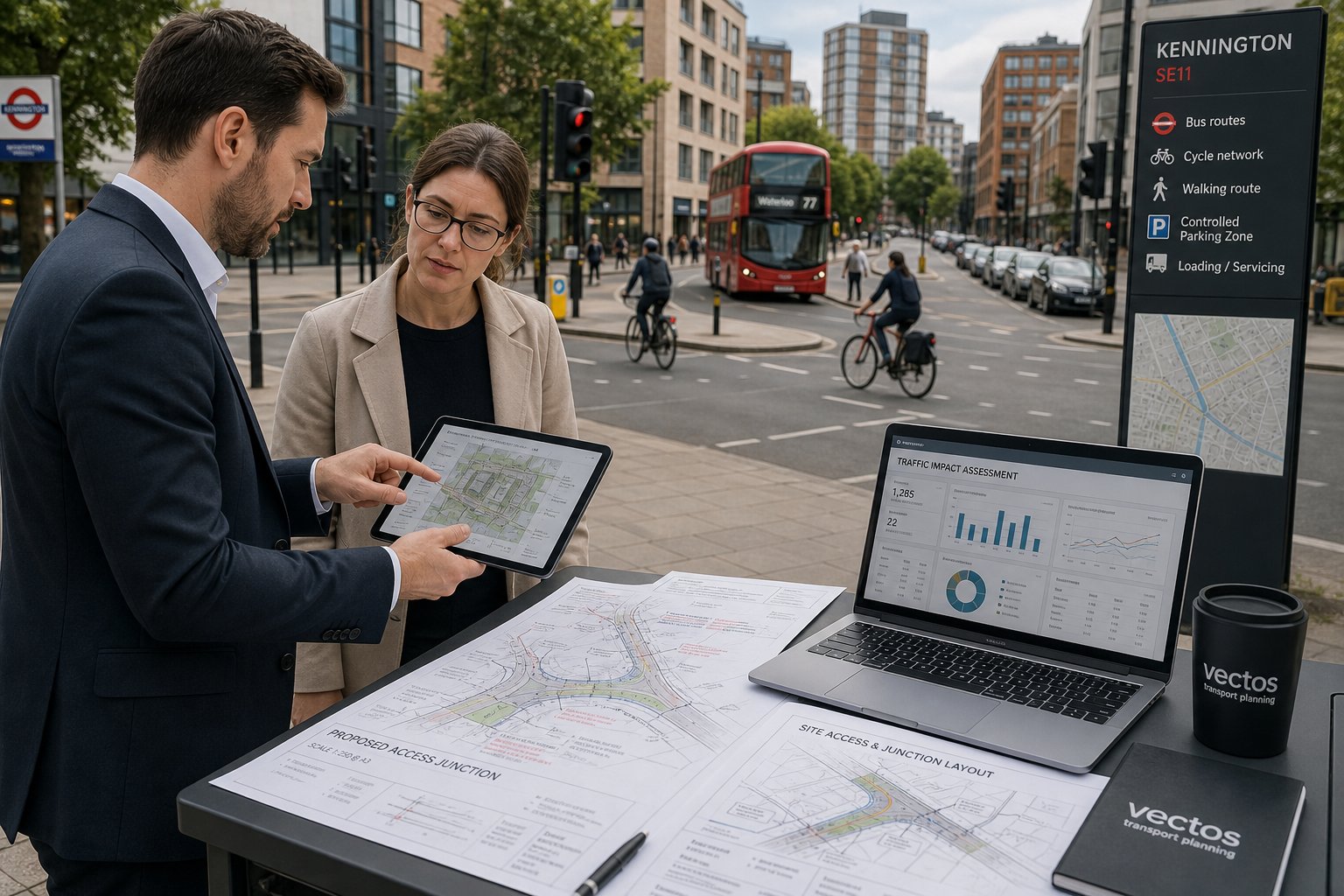
In planning terms, our job is to translate a development proposal into transport reality. We assess how a scheme will interact with the surrounding network, whether that is a small residential infill plot, a commercial refurbishment, a mixed-use redevelopment or a change of use that alters travel demand.
That usually starts with baseline evidence. We review site access, nearby junctions, public transport availability, walking and cycling connections, parking controls, servicing constraints and known road safety issues. Depending on the scale of the project, we may also arrange traffic counts, queue observations, speed data, pedestrian surveys or swept path analysis.
From there, we estimate the trips a development is likely to generate and test whether the local network can absorb them. If not, we identify proportionate mitigation: revised access geometry, loading arrangements, cycle parking, delivery strategy, junction amendments, crossing improvements or travel plan measures. The point is not to make a scheme sound harmless when it is not. The point is to present a robust, policy-aligned case.
That practical role is why many teams bring in Traffic Engineering Consultants: early, before layouts are fixed. In Kennington especially, early transport advice can prevent a design team from spending weeks developing an access or parking arrangement that the highway authority is unlikely to support.
Why Local Transport Input Matters For Developments In Kennington
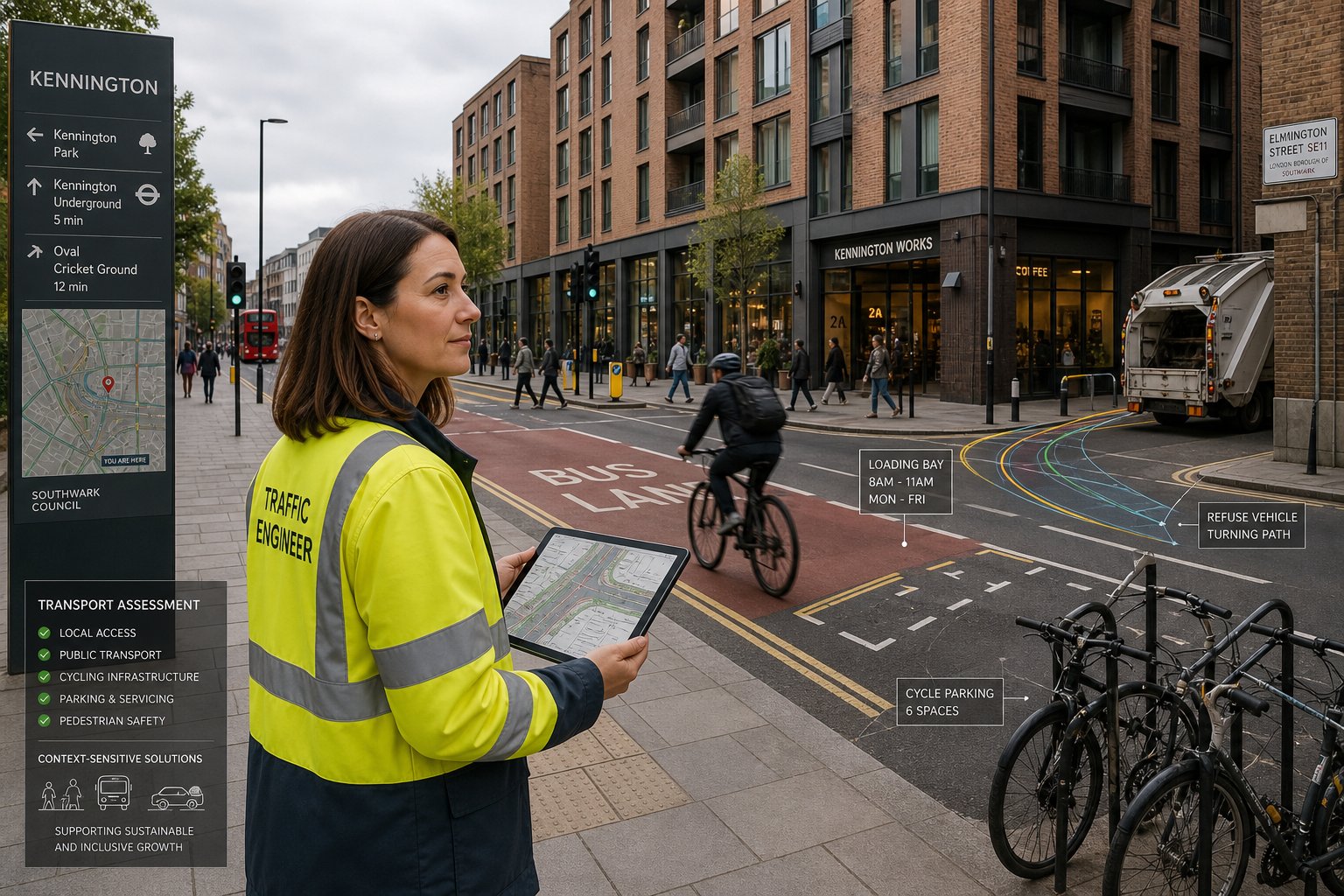
Kennington is not a blank canvas. It sits within a tightly connected part of London where development impacts are judged against local movement patterns, borough standards, London Plan expectations and, where relevant, Transport for London considerations. A generic report prepared without local awareness often reads exactly like that, generic.
Local transport input matters because the success of a planning application depends on context. A modest trip increase can still be sensitive if it feeds a stressed junction, conflicts with bus operations, worsens servicing on a narrow frontage or creates pressure in an already managed parking area. Equally, a scheme in a highly accessible location may justify lower car parking provision if the evidence is assembled properly.
We also find that local knowledge sharpens judgement on what officers are likely to focus on. Sometimes the real issue is not traffic volume but how refuse vehicles will turn. Sometimes it is cycle parking quality. Sometimes it is whether a basement ramp, crossover or loading bay creates pedestrian conflict.
That is why broader strategic understanding, including the lessons set out in Traffic Engineer In London:, helps frame the right level of assessment. In Kennington, transport reports need to be precise enough for urban conditions, not copied from suburban templates that ignore how London streets actually work.
Common Planning Applications That Need Traffic Engineering Support

Not every proposal needs a long transport document, but many more schemes need traffic engineering input than applicants first assume. In Kennington, that includes new residential development, office schemes, retail units, healthcare uses, education sites, leisure proposals, hotels, supermarkets, mixed-use projects and changes of use that materially change trip patterns.
Residential applications are a common example. Even where traffic generation is relatively modest, issues around pick-up and drop-off activity, cycle storage, disabled parking, refuse collection and delivery management can trigger detailed questions. For commercial schemes, the emphasis may shift towards servicing frequency, loading demand, employee travel and peak-hour impacts.
Change-of-use applications are often underestimated. A unit moving from one lawful use to another may appear simple on paper, yet the transport implications can be very different. A café, medical use or convenience retail unit can intensify short-stay trips, kerbside demand and pedestrian flows in ways officers will want tested.
This is especially true in urban schemes with active frontages and constrained highway space, which is why Commercial Traffic Engineering In 2026 has become such an important discipline for developers and planning teams. The earlier these transport questions are surfaced, the easier it is to design around them rather than defend weak assumptions later.
Transport Assessments, Transport Statements, And Travel Plans Explained
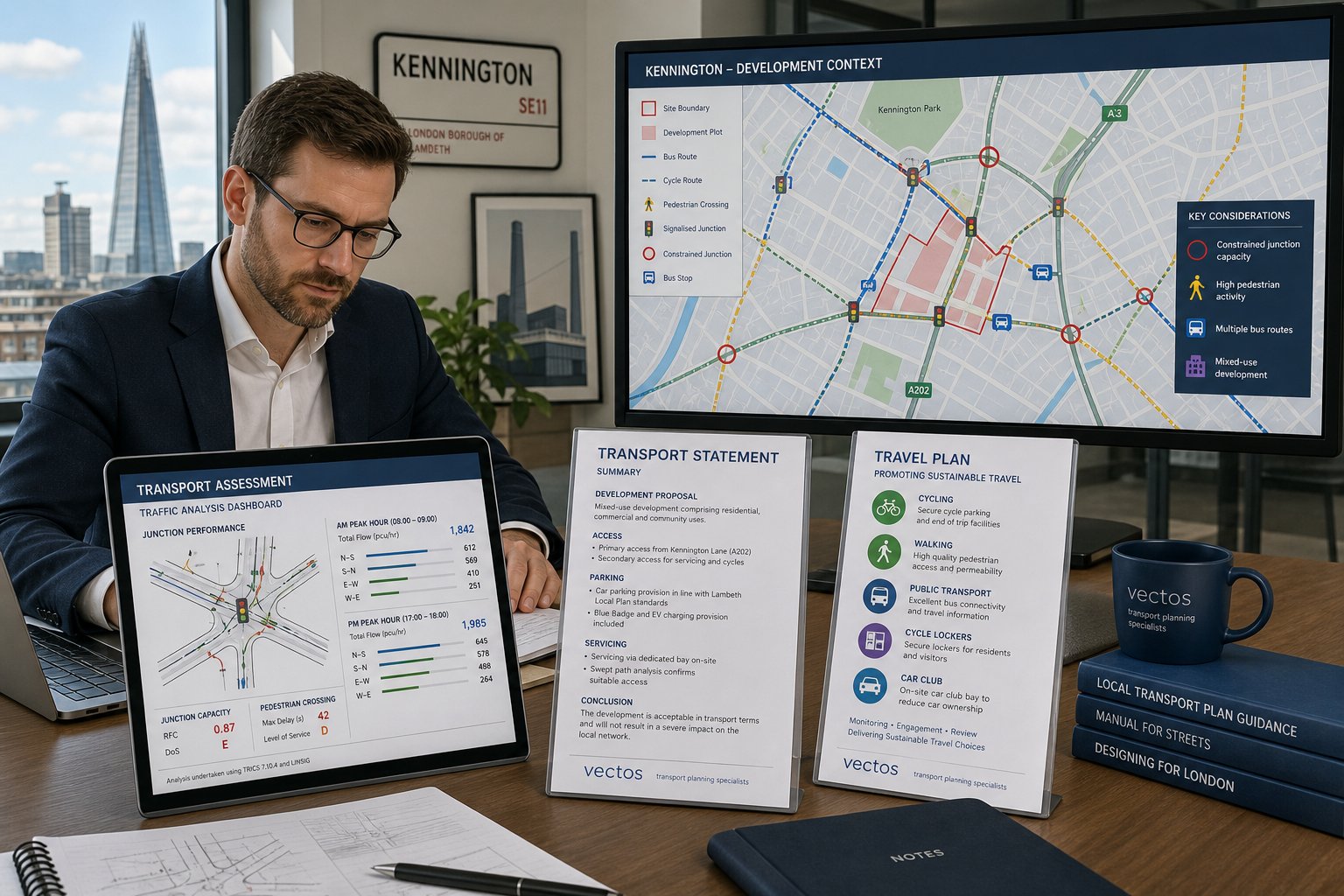
These three documents are related, but they do different jobs.
A Transport Assessment (TA) is the most detailed. It is normally prepared for larger or more transport-sensitive developments and examines existing conditions, trip generation, trip distribution, mode share, junction capacity, road safety, parking, servicing and mitigation. It is the document planning officers and highway officers rely on when they need a fuller picture of likely impact.
A Transport Statement (TS) is a more concise report for smaller or lower-impact proposals. It still needs evidence and sound reasoning, but the level of modelling and analysis is usually lighter because the scheme is not expected to create severe transport effects.
A Travel Plan focuses on behaviour and management. It sets out practical measures to reduce single-occupancy car use and encourage sustainable travel, often through cycle facilities, public transport information, monitoring, travel packs, car club membership, showers, lockers or coordinator arrangements.
Choosing between them is not just a box-ticking exercise. The wrong document can lead to immediate requests for further information. Our approach follows the principles of Traffic Engineering and Transportation: match the scope of assessment to the scale, location and sensitivity of the scheme, then make sure the evidence is proportionate but credible.
When A Full Transport Assessment Is Needed
A full Transport Assessment is typically needed where a proposal is major in scale, generates significant trips, affects sensitive junctions, or sits on a corridor where the existing network is already under pressure. In Kennington, that threshold can be reached sooner than applicants expect because urban conditions are complex and spare capacity is often limited.
We would usually advise a TA where a development could materially alter peak-hour flows, create servicing demands that affect the carriageway, intensify pedestrian crossing movements, or raise concern around highway safety. Larger residential blocks, mixed-use schemes, education uses, healthcare proposals and substantial commercial redevelopment commonly fall into this category.
A TA is also sensible where pre-application feedback suggests transport will be a live issue, or where the site has awkward access constraints. If a scheme relies on a specific assumption, for example, reduced car ownership due to strong public transport accessibility, the case is stronger when it is set out fully with local evidence rather than asserted briefly.
In practice, a robust TA gives everyone a clearer basis for decision-making. It allows the authority to understand the impacts, and it allows the applicant team to answer objections with evidence instead of optimism.
When A Transport Statement Or Travel Plan May Be Appropriate
A Transport Statement may be appropriate for a smaller proposal where transport impacts are expected to be limited and straightforward to explain. That might include minor residential development, small commercial schemes, modest changes of use, or infill projects in highly accessible locations where there is no reason to expect severe network effects.
But “smaller” does not mean “casual”. A TS still needs to address access, parking, servicing, local policy, sustainable transport and, where relevant, collision history or visibility. Officers are rarely persuaded by a two-page note that skips over the difficult bits.
A Travel Plan may sit alongside a TA or TS, or occasionally act as the main transport management document where the core question is how occupiers, staff or visitors will travel. In London locations, Travel Plans are often valuable because they show a scheme is not simply relying on good public transport by default: it is actively supporting walking, cycling and public transport use.
Done well, a TS or Travel Plan can be enough. Done thinly, it often becomes the reason an authority asks for more.
Key Traffic And Highway Issues Reviewed During A Planning Application
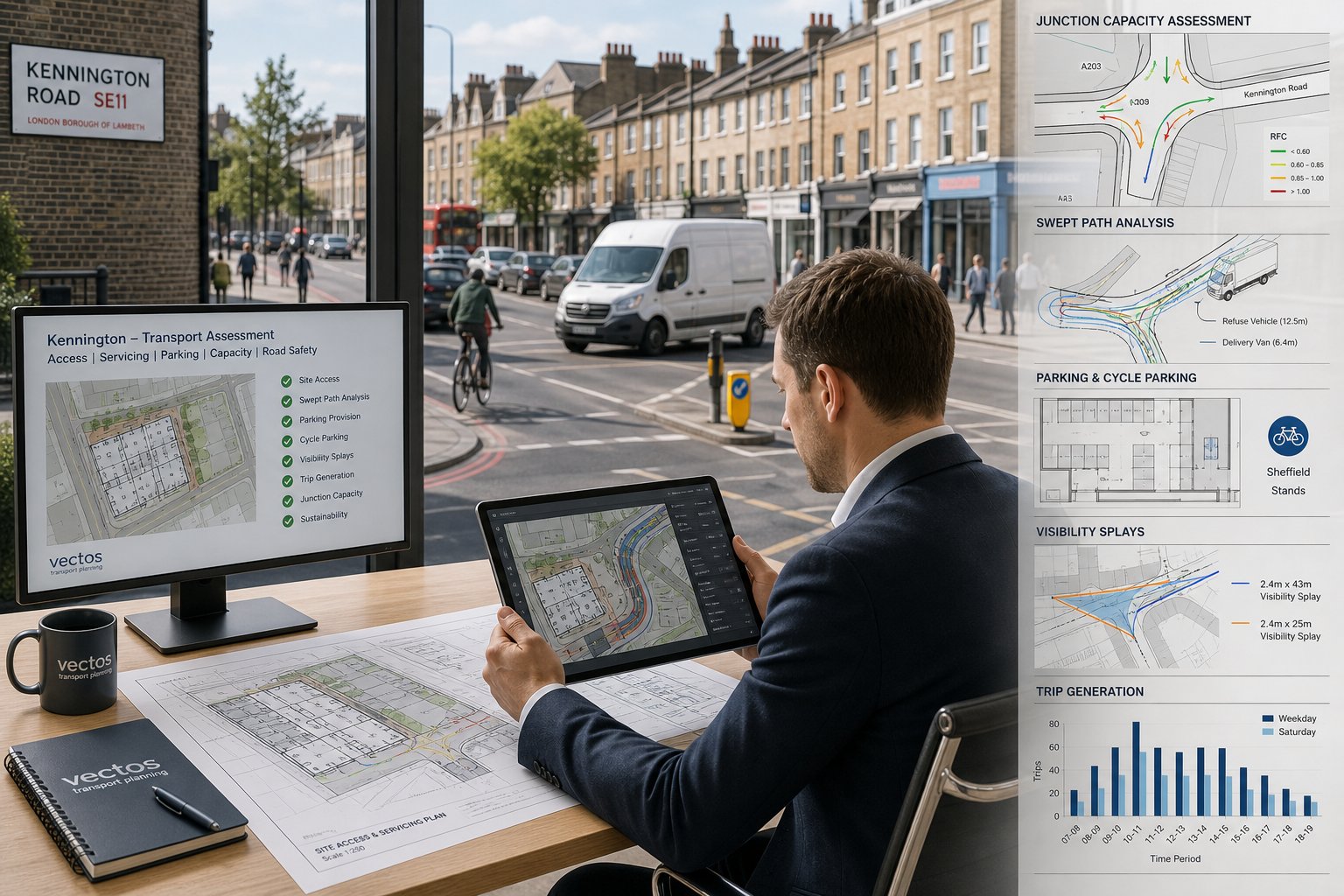
Highway review is rarely about one single metric. Officers tend to look across a package of issues: how people and vehicles access the site, whether servicing is workable, whether parking provision is justified, how many trips the development will generate, whether nearby junctions can cope, and whether any aspect of the proposal introduces road safety risk.
The key point is that these issues interact. A layout with minimal parking might look policy-compliant, but if servicing then spills onto the highway, the overall transport case weakens. A low trip generation forecast may appear favourable, but if access visibility is poor, that forecast does not solve the main concern.
In urban planning applications, we hence test not only capacity but also operation. Can a van enter, turn and leave in a forward gear? Will pedestrians cross where drivers least expect them? Does cycle parking sit where people will actually use it? Are disabled bays convenient and workable? Does a gate, ramp or bin store arrangement create friction on the footway?
Those are classic Traffic Engineering: Your territory questions: practical, technical, and directly tied to whether a scheme functions in the real world rather than just on a drawing.
Access, Servicing, Parking, And Visibility Considerations
Access is usually the first highway issue reviewed, and for good reason. If vehicles cannot enter and leave safely, or if pedestrians and cyclists are exposed to avoidable conflict, the scheme is vulnerable from the start. In Kennington, frontage constraints, mature street patterns and active footways often make access design a genuinely technical exercise.
We assess entry widths, radii, gradients, crossover arrangements, tracking for service and refuse vehicles, and whether the layout allows safe manoeuvring on site. Visibility splays are reviewed in context: what is achievable on an urban street can differ from a rural standard, but the reasoning must be defensible and aligned with guidance.
Parking also attracts close scrutiny. The question is not just how many spaces are proposed, but whether the provision reflects local standards, disabled access needs, cycle demand, electric charging expectations and the site’s public transport accessibility. Poorly arranged parking can create as many objections as over-provision.
Servicing is another common pressure point. If deliveries are expected from standard vans, larger rigid vehicles or occasional specialist vehicles, that needs to be demonstrated clearly. A planning application that leaves servicing “to be managed later” often invites trouble.
Junction Capacity, Trip Generation, And Road Safety Factors
Trip generation is the backbone of most transport reports. We usually derive it from accepted industry sources such as TRICS, then sense-check it against location, land use, scale and local travel patterns. In a place like Kennington, mode share assumptions matter a great deal: overstate car use and the scheme looks worse than it is, understate it and the report loses credibility.
Once trips are forecast, we consider assignment and impact. Which routes will vehicles likely use? Are there nearby junctions already under stress? Does the development affect weekday peaks, school peaks, weekend peaks or all three? For larger schemes, capacity modelling may be needed to show whether queues, delays or reserve capacity remain acceptable.
Road safety review is just as important. We examine available collision records, site conditions and conflict points to identify whether the development could worsen an existing problem. That may lead to mitigation such as access changes, waiting restrictions, pedestrian crossing improvements, warning measures or revised servicing controls.
Good analysis here is rarely dramatic. It is calm, evidence-based and difficult to pick apart, which is exactly what planning teams need when transport becomes a contested issue.
How A Traffic Engineer Supports Architects, Planners, And Developers
Our role is partly technical and partly collaborative. We do not just write reports at the end of the process: we help shape schemes so they are easier to defend in the first place.
For architects, that often means early input on access, turning, cycle parking, refuse strategy and frontage design before layouts harden. A small change to a core arrangement at concept stage can remove a major objection later. For planners and planning consultants, we provide the evidence base that supports statements on policy compliance, sustainable movement and proportionate impact. For developers, we help de-risk programmes by identifying transport issues before they emerge in consultation.
We also work closely with lawyers, surveyors and project managers where transport matters intersect with rights of access, Section 106 discussions, planning conditions or delivery strategy. And when highway comments come back with queries, as they often do, we respond in a way that is technical but commercially aware. The aim is not to win points in a debate. It is to move the application toward a decision.
That practical, cross-discipline approach is central to Traffic Engineer In other urban planning contexts as well, but in Kennington it is especially valuable because design, transport and policy are so tightly linked.
The Process From Initial Review To Planning Submission
A well-run transport workstream tends to follow a clear sequence, even if the details vary by project.
First, we carry out an initial review. That involves understanding the proposal, the site constraints, likely policy triggers and whether the development may need a TA, TS, Travel Plan, swept path analysis, delivery strategy or junction modelling. If required, we advise on pre-application input so transport issues can be discussed before a formal submission.
Next comes evidence gathering. We review drawings, visit the site, inspect nearby streets, commission surveys where needed and establish the baseline transport context. Then we test the proposal: trip generation, mode split, servicing, parking, access, capacity and safety, depending on the scale of the scheme.
After that, we prepare the report package in a format suitable for the application. The best reports are concise without being thin. They answer the likely officer questions before those questions are asked.
Once the application is submitted, our involvement often continues. Highway officers may request clarifications, further drawings, revised wording or additional evidence. We respond, refine and support the team through to determination. That end-to-end process is a big reason clients use experienced Traffic Engineer In urban specialists rather than treating transport as a last-minute appendix.
Common Reasons Transport Reports Are Challenged And How To Avoid Delays
Most transport objections are not caused by the existence of impacts alone. They arise because the analysis is incomplete, outdated, badly scoped or too easy to challenge.
One common issue is weak baseline data. Traffic counts may be old, unrepresentative or collected on dates that do not reflect normal conditions. Another is unrealistic trip generation, especially where a report selects comparator sites poorly or applies mode share assumptions without proper justification. Authorities also push back when local highway constraints are brushed aside, awkward servicing, school-time pressure, existing collision patterns, controlled parking stress or footway conflict.
Reports can also run into trouble when they ignore policy detail. London and borough expectations on cycle parking, disabled provision, car-free development, deliveries or sustainable travel are not optional extras. If the report does not engage with them, officers notice.
The best way to avoid delay is simple, though not always easy: scope the work properly at the start, use current evidence, be candid about constraints, and make sure every conclusion flows from data rather than wishful thinking. We have found that concise honesty travels further than glossy overstatement.
Where broader benchmarking helps, examples from Traffic Engineer In Bristol: and comparable city work can be useful, not because Kennington is identical, but because experienced urban practitioners know how quickly weak assumptions unravel under scrutiny.
Choosing The Right Traffic Engineer In Kennington For Your Project
Choosing the right consultant is about more than finding someone who can produce a transport report. You need a team that understands planning strategy, local authority expectations, urban highway design, trip analysis, sustainable transport policy and the commercial reality of development programmes.
We would look for four things.
First, relevant urban experience. Kennington projects are shaped by constrained streets, public transport accessibility, active travel policy and sensitive servicing conditions. A consultant used only to edge-of-town development may struggle with those nuances.
Second, report quality. Good transport work is clear, proportionate and technically defensible. It should be easy for planners, architects and officers to follow, without burying key issues under jargon.
Third, practical judgement. The best traffic engineer in Kennington will know when a full TA is necessary, when a TS is enough, and when the real answer is to adjust the design rather than argue harder.
Fourth, responsiveness. Planning programmes move quickly, and transport advice is often needed at concept, pre-app, submission and post-submission stages. Delays at any one of those points can affect the whole team.
For us, the strongest transport support combines technical credibility with straightforward communication. That is usually what turns transport from a planning risk into a planning advantage, and in a demanding London location, that difference genuinely matters.
Frequently Asked Questions about Traffic Engineering in Kennington
What roles does a traffic engineer play in Kennington development projects?
A traffic engineer in Kennington assesses how a development impacts local transport, including vehicle access, parking, and junction capacity. They gather data, forecast trip generation, and propose mitigation measures to ensure schemes comply with local policies and operate safely and efficiently.
When is a full Transport Assessment required for a Kennington planning application?
A full Transport Assessment is needed for major developments or those affecting sensitive junctions or busy corridors in Kennington. It provides a detailed evaluation of trip generation, road safety, and mitigation to satisfy local authority and Transport for London requirements.
How does local transport knowledge improve planning applications in Kennington?
Local transport input ensures development proposals address Kennington’s specific conditions, such as constrained streets, bus routes, and parking controls. This sharpens judgements on access, servicing, and safety issues, making applications more credible to highway officers and reducing delays.
What are the differences between a Transport Assessment, Transport Statement, and Travel Plan?
A Transport Assessment is a comprehensive study for larger developments. A Transport Statement is a shorter report for smaller or less impactful schemes. A Travel Plan outlines measures to encourage sustainable travel and reduce car use, often complementing the other documents.
Which types of developments in Kennington commonly need traffic engineering support?
New residential blocks, commercial or mixed-use schemes, schools, healthcare, leisure sites, supermarkets, and changes of use that increase trips typically require traffic engineering input to address trip generation, parking, servicing, and safety.
How can selecting the right traffic engineer benefit a Kennington development project?
Choosing a local expert with urban transport experience, strong reporting skills, and knowledge of London policies ensures clear, credible assessments. Their early advice helps shape schemes to meet standards and can prevent costly delays during planning approval.