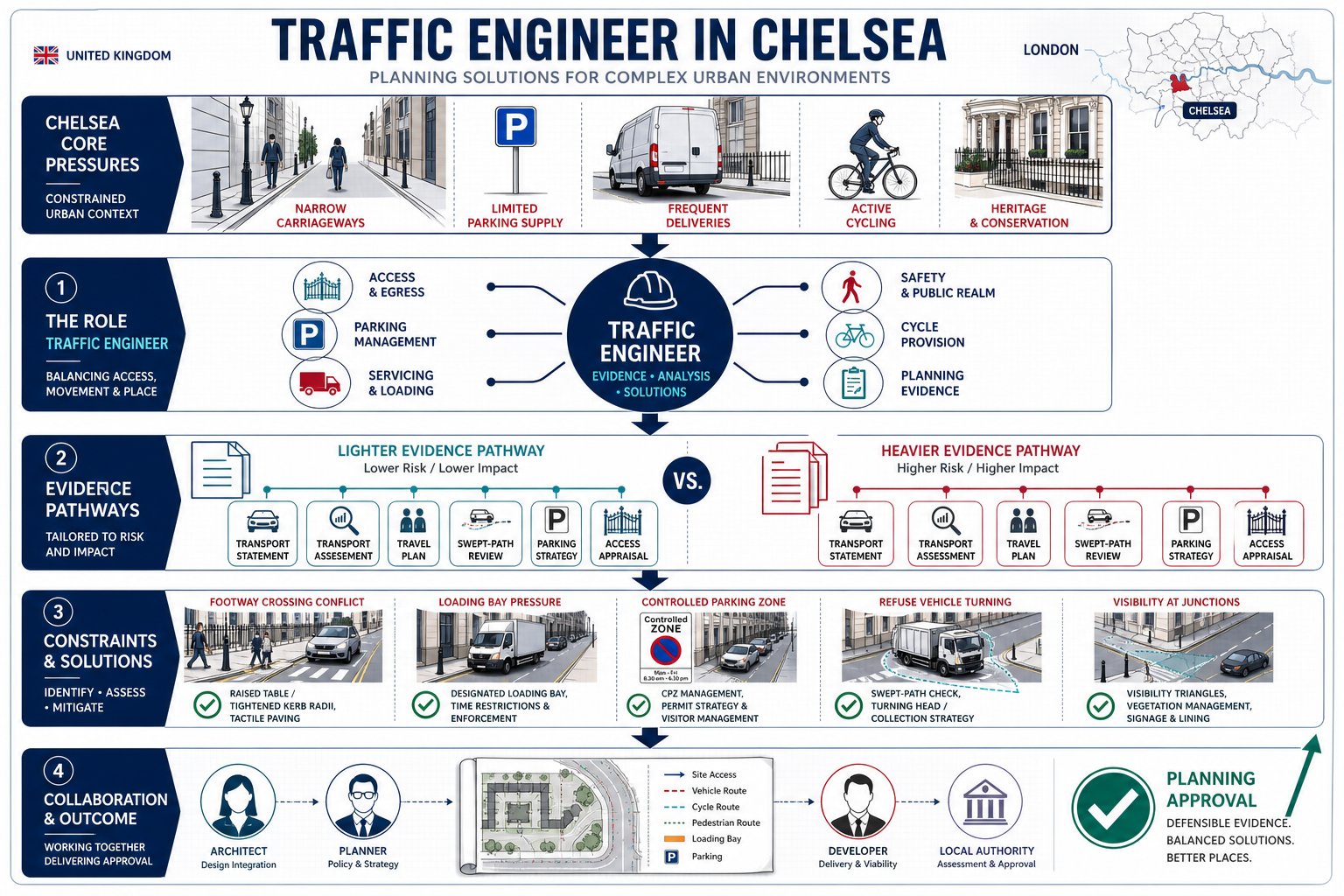
Chelsea schemes rarely fail on design ambition alone. More often, they get slowed down by something less glamorous and far more technical: access, servicing, parking stress, highway safety, or a planning officer asking for transport evidence that should have been scoped months earlier.
That is where a traffic engineer in Chelsea becomes central to the planning team rather than an afterthought. In a borough defined by constrained streets, high pedestrian activity, controlled parking, conservation sensitivities and close scrutiny from both the Royal Borough and, in many cases, Transport for London, transport planning has to be precise, proportionate and defensible.
We work with architects, planners, surveyors, developers, lawyers and local authorities to turn transport issues into planning-ready evidence. Sometimes that means a concise Transport Statement for a modest change of use. Sometimes it means a fuller Transport Assessment, servicing review, swept-path analysis, parking strategy or Travel Plan for a more demanding site. Either way, the aim is the same: reduce risk, answer likely objections early, and keep the application moving.
In this text, we set out what a traffic engineer in Chelsea actually does, why specialist local input matters, which reports are commonly needed, and how the process usually unfolds from early feasibility to planning determination. If you’re assembling a team for a Chelsea project in 2026, this is the practical transport overview you’ll want at the table.
Key Takeaways
- A traffic engineer in Chelsea plays a crucial role in addressing complex transport challenges such as access, parking, servicing, and highway safety to ensure smoother planning approvals.
- Early specialist transport input helps identify and resolve issues related to narrow streets, controlled parking zones, and heritage constraints before planning submissions.
- Transport Assessments or Statements provide essential, proportionate evidence on traffic impact and operational feasibility tailored to Chelsea’s unique urban environment.
- Collaborative work between traffic engineers, architects, planners, and developers influences design choices that enhance transport strategies and reduce planning risks.
- Effective transport planning in Chelsea requires clear, concise reports that reflect local policy, operational realities, and support sustainable travel measures like Travel Plans.
- Choosing a traffic engineer with proven London experience, local authority knowledge, comprehensive service offerings, and strong communication skills improves the chances of timely and successful planning consent.
What A Traffic Engineer In Chelsea Does
A traffic engineer in Chelsea assesses how a proposal will affect the movement of people and vehicles, then translates that analysis into designs and reports that planning and highway officers can rely on. At a practical level, that usually covers traffic impact, access geometry, parking provision, servicing arrangements, cycle facilities, refuse collection movements and pedestrian safety.
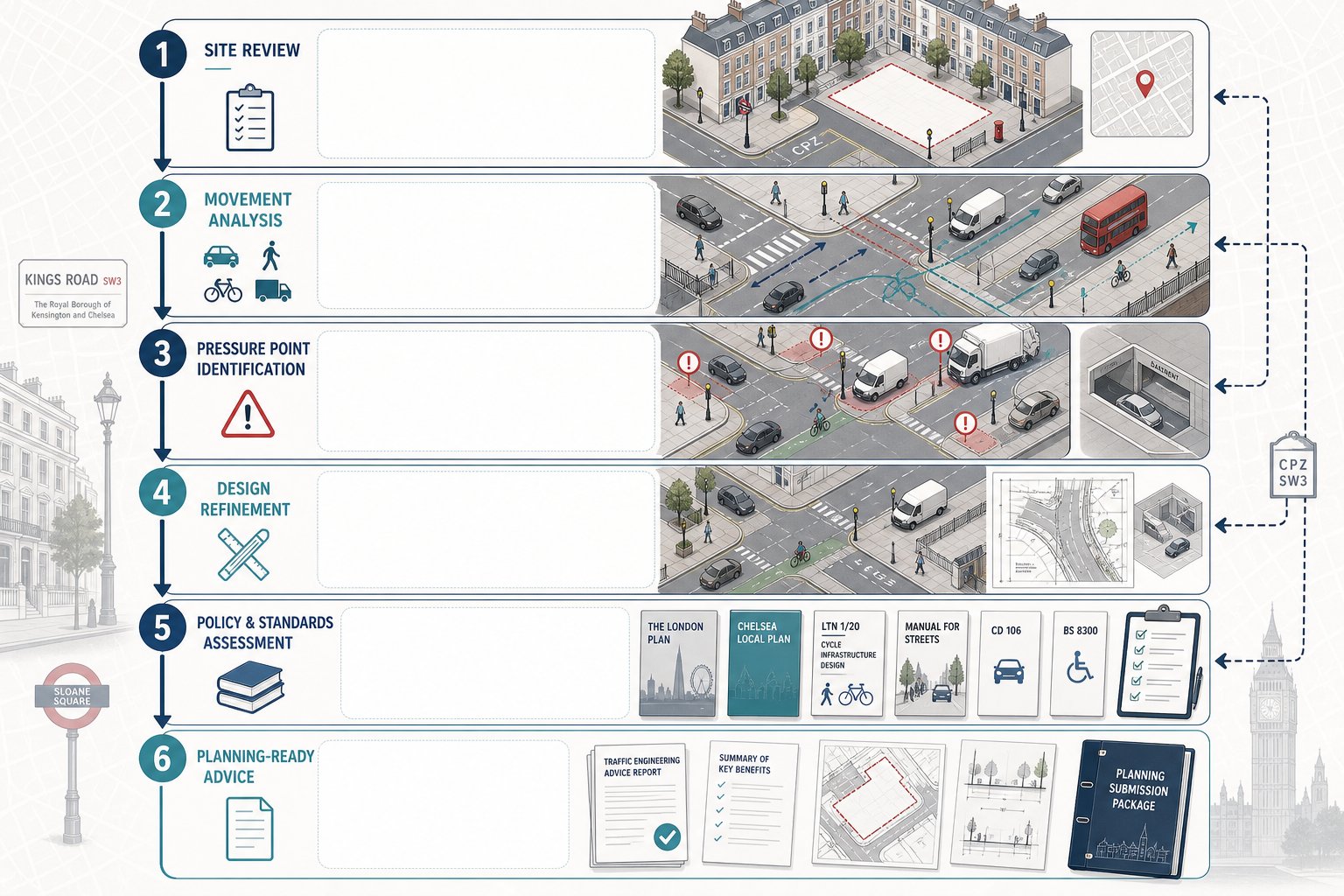
The role is partly analytical and partly strategic. We review the existing street network, identify likely pressure points, compare the proposal against planning policy and highway standards, and advise on what level of evidence will be proportionate. On one site, the key issue might be whether a basement ramp works safely without creating conflict on the footway. On another, it may be whether delivery activity can happen on-site rather than blocking a narrow street in a controlled parking zone.
In central London locations, that judgement matters. A generic transport report can miss the local nuance that officers immediately pick up. That is why many teams look for support with both technical depth and planning awareness, whether through a dedicated Traffic Engineer In London: resource or more specialist Traffic Engineering Consultants: who understand how evidence is tested in live applications.
A good engineer doesn’t simply measure traffic. We help shape the development so the transport case is stronger before the application is even submitted.
Why Chelsea Developments Need Specialist Transport Input
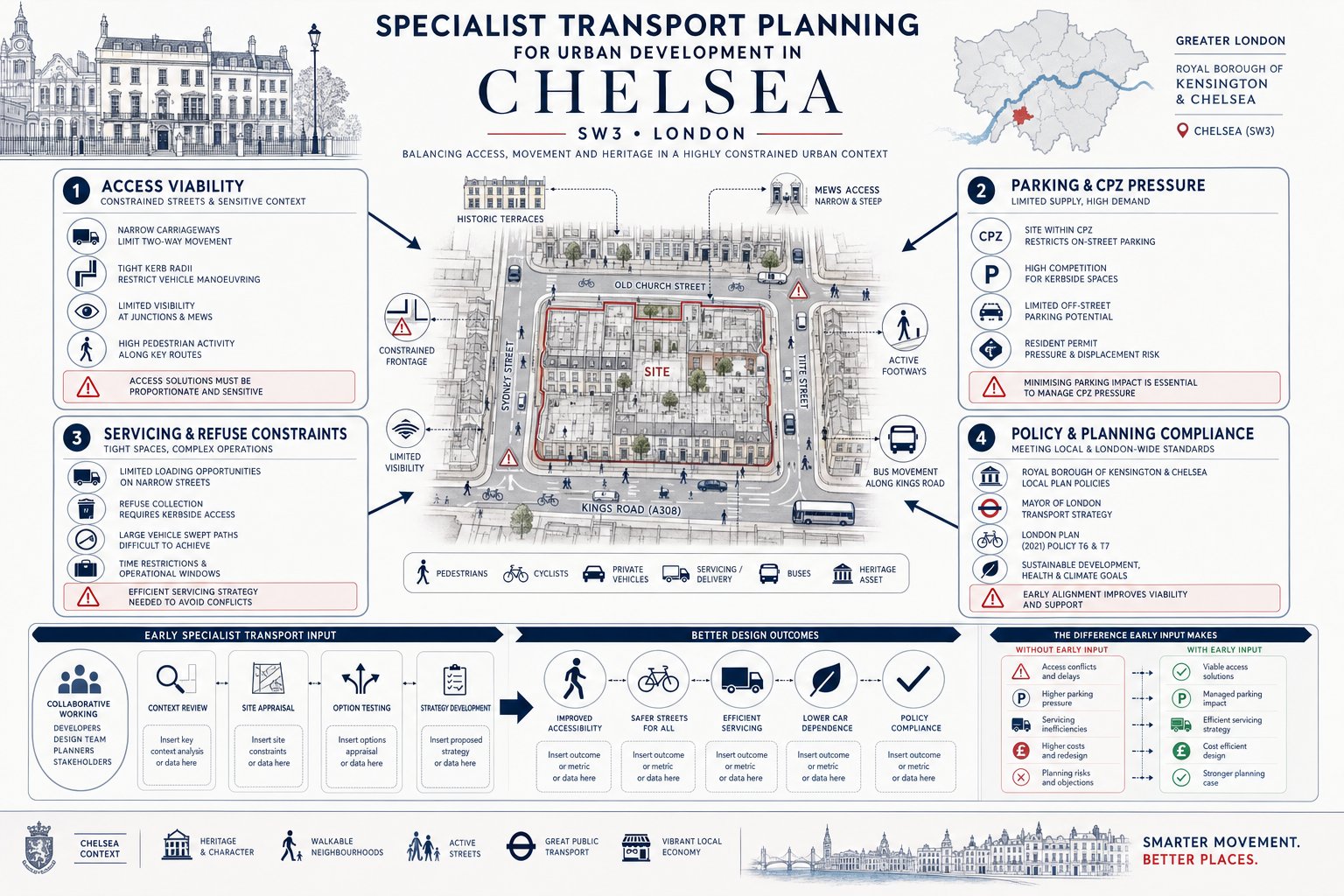
Chelsea is not forgiving when transport issues are left unresolved. Streets are often narrow, demand for kerbside space is intense, walking activity is high, and many sites sit within a fabric that was never designed for modern servicing patterns. Add heritage constraints, resident sensitivity to parking displacement, and the policy expectations applied across London, and even relatively small schemes can trigger detailed transport questions.
That is why specialist input is useful early. We can test whether access is viable, whether parking assumptions stack up, whether servicing can be safely accommodated, and whether the likely planning ask is a Transport Statement or something more robust. This is especially important where a scheme looks modest on paper but has operational characteristics that create local concern, such as frequent deliveries, staff arrivals in peaks, or refuse collection from a constrained frontage.
Chelsea projects also sit within a wider transport policy environment shaped by London Plan requirements, borough standards and, where relevant, TfL expectations. Evidence needs to be clear, proportionate and locally literate. The best outcomes usually come from integrating transport thinking with layout and planning strategy from the start, not bolting it on once objections appear.
Planning Constraints That Commonly Affect Sites In Chelsea
Several constraints recur again and again in Chelsea applications. Controlled Parking Zones are one of the biggest. If a proposal is likely to generate car ownership or on-street demand, officers will want a credible position on parking stress, permit eligibility and policy compliance. In some locations, cycle parking can be easier to support than car parking, but only if it is secure, convenient and genuinely usable.
Servicing is another frequent pinch point. Historic frontages and tight carriageways can leave little room for loading, refuse collection or emergency access. If vans have to stop on-street, the knock-on effect on pedestrians, buses, cyclists and general traffic may become a material issue. We often find that an early servicing strategy saves weeks later.
Visibility, footway protection and access width also matter, particularly where new crossovers, basement entrances or mews access points are proposed. And in conservation areas, physical highway changes may be harder to justify or deliver. Broadly speaking, Chelsea rewards schemes that prove they understand operational reality, not just land-use ambition.
How Transport Assessments Support Planning Applications
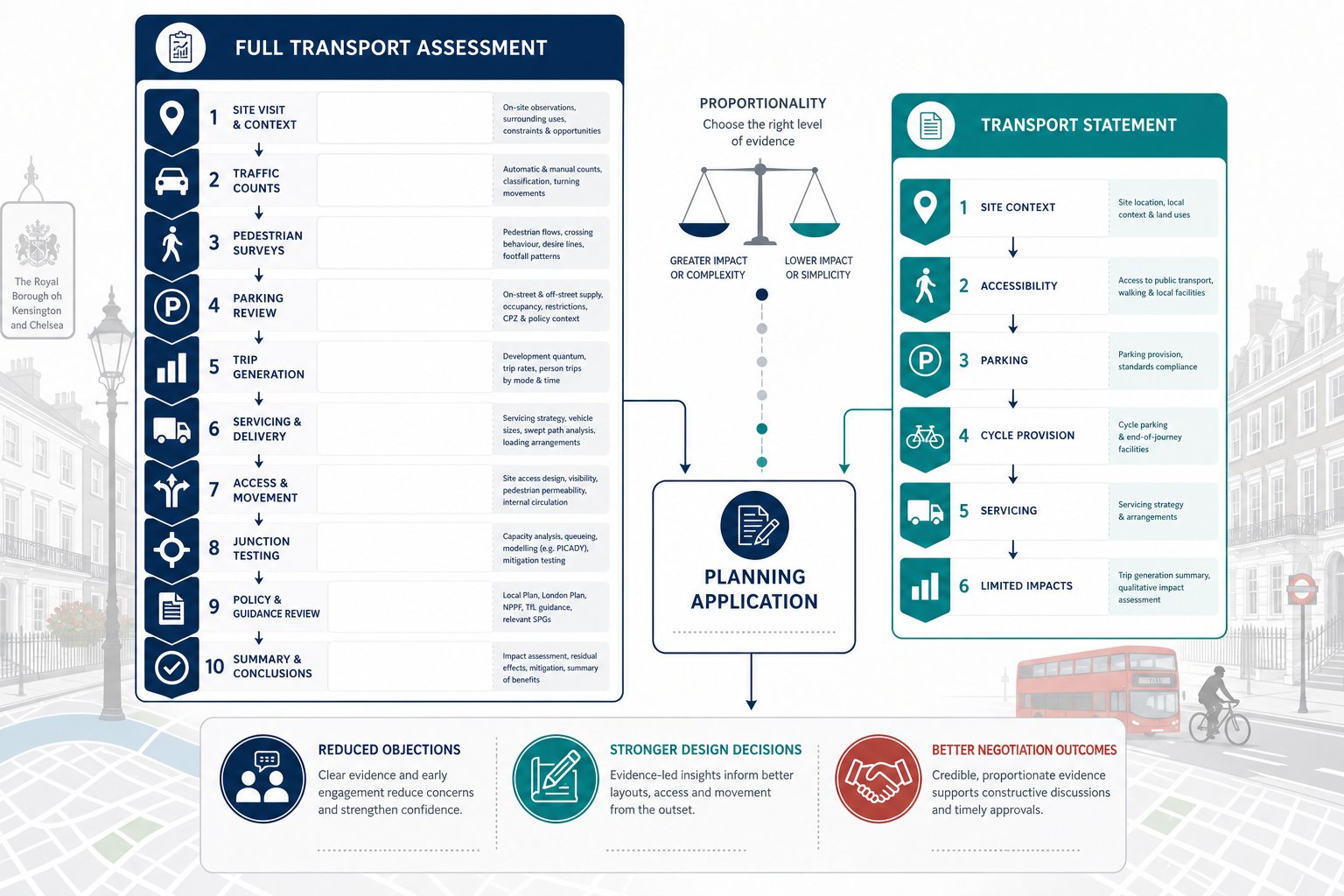
A Transport Assessment provides the structured evidence needed when a proposal could create material transport effects. It goes beyond description. It sets out existing conditions, estimates trip generation, reviews travel patterns, assesses access and servicing, and where necessary tests junction or network implications. The point is not to produce a fat document for its own sake: it is to show that the transport impacts are understood and, where needed, mitigated.
In Chelsea, that can include baseline site visits, traffic and pedestrian surveys, parking accumulation reviews, trip-rate analysis, servicing appraisals and policy assessment. For some schemes, a qualitative case is enough. For others, especially larger residential, mixed-use or commercial proposals, a more detailed evidence trail is necessary. Teams working on city-centre projects often benefit from broader Highway And Traffic experience because the real challenge is often coordination between design, operation and planning risk.
A well-prepared TA helps in three ways. First, it answers likely officer questions before they become formal objections. Second, it gives the design team a technical basis for layout decisions. Third, it improves negotiation positions if conditions, Section 106 obligations or highway agreements are discussed. Done properly, it is less about paperwork and more about making the planning case durable.
When A Transport Statement May Be Suitable Instead
Not every Chelsea development needs a full TA. A Transport Statement may be more appropriate where impacts are likely to be limited and the key issues can be addressed proportionately. That often applies to smaller schemes, minor intensification, some changes of use, modest refurbishments or proposals where trip generation is low and there is no significant junction concern.
A TS is still a technical planning document, not a light-touch note dashed off at the last minute. It should explain the site context, accessibility, parking position, cycle provision, servicing arrangements and expected transport effects in a concise, evidence-based way. If there is a sensitive access arrangement or a specific operational issue, we address that directly rather than padding the report with generic material.
The important point is proportionality. Under-scoping can lead to delays if officers ask for more evidence. Over-scoping can waste time and budget. We typically advise clients on the minimum robust document needed for the scheme, which is especially useful in Commercial Traffic Engineering cases where operational detail tends to matter as much as headline trip numbers.
Common Reports And Studies Required For Chelsea Projects
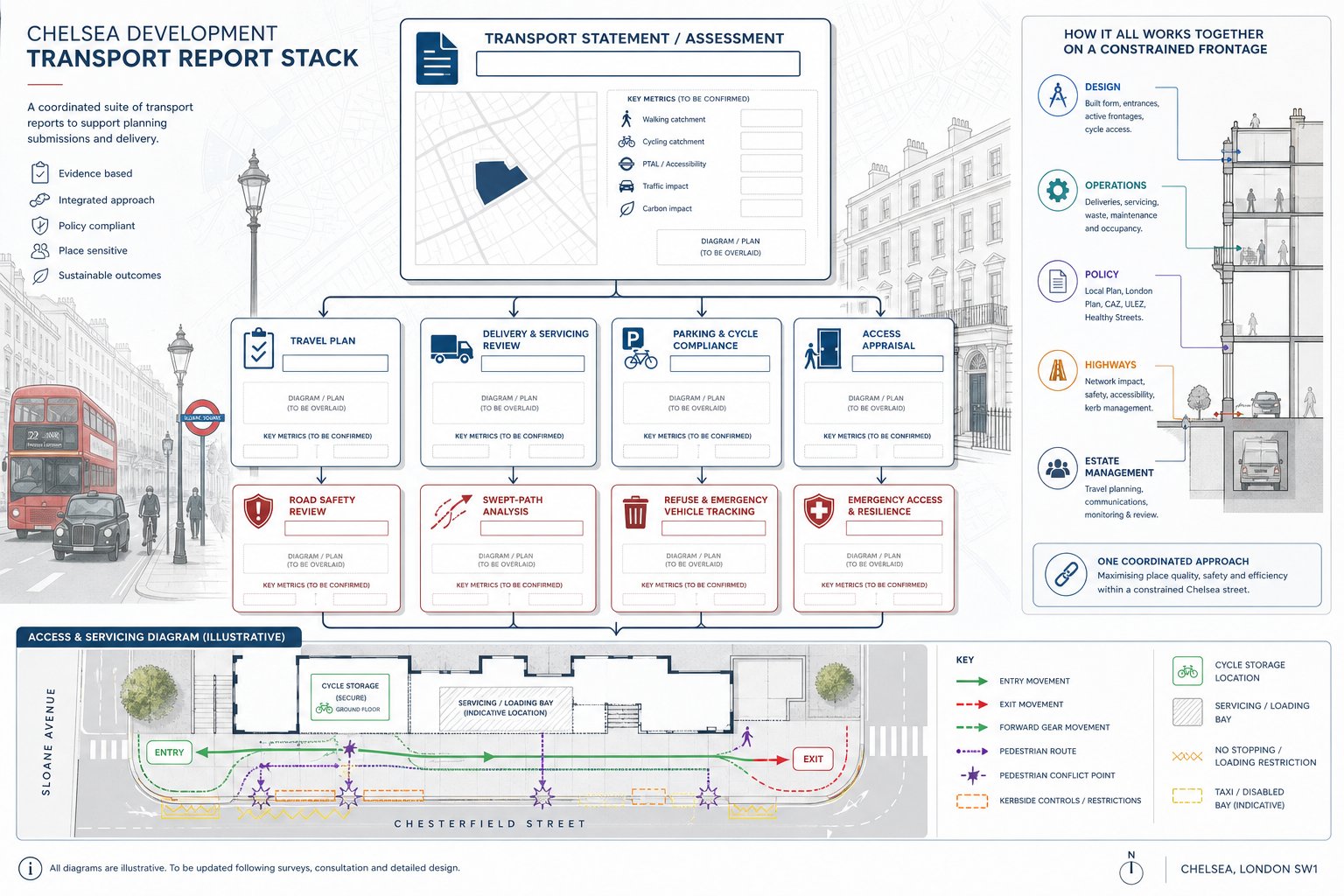
Chelsea schemes rarely rely on a single transport document. Even where the core submission is a TS or TA, supporting studies are often needed to address specific planning concerns. Which ones matter depends on the land use, frontage conditions, local policy triggers and the practical realities of running the development once built and occupied.
Typical requirements include a Travel Plan, parking and cycle compliance review, delivery and servicing strategy, swept-path analysis, road safety commentary, access appraisal and refuse vehicle tracking. Sometimes these are standalone documents: sometimes they are integrated within the main report. The key is that they should answer the actual questions the authority will ask, rather than ticking boxes in the abstract.
For teams that need a broader framework, Traffic Engineering and transportation planning principles are useful because Chelsea applications often cut across disciplines: architecture, logistics, highways, planning policy and estate management all intersect in a very small piece of street.
Transport Statements, Transport Assessments, And Travel Plans
Transport Statements and Transport Assessments are the backbone documents, but Travel Plans are often what make the strategy feel credible over the long term. A Travel Plan explains how a development will support sustainable travel through measures such as cycle storage, welcome information, staff travel initiatives, car-free commitments, monitoring and review mechanisms.
In London boroughs, Travel Plans are not unusual extras: they are often expected where a development has measurable transport implications or policy asks for mode shift. In Chelsea, a Travel Plan can be particularly useful where on-site parking is limited and the planning case depends on strong public transport, walking and cycling accessibility. A good plan is specific to the occupier profile and building operation. A weak one reads like it could have been attached to any scheme anywhere.
For us, the best approach is simple: tie the Travel Plan to the actual design and management of the site. If cycle parking is awkward to reach, staff are unlikely to use it. If delivery bookings are unmanaged, servicing promises won’t hold. The document needs to reflect reality.
Delivery, Servicing, Parking, And Access Reviews
These reviews are often decisive in Chelsea. Parking numbers alone are rarely the whole story: what matters is whether spaces are policy compliant, practical to use, and aligned with the intended occupier type. The same goes for cycle parking. Plenty of schemes technically provide it but fail on convenience, security or access geometry.
Servicing is even more sensitive. We assess what vehicles are likely to arrive, when they arrive, how long they stay, whether they can enter and leave in forward gear where required, and what happens if they cannot. Refuse collection and emergency access should never be left vague. Officers notice immediately when those issues have been glossed over.
Access reviews also deal with visibility splays, pedestrian conflict points, ramp gradients, crossover design and interactions with existing kerbside controls. In many cases, this is where broad Traffic Engineering: Your principles meet the everyday messiness of a real Chelsea street. And that’s the point: reports should not just sound technical: they should work in the physical world.
Key Traffic And Highway Issues In Chelsea
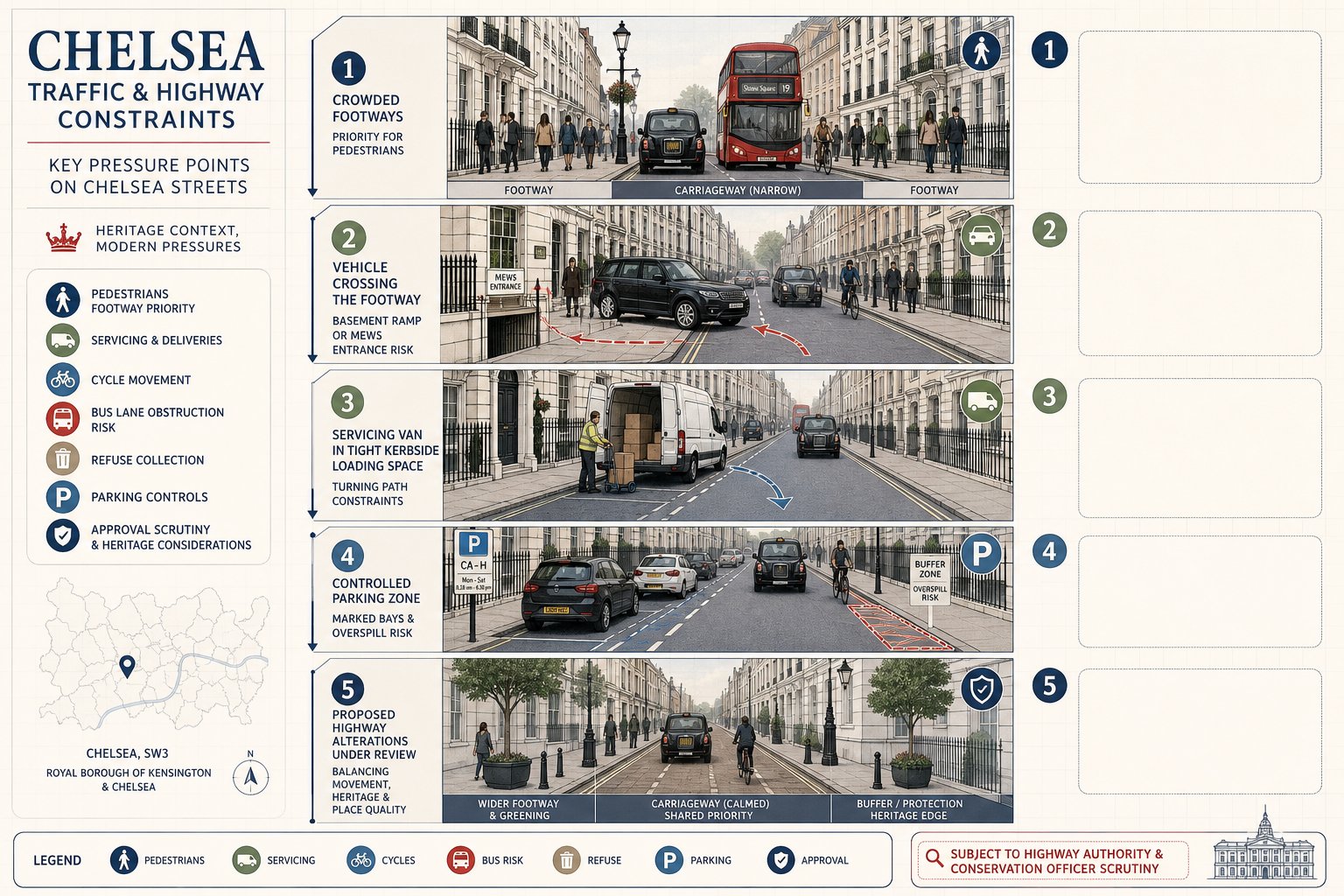
Several transport issues come up repeatedly in Chelsea, and most of them are tied to scarcity. There is limited road space, limited kerbside capacity, limited tolerance for highway changes, and limited room for error. That creates a planning environment where detail matters.
One major issue is pedestrian priority. Chelsea attracts heavy footfall, and on many streets the footway already feels busy. Any proposal that introduces vehicle movements across the footway, delivery stopping activity or visibility compromises needs careful justification. Basement access points, mews entrances and intensification of existing vehicular access can all become contentious if pedestrian conflict is not addressed convincingly.
Another is servicing on constrained streets. A development may appear acceptable until the servicing profile is tested. Then the questions start: where does the van wait, how often does it arrive, can it turn, does it obstruct a bus lane or cycle movement, what about refuse on collection day? We spend a lot of time resolving exactly those practical questions because they often carry more planning weight than abstract trip forecasts.
Parking is also politically and technically sensitive. In Controlled Parking Zones, officers will scrutinise whether a scheme will create overspill pressure or undermine policy objectives. Finally, highway alterations themselves can be difficult in heritage-sensitive areas. Even if an access works technically, deliverability on the public highway may still need separate scrutiny and negotiation.
How A Traffic Engineer Works With Architects, Planners, And Developers
The strongest planning submissions are usually collaborative. We work best when transport advice is brought in while the layout is still flexible, not after the design has hardened around assumptions that turn out to be unworkable. Early input can influence access location, parking strategy, servicing yards, cycle provision, ramp geometry, refuse storage and even unit mix where transport effects differ materially by use.
With architects, we tend to focus on physical fit and operational realism. Can a vehicle actually manoeuvre? Is the cycle store usable? Will pedestrians be squeezed at the entrance? With planners and planning consultants, the conversation shifts more towards policy alignment, scoping, report strategy and likely officer concerns. With developers, there is usually a practical emphasis on risk, programme and cost: what level of transport evidence is necessary, what can be agreed at condition stage, and what might trigger redesign if left unresolved.
That collaborative role often continues after submission. We respond to consultee comments, support pre-app discussions, refine mitigation, and assist with conditions or legal agreement wording where transport commitments are involved. In that sense, a traffic engineer in Chelsea is not simply an external report writer. We are part of the wider planning team, helping technical transport evidence support the commercial and design objectives of the scheme.
What To Expect From The Transport Planning Process
Most Chelsea projects follow a fairly recognisable transport planning path, even if the level of detail varies. It usually begins with scoping: understanding the proposal, the site context, likely policy triggers and whether liaison with the borough or TfL is advisable before submission. At this stage, we identify what documents are likely to be needed and where the main risks sit.
Next comes data collection. That may involve site visits, parking surveys, traffic counts, pedestrian observations, delivery reviews or analysis of public transport accessibility. Then we move into assessment: trip generation, access design, servicing strategy, cycle and parking review, and if necessary modelling or technical tracking. Once the evidence is assembled, we prepare the report package and coordinate it with the wider planning submission.
After submission, there is often a live period of clarification and negotiation. Officers may ask questions, request amendments, or seek additional comfort on operational points. We support those discussions and, where needed, refine the proposed mitigation.
A lot of clients want certainty on timing. In practice, the biggest gains come from identifying transport risks early and avoiding rework. Our own approach at ML Traffic is built around concise reporting, local-authority-aware scoping and quick turnaround, because in planning, speed only helps if the document is right first time. Lessons from schemes outside London, including Traffic Engineer In Manchester: and Traffic Engineer In Birmingham: contexts, can be useful on process discipline, but Chelsea always demands its own local calibration.
Choosing The Right Traffic Engineer For A Chelsea Scheme
Not all transport consultants are equally suited to Chelsea work. The technical basics may be the same across the country, but central London planning is less forgiving of generic reports and weak assumptions. You want a consultant who understands the difference between what is theoretically acceptable and what a local authority is likely to support in practice.
We would look for four things. First, proven London experience, ideally on constrained urban sites rather than only edge-of-town developments. Second, familiarity with borough and TfL expectations, including when a concise statement is enough and when a more evidence-heavy package is safer. Third, the ability to cover the full suite of likely needs: TS, TA, Travel Plan, servicing review, parking strategy, swept-path analysis and access advice. Fourth, responsiveness. Transport issues often emerge late in design coordination, and slow advice can delay an entire application.
It is also worth looking at writing quality. A technically correct report that is hard to follow can still create friction in planning. Officers, clients and legal teams all benefit from documents that are clear, direct and proportionate.
In short, the right consultant should make the scheme easier to approve, not simply more documented. That means technical judgement, local awareness, and a willingness to challenge weak assumptions before they become expensive planning problems.
Conclusion
Chelsea developments succeed more smoothly when transport is treated as a core planning discipline from the outset. Access, servicing, parking, pedestrian safety and policy alignment can all affect whether an application moves cleanly through determination or gets delayed by avoidable objections.
A capable traffic engineer in Chelsea helps turn those issues into a coherent strategy: proportionate evidence, workable layouts, realistic servicing, and reports that stand up to scrutiny from officers, highways teams and, where relevant, TfL. For architects, planners, lawyers, surveyors, builders, developers and councils, that means less uncertainty and a clearer route through the planning process.
By 2026, the schemes most likely to secure smoother approval will be the ones that combine design quality with operational credibility. Transport planning is where that credibility often gets tested first.
Frequently Asked Questions about Traffic Engineering in Chelsea
What does a traffic engineer in Chelsea typically do?
A traffic engineer in Chelsea assesses a development’s impact on vehicle and pedestrian movement, designing access, parking, servicing arrangements and preparing Transport Statements or Assessments to meet planning requirements.
Why is specialist transport input important for Chelsea developments?
Chelsea’s constrained streets, high pedestrian activity, and strict local policies require expert analysis to ensure access, parking, and servicing meet borough and TfL standards, avoiding delays or objections in planning.
When is a Transport Statement suitable instead of a full Transport Assessment in Chelsea?
A Transport Statement is appropriate for smaller schemes with limited transport impact, focusing on access and servicing, whereas larger or complex proposals typically require a detailed Transport Assessment with surveys and trip modelling.
How does a traffic engineer collaborate with architects and planners in Chelsea projects?
Traffic engineers provide early input on site layout and transport design, advise on parking and servicing strategies, and support planning submissions, conditions negotiation, and legal agreements to ensure smooth approval.
What are common transport issues faced in Chelsea developments?
Issues include parking stress in Controlled Parking Zones, pedestrian safety on busy footways, servicing constraints on narrow streets, and challenges with highway alterations in conservation areas affecting access and deliveries.
How can I choose the right traffic engineer for a Chelsea project?
Select a traffic engineer with proven London experience, familiarity with RBKC and TfL policies, the ability to deliver comprehensive Transport Statements, Assessments, and Travel Plans, and strong responsiveness to planning timelines.