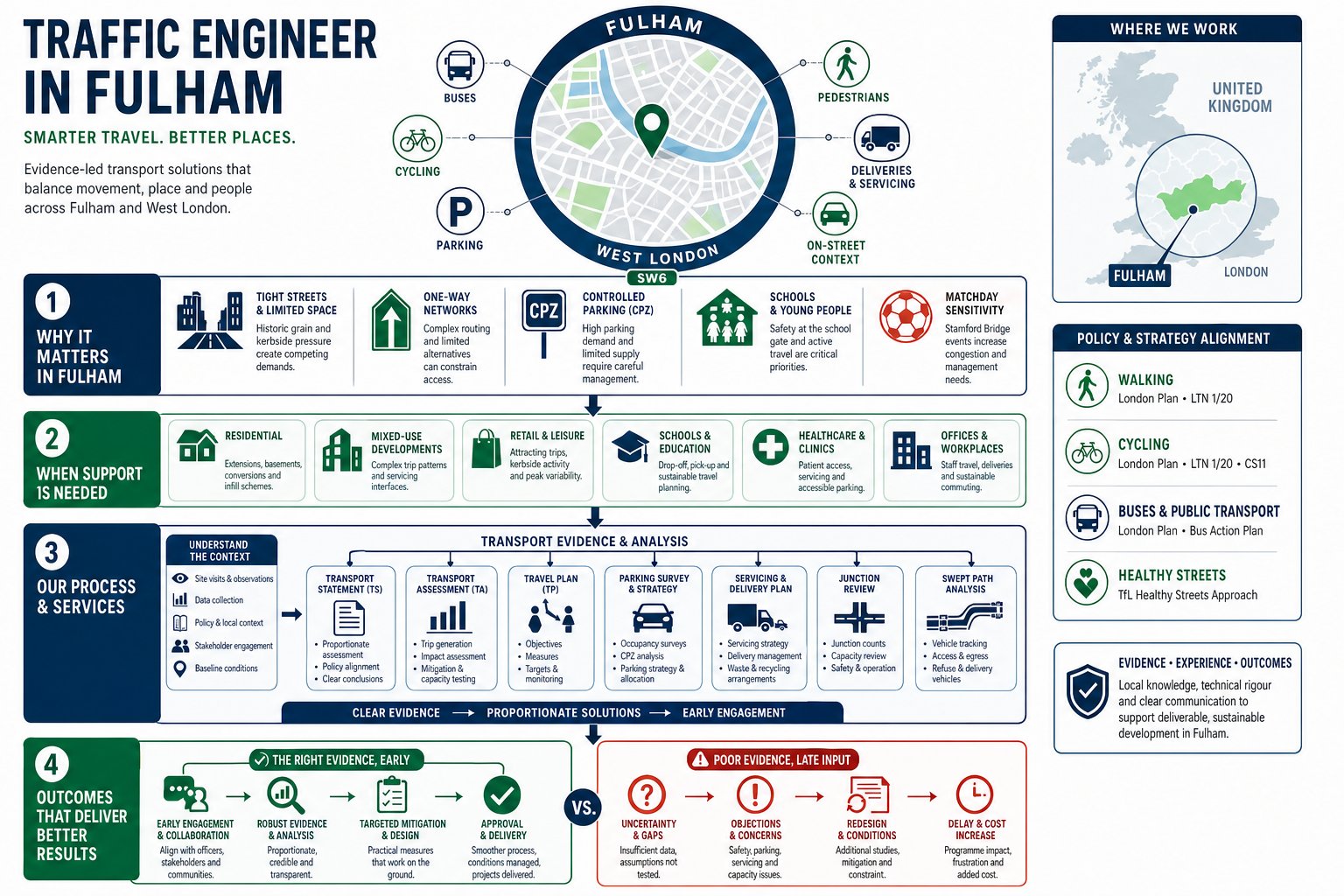
Fulham is not a forgiving place to get transport wrong. Streets are tight, parking pressure is real, bus movements are constant, and there’s rarely much tolerance from planners or neighbours for schemes that add friction to an already busy network. That means transport evidence is rarely just a box-ticking exercise. In many cases, it can shape whether an application moves smoothly through validation and consultation or gets dragged into rounds of objections, redesigns, and delay.
For architects, planning consultants, developers, surveyors, solicitors, and local authorities, the value of a skilled Traffic Engineer in Fulham is straightforward: we translate a scheme’s likely transport effects into clear, proportionate, policy-aligned evidence. That might mean a concise Transport Statement for a modest change of use, or a more detailed Transport Assessment with trip generation, junction review, servicing strategy, parking analysis, and mitigation.
In Fulham, that work has to be grounded in local realities. Controlled Parking Zones, one-way streets, school pick-up peaks, matchday sensitivities, cycling demand, and Healthy Streets priorities all influence the strategy. And because the London Borough of Hammersmith & Fulham expects robust justification, early transport input often saves far more time than it costs.
Below, we set out when traffic engineering support is typically needed, what services matter most, what evidence councils expect, and how to avoid the planning pitfalls that catch out otherwise good schemes.
Key Takeaways
- A Traffic Engineer in Fulham plays a crucial role in translating development schemes into policy-aligned transport evidence, ensuring smoother planning approval.
- Early engagement with traffic engineering can prevent costly redesigns by addressing key local issues like Controlled Parking Zones and road congestion upfront.
- Transport assessments must consider local constraints such as narrow streets, bus corridors, and peak school times to create effective, practical solutions.
- Sustainable travel support including walking, cycling, and public transport integration is essential in Fulham developments to meet borough policies.
- Robust parking surveys and junction capacity reviews help mitigate neighbor objections and demonstrate scheme feasibility.
- Choosing a Traffic Engineer with local experience and clear communication skills ensures proportionate, well-reasoned submissions that align with Fulham’s specific planning environment.
Why Traffic Engineering Matters For Development In Fulham
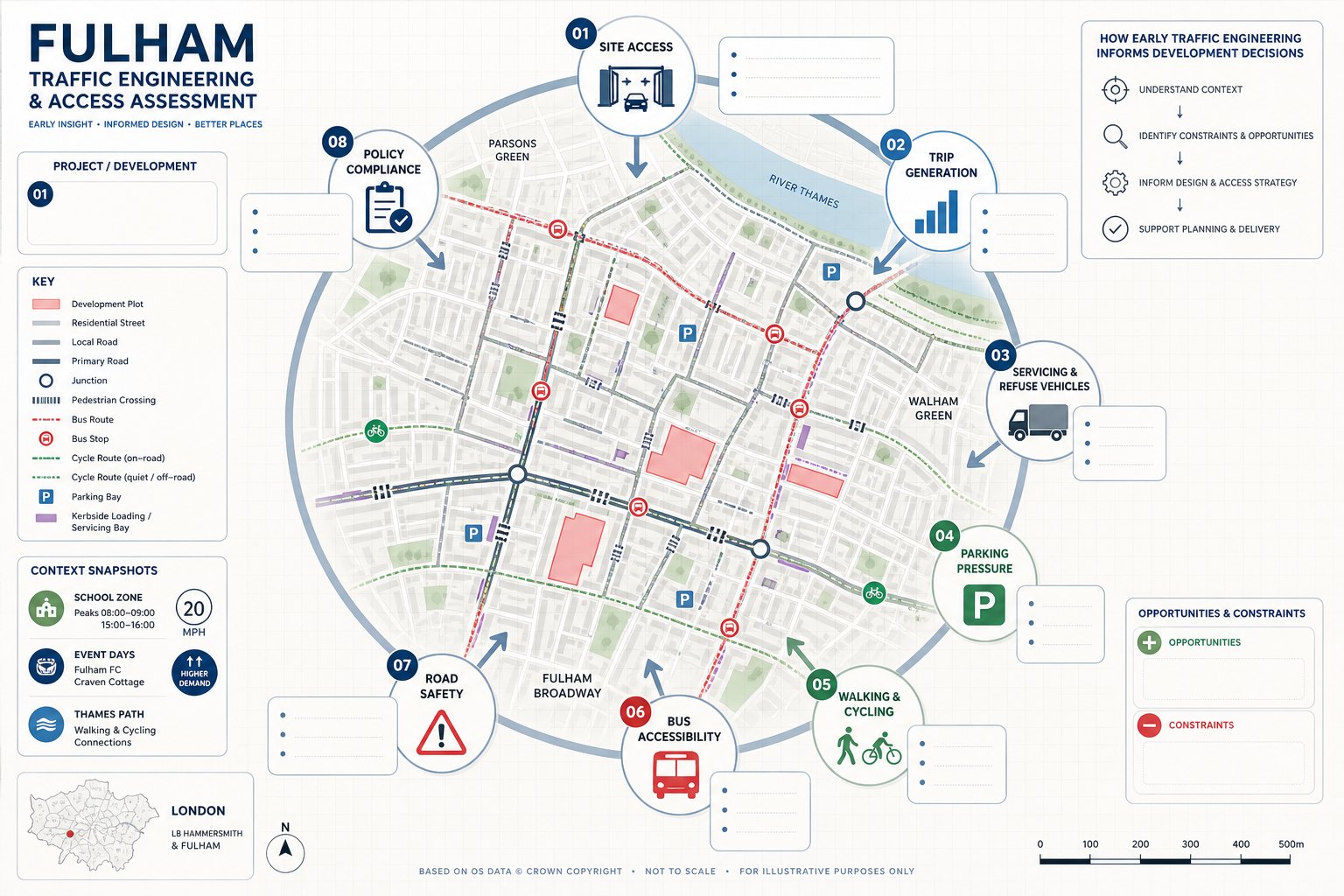
Fulham presents a very specific planning environment. It is urban, constrained, heavily trafficked in places, and sensitive to incremental change. A development does not need to be enormous to raise transport questions: sometimes a modest intensification, a revised servicing pattern, or the loss of a few parking spaces is enough to trigger concern.
From a planning perspective, transport engineering matters because local authorities are not only asking whether a scheme can physically function. They are also asking whether it aligns with policy. In London, that means thinking beyond vehicle movement alone. Walking, cycling, bus accessibility, road danger reduction, servicing efficiency, kerbside pressure, and car-lite design all sit within the same conversation.
For that reason, a Traffic Engineer in Fulham is often involved early to test the likely pressure points before the application is submitted. We assess trip generation, review site access, consider refuse and delivery movements, and identify whether nearby junctions, crossings, or parking controls are likely to become planning issues. That early review can shape layout decisions long before they become expensive to change.
This is also where local experience counts. The way transport concerns are handled in inner London is rarely identical to practice elsewhere. Work informed by broader Traffic Engineer In London: planning support is useful, but Fulham still has its own character: constrained residential streets, busy local centres, school activity, and areas affected by event-day conditions.
In short, traffic engineering matters here because transport is one of the main ways a sensible scheme can be either validated and supported quickly or challenged on detail that should have been addressed earlier.
When A Traffic Engineer Is Needed For A Fulham Planning Application
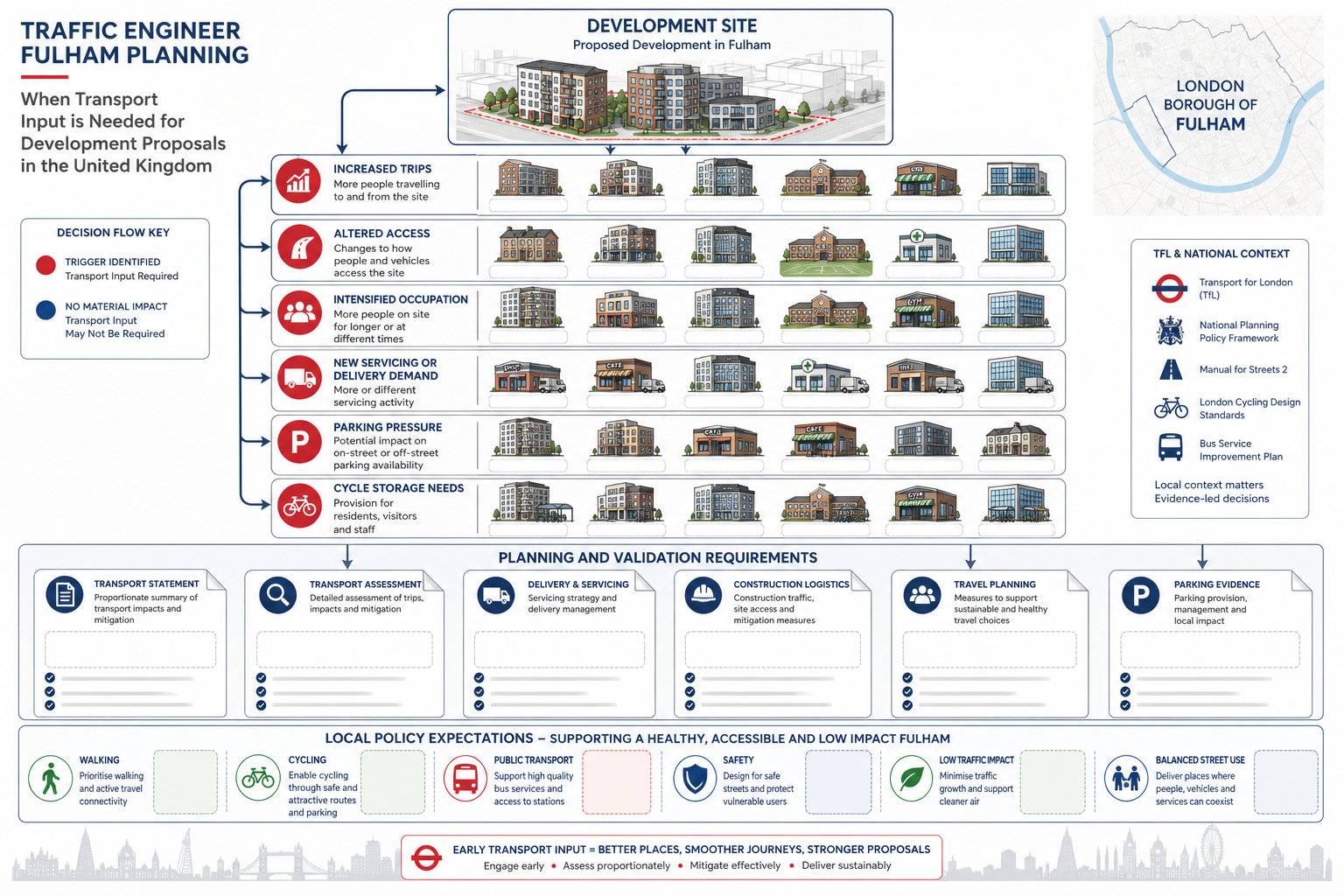
Not every proposal needs a full transport evidence package. But many developments in Fulham benefit from specialist input far earlier than applicants first assume. The main question is not simply size: it is whether the proposal changes how people, vehicles, deliveries, or servicing interact with the street.
A Traffic Engineer in Fulham is usually needed where a scheme is expected to generate additional trips, alter access, intensify occupation, create new servicing demand, or introduce parking and cycle storage questions that the council will want justified. In practice, that covers far more applications than just major developments.
Common Development Types That Require Transport Input
Typical examples include flatted residential schemes, mixed-use redevelopment, student accommodation, hotels, schools, nurseries, clinics, retail units, food and drink uses, gyms, and office intensification. Changes of use can be especially deceptive. A building may appear unchanged externally, yet its trip profile, delivery pattern, or peak demand can change materially.
HMOs and larger residential conversions can also prompt scrutiny where parking stress, drop-off activity, or refuse arrangements are likely to affect neighbouring streets. Likewise, schemes close to schools, strategic bus corridors, or stadium-related activity often need more careful transport framing because local conditions already operate with limited spare capacity.
For commercial and employment-led proposals, the principles discussed in Commercial Traffic Engineering regularly apply: servicing, staff mode share, delivery timing, and visitor demand can become as important as pure traffic generation.
Planning Triggers, Validation Requirements, And Local Expectations
In Fulham, transport submissions are commonly triggered by floorspace, residential unit numbers, new or altered vehicular access, changes to parking provision, and proposals that increase trip generation. The exact requirement varies by scheme, but boroughs across London increasingly expect applicants to submit evidence proportionate to likely impact rather than wait to be asked for it later.
Validation requirements may include a Transport Statement, Transport Assessment, Delivery and Servicing Plan, Construction Logistics Plan, Travel Plan, or parking survey evidence. Even where a document is not formally listed at validation stage, transport concerns can surface through consultation and slow determination.
Local expectations are shaped by the London Plan, borough planning policies, Healthy Streets principles, Vision Zero, and a clear preference for sustainable travel. That means applicants usually need to show not just that the highway can cope, but that the scheme supports walking, cycling, public transport use, and safe street operation. We often find that a proportionate early scope avoids disagreement later, a lesson reinforced across wider Traffic Engineering Consultants: planning work.
Core Traffic Engineering Services Available In Fulham
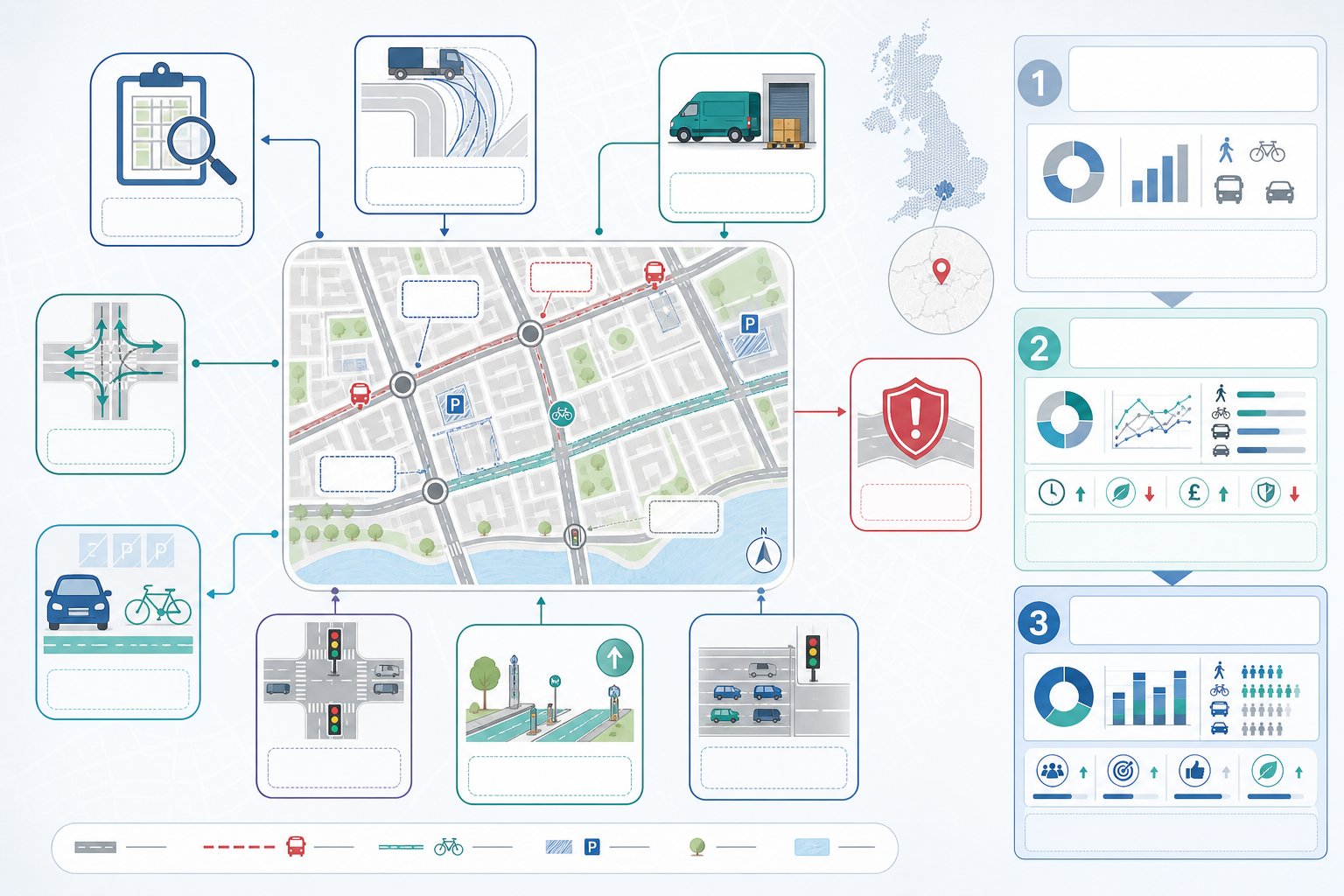
Traffic engineering support in Fulham is rarely a single report produced in isolation. More often, it is a package of technical advice built around the planning strategy, site constraints, and likely concerns from the case officer, highways team, and neighbours.
At the outset, we usually review the proposal against local thresholds and probable transport issues. From there, the service may include access appraisal, swept path analysis, traffic impact review, parking and cycle strategy, servicing and delivery planning, road safety review, junction capacity assessment, and mitigation proposals. For larger or more sensitive applications, we also coordinate with architects and planning consultants so the transport case is integrated into the wider submission rather than bolted on at the end.
That joined-up approach matters because transport issues are often interconnected. A revised core layout may improve refuse collection but worsen cycle storage convenience. A reduced parking provision may support policy but create neighbour concern unless backed by proper parking survey evidence. A servicing bay might function technically but still conflict with bus movement or local loading restrictions.
Broader guidance on Highway And Traffic Engineering is useful, but in Fulham the emphasis is usually on proportionate, defensible planning evidence rather than engineering for its own sake.
Transport Statements, Transport Assessments, And Travel Plans Explained
A Transport Statement is generally used for smaller developments where impacts are expected to be limited. It explains the existing transport context, site accessibility, likely trip generation, parking and servicing arrangements, and why the scheme’s effects are modest or manageable.
A Transport Assessment goes further. It is the more detailed option for developments with greater potential impact, more complex access questions, or sensitivity around junction operation, servicing, or parking stress. A TA may include trip rates, assignment, junction analysis, collision review, sustainable travel opportunities, and proposed mitigation.
A Travel Plan complements either document by setting out measures to encourage lower car use and stronger uptake of walking, cycling, and public transport. In London, that is not an optional extra in spirit even where it is proportionate in scale. Councils want to understand how a scheme will support sustainable travel behaviour over time.
Good transport reporting should be concise where possible and detailed where necessary. That sounds obvious, but it is where many submissions go wrong.
Junction Modelling, Capacity Reviews, And Parking Assessments
Where a proposal raises concern about traffic effect on the surrounding network, junction modelling and capacity review become central. We use these tools to test whether nearby junctions or access points are likely to experience material changes in queueing, delay, or operational stress. In an area like Fulham, even small changes can matter if baseline conditions are already tight.
Parking assessments are just as important. Controlled Parking Zones, permit restrictions, and limited kerb space mean overspill risk is often a major objection theme. A robust parking study does more than count parked cars: it explains occupancy patterns, timing, local controls, and whether the development’s parking approach is reasonable in policy and practical terms.
That analysis often sits alongside sustainable mode justification, especially for car-lite proposals. The strongest submissions show the whole picture: access to bus routes, walkability to services, cycle provision, delivery management, and parking controls all working together. Similar principles are explored in Traffic Engineering and Transportation, but Fulham applications usually demand very local evidence.
How Fulham Site Constraints Influence Transport Strategy
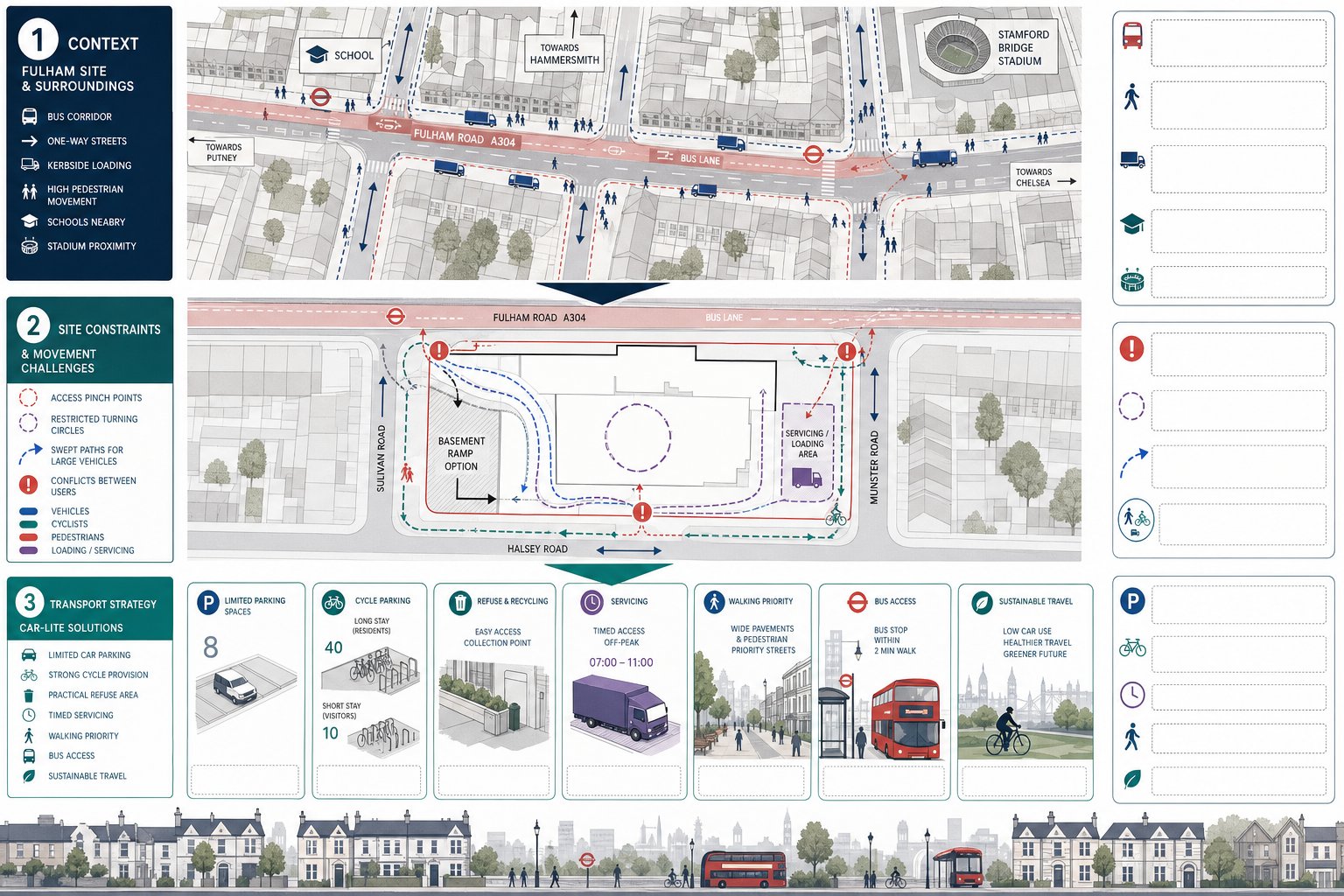
Transport strategy in Fulham is shaped less by abstract theory and more by physical reality. Streets are often narrow. Turning space is limited. Kerbside competition is intense. One-way systems can lengthen routes that look simple on a plan. Bus corridors reduce flexibility. And near schools or event-related destinations, peak conditions can change quickly.
That has a direct effect on how we advise clients. A proposed access that works geometrically may still be poor in planning terms if it conflicts with pedestrian movement or loading demand. A basement ramp may be technically possible but operationally awkward. An on-site loading arrangement may look attractive until swept path tracking shows larger vehicles cannot use it without unacceptable manoeuvring.
In Fulham, site strategy often has to embrace a car-lite or low-car approach from the outset. That is not simply because policy prefers it. It is also because many sites cannot absorb conventional parking and servicing arrangements without compromising layout quality or street function. The smarter route is usually to combine limited parking, strong cycle provision, practical refuse storage, timed servicing, and clear sustainable travel messaging.
We also pay close attention to surrounding character. A site near local shops has different transport implications from one on a quiet residential street. Proximity to schools, stadium effects, bus stops, or constrained junctions can all influence what the council considers acceptable. This is where wider Traffic Engineering: Your principles meet the very particular demands of Fulham.
The key point is simple: local constraints are not a footnote. They are the transport strategy.
Typical Data, Surveys, And Evidence Used To Support Applications
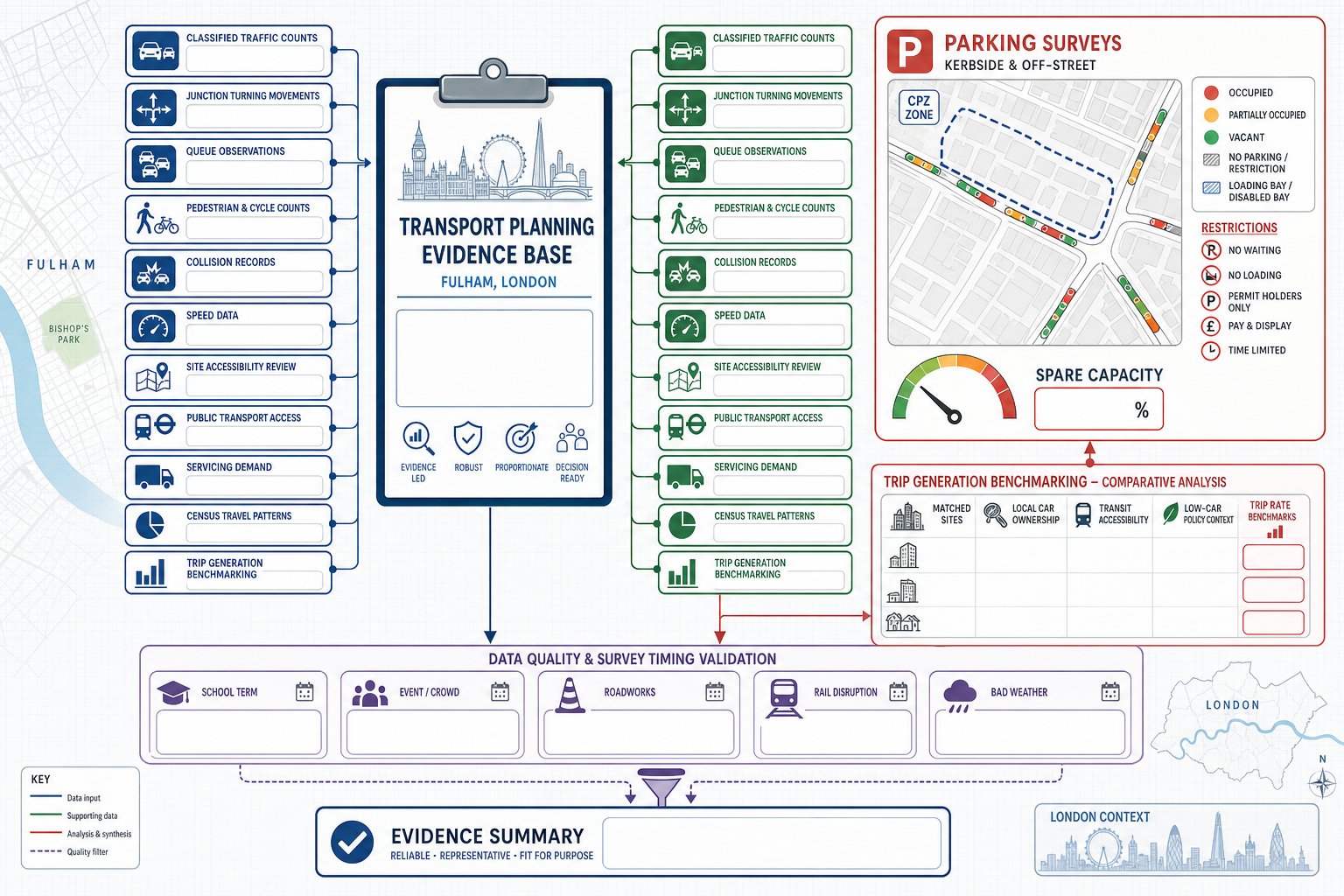
Planning decisions are rarely won by assertion alone. In transport matters, evidence is what gives a submission credibility. For Fulham applications, we normally assemble a proportionate evidence base that reflects both the scale of the scheme and the likely questions from officers, highways engineers, and consultees.
Common inputs include classified traffic counts, turning counts at nearby junctions, queue length observations, parking beat surveys, pedestrian and cycle counts where relevant, collision data, speed information, site accessibility reviews, and trip generation drawn from recognised datasets such as TRICS. We may also review public transport accessibility, servicing demand, and census or local travel pattern data where that helps explain likely mode share.
Parking surveys deserve special mention. In dense London locations, objectors often focus on overspill parking. A weak survey can undermine an otherwise solid planning case, especially if timing is poor or the area surveyed is too limited. Good evidence, by contrast, shows existing occupancy, CPZ operation, local restrictions, and whether there is genuine spare capacity.
The same principle applies to trip generation. Generic assumptions rarely convince anyone. We usually benchmark against comparable sites and adjust for local car ownership patterns, public transport accessibility, and car-lite policy context. When a scheme is genuinely low trip-generating, we show why with evidence rather than broad claims.
And yes, the quality of survey timing matters. School terms, event days, roadworks, rail disruption, and unusual weather can all distort results. A strong transport submission is often less about having more data and more about having the right data, gathered at the right time, and interpreted properly.
Working With Architects, Planners, Developers, And Local Councils
The best transport outcomes usually come from collaboration, not rescue work. When traffic engineers are brought in after layouts are fixed and planning statements are drafted, our role becomes reactive. We can still solve problems, but options are narrower. When we are involved earlier, transport considerations can improve the scheme rather than merely defend it.
With architects, we typically review access geometry, cycle storage, servicing arrangements, refuse collection, visibility, and the knock-on effects of layout choices. Small design changes at concept stage can remove major objections later. With planning consultants, we align the technical narrative to policy, ensuring the transport document supports rather than contradicts the broader case for development.
Developers often need a different kind of advice: risk, programme, and cost. We help identify whether a proposal is likely to trigger junction analysis, parking surveys, delivery planning, or negotiation over highway works, so there are fewer surprises downstream. That practical approach is part of the value we bring through our planning-led work at ML Traffic, where concise reporting and local authority awareness matter just as much as technical competence.
Councils and, where relevant, TfL are part of the process too. Productive engagement is rarely about flooding them with analysis. It is about answering the right questions clearly, proportionately, and with enough evidence to support decision-making. Comparable lessons appear even in locations outside London, such as work discussed under Traffic Engineer In Bristol:, though Fulham naturally has its own policy and network pressures.
In practice, the most successful applications are usually those where the transport engineer acts as a bridge between design, planning, and highways expectations.
What To Look For In A Traffic Engineer In Fulham
If you are appointing a consultant for a Fulham scheme, technical qualifications are only the starting point. What you really need is someone who understands how transport evidence functions within the planning process, especially in a London borough where policy expectations are high and street conditions are unforgiving.
First, look for local and London-specific experience. A consultant may be perfectly capable in general highway terms but still miss the practical significance of CPZ controls, bus priority issues, Healthy Streets framing, or the way boroughs assess car-lite proposals. Local context changes the analysis.
Second, assess whether they can scale their work properly. Not every project needs a 100-page assessment. A good Traffic Engineer in Fulham knows when a concise Transport Statement is enough and when a more detailed package is essential. That judgement can save weeks.
Third, check technical breadth. You may need trip generation, parking analysis, swept paths, junction review, servicing strategy, or road safety input, sometimes all within one application. Experience across those tasks helps avoid fragmented advice.
Fourth, communication matters. The report has to satisfy technical reviewers, but it also needs to make sense to planners, members, clients, and sometimes residents. Clear writing is not cosmetic: it can materially affect how evidence is received.
Finally, ask how they handle negotiation. Can they respond efficiently to officer queries? Can they defend assumptions? Can they adapt if the scheme evolves? The strongest consultants combine technical rigour with planning pragmatism, which is often the real differentiator.
Avoiding Delays, Objections, And Costly Revisions During Planning
Most planning delay on transport issues is avoidable. Not all of it, of course, some schemes are genuinely difficult, but many applications run into trouble because transport has been left too late, scoped too loosely, or presented with evidence that does not match local expectations.
The first step is early engagement. If a proposal in Fulham is likely to affect parking, servicing, access, or local traffic conditions, we prefer to test those points while design is still flexible. That can reveal whether a reduced parking strategy needs stronger survey backing, whether refuse collection needs redesign, or whether a Travel Plan should be introduced from the start rather than as a late concession.
Second, scope the work properly. Councils are more receptive when submissions are proportionate but complete. Too little information creates officer questions and reconsultation risk. Too much irrelevant analysis can obscure the important points. Good judgement sits in the middle.
Third, keep the evidence current. Out-of-date surveys, school-holiday counts, or assumptions lifted from another location can quickly damage confidence in the application. This is one reason planning teams often value consultants used to producing concise, authority-aware reports rather than generic templates.
Neighbour amenity is another recurring theme. Parking stress, delivery noise, waste collection, idling, and late-night servicing can all drive objections even where traffic flow impacts are modest. Addressing those concerns directly is usually more effective than treating them as peripheral.
And finally, make sure the transport strategy matches the planning story. If the proposal is presented as sustainable and car-lite, the evidence needs to support that through location analysis, cycle provision, mode share reasoning, and practical servicing arrangements. Similar planning discipline is visible across sectors, whether in London or in examples such as Birmingham Transport Consultant: Planning-Led.
A well-prepared submission will not eliminate scrutiny, nor should it, but it gives decision-makers fewer reasons to hesitate and fewer openings for avoidable objection.
Conclusion
In Fulham, transport planning is rarely a side issue. It is often one of the practical tests that determines whether a proposal looks workable, policy-compliant, and acceptable to the council and surrounding community.
A capable Traffic Engineer in Fulham helps turn that challenge into a structured planning advantage. By identifying transport risks early, preparing proportionate evidence, and aligning the submission with local policy and street conditions, we can reduce avoidable delay and strengthen the overall application.
For architects, planners, developers, lawyers, and surveyors, the main takeaway is simple: treat transport as part of design and planning strategy from the beginning, not as a late technical add-on. In a borough with constrained streets, parking pressure, strong sustainable travel expectations, and sensitive local networks, that early approach usually leads to clearer submissions, faster responses, and better planning outcomes.
Frequently Asked Questions About Traffic Engineering in Fulham
Why is a Traffic Engineer important for developments in Fulham?
A Traffic Engineer in Fulham ensures that new developments align with local transport policies and address challenges like narrow streets, controlled parking zones, and busy bus routes. Their input helps avoid objections and delays by providing clear, proportionate transport evidence tailored to Fulham’s unique context.
When is it necessary to hire a Traffic Engineer for a planning application in Fulham?
You typically need a Traffic Engineer when a development changes trip generation, access, parking, or servicing patterns—for example, in residential conversions, mixed-use schemes, or proposals near schools and stadiums. Early involvement helps address potential traffic impacts effectively.
What transport reports are commonly required for Fulham developments?
Fulham developments may require a Transport Statement for smaller impacts or a more detailed Transport Assessment when bigger transport effects are expected. Additionally, Travel Plans to promote sustainable travel are often needed to meet local authorities’ expectations.
How do local site constraints in Fulham influence traffic engineering strategies?
Fulham’s narrow streets, one-way systems, and bus corridors limit parking and servicing options. Traffic engineering strategies here often adopt car-lite designs, emphasising strong cycle provision, timed servicing, and sustainable travel measures to fit local street conditions and policies.
What types of evidence and surveys support planning applications in Fulham?
Effective Fulham transport submissions rely on classified traffic counts, junction turning counts, parking surveys, collision data, and trip generation statistics from datasets like TRICS. Timing these surveys carefully ensures the data reflects normal conditions and supports robust transport evidence.
How can a Traffic Engineer in Fulham help avoid planning delays and objections?
By engaging early, correctly scoping transport work, using up-to-date surveys, and aligning with local policies on sustainable travel and parking, Traffic Engineers reduce the risk of objections related to amenity, noise, or servicing. Clear, concise reporting also facilitates smoother council and public consultation.